


 |
市場調查報告書
商品編碼
2118093
針對OTT的AI影片產生:市場佔有率分析、產業趨勢與統計、成長預測(2026-2031年)AI Video Generation For OTT - Market Share Analysis, Industry Trends & Statistics, Growth Forecasts (2026 - 2031) |
||||||

※ 本網頁內容可能與最新版本有所差異。詳細情況請與我們聯繫。
根據 Mordor Intelligence 預測,OTT AI影片生成市場規模將從 2025 年的 11.3 億美元成長到 2026 年的 16.1 億美元,然後在 2031 年達到 52.4 億美元,2026 年至 2031 年的複合年成長率為 26.62%。
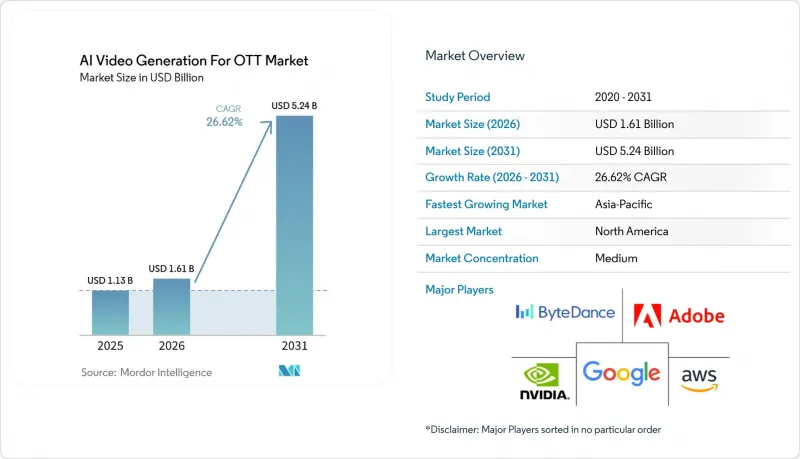
本報告按生成類型(文字轉影片、影像轉影片及其他)、最終用戶(串流平台、電影製片廠和製作公司、廣播公司和電視網路及其他)以及地區(北美、南美、歐洲、亞太、中東和非洲)進行細分。市場預測以美元計價。
OTT AI影片生成市場的趨勢和洞察。
OTT內容快速製作與製作週期縮短
OTT AI影片產生市場將惠及那些需要更多內容但又不想延長製作週期的服務商。 Netflix在2026年報告稱,使用生成式AI技術使他們製作一部17分鐘影像的速度比傳統方法快一倍,成本卻降低了一半。這項結果表明,OTT AI影片生成市場可以輔助完成特定任務,而不是取代整個製作流程。更快的製作速度使得廣播公司和工作室能夠更輕鬆地更新節目庫、製作季節性內容並擴展現有智慧財產權。串流媒體平台還可以在投入大規模製作預算之前,嘗試各種小眾節目形式。在OTT AI影片生成市場,這意味著製作速度成為決定投資哪些項目的直接因素。
為OTT內容提供高度可擴展的在地化、配音和版本創建服務。
在國際串流媒體發行中,在地化仍然是成本和時間上的一大限制。韓國的「K-FAST」舉措在2025年至2026年間,將超過1200部影片(總時長1400小時)在地化為英語、西班牙語和葡萄牙語。該計劃透過22個由人工智慧配音的FAST頻道,在五個月內於22個國家累計獲得了1億次觀看。這一規模表明,即使在傳統配音無利可圖的市場,人工智慧配音也能幫助版權所有擁有者實現內容庫的盈利。 2026年4月,Deepdub推出了一款“基於代理的配音助手”,用於其自身的製作流程。因此,隨著平台的擴展,OTT人工智慧影片生成市場可望受益於語言適配、版本控制和唇形同步等功能。
與智慧財產權、版權和名人形象權相關的風險。
法律和授權要求可能會延緩人工智慧產生的影片在商業工作流程中的應用。紐約州於2025年12月頒布了《人工智慧透明法案》,該法案於2026年6月9日生效。該法案強制要求在商業廣告中披露合成表演者的信息,並對違規行為處以最高5000美元的民事罰款。紐約州也頒布了關於死後宣傳權的法律,以應對未經授權對已故表演者進行數位複製的行為。 Netflix要求,如果人工智慧輸出涉及最終產品、藝人肖像、個人資料或第三方智慧財產權,則必須獲得書面批准。這些法規為OTT人工智慧影片生成市場增加了審查程序,尤其是在涉及可識別個人或現有資產的情況下。
細分市場分析
預計到2025年,文字轉影片產生將佔OTT AI影片生成市場41.63%的佔有率,到2031年將以27.48%的複合年成長率成長。這個市場定位反映了創新團隊對文字提示的熟悉程度,他們通常已經能夠根據劇本、創意方案和製作大綱進行創作。此外,文字輸入省去了圖像轉影片生成中通常所需的圖像準備。 2026年7月,位元組跳動透過BytePlus API發布了Seedance 2.5,支援透過單次API呼叫連續產生30秒的影片。 Runway於2025年12月發布了Gen-4.5,Google於2025年5月發布了Veo 3。所有這些發展都提高了影片的保真度。這些模型在後製品質提升、場景視覺化、概念演示和宣傳材料製作中發揮越來越重要的作用。
影像轉影片生成技術扮演不同的角色,它能為現有的靜態影像、概念圖、檔案素材和連續影格添加動畫。當製片人擁有已通過核准的視覺素材時,這項技術可以透過OTT人工智慧影片產生市場的合成功能,幫助擴展智慧財產權並支援後續的拍攝工作。獅門影業計畫從其片庫中製作短劇集,就是一個利用現有視覺資產的工作流程範例。音訊轉影片和風格傳輸工具在需要所有廣告位保持一致視覺效果的宣傳活動中也十分有用。在OTT人工智慧影片生成市場,當使用可識別的圖像、片庫素材或演員肖像時,相關工具需要更嚴格的版權審查。 Netflix的人工智慧生成指南要求最終產品、個人資料、演員肖像以及與第三方智慧財產權相關的素材均需獲得批准。這個審查流程使團隊能夠在探索更簡便的獲取授權方式的同時,保持其在文字轉影片轉換技術領域的優勢。
區域分析
到2025年,北美將佔全球整體收入的41.56%。該地區的OTT人工智慧影片生成市場是主要串流媒體服務、新創企業投資和成熟後製系統融合的產物。 2026年2月,Runway在由General Atlantic主導的一輪融資中籌集了3.15億美元,估值達到53億美元。 NVIDIA、Fidelity Management and Research、AllianceBernstein、Adobe Ventures和AMD Ventures也參與了此輪資金籌措。紐約州2025年的立法也影響著區域工作室和廣播公司的採用政策。加拿大憑藉其視覺特效(VFX)產業提供了第二個應用市場,而墨西哥則支持西班牙語在地化。
預計到2031年,亞太地區的複合年成長率將達到26.93%。該地區不僅現有內容庫品質不斷提升,而且行動優先的內容製作量也大幅成長。 2026年7月,中國移動旗下的咪咕推出了人工智慧短劇製作平台,該平台將多種模型整合到自動化製作鏈中。據該公司稱,該平台已將總製作成本降低了30%以上。在印度,JioStar的「JAMS」計畫和「Tadka」微劇也同樣專注於影片。韓國的「K-FAST」計畫進一步展示了公共支援如何將本地化與國際發行管道結合。
在2025年的OTT人工智慧影片生成市場中,歐洲、南美以及中東和非洲將佔據雖小但重要的佔有率。歐洲的應用受到有關合成媒體、透明度、文件記錄和人工監督的法規的影響。這些要求可能會增加受監管的廣播公司和平台在實施過程中的工作量。在南美,對西班牙語和葡萄牙語在地化的需求正在推動市場發展,其中巴西和阿根廷是主要的商業市場。在中東,波灣合作理事會(GCC)成員國正透過對媒體技術的投資和在OTT領域的巨額支出,推動早期階段的應用。非洲的角色預計將取決於行動串流媒體的成長和多語言配音工具成本的下降。
其他好處
- Excel格式的市場預測(ME)表
- 3個月的分析師支持
目錄
第1章:引言
- 研究假設和市場定義
- 調查範圍
第2章:調查方法
第3章執行摘要
第4章 市場狀況
- 市場概覽
- 市場促進因素
- OTT內容快速製作與製作週期縮短
- 為OTT內容提供高度可擴展的在地化、配音和版本創建服務。
- 對人工智慧生成的預告片、宣傳影像和廣告的需求日益成長。
- 自動產生社交平臺的短篇衍生內容
- 多使用合成補拍和重拍來延長現有影像。
- 在整個OTT目錄中產生支援元資料的個人化影片資產
- 市場限制因素
- 與智慧財產權、版權和名人肖像權相關的風險
- 對輸出品質波動性和企業級品牌安全性的擔憂。
- 生成時長較長、解析度較高的影片需要很高的運算和儲存成本。
- AI影片工具與現有OTT製作工作流程之間缺乏互通性。
- 產業價值鏈分析
- 監理情勢
- 技術展望
- 波特五力分析
- 宏觀經濟因素對市場的影響
第5章 市場規模與成長預測
- 按世代類型
- 文字轉影片生成
- 影像轉影片生成
- 其他世代類型
- 最終用戶
- 串流媒體平台
- 電影製片廠和製作公司
- 廣播公司及電視網路
- 其他
- 按地區
- 北美洲
- 美國
- 加拿大
- 墨西哥
- 南美洲
- 巴西
- 阿根廷
- 智利
- 其他南美國家
- 歐洲
- 德國
- 英國
- 法國
- 義大利
- 西班牙
- 其他歐洲國家
- 亞太地區
- 中國
- 日本
- 印度
- 韓國
- 澳洲
- 其他亞太國家
- 中東
- 沙烏地阿拉伯
- 阿拉伯聯合大公國
- 卡達
- 其他中東國家
- 非洲
- 南非
- 埃及
- 奈及利亞
- 其他非洲國家
- 北美洲
第6章 競爭情勢
- 市場集中度
- 策略趨勢
- 供應商定位分析
- 公司簡介
- Adobe Inc.
- Amazon Web Services, Inc.
- ByteDance Ltd.
- Google LLC
- NVIDIA Corporation
- OpenAI, Inc.
- Runway AI, Inc.
- Synthesia Limited
- HeyGen Inc.
- Pika Labs, Inc.
- Stability AI Ltd.
- Kaiber AI, Inc.
- Canva Pty Ltd
- Microsoft Corporation
- WPP plc
- Publicis Groupe SA
- Shenzhen Jianying Technology Co., Ltd.
- Flawless AI Ltd.
第7章 市場機會與未來展望
According to Mordor Intelligence, the AI video generation for OTT market size is expected to grow from USD 1.13 billion in 2025 to USD 1.61 billion in 2026 and is forecast to reach USD 5.24 billion by 2031 at 26.62% CAGR over 2026-2031.
This report is Segmented by Generation Type (Text-To-Video Generation, Image-To-Video Generation, and More), End User (Streaming Platforms, Film Studios and Production Houses, Broadcasters and Television Networks, and More), and Geography (North America, South America, Europe, Asia-Pacific, Middle East, and Africa). The Market Forecasts are Provided in Terms of Value (USD).
Global AI Video Generation For OTT Market Trends and Insights
Faster OTT Content Turnaround and Shorter Production Cycles
The AI video generation for OTT market benefits when services need more content without extending production calendars. Netflix reported in 2026 that generative AI helped produce 17 minutes of documentary footage at half the cost and twice the speed of conventional methods. This result shows how the AI video generation for OTT market can support defined tasks rather than replace a full production process. Faster creation can make catalog refreshes, seasonal content, and extensions of existing intellectual property more practical for broadcasters and studios. It also lets streaming platforms test narrower formats before committing to a larger production budget. In the AI video generation for OTT market, this makes production speed a direct factor in decisions on which projects receive funding.
Scalable Localization, Dubbing, and Versioning of OTT Content
Localization remains a major cost and timing constraint for international streaming distribution. South Korea's K-FAST initiative localized more than 1,200 titles, totaling 1,400 hours, into English, Spanish, and Portuguese during 2025 and 2026. The program reached 100 million cumulative views in 22 countries through 20 AI-dubbed FAST channels within 5 months. This scale suggests that AI-assisted dubbing can help rights holders monetize libraries in markets where conventional dubbing has been difficult to justify. Deepdub introduced an agentic dubbing co-worker in April 2026 for use within its production workflow. The AI video generation for OTT market can therefore gain from language adaptation, versioning, and lip-sync work that follows platform expansion.
Intellectual Property, Copyright, and Talent Likeness Risks
Legal and consent requirements can slow the use of generated video in commercial workflows. New York enacted the AI Transparency Law in December 2025, and the law took effect on June 9, 2026. It requires disclosure of synthetic performers in commercial advertising and provides civil penalties of up to USD 5,000 for later violations. The state also enacted a posthumous right of publicity law to address unauthorized digital replicas of deceased performers. Netflix requires written approval when AI output involves final deliverables, talent likeness, personal data, or third-party intellectual property. These controls add review steps in the AI video generation for OTT market, particularly where recognizable people or existing assets are involved.
Other drivers and restraints analyzed in the detailed report include:
- Growing Demand for AI-Generated Trailers, Promos, and Advertisements
- Automated Creation of Short-Form Content Derivatives for Social Platforms
- Inconsistent Output Quality and Enterprise-Grade Brand-Safety Concerns
For complete list of drivers and restraints, kindly check the Table Of Contents.
Segment Analysis
Text-to-video generation accounted for 41.63% of AI video generation for OTT market in 2025 and is projected to grow at a 27.48% CAGR through 2031. Its position reflects the familiarity of text prompts for creative teams that already work from scripts, treatments, and production briefs. Text input also avoids the image preparation step that image-to-video work often requires. ByteDance made Seedance 2.5 available through the BytePlus API in July 2026, supporting 30-second continuous generation in a single API call. Runway released Gen-4.5 in December 2025, while Google introduced Veo 3 in May 2025, and both developments supported improved video fidelity. These models are increasingly relevant for post-production enhancements, scene visualization, concept reels, and promotional material.
Image-to-video generation serves a different role by animating existing stills, concept art, archival material, and continuity frames. It can support intellectual-property extension and synthetic pickup work in the AI video generation for OTT market when a production has approved visual source material. Lionsgate's plan to generate short-form series from its catalog illustrates a workflow that can use existing visual assets. Audio-to-video and style-transfer tools also have relevance in campaigns that require a consistent look across advertising placements. The AI video generation for OTT industry faces greater rights review when tools use recognizable images, catalog assets, or talent likenesses. Netflix's guidance on generative AI requires approval for material involving final deliverables, personal data, talent likeness, and third-party intellectual property. That review process can preserve text-to-video leadership where teams seek less complex paths to approved use.
Complete Report Scope:
- By Generation Type
- Text-to-Video Generation
- Image-to-Video Generation
- Other Generation Types
- By End User
- Streaming Platforms
- Film Studios and Production Houses
- Broadcasters and Television Networks
- Other End Users
- By Geography
- North America
- United States
- Canada
- Mexico
- South America
- Brazil
- Argentina
- Chile
- Rest of South America
- Europe
- Germany
- United Kingdom
- France
- Italy
- Spain
- Rest of Europe
- Asia-Pacific
- China
- Japan
- India
- South Korea
- Australia
- Rest of Asia-Pacific
- Middle East
- Saudi Arabia
- United Arab Emirates
- Qatar
- Rest of Middle East
- Africa
- South Africa
- Egypt
- Nigeria
- Rest of Africa
- North America
Geography Analysis
North America held 41.56% of global revenue in 2025. The AI video generation for OTT market in the region combines large streaming services, startup investment, and established post-production capacity. Runway raised USD 315 million in February 2026 at a USD 5.3 billion valuation, with General Atlantic leading the round. NVIDIA, Fidelity Management and Research, AllianceBernstein, Adobe Ventures, and AMD Ventures participated in the financing. New York's 2025 legislation is also influencing deployment policies at regional studios and broadcasters. Canada offers a secondary adoption base through its visual-effects sector, while Mexico supports Spanish-language localization.
Asia-Pacific is projected to grow at a 26.93% CAGR through 2031. The region is defined by high-volume, mobile-first content production rather than only quality enhancement for established catalogs. China Mobile Migu introduced an AI short-drama creation platform in July 2026 that integrates several models into an automated production chain. The company said the platform reduced total production costs by more than 30%. JioStar's JAMS program and Tadka micro-drama show the same focus on short serialized video in India. South Korea's K-FAST program further shows how public support can combine localization and international channel distribution.
Europe, South America, the Middle East, and Africa represented smaller but important parts of the AI video generation for OTT market in 2025. Europe's use is influenced by rules on synthetic media, transparency, documentation, and human oversight. These requirements can increase implementation work for regulated broadcasters and platforms. South America is supported by Spanish and Portuguese localization needs, with Brazil and Argentina serving as primary commercial markets. Gulf Cooperation Council countries support earlier-stage use in the Middle East through media technology investment and high OTT spending. Africa's role will depend on mobile streaming growth and the declining cost of multilingual dubbing tools.
- Adobe Inc.
- Amazon Web Services, Inc.
- ByteDance Ltd.
- Google LLC
- NVIDIA Corporation
- OpenAI, Inc.
- Runway AI, Inc.
- Synthesia Limited
- HeyGen Inc.
- Pika Labs, Inc.
- Stability AI Ltd.
- Kaiber AI, Inc.
- Canva Pty Ltd
- Microsoft Corporation
- WPP plc
- Publicis Groupe S.A.
- Shenzhen Jianying Technology Co., Ltd.
- Flawless AI Ltd.
Additional Benefits:
- The market estimate (ME) sheet in Excel format
- 3 months of analyst support
TABLE OF CONTENTS
1 INTRODUCTION
- 1.1 Study Assumptions and Market Definition
- 1.2 Scope of The Study
2 RESEARCH METHODOLOGY
3 EXECUTIVE SUMMARY
4 MARKET LANDSCAPE
- 4.1 Market Overview
- 4.2 Market Drivers
- 4.2.1 Faster OTT Content Turnaround and Shorter Production Cycles
- 4.2.2 Scalable Localization, Dubbing, and Versioning of OTT Content
- 4.2.3 Growing Demand for AI-Generated Trailers, Promos, and Advertisements
- 4.2.4 Automated Creation of Short-Form Content Derivatives for Social Platforms
- 4.2.5 Increasing Use of Synthetic Pickups and Reshoots to Extend Existing Footage
- 4.2.6 Metadata-Aware Generation of Personalized Video Assets Across OTT Catalogs
- 4.3 Market Restraints
- 4.3.1 Intellectual Property, Copyright, and Talent Likeness Risks
- 4.3.2 Inconsistent Output Quality and Enterprise-Grade Brand-Safety Concerns
- 4.3.3 High Compute and Storage Costs for Long-Form, High-Resolution Video Generation
- 4.3.4 Limited Interoperability Between AI Video Tools and Existing OTT Production Workflows
- 4.4 Industry Value Chain Analysis
- 4.5 Regulatory Landscape
- 4.6 Technological Outlook
- 4.7 Porter's Five Forces Analysis
- 4.7.1 Bargaining Power of Buyers
- 4.7.2 Bargaining Power of Suppliers
- 4.7.3 Threat of New Entrants
- 4.7.4 Threat of Substitutes
- 4.7.5 Intensity of Competitive Rivalry
- 4.8 Impact of Macroeconomic Factors on the Market
5 MARKET SIZE AND GROWTH FORECASTS (VALUE)
- 5.1 By Generation Type
- 5.1.1 Text-to-Video Generation
- 5.1.2 Image-to-Video Generation
- 5.1.3 Other Generation Types
- 5.2 By End User
- 5.2.1 Streaming Platforms
- 5.2.2 Film Studios and Production Houses
- 5.2.3 Broadcasters and Television Networks
- 5.2.4 Other End Users
- 5.3 By Geography
- 5.3.1 North America
- 5.3.1.1 United States
- 5.3.1.2 Canada
- 5.3.1.3 Mexico
- 5.3.2 South America
- 5.3.2.1 Brazil
- 5.3.2.2 Argentina
- 5.3.2.3 Chile
- 5.3.2.4 Rest of South America
- 5.3.3 Europe
- 5.3.3.1 Germany
- 5.3.3.2 United Kingdom
- 5.3.3.3 France
- 5.3.3.4 Italy
- 5.3.3.5 Spain
- 5.3.3.6 Rest of Europe
- 5.3.4 Asia-Pacific
- 5.3.4.1 China
- 5.3.4.2 Japan
- 5.3.4.3 India
- 5.3.4.4 South Korea
- 5.3.4.5 Australia
- 5.3.4.6 Rest of Asia-Pacific
- 5.3.5 Middle East
- 5.3.5.1 Saudi Arabia
- 5.3.5.2 United Arab Emirates
- 5.3.5.3 Qatar
- 5.3.5.4 Rest of Middle East
- 5.3.6 Africa
- 5.3.6.1 South Africa
- 5.3.6.2 Egypt
- 5.3.6.3 Nigeria
- 5.3.6.4 Rest of Africa
- 5.3.1 North America
6 COMPETITIVE LANDSCAPE
- 6.1 Market Concentration
- 6.2 Strategic Moves
- 6.3 Vendor Positioning Analysis
- 6.4 Company Profiles (includes Global Level Overview, Market Level Overview, Core Segments, Financials as available, Strategic Information, Market Rank/Share, Products and Services, Recent Developments)
- 6.4.1 Adobe Inc.
- 6.4.2 Amazon Web Services, Inc.
- 6.4.3 ByteDance Ltd.
- 6.4.4 Google LLC
- 6.4.5 NVIDIA Corporation
- 6.4.6 OpenAI, Inc.
- 6.4.7 Runway AI, Inc.
- 6.4.8 Synthesia Limited
- 6.4.9 HeyGen Inc.
- 6.4.10 Pika Labs, Inc.
- 6.4.11 Stability AI Ltd.
- 6.4.12 Kaiber AI, Inc.
- 6.4.13 Canva Pty Ltd
- 6.4.14 Microsoft Corporation
- 6.4.15 WPP plc
- 6.4.16 Publicis Groupe S.A.
- 6.4.17 Shenzhen Jianying Technology Co., Ltd.
- 6.4.18 Flawless AI Ltd.
7 MARKET OPPORTUNITIES AND FUTURE OUTLOOK
- 7.1 White-Space and Unmet-Need Assessment

 專有大規模語言模型市場:2026-2032年全球市場預測人工智慧文字轉影片市場:全球市場預測,2026-2032年
 人工智慧市場規模、佔有率及成長分析(文字轉影片):按組件、部署模式、模型類型、影片生成類型、應用、企業規模和地區分類-2026-2033年產業預測
 全球人工智慧影片生成市場:按產品、模型類型、部署方式、應用領域和企業規模分類-市場規模、產業動態、機會分析及預測(2026-2035 年)AI文本生成市場:2026-2032年全球市場預測(依部署模式、輸出內容類型及應用程式分類)
 人工智慧市場分析與預測(至2035年):文字轉影片:類型、產品類型、服務、技術、組件、應用、部署模式、最終用戶、解決方案、交付模式
 2026年全球人工智慧市場報告:文字轉影片整合2026年全球人工智慧文本產生器市場報告2026年全球人工智慧(AI)視訊產生器市場報告
 人工智慧(AI)文本產生器市場-策略分析與預測(2026-2031)