


 |
市場調查報告書
商品編碼
2118084
刺槐豆膠:市場佔有率分析、產業趨勢與統計、成長預測(2026-2031)Locust Bean Gum - Market Share Analysis, Industry Trends & Statistics, Growth Forecasts (2026 - 2031) |
||||||

※ 本網頁內容可能與最新版本有所差異。詳細情況請與我們聯繫。
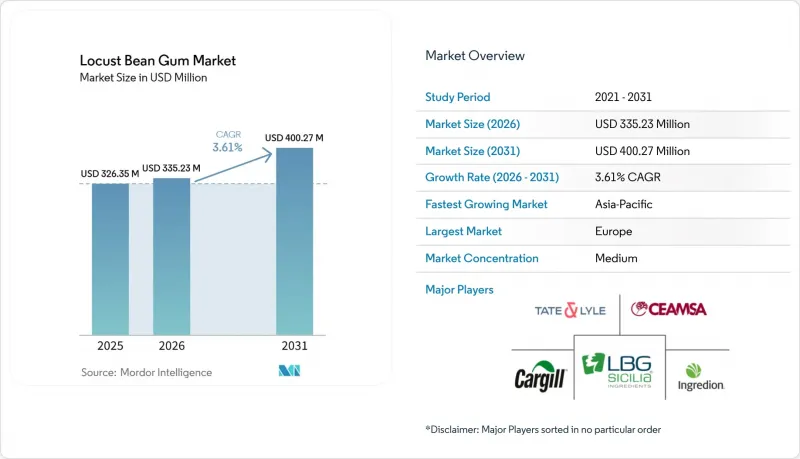
根據 Mordor Intelligence 估計,刺槐豆膠市場在 2025 年的價值為 3.2635 億美元,在 2026 年的價值為 3.3523 億美元,預計到 2031 年將達到 4.0027 億美元,在預測期內的複合年成長率為 3.61%。
本報告按形態(粉末、顆粒、其他)、應用領域(食品飲料、藥品和保健品、化妝品和個人護理、工業應用、其他)以及地區(北美、歐洲、亞太、南美、中東和非洲)進行細分。市場預測以價值(美元)和數量(噸)兩種單位呈現。
全球刺槐豆膠市場趨勢及洞察
擴大植物來源食品配方中的應用
隨著製造商日益尋求能夠改善質地、穩定性和一致性並支持潔淨標示配方的天然成分,刺槐豆膠在植物來源食品配方中的應用也日益增加。刺槐豆膠是一種理想的植物來源源親水膠體,可用於食品配方,因為它能有效控制黏度、保持水分並提高加工穩定性。它與其他天然膠的相容性進一步增強了配方性能和產品品質。根據植物性食品協會 (PBFA) 預測,到 2025 年,60% 的美國家庭將購買植物來源產品,這反映出消費者對植物來源食品的接受度不斷提高,並推動了對刺槐豆膠等功能性成分的需求成長。
簡便食品和即食食品的擴張
簡便食品和即食食品的擴張正在推動刺槐豆膠市場的發展。這是因為製造商越來越需要功能性配料,以確保產品在加工、包裝、儲存和分銷的整個過程中質地、黏度和穩定性的一致性。刺槐豆膠非常適合大規模食品生產,因為它能提高保水性,增強配方穩定性,並在各種加工條件下維持產品品質。此外,該配料還能增強凍融穩定性並抑制滲出,這對於冷藏和冷凍食品應用至關重要。隨著消費者對方便、低成本食品的需求不斷成長,製造商正在使用刺槐豆膠等多功能天然親水膠體來提高加工效率,減少對合成添加劑的依賴,並在較長的保存期限內保持產品品質的一致性。
對角豆種子供應的限制
角豆種子供應有限是刺槐豆膠市場的主要限制因素。由於刺槐豆膠只能從角豆樹的果實中提取,因此其原料僅限於少數農業產區。角豆種植集中在地中海的特定區域,即使需求增加,也難以迅速擴大產量。此外,角豆樹的生長週期長,也限制了供應成長,使得生產者難以快速回應市場需求。這些產區的季節性產量波動和對氣候的敏感度進一步增加了供應鏈的不確定性。這種對有限原料的依賴造成了供應的不確定性,影響生產計畫,並可能限制工業製造商獲得穩定的刺槐豆膠供應,尤其是在需求旺盛時期或主要產區遭遇惡劣天氣時。
細分市場分析
2025年,粉狀刺槐豆膠佔了63.42%的市佔率。這主要歸功於其高效的加工性能、良好的儲存穩定性以及與現代生產流程的兼容性。粉狀刺槐豆膠粒徑均勻,物理性質一致,便於精確稱量,在加工過程中分散性較佳,且批次間性能穩定。在適當的儲存條件下,粉狀刺槐豆膠不易受到物理損傷,儲存穩定性高,與其他形式相比,更易於運輸、儲存和處理。製造商更青睞粉狀刺槐豆膠,因為它能更好地與自動化稱重、輸送、混合和攪拌設備整合,從而減少人工操作,提高生產效率和製程控制。此外,粉狀刺槐豆膠還能提高配方調整的柔軟性,簡化庫存管理,並支援跨多個生產基地的標準化生產。
由於其優異的流動性、更低的粉塵產生量以及在工業加工環境中更高的處理效率,顆粒狀刺槐豆膠預計在2026年至2031年間將以5.49%的複合年成長率成長。其較大的粒徑可最大限度地減少運輸、儲存和生產過程中空氣中的物料損失,從而有助於創造更清潔的生產環境並提高職場的安全性。此外,顆粒狀刺槐豆膠與自動化送料、輸送和稱重系統具有更好的兼容性,能夠實現更精準的原料供應並減少加工中斷。而且,顆粒狀刺槐豆膠在儲存過程中不易結塊,並在各種環境條件下表現出較高的物理穩定性,從而簡化庫存管理並長期保持產品品質的穩定性。
區域分析
到2025年,歐洲將佔據全球刺槐豆膠市場32.31%的佔有率,憑藉其成熟的親水膠體加工產業、嚴格的食品配料法律規範以及對產品品質和可追溯性的高度重視,繼續保持主導地位。該地區受益於成熟的價值鏈,這得益於先進的加工能力、天然食品添加劑的高滲透率以及原料技術的持續創新。此外,根據(EC) 1333/2008號法規對E 410(刺槐豆膠)的授權,建立了整體的食品添加劑法規結構,增強了生產商的信心,並促進了其在可銷售產品中的長期應用。歐洲強大的技術實力、完善的品質標準和一體化的供應鏈網路將繼續鞏固其在全球市場的主導地位。
預計2026年至2031年,亞太地區將以5.53%的複合年成長率實現最高成長,這主要得益於親水膠體加工能力的快速擴張、原料製造投資的增加以及該地區價值創造能力的提升。透過加工技術、混合能力和原料標準化方面的改進,該地區正穩步從刺槐豆膠的淨進口地區轉型為在全球親水膠體價值鏈中扮演更積極的角色。對現代化製造基礎設施的投資增加、技術專長的提升以及工業加工能力的擴大,正使該地區的製造商能夠減少對進口的依賴,同時提高其在國內外市場的競爭力。預計這種結構性轉型將使該地區在整個預測期內保持高於平均水平的成長。
北美、南美以及中東和非洲在全球刺槐豆膠市場中佔據著重要的戰略佔有率,儘管規模較小。北美的特點是對高性能天然親水膠體有著強勁的需求,擁有先進的配方技術,並且對品質有著嚴格的要求,因此採用優質原料。南美正透過擴大食品配料加工能力和深化融入國際供應鏈,逐步鞏固其市場地位。同時,中東和非洲憑藉其靠近地中海沿岸角豆產區的地理優勢,便於原料採購和區域間貿易。雖然這些地區的產量與歐洲和亞太地區相比相對較小,但由於加工基礎設施和價值鏈的現代化以及對高附加價值原料生產的持續投資,它們在全球刺槐豆膠市場的戰略重要性仍在不斷提升。
其他好處
- Excel格式的市場預測(ME)表
- 3個月的分析師支持
目錄
第1章:引言
- 研究假設和市場定義
- 調查範圍
第2章:調查方法
第3章執行摘要
第4章 市場狀況
- 市場概覽
- 市場促進因素
- 擴大植物來源食品配方中的應用
- 簡便食品和即食食品的擴張
- 對天然和潔淨標示成分的需求日益成長
- 親水膠體製劑技術的進步
- 對天然增稠劑和穩定劑的需求日益成長
- 在藥物製劑中應用日益廣泛
- 市場限制因素
- 對角豆種子供應的限制
- 來自其他親水膠體的競爭
- 供應鏈中斷和物流瓶頸的風險。
- 監管監測和文件記錄要求
- 供應鏈分析
- 監理情勢
- 技術展望
- 波特五力模型
第5章 市場規模與成長預測
- 按形式
- 粉末
- 顆粒
- 其他
- 透過使用
- 飲食
- 藥品和營養保健品
- 化妝品和個人護理
- 工業應用
- 其他
- 按地區
- 北美洲
- 美國
- 加拿大
- 墨西哥
- 其他北美國家
- 歐洲
- 德國
- 英國
- 義大利
- 法國
- 西班牙
- 其他歐洲國家
- 亞太地區
- 中國
- 印度
- 日本
- 其他亞太國家
- 南美洲
- 中東和非洲
- 北美洲
第6章 競爭情勢
- 市場集中度
- 策略趨勢
- 市場排名分析
- 公司簡介
- LBG Sicilia Ingredients SRL
- Tate & Lyle PLC
- Compania Espanola de Algas Marinas(CEAMSA)
- Cargill, Incorporated
- Ingredion Inc.
- CAROB SA
- CP Kelco
- Nexira
- Polygal AG
- KERAGUM SA
- INCOM AS
- Gumix International, Inc.
- AEP Colloids
- Gum Technology Corporation
- Brenntag SE
- DuPont de Nemours, Inc.
- FMC Corporation
- Fiberstar, Inc.
- Kerry Group plc
- EA Calvo SL
第7章 市場機會與未來展望
According to Mordor Intelligence, the locust bean gum market was valued at USD 326.35 million in 2025 and is estimated at USD 335.23 million in 2026, projected to reach USD 400.27 million by 2031, expanding at a CAGR of 3.61% during the forecast period.
This report is Segmented by Form (Powders, Granules, and Others), Application (Food and Beverages, Pharmaceutical and Nutraceutical, Cosmetics and Personal Care, Industrial Applications, and Others), and Geography (North America, Europe, Asia-Pacific, South America, and Middle East and Africa). The Market Forecasts are Provided in Both Value (USD) and Volume (Tons).
Global Locust Bean Gum Market Trends and Insights
Rising adoption in plant-based food formulations
Adoption of locust bean gum in plant-based food formulations is rising as manufacturers increasingly require natural ingredients that improve texture, stability, and consistency while supporting clean-label formulations. Locust bean gum provides effective viscosity control, water-binding capacity, and processing stability, making it a preferred plant-derived hydrocolloid for food formulations. Its compatibility with other natural gums further improves formulation performance and product quality. The Plant Based Foods Association (PBFA) reported that 60% of United States households purchased plant-based products in 2025, reflecting growing consumer acceptance of plant-based foods and supporting increased demand for functional ingredients such as locust bean gum .
Expansion of convenience and ready-to-eat food products
The expansion of convenience and ready-to-eat food products is driving the locust bean gum market, as manufacturers increasingly seek functional ingredients that ensure consistent texture, viscosity, and product stability throughout processing, packaging, storage, and distribution. Locust bean gum helps maintain product integrity under varying processing conditions while improving moisture retention and extending formulation stability, making it well suited for large-scale food manufacturing. The ingredient also supports freeze-thaw stability and reduces syneresis, which are critical performance requirements in chilled and frozen food applications. As demand for convenient, minimally prepared food products continues to rise, manufacturers are incorporating multifunctional natural hydrocolloids such as locust bean gum to enhance processing efficiency, reduce reliance on synthetic additives, and maintain consistent product quality across extended shelf lives.
Limited availability of carob seeds
The limited availability of carob seeds is a key restraint on the locust bean gum market. Locust bean gum is extracted exclusively from the seeds of the carob tree, restricting the raw material base to a narrow agricultural source. Carob cultivation is concentrated in specific Mediterranean regions, limiting the ability to rapidly expand production when demand increases. The long maturation period of carob trees further constrains supply growth, making it difficult for producers to respond quickly to market requirements. Seasonal yield variations and climate sensitivity in these growing regions add another layer of unpredictability to the supply chain. This dependence on a limited raw material source creates supply uncertainty, affects production planning, and can restrict the consistent availability of locust bean gum for industrial manufacturers, particularly during periods of heightened demand or adverse weather conditions in key producing areas.
Other drivers and restraints analyzed in the detailed report include:
- Growing demand for natural and clean-label ingredients
- Advancements in hydrocolloid blending technologies
- Competition from alternative hydrocolloids
For complete list of drivers and restraints, kindly check the Table Of Contents.
Segment Analysis
Powder held a 63.42% share of the locust bean gum market in 2025, driven by its processing efficiency, storage stability, and compatibility with modern manufacturing operations. The powdered form offers uniform particle size and consistent physical properties, enabling precise dosing, improved dispersion during processing, and reliable batch-to-batch performance. It is easier to transport, store, and handle than other forms due to its lower susceptibility to physical damage and longer shelf stability under appropriate storage conditions. Manufacturers prefer powder as it integrates well with automated weighing, conveying, blending, and mixing equipment, reducing manual intervention while improving production efficiency and process control. The powdered format also allows greater flexibility in formulation adjustments, simplifies inventory management, and supports standardized production across multiple manufacturing facilities.
Granules are forecast to grow at a CAGR of 5.49% from 2026 to 2031, driven by their superior flowability, reduced dust generation, and improved handling efficiency in industrial processing environments. Their larger particle size minimizes airborne material loss during transportation, storage, and production, contributing to cleaner manufacturing conditions and improved workplace safety. Granular locust bean gum also offers improved compatibility with automated feeding, conveying, and metering systems, enabling more precise ingredient delivery and reducing processing interruptions. In addition, granules are less prone to caking during storage and exhibit greater physical stability under varying environmental conditions, simplifying inventory management and maintaining consistent product quality over extended periods.
Complete Report Scope:
- By Form
- Powders
- Granules
- Others
- By Application
- Food and Beverages
- Pharmaceutical and Nutraceutical
- Cosmetics and Personal Care
- Industrial Applications
- Others
- By Geography
- North America
- United States
- Canada
- Mexico
- Rest of North America
- Europe
- Germany
- United Kingdom
- Italy
- France
- Spain
- Rest of Europe
- Asia-Pacific
- China
- India
- Japan
- Rest of Asia-Pacific
- South America
- Middle East and Africa
- North America
Geography Analysis
Europe accounted for 32.31% of the global locust bean gum market revenue in 2025, maintaining its leadership due to its well-established hydrocolloid processing industry, stringent food ingredient regulatory framework, and strong emphasis on product quality and traceability. The region benefits from a mature value chain supported by advanced processing capabilities, high adoption of natural food additives, and continuous innovation in ingredient technologies. Furthermore, the authorization of E 410 (Locust Bean Gum) under Regulation (EC) No. 1333/2008 has provided a harmonized regulatory framework for its use across food products, strengthening manufacturer confidence and encouraging long-term incorporation into commercial formulations. Europe's strong technical expertise, established quality standards, and integrated supply network continue to reinforce its dominant position in the global market.
Asia-Pacific is projected to register the fastest CAGR of 5.53% during 2026-2031, supported by the rapid expansion of regional hydrocolloid processing capabilities, increasing investments in ingredient manufacturing, and strengthening domestic value addition. The region is steadily transitioning from being primarily a net importer of locust bean gum to becoming a more active participant in the global hydrocolloid value chain through improvements in processing technologies, blending capabilities, and ingredient standardization. Growing investments in modern manufacturing infrastructure, enhanced technical expertise, and expanding industrial processing capacity are enabling regional manufacturers to reduce import dependence while improving competitiveness in both domestic and international markets. This structural transformation is expected to sustain the region's above-average growth over the forecast period.
North America, South America, and the Middle East and Africa (MEA) collectively account for a smaller yet strategically important share of the global locust bean gum market. North America is characterized by strong demand for high-performance natural hydrocolloids, advanced formulation technologies, and stringent quality requirements that support the adoption of premium-grade ingredients. South America is gradually strengthening its position through expanding food ingredient processing capabilities and increasing integration into international supply chains. Meanwhile, the Middle East & Africa benefits from its proximity to Mediterranean carob-producing regions, supporting raw material accessibility and regional trade. Although these regions contribute comparatively lower volumes than Europe and Asia-Pacific, ongoing investments in processing infrastructure, supply chain modernization, and value-added ingredient manufacturing continue to enhance their strategic importance in the global locust bean gum market...
- LBG Sicilia Ingredients S.R.L.
- Tate & Lyle PLC
- Compania Espanola de Algas Marinas (CEAMSA)
- Cargill, Incorporated
- Ingredion Inc.
- CAROB S.A.
- CP Kelco
- Nexira
- Polygal AG
- KERAGUM SA
- INCOM A.S.
- Gumix International, Inc.
- AEP Colloids
- Gum Technology Corporation
- Brenntag SE
- DuPont de Nemours, Inc.
- FMC Corporation
- Fiberstar, Inc.
- Kerry Group plc
- E. A. Calvo S.L.
Additional Benefits:
- The market estimate (ME) sheet in Excel format
- 3 months of analyst support
TABLE OF CONTENTS
1 INTRODUCTION
- 1.1 Study Assumptions and Market Definition
- 1.2 Scope of the Study
2 RESEARCH METHODOLOGY
3 EXECUTIVE SUMMARY
4 MARKET LANDSCAPE
- 4.1 Market Overview
- 4.2 Market Drivers
- 4.2.1 Rising adoption in plant-based food formulations
- 4.2.2 Expansion of convenience and ready-to-eat food products
- 4.2.3 Growing demand for natural and clean-label ingredients
- 4.2.4 Advancements in hydrocolloid blending technologies
- 4.2.5 Increasing demand for natural thickening and stabilizing agents
- 4.2.6 Increasing use in pharmaceutical formulations
- 4.3 Market Restraints
- 4.3.1 Limited availability of carob seeds
- 4.3.2 Competition from alternative hydrocolloids
- 4.3.3 Risk of supply chain disruptions and logistics bottlenecks
- 4.3.4 Regulatory scrutiny and documentation requirements
- 4.4 Supply Chain Analysis
- 4.5 Regulatory Landscape
- 4.6 Technological Outlook
- 4.7 Porter's Five Forces
- 4.7.1 Bargaining Power of Suppliers
- 4.7.2 Bargaining Power of Buyers
- 4.7.3 Threat of New Entrants
- 4.7.4 Threat of Substitutes
- 4.7.5 Competitive Rivalry
5 MARKET SIZE AND GROWTH FORECASTS (VALUE AND VOLUME)
- 5.1 By Form
- 5.1.1 Powders
- 5.1.2 Granules
- 5.1.3 Others
- 5.2 By Application
- 5.2.1 Food and Beverages
- 5.2.2 Pharmaceutical and Nutraceutical
- 5.2.3 Cosmetics and Personal Care
- 5.2.4 Industrial Applications
- 5.2.5 Others
- 5.3 By Geography
- 5.3.1 North America
- 5.3.1.1 United States
- 5.3.1.2 Canada
- 5.3.1.3 Mexico
- 5.3.1.4 Rest of North America
- 5.3.2 Europe
- 5.3.2.1 Germany
- 5.3.2.2 United Kingdom
- 5.3.2.3 Italy
- 5.3.2.4 France
- 5.3.2.5 Spain
- 5.3.2.6 Rest of Europe
- 5.3.3 Asia-Pacific
- 5.3.3.1 China
- 5.3.3.2 India
- 5.3.3.3 Japan
- 5.3.3.4 Rest of Asia-Pacific
- 5.3.4 South America
- 5.3.5 Middle East and Africa
- 5.3.1 North America
6 COMPETITIVE LANDSCAPE
- 6.1 Market Concentration
- 6.2 Strategic Moves
- 6.3 Market Ranking Analysis
- 6.4 Company Profiles (includes Global level Overview, Market level overview, Core Segments, Financials (if available), Strategic Information, Products, Recent Developments)
- 6.4.1 LBG Sicilia Ingredients S.R.L.
- 6.4.2 Tate & Lyle PLC
- 6.4.3 Compania Espanola de Algas Marinas (CEAMSA)
- 6.4.4 Cargill, Incorporated
- 6.4.5 Ingredion Inc.
- 6.4.6 CAROB S.A.
- 6.4.7 CP Kelco
- 6.4.8 Nexira
- 6.4.9 Polygal AG
- 6.4.10 KERAGUM SA
- 6.4.11 INCOM A.S.
- 6.4.12 Gumix International, Inc.
- 6.4.13 AEP Colloids
- 6.4.14 Gum Technology Corporation
- 6.4.15 Brenntag SE
- 6.4.16 DuPont de Nemours, Inc.
- 6.4.17 FMC Corporation
- 6.4.18 Fiberstar, Inc.
- 6.4.19 Kerry Group plc
- 6.4.20 E. A. Calvo S.L.


