


 |
市場調查報告書
商品編碼
2118069
生質燃料添加劑:市場佔有率分析、產業趨勢與統計、成長預測(2026-2031)Biofuel Additives - Market Share Analysis, Industry Trends & Statistics, Growth Forecasts (2026 - 2031) |
||||||

※ 本網頁內容可能與最新版本有所差異。詳細情況請與我們聯繫。
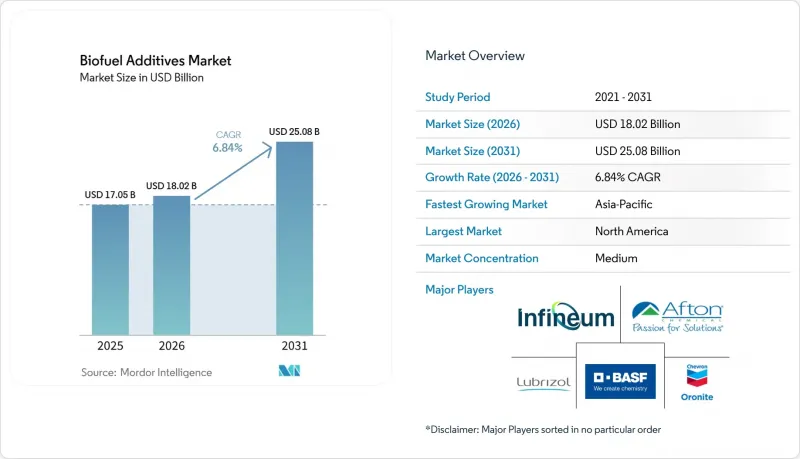
根據 Mordor Intelligence 預測,生質燃料添加劑市場規模預計將在 2025 年達到 170.5 億美元,2026 年達到 180.2 億美元,到 2031 年達到 250.8 億美元,2026 年至 2031 年的複合年成長率為 6.84%。
本報告按類型(抗氧化劑、腐蝕抑制劑等)、生質燃料類型(生質乙醇、生物柴油)、應用(柴油添加劑、重油添加劑等)、終端用戶產業(運輸、發電等)和地區(亞太地區、北美地區、歐洲地區、南美地區、中東和非洲)進行細分。市場預測以美元計價。
全球生質燃料添加劑市場趨勢與洞察
嚴格的排放法規正在加速生質燃料添加劑的採用。
生質燃料添加劑市場不僅與生質燃料的產量密切相關,而且與排放法規週期也息息相關。德國於2026年4月將可再生能源指令III(RED III)納入其國家法律,將先進生質燃料的配額比例從2026年合規年度的1%提高到2%,並設定了到2030年達到3%的目標。廢棄食用油、木質纖維素乙醇和氫化植物油(HVO)的日益普及,使得對特定應用的抗氧化劑和穩定劑系統的需求不斷成長,這些系統不同於標準的脂肪酸甲酯(FAME)包裝。取消重複累計迫使供應商將重點放在物理混合而非統計合規性上,這直接增加了對添加劑的需求。這確保了生質燃料添加劑市場與整個燃料供應鏈的合規品質、儲存穩定性和運作可靠性緊密相關。
生質燃料混合物對燃料穩定性的需求催生了對結構添加劑的需求。
生質燃料添加劑市場依賴於能夠在儲存、處理和燃燒過程中保持穩定的燃料。基於脂肪酸甲酯(FAME)的生物柴油由於其高不飽和脂肪酸含量,容易氧化,氧化後會形成沉澱物和膠狀物質,堵塞過濾器和噴油器。由於氧化穩定性是ASTM D6751和EN 14214標準中的強制性性能指標,因此添加抗氧化劑勢在必行。此外,較高的乙醇混合比例會增加吸濕性,從而增加非高醇含量燃料設計燃料系統中發生相分離的風險。因此,腐蝕抑制劑和去乳化劑在生質燃料添加劑市場中扮演著越來越重要的角色,尤其是在老舊儲槽和管道繼續使用的情況下。
添加劑對成本的敏感度限制了它們在新興經濟體中的應用。
添加劑成本持續拖累生質燃料添加劑市場,尤其是在混合燃料並非強制性或燃料利潤微薄的地區。高品質生物柴油添加劑包的成本可佔混合燃料總成本的3%至5%,這使得對價格敏感的車隊難以承擔持續添加添加劑的成本。當原料或混合比例改變時,調配商必須調整添加劑用量,這進一步加劇了成本挑戰。許多特種中間體來自歐洲和北美,將物流和外匯風險轉移到了新興市場。這導致生質燃料添加劑市場呈現兩極化的局面:高品質配方在監管嚴格的地區佔據主導地位,而成本最佳化型產品則在其他地區廣泛供應。
細分市場分析
到2025年,抗氧化劑將佔生質燃料添加劑市場22.64%的佔有率,成為最大的添加劑類型。這一地位反映了生物柴油穩定性方面的挑戰,氧化劣化會縮短其保存期限,並增加膠質和沈澱的風險。 ASTM D6751和EN 14214標準意味著抗氧化劑的使用與燃料品質標準的合規性密切相關,而非出於可自由支配的支出。該領域還包括合成酚類化合物和新型生物基替代品,這使得供應商可以根據政策和永續性的考慮來調整配方。
預計到2031年,低溫流動性增強劑的複合年成長率將達到7.58%,反映出法規範圍不斷擴大,涵蓋了寒冷和高海拔地區的運作條件。隨著混合比例的增加,低溫運行性能對於經銷商、車輛運營商和倉儲設施變得越來越重要。隨著乙醇含量的增加,燃料和水的行為發生變化,腐蝕抑制劑的重要性也日益凸顯。同時,在優先考慮抑制沉積物和提高石蠟基可再生柴油性能的領域,清潔劑、分散劑和潤滑性促進劑繼續發揮至關重要的作用。儘管主要細分市場備受關注,但生質燃料添加劑的整體需求十分廣泛,這得益於抗乳化劑、著色劑、標記劑、穩定劑以及辛烷值或十六烷改良劑等產品的廣泛應用。
預計到2025年,生質柴油將佔據63.41%的市場佔有率,從而在大規模生產和使用的基礎上,確立生質燃料燃料添加劑市場的地位。這一規模反映了成熟的政策應對措施以及生物柴油在道路運輸、船舶和固定式發電等領域的廣泛應用。即使燃料經濟狀況不斷變化,對抑制氧化和提高低溫性能的需求也將確保生物柴油添加劑的穩定需求,為供應商提供抗氧化劑、低溫流動性增強劑和儲存穩定性增強劑等產品的廣泛且持續的需求基礎。
預計到2031年,生質乙醇的複合年成長率將達到7.19%,成為市場上成長最快的生質燃料類型。在印度,將於2026年4月起在全國推廣20%的乙醇混合燃料,將提升儲存和分銷系統中防腐蝕和防潮的重要性。隨著高比例乙醇混合燃料的普及,根據各國燃料標準,染料和標記包裝、抗乳化劑以及辛烷值提升配方變得越來越重要。供應商可以透過客製化包裝而非採用單一的全球配方來提高利潤率。
區域分析
到2025年,北美將繼續保持在區域市場的領先地位,佔據生質燃料添加劑市場佔有率的35.18%。該地區受益於可再生燃料標準(RFS)的嚴格執行、大規模可再生柴油煉製能力以及成熟的調配商和經銷商網路。這種結構支撐了對抗氧化劑、低溫流動性增強劑和其他有助於燃料滿足監管合規性和儲存要求的添加劑組合的持續需求。在美國,新型無污染燃料的獎勵正在影響原料的經濟性,並提升碳強度反應型調配支援的價值。北美作為商業規模技術支援和優質添加劑系統的早期採用標竿市場,發揮關鍵作用。
預計到2031年,亞太地區將以7.63%的複合年成長率成長,成為生質燃料添加劑成長最快的區域市場。在印度,一項計劃從2026年4月起將乙醇摻混比例提高到20%的方案,推動了整個儲存和分銷網路中對腐蝕抑制劑、著色劑和標記系統以及水處理化學品的需求成長。在中國,乙醇摻混計畫的廣泛實施,增加了對滿足龐大車輛需求的客製化添加劑方案的需求,從而進一步推動了市場成長。在日本和韓國,永續航空燃料(SAF)計畫的擴展,隨著可再生噴射機燃料的成長,也擴大了高附加價值產品的潛在市場。與更標準化的市場相比,亞太地區原料的多樣性進一步凸顯了技術服務和在地化摻混能力的重要性。
在歐洲,生質燃料添加劑市場持續保持較高的絕對銷售量,這得益於鼓勵推廣先進混合燃料、普及可再生柴油以及嚴格執行相關政策框架的支持。德國將於2026年將可再生能源指令III(RED III)納入國家法律,此舉提高了對先進生質燃料的要求,並取消了2026年合規年度的重複累計,從而增加了對高品質混合燃料的需求。南美洲市場依然蓬勃發展,這得益於巴西成熟的乙醇體係以及在生物柴油強制實施方面的進展。中東和非洲雖然規模較小,但正因能源多元化和排放氣體法規的考量而日益受到政策關注。在全部區域,生質燃料添加劑市場呈現出明顯的分化:一方面是支持高品質化學品的成熟監管體系,另一方面是優先考慮低成本加工方案的新興監管體系。
其他好處:
- Excel格式的市場預測(ME)表
- 3個月的分析師支持
目錄
第1章:引言
- 研究假設和市場定義
- 調查範圍
第2章:調查方法
第3章執行摘要
第4章 市場狀況
- 市場概覽
- 市場促進因素
- 嚴格的排放法規正在推動生質燃料的使用。
- 高混合比下燃料穩定性的需求
- 擴大可再生柴油和SAF的生產。
- 加強對引擎積碳的監管要求
- 低純度原料推高了對添加劑的需求。
- 數位化燃料配方和現場檢驗
- 市場限制因素
- 添加劑在競爭激烈的混合產品中的成本敏感性
- 由於原料差異導致的兼容性問題
- 新化學物質的認證途徑有限。
- 在受監管燃料池之外的部署速度放緩
- 價值鏈分析
- 波特五力分析
第5章 市場規模與成長預測
- 按類型
- 抗氧化劑
- 腐蝕抑制劑
- 冷流改善劑
- 洗滌劑和分散劑
- 辛烷值和十六烷改良劑
- 染料和記號筆
- 潤滑性促進劑
- 去乳化劑
- 穩定器
- 其他
- 依生質燃料類型
- 生質乙醇
- 生質柴油
- 透過使用
- 柴油燃料添加劑
- 重油添加劑
- 船用燃料添加劑
- 汽油燃料添加劑
- 航空燃油添加劑
- 其他
- 按最終用戶行業分類
- 運輸
- 發電
- 產業
- 農業
- 按地區
- 亞太地區
- 中國
- 印度
- 日本
- 韓國
- 其他亞太國家
- 北美洲
- 美國
- 加拿大
- 墨西哥
- 歐洲
- 德國
- 英國
- 法國
- 義大利
- 俄羅斯
- 其他歐洲國家
- 南美洲
- 巴西
- 阿根廷
- 其他南美國家
- 中東和非洲
- 沙烏地阿拉伯
- 南非
- 其他中東和非洲國家
- 亞太地區
第6章 競爭情勢
- 市場集中度
- 策略趨勢
- 市佔率和排名分析
- 公司簡介
- Afton Chemical
- Arkema
- BASF
- Biofuel Systems Group Ltd.
- Chemiphase International Ltd.
- Chevron Oronite Company LLC
- Clariant AG
- Dorf Ketal Chemicals
- Eastman Chemical Company
- Evonik Industries AG
- E-ZOIL
- Fuel Quality Services Inc.
- Infineum International Limited
- Innospec Inc.
- Lubrizol
- Nalco Champion
- NewMarket Corporation
- Solvay SA
- TotalEnergies Additives and Special Fuels
第7章 市場機會與未來展望
According to Mordor Intelligence, the biofuel additives market size is projected to be USD 17.05 billion in 2025, USD 18.02 billion in 2026, and reach USD 25.08 billion by 2031, and is expected to grow at a CAGR of 6.84% from 2026 to 2031.
This report is Segmented by Type (Antioxidants, Corrosion Inhibitors, and More), Biofuel Type (Bioethanol and Biodiesel), Application (Diesel Fuel Additives, Heavy Fuel Oil Additives, and More), End-User Industry (Transportation, Power Generation, and More), and Geography (Asia-Pacific, North America, Europe, South America, and Middle-East and Africa). The Market Forecasts are Provided in Terms of Value (USD).
Global Biofuel Additives Market Trends and Insights
Stringent Emission Limits Accelerate Biofuel Additive Adoption
The biofuel additives market is closely tied to emissions regulation cycles, not just to headline biofuel output. Germany adopted Renewable Energy Directive III (RED III) transposition in April 2026, which doubled the advanced biofuels sub-quota from 1% to 2% for the 2026 compliance year and set a path to 3% by 2030. Higher use of used cooking oil, lignocellulosic ethanol, and Hydrotreated Vegetable Oil (HVO) raises the need for tailored antioxidant and stabilizer systems that differ from standard Fatty Acid Methyl Ester (FAME) packages. The move away from double-counting also pushes suppliers toward physical blending rather than statistical compliance, which directly increases additive demand. This keeps the biofuel additives market linked to compliance quality, storage stability, and operational reliability across the fuel chain.
Fuel Stability Needs in Biofuel Blends Create Structural Additive Demand
The biofuel additives market depends on fuels that remain stable during storage, handling, and combustion. FAME-based biodiesel oxidizes easily because it contains more unsaturated fatty acids, which can form sediments and gums that plug filters and injectors. ASTM D6751 and EN 14214 maintain oxidative stability as a required performance threshold, making antioxidant dosing difficult to avoid. Higher ethanol blend ratios also increase water absorption and the risk of phase separation in fuel systems not designed for higher alcohol content. As a result, corrosion inhibitors and demulsifiers are taking on a more permanent role in the biofuel additives market, particularly where older tanks and pipelines remain in service.
Additive Cost Sensitivity Constrains Uptake in Emerging Economies
Additive costs continue to constrain the biofuel additives market in regions where blending is voluntary or fuel margins are thin. Premium biodiesel additive packages can account for 3%-5% of blended fuel costs, making consistent treatment difficult to justify for price-sensitive fleets. This cost challenge intensifies when blenders must adjust treat rates as feedstocks and blend ratios change. Many specialty intermediates are sourced from Europe and North America, transferring logistics and currency risks to emerging markets. This creates a two-tier biofuel additives market, with premium formulations concentrated in highly regulated regions and cost-optimized packages carrying higher volumes in other regions.
Other drivers and restraints analyzed in the detailed report include:
- Renewable Diesel and Sustainable Aviation Fuel (SAF) Demand Open High-Margin Additive Segments
- Rising Engine Deposit Concerns Drive Demand for Detergent and Dispersant Chemistry
- Compatibility Challenges Across Feedstock and Fleet Diversity Slow Deployment
For complete list of drivers and restraints, kindly check the Table Of Contents.
Segment Analysis
Antioxidants accounted for 22.64% of the biofuel additives market in 2025, making them the largest additive type. This position reflects the stability challenge in biodiesel, where oxidative degradation can reduce storage life and increase the risk of gums and sediments. ASTM D6751 and EN 14214 keep antioxidant use closely tied to fuel quality compliance rather than discretionary spending. The segment also includes synthetic phenolic chemistries and newer bio-based alternatives, giving suppliers room to adjust formulations based on policy and sustainability preferences.
Cold flow improvers are forecast to grow at a 7.58% CAGR through 2031, indicating that mandates are extending into cold-weather and high-altitude operating conditions. As blend levels rise, operability at lower temperatures becomes more important for distributors, fleet operators, and storage sites. Corrosion inhibitors are also gaining ground as higher ethanol ratios alter fuel-water behavior, while detergents, dispersants, and lubricity improvers remain important where deposit control and paraffinic renewable diesel performance are priorities. Demand across the biofuel additives market remains broad, supported by demulsifiers, dyes, markers, stabilizers, and octane or cetane improvers, even as the leading sub-segments attract most of the attention.
Biodiesel held a 63.41% share in 2025, anchoring the biofuel additives market to a fuel stream with a large installed production and usage base. Its scale reflects mature policy treatment and widespread use across road transport, marine activity, and stationary power applications. The need for oxidation control and cold performance support keeps biodiesel additive demand stable even when fuel economics shift, providing suppliers with a broad, recurring base of antioxidant, cold-flow, and storage-stability products.
Bioethanol is projected to grow at a 7.19% CAGR through 2031, making it the fastest-growing biofuel type in the market. India's move to nationwide 20% ethanol blending from April 2026 is increasing the importance of corrosion control and water management in storage and distribution systems. As higher ethanol blends become more widespread, dye and marker packages, demulsifiers, and octane-oriented formulations become more relevant within country-specific fuel standards. This is an area where suppliers can improve margins through customized packages rather than a single global formula.
Complete Report Scope:
- By Type
- Antioxidants
- Corrosion Inhibitors
- Cold Flow Improvers
- Detergents and Dispersants
- Octane and Cetane Improvers
- Dyes and Markers
- Lubricity Improvers
- Demulsifiers
- Stabilizers
- Others
- By Biofuel Type
- Bioethanol
- Biodiesel
- By Application
- Diesel Fuel Additives
- Heavy Fuel Oil Additives
- Shipping Fuel Additives
- Gasoline Fuel Additives
- Aviation Fuel Additives
- Others
- By End-User Industry
- Transportation
- Power Generation
- Industrial
- Agriculture
- By Geography
- Asia-Pacific
- China
- India
- Japan
- South Korea
- Rest of Asia-Pacific
- North America
- United States
- Canada
- Mexico
- Europe
- Germany
- United Kingdom
- France
- Italy
- Russia
- Rest of Europe
- South America
- Brazil
- Argentina
- Rest of South America
- Middle-East and Africa
- Saudi Arabia
- South Africa
- Rest of Middle-East and Africa
- Asia-Pacific
Geography Analysis
North America held 35.18% of the biofuel additives market share in 2025, maintaining its lead among regional markets. The region benefits from strong enforcement of the Renewable Fuel Standard, large renewable diesel refining capacity, and a mature base of blenders and distributors. This structure supports recurring demand for antioxidants, cold-flow improvers, and other additive packages that help fuels meet compliance and storage requirements. In the United States, new clean fuel incentives are shaping feedstock economics and increasing the value of carbon-intensity-aligned formulation support. North America serves as the reference market for commercial-scale technical support and early adoption of premium additive systems.
Asia-Pacific is forecast to grow at a 7.63% CAGR through 2031, making it the fastest-growing regional market for biofuel additives. India's move to 20% ethanol blending from April 2026 is increasing demand for corrosion inhibitors, dye and marker systems, and water-handling chemistries across storage and distribution networks. China adds further momentum, as broader ethanol-blending efforts raise the need for country-specific additive packages across a large vehicle base. Japan and South Korea are expanding sustainable aviation fuel programs, widening the addressable market for higher-value products tied to the growth of renewable jet fuel. Feedstock diversity across Asia-Pacific makes technical service and localized formulation capability more important than in more standardized markets.
Europe continues to generate high absolute volumes in the biofuel additives market, supported by a policy framework that rewards advanced blending, renewable diesel uptake, and compliance discipline. Germany's transposition of the Renewable Energy Directive III (RED III) in 2026 strengthened demand for premium formulations by raising advanced biofuel requirements and ending double counting from the 2026 compliance year. South America remains anchored by Brazil's mature ethanol system and the progression of its biodiesel mandate, while the Middle East and Africa are smaller markets gaining policy attention for energy diversification and emissions control. Across these regions, the biofuel additives market shows a clear divide between mature regulatory systems that support premium chemistry and emerging systems that prioritize lower-cost treatment options.
- Afton Chemical
- Arkema
- BASF
- Biofuel Systems Group Ltd.
- Chemiphase International Ltd.
- Chevron Oronite Company LLC
- Clariant AG
- Dorf Ketal Chemicals
- Eastman Chemical Company
- Evonik Industries AG
- E-ZOIL
- Fuel Quality Services Inc.
- Infineum International Limited
- Innospec Inc.
- Lubrizol
- Nalco Champion
- NewMarket Corporation
- Solvay S.A.
- TotalEnergies Additives and Special Fuels
Additional Benefits:
- The market estimate (ME) sheet in Excel format
- 3 months of analyst support
TABLE OF CONTENTS
1 Introduction
- 1.1 Study Assumptions and Market Definition
- 1.2 Scope of the Study
2 Research Methodology
3 Executive Summary
4 Market Landscape
- 4.1 Market Overview
- 4.2 Market Drivers
- 4.2.1 Stringent Emission Limits Supporting Biofuel Blending
- 4.2.2 Fuel Stability Needs in Higher Blend Ratios
- 4.2.3 Renewable Diesel and SAF Scale-Up
- 4.2.4 Rising Engine Deposit Control Requirements
- 4.2.5 Lower-Purity Feedstock Increasing Additive Demand
- 4.2.6 Digitalized Fuel Formulation and Field Validation
- 4.3 Market Restraints
- 4.3.1 Additive Cost Sensitivity in Price-Competitive Blends
- 4.3.2 Compatibility Challenges Across Feedstock Variability
- 4.3.3 Limited Certification Pathways for New Chemistries
- 4.3.4 Slower Adoption Outside Regulated Fuel Pools
- 4.4 Value Chain Analysis
- 4.5 Porter's Five Forces Analysis
- 4.5.1 Threat of New Entrants
- 4.5.2 Bargaining Power of Suppliers
- 4.5.3 Bargaining Power of Buyers
- 4.5.4 Threat of Substitutes
- 4.5.5 Competitive Rivalry
5 Market Size and Growth Forecasts (Value)
- 5.1 By Type
- 5.1.1 Antioxidants
- 5.1.2 Corrosion Inhibitors
- 5.1.3 Cold Flow Improvers
- 5.1.4 Detergents and Dispersants
- 5.1.5 Octane and Cetane Improvers
- 5.1.6 Dyes and Markers
- 5.1.7 Lubricity Improvers
- 5.1.8 Demulsifiers
- 5.1.9 Stabilizers
- 5.1.10 Others
- 5.2 By Biofuel Type
- 5.2.1 Bioethanol
- 5.2.2 Biodiesel
- 5.3 By Application
- 5.3.1 Diesel Fuel Additives
- 5.3.2 Heavy Fuel Oil Additives
- 5.3.3 Shipping Fuel Additives
- 5.3.4 Gasoline Fuel Additives
- 5.3.5 Aviation Fuel Additives
- 5.3.6 Others
- 5.4 By End-User Industry
- 5.4.1 Transportation
- 5.4.2 Power Generation
- 5.4.3 Industrial
- 5.4.4 Agriculture
- 5.5 By Geography
- 5.5.1 Asia-Pacific
- 5.5.1.1 China
- 5.5.1.2 India
- 5.5.1.3 Japan
- 5.5.1.4 South Korea
- 5.5.1.5 Rest of Asia-Pacific
- 5.5.2 North America
- 5.5.2.1 United States
- 5.5.2.2 Canada
- 5.5.2.3 Mexico
- 5.5.3 Europe
- 5.5.3.1 Germany
- 5.5.3.2 United Kingdom
- 5.5.3.3 France
- 5.5.3.4 Italy
- 5.5.3.5 Russia
- 5.5.3.6 Rest of Europe
- 5.5.4 South America
- 5.5.4.1 Brazil
- 5.5.4.2 Argentina
- 5.5.4.3 Rest of South America
- 5.5.5 Middle-East and Africa
- 5.5.5.1 Saudi Arabia
- 5.5.5.2 South Africa
- 5.5.5.3 Rest of Middle-East and Africa
- 5.5.1 Asia-Pacific
6 Competitive Landscape
- 6.1 Market Concentration
- 6.2 Strategic Moves
- 6.3 Market Share (%)/Ranking Analysis
- 6.4 Company Profiles (includes Global Overview, Market Overview, Core Segments, Financials as available, Strategic Information, Products and Services, and Recent Developments)
- 6.4.1 Afton Chemical
- 6.4.2 Arkema
- 6.4.3 BASF
- 6.4.4 Biofuel Systems Group Ltd.
- 6.4.5 Chemiphase International Ltd.
- 6.4.6 Chevron Oronite Company LLC
- 6.4.7 Clariant AG
- 6.4.8 Dorf Ketal Chemicals
- 6.4.9 Eastman Chemical Company
- 6.4.10 Evonik Industries AG
- 6.4.11 E-ZOIL
- 6.4.12 Fuel Quality Services Inc.
- 6.4.13 Infineum International Limited
- 6.4.14 Innospec Inc.
- 6.4.15 Lubrizol
- 6.4.16 Nalco Champion
- 6.4.17 NewMarket Corporation
- 6.4.18 Solvay S.A.
- 6.4.19 TotalEnergies Additives and Special Fuels
7 Market Opportunities and Future Outlook
- 7.1 White-Space and Unmet-Need Assessment


