


 |
市場調查報告書
商品編碼
2117994
量子隨機數產生軟體:市場佔有率分析、產業趨勢與統計、成長預測(2026-2031)Quantum Random Number Generation Software - Market Share Analysis, Industry Trends & Statistics, Growth Forecasts (2026 - 2031) |
||||||

※ 本網頁內容可能與最新版本有所差異。詳細情況請與我們聯繫。
據 Mordor Intelligence 稱,2025 年量子隨機數產生軟體市值為 2.3419 億美元,預計從 2026 年到 2031 年將以 22.80% 的複合年成長率成長,到 2031 年達到 7.7795 億美元。
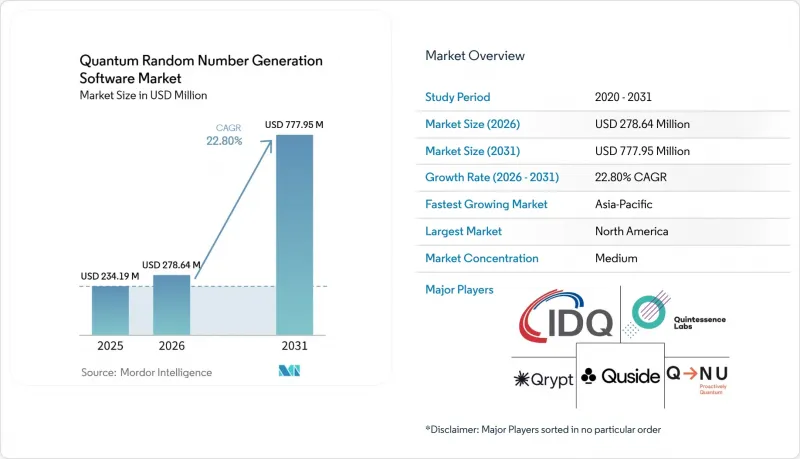
本報告按產品/服務(軟體解決方案、服務)、部署模式(雲端、本地部署、混合部署)、功能(QRNG開發平台、其他)、最終用戶(IT與電信、銀行、金融服務和保險、醫療保健與生命科學、零售與電子商務、航太與國防、其他)以及地區進行細分。市場預測以美元計價。
全球量子隨機數生成軟體市場趨勢及洞察
日益成長的網路安全威脅和加密需求
「先取得後解密」攻擊改變了組織評估加密資訊生命週期的方式。攻擊者可以立即持有加密數據,並在實用量子運算技術普及後嘗試解密。因此,對於必須保密超過10年的記錄和通訊,需要更早採取措施來提高密碼敏捷性和熵品質。銀行、醫療保健、國防和情報機構都將熵視為安全要素,需要規劃、監控和管治。量子隨機數產生 (QRNG) 軟體市場正從中受益,因為基於軟體的熵可以整合到現有的金鑰管理系統中,而無需採購單獨的硬體。 ETSI 於2026年3月發布的指南指出,受監管的 QRNG 的部署將需要持續的健康監控和硬體信任根的認證。
向後量子密碼學的過渡和熵的現代化
2024年8月,美國國家標準與技術研究院 (NIST) 批准了FIPS 203、FIPS 204和FIPS 205標準,為聯邦系統及其相關供應商實施後量子密碼技術鋪平了道路。這些標準涵蓋了ML-KEM、ML-DSA和SLH-DSA,所有這些標準都要求金鑰產生和簽章使用強種子隨機數。軟體量子隨機數產生器 (QRNG) 產品可以作為庫或服務層修改引入,從而最大限度地減少對已認證密碼環境的影響。 Quantinuum公司的「Quantum Origin」於2025年4月獲得NIST SP 800-90B「檢驗熵源」認證,為買家提供了以軟體為中心的合規性指南。大規模金融網路不僅需要在金鑰產生環節解決熵問題,還需要在大量的硬體安全模組 (HSM) 操作中解決熵問題。因此,量子隨機數產生軟體市場有機會開發服務模型,將現有密碼操作中的熵提供過程抽象化。
整合傳統加密協定棧的複雜性
部署傳統硬體安全模組 (HSM)、PKIX 基礎架構和舊版加密庫的組織在更換熵來源時可能會面臨重大的整合挑戰。這會影響 HSM韌體、應用程式介面 (API) 和熵池管理。歐洲電信標準化協會 (ETSI) 指出,量子隨機數產生器 (QRNG) 的實現必須符合安全保障要求,包括在安全等級要求更高的環境中滿足 FIPS 140-3 的要求。目前,量子密碼技術尚未採用通用的QRNG 介面和控制平面標準。這給擁有混合供應商環境和多代安全設備的買家帶來了更大的負擔。在中型金融機構和醫療保健網路中,由於需要滿足合規性要求但工程資源有限,量子隨機數產生軟體市場的普及速度較為緩慢。
細分市場分析
到 2025 年,軟體解決方案將佔據量子隨機數產生軟體市場 72.41% 的佔有率,成為領先的產品類別。當需要在多個雲端環境中部署且無需承擔每個用戶的硬體成本時,買家更傾向於選擇軟體。這個類別正從單純的熵生成發展成為一個集交付、金鑰管理、健康監控和後量子密碼庫於一體的平台。 Palo Alto Networks 及其 QRNG 技術合作夥伴於 2025 年 1 月推出了 QRNG Open API 框架,旨在提升安全平台之間的互通性。隨著通用介面的普及,基本熵交付方式的差異化可能會逐漸消失。同時,身分驗證範圍、整合深度和託管服務的重要性也可能日益凸顯。
預計2026年至2031年間,服務業的複合年成長率將達到25.83%,成為該領域內成長率最高的產業。對於不願自行運作量子安全功能的機構而言,託管熵分佈、整合支援和合規服務極具吸引力。金融、保險和證券(BFSI)以及醫療保健行業的買家需要監控、審計日誌、容錯移轉以及熵源證據方面的支援。遊戲公司也需要能夠滿足基於RTS 7的身份驗證和稽核要求的隨機數產生系統。因此,量子隨機數產生軟體市場可能會從一次性軟體部署轉向持續服務合約。能夠提供具有防篡改功能的持續檢驗報告和審計追蹤的供應商,將更有能力滿足最苛刻的專案需求。
到 2025 年,基於雲端的部署將佔量子隨機數產生軟體市場 68.19% 的佔有率。這反映了雲端原生安全工作負載與熵即服務 (EaaS) 交付模式之間的親和性。雲端資源通常需要頻繁的金鑰更新、交易簽章和受保護的身份處理。 AWS Marketplace 提供了一個面向雲端的量子隨機數產生器 (QRNG) 產品範例,該產品結合了多種熵源,可與 EC2 資源搭配使用。對於國防機構、金融機構以及具有嚴格網路隔離規則的資料中心而言,本地部署系統仍然至關重要。預計這些買家將繼續傾向於選擇本地或空氣間隙的熵生成器。
混合部署預計到2031年將以24.43%的複合年成長率成長。這種模式將本地熵生成或控制與基於雲端的交付和應用程式存取相結合。當組織需要記錄加密金鑰生命週期並管理資料駐留需求時,此模式尤其適用。 Quantropi的「QiSpace」服務利用多供應商的主導供應,並允許客戶在隔離環境中進行配置。混合配置需要協調本地設備、雲端服務和存取控制。這種複雜性為能夠跨多個地區提供認證支援的供應商創造了專業服務業務機會。在量子隨機數產生軟體市場,同時具備雲端整合和本地部署能力的供應商可能更具優勢。
區域分析
2025年,北美將佔據量子隨機數產生軟體市場34.62%的佔有率。該地區擁有完善的聯邦網路安全採購體系,並聚集了許多量子隨機數產生器(QRNG)軟體供應商。基於美國國家標準與技術研究院(NIST)認可的後量子標準的美國過渡要求,正在推動政府機構、承包商和供應商的需求。 Quantinuum於2025年4月通過了NIST SP 800-90B的檢驗,為政府採購中基於軟體的熵應用確立了合法途徑。加拿大和墨西哥的金融業和政府準備計畫也正在催生對量子隨機數產生軟體的次要需求。此外,公開可用的量子隨機性服務CURBy也加強了該地區檢驗隨機性的研究基礎。
預計亞太地區2026年至2031年的複合年成長率將達到25.91%。中國、日本和韓國的國家級量子計畫正在推動量子安全功能的應用。該地區的電信和金融基礎設施為量子隨機數產生器(QRNG)的整合提供了切實可行的環境。韓國將QRNG整合到5G設備中的努力表明,電信業將在推動這項技術走向商業化方面發揮重要作用。隨著印度國內企業建立國際研發和商業關係,印度正崛起成為新的貢獻者。東南亞和亞太其他地區仍處於早期市場階段,其發展與金融數位化和政府網路安全現代化密切相關。
歐洲是繼北美之後全球第三大銷售區域,其中德國、英國和法國為核心市場。金融機構需要管理營運彈性並記錄加密管理措施,這將有助於識別熵的來源。歐洲電信標準化協會 (ETSI) 於 2026 年 3 月發布的量子隨機數產生器 (QRNG) 實施指南涵蓋了基於 FIPS 140-3、NIST SP 800-90B、BSI AIS 20/31 和 ISO/IEC 19790 標準的實施路徑。南美洲、中東和非洲雖然規模較小,但在量子隨機數生成軟體市場中正處於發展階段。巴西和海灣國家正在對量子安全基礎設施進行初步投資。南非和沙烏地阿拉伯也已啟動國家級網路安全計劃,這些計劃有望創造機構需求。
其他好處
- Excel格式的市場預測(ME)表
- 3個月的分析師支持
目錄
第1章:引言
- 研究假設和市場定義
- 調查範圍
第2章:調查方法
第3章執行摘要
第4章 市場狀況
- 市場概覽
- 市場促進因素
- 日益成長的網路安全威脅和加密需求
- 向後量子密碼學的過渡和熵的現代化
- 雲端運算和邊緣運算的擴展正在產生需要大量熵的工作負載。
- 物聯網、行動裝置和聯網汽車。
- 監管機構對遊戲和金融服務中檢驗隨機性的要求
- 量子運算的普及提高了基於軟體的量子隨機數產生器的潛力。
- 市場限制因素
- 整合傳統加密協定棧的複雜性
- 傳統偽隨機數產生器的優勢:價格低廉,使用者熟悉。
- 關於證明遠程量子熵起源的證據和審計責任
- 跨境熵服務中與延遲、可用性和資料居住相關的摩擦
- 宏觀經濟因素對市場的影響
- 產業價值鏈分析
- 科技趨勢
- 監理情勢
- 波特五力分析
第5章 市場規模與成長預測
- 透過提供
- 軟體解決方案
- 服務
- 部署模式
- 基於雲端的
- 現場
- 混合
- 按功能
- QRNG開發平台
- 熵管理與分佈
- 隨機性檢驗和健康監測
- 後處理和熵調整
- 檢驗、審計、合規性
- 最終用戶
- 資訊科技/通訊
- BFSI
- 醫療保健和生命科學
- 零售與電子商務
- 航太/國防
- 工業製造
- 教育和研究機構
- 媒體與娛樂
- 政府/行政部門
- 能源與公共產業
- 其他
- 按地區
- 北美洲
- 美國
- 加拿大
- 墨西哥
- 南美洲
- 巴西
- 阿根廷
- 其他南美國家
- 歐洲
- 德國
- 英國
- 法國
- 俄羅斯
- 西班牙
- 其他歐洲國家
- 亞太地區
- 中國
- 日本
- 印度
- 韓國
- 東南亞
- 其他亞太國家
- 中東和非洲
- 中東
- 沙烏地阿拉伯
- 阿拉伯聯合大公國
- 其他中東國家
- 非洲
- 南非
- 奈及利亞
- 其他非洲地區
- 中東
- 北美洲
第6章 競爭情勢
- 市場集中度
- 策略趨勢
- 市佔率分析
- 公司簡介
- ID Quantique SA
- QuintessenceLabs Pty Ltd
- Quside Technologies SL
- Qrypt Inc.
- QNu Labs Private Limited
- Quantum Dice Ltd.
- Crypta Labs Limited
- KETS Quantum Security Limited
- Quantropi Inc.
- Quantum eMotion Corp.
- QuantumCTek Co., Ltd.
- Qutools GmbH
- MagiQ Technologies, Inc.
- NuCrypt LLC
- Terra Quantum AG
- Alea Quantum Technologies ApS
- InfiniQuant
- Quantum Numbers Corp.
- Quantum Computing Inc.
- Quantinuum Ltd.
- Qnami AG
- SK Telecom Co., Ltd.
- Fujitsu Limited
- Atos SE
第7章 市場機會與未來展望
According to Mordor Intelligence, the quantum random number generation software market size was valued at USD 234.19 million in 2025 and is forecast to reach USD 777.95 million by 2031, at a CAGR of 22.80% during 2026-2031.
This report is Segmented by Offering (Software Solutions, and Services), Deployment Mode (Cloud-Based, On-Premises, and Hybrid), Function (QRNG Development Platforms, and More), End User (IT and Telecommunication, BFSI, Healthcare and Life Sciences, Retail and E-Commerce, Aerospace and Defense, and More), and Geography. The Market Forecasts are Provided in Terms of Value (USD).
Global Quantum Random Number Generation Software Market Trends and Insights
Escalating Cybersecurity Threats and Encryption Requirements
Harvest-now-decrypt-later attacks have changed how organizations assess the lifespan of encrypted information. Attackers can retain encrypted data now and seek to decrypt it after capable quantum computing becomes available. Records and communications that must remain confidential for more than 10 years therefore require earlier action on cryptographic agility and entropy quality. Banking, healthcare, defense, and intelligence organizations are treating entropy as a security input that needs planning, monitoring, and governance. The Quantum random number generation software market benefits because software-based entropy can be connected to existing key management systems without a separate hardware procurement process. ETSI guidance issued in March 2026 set expectations for continuous health monitoring and hardware root-of-trust attestation in regulated QRNG deployments.
Post-Quantum Cryptography Migration and Entropy Modernization
NIST approved FIPS 203, FIPS 204, and FIPS 205 in August 2024, placing post-quantum cryptography on a path to implementation for federal systems and related suppliers. The standards cover ML-KEM, ML-DSA, and SLH-DSA, all of which require strong-seeded randomness for key generation and signing. Software QRNG products can be introduced as library and service-layer changes, reducing disruption to certified cryptographic environments. Quantinuum's Quantum Origin received NIST SP 800-90B validation as a Validated Entropy Source in April 2025, creating a software-focused compliance reference for buyers. Large financial networks must also address entropy across high-volume HSM operations rather than only at the point of key creation. The Quantum random number generation software market, therefore, has an opportunity to develop service models that abstract entropy delivery across existing cryptographic operations.
Integration Complexity Across Legacy Cryptographic Stacks
Organizations with legacy HSMs, PKIX infrastructure, and older cryptographic libraries can face material integration work when changing entropy sources. The work can affect HSM firmware, application programming interfaces, and entropy-pool management. ETSI notes that QRNG implementation must align with assurance requirements, including FIPS 140-3 considerations in higher-security settings. A common QRNG interface and control-plane standard has not yet been adopted across quantum cryptography technologies. This creates more work for buyers with mixed vendor environments and several generations of security equipment. The Quantum random number generation software market faces slower adoption among mid-sized financial institutions and healthcare networks that need compliance but have limited engineering capacity.
Other drivers and restraints analyzed in the detailed report include:
- Cloud and Edge Expansion Creating Entropy-Starved Workloads
- Growth of Embedded Security Across IoT, Mobile, and Connected Vehicles
- Price and Familiarity Advantages of Classical PRNGs
For complete list of drivers and restraints, kindly check the Table Of Contents.
Segment Analysis
Software Solutions held 72.41% of the Quantum random number generation software market share in 2025, making it the leading offering category. Buyers prefer software when they need to deploy across multiple cloud environments without per-seat hardware costs. The category is moving beyond entropy generation toward platforms that combine delivery, key management, health monitoring, and post-quantum cryptography libraries. Palo Alto Networks and its QRNG technology partners introduced the QRNG Open API framework in January 2025 to improve interoperability in security platforms. A common interface can make basic entropy delivery less distinctive over time. It can also increase the importance of certification coverage, integration depth, and managed services.
Services are projected to record a 25.83% CAGR from 2026 to 2031, the fastest rate within this segmentation. Managed entropy delivery, integration support, and compliance services appeal to organizations that do not want to operate an internal quantum security function. BFSI and healthcare buyers need support for monitoring, audit logs, failover, and evidence of entropy provenance. Gaming operators also need random number generation systems that can support certification and audit requirements under RTS 7. The Quantum random number generation software market can therefore shift toward recurring service relationships instead of one-time software deployments. Providers with continuous verification reports and tamper-evident audit trails are positioned to serve the most demanding programs.
Cloud-Based deployment accounted for 68.19% of the Quantum random number generation software market size in 2025. This position reflects the close fit between cloud-native security workloads and entropy-as-a-service delivery. Cloud resources often need frequent key refreshes, transaction signing, and protected identity processes. AWS Marketplace offered an example of cloud-oriented QRNG delivery that combines entropy sources for use with EC2 resources. On-premises systems still matter for defense agencies, financial institutions, and data centers with strict network isolation rules. These buyers may continue to prefer local or air-gapped entropy equipment.
Hybrid deployment is projected to grow at a 24.43% CAGR through 2031. The model combines local entropy generation or control with cloud-based distribution and application access. It is relevant where organizations must document cryptographic key lifecycles and manage data residency requirements. Quantropi's QiSpace service uses a multi-vendor entropy supply and also allows customer-hosted configurations for isolated deployments. Hybrid arrangements require coordination across local appliances, cloud services, and access controls. This complexity creates a professional services opportunity for providers that can deliver certified support across multiple regions. The Quantum random number generation software market may favor suppliers with both cloud integration and on-premises deployment capability.
Complete Report Scope:
- By Offering
- Software Solutions
- Services
- By Deployment Mode
- Cloud-Based
- On-Premises
- Hybrid
- By Function
- QRNG Development Platforms
- Entropy Management and Distribution
- Randomness Validation and Health Monitoring
- Post-Processing and Entropy Conditioning
- Verification, Audit and Compliance
- By End User
- IT and Telecommunication
- BFSI
- Healthcare and Life Sciences
- Retail and E-Commerce
- Aerospace and Defense
- Industrial Manufacturing
- Education and Research Institutions
- Media and Entertainment
- Government and Administration
- Energy and Utilities
- Other End-Users
- By Geography
- North America
- United States
- Canada
- Mexico
- South America
- Brazil
- Argentina
- Rest of South America
- Europe
- Germany
- United Kingdom
- France
- Russia
- Spain
- Rest of Europe
- Asia-Pacific
- China
- Japan
- India
- South Korea
- Southeast Asia
- Rest of Asia-Pacific
- Middle East and Africa
- Middle East
- Saudi Arabia
- United Arab Emirates
- Rest of Middle East
- Africa
- South Africa
- Nigeria
- Rest of Africa
- Middle East
- North America
Geography Analysis
North America held 34.62% of the Quantum random number generation software market share in 2025. The region has a developed federal cybersecurity procurement system and a high concentration of QRNG software providers. U.S. migration requirements based on NIST-approved post-quantum standards support demand among agencies, contractors, and suppliers. Quantinuum's April 2025 NIST SP 800-90B validation established a recognized path for software-based entropy in government procurement. Canada and Mexico add secondary demand through financial-sector and government readiness programs. The CURBy public quantum randomness service also strengthened the region's research base for verifiable randomness.
Asia-Pacific is projected to grow at a 25.91% CAGR from 2026 to 2031. National quantum programs in China, Japan, and South Korea support the adoption of quantum security capabilities. Regional telecom and financial infrastructure provide practical settings for QRNG integration. South Korea's work to integrate QRNG into 5G equipment shows the role of telecommunications in bringing the technology into commercial environments. India is an emerging contributor as domestic companies build international research and commercial relationships. Southeast Asia and the rest of Asia-Pacific remain earlier-stage markets, with progress linked to financial digitalization and government cybersecurity modernization.
Europe followed North America as the third-largest revenue region, with Germany, the United Kingdom, and France forming the core. Financial institutions must manage operational resilience and document cryptographic controls, which support attention to entropy provenance. ETSI's March 2026 QRNG implementation guidance covered FIPS 140-3, NIST SP 800-90B, BSI AIS 20/31, and ISO/IEC 19790 pathways. South America, the Middle East, and Africa represent smaller but developing areas for the Quantum random number generation software market. Brazil and Gulf states are making early investments in quantum security infrastructure. South Africa and Saudi Arabia have also begun sovereign cybersecurity programs that can build institutional demand.
- ID Quantique SA
- QuintessenceLabs Pty Ltd
- Quside Technologies S.L.
- Qrypt Inc.
- QNu Labs Private Limited
- Quantum Dice Ltd.
- Crypta Labs Limited
- KETS Quantum Security Limited
- Quantropi Inc.
- Quantum eMotion Corp.
- QuantumCTek Co., Ltd.
- Qutools GmbH
- MagiQ Technologies, Inc.
- NuCrypt LLC
- Terra Quantum AG
- Alea Quantum Technologies ApS
- InfiniQuant
- Quantum Numbers Corp.
- Quantum Computing Inc.
- Quantinuum Ltd.
- Qnami AG
- SK Telecom Co., Ltd.
- Fujitsu Limited
- Atos SE
Additional Benefits:
- The market estimate (ME) sheet in Excel format
- 3 months of analyst support
TABLE OF CONTENTS
1 INTRODUCTION
- 1.1 Study Assumptions and Market Definition
- 1.2 Scope of the Study
2 RESEARCH METHODOLOGY
3 EXECUTIVE SUMMARY
4 MARKET LANDSCAPE
- 4.1 Market Overview
- 4.2 Market Drivers
- 4.2.1 Escalating Cybersecurity Threats and Encryption Requirements
- 4.2.2 Post-Quantum Cryptography Migration and Entropy Modernization
- 4.2.3 Cloud and Edge Expansion Creating Entropy-Starved Workloads
- 4.2.4 Growth of Embedded Security Across IoT, Mobile, and Connected Vehicles
- 4.2.5 Regulated Demand for Verifiable Randomness in Gaming and Financial Services
- 4.2.6 Quantum-Computing Access Expanding Software QRNG Availability
- 4.3 Market Restraints
- 4.3.1 Integration Complexity Across Legacy Cryptographic Stacks
- 4.3.2 Price and Familiarity Advantages of Classical PRNGs
- 4.3.3 Evidence and Audit Burden for Remote Quantum Entropy Provenance
- 4.3.4 Latency, Availability, and Data-Residency Friction in Cross-Border Entropy Services
- 4.4 Impact of Macroeconomic Factors on the Market
- 4.5 Industry Value-Chain Analysis
- 4.6 Technology Outlook
- 4.7 Regulatory Landscape
- 4.8 Porter's Five Forces Analysis
- 4.8.1 Threat of New Entrants
- 4.8.2 Bargaining Power of Suppliers
- 4.8.3 Bargaining Power of Buyers
- 4.8.4 Threat of Substitutes
- 4.8.5 Intensity of Competitive Rivalry
5 MARKET SIZE AND GROWTH FORECASTS (VALUE)
- 5.1 By Offering
- 5.1.1 Software Solutions
- 5.1.2 Services
- 5.2 By Deployment Mode
- 5.2.1 Cloud-Based
- 5.2.2 On-Premises
- 5.2.3 Hybrid
- 5.3 By Function
- 5.3.1 QRNG Development Platforms
- 5.3.2 Entropy Management and Distribution
- 5.3.3 Randomness Validation and Health Monitoring
- 5.3.4 Post-Processing and Entropy Conditioning
- 5.3.5 Verification, Audit and Compliance
- 5.4 By End User
- 5.4.1 IT and Telecommunication
- 5.4.2 BFSI
- 5.4.3 Healthcare and Life Sciences
- 5.4.4 Retail and E-Commerce
- 5.4.5 Aerospace and Defense
- 5.4.6 Industrial Manufacturing
- 5.4.7 Education and Research Institutions
- 5.4.8 Media and Entertainment
- 5.4.9 Government and Administration
- 5.4.10 Energy and Utilities
- 5.4.11 Other End-Users
- 5.5 By Geography
- 5.5.1 North America
- 5.5.1.1 United States
- 5.5.1.2 Canada
- 5.5.1.3 Mexico
- 5.5.2 South America
- 5.5.2.1 Brazil
- 5.5.2.2 Argentina
- 5.5.2.3 Rest of South America
- 5.5.3 Europe
- 5.5.3.1 Germany
- 5.5.3.2 United Kingdom
- 5.5.3.3 France
- 5.5.3.4 Russia
- 5.5.3.5 Spain
- 5.5.3.6 Rest of Europe
- 5.5.4 Asia-Pacific
- 5.5.4.1 China
- 5.5.4.2 Japan
- 5.5.4.3 India
- 5.5.4.4 South Korea
- 5.5.4.5 Southeast Asia
- 5.5.4.6 Rest of Asia-Pacific
- 5.5.5 Middle East and Africa
- 5.5.5.1 Middle East
- 5.5.5.1.1 Saudi Arabia
- 5.5.5.1.2 United Arab Emirates
- 5.5.5.1.3 Rest of Middle East
- 5.5.5.2 Africa
- 5.5.5.2.1 South Africa
- 5.5.5.2.2 Nigeria
- 5.5.5.2.3 Rest of Africa
- 5.5.5.1 Middle East
- 5.5.1 North America
6 COMPETITIVE LANDSCAPE
- 6.1 Market Concentration
- 6.2 Strategic Moves
- 6.3 Market Share Analysis
- 6.4 Company Profiles (includes Global Level Overview, Market Level Overview, Core Segments, Financials as available, Strategic Information, Market Rank/Share, Products and Services, Recent Developments)
- 6.4.1 ID Quantique SA
- 6.4.2 QuintessenceLabs Pty Ltd
- 6.4.3 Quside Technologies S.L.
- 6.4.4 Qrypt Inc.
- 6.4.5 QNu Labs Private Limited
- 6.4.6 Quantum Dice Ltd.
- 6.4.7 Crypta Labs Limited
- 6.4.8 KETS Quantum Security Limited
- 6.4.9 Quantropi Inc.
- 6.4.10 Quantum eMotion Corp.
- 6.4.11 QuantumCTek Co., Ltd.
- 6.4.12 Qutools GmbH
- 6.4.13 MagiQ Technologies, Inc.
- 6.4.14 NuCrypt LLC
- 6.4.15 Terra Quantum AG
- 6.4.16 Alea Quantum Technologies ApS
- 6.4.17 InfiniQuant
- 6.4.18 Quantum Numbers Corp.
- 6.4.19 Quantum Computing Inc.
- 6.4.20 Quantinuum Ltd.
- 6.4.21 Qnami AG
- 6.4.22 SK Telecom Co., Ltd.
- 6.4.23 Fujitsu Limited
- 6.4.24 Atos SE
7 MARKET OPPORTUNITIES AND FUTURE OUTLOOK
- 7.1 White-Space and Unmet-Need Assessment

 供應商概況:2025 年全球先進創傷護理管理市場展望
 量子技術市場(2026-2036):計算、通訊、成像、安全、感測、建模、仿真全球量子技術市場規模、佔有率、趨勢和成長分析報告(2026-2034)全球量子2.0市場(2026-2036年)
 2026年全球衛星量子網際網路市場報告2026年全球量子安全市場報告2026年全球量子安全通訊市場報告2026年全球量子技術市場報告2026年全球量子隨機數產生器(QRNG)市場報告
 量子安全通訊晶片市場分析及預測(至2035年):依類型、產品類型、服務、技術、組件、應用、部署類型、最終用戶及功能分類