


 |
市場調查報告書
商品編碼
2117626
鎂補充劑:市場佔有率分析、行業趨勢和統計數據、成長預測(2026-2031)Magnesium Supplements - Market Share Analysis, Industry Trends & Statistics, Growth Forecasts (2026 - 2031) |
||||||

※ 本網頁內容可能與最新版本有所差異。詳細情況請與我們聯繫。
在鎂補充劑市場中,粉狀鎂補充劑預計將成為成長最快的形式,從 2026 年到 2031 年,其複合年成長率將達到 8.61%。
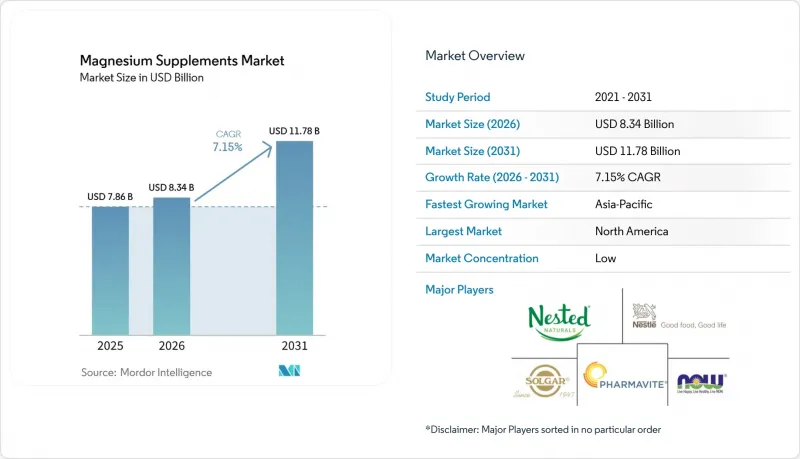
根據Mordor Intelligence預測,鎂補充劑市場規模預計將從2025年的78.6億美元成長至2026年的83.4億美元,並在2031年達到117.8億美元,2026年至2031年的複合年成長率(CAGR)為7.15%。本報告按產品類型(氧化鎂、檸檬酸鎂、甘氨酸鎂等)、劑型(片劑、膠囊、軟糖、粉劑、液體)、應用領域(骨骼和肌肉、睡眠支持、心血管及其他)、終端用戶(Z世代、千禧世代、X世代、嬰兒潮世代、Alpha世代)以及地區(北美、歐洲、亞太、南美、中東和非洲)進行細分。市場預測以美元(USD)為單位。
全球鎂補充劑市場趨勢及洞察
鎂缺乏症盛行率上升
鎂缺乏症的日益普遍推動了鎂補充劑的需求。這是因為消費者希望彌補膳食攝取不足,並支持重要的生理功能。根據美國國家醫學圖書館發布的2025年回顧報告,約有24億人(約佔世界人口的31%)將無法達到每日建議鎂攝取量。這種普遍存在的營養缺乏症促使人們更加關注鎂在肌肉和神經功能、能量代謝、骨骼健康和電解質平衡中的作用,尤其是在消費者越來越積極主動地進行預防性健康管理和保健的情況下。因此,消費者擴大使用補充劑來彌補膳食攝取不足並維持充足的鎂水平,這推動了全球鎂補充劑市場的成長。
對睡眠和壓力管理解決方案的需求日益成長
消費者對睡眠和壓力管理解決方案的需求日益成長,推動了鎂補充劑市場的發展。這是因為消費者越來越傾向於選擇天然來源的產品來解決睡眠障礙、壓力和放鬆等問題。日益成長的工作壓力、生活方式的改變以及人們對睡眠重要性的認知不斷提高,促使消費者探索有助於放鬆和整體健康的營養補充劑。鎂擴大被添加到睡眠和壓力管理產品中,尤其受到關注的是含有甘氨酸鎂、檸檬酸鎂和其他旨在促進放鬆的鎂形式的產品。消費者對預防性健康管理和非藥物解決方案的日益偏好,也提升了他們對鎂補充劑的興趣,並推動了市場成長。
消費者對鎂的各種形式缺乏了解。
消費者對各種鎂形式差異的認知不足,導致產品選擇混亂,阻礙了鎂補充劑市場的成長。鎂補充劑有多種形式,包括檸檬酸鎂、甘氨酸鎂、氧化鎂、蘋果酸鎂和氯化鎂,每種形式的吸收特性、用途和目標消費者群體各不相同。然而,許多消費者缺乏對這些差異的充分了解,可能主要根據價格、劑量或品牌知名度來選擇產品。這種認知不足會降低購買意願,削弱消費者對高品質產品的信心,使製造商難以有效地宣傳產品差異,最終限制了市場成長。
細分市場分析
預計到2025年,氧化鎂將佔全球鎂補充劑市場最大佔有率,達到25.62%。其主導地位得益於其在膳食補充劑領域悠久的應用歷史以及廣泛的消費者認可。氧化鎂有多種劑型,包括片劑和膠囊,可透過藥局、超級市場、保健食品商店和線上管道輕鬆購買。其相對較低的生產成本也促進了其在大眾市場和成本績效補充劑產品中的應用。此成分通常用於補充鎂元素,並有助於維持骨骼和肌肉健康。其強大的市場地位和廣泛的供應表明,在整個預測期內,氧化鎂將保持顯著的市場佔有率。
預計甘氨酸鎂將成為成長最快的鎂產品類型,2026年至2031年的複合年成長率將達到8.56%。這一成長主要得益於消費者對高吸收率、低負擔鎂製劑的需求日益成長。甘氨酸鎂尤其受到尋求助眠、放鬆、肌肉恢復和整體健康改善補充劑的消費者的青睞。其高階定位也符合消費者對更高品質、特定用途膳食補充劑的普遍需求。隨著消費者對各種鎂形態的認知不斷提高,他們正逐漸從傳統的氧化鎂產品轉向其他形式的鎂。
在鎂補充劑市場,膠囊佔最大佔有率,預計到2025年將佔市場佔有率的34.62%。其主導地位得益於膠囊的便利性、便攜性和易服用性。此外,膠囊還允許生產商精確控制各種鎂製劑的劑量,包括甘氨酸鎂、檸檬酸鎂和氧化鎂。這種形式的產品廣泛銷售於藥局、保健食品店、超級市場和電商平台。消費者對便利的日常補充劑服用方式的需求日益成長,進一步推動了對膠囊型產品的需求。因此,預計在整個預測期內,膠囊仍將保持其主導地位。
這種成長主要源於消費者對靈活劑量和便捷補充劑形式的日益成長的需求。鎂粉因其易於與水和其他飲料混合,深受尋求片劑和膠囊替代品的消費者歡迎。此外,鎂粉也越來越受到注重補水、恢復和日常補充劑攝取的運動營養和健康消費者的關注。
區域分析
北美在全球鎂補充劑市場佔最大佔有率,預計到2025年將佔市場佔有率的36.11%。該地區受益於消費者對營養補充品、預防醫學和運動營養的高度重視。消費者對促進肌肉健康、睡眠、心血管健康和認知健康的產品的強勁需求持續推動著市場成長。成熟的補充劑生產商、廣泛的零售網路、藥局和電商平台進一步提升了產品的可及性。此外,該地區的消費者對高階、專業和特定健康的鎂配方產品也表現出濃厚的興趣。
預計亞太地區在2026年至2031年間將以9.23%的複合年成長率成長,成為成長最快的區域市場。這一成長主要得益於健康意識的提高、可支配收入的增加以及營養補充劑在中國、日本、印度和澳洲等主要市場滲透率的不斷提高。人們對運動營養、睡眠支持、積極生活方式和預防醫學的日益關注,也推動了含鎂產品的需求成長。此外,電子商務和現代零售業的擴張也提高了消費者獲取國內外營養補充品品牌的管道。
歐洲是一個重要的區域市場,這得益於較高的健康意識、成熟的營養補充劑消費習慣以及對高級產品和潔淨標示產品的需求。南美洲預計將受益於日益成長的健康意識以及透過零售和電子商務不斷擴大的分銷網路。中東和非洲市場則受到人們對預防醫學、健身和營養補充劑日益成長的興趣的推動,但市場滲透率仍然相對較低。
其他好處:
- Excel格式的市場預測(ME)表
- 3個月的分析師支持
目錄
第1章:引言
- 研究假設和市場定義
- 調查範圍
第2章:調查方法
第3章執行摘要
第4章 市場狀況
- 市場概覽
- 市場促進因素
- 鎂缺乏症加重
- 人們對預防醫學的興趣日益濃厚
- 對睡眠和壓力管理解決方案的需求日益成長
- 更多參與運動營養和健身
- 人口老化正在支撐經濟成長。
- 產品創新和配方多樣化
- 市場限制因素
- 消費者對各種形式的鎂的認知度較低
- 過量服用引起的副作用
- 與富含鎂的食物競爭
- 各國法規的差異
- 供應鏈分析
- 監理展望
- 波特五力模型
第5章 市場規模與成長預測
- 依產品類型
- 氧化鎂
- 檸檬酸鎂
- 甘胺酸鎂
- L-蘇糖酸鎂
- 牛磺酸鎂
- 其他產品類型
- 按形式
- 藥片
- 膠囊
- 軟糖
- 粉末
- 液體
- 透過使用
- 骨骼和肌肉
- 睡眠支持
- 心血管健康
- 大腦與認知健康
- 其他用途
- 最終用戶
- 阿爾法世代
- Z世代
- 千禧世代
- X世代
- 嬰兒潮世代
- 按地區
- 北美洲
- 美國
- 加拿大
- 墨西哥
- 其他北美國家
- 歐洲
- 德國
- 英國
- 義大利
- 西班牙
- 法國
- 比利時
- 波蘭
- 其他歐洲國家
- 亞太地區
- 中國
- 印度
- 日本
- 澳洲
- 韓國
- 泰國
- 印尼
- 越南
- 其他亞太國家
- 南美洲
- 巴西
- 阿根廷
- 智利
- 秘魯
- 其他南美國家
- 中東和非洲
- 南非
- 沙烏地阿拉伯
- 阿拉伯聯合大公國
- 卡達
- 埃及
- 摩洛哥
- 其他中東和非洲國家
- 北美洲
第6章 競爭情勢
- 市場集中度
- 策略趨勢
- 市場排名分析
- 公司簡介
- Pharmavite LLC
- Nestle SA
- NOW Foods
- Nested Naturals, Inc.
- Solaray(Nutraceutical International Corporation)
- Doctor's Best, Inc.
- Solgar, Inc.
- Pure Encapsulations, LLC
- Life Extension Foundation
- Thorne HealthTech, Inc.
- Natural Vitality(The Clorox Company)
- Jigsaw Health, LLC
- BioEmblem, LLC
- Balchem Corporation(Albion Minerals)
- Jungbunzlauer Suisse AG
- Fortitech, Inc.
- Magceutics, Inc.
- Swanson Health Products, Inc.
- Jarrow Formulas, Inc.
- Sundown Naturals(The Bountiful Company)
第7章 市場機會與未來展望
Powder is projected to be the fastest-growing form in the magnesium supplements market, expanding at a CAGR of 8.61% from 2026 to 2031.
According to Mordor Intelligence, the magnesium supplements is expected to grow from USD 7.86 billion in 2025 to USD 8.34 billion in 2026 and is forecast to reach USD 11.78 billion by 2031 at 7.15% CAGR over 2026-2031. This report is Segmented by Product Type (Oxide, Citrate, Glycinate, and More), Form (Tablets, Capsules, Gummies, Powder, Liquid), Application (Bone and Muscle, Sleep Support, Cardiovascular, and More), End User (Gen Z, Millennials, Gen X, Boomers, Gen Alpha), Geography (North America, Europe, Asia-Pacific, South America, Middle East and Africa). The Market Forecasts are Provided in Terms of Value (USD).
Global Magnesium Supplements Market Trends and Insights
Rising Prevalence of Magnesium Deficiency
The rising prevalence of magnesium inadequacy is driving demand for magnesium supplements, as consumers seek to address insufficient dietary intake and support essential physiological functions. According to a 2025 review published in the National Library of Medicine, approximately 2.4 billion people, or around 31% of the global population, do not meet recommended magnesium intake levels . This widespread nutritional gap is raising awareness of magnesium's role in muscle and nerve function, energy metabolism, bone health, and electrolyte balance, particularly as consumers become more proactive about preventive health and wellness. As a result, consumers are increasingly using supplements to bridge dietary gaps and maintain adequate magnesium levels, thereby supporting the growth of the global magnesium supplements market.
Increasing Demand for Sleep and Stress-Management Solutions
Increasing demand for sleep and stress-management solutions is supporting the growth of the magnesium supplements market as consumers increasingly seek natural products to address sleep disturbances, stress, and relaxation-related concerns. Rising work-related pressures, changing lifestyles, and growing awareness of the importance of sleep are encouraging consumers to explore nutritional supplements that support relaxation and overall well-being. Magnesium is increasingly incorporated into sleep and stress-management products, particularly formulations featuring magnesium glycinate, magnesium citrate, and other forms positioned for relaxation support. The growing preference for preventive wellness and non-pharmaceutical solutions is therefore expanding consumer interest in magnesium supplements and supporting market growth.
Limited Consumer Awareness of Different Magnesium Forms
Limited consumer awareness of the differences between magnesium forms is restraining the growth of the magnesium supplements market by creating confusion during product selection. Magnesium supplements are available in various forms, including magnesium citrate, glycinate, oxide, malate, and chloride, which differ in absorption characteristics, applications, and consumer positioning. However, many consumers have limited knowledge of these differences and may select products based primarily on price, dosage, or brand recognition. This lack of understanding can discourage purchases, reduce confidence in premium formulations, and make it more difficult for manufacturers to communicate product differentiation, thereby limiting market growth.
Other drivers and restraints analyzed in the detailed report include:
- Rising Sports Nutrition and Fitness Participation
- Growing Aging Population Supporting Growth
- Side Effects Associated with Excessive Consumption
For complete list of drivers and restraints, kindly check the Table Of Contents.
Segment Analysis
Magnesium oxide held the largest share of the global magnesium supplements market, accounting for 25.62% in 2025. Its leading position is supported by its long-standing use in dietary supplements and broad consumer familiarity. Magnesium oxide is widely available across tablets and capsules, making it accessible through pharmacies, supermarkets, health stores, and online channels. Its relatively low production cost also supports its presence in mass-market and value-oriented supplement products. The ingredient is commonly positioned for general magnesium supplementation and bone and muscle health. Its established market presence and broad availability are expected to help it retain a significant share during the forecast period.
Magnesium glycinate is projected to be the fastest-growing product type, recording a CAGR of 8.56% from 2026 to 2031. Growth is being driven by increasing consumer interest in highly absorbable and well-tolerated magnesium formulations. The ingredient is particularly gaining traction among consumers seeking supplements for sleep support, relaxation, muscle recovery, and general wellness. Its premium positioning also aligns with the broader shift toward higher-quality and targeted nutritional supplements. Growing awareness of different magnesium forms is encouraging consumers to move beyond traditional magnesium oxide products.
Capsules accounted for the largest share of the magnesium supplements market, representing 34.62% of the market size in 2025. Their leading position is supported by convenience, portability, and ease of consumption. Capsules also enable manufacturers to offer precise dosages across various magnesium formulations, including glycinate, citrate, and oxide. The format is widely distributed through pharmacies, health stores, supermarkets, and e-commerce platforms. Growing consumer preference for convenient daily supplementation further supports demand for capsule-based products. As a result, capsules are expected to remain the dominant form throughout the forecast period.
Growth is being supported by increasing demand for flexible dosing and convenient supplementation formats. Magnesium powders can be easily mixed with water or other beverages, appealing to consumers seeking alternatives to tablets and capsules. The format is also gaining traction among sports nutrition and wellness consumers focused on hydration, recovery, and daily supplementation.
Complete Report Scope:
- By Product Type
- Magnesium Oxide
- Magnesium Citrate
- Magnesium Glycinate
- Magnesium L-Threonate
- Magnesium Taurate
- Other Product Types
- By Form
- Tablets
- Capsules
- Gummies
- Powder
- Liquid
- By Application
- Bone and Muscle
- Sleep Support
- Cardiovascular Health
- Brain and Cognitive Health
- Other Applications
- By End User
- Gen Alpha
- Gen Z
- Millennials
- Gen X
- Boomers
- By Geography
- North America
- United States
- Canada
- Mexico
- Rest of North America
- Europe
- Germany
- United Kingdom
- Italy
- Spain
- France
- Belgium
- Poland
- Rest of Europe
- Asia-Pacific
- China
- India
- Japan
- Australia
- South Korea
- Thailand
- Indonesia
- Vietnam
- Rest of Asia-Pacific
- South America
- Brazil
- Argentina
- Chile
- Peru
- Rest of South America
- Middle East and Africa
- South Africa
- Saudi Arabia
- United Arab Emirates
- Qatar
- Egypt
- Morocco
- Rest of Middle East and Africa
- North America
Geography Analysis
North America held the largest share of the global magnesium supplements market, accounting for 36.11% of market value in 2025. The region benefits from high consumer awareness of dietary supplements, preventive healthcare, and sports nutrition. Strong demand for products supporting muscle health, sleep, cardiovascular wellness, and cognitive health continues to support market growth. The presence of established supplement manufacturers, extensive retail networks, pharmacies, and e-commerce platforms further strengthens product accessibility. Consumers in the region also show strong interest in premium, specialized, and condition-focused magnesium formulations.
Asia-Pacific is projected to be the fastest-growing regional market, expanding at a CAGR of 9.23% from 2026 to 2031. Growth is supported by rising health awareness, increasing disposable incomes, and the expanding adoption of dietary supplements across major markets such as China, Japan, India, and Australia. Growing interest in sports nutrition, sleep support, active lifestyles, and preventive healthcare is increasing demand for magnesium-based products. The expansion of e-commerce and modern retail is also improving access to international and domestic supplement brands.
Europe represents a significant regional market, supported by strong health awareness, established supplement consumption, and demand for premium and clean-label products. South America is expected to benefit from rising wellness awareness and expanding retail and e-commerce distribution. The Middle East and Africa market is supported by growing interest in preventive health, fitness, and nutritional supplementation, although market penetration remains comparatively lower.
- Pharmavite LLC
- Nestle S.A.
- NOW Foods
- Nested Naturals, Inc.
- Solaray (Nutraceutical International Corporation)
- Doctor's Best, Inc.
- Solgar, Inc.
- Pure Encapsulations, LLC
- Life Extension Foundation
- Thorne HealthTech, Inc.
- Natural Vitality (The Clorox Company)
- Jigsaw Health, LLC
- BioEmblem, LLC
- Balchem Corporation (Albion Minerals)
- Jungbunzlauer Suisse AG
- Fortitech, Inc.
- Magceutics, Inc.
- Swanson Health Products, Inc.
- Jarrow Formulas, Inc.
- Sundown Naturals (The Bountiful Company)
Additional Benefits:
- The market estimate (ME) sheet in Excel format
- 3 months of analyst support
TABLE OF CONTENTS
1 INTRODUCTION
- 1.1 Study Assumptions and Market Definition
- 1.2 Scope of the Study
2 RESEARCH METHODOLOGY
3 EXECUTIVE SUMMARY
4 MARKET LANDSCAPE
- 4.1 Market Overview
- 4.2 Market Drivers
- 4.2.1 Rising Prevalence of Magnesium Deficiency
- 4.2.2 Growing Focus on Preventive Healthcare
- 4.2.3 Increasing Demand for Sleep and Stress-Management Solutions
- 4.2.4 Rising Sports Nutrition and Fitness Participation
- 4.2.5 Growing Aging Population Supporing Growth
- 4.2.6 Product Innovation and Formulation Diversification
- 4.3 Market Restraints
- 4.3.1 Limited Consumer Awareness of Different Magnesium Forms
- 4.3.2 Side Effects Associated with Excessive Consumption
- 4.3.3 Competition from Magnesium-Rich Foods
- 4.3.4 Regulatory Variations Across Countries
- 4.4 Supply Chain Analysis
- 4.5 Regulatory Outlook
- 4.6 Porter's Five Forces
- 4.6.1 Threat of New Entrants
- 4.6.2 Bargaining Power of Buyers/Consumers
- 4.6.3 Bargaining Power of Suppliers
- 4.6.4 Threat of Substitute Products
- 4.6.5 Intensity of Competitive Rivalry
5 MARKET SIZE and GROWTH FORECASTS (VALUE)
- 5.1 By Product Type
- 5.1.1 Magnesium Oxide
- 5.1.2 Magnesium Citrate
- 5.1.3 Magnesium Glycinate
- 5.1.4 Magnesium L-Threonate
- 5.1.5 Magnesium Taurate
- 5.1.6 Other Product Types
- 5.2 By Form
- 5.2.1 Tablets
- 5.2.2 Capsules
- 5.2.3 Gummies
- 5.2.4 Powder
- 5.2.5 Liquid
- 5.3 By Application
- 5.3.1 Bone and Muscle
- 5.3.2 Sleep Support
- 5.3.3 Cardiovascular Health
- 5.3.4 Brain and Cognitive Health
- 5.3.5 Other Applications
- 5.4 By End User
- 5.4.1 Gen Alpha
- 5.4.2 Gen Z
- 5.4.3 Millennials
- 5.4.4 Gen X
- 5.4.5 Boomers
- 5.5 By Geography
- 5.5.1 North America
- 5.5.1.1 United States
- 5.5.1.2 Canada
- 5.5.1.3 Mexico
- 5.5.1.4 Rest of North America
- 5.5.2 Europe
- 5.5.2.1 Germany
- 5.5.2.2 United Kingdom
- 5.5.2.3 Italy
- 5.5.2.4 Spain
- 5.5.2.5 France
- 5.5.2.6 Belgium
- 5.5.2.7 Poland
- 5.5.2.8 Rest of Europe
- 5.5.3 Asia-Pacific
- 5.5.3.1 China
- 5.5.3.2 India
- 5.5.3.3 Japan
- 5.5.3.4 Australia
- 5.5.3.5 South Korea
- 5.5.3.6 Thailand
- 5.5.3.7 Indonesia
- 5.5.3.8 Vietnam
- 5.5.3.9 Rest of Asia-Pacific
- 5.5.4 South America
- 5.5.4.1 Brazil
- 5.5.4.2 Argentina
- 5.5.4.3 Chile
- 5.5.4.4 Peru
- 5.5.4.5 Rest of South America
- 5.5.5 Middle East and Africa
- 5.5.5.1 South Africa
- 5.5.5.2 Saudi Arabia
- 5.5.5.3 United Arab Emirates
- 5.5.5.4 Qatar
- 5.5.5.5 Egypt
- 5.5.5.6 Morocco
- 5.5.5.7 Rest of Middle East and Africa
- 5.5.1 North America
6 COMPETITIVE LANDSCAPE
- 6.1 Market Concentration
- 6.2 Strategic Moves
- 6.3 Market Ranking Analysis
- 6.4 Company Profiles (includes Global-level Overview, Market-level Overview, Core Segments, Financials (if available), Strategic Information, Market Rank/Share, Products and Services, Recent Developments)
- 6.4.1 Pharmavite LLC
- 6.4.2 Nestle S.A.
- 6.4.3 NOW Foods
- 6.4.4 Nested Naturals, Inc.
- 6.4.5 Solaray (Nutraceutical International Corporation)
- 6.4.6 Doctor's Best, Inc.
- 6.4.7 Solgar, Inc.
- 6.4.8 Pure Encapsulations, LLC
- 6.4.9 Life Extension Foundation
- 6.4.10 Thorne HealthTech, Inc.
- 6.4.11 Natural Vitality (The Clorox Company)
- 6.4.12 Jigsaw Health, LLC
- 6.4.13 BioEmblem, LLC
- 6.4.14 Balchem Corporation (Albion Minerals)
- 6.4.15 Jungbunzlauer Suisse AG
- 6.4.16 Fortitech, Inc.
- 6.4.17 Magceutics, Inc.
- 6.4.18 Swanson Health Products, Inc.
- 6.4.19 Jarrow Formulas, Inc.
- 6.4.20 Sundown Naturals (The Bountiful Company)
7 MARKET OPPORTUNITIES AND FUTURE OUTLOOK

 2026-2030年全球鎂市場
 鎂補充劑市場機會、成長要素、產業趨勢分析及2026-2035年預測
 全球鎂金屬市場規模、佔有率、趨勢和成長分析報告(2026-2034)氯化鎂市場機會、成長要素、產業趨勢分析及2026-2035年預測
 鎂金屬市場:按應用和地區分類
 鎂電池市場規模、佔有率和趨勢分析報告:按類型、應用、地區和細分市場預測(2026-2033 年)
 鎂顆粒市場按產品類型、製造流程和應用分類,全球預測(2026-2032)2026-2034年全球氯化鎂市場規模、佔有率、趨勢和成長分析報告鎂補充劑市場按劑量、劑型、產品類型、最終用戶、分銷管道和應用分類-全球預測,2026-2032年
 氯化鎂市場規模、佔有率和成長分析(按形態、等級、類型、應用、最終用戶、通路和地區分類)-2026-2033年產業預測