


 |
市場調查報告書
商品編碼
2117604
客戶回饋軟體:市場佔有率分析、產業趨勢與統計、成長預測(2026-2031)Customer Feedback Software - Market Share Analysis, Industry Trends & Statistics, Growth Forecasts (2026 - 2031) |
||||||

※ 本網頁內容可能與最新版本有所差異。詳細情況請與我們聯繫。
根據 Mordor Intelligence 預測,客戶回饋軟體市場規模預計將在 2025 年達到 43.8 億美元,到 2031 年達到 107.1 億美元,2026 年至 2031 年的複合年成長率為 16.50%。
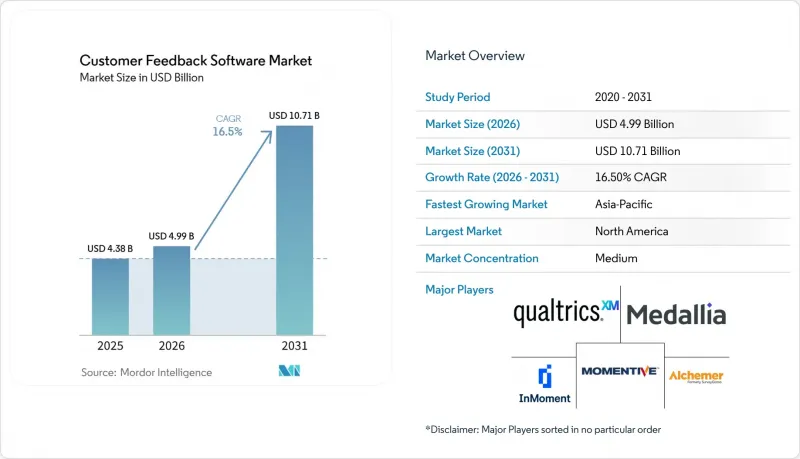
本報告按元件(軟體和服務)、回饋收集管道(網站和網路應用程式、行動應用程式、其他)、部署模式(雲端、本地部署、混合部署)、應用程式(客戶之聲管理、其他)、最終用戶(IT與電信、醫療保健與生命科學、其他)以及地區進行細分。市場預測以美元計價。
全球客戶回饋軟體市場趨勢與洞察
持續進行的全通路客戶之聲 (VoC) 項目
企業客戶經驗專案越來越注重從網站、行動應用程式、客服中心、社群媒體和產品內介面收集訊號。這種方法使團隊能夠比在單次互動後發送問卷更全面地了解客戶旅程。因此,客戶回饋軟體市場正從孤立的調查工具轉向整合多種資料類型的平台。買家尋求功能更強大的系統,這可以擴大合約範圍和延長合約期限。整合平台可以將請求的回饋、社群媒體上的公開評論和行為訊號整合到一個統一的視圖中。這使得僅提供未整合、獨立產品的供應商難以在大型企業部署中競爭。
利用人工智慧分析非結構化回饋
過去,由於人工核實是常態,開放式調查評論、對話記錄、社交媒體貼文和聊天記錄難以大規模利用。如今,人工智慧驅動的說明使企業能夠更快地對這些記錄進行分類、匯總和路由。這使得團隊能夠處理更多先前超出正式分析範圍的回饋。處理速度的提升也縮短了從客戶訊號到營運回應的時間。在客戶回饋軟體市場,人們越來越重視能夠支援特定產業內有意義分析的資料集,而非泛泛的情感分析結果。識別醫療保健、零售和銀行等行業的服務問題,取決於模型的品質以及可用於訓練的資料。
資料隱私和同意管理的複雜性
隨著回饋收集範圍的擴大,對話記錄、行為記錄、健康資訊和財務交易詳情等數據被整合在一起。這使得供應商和使用者在同意和資料處理方面都承擔了更大的責任。 《一般資料保護規範》(GDPR)、《加州消費者隱私法案》(CCPA)、相關州法律以及印度的《數位個人資料保護法》對個人資料的收集和管理提出了不同的要求。思科的一項調查發現,95%的消費者表示,他們不會從那些未能充分保護其資料的供應商購買產品或服務。雖然人工智慧模型受益於長期資料集,但隨著隱私法規可能要求資料最小化和限制資料保留期限,客戶回饋軟體市場面臨更大的壓力。合規性證明,包括ISO 27001實施情形和資料處理者義務,可以決定供應商能否通過醫療保健和金融服務業的技術評估。
細分市場分析
至2025年,軟體將佔據客戶回饋軟體市場74.18%的佔有率。這個細分市場涵蓋了調查設計和分發工具、回饋收集系統、「客戶之聲 (VoC)」平台、分析和報告產品,以及工作流程和案例管理功能。各組織機構致力於投資能夠將海量回饋轉化為結構化資訊供營運團隊使用的系統。到2025年,「客戶之聲 (VoC)」管理和數據分析產品將成為企業重點投資領域。這些工具能夠幫助企業整理透過多個管道收到的回饋,並識別出因客戶評論分散在不同系統中而可能被忽略的重複性服務問題。報告功能使團隊能夠輕鬆比較來自不同地區、管道或客戶群的資訊。此外,工作流程和個案管理功能能夠將回饋合理分配給營運團隊。軟體的價值不僅在於其收集功能,還在於使用者能否有效利用所收集的資訊。
預計2026年至2031年,服務市場將以19.24%的複合年成長率成長。這一成長反映了將回饋應用程式與客戶關係管理 (CRM)、企業資源規劃 (ERP) 和服務管理系統整合所需的工作量。實施回饋系統通常需要資料設計、工作流程設定、變更管理和持續支援。史丹佛醫療保健中心的專案將60萬份調查回應與業務資料來源整合,顯示大規模專案遠不止設定調查那麼簡單。這項工作包括定義團隊如何對回饋進行分類、資訊的儲存位置以及哪些事件會觸發警報。組織還需要決定哪些客戶問題應該直接解決,哪些問題應該用於更廣泛的服務改善。專業服務有助於將這些決策與現有的業務流程保持一致。將專業服務納入訂閱服務的供應商可以幫助建立大規模的初始合約和長期的客戶關係。這種模式也使得整合平台比簡單的調查產品更難被取代。
到2025年,網站和網路應用程式將佔據客戶回饋軟體市場28.41%的佔有率。這些平台具有許多優勢,例如成熟的嵌入式方法以及與網路分析和測試工具的廣泛相容性。基於網站的回饋收集仍然十分有效,因為它允許在瀏覽、服務使用和交易流程的各個環節收集回饋。回饋可以在購買後、支援過程中或訪客離開頁面未完成操作時收集。這種廣泛的覆蓋範圍使得基於網路的回饋收集對許多組織都很有用,無論其主要客戶管道是什麼。行動應用程式也提供了一個重要的回饋平台,客戶可以透過智慧型手機進行互動。社群媒體和評論平台使組織能夠聽到自身管道之外的客戶聲音。這些資訊來源可以突顯客戶可能不會在正式調查中提及的問題。每個管道都帶來不同的背景訊息,從而幫助組織更深入地了解客戶的擔憂。
預計從2026年到2031年,產品內界面將以20.83%的複合年成長率成長。這些工具避免了外部電子郵件邀請帶來的延遲,因為它們可以在使用者實際使用產品時收集回饋。這使得收集到的回饋與特定功能、任務或痛點更相關。據Pendo稱,與僅使用電子郵件的調查相比,在應用程式內進行調查可以將回覆數量提高高達1300%。實體店和自助服務終端滿足了在需要匿名和即時回饋的場景中的不同需求,例如零售店、機場和醫療機構。這些實體系統可以在顧客離開或忘記體驗之前收集回饋。 Unison Retail Management在芝加哥奧黑爾國際機場的180多家商店部署了HappyOrNot的「笑臉標誌」設備。部署後的前六個月,收集了超過23000條回饋。客戶回饋軟體產業需要實現跨不同收集環境的一致性分析。
區域分析
到2025年,北美將佔據客戶回饋軟體市場34.62%的佔有率。該地區的特點是企業軟體採購成熟、供應商集中,以及零售、醫療保健和金融服務等行業廣泛推行客戶體驗計劃。美國佔據了該地區的大部分需求,因為大型企業在多個業務部門和客戶管道部署反饋平台。在加拿大,金融服務和政府部門正在加速採用雲端解決方案,這些部門需要簡化數位服務的回饋流程。隨著零售商和製造商在其北美業務中標準化客戶體驗計劃,墨西哥作為部署中心正日益受到關注。儘管與亞太和南美相比成長速度較慢,但該地區良好的業績記錄和較長的更新周期使其繼續保持主導。
預計亞太地區在2026年至2031年間將以19.68%的複合年成長率成長。根據Genesys的報告,該地區44%的客戶經驗機構正在使用基於代理的AI驅動型虛擬代理,高於41%的全球平均。中國、印度、日本、韓國和東南亞是關鍵的成長區域,但各地區的商業環境有所不同。在中國,本地供應商和能夠實現產品在地化的全球供應商更受青睞。同時,印度的《數位個人資料保護法》(DPDPA)正在推動以用戶同意為中心的架構的需求。東南亞的行動優先用戶正在推動對產品內和行動端回饋收集的需求。在日本和韓國,以分析為中心的應用正在推進,而澳洲則為基於AI的回饋功能提供了概念驗證。
預計2025年歐洲市場需求將顯著成長,其中德國、英國和法國是企業應用的關鍵市場。 GDPR(一般資料保護規則)要求嚴格的同意管理、資料最小化、稽核追蹤和資料居住選項,這將對採購和產品設計產生影響。在南美洲,市場正在擴張,尤其是在零售、銀行和電信領域,巴西和阿根廷的市場成長尤其顯著,在地化要求影響供應商的選擇。在中東和非洲,沙烏地阿拉伯和阿拉伯聯合大公國正在投資政府、零售和金融服務的數位基礎設施,從而創造了早期商業機會。企業軟體在南非和奈及利亞的應用日益普及,預計在預測期內,行動連線的擴展將有助於在非洲範圍內收集更廣泛的回饋。
其他好處
- Excel格式的市場預測(ME)表
- 3個月的分析師支持
目錄
第1章:引言
- 研究假設和市場定義
- 調查範圍
第2章:調查方法
第3章執行摘要
第4章 市場狀況
- 市場概覽
- 市場促進因素
- 持續進行的全通路客戶之聲 (VoC) 項目
- 利用人工智慧分析非結構化回饋
- 整合回饋與客戶體驗工作流程
- 擴大中小企業對雲端軟體的採用。
- 在應用程式內和數位化旅程中擴展反饋
- 以回饋為導向的個人化和客戶維繫計劃
- 市場限制因素
- 資料隱私和同意管理的複雜性
- 調查疲勞和回復品質下降
- 現有客戶系統之間的整合障礙
- 回饋所有權分散在各個業務部門
- 宏觀經濟因素對市場的影響
- 產業價值鏈分析
- 科技趨勢
- 監理情勢
- 波特五力分析
第5章 市場規模與成長預測
- 按組件
- 軟體
- 調查設計和分發工具
- 全通路回饋收集解決方案
- 客戶之聲 (VoC) 管理平台
- 數據分析和報告工具
- 回饋工作流程與個案管理軟體
- 服務
- 軟體
- 透過回饋收集管道
- 網站和網路應用程式
- 行動應用
- 電子郵件
- 客服中心
- 社群媒體與評論平台
- 產品介面
- 實體店面和售貨亭
- 部署模式
- 雲
- 現場
- 混合
- 透過使用
- 客戶之聲 (VoC) 管理
- 產品體驗管理
- 品牌和聲譽管理
- 客戶服務品管
- 客戶研究和市場檢驗
- 客戶維繫與客戶流失預防
- 最終用戶
- 資訊科技/通訊
- BFSI
- 醫療保健和生命科學
- 零售與電子商務
- 工業製造
- 教育和研究機構
- 媒體與娛樂
- 政府/行政部門
- 旅遊與飯店
- 其他
- 按地區
- 北美洲
- 美國
- 加拿大
- 墨西哥
- 南美洲
- 巴西
- 阿根廷
- 其他南美國家
- 歐洲
- 德國
- 英國
- 法國
- 俄羅斯
- 西班牙
- 其他歐洲國家
- 亞太地區
- 中國
- 日本
- 印度
- 韓國
- 東南亞
- 其他亞太國家
- 中東和非洲
- 中東
- 沙烏地阿拉伯
- 阿拉伯聯合大公國
- 其他中東國家
- 非洲
- 南非
- 奈及利亞
- 其他非洲地區
- 中東
- 北美洲
第6章 競爭情勢
- 市場集中度
- 策略趨勢
- 市佔率分析
- 公司簡介
- Qualtrics International Inc.
- Medallia, Inc.
- Momentive Inc.
- Alchemer LLC
- Zoho Corporation Private Limited
- Typeform SL
- SurveySparrow Inc.
- Sogolytics LLC
- QuestionPro Inc.
- Survicate Sp. z oo
- AskNicely, Inc.
- UserVoice, Inc.
- InMoment, Inc.
- Mopinion BV
- Zonka Technologies Private Limited
- SmartSurvey Limited
- Snap Surveys Limited
- LimeSurvey GmbH
- WorldAPP, Inc.
- SurveyLegend AB
- Nicereply, Inc.
- HappyOrNot Oy
- Feedbackly Oy
第7章 市場機會與未來展望
According to Mordor Intelligence, the customer feedback software market size was USD 4.38 billion in 2025 and is forecast to reach USD 10.71 billion by 2031, growing at a CAGR of 16.50% during 2026-2031.
This report is Segmented by Component (Software, and Services), Feedback Collection Channel (Websites and Web Applications, Mobile Applications, and More), Deployment Mode (Cloud, On-Premise, and Hybrid), Application (Voice of Customer Management, and More), End User (IT and Telecom, Healthcare and Life Sciences, and More), and Geography. The Market Forecasts are Provided in Terms of Value (USD).
Global Customer Feedback Software Market Trends and Insights
Continuous Omnichannel Voice-of-Customer Programs
Enterprise customer experience programs increasingly collect signals from websites, mobile apps, contact centers, social media, and in-product interfaces. This approach gives teams a more complete view of a customer journey than a survey sent after a single interaction. The customer feedback software market is therefore moving away from isolated survey tools toward platforms that bring together multiple data types. Buyers are seeking fewer systems with broader capabilities, which can increase both contract scope and contract duration. Unified platforms can combine requested feedback, public social comments, and behavioral signals into a single view. This makes it harder for vendors with disconnected point products to compete for large enterprise deployments.
AI-Based Analysis of Unstructured Feedback
Open-ended survey comments, transcripts, social posts, and chat records were difficult to use at scale when review depended on manual effort. AI-based analysis now allows organizations to classify, summarize, and route those records more quickly. This allows teams to work with a larger share of feedback that was previously left outside formal analysis. Faster processing can also shorten the time between a customer signal and a possible operational response. The customer feedback software market is placing greater value on data sets that can support useful analysis for specific sectors, rather than generic sentiment results. The ability to identify service problems in healthcare, retail, and banking will depend on both model quality and the data available to train it.
Data Privacy and Consent Management Complexity
Broader feedback collection brings together data such as conversation transcripts, behavioral records, health information, and financial interaction details. That creates greater responsibility for vendors and users regarding consent and data handling. GDPR, the California Consumer Privacy Act, and related state laws, and India's Digital Personal Data Protection Act impose different requirements for collecting and managing personal data. Cisco found that 95% of consumers would not buy from a provider that did not protect their data properly. The customer feedback software market faces additional pressure because AI models benefit from long-running datasets, while privacy rules may require data minimization and limited retention. Compliance evidence, including ISO 27001 practices and processor obligations, can determine whether a vendor reaches technical evaluation in healthcare and financial services.
Other drivers and restraints analyzed in the detailed report include:
- Integration of Feedback With Customer Experience Workflows
- Rising Adoption of Cloud Software by Small and Medium-Sized Enterprises
- Survey Fatigue and Declining Response Quality
For complete list of drivers and restraints, kindly check the Table Of Contents.
Segment Analysis
Software accounted for 74.18% of the customer feedback software market share in 2025. The segment includes survey design and distribution tools, feedback collection systems, Voice of Customer platforms, analysis and reporting products, and workflow and case management functions. Organizations have focused spending on systems that convert large volumes of feedback into structured information for operating teams. Voice of Customer management and data analysis products were important areas of enterprise investment in 2025. These tools help companies organize feedback received across multiple channels. They can also identify recurring service issues that might be missed when customer comments sit in separate systems. Reporting functions make it easier for teams to compare input from different locations, channels, or customer groups. Workflow and case management functions then help assign a response to the appropriate operational team. The value of software depends not only on collection capacity, but also on whether users can apply the resulting information.
Services are projected to expand at a 19.24% CAGR from 2026 to 2031. Growth reflects the work required to connect feedback applications with customer relationship management, enterprise resource planning, and service management systems. A feedback deployment often requires data design, workflow configuration, change management, and ongoing support. Stanford Health Care's program combined 600,000 survey responses with operational data sources, which illustrates that large projects extend beyond survey configuration. The work can include defining how teams classify feedback, where information is stored, and which events trigger alerts. Organizations also need to decide which customer issues need a direct response and which should inform broader service improvements. Professional services can help align these decisions with existing business processes. Vendors that package professional services with subscriptions can support larger starting contracts and longer customer relationships. This model also makes integrated platforms harder to replace than simple survey products.
Websites and web applications held 28.41% of the customer feedback software market share in 2025. They benefit from established embedding methods and wide compatibility with web analytics and testing tools. Website collection remains useful because it can capture feedback during browsing, service, and transaction journeys. Feedback can be requested after a purchase, during a support journey, or when a visitor leaves a page without completing an action. This broad coverage makes web collection relevant to many organizations, regardless of their primary customer channel. Mobile applications also provide an important setting for feedback, where customers interact on their phones. Social media and review platforms extend listening beyond the organization's owned channels. Those sources can highlight issues that customers may not report in a formal survey. Each channel adds a different context that can improve the understanding of customer concerns.
In-product interfaces are projected to grow at a 20.83% CAGR from 2026 to 2031. These tools request feedback while a user is actively using a product, avoiding the delay created by an external email invitation. This makes the response more closely connected to a specific feature, task, or point of friction. Pendo stated that in-app survey delivery can generate up to a 1,300% increase in responses compared with email-only programs. Physical locations and kiosks serve a different need in retail, airports, and healthcare settings where anonymous, immediate input can be useful. These physical systems can capture a reaction before the customer leaves the location or forgets the experience. Unison Retail Management used HappyOrNot Smiley Sign devices across more than 180 concessions at Chicago O'Hare International Airport. The deployment collected more than 23,000 feedback interactions in its first 6 months. The customer feedback software industry will need to support consistent analysis across these varied collection settings.
Complete Report Scope:
- By Component
- Software
- Survey Design and Distribution Tools
- Omnichannel Feedback Collection Solutions
- Voice of Customer (VoC) Management Platforms
- Data Analysis and Reporting Tools
- Feedback Workflow and Case Management Software
- Services
- Software
- By Feedback Collection Channel
- Websites and Web Applications
- Mobile Applications
- Contact Centers
- Social Media and Review Platforms
- In-Product Interfaces
- Physical Locations and Kiosks
- By Deployment Mode
- Cloud
- On-Premise
- Hybrid
- By Application
- Voice of Customer (VoC) Management
- Product Experience Management
- Brand and Reputation Management
- Customer Service Quality Management
- Customer Research and Market Validation
- Customer Retention and Churn Prevention
- By End User
- IT and Telecommunication
- BFSI
- Healthcare and Life Sciences
- Retail and E-Commerce
- Industrial Manufacturing
- Education and Research Institutions
- Media and Entertainment
- Government and Administration
- Travel and Hospitality
- Other End Users
- By Geography
- North America
- United States
- Canada
- Mexico
- South America
- Brazil
- Argentina
- Rest of South America
- Europe
- Germany
- United Kingdom
- France
- Russia
- Spain
- Rest of Europe
- Asia-Pacific
- China
- Japan
- India
- South Korea
- Southeast Asia
- Rest of Asia-Pacific
- Middle East and Africa
- Middle East
- Saudi Arabia
- United Arab Emirates
- Rest of Middle East
- Africa
- South Africa
- Nigeria
- Rest of Africa
- Middle East
- North America
Geography Analysis
North America held 34.62% of the customer feedback software market share in 2025. The region has mature enterprise software purchasing, a concentrated vendor base, and broad adoption of customer experience across retail, healthcare, and financial services. The United States accounts for much of the regional demand because large enterprises deploy feedback platforms across several business units and customer channels. Canada is increasingly adopting cloud-based solutions in financial services and government administration, where organizations need to organize digital service feedback. Mexico is becoming a deployment location as retailers and manufacturers standardize customer experience programs across North American operations. The region's installed base and long renewal cycles continue to support its leading position even as growth moderates relative to Asia-Pacific and South America.
Asia-Pacific is projected to grow at a 19.68% CAGR from 2026 to 2031. Genesys reported that 44% of customer experience organizations in the region use agentic AI-powered virtual agents, compared with a global average of 41%. China, India, Japan, South Korea, and Southeast Asia provide the main growth base, although their operating conditions differ. China favors local providers and global vendors that can localize products, while India's Digital Personal Data Protection Act increases demand for consent-aware architectures. Southeast Asia's mobile-first users support demand for in-product and mobile feedback collection. Japan and South Korea support analytics-focused deployments, while Australia provides a testing ground for AI-based feedback capabilities.
Europe had meaningful demand in 2025, with Germany, the United Kingdom, and France as important enterprise deployment markets. GDPR requires strong consent management, data minimization, audit trails, and data residency options, which affect both procurement and product design. South America is expanding through Brazil and Argentina, particularly in retail, banking, and telecommunications, with localization requirements influencing vendor choice. The Middle East and Africa present early-stage opportunities as Saudi Arabia and the United Arab Emirates invest in digital infrastructure for government, retail, and financial services. South Africa and Nigeria have more established enterprise software adoption, while growing mobile connectivity can support broader feedback collection across Africa during the forecast period.
- Qualtrics International Inc.
- Medallia, Inc.
- Momentive Inc.
- Alchemer LLC
- Zoho Corporation Private Limited
- Typeform S.L.
- SurveySparrow Inc.
- Sogolytics LLC
- QuestionPro Inc.
- Survicate Sp. z o.o.
- AskNicely, Inc.
- UserVoice, Inc.
- InMoment, Inc.
- Mopinion B.V.
- Zonka Technologies Private Limited
- SmartSurvey Limited
- Snap Surveys Limited
- LimeSurvey GmbH
- WorldAPP, Inc.
- SurveyLegend AB
- Nicereply, Inc.
- HappyOrNot Oy
- Feedbackly Oy
Additional Benefits:
- The market estimate (ME) sheet in Excel format
- 3 months of analyst support
TABLE OF CONTENTS
1 INTRODUCTION
- 1.1 Study Assumptions and Market Definition
- 1.2 Scope of the Study
2 RESEARCH METHODOLOGY
3 EXECUTIVE SUMMARY
4 MARKET LANDSCAPE
- 4.1 Market Overview
- 4.2 Market Drivers
- 4.2.1 Continuous Omnichannel Voice-of-Customer Programs
- 4.2.2 AI-Based Analysis of Unstructured Feedback
- 4.2.3 Integration of Feedback with Customer Experience Workflows
- 4.2.4 Rising Adoption of Cloud Software by Small and Medium-Sized Enterprises
- 4.2.5 Expansion of In-App and Digital Journey Feedback
- 4.2.6 Feedback-Linked Personalization and Retention Programs
- 4.3 Market Restraints
- 4.3.1 Data Privacy and Consent Management Complexity
- 4.3.2 Survey Fatigue and Declining Response Quality
- 4.3.3 Integration Barriers Across Legacy Customer Systems
- 4.3.4 Feedback Ownership Fragmentation Across Business Functions
- 4.4 Impact of Macroeconomic Factors on the Market
- 4.5 Industry Value-Chain Analysis
- 4.6 Technology Outlook
- 4.7 Regulatory Landscape
- 4.8 Porter's Five Forces Analysis
- 4.8.1 Threat of New Entrants
- 4.8.2 Bargaining Power of Suppliers
- 4.8.3 Bargaining Power of Buyers
- 4.8.4 Threat of Substitutes
- 4.8.5 Intensity of Competitive Rivalry
5 MARKET SIZE AND GROWTH FORECASTS (VALUE)
- 5.1 By Component
- 5.1.1 Software
- 5.1.1.1 Survey Design and Distribution Tools
- 5.1.1.2 Omnichannel Feedback Collection Solutions
- 5.1.1.3 Voice of Customer (VoC) Management Platforms
- 5.1.1.4 Data Analysis and Reporting Tools
- 5.1.1.5 Feedback Workflow and Case Management Software
- 5.1.2 Services
- 5.1.1 Software
- 5.2 By Feedback Collection Channel
- 5.2.1 Websites and Web Applications
- 5.2.2 Mobile Applications
- 5.2.3 Email
- 5.2.4 Contact Centers
- 5.2.5 Social Media and Review Platforms
- 5.2.6 In-Product Interfaces
- 5.2.7 Physical Locations and Kiosks
- 5.3 By Deployment Mode
- 5.3.1 Cloud
- 5.3.2 On-Premise
- 5.3.3 Hybrid
- 5.4 By Application
- 5.4.1 Voice of Customer (VoC) Management
- 5.4.2 Product Experience Management
- 5.4.3 Brand and Reputation Management
- 5.4.4 Customer Service Quality Management
- 5.4.5 Customer Research and Market Validation
- 5.4.6 Customer Retention and Churn Prevention
- 5.5 By End User
- 5.5.1 IT and Telecommunication
- 5.5.2 BFSI
- 5.5.3 Healthcare and Life Sciences
- 5.5.4 Retail and E-Commerce
- 5.5.5 Industrial Manufacturing
- 5.5.6 Education and Research Institutions
- 5.5.7 Media and Entertainment
- 5.5.8 Government and Administration
- 5.5.9 Travel and Hospitality
- 5.5.10 Other End Users
- 5.6 By Geography
- 5.6.1 North America
- 5.6.1.1 United States
- 5.6.1.2 Canada
- 5.6.1.3 Mexico
- 5.6.2 South America
- 5.6.2.1 Brazil
- 5.6.2.2 Argentina
- 5.6.2.3 Rest of South America
- 5.6.3 Europe
- 5.6.3.1 Germany
- 5.6.3.2 United Kingdom
- 5.6.3.3 France
- 5.6.3.4 Russia
- 5.6.3.5 Spain
- 5.6.3.6 Rest of Europe
- 5.6.4 Asia-Pacific
- 5.6.4.1 China
- 5.6.4.2 Japan
- 5.6.4.3 India
- 5.6.4.4 South Korea
- 5.6.4.5 Southeast Asia
- 5.6.4.6 Rest of Asia-Pacific
- 5.6.5 Middle East and Africa
- 5.6.5.1 Middle East
- 5.6.5.1.1 Saudi Arabia
- 5.6.5.1.2 United Arab Emirates
- 5.6.5.1.3 Rest of Middle East
- 5.6.5.2 Africa
- 5.6.5.2.1 South Africa
- 5.6.5.2.2 Nigeria
- 5.6.5.2.3 Rest of Africa
- 5.6.5.1 Middle East
- 5.6.1 North America
6 COMPETITIVE LANDSCAPE
- 6.1 Market Concentration
- 6.2 Strategic Moves
- 6.3 Market Share Analysis
- 6.4 Company Profiles (includes Global Level Overview, Market Level Overview, Core Segments, Financials as available, Strategic Information, Market Rank/Share, Products and Services, Recent Developments)
- 6.4.1 Qualtrics International Inc.
- 6.4.2 Medallia, Inc.
- 6.4.3 Momentive Inc.
- 6.4.4 Alchemer LLC
- 6.4.5 Zoho Corporation Private Limited
- 6.4.6 Typeform S.L.
- 6.4.7 SurveySparrow Inc.
- 6.4.8 Sogolytics LLC
- 6.4.9 QuestionPro Inc.
- 6.4.10 Survicate Sp. z o.o.
- 6.4.11 AskNicely, Inc.
- 6.4.12 UserVoice, Inc.
- 6.4.13 InMoment, Inc.
- 6.4.14 Mopinion B.V.
- 6.4.15 Zonka Technologies Private Limited
- 6.4.16 SmartSurvey Limited
- 6.4.17 Snap Surveys Limited
- 6.4.18 LimeSurvey GmbH
- 6.4.19 WorldAPP, Inc.
- 6.4.20 SurveyLegend AB
- 6.4.21 Nicereply, Inc.
- 6.4.22 HappyOrNot Oy
- 6.4.23 Feedbackly Oy
7 MARKET OPPORTUNITIES AND FUTURE OUTLOOK
- 7.1 White-Space and Unmet-Need Assessment

 2026年全球語音訓練軟體市場報告
 人工智慧驅動的生產調度市場預測至2034年:全球調度方法、人工智慧技術、功能、部署模式、最終用戶和區域分析2026年全球倉庫貨位最佳化軟體市場報告2026年全球人工智慧庫存最佳化市場報告2026年全球庫存最佳化市場報告員工學習與技能發展市場預測至2034年-按學習類型、交付方式、部署方式、組成部分、應用、最終用戶和地區分類的全球分析
 資料提取軟體市場規模、佔有率和成長分析:按組件、部署模式、組織規模、資料類型、技術、最終用戶和地區分類-2026-2033年產業預測住宅互動解決方案市場預測至2034年-按解決方案類型、部署模式、應用、最終用戶和地區分類的全球分析社區連接解決方案市場預測至2034年—按連接方式、網路類型、組件、應用、最終用戶和地區分類的全球分析
 本地商家資訊管理軟體市場:按組件、部署類型、組織規模和產業分類-2026-2032年全球市場預測