


 |
市場調查報告書
商品編碼
2117575
人工智慧驅動的生成式課程設計和教育自適應學習系統:市場佔有率分析、行業趨勢和統計數據以及成長預測(2026-2031 年)Generative AI In Education Curriculum Design and Adaptive Learning Systems - Market Share Analysis, Industry Trends & Statistics, Growth Forecasts (2026 - 2031) |
||||||

※ 本網頁內容可能與最新版本有所差異。詳細情況請與我們聯繫。
據 Mordor Intelligence 稱,教育領域中由人工智慧驅動的生成式課程設計和自適應學習系統的市場規模預計將從 2025 年的 51.4 億美元成長到 2026 年的 64.8 億美元,到 2031 年達到 226.3 億美元,2026 年至 2031 年的複合年成長率為 28.42%。
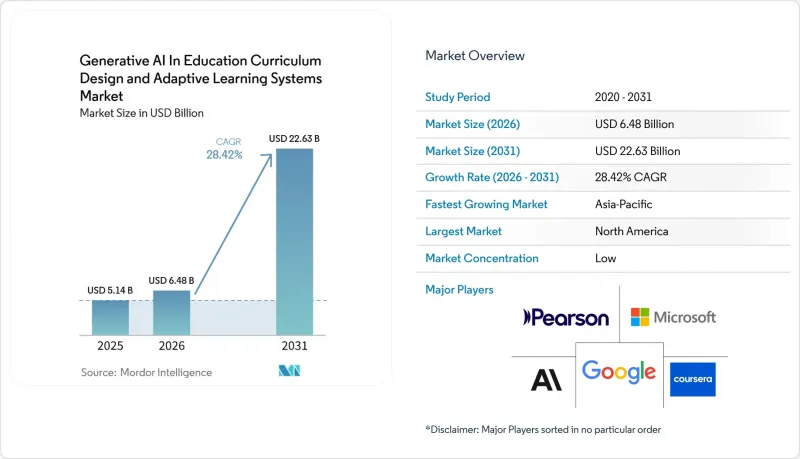
本報告按元件(軟體平台和服務)、部署模式(雲端、本地部署等)、人工智慧技術(學習學習管理、多模態生成式人工智慧等)、應用(課程設計、自適應學習路徑等)、最終用戶(K-12、高等教育等)和地區進行細分。市場預測以美元計價。
教育領域中基於生成式人工智慧的課程設計和自適應學習系統的全球趨勢與洞察
對人工智慧驅動的個人化教育解決方案的需求日益成長
在教育領域,以生成式人工智慧為導向的課程設計和自適應學習系統市場正在轉變,個人化教學不再是少數早期採用者獨享的高階功能,而逐漸成為一項基本需求。 2025年發表於《科學報告》(Scientific Reports)的一項隨機對照試驗表明,人工智慧驅動的個人化教學在課堂教學中優於主動學習,顯著提高了知識保留率和學習者參與度。經合組織(OECD)在其2026年《數位教育展望》中也指出,基於清晰教學原則而非僅僅是通用聊天工具的生成式人工智慧輔導系統,能夠產生永續的學習成果。這正在改變教育機構評估產品的方式,採購團隊更加重視學習成果、教學結構和可解釋的個人化,而不僅僅是模型的新穎性。這也提高了「面向教育領域的生成式人工智慧課程設計和自適應學習系統」市場供應商的門檻,因為能夠將個人化與課堂和職場的實際表現聯繫起來的平台更有可能獲得長期合約。因此,人們不再提倡廣泛但缺乏說服力的個人化策略,而是轉向在單一環境中結合自適應排序、學習者建模和課程一致性的系統。
生成式人工智慧在內容創作和課程設計的應用日益廣泛
生成式人工智慧正在改變整個「教育課程設計和自適應學習系統市場」的課程創建成本、速度和工作流程。 2026年1月,Google和可汗學院宣布開發基於Gemini模型的新型人工智慧學習工具。這些工具包含寫作和閱讀支援功能,將內容生成與教學應用更緊密地結合起來,而非自由創作。 2026年7月,Google進一步拓展了這個方向,推出了Gemini學習筆記本、診斷性測驗、自動更新的小單元課程以及基於課程的學生學習體驗。這些都顯示內容生成與結構化課程流程的連結日益緊密。麥格勞-希爾公司也在2025年9月推出了「Sharpen Advantage」平台,在其面向高等教育的更廣泛的企業學習解決方案中加入了客製化內容創建功能和人工智慧驅動的學術工具。隨著內容創作的加速,「教育領域的生成式人工智慧驅動課程設計和自適應學習系統市場」的價值正從單純的產出量轉向課程的一致性、審核、證據品質以及學習設計的系統性。這意味著,能夠幫助教育機構產生、組織、檢驗並持續更新內容,同時又不影響教育品質的供應商將最有價值。
與學生資料隱私、安全和合規性相關的挑戰
在教育領域,生成式人工智慧驅動的課程設計和自適應學習系統在市場推廣應用方面,隱私和合規性仍然是最大的障礙之一,尤其是在產品涉及學習者記錄、評估內容或行為數據時。經合組織在2026年指出,生成式人工智慧在教育領域的應用引發了教育實踐以外的管治問題,需要更強力的政策考量、公眾監督和永續的組織能力。在實踐中,這意味著許多教育機構現在將隱私審查、資料使用協議和模型管治視為採購條件,而非購買後的合規任務。在監管嚴格的學校系統和跨境環境中,資料儲存位置、學生保護和供應商課責都受到嚴格審查,這種影響尤其顯著。在這樣的環境中,擁有現有法律、技術和合約資源的大規模供應商往往更具優勢,因為他們可以從設計階段就開始支援合規性。此外,即使規模小規模、成立時間較短的參與企業的產品具有更高的教育價值,這也減緩了它們進入生成式人工智慧驅動的課程設計和自適應學習系統市場的步伐。
細分市場分析
預計到2025年,軟體平台將佔總收入的69.83%,並繼續在教育領域基於人工智慧的生成式課程設計和自適應學習系統市場中佔據核心地位。這種主導地位反映了教育機構通常透過學習管理系統、自適應平台和課程創建工具來購買人工智慧功能,並將這些工具整合到其日常教學工作流程中。在部署初期,買家往往首先關注平台層,因為它涵蓋了使用者存取、內容客製化、資料視覺化和系統整合。這使得平台供應商能夠獲得大規模的部署基礎,同時也塑造了整個教育領域基於人工智慧的生成式課程設計和自適應學習系統市場的功能預期。這也意味著軟體供應商正在影響著人工智慧新功能從試點計畫到在教育機構全面部署的速度。
預計到2031年,服務業將以29.21%的複合年成長率成長,顯示隨著市場日趨成熟,成長重點正轉向更深入的應用。在「生成式人工智慧驅動的課程設計和教育自適應學習系統」市場中,服務業的擴張源於教育機構在首次購買軟體後需要培訓、整合支援、教育設計指導以及持續的績效評估。麥格勞-希爾公司於2025年9月發布的「Sharpen Advantage」融合了企業分析、客製化內容創作和人工智慧驅動的學術支持,展現了成熟供應商如何拓展其收入來源,而不僅限於軟體授權。隨著人工智慧應用的普及,服務品質變得日益重要,因為教育機構需要更強大的變革管理和更清晰的成果追蹤。因此,那些早期就建立起諮詢、支援和教師援助體系的供應商,在長期內更有利於提升客戶價值並降低轉換風險。
到2025年,雲端服務將佔「生成式人工智慧驅動的課程設計和教育自適應學習系統」市場收入的74.26%,並佔據該市場部署類型的最大佔有率。這反映了大多數學校、學院和職場學習團隊缺乏必要的內部基礎設施,無法進行廣泛的本地人工智慧推理和快速的功能更新。雲端服務也與許多學習平台的營運模式相契合,簡化了跨分散式學習群體的部署、內容同步和存取。雲端服務的優勢正在推動「生成式人工智慧驅動的課程設計和教育自適應學習系統」市場更快成長,尤其對於那些希望減輕初始基礎設施負擔和縮短產品發布週期的教育機構而言更是如此。這也與主要技術供應商將人工智慧學習功能整合到更廣泛的軟體生態系統中的趨勢相一致。
預計到2031年,混合部署將以29.74%的複合年成長率成長,隨著管治需求的日益複雜,混合部署將成為成長最快的部署模式。 2025年7月,Instructure和OpenAI宣佈建立全球合作夥伴關係,將AI學習體驗整合到Canvas平台,進一步鞏固了教育機構採用AI的「雲端優先」方向。然而,許多教育機構希望使用外部AI服務進行產生和推理,同時對敏感的學生資訊進行更嚴格的本地控制。因此,在大學系統、大規模學區和公共機構中,混合架構正日益受到關注,因為這些機構必須平衡可擴展性和資料管治。在教育領域,本地部署在生成式AI驅動的課程設計和自適應學習系統市場中仍然佔據著雖小但穩固的地位。這是因為在某些情況下,由於主權法規、安全要求或專門的培訓計劃,完全依賴雲端可能並不合適。
區域分析
到2025年,北美將佔全球銷售額的39.12%,成為教育領域生成式人工智慧驅動課程設計和自適應學習系統市場最大的區域貢獻者。該地區受益於主要技術供應商的集中、對企業學習的高需求,以及眾多以研究為導向的大學的存在,這些大學通常是早期採用者和實施合作夥伴。谷歌在2025年報告稱,其「教育人工智慧加速器」將在全美50個州的400多所高等教育機構部署,凸顯了人工智慧在教育機構中已形成的廣泛應用規模。 2026年6月,微軟也表示,在整合到Microsoft 365教育版和合作夥伴學習管理系統中的新型人工智慧工具的支援下,人工智慧在中小學和大學的應用正在迅速擴展。這些因素使得北美成為教育機構商業部署、持續使用和規模化發展最成熟的區域環境。
預計到2031年,亞太地區將以30.37%的複合年成長率成長,成為「教育領域生成式人工智慧課程設計和自適應學習系統市場」成長最快的地區。 2026年4月,中國文部科學省等部門宣布了一項「人工智慧+教育」行動計劃,涵蓋自適應學習、數位化學生檔案和生成式內容工具,涵蓋各級教育,進一步鞏固了其在該領域的領先地位。日本也透過政策和實施加速發展,東京都教育委員會於2026年6月在東京各高中推出了「學校人工智慧實驗室」。印度仍然是一個重要的成長地區,高等教育中人工智慧的應用迅速擴展,儘管各地區的成熟度有所不同,但仍支撐著更廣泛的區域需求。韓國和澳洲也透過積極使用數位化教育工具以及教育機構接受人工智慧驅動的學習模式,推動了該地區人工智慧的早期應用趨勢。
歐洲在教育領域基於生成式人工智慧的課程設計和自適應學習系統市場中繼續佔據重要地位,其中德國、英國和法國是主要的支出中心。德國人工智慧研究中心(DFKI)和德國電信在2025年發布的報告顯示,德國學校的人工智慧應用供應量將比2021年增加三倍。其中,生成式人工智慧工具成為應用最廣泛的類別,這表明人們對與資料主權需求相關的歐洲自主研發的替代解決方案表現出濃厚的興趣。 2026年,IESEG商學院向Compleducation投資了50萬歐元(約54.5萬美元),這顯示一些歐洲機構正在超越簡單的採購,直接策略性地參與自適應學習平台。南美洲、中東和非洲仍處於應用初期,但行動優先的交付模式、公共數位教育計畫和本地現代化計畫為長期應用提供了支持。
其他好處:
- Excel格式的市場預測(ME)表
- 3個月的分析師支持
目錄
第1章:引言
- 研究假設和市場定義
- 調查範圍
第2章:調查方法
第3章執行摘要
第4章 市場狀況
- 市場概覽
- 市場促進因素
- 對人工智慧生成的個人化課程和教學內容的需求日益成長。
- 擴大生成式人工智慧的應用,以提高教師效率並實現課程計劃自動化。
- 機構對人工智慧驅動的自適應學習平台的採用率不斷提高
- 多模態、易於獲取和多語言的AI生成學習內容的需求日益成長。
- 對即時個人化指導、回饋和學習者支援的需求日益成長。
- 以能力為基礎、以結果為導向的個人化學習正變得越來越普遍。
- 市場限制因素
- 與學生資料隱私、同意、安全和監管合規相關的風險。
- 人工智慧產生的教育內容中存在的錯覺、偏見和準確性風險
- 與傳統學習管理系統 (LMS)、學生資訊系統 (SIS) 和教育IT基礎設施。
- 高昂的初始成本、訂閱費和人工智慧推理成本。
- 價值鏈分析
- 監理情勢
- 技術展望
- 波特五力分析
第5章 市場規模與成長預測
- 報價
- 軟體平台
- 服務
- 部署模式
- 雲
- 現場
- 混合
- 透過人工智慧技術
- 大規模語言模型
- 多模態生成人工智慧
- 自然語言處理與互動式人工智慧
- 知識圖譜與搜尋輔助生成
- 其他人工智慧技術
- 透過使用
- 課程設計與教材編寫
- 制定課程計畫和教授課程內容
- 個人化和自適應學習路徑
- 智慧輔導與互動式學習
- 其他用途
- 最終用戶
- K-12教育機構
- 高等教育機構
- 企業培訓與人力資源開發
- 個人輔導和考試準備服務提供者
- 教育出版商和內容提供者
- 政府和公共教育機構
- 按地區
- 北美洲
- 美國
- 加拿大
- 墨西哥
- 南美洲
- 巴西
- 阿根廷
- 其他南美國家
- 歐洲
- 德國
- 英國
- 法國
- 義大利
- 西班牙
- 俄羅斯
- 其他歐洲國家
- 亞太地區
- 中國
- 日本
- 印度
- 韓國
- 澳洲
- 其他亞太國家
- 中東
- 沙烏地阿拉伯
- 阿拉伯聯合大公國
- 土耳其
- 其他中東國家
- 非洲
- 南非
- 埃及
- 其他非洲國家
- 北美洲
第6章 競爭情勢
- 市場集中度
- 策略趨勢
- 市佔率分析
- 公司簡介
- Microsoft Corporation
- Google LLC
- Pearson plc
- Anthropic
- Coursera, Inc.
- Duolingo, Inc.
- Khan Academy
- D2L Corporation
- Instructure Holdings, Inc.
- DreamBox Learning, Inc.
- Curriculum Associates LLC
- McGraw Hill LLC
- Quizlet, Inc.
- Sana Labs AB
- Squirrel AI Learning, Inc.
- MagicSchool, Inc.
- Area9 Lyceum ApS
- OpenAI
- IXL Learning, Inc
第7章 市場機會與未來展望
According to Mordor Intelligence, the generative AI in Education Curriculum Design and Adaptive Learning Systems Market size is expected to increase from USD 5.14 billion in 2025 to USD 6.48 billion in 2026 and reach USD 22.63 billion by 2031, growing at a CAGR of 28.42% over 2026-2031.
This report is Segmented by Component (Software Platforms, and Services), Deployment (Cloud, On-Premises, and More), AI Technology (LLMs, Multimodal Generative AI, and More), Application (Curriculum Design, Adaptive Pathways, and More), End User (K-12, Higher Education, and More), and Geography. The Market Forecasts are Provided in Terms of Value (USD).
Global Generative AI In Education Curriculum Design and Adaptive Learning Systems Market Trends and Insights
Growing Demand for AI-Powered Personalized Education Solutions
Personalized delivery is becoming a baseline expectation across the Generative AI in Education Curriculum Design and Adaptive Learning Systems Market, not a premium feature reserved for a small group of advanced adopters. A 2025 randomized controlled trial published in Scientific Reports found that AI tutoring outperformed in-class active learning, with measurable gains in knowledge retention and learner engagement. The OECD also stated in its 2026 digital education outlook that generative AI tutoring systems can produce sustained learning gains when they are built around clear pedagogical principles rather than used as generic chat tools. This is changing how institutions evaluate products, because procurement teams are placing more weight on learner outcomes, instructional structure, and explainable personalization than on model novelty alone. It also raises the bar for vendors in the Generative AI in Education Curriculum Design and Adaptive Learning Systems Market, since platforms that can connect personalization to validated classroom or workplace performance are more likely to retain long-term contracts. The result is a shift toward systems that combine adaptive sequencing, learner modeling, and curriculum alignment within a single environment rather than making broad but weak personalization claims.
Growing Adoption of Generative AI in Content Creation and Curriculum Design
Generative AI is changing the cost, speed, and workflow of curriculum creation across the Generative AI in Education Curriculum Design and Adaptive Learning Systems Market. Google and Khan Academy announced in January 2026 that they were building new AI learning tools using Gemini models, including writing and reading support that more closely ties content generation to guided educational use rather than open-ended drafting. Google expanded in this direction in July 2026 with Gemini study notebooks, diagnostic quizzes, auto-updating bite-sized lessons, and course-grounded student learning experiences, which show how content generation is increasingly linked to a structured curriculum flow. McGraw-Hill also launched Sharpen Advantage in September 2025, adding custom content creation and AI-supported academic tools to a broader enterprise learning offer for higher education. As creation becomes faster, value in the Generative AI in Education Curriculum Design and Adaptive Learning Systems Market is moving away from raw output volume and toward alignment, review, evidence quality, and learning design discipline. This means the strongest providers are the ones that can help institutions generate, organize, validate, and continuously refresh content without weakening instructional quality.
Student Data Privacy, Security, and Compliance Challenges
Privacy and compliance remain among the clearest adoption barriers in the Generative AI in Education Curriculum Design and Adaptive Learning Systems Market, especially when products handle learner records, assessment content, or behavioral data. The OECD noted in 2026 that generative AI in education raises governance concerns that extend beyond teaching practice and require stronger policy attention, public oversight, and sustained institutional capacity. In practice, this means many institutions now treat privacy review, data use terms, and model governance as procurement conditions rather than post-purchase compliance work. The effect is especially strong in regulated school systems and cross-border settings where data residency, student protection, and vendor accountability are closely examined. This environment tends to favor larger providers that already have legal, technical, and contractual resources to support compliance by design. It also slows smaller entrants in the Generative AI in Education Curriculum Design and Adaptive Learning Systems Market, even when their products are strong on instructional value.
Other drivers and restraints analyzed in the detailed report include:
- Increasing Demand for Workforce Upskilling and Reskilling
- Growing Institutional Investments in Educational Technology
- Hallucination, Bias, and Accuracy Issues in AI Models
For complete list of drivers and restraints, kindly check the Table Of Contents.
Segment Analysis
Software platforms accounted for 69.83% of revenue in 2025, keeping this segment at the center of the Generative AI in Education Curriculum Design and Adaptive Learning Systems Market. That lead reflects the fact that institutions usually purchase AI capability through learning management systems, adaptive platforms, and curriculum authoring tools that sit inside everyday teaching and learning workflows. In the early deployment stage, buyers often focus first on the platform layer because that is where user access, content orchestration, data visibility, and system integration come together. This has helped platform vendors secure a large installed base while also shaping feature expectations across the broader Generative AI in Education Curriculum Design and Adaptive Learning Systems Market. It also means software providers influence how quickly new AI capabilities move from trial use into institution-wide deployment.
Services are projected to expand at a 29.21% CAGR through 2031, indicating that growth is shifting toward deeper implementation as the market matures. The Generative AI in Education Curriculum Design and Adaptive Learning Systems Market for services is rising because institutions now need training, integration support, instructional design guidance, and ongoing performance review after the initial software purchase. McGraw Hill's September 2025 launch of Sharpen Advantage, which combined enterprise analytics, custom content creation, and AI academic support, illustrates how established vendors are widening revenue beyond software licenses alone. As AI adoption scales, service intensity becomes more important because institutions need stronger change management and clearer outcome tracking. Vendors that built consulting, support, and educator enablement capacity early are therefore in a better position to increase account value and reduce switching risk over time.
Cloud accounted for 74.26% of revenue in 2025, giving it the largest share in the Generative AI in Education Curriculum Design and Adaptive Learning Systems Market by deployment mode. This reflects the practical reality that most schools, colleges, and workplace learning teams lack the internal infrastructure needed for broad on-premises AI inference or rapid feature updates. Cloud also aligns with the operating model of many learning platforms, as it simplifies rollout, content synchronization, and access across distributed learner groups. The strong position of cloud deployment supports faster expansion in the Generative AI in Education Curriculum Design and Adaptive Learning Systems Market, especially where institutions want low upfront infrastructure burden and quicker product release cycles. It also aligns with the way large technology vendors bundle AI learning features into broader software ecosystems.
Hybrid deployment is projected to grow at a 29.74% CAGR through 2031, making it the fastest-growing mode as governance needs become more complex. In July 2025, Instructure and OpenAI announced a global partnership to embed AI learning experiences into Canvas, reinforcing the cloud-first direction of institutional AI deployment. Even so, many institutions want sensitive student information to remain under tighter local control while still using external AI services for generation and inference. That is why hybrid architectures are gaining traction across university systems, large districts, and public institutions that must balance scalability with data governance. On-premises deployment remains a smaller but durable part of the Generative AI in Education Curriculum Design and Adaptive Learning Systems Market where sovereignty rules, security needs, or specialized training programs make full cloud reliance less suitable.
Complete Report Scope:
- By Offering
- Software Platforms
- Services
- By Deployment Mode
- Cloud
- On-Premises
- Hybrid
- By AI Technology
- Large Language Models
- Multimodal Generative AI
- Natural Language Processing and Conversational AI
- Knowledge Graphs and Retrieval-Augmented Generation
- Other AI Technologies
- By Application
- Curriculum Design and Course Authoring
- Lesson Planning and Instructional Content Generation
- Personalized and Adaptive Learning Pathways
- Intelligent Tutoring and Conversational Learning
- Other Applications
- By End User
- K-12 Education Institutions
- Higher Education Institutions
- Corporate Learning and Workforce Development
- Tutoring and Test Preparation Providers
- Education Publishers and Content Providers
- Government and Public Education Authorities
- By Geography
- North America
- United States
- Canada
- Mexico
- South America
- Brazil
- Argentina
- Rest of South America
- Europe
- Germany
- United Kingdom
- France
- Italy
- Spain
- Russia
- Rest of Europe
- Asia-Pacific
- China
- Japan
- India
- South Korea
- Australia
- Rest of Asia-Pacific
- Middle East
- Saudi Arabia
- United Arab Emirates
- Turkey
- Rest of Middle East
- Africa
- South Africa
- Egypt
- Rest of Africa
- North America
Geography Analysis
North America accounted for 39.12% of revenue in 2025, making it the largest regional contributor to the Generative AI in Education Curriculum Design and Adaptive Learning Systems Market. The region benefits from a high concentration of major technology vendors, strong demand for enterprise learning, and research-intensive universities that often serve as early adopters and implementation partners. Google reported in 2025 that its AI for Education Accelerator reached 400 or more higher education institutions across all 50 U.S. states, which highlights the scale of institutional exposure already in place. Microsoft also stated in June 2026 that schools and colleges were showing widespread adoption momentum, supported by new AI-powered tools across Microsoft 365 Education and partner learning management systems. These factors make North America the most mature regional environment for commercial deployment, recurring usage, and institutional scaling.
Asia-Pacific is projected to grow at a 30.37% CAGR through 2031, which makes it the fastest-growing geography in the Generative AI in Education Curriculum Design and Adaptive Learning Systems Market. China strengthened this position in April 2026, when the Ministry of Education and other ministries issued the AI-plus-education action plan, covering adaptive learning, digital student portfolios, and generative content tools across all education levels. Japan also added momentum through policy and deployment, with the Tokyo Metropolitan Board of Education launching its school AI lab across metropolitan high schools in June 2026. India remains an important expansion zone because higher education AI adoption is rising quickly and supports broader regional demand even where deployment maturity varies. South Korea and Australia also contribute to the region's early adoption profile through active use of digital education tools and institutional openness to AI-supported learning models.
Europe continues to hold a meaningful position in the Generative AI in Education Curriculum Design and Adaptive Learning Systems Market, with Germany, the United Kingdom, and France acting as key spending centers. DFKI and Deutsche Telekom Stiftung reported in 2025 that AI application supply for German schools had tripled since 2021, with generative tools emerging as the most widely adopted category and with clear interest in European-developed alternatives tied to data sovereignty needs. In 2026, IESEG Business School took an equity stake of EUR 500,000 (USD 545,000) in Compleducation, which shows that some European institutions are moving beyond procurement and into direct strategic participation in adaptive learning platforms. South America, the Middle East, and Africa remain earlier-stage regions, but mobile-first delivery, public digital education programs, and local modernization agendas are supporting longer-term adoption potential.
- Microsoft Corporation
- Google LLC
- Pearson plc
- Anthropic
- Coursera, Inc.
- Duolingo, Inc.
- Khan Academy
- D2L Corporation
- Instructure Holdings, Inc.
- DreamBox Learning, Inc.
- Curriculum Associates LLC
- McGraw Hill LLC
- Quizlet, Inc.
- Sana Labs AB
- Squirrel AI Learning, Inc.
- MagicSchool, Inc.
- Area9 Lyceum ApS
- OpenAI
- IXL Learning, Inc
Additional Benefits:
- The market estimate (ME) sheet in Excel format
- 3 months of analyst support
TABLE OF CONTENTS
1 INTRODUCTION
- 1.1 Study Assumptions and Market Definition
- 1.2 Scope of the Study
2 RESEARCH METHODOLOGY
3 EXECUTIVE SUMMARY
4 MARKET LANDSCAPE
- 4.1 Market Overview
- 4.2 Market Drivers
- 4.2.1 Growing Demand for AI-Generated Personalized Curriculum and Instructional Content
- 4.2.2 Growing Adoption of Generative AI for Teacher Productivity and Instructional Design Automation
- 4.2.3 Growing Institutional Adoption of AI-Enabled Adaptive Learning Platforms
- 4.2.4 Growing Demand for Multimodal, Accessible, and Multilingual AI-Generated Learning Content
- 4.2.5 Increasing Demand for Real-Time Personalized Tutoring, Feedback, and Learner Support
- 4.2.6 Rising Adoption of Competency-Based and Outcome-Driven Personalized Learning
- 4.3 Market Restraints
- 4.3.1 Student Data Privacy, Consent, Security, and Regulatory Compliance Risks
- 4.3.2 Hallucination, Bias, and Accuracy Risks in AI-Generated Educational Content
- 4.3.3 Integration Challenges with Legacy LMS, SIS, and Education IT Infrastructure
- 4.3.4 High Implementation, Subscription, and AI Inference Costs
- 4.4 Value Chain Analysis
- 4.5 Regulatory Landscape
- 4.6 Technological Outlook
- 4.7 Porter's Five Forces Analysis
- 4.7.1 Bargaining Power of Suppliers
- 4.7.2 Bargaining Power of Buyers
- 4.7.3 Threat of New Entrants
- 4.7.4 Threat of Substitutes
- 4.7.5 Intensity of Competitive Rivalry
5 MARKET SIZE AND GROWTH FORECASTS (VALUE)
- 5.1 By Offering
- 5.1.1 Software Platforms
- 5.1.2 Services
- 5.2 By Deployment Mode
- 5.2.1 Cloud
- 5.2.2 On-Premises
- 5.2.3 Hybrid
- 5.3 By AI Technology
- 5.3.1 Large Language Models
- 5.3.2 Multimodal Generative AI
- 5.3.3 Natural Language Processing and Conversational AI
- 5.3.4 Knowledge Graphs and Retrieval-Augmented Generation
- 5.3.5 Other AI Technologies
- 5.4 By Application
- 5.4.1 Curriculum Design and Course Authoring
- 5.4.2 Lesson Planning and Instructional Content Generation
- 5.4.3 Personalized and Adaptive Learning Pathways
- 5.4.4 Intelligent Tutoring and Conversational Learning
- 5.4.5 Other Applications
- 5.5 By End User
- 5.5.1 K-12 Education Institutions
- 5.5.2 Higher Education Institutions
- 5.5.3 Corporate Learning and Workforce Development
- 5.5.4 Tutoring and Test Preparation Providers
- 5.5.5 Education Publishers and Content Providers
- 5.5.6 Government and Public Education Authorities
- 5.6 By Geography
- 5.6.1 North America
- 5.6.1.1 United States
- 5.6.1.2 Canada
- 5.6.1.3 Mexico
- 5.6.2 South America
- 5.6.2.1 Brazil
- 5.6.2.2 Argentina
- 5.6.2.3 Rest of South America
- 5.6.3 Europe
- 5.6.3.1 Germany
- 5.6.3.2 United Kingdom
- 5.6.3.3 France
- 5.6.3.4 Italy
- 5.6.3.5 Spain
- 5.6.3.6 Russia
- 5.6.3.7 Rest of Europe
- 5.6.4 Asia-Pacific
- 5.6.4.1 China
- 5.6.4.2 Japan
- 5.6.4.3 India
- 5.6.4.4 South Korea
- 5.6.4.5 Australia
- 5.6.4.6 Rest of Asia-Pacific
- 5.6.5 Middle East
- 5.6.5.1 Saudi Arabia
- 5.6.5.2 United Arab Emirates
- 5.6.5.3 Turkey
- 5.6.5.4 Rest of Middle East
- 5.6.6 Africa
- 5.6.6.1 South Africa
- 5.6.6.2 Egypt
- 5.6.6.3 Rest of Africa
- 5.6.1 North America
6 COMPETITIVE LANDSCAPE
- 6.1 Market Concentration
- 6.2 Strategic Moves
- 6.3 Market Share Analysis
- 6.4 Company Profiles (includes Global Level Overview, Market Level Overview, Core Segments, Financials as available, Strategic Information, Market Rank/Share, Products and Services, Recent Developments)
- 6.4.1 Microsoft Corporation
- 6.4.2 Google LLC
- 6.4.3 Pearson plc
- 6.4.4 Anthropic
- 6.4.5 Coursera, Inc.
- 6.4.6 Duolingo, Inc.
- 6.4.7 Khan Academy
- 6.4.8 D2L Corporation
- 6.4.9 Instructure Holdings, Inc.
- 6.4.10 DreamBox Learning, Inc.
- 6.4.11 Curriculum Associates LLC
- 6.4.12 McGraw Hill LLC
- 6.4.13 Quizlet, Inc.
- 6.4.14 Sana Labs AB
- 6.4.15 Squirrel AI Learning, Inc.
- 6.4.16 MagicSchool, Inc.
- 6.4.17 Area9 Lyceum ApS
- 6.4.18 OpenAI
- 6.4.19 IXL Learning, Inc
7 MARKET OPPORTUNITIES AND FUTURE OUTLOOK
- 7.1 White-Space and Unmet-Need Assessment

 職業、大學及升學準備市場預測(2034 年)—按組件、解決方案、部署模式、交付模式、應用、最終用戶和地區分類的全球分析語言評估市場預測至2034年—按評估類型、語言、交付方式、技術、應用、最終用戶和地區分類的全球分析
 教育科技與智慧教室市場-2026-2032年全球市場預測STEAM教育市場預測(2034年)-按教育程度、學習方式、學科、最終用戶和地區分類的全球分析寵物飼主互動平台市場預測至2034年—全球解決方案類型、平台類型、訂閱模式、應用程式、最終用戶和區域分析神經多樣性學習平台市場預測至 2034 年:按解決方案類型、交付形式、經營模式、最終用戶和地區進行全球分析。
 教育科技和智慧教室市場規模、佔有率和成長分析:按組件、部署模式、最終用戶、技術和地區分類——2026-2033年產業預測STEAM教育平台市場預測至2034年-按組件、學科領域、學習風格、應用、最終用戶和地區分類的全球分析
 2026年全球教育科技領域生成式人工智慧市場報告
 2026-2030年全球教育科技市場