


 |
市場調查報告書
商品編碼
2117534
肉桂醛:市場佔有率分析、產業趨勢與統計、成長預測(2026-2031)Cinnamic Aldehyde - Market Share Analysis, Industry Trends & Statistics, Growth Forecasts (2026 - 2031) |
||||||

※ 本網頁內容可能與最新版本有所差異。詳細情況請與我們聯繫。
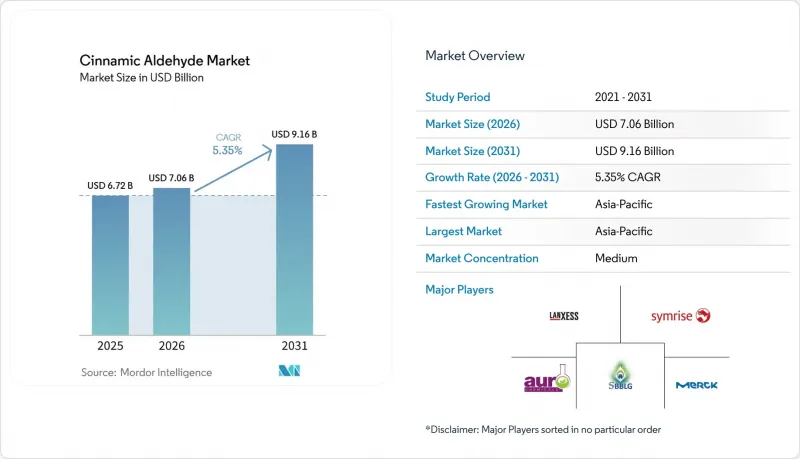
根據 Mordor Intelligence 預測,肉桂醛市場規模預計將在 2025 年達到 67.2 億美元,在 2026 年成長至 70.6 億美元,並在 2031 年達到 91.6 億美元,2026 年至 2031 年的複合年成長率為 5.35%。
本報告按等級(食品級 (FCC)、技術級、其他)、原料來源(合成、天然、生物衍生、發酵衍生)、應用(香料、調味配料等)、最終用途(食品飲料、個人護理及化妝品等)和地區(亞太、北美、歐洲、南美、中東和非洲)進行細分。市場預測以美元 (USD) 為單位。
全球肉桂醛市場趨勢及洞察
香料和芳香應用領域對肉桂醛的需求不斷成長。
由於反式肉桂醛在食品領域已有大量商業性用途,因此其在香料和香料領域的應用仍然是肉桂醛市場的主要需求驅動力。根據MDPI統計,食品領域的年消費量為18萬公斤,其中14.1萬公斤是作為香料添加的,而非源自肉桂香辛料。這種使用模式支撐了糖果甜點、烘焙、口香糖和飲料製造商的穩定訂單,這些製造商重視肉桂獨特的風味。此外,肉桂醛溫暖辛辣的香氣也廣泛用於個人護理和家居香氛產品,類似的感官特性也推動了香料的需求。這種橫跨食品和香料領域的特性,使得肉桂醛市場的需求基礎比那些依賴單一終端用途的原料更為廣泛。此外,即使某個領域的訂單放緩,其他領域的蓬勃發展也能抵消肉桂醛市場需求的下降。
消費者越來越偏好選擇天然和潔淨標示的原料。
隨著可追溯性的增強和原料體係向更簡化方向發展,市場對天然來源和天然同源肉桂醛的需求日益成長。朗盛生產的天然同源肉桂醛純度超過97%,除了擁有ISO 9001:2015、ISO 14001:2015和FSSC 22000認證外,還確保符合清真和猶太潔食標準。這些認證至關重要,因為食品、香料和機構管道的買家越來越需要同時滿足品質、安全和文件要求的供應商。此外,天然同源產品的供應解決了實際難題,因為它可以提供一致的感官特性,而不會直接受到樹皮提取差異的影響。這種天然來源和生產一致性之間的平衡使供應商更容易為特定客戶提供高價產品。因此,肉桂醛市場的需求正在轉向支援潔淨標示聲明且不影響供應連續性的認證等級產品。
天然肉桂原料的價格波動與供應限制
天然肉桂醛的供應取決於肉桂皮的供應量,而肉桂醛市場的部分佔有率又受到季節性收割週期和區域供應波動的影響。從肉桂皮中提取肉桂醛無法像合成路線那樣提供全年穩定的生產。如果肉桂皮供應減少,或者競爭對手搶佔了上游收成,依賴認證天然原料的生產商的利潤率就會面臨壓力。在高階香水和某些食品應用領域,這種壓力尤其顯著,因為這些領域對植物來源來源的要求非常高,而且替代品很難找到。此外,供應波動也使得買家難以在長期合約中確保穩定的原料成本。因此,當原料供應緊張時,天然肉桂醛和合成肉桂醛之間的價格差距就會擴大。
細分市場分析
到2025年,食品級肉桂醛(FCC)將佔肉桂醛市場佔有率的38.52%,成為以金額為準最高的等級。其主導地位源於其在糖果甜點、烘焙、口香糖和飲料等領域的成熟應用,在這些領域,穩定的風味輸出至關重要。此外,大規模食品製造企業的採購模式也有利於該等級的肉桂醛發展,因為這些企業優先考慮的是穩定的採購量和標準化的規格。食品飲料行業龐大的需求基礎確保了該等級肉桂醛將繼續保持主導地位,即使其他等級的肉桂醛不斷湧現。香水和化妝品級肉桂醛在高階香水和個人護理產品領域仍然十分重要,因為在這些領域,香精成分和配方特性的穩定性比單純的用量更為重要。
預計到2031年,藥用級(USP/EP)肉桂醛將以6.18%的複合年成長率成長,成為肉桂醛市場中成長最快的細分市場。這一成長與肉桂醛在原料藥合成、營養補充劑系統中的廣泛應用以及在代謝、抗菌和腫瘤學領域對肉桂醛衍生物的持續研究密切相關。朗盛公司符合肉桂醛行業該領域所需的品質標準,其天然等效產品擁有食品安全和品質認證,確保了合規採購。技術級肉桂醛在工業和家用應用中仍然十分重要,因為在這些應用中,成本競爭力比藥用級純度更為重要。然而,高階肉桂醛市場正朝著更嚴格的品管和更全面的文件記錄方向發展。
到2025年,合成肉桂醛將佔肉桂醛市場63.22%的佔有率,成為所有主要應用領域的主要來源。其主導地位源於其可靠的純度、對農業週期的低依賴性以及適合大規模食品和香料項目的成本結構。此外,這種生產方式使供應商能夠全年交付,這對需要連續生產的客戶至關重要。當天然原料供應不穩定時,這種穩定性更顯價值。天然肉桂醛在高階香料和某些食品應用領域仍保持一定的地位,其植物來源使其售價更高。
預計到2031年,生物基和發酵法製備的肉桂醛將以7.02%的複合年成長率成長,成為肉桂醛市場中成長最快的來源細分市場。發酵法的重要性日益凸顯,因為它既能增強供應的穩定性,又能在某些法規環境下鞏固其作為天然來源產品的地位。這有望使其在長期發展中扮演更清晰的角色,而不僅限於一種小眾的實驗性生產途徑。因此,肉桂醛產業正密切關注生物基供應格局,因為它有可能重塑目前與樹皮萃取的天然級肉桂醛相關的溢價結構。
區域分析
預計到2025年,亞太地區將佔肉桂醛市場規模的41.86%,2031年複合年成長率(CAGR)為6.08%。這將使該地區成為肉桂醛市場規模最大、成長最快的地區。該地區擁有大規模的消費群和強大的生產基地,支撐著國內需求和出口活動。中國繼續在該地區供應和加工中發揮核心作用,而印度、日本和韓國則推動了食品製造、個人護理和製藥行業的需求。這種區域結構使亞太地區能夠在肉桂醛市場的普通商品和高階產品領域都展現出其規模優勢。
北美仍然是食品級和香料級原料的主要消費市場,這得益於糖果甜點、烘焙產品、家居用品和個人護理行業的活躍發展。該地區受惠於日常消費品多個品類廣泛而穩定的需求。歐洲在高檔香水、香氛和受監管的個人護理應用領域仍佔有重要地位。然而,歐洲市場目前面臨更嚴格的合規要求。歐盟委員會第2023/1545號條例規定,殘留型產品中肉桂醛濃度達0.001%或以上,沖洗型產品中肉桂醛濃度達0.01%或以上,必須進行標籤標註,該條例將於2026年7月31日生效。這項要求增加了配方修訂和文件準備的工作量,尤其是對於向高級化妝品和香水行業客戶供應產品的供應商。
儘管南美洲市場規模相對小規模,但巴西和阿根廷的食品飲料應用正推動肉桂醛市場穩定成長。該地區的需求主要來自加工食品以及肉桂醛在個人保健產品和家居用品生產中的應用。中東和非洲作為食品調味劑、個人護理和香精應用領域合成級原料的進口市場也不斷成長。在中東部分地區,清真認證仍然是重要的採購因素,朗盛透過其認證產品系列直接滿足此要求。在上述兩個地區,需求成長主要受包裝食品和日常個人保健產品的消費增加所驅動,而非尖端研究。
其他好處:
- Excel格式的市場預測(ME)表
- 3個月的分析師支持
目錄
第1章:引言
- 研究假設和市場定義
- 調查範圍
第2章:調查方法
第3章執行摘要
第4章 市場狀況
- 市場概覽
- 市場促進因素
- 香料和空氣清新劑領域對肉桂醛的需求不斷成長。
- 消費者越來越偏好選擇天然和潔淨標示的原料。
- 在口腔護理、個人護理和化妝品配方中得到更廣泛的應用。
- 擴大多功能抗菌防腐成分的使用範圍
- 來自製藥和特種化學品行業的需求不斷成長
- 市場限制因素
- 價格波動以及難以取得天然肉桂原料。
- 對產品安全和過敏原標籤有嚴格的監管要求。
- 替代合成和天然芳香化合物的可用性
- 價值鏈分析
- 波特五力分析
第5章 市場規模與成長預測
- 按年級
- 食品級(FCC)
- 技術級
- 藥用級(USP/EP)
- 香水和化妝品級
- 來源
- 合成
- 天然來源
- 生物衍生和發酵衍生
- 透過使用
- 香料
- 香料原料
- 抗菌劑和防腐劑
- 醫藥中間體
- 化學中間體
- 其他用途
- 終端用戶產業
- 食品/飲料
- 個人護理化妝品
- 居家照護
- 口腔護理
- 藥品和醫療保健
- 產業
- 按地區
- 亞太地區
- 中國
- 印度
- 日本
- 韓國
- 其他亞太國家
- 北美洲
- 美國
- 加拿大
- 墨西哥
- 歐洲
- 德國
- 英國
- 法國
- 義大利
- 俄羅斯
- 其他歐洲國家
- 南美洲
- 巴西
- 阿根廷
- 其他南美國家
- 中東和非洲
- 沙烏地阿拉伯
- 南非
- 其他中東和非洲國家
- 亞太地區
第6章 競爭情勢
- 市場集中度
- 策略趨勢
- 市佔率和排名分析
- 公司簡介
- LANXESS
- Privi Speciality Chemicals Limited
- Aadhunik Industries
- Advanced Biotech
- AUROCHEMICALS
- Axxence Aromatic GmbH
- Hindustan Mint & Agro Products Pvt. Ltd.
- Kao Corporation
- Merck KGaA
- Robertet Group
- SBBLG
- Shandong Yaroma Perfumery Co., Ltd.
- Symrise
第7章 市場機會與未來展望
According to Mordor Intelligence, the cinnamic aldehyde market reached USD 6.72 billion in 2025, and is expected to grow from USD 7.06 billion in 2026 to USD 9.16 billion by 2031, and is expected to grow at a CAGR of 5.35% from 2026 to 2031.
This report is Segmented by Grade (Food (FCC), Technical Grade, and More), Source (Synthetic, Natural, Bio-Based and Fermentation-Derived), Application (Flavoring Agent, Fragrance Ingredient, and More), End-Use (Food & Beverage, Personal Care & Cosmetics, and More), and Geography (Asia-Pacific, North America, Europe, South America, Middle East and Africa). The Market Forecasts are Provided in Terms of Value (USD).
Global Cinnamic Aldehyde Market Trends and Insights
Rising Demand for Cinnamic Aldehyde in Flavor and Fragrance Applications
Flavor and fragrance applications remain the primary demand driver for the cinnamic aldehyde market, as trans-cinnamaldehyde already has meaningful commercial use in food systems. MDPI reported annual consumption of 180,000 kg in food applications, including 141,000 kg deliberately added as a flavoring agent rather than derived from cinnamon spice. This usage pattern supports steady orders from confectionery, bakery, chewing gum, and beverage manufacturers that rely on a recognizable cinnamon profile. The same sensory profile also drives fragrance demand, as warm and spicy notes remain widely used in personal care and household scent systems. This overlap between food and fragrance channels gives the cinnamic aldehyde market a broader demand base than ingredients that depend on a single end-use category. It also helps the cinnamic aldehyde market offset slower ordering in one channel when another remains active.
Growing Consumer Preference for Natural and Clean-Label Ingredients
The shift toward traceable and simpler ingredient systems is increasing interest in both natural and nature-identical materials in the cinnamic aldehyde market. LANXESS produces nature-identical cinnamic aldehyde with a minimum purity of 97% and supports it with ISO 9001:2015, ISO 14001:2015, and FSSC 22000 certifications, along with halal and kosher compliance. These certifications matter as buyers in food, fragrance, and institutional channels increasingly seek supply that meets quality, safety, and documentation requirements simultaneously. Nature-identical supply also addresses a practical issue by offering stable sensory performance without direct exposure to variability in bark extraction. This balance between natural positioning and production consistency helps suppliers defend premium pricing in selected accounts. As a result, demand in the cinnamic aldehyde market is shifting toward verified grades that support clean-label claims without compromising supply continuity.
Price Volatility and Limited Availability of Natural Cinnamon-Derived Feedstocks
Natural cinnamaldehyde supply depends on cinnamon bark availability, exposing part of the cinnamic aldehyde market to seasonal harvesting cycles and uneven regional supply. Bark extraction does not provide the same year-round production stability as synthetic routes. Producers that rely on certified natural raw materials face tighter margins when bark availability declines or competing buyers absorb more of the upstream crop. This pressure is stronger in premium fragrances and selected food applications, where botanical origin matters and substitution is less immediate. These supply swings also make it harder for buyers to secure stable input costs over longer contract periods. As a result, the cinnamic aldehyde market shows a wider cost gap between natural and synthetic grades when raw material conditions tighten.
Other drivers and restraints analyzed in the detailed report include:
- Increasing Adoption in Oral Care, Personal Care, and Cosmetic Formulations
- Expanding Use of Multifunctional Antimicrobial and Preservative Ingredients
- Stringent Regulatory Requirements for Product Safety and Allergen Labeling
For complete list of drivers and restraints, kindly check the Table Of Contents.
Segment Analysis
Food Grade (FCC) held a market share of 38.52% of the cinnamic aldehyde market size in 2025, making it the largest grade segment by value. Its leadership reflects its well-established use in confectionery, bakery, chewing gum, and beverage applications, where consistent flavor delivery remains critical. This grade also benefits from purchasing patterns that favor repeat volumes and standardized specifications across large food manufacturing programs. The scale of the food and beverage demand base keeps this segment ahead, even as other grades gain traction. Perfumery and cosmetic grade remains important in premium fragrance and personal care applications, where odor profile consistency and formulation behavior carry more weight than volume alone.
Pharmaceutical Grade (USP/EP) is projected to register a 6.18% CAGR through 2031, making it the fastest-growing grade segment in the cinnamic aldehyde market. This growth is tied to broader use in API synthesis, nutraceutical systems, and research programs that continue to explore cinnamaldehyde derivatives in metabolic, antimicrobial, and oncology contexts. LANXESS illustrates the quality standards required in this part of the cinnamic aldehyde industry, as its nature-identical offering carries food safety and quality certifications that support regulated procurement. Technical grade remains relevant in industrial and household applications, where cost competitiveness matters more than pharmaceutical purity. Even so, the cinnamic aldehyde market is moving toward tighter quality control and stronger documentation at the premium end.
Synthetic cinnamaldehyde accounted for 63.22% of the cinnamic aldehyde market size in 2025, making it the clear volume anchor across major applications. Its leadership stems from dependable purity, lower exposure to agricultural cycles, and a cost structure suited to large-scale food and fragrance programs. This production route also enables suppliers to offer year-round delivery, which is critical for buyers operating continuous manufacturing schedules. The value of this stability increases further when natural feedstock conditions become uncertain. Natural cinnamaldehyde continues to hold a position in premium fragrance applications and selected food uses, where botanical origin can support a higher selling price.
Bio-based and fermentation-derived cinnamaldehyde is projected to grow at a CAGR of 7.02% through 2031, making it the fastest-growing source segment in the cinnamic aldehyde market. Fermentation is important because it can strengthen supply resilience while supporting natural positioning in certain regulatory settings. This gives it a clearer long-term role beyond a niche experimental route. As a result, the cinnamic aldehyde industry is closely monitoring bio-based supply, as it could reshape the premium currently associated with bark-derived natural grades.
Complete Report Scope:
- By Grade
- Food Grade (FCC)
- Technical Grade
- Pharmaceutical Grade (USP/EP)
- Perfumery & Cosmetic Grade
- By Source
- Synthetic
- Natural
- Bio-Based and Fermentation-Derived
- By Application
- Flavoring Agent
- Fragrance Ingredient
- Antimicrobial & Preservative
- Pharmaceutical Intermediate
- Chemical Intermediate
- Other Applications
- End-use Industry
- Food & Beverage
- Personal Care & Cosmetics
- Household Care
- Oral Care
- Pharmaceuticals & Healthcare
- Industrial
- By Geography
- Asia-Pacific
- China
- India
- Japan
- South Korea
- Rest of Asia-Pacific
- North America
- United States
- Canada
- Mexico
- Europe
- Germany
- United Kingdom
- France
- Italy
- Russia
- Rest of Europe
- South America
- Brazil
- Argentina
- Rest of South America
- Middle-East and Africa
- Saudi Arabia
- South Africa
- Rest of Middle-East and Africa
- Asia-Pacific
Geography Analysis
Asia Pacific accounted for 41.86% of the cinnamic aldehyde market size in 2025 and registered a CAGR of 6.08% through 2031. This positions the region as both the largest and fastest-growing geography in the cinnamic aldehyde market. The region combines large consumption centers with a strong production base, supporting domestic use and export activity. China remains central to regional supply and processing, while India, Japan, and South Korea drive demand from food manufacturing, personal care, and pharmaceutical production. This regional mix gives Asia Pacific scale across both the commodity and premium segments of the market.
North America remains a major consumption center for food-grade and fragrance-grade material, supported by strong activity in confectionery, baked goods, household products, and personal care. The region benefits from broad and stable demand across several everyday consumer categories. Europe remains important for premium fragrance, perfumery, and regulated personal care applications. However, the European market now faces a tighter compliance burden, as Commission Regulation (EU) 2023/1545 requires the declaration of cinnamaldehyde above 0.001% in leave-on products and 0.01% in rinse-off products from July 31, 2026. This requirement is increasing reformulation and documentation work, especially for suppliers serving premium cosmetic and fragrance accounts.
South America remains a smaller market, but food and beverage applications in Brazil and Argentina are supporting steady expansion in the cinnamic aldehyde market. The region benefits from demand for processed foods and the use of cinnamic aldehyde in personal care and household product manufacturing. The Middle East and Africa are also growing import markets for synthetic-grade material used in food flavoring, personal care, and scent applications. Halal compliance remains a notable buying factor in parts of the Middle East, and LANXESS directly addresses this requirement through its certified product profile. Across both regions, demand growth is driven less by frontier research and more by rising consumption of packaged foods and routine personal care products.
- LANXESS
- Privi Speciality Chemicals Limited
- Aadhunik Industries
- Advanced Biotech
- AUROCHEMICALS
- Axxence Aromatic GmbH
- Hindustan Mint & Agro Products Pvt. Ltd.
- Kao Corporation
- Merck KGaA
- Robertet Group
- SBBLG
- Shandong Yaroma Perfumery Co., Ltd.
- Symrise
Additional Benefits:
- The market estimate (ME) sheet in Excel format
- 3 months of analyst support
TABLE OF CONTENTS
1 Introduction
- 1.1 Study Assumptions and Market Definition
- 1.2 Scope of the Study
2 Research Methodology
3 Executive Summary
4 Market Landscape
- 4.1 Market Overview
- 4.2 Market Drivers
- 4.2.1 Rising Demand for Cinnamic Aldehyde in Flavor and Fragrance Applications
- 4.2.2 Growing Consumer Preference for Natural and Clean-Label Ingredients
- 4.2.3 Increasing Adoption in Oral Care, Personal Care, and Cosmetic Formulations
- 4.2.4 Expanding Use of Multifunctional Antimicrobial and Preservative Ingredients
- 4.2.5 Rising Demand from Pharmaceutical and Specialty Chemical Industries
- 4.3 Market Restraints
- 4.3.1 Price Volatility and Limited Availability of Natural Cinnamon-Derived Feedstocks
- 4.3.2 Stringent Regulatory Requirements for Product Safety and Allergen Labeling
- 4.3.3 Availability of Alternative Synthetic and Natural Aroma Compounds
- 4.4 Value Chain Analysis
- 4.5 Porter's Five Forces Analysis
- 4.5.1 Threat of New Entrants
- 4.5.2 Bargaining Power of Suppliers
- 4.5.3 Bargaining Power of Buyers
- 4.5.4 Threat of Substitutes
- 4.5.5 Competitive Rivalry
5 Market Size and Growth Forecasts (Value)
- 5.1 By Grade
- 5.1.1 Food Grade (FCC)
- 5.1.2 Technical Grade
- 5.1.3 Pharmaceutical Grade (USP/EP)
- 5.1.4 Perfumery & Cosmetic Grade
- 5.2 By Source
- 5.2.1 Synthetic
- 5.2.2 Natural
- 5.2.3 Bio-Based and Fermentation-Derived
- 5.3 By Application
- 5.3.1 Flavoring Agent
- 5.3.2 Fragrance Ingredient
- 5.3.3 Antimicrobial & Preservative
- 5.3.4 Pharmaceutical Intermediate
- 5.3.5 Chemical Intermediate
- 5.3.6 Other Applications
- 5.4 End-use Industry
- 5.4.1 Food & Beverage
- 5.4.2 Personal Care & Cosmetics
- 5.4.3 Household Care
- 5.4.4 Oral Care
- 5.4.5 Pharmaceuticals & Healthcare
- 5.4.6 Industrial
- 5.5 By Geography
- 5.5.1 Asia-Pacific
- 5.5.1.1 China
- 5.5.1.2 India
- 5.5.1.3 Japan
- 5.5.1.4 South Korea
- 5.5.1.5 Rest of Asia-Pacific
- 5.5.2 North America
- 5.5.2.1 United States
- 5.5.2.2 Canada
- 5.5.2.3 Mexico
- 5.5.3 Europe
- 5.5.3.1 Germany
- 5.5.3.2 United Kingdom
- 5.5.3.3 France
- 5.5.3.4 Italy
- 5.5.3.5 Russia
- 5.5.3.6 Rest of Europe
- 5.5.4 South America
- 5.5.4.1 Brazil
- 5.5.4.2 Argentina
- 5.5.4.3 Rest of South America
- 5.5.5 Middle-East and Africa
- 5.5.5.1 Saudi Arabia
- 5.5.5.2 South Africa
- 5.5.5.3 Rest of Middle-East and Africa
- 5.5.1 Asia-Pacific
6 Competitive Landscape
- 6.1 Market Concentration
- 6.2 Strategic Moves
- 6.3 Market Share (%)/Ranking Analysis
- 6.4 Company Profiles (includes Global Overview, Market Overview, Core Segments, Financials as available, Strategic Information, Products and Services, and Recent Developments)
- 6.4.1 LANXESS
- 6.4.2 Privi Speciality Chemicals Limited
- 6.4.3 Aadhunik Industries
- 6.4.4 Advanced Biotech
- 6.4.5 AUROCHEMICALS
- 6.4.6 Axxence Aromatic GmbH
- 6.4.7 Hindustan Mint & Agro Products Pvt. Ltd.
- 6.4.8 Kao Corporation
- 6.4.9 Merck KGaA
- 6.4.10 Robertet Group
- 6.4.11 SBBLG
- 6.4.12 Shandong Yaroma Perfumery Co., Ltd.
- 6.4.13 Symrise
7 Market Opportunities and Future Outlook
- 7.1 White-Space and Unmet-Need Assessment

 丙烯醛溶液市場:全球市場預測,2026-2032年丙烯醛市場:全球市場預測,2026-2032年
 3-甲基丁醛市場規模、佔有率和成長分析:按等級、形態、應用、最終用戶和地區分類-2026-2033年產業預測
 紫蘇醛市場規模、佔有率和成長分析:按原料、等級、應用、最終用戶、分銷管道和地區分類-2026-2033年產業預測醛類市場:2026-2032年全球市場預測(依產品類型、衍生物、純度等級、應用及最終用途產業分類)
 全球異丁醛市場:市場規模、佔有率、趨勢和成長分析(2026-2034)丙烯醛全球市場規模、佔有率、趨勢和成長分析報告(2026-2034)
 2026年全球丁香醛市場報告異丁醛全球市場報告(2026)水楊醛市場按類型、純度等級、形態、應用和通路-2026-2032年全球預測