


 |
市場調查報告書
商品編碼
2117504
陶瓷:市場佔有率分析、產業趨勢與統計、成長預測(2026-2031)Ceramics - Market Share Analysis, Industry Trends & Statistics, Growth Forecasts (2026 - 2031) |
||||||

※ 本網頁內容可能與最新版本有所差異。詳細情況請與我們聯繫。
2025年陶瓷市場價值為2,376.6億美元,預計從2026年的2529.3億美元成長到2031年的3,448.3億美元,預測期(2026-2031年)複合年成長率預計為6.39%。
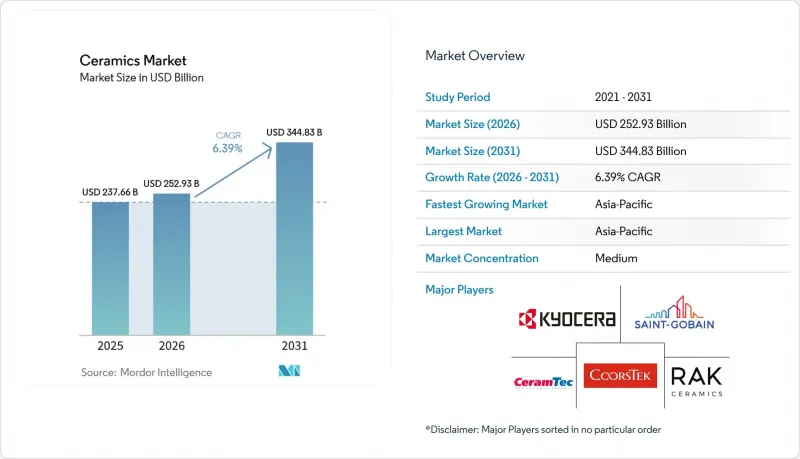
本報告按類型(傳統型和先進型)、應用(瓷磚、衛浴設備等)、終端用戶行業(建築、電氣電子等)以及地區(亞太、北美、歐洲、南美、中東和非洲)進行細分。市場預測以美元計價。
全球陶瓷市場趨勢及洞察
全球建設活動導致需求增加
在建築業,陶瓷市場與住宅、維修和公共基礎設施建設密切相關,其主要應用包括瓷磚、衛浴設備、磚塊和管道。這一趨勢在高成長經濟體中尤其顯著,因為城市建設計畫需要穩定的基礎建材和室內裝飾產品供應。當住宅、城市擴張和商業開發同步進行時,同一批項目可以同時帶動多個陶瓷產品類型的需求。數據顯示,印度對高階瓷磚的需求不斷成長,這表明這些地區的陶瓷市場不僅銷量增加,而且產品組合也正向高附加價值方向轉變。這種轉變支撐了銷售成長,即使低價產品面臨價格競爭,這也是陶瓷市場儘管新的應用領域受到策略關注,但仍紮根於建設業基本面的原因之一。
半導體和人工智慧基礎設施中先進陶瓷的廣泛應用
對半導體和人工智慧基礎設施的投資也在推動陶瓷市場的成長,因為製造、封裝和溫度控管系統都需要高純度陶瓷元件。 2026年4月,NGK絕緣體公司宣布投資700億日圓(約4.8億美元)新建一座工廠,以擴大其用於半導體製造設備的陶瓷產能。同年4月,京瓷推出了用於xPU和專用積體電路(ASIC)等先進人工智慧半導體封裝的多層陶瓷芯基板。這顯示陶瓷市場在資料中心硬體需求方面的滲透率正在不斷提高。這些趨勢表明,陶瓷市場不再局限於最終產品,而是在支援半導體生產的資本設備和基礎材料領域中發揮越來越重要的作用。隨著封裝架構要求的日益嚴格,產品複雜性不斷增加,這使得擁有豐富製程經驗和可控制造條件的供應商更具優勢。這提高了市場准入門檻,使陶瓷市場擁有比傳統建築業更強大的技術基礎。
陶瓷製造過程中的高能耗
高能耗的燒製和熱處理過程是陶瓷市場運作的一大限制。 2025年發表於《國際應用陶瓷技術雜誌》(International Journal of Applied Ceramic Technology)的一項研究表明,每平方公尺瓷磚的生產耗能32千瓦時,其中窯爐排放佔該行業總排放量的80%以上,全球變暖潛值(GWP)為每平方公尺14.4千克二氧化碳當量。這些數據意義重大,因為陶瓷市場仍然擁有大規模的傳統生產基地,燃料成本的波動會擠壓利潤空間並降低工廠運轉率。研究也指出,雖然電窯、氫氣燒製和餘熱回收等脫碳方案在技術上可行,但需要大量資本投入,這對小規模生產者而言難以資金籌措。陶瓷市場面臨成本挑戰,既包括燃料價格上漲,也包括降低長期燃料依賴所需的投資。這項限制因素在歐洲尤為突出,因為更嚴格的法規增加了高能耗工廠現代化改造的成本。
細分市場分析
2025年,傳統陶瓷的銷售額佔比達到62.15%,繼續保持其在陶瓷市場銷售額最大類別的地位。這一佔有率反映了其與瓷磚、磚塊、管道、衛浴設備和陶器等產品的緊密聯繫,這些產品仍然是建築應用中的主要陶瓷產品。這些產品分銷廣泛,依賴成熟的分銷系統,並受益於持續的更換和維修需求。此外,由於完善的物流系統、承包商的熟悉程度以及規範標準的統一,傳統陶瓷能夠輕鬆地在區域市場分銷。因此,即使在競爭激烈的價格市場中,傳統陶瓷仍然是陶瓷市場中最大的細分市場。因此,住宅、基礎設施和翻新活動的趨勢將繼續對總銷售額產生廣泛影響。
預計到2031年,高科技陶瓷的複合年成長率將達到7.83%。這一成長主要得益於其在電子、工業設備、醫療植入和能源系統等領域的功能性和結構性應用,在這些領域,純度、尺寸精度和性能比成本更為重要。 NGK於2026年4月擴大了半導體設備陶瓷的產能,而京瓷也開發了人工智慧構裝基板,這些都反映出製造商正在加大對更專業化產品的投入。村田製作所於2026年2月啟用的新型陶瓷電容器研發中心以及於2026年4月完工的新生產大樓,同樣體現了向高附加價值陶瓷系統發展的趨勢。因此,儘管傳統產品仍佔絕對銷售額的大部分,但陶瓷產業的價值創造正轉向先進材料。由此,陶瓷市場呈現雙重結構,既受結構需求驅動,也受技術性能要求驅動。
區域分析
到2025年,亞太地區將佔全球陶瓷銷售額的46.27%,成為全球最大的陶瓷市場區域。此外,預計到2031年,該地區將以7.26%的複合年成長率成長,成為陶瓷市場成長最快的區域板塊。亞太地區擁有全球最大的傳統陶瓷生產基地,而先進陶瓷供應商則集中在日本和韓國。儘管中國仍然是瓷磚生產中心,但日本和韓國在高附加價值電子陶瓷和精密陶瓷領域正做出越來越大的貢獻。這使得亞太地區在規模、成本競爭力、技術實力和終端市場深度方面都具備均衡優勢。
北美和歐洲是陶瓷市場較成熟的地區,其成長較少依賴新建住宅,更多受到翻新需求、工業應用、半導體相關材料和能源轉型設備等因素的驅動。在歐洲,修訂後的《工業排放指令》使得合規性和窯爐現代化成為陶瓷製造商更重要的競爭因素。這種政策環境有利於能夠為設備升級提供資金並維持穩定生產的大規模企業。北美則受益於穩定的翻新需求和先進製造業應用領域的堅實基礎。莫霍克工業公司(Mohawk Industries)公佈,2026年第一季淨銷售額達27億美元,年增8.0%,顯示該地區對地板材料的需求強勁。
儘管南美洲和中東及非洲的總銷售額相對較低,但由於其成長潛力和在區域多元化中的作用,這些地區對陶瓷市場仍然至關重要。在中東,大規模建設項目和酒店開發持續支撐著對陶瓷的需求,即便貿易路線持續受到干擾。 RAK Ceramics在2026年的報告中指出,區域情勢影響了出口流量,顯示中東及非洲(MEA)陶瓷市場受專案需求和物流風險的雙重驅動。南美市場仍然與住宅建設週期和資金籌措狀況密切相關,但這兩個地區對先進陶瓷的需求仍然主要依靠進口來滿足。
其他好處:
- Excel格式的市場預測(ME)表
- 3個月的分析師支持
目錄
第1章:引言
- 研究假設和市場定義
- 調查範圍
第2章:調查方法
第3章執行摘要
第4章 市場狀況
- 市場概覽
- 市場促進因素
- 住宅和非住宅建築對陶瓷材料的需求不斷成長。
- 先進陶瓷在高性能工業應用的廣泛應用
- 整體製造業對耐磨陶瓷替換零件的需求正在不斷成長。
- 都市化和住宅開發推動了對現代衛浴設備的需求不斷成長。
- 擴大新興國家的瓷磚生產能力
- 市場限制因素
- 陶瓷製造過程能耗高
- 氧化鋁、鋯石和高嶺土等原料價格波動
- 嚴格的環境和碳排放法規合規要求
- 價值鏈分析
- 波特五力分析
第5章 市場規模與成長預測
- 按類型
- 傳統的
- 高度
- 透過使用
- 瓦
- 衛浴設備
- 磚管
- 耐火材料
- 磨料
- 用於電氣和電子應用的陶瓷
- 陶瓷和餐具
- 其他用途
- 按最終用戶行業分類
- 建築/施工
- 電氣和電子設備
- 工業製造
- 醫療保健
- 能源公用事業
- 其他終端用戶產業
- 按地區
- 亞太地區
- 中國
- 印度
- 日本
- 韓國
- 其他亞太國家
- 北美洲
- 美國
- 加拿大
- 墨西哥
- 歐洲
- 德國
- 英國
- 法國
- 義大利
- 俄羅斯
- 其他歐洲國家
- 南美洲
- 巴西
- 阿根廷
- 其他南美國家
- 中東和非洲
- 沙烏地阿拉伯
- 南非
- 其他中東和非洲國家
- 亞太地區
第6章 競爭情勢
- 市場集中度
- 策略趨勢
- 市佔率和排名分析
- 公司簡介
- 3M
- AGC Ceramics Co., Ltd.
- CeramTec GmbH
- CoorsTek Inc.
- Du-Co Ceramics Company
- Imerys SA
- Kajaria Ceramics Limited
- KYOCERA Corporation
- LIXIL Corporation
- Materion Corporation
- McDanel Advanced Ceramic Technologies
- MOHAWK INDUSTRIES, INC.
- Morgan Advanced Materials plc
- Murata Manufacturing Co., Ltd.
- NGK Spark Plug Co., Ltd.
- RAK CERAMICS
- Rauschert GmbH
- Saint-Gobain
第7章 市場機會與未來展望
According to Mordor Intelligence, the ceramics market size was valued at USD 237.66 billion in 2025 and is estimated to grow from USD 252.93 billion in 2026 to reach USD 344.83 billion by 2031, at a CAGR of 6.39% during the forecast period (2026-2031).
This report is Segmented by Type (Traditional and Advanced), Application (Tiles, Sanitary Ware, and More), End-User Industry (Building & Construction, Electrical & Electronics, and More), and Geography (Asia-Pacific, North America, Europe, South America, and Middle-East and Africa). The Market Forecasts are Provided in Terms of Value (USD).
Global Ceramics Market Trends and Insights
Rising Demand from Global Construction Activity
In construction, the ceramics market is closely tied to housing completions, renovation work, and public infrastructure delivery, with key applications including tiles, sanitary ware, bricks, and pipes. This pattern is especially visible in high-growth economies where urban expansion requires a steady supply of basic building materials and interior finishing products. When housing programs, city expansion, and commercial development advance together, the same project pipeline can lift demand across several ceramic product categories simultaneously. Data indicates that premium tile formats have been gaining traction in India, suggesting that the ceramics market in these locations is not only selling more units but also a more valuable product mix. This shift supports revenue growth even when lower-end products face price competition, and helps explain why the ceramics market remains anchored in construction fundamentals, even as newer applications attract greater strategic attention.
Increasing Adoption of Advanced Ceramics in Semiconductor and AI Infrastructure
Semiconductor and AI infrastructure spending is also driving growth in the ceramics market, as high-purity ceramic parts are required for fabrication, packaging, and thermal management systems. NGK Insulators, Ltd. announced in April 2026 that it would invest JPY 70 billion (approximately USD 480 million) in a new facility to expand capacity for ceramics used in semiconductor manufacturing equipment. KYOCERA introduced a multilayer ceramic core substrate in April 2026 for advanced AI semiconductor packages used in xPUs and switch Application-Specific Integrated Circuits (ASICs), demonstrating how the ceramics market is moving deeper into data center hardware requirements. These developments indicate that the ceramics market is no longer tied solely to end products, as it is also becoming increasingly important for capital equipment and enabling materials that support semiconductor output. Product complexity is rising as package architecture becomes more demanding, which favors suppliers with extensive process experience and controlled manufacturing conditions. This raises entry barriers and gives the ceramics market a stronger technology layer than traditional construction categories typically offer.
High Energy Consumption in Ceramics Manufacturing
Energy-intensive firing and heat treatment processes present a clear operating constraint for the ceramics market. Research published in the International Journal of Applied Ceramic Technology in 2025 found that ceramic tile production consumed 32 kWh per square meter of output, with kilns responsible for more than 80% of sector emissions and a total global warming potential of 14.4 kg CO2e per square meter. These figures are significant because the ceramics market still has a large traditional manufacturing base where fuel cost fluctuations can pressure margins and reduce plant utilization. The research also notes that decarbonization options such as electrified kilns, hydrogen firing, and waste heat recovery are technically viable but require substantial capital investment that smaller producers may struggle to fund. The ceramics market faces a cost challenge from both fuel prices and the investment required to reduce fuel dependence over time. This restraint is particularly relevant in Europe, where regulatory tightening is increasing the cost of modernization for energy-intensive plants.
Other drivers and restraints analyzed in the detailed report include:
- Expansion of Ceramics in Renewable Energy and Electric Vehicles
- Growing Replacement Demand and Material Substitution
- Volatility in Raw Material Prices
For complete list of drivers and restraints, kindly check the Table Of Contents.
Segment Analysis
Traditional ceramics accounted for 62.15% of revenue in 2025, maintaining its position as the largest category in the ceramics market by revenue. This share reflects its strong ties to tiles, bricks, pipes, sanitary ware, and pottery, which remain the primary ceramic products used in construction applications. These products move in large volumes, rely on established distribution systems, and benefit from consistent replacement and renovation demand. Traditional ceramics are also easier to distribute across regional markets, as logistics, installer familiarity, and specification standards are already well established. This makes the traditional ceramics category the largest segment of the ceramics market, even where pricing is more competitive. Shifts in housing, infrastructure, and remodeling activity, therefore, continue to have a broad effect on total revenue.
Advanced ceramics are forecast to grow at a CAGR of 7.83% through 2031. Growth is supported by functional and structural applications in electronics, industrial equipment, medical implants, and energy systems, where purity, dimensional control, and performance are prioritized over cost. NGK's April 2026 capacity expansion for semiconductor equipment ceramics and KYOCERA's product development in AI package substrates reflect how producers are directing investment toward more specialized output. Murata's new Ceramic Capacitor R&D Center, opened in February 2026, and its new production building, completed in April 2026, point in the same direction toward higher-value ceramic systems. More value creation in the ceramics industry is therefore shifting toward advanced materials, even as traditional products continue to dominate absolute revenue. This gives the ceramics market a two-track structure, with one side driven by construction demand and the other by technical performance requirements.
Complete Report Scope:
- By Type
- Traditional
- Advanced
- By Application
- Tiles
- Sanitary Ware
- Bricks & Pipes
- Refractories
- Abrasives
- Electrical & Electronic Ceramics
- Pottery & Tableware
- Other Applications
- By End-User Industry
- Building & Construction
- Electrical & Electronics
- Industrial Manufacturing
- Healthcare & Medical
- Energy & Utilities
- Other End-Use Industries
- By Geography
- Asia-Pacific
- China
- India
- Japan
- South Korea
- Rest of Asia-Pacific
- North America
- United States
- Canada
- Mexico
- Europe
- Germany
- United Kingdom
- France
- Italy
- Russia
- Rest of Europe
- South America
- Brazil
- Argentina
- Rest of South America
- Middle-East and Africa
- Saudi Arabia
- South Africa
- Rest of Middle-East and Africa
- Asia-Pacific
Geography Analysis
Asia-Pacific accounted for 46.27% of global revenue in 2025, making it the largest region in the ceramics market. The region is also projected to expand at a 7.26% CAGR through 2031, making it the fastest-growing regional block in the ceramics market. Asia-Pacific combines the world's largest production base for traditional ceramics with a strong concentration of advanced ceramics suppliers in Japan and South Korea. China remains central to tile output, while Japan and South Korea contribute more strongly to higher-value electronics and precision ceramics. This gives Asia-Pacific a balance of scale, cost competitiveness, technical capability, and end-market depth.
North America and Europe represent more mature parts of the ceramics market, where growth is tied less to new housing construction and more to renovation demand, industrial applications, semiconductor-related materials, and energy transition equipment. In Europe, the revised Industrial Emissions Directive has made compliance and kiln modernization a more visible competitive factor for ceramic manufacturers. This policy environment favors larger operators that can fund upgrades while maintaining stable output. North America benefits from steady remodeling activity and a meaningful base of advanced manufacturing applications. Mohawk Industries reported Q1 2026 net sales of USD 2.7 billion, up 8.0% year over year, indicating resilient flooring demand in the region.
South America, the Middle East, and Africa generate lower total revenue but remain important to the ceramics market due to their growth potential and role in regional diversification. In the Middle East, large construction programs and hospitality development continue to support ceramic demand, even amid disruptions to trade routes. RAK Ceramics reported in 2026 that regional conditions affected export flows, illustrating how the ceramics market in the Middle East and Africa (MEA) is shaped by both project demand and logistics risk. South America remains more closely linked to residential construction cycles and financing conditions, while advanced ceramics demand in both regions is still served largely through imports.
- 3M
- AGC Ceramics Co., Ltd.
- CeramTec GmbH
- CoorsTek Inc.
- Du-Co Ceramics Company
- Imerys S.A.
- Kajaria Ceramics Limited
- KYOCERA Corporation
- LIXIL Corporation
- Materion Corporation
- McDanel Advanced Ceramic Technologies
- MOHAWK INDUSTRIES, INC.
- Morgan Advanced Materials plc
- Murata Manufacturing Co., Ltd.
- NGK Spark Plug Co., Ltd.
- RAK CERAMICS
- Rauschert GmbH
- Saint-Gobain
Additional Benefits:
- The market estimate (ME) sheet in Excel format
- 3 months of analyst support
TABLE OF CONTENTS
1 Introduction
- 1.1 Study Assumptions and Market Definition
- 1.2 Scope of the Study
2 Research Methodology
3 Executive Summary
4 Market Landscape
- 4.1 Market Overview
- 4.2 Market Drivers
- 4.2.1 Rising Demand for Ceramic Materials in Residential and Non-Residential Construction
- 4.2.2 Increasing Adoption of Advanced Ceramics in High-Performance Industrial Applications
- 4.2.3 Growing Replacement Demand for Wear-Resistant Ceramic Components Across Manufacturing Industries
- 4.2.4 Rising Demand for Modern Sanitary Ware Driven by Urbanization and Housing Development
- 4.2.5 Expansion of Ceramic Tile Manufacturing Capacity in Emerging Economies
- 4.3 Market Restraints
- 4.3.1 High Energy Consumption Associated with Ceramic Manufacturing Processes
- 4.3.2 Volatility in Raw Material Prices, Including Alumina, Zircon, and Kaolin
- 4.3.3 Stringent Environmental Regulations and Carbon Emission Compliance Requirements
- 4.4 Value Chain Analysis
- 4.5 Porter's Five Forces Analysis
- 4.5.1 Threat of New Entrants
- 4.5.2 Bargaining Power of Suppliers
- 4.5.3 Bargaining Power of Buyers
- 4.5.4 Threat of Substitutes
- 4.5.5 Competitive Rivalry
5 Market Size and Growth Forecasts (Value)
- 5.1 By Type
- 5.1.1 Traditional
- 5.1.2 Advanced
- 5.2 By Application
- 5.2.1 Tiles
- 5.2.2 Sanitary Ware
- 5.2.3 Bricks & Pipes
- 5.2.4 Refractories
- 5.2.5 Abrasives
- 5.2.6 Electrical & Electronic Ceramics
- 5.2.7 Pottery & Tableware
- 5.2.8 Other Applications
- 5.3 By End-User Industry
- 5.3.1 Building & Construction
- 5.3.2 Electrical & Electronics
- 5.3.3 Industrial Manufacturing
- 5.3.4 Healthcare & Medical
- 5.3.5 Energy & Utilities
- 5.3.6 Other End-Use Industries
- 5.4 By Geography
- 5.4.1 Asia-Pacific
- 5.4.1.1 China
- 5.4.1.2 India
- 5.4.1.3 Japan
- 5.4.1.4 South Korea
- 5.4.1.5 Rest of Asia-Pacific
- 5.4.2 North America
- 5.4.2.1 United States
- 5.4.2.2 Canada
- 5.4.2.3 Mexico
- 5.4.3 Europe
- 5.4.3.1 Germany
- 5.4.3.2 United Kingdom
- 5.4.3.3 France
- 5.4.3.4 Italy
- 5.4.3.5 Russia
- 5.4.3.6 Rest of Europe
- 5.4.4 South America
- 5.4.4.1 Brazil
- 5.4.4.2 Argentina
- 5.4.4.3 Rest of South America
- 5.4.5 Middle-East and Africa
- 5.4.5.1 Saudi Arabia
- 5.4.5.2 South Africa
- 5.4.5.3 Rest of Middle-East and Africa
- 5.4.1 Asia-Pacific
6 Competitive Landscape
- 6.1 Market Concentration
- 6.2 Strategic Moves
- 6.3 Market Share (%)/Ranking Analysis
- 6.4 Company Profiles (includes Global Overview, Market Overview, Core Segments, Financials as available, Strategic Information, Products and Services, and Recent Developments)
- 6.4.1 3M
- 6.4.2 AGC Ceramics Co., Ltd.
- 6.4.3 CeramTec GmbH
- 6.4.4 CoorsTek Inc.
- 6.4.5 Du-Co Ceramics Company
- 6.4.6 Imerys S.A.
- 6.4.7 Kajaria Ceramics Limited
- 6.4.8 KYOCERA Corporation
- 6.4.9 LIXIL Corporation
- 6.4.10 Materion Corporation
- 6.4.11 McDanel Advanced Ceramic Technologies
- 6.4.12 MOHAWK INDUSTRIES, INC.
- 6.4.13 Morgan Advanced Materials plc
- 6.4.14 Murata Manufacturing Co., Ltd.
- 6.4.15 NGK Spark Plug Co., Ltd.
- 6.4.16 RAK CERAMICS
- 6.4.17 Rauschert GmbH
- 6.4.18 Saint-Gobain
7 Market Opportunities and Future Outlook
- 7.1 White-Space and Unmet-Need Assessment

 半導體陶瓷市場規模、佔有率和趨勢分析報告:按最終用途、材料、地區和細分市場預測(2026-2033 年)
 超高溫陶瓷(UHTC)市場預測至2034年-全球材料類型、技術、形狀、製造流程、應用、最終用戶和地區分析
 堇青石市場規模、佔有率和成長分析:按類型、產品類型、應用、最終用戶產業、等級、分銷管道和地區分類-2026-2033年產業預測
 2026年全球整體式耐火材料市場報告
 陶瓷市場:2026-2032年全球市場預測(依產品類型、原料、產品形態、製造流程、表面處理、銷售管道及最終用途產業分類)陶瓷市場預測至2034年-全球分析(按類型、材料、產品類型、先進陶瓷材料、製造流程、應用、分銷管道和地區分類)
 2026-2030年全球陶瓷和天然石瓷磚市場
 HTCC封裝與管殼市場報告:趨勢、預測與競爭分析(至2035年)
 單片陶瓷:市佔率分析、產業趨勢與統計、成長預測(2026-2031)
 陶瓷市場報告:按產品、應用、最終用途和地區分類(2026-2034 年)