


 |
市場調查報告書
商品編碼
2117497
碳酸二甲酯:市場佔有率分析、產業趨勢與統計、成長預測(2026-2031)Dimethyl Carbonate - Market Share Analysis, Industry Trends & Statistics, Growth Forecasts (2026 - 2031) |
||||||

※ 本網頁內容可能與最新版本有所差異。詳細情況請與我們聯繫。
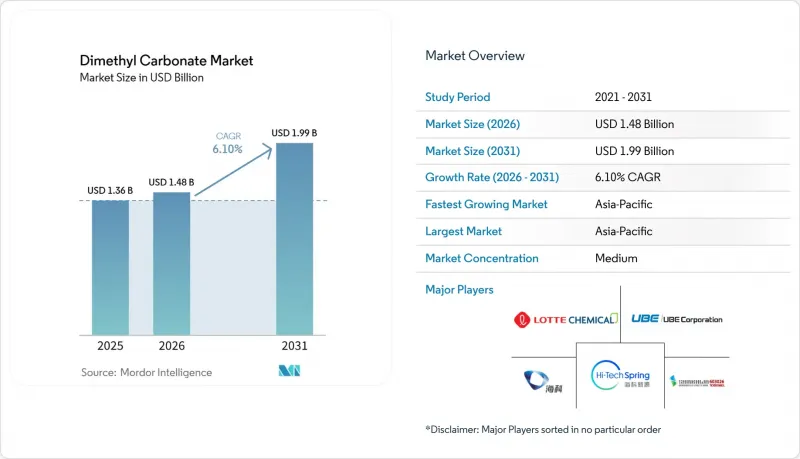
根據 Mordor Intelligence 預測,碳酸二甲酯市場規模將從 2025 年的 13.6 億美元和 2026 年的 14.8 億美元成長到 2031 年的 19.9 億美元,2026 年至 2031 年的複合年成長率為 6.10%。
本報告按產品等級(例如,工業用碳酸二甲酯、藥用碳酸二甲酯)、應用領域(例如,溶劑、試劑)、終端用戶產業(例如,塑膠產業、製藥業)和地區(亞太地區、北美地區、歐洲地區、南美地區、中東和非洲地區)進行細分。市場預測以美元計價。
全球碳酸二甲酯市場趨勢及洞察
電池電解中對高純度碳酸二甲酯的需求增加。
由於電池用碳酸二甲酯的純度要求超過99.99%,其市場價格遠高於工業級原料。這種價格差異在碳酸二甲酯市場意義重大,因為銷售成長不僅取決於銷售量增加,還取決於產品組合的最佳化。 2024年,全球電動車和儲能應用電池需求量達到1太瓦時(TWh),其中電動車電池需求量超過950吉瓦時(GWh),較2023年成長25%。預計到2030年,電池需求量將超過3太瓦時,為溶劑採購提供了強勁的長期前景。在歐洲,化學成分仍然是關鍵考慮因素,因為磷酸鋰鐵(LFP)電池單位使用的碳酸二甲酯量低於NMC電池,這意味著產能的提升並不會轉化為溶劑需求的比例成長。因此,能夠獲得長期電池供應合約並可靠地滿足純度要求、物流管理和污染風險標準的供應商將在碳酸二甲酯市場中佔據優勢。
擴大在聚碳酸酯合成中的應用:作為光氣製造方法的替代方案。
碳酸二甲酯是聚碳酸酯生產中無光氣製程的基礎原料,並在化學品處理標準日益嚴格的領域中發揮至關重要的作用。在碳酸二甲酯市場,即使電池應用領域基於價值的成長加速,工業級產品的需求仍保持穩定。一項2025年的初步試驗表明,二氧化碳製碳酸二甲酯(DMC)並隨後製取碳酸二苯酯的工藝,在連續運行150小時後,DMC總收率達到85.9%,並生產出與傳統材料質量相當的聚合物級聚碳酸酯。中國、韓國和日本仍然是最大的聚碳酸酯生產中心,維持著該應用領域區域需求的強勁下限。由於工業級和高純度產品均可採用相同的上游製程生產,生產商可根據下游市場的變化靈活調整其精煉策略。碳酸二甲酯市場正受益於這種雙軌模式,使供應商能夠平衡成熟塑膠的需求和電池相關領域的快速成長。
對甲醇和二氧化碳原料價格的高度依賴
甲醇和二氧化碳是碳酸二甲酯市場主要合成路線的關鍵原料,其生產經濟效益與能源週期和採購條件密切相關,而供應商無法完全控制這些因素。 2026年第一季,甲醇成本上漲了35%至40%,同期亞洲碳酸二甲酯現貨價格上漲了25%至30%。成本上漲導致部分大宗商品買家在2026年第三季之前採取了更為謹慎的採購策略。此外,碳酸二甲酯市場也面臨二氧化碳採購風險,因為注重環保的生產路線依賴附近的工業排放,相關產業的波動可能會影響原定的生產計畫。
細分市場分析
到2025年,工業級碳酸二甲酯將佔據47.22%的市場佔有率,這反映了其在聚碳酸酯合成和塗料生產領域成熟的應用。由於許多下游用戶需要大量可靠的基礎供應,工業級碳酸二甲酯在無光氣羰基化反應中的作用確保了其穩定的需求。市場對工業級碳酸二甲酯的規模需求持續成長,這一趨勢在亞洲尤為顯著,因為亞洲的塑膠加工和工程材料生產仍然十分發達。預計到2031年,電池級碳酸二甲酯的複合年成長率將達到7.91%,成為本研究中成長最快的產品等級。這一成長主要得益於電動車和能源儲存系統的日益普及,這兩者都增加了對電解溶劑的需求。
由於產量相對較低、純度要求超過99.995%以及更嚴格的合規要求,醫藥級碳酸二甲酯的售價最高。這種受監管的供應模式形成了一個專業化的細分市場,可靠的生產商數量較少,利潤率保障也更強。燃料添加劑級碳酸二甲酯受益於多個司法管轄區對甲基叔丁基醚(MTBE)的監管,這鞏固了其在產品系列中的地位,但MTBE並非其需求的主要促進因素。因此,碳酸二甲酯市場被細分為不同的價值池:工業級佔據了大部分銷售量,電池級是成長的主要驅動力,而醫藥級則支撐著高價。這種細分對生產商的策略至關重要,因為相同的上游工程化學反應可以生產多種等級的產品,而下游精煉則決定了最終價格。
區域分析
預計到2025年,亞太地區將佔據碳酸二甲酯市場59.37%的佔有率,並在2031年之前以6.92%的複合年成長率成長,成為規模最大且成長最快的區域市場。這一區域地位主要得益於中國,中國擁有大規模的化學品生產、強大的電池製造能力以及龐大的下游塑膠需求。到2025年,中國的碳酸二甲酯年產能將超過4.055億噸,其中52%將用於Delta地區的電池級消費。此外,華東地區佔下游聚碳酸酯客戶總數的72%,支撐著區域需求並有助於降低物流成本。 2024年,中國新能源汽車銷量突破1,000萬輛,顯示對電解二甲酯做出了貢獻,其中宇部興產株式會社(UBE Corporation)採用氣相亞硝酸鹽製程來滿足高階電池應用的需求。
在北美,電池供應鏈正從依賴進口轉向國內生產。先前,由於碳酸二甲酯 (DMC) 和碳酸乙基甲酯完全依賴進口進入美國,電池供應鏈面臨外部採購風險。宇部興產 (UBE) 正在路易斯安那州投資 7 億美元建造一座工廠,目標是年產 10 萬噸 DMC,預計將於 2027 會計年度第一季投產。日本國際協力銀行 (JBIC) 已確認將透過宇部興產的美國子公司為該專案提供融資支持,凸顯了國內電池溶劑供應的戰略重要性。
歐洲仍是藥品、塗料和特殊化學品的重要需求中心,而非電池電解的大量需求中心。歐洲碳酸二甲酯市場受《化學品註冊、評估、授權和限制法規》(REACH) 的監管,該法規正在加強對該地區供應商的註冊和可追溯性要求。預計到2025年,磷酸鋰鐵(LFP)電池將佔歐洲電動車(EV)電池需求的10%以上,與主要由鎳錳鈷(NMC)組成的化學成分相比,每千瓦時碳酸二甲酯的使用量將會下降。南美洲、中東和非洲仍是新興市場,但預計巴西、阿根廷和沙烏地阿拉伯將透過對石化和特種化學品領域的投資活動來成長。
其他好處:
- Excel格式的市場預測(ME)表
- 3個月的分析師支持
目錄
第1章:引言
- 研究假設和市場定義
- 調查範圍
第2章:調查方法
第3章執行摘要
第4章 市場狀況
- 市場概覽
- 市場促進因素
- 對高純度電池電解溶劑的需求不斷成長
- 聚碳酸酯合成領域的應用不斷拓展
- 改用更安全、毒性更小的試劑和溶劑。
- 醫藥和特用化學品製劑市場的成長
- 擴大鋰離子電池產能
- 市場限制因素
- 對原物料和工藝經濟性的高度依賴
- 電池級材料處理和提煉方面的限制
- 替代碳酸酯溶劑和替代品的競爭
- 價值鏈分析
- 監理情勢
- 波特五力分析
第5章 市場規模與成長預測
- 按產品等級
- 工業級碳酸二甲酯
- 藥用級碳酸二甲酯
- 電池級碳酸二甲酯
- 燃料添加劑級碳酸二甲酯
- 透過使用
- 聚碳酸酯合成
- 電池電解
- 溶劑
- 試劑
- 燃油添加劑
- 其他用途
- 按最終用途行業分類
- 塑膠產業
- 油漆和塗料行業
- 製藥業
- 電池產業
- 農業化學工業
- 黏合劑和密封劑行業
- 電子產業
- 按地區
- 亞太地區
- 中國
- 印度
- 日本
- 韓國
- 其他亞太國家
- 北美洲
- 美國
- 加拿大
- 墨西哥
- 歐洲
- 德國
- 英國
- 法國
- 義大利
- 俄羅斯
- 其他歐洲國家
- 南美洲
- 巴西
- 阿根廷
- 其他南美國家
- 中東和非洲
- 沙烏地阿拉伯
- 南非
- 其他中東和非洲國家
- 亞太地區
第6章 競爭情勢
- 市場集中度
- 策略趨勢
- 市佔率和排名分析
- 公司簡介
- Dongying Hi-tech Spring Chemical Industry Co., Ltd.
- Hebei New Chaoyang Chemical Stock Co., Ltd.
- Kishida Chemical Co. Ltd.
- Kowa Company, Ltd.
- Liaoning Oxiranchem, Inc.
- Lotte Chemical Corporation
- Merck KGaA
- Shandong Haike Chemical Group Co., Ltd.
- Shanghai Jinshan Jingwei Chemical Co., Ltd.
- Shinghwa Advanced Material Group Co.,Ltd.
- Tokyo Chemical Industry Co., Ltd.
- UBE Corporation
- Zhejiang Yuanli Chemical Co., Ltd.
第7章 市場機會與未來展望
According to Mordor Intelligence, the dimethyl carbonate market size is projected to expand from USD 1.36 billion in 2025 and USD 1.48 billion in 2026 to USD 1.99 billion by 2031, and is expected to register a CAGR of 6.10% between 2026 to 2031.
This report is Segmented by Product Grade (Industrial Grade Dimethyl Carbonate, Pharmaceutical Grade Dimethyl Carbonate and More), Application (Solvents, Reagents, and More), End-Use Industry (Plastics Industry, Pharmaceutical Industry, and More), and Geography (Asia-Pacific, North America, Europe, South America, and Middle-East and Africa). The Market Forecasts are Provided in Terms of Value (USD).
Global Dimethyl Carbonate Market Trends and Insights
Rising Demand for High-Purity Dimethyl Carbonate in Battery Electrolytes
Battery-grade dimethyl carbonate requires purity of 99.99% or above, which keeps its realized pricing well above industrial-grade material. In the dimethyl carbonate market, this premium is significant because revenue growth is being driven by product mix improvement, not only by higher volumes. Global battery demand for EV and storage applications reached 1 TWh in 2024, with EV batteries accounting for more than 950 GWh, up 25% from 2023. Battery demand is projected to exceed 3 TWh by 2030, supporting a firm long-term outlook for solvent procurement. In Europe, chemistry mix remains an important consideration because Lithium Iron Phosphate (LFP) batteries use less dimethyl carbonate per unit than NMC cells, meaning rising capacity does not translate into a proportional increase in solvent demand. The dimethyl carbonate market therefore favors suppliers that secure long-term battery contracts and can consistently meet purity requirements, logistics control, and contamination risk standards.
Expanding Use in Polycarbonate Synthesis Replacing Phosgene-Based Routes
Dimethyl carbonate supports a non-phosgene route to polycarbonate production, making it relevant where chemical handling standards are tightening. In the dimethyl carbonate market, this application keeps industrial-grade demand stable even as battery applications grow faster in value terms. A 2025 pilot study validated a continuous CO2-to-dimethyl carbonate (DMC)-to-diphenyl carbonate process over a 150-hour run, achieving an 85.9% overall DMC yield and polymer-grade polycarbonate quality comparable to conventional material. China, South Korea, and Japan remain the largest polycarbonate production base, maintaining a strong regional demand floor for this application. The same upstream process can support both industrial and high-purity output, giving producers flexibility to adjust purification focus as downstream conditions change. The dimethyl carbonate market benefits from this dual-track model as it allows suppliers to balance mature plastics demand with faster battery-related growth.
High Dependence on Methanol and CO2 Feedstock Prices
Methanol and CO2 are the primary feedstocks in the main synthesis routes used across the dimethyl carbonate market, making production economics closely tied to energy cycles and procurement conditions that suppliers cannot fully control. Methanol costs rose 35% to 40% in the first quarter of 2026, and dimethyl carbonate spot prices in Asia increased by 25% to 30% during the same period. This cost increase pushed some commodity buyers toward a more cautious procurement stance through the third quarter of 2026. The dimethyl carbonate market also faces CO2 sourcing risk, as green production routes rely on nearby industrial flue gas streams, and disruptions in adjacent sectors can interrupt planned output.
Other drivers and restraints analyzed in the detailed report include:
- Shift Toward Safer, Low-Toxicity Solvents Across Industries
- Growth in pharmaceutical manufacturing and green Active Pharmaceutical Ingredient (API) synthesis
- Handling and Purification Challenges for High-Purity Grades
For complete list of drivers and restraints, kindly check the Table Of Contents.
Segment Analysis
Industrial grade held 47.22% of the dimethyl carbonate market in 2025, reflecting its established use in polycarbonate synthesis and coatings production. Its role in phosgene-free carbonylation keeps demand steady, as many downstream users require large, reliable base volumes. The market continues to depend on this grade for scale, particularly in Asia where plastics processing and engineering materials production remain well established. Battery grade is projected to grow at a 7.91% CAGR through 2031, making it the fastest-growing product grade in the study. This growth is driven by the expansion of electric vehicles and rising energy storage deployment, both of which are increasing demand for electrolyte solvents.
Pharmaceutical grade remains smaller in volume but commands the highest selling price, as purity must exceed 99.995% and compliance requirements are more stringent. This makes regulated supply a specialized niche with fewer credible producers and stronger margin protection. Fuel additive grade benefits from restrictions on methyl tert-butyl ether (MTBE) in several jurisdictions, which supports its place in the product portfolio, although it is not the primary demand driver. The dimethyl carbonate market is therefore divided across distinct value pools: industrial grade carries the bulk of volume, battery grade drives growth, and pharmaceutical grade supports premium pricing. This division is central to producer strategy, as the same upstream chemistry can supply multiple grades, while downstream purification determines final pricing power.
Complete Report Scope:
- By Product Grade
- Industrial Grade Dimethyl Carbonate
- Pharmaceutical Grade Dimethyl Carbonate
- Battery Grade Dimethyl Carbonate
- Fuel Additive Grade Dimethyl Carbonate
- By Application
- Polycarbonate Synthesis
- Battery Electrolyte
- Solvents
- Reagents
- Fuel Additives
- Other Applications
- By End-Use Industry
- Plastics Industry
- Paints and Coatings Industry
- Pharmaceutical Industry
- Battery Industry
- Agrochemicals Industry
- Adhesives and Sealants Industry
- Electronics Industry
- By Geography
- Asia-Pacific
- China
- India
- Japan
- South Korea
- Rest of Asia-Pacific
- North America
- United States
- Canada
- Mexico
- Europe
- Germany
- United Kingdom
- France
- Italy
- Russia
- Rest of Europe
- South America
- Brazil
- Argentina
- Rest of South America
- Middle-East and Africa
- Saudi Arabia
- South Africa
- Rest of Middle-East and Africa
- Asia-Pacific
Geography Analysis
Asia-Pacific held 59.37% of the dimethyl carbonate market share in 2025 and is expected to grow at a CAGR of 6.92% through 2031, making it both the largest and fastest-growing regional market. The region's position is driven by China, which combines large-scale chemical production, strong battery manufacturing, and significant downstream demand for plastics. China's dimethyl carbonate capacity exceeded 405.5 million tons per year in 2025, with the Pearl River Delta accounting for 52% of the country's battery-grade consumption. Eastern China accounted for 72% of downstream polycarbonate customers, supporting local demand and reducing logistics costs. China's new energy vehicle sales surpassed 10 million units in 2024, sustaining strong structural demand for electrolyte solvents. Japan and South Korea contribute through premium-quality supply, with UBE Corporation utilizing its gas-phase nitrite process to serve higher-end battery applications.
North America has been shifting away from reliance on imports toward domestic production. Previously, dimethyl carbonate (DMC) and ethyl methyl carbonate were fully imported into the United States, exposing battery supply chains to external sourcing risks. UBE Corporation has committed USD 700 million to a Louisiana facility targeting 100,000 tons per year of DMC, with operations scheduled for the first quarter of fiscal year 2027. The Japan Bank for International Cooperation (JBIC) confirmed financing support for this project through UBE's U.S. subsidiary, reinforcing the strategic importance of domestic battery solvent supply.
Europe remains a significant demand center for pharmaceuticals, coatings, and specialty chemicals, rather than for large volumes of battery electrolytes. The dimethyl carbonate market in Europe is shaped by Registration, Evaluation, Authorisation and Restriction of Chemicals (REACH) compliance, which increases registration and traceability requirements for suppliers serving the region. Lithium iron phosphate (LFP) batteries exceeded 10% of European electric vehicle (EV) battery demand in 2025, reducing dimethyl carbonate intensity per kilowatt-hour compared with nickel manganese cobalt (NMC)-heavy chemistries. South America and the Middle East and Africa remain early-stage markets, though Brazil, Argentina, and Saudi Arabia show potential through petrochemical and specialty chemical investment activity.
- Dongying Hi-tech Spring Chemical Industry Co., Ltd.
- Hebei New Chaoyang Chemical Stock Co., Ltd.
- Kishida Chemical Co. Ltd.
- Kowa Company, Ltd.
- Liaoning Oxiranchem, Inc.
- Lotte Chemical Corporation
- Merck KGaA
- Shandong Haike Chemical Group Co., Ltd.
- Shanghai Jinshan Jingwei Chemical Co., Ltd.
- Shinghwa Advanced Material Group Co.,Ltd.
- Tokyo Chemical Industry Co., Ltd.
- UBE Corporation
- Zhejiang Yuanli Chemical Co., Ltd.
Additional Benefits:
- The market estimate (ME) sheet in Excel format
- 3 months of analyst support
TABLE OF CONTENTS
1 Introduction
- 1.1 Study Assumptions and Market Definition
- 1.2 Scope of the Study
2 Research Methodology
3 Executive Summary
4 Market Landscape
- 4.1 Market Overview
- 4.2 Market Drivers
- 4.2.1 Rising Demand for High-Purity Battery Electrolyte Solvents
- 4.2.2 Expanding Use in Polycarbonate Synthesis
- 4.2.3 Shift Toward Safer, Low-Toxicity Reagents and Solvents
- 4.2.4 Growth in Pharmaceutical and Specialty Chemical Formulations
- 4.2.5 Expansion of Lithium-Ion Battery Manufacturing Capacity
- 4.3 Market Restraints
- 4.3.1 High Dependence on Feedstock and Process Economics
- 4.3.2 Handling and Purification Constraints for Battery Grade Material
- 4.3.3 Competition From Alternative Carbonate Solvents and Substitutes
- 4.4 Value Chain Analysis
- 4.5 Regulatory Landscape
- 4.6 Porter's Five Forces Analysis
- 4.6.1 Bargaining Power of Suppliers
- 4.6.2 Bargaining Power of Buyers
- 4.6.3 Threat of New Entrants
- 4.6.4 Threat of Substitutes
- 4.6.5 Intensity of Competitive Rivalry
5 Market Size and Growth Forecasts (Value)
- 5.1 By Product Grade
- 5.1.1 Industrial Grade Dimethyl Carbonate
- 5.1.2 Pharmaceutical Grade Dimethyl Carbonate
- 5.1.3 Battery Grade Dimethyl Carbonate
- 5.1.4 Fuel Additive Grade Dimethyl Carbonate
- 5.2 By Application
- 5.2.1 Polycarbonate Synthesis
- 5.2.2 Battery Electrolyte
- 5.2.3 Solvents
- 5.2.4 Reagents
- 5.2.5 Fuel Additives
- 5.2.6 Other Applications
- 5.3 By End-Use Industry
- 5.3.1 Plastics Industry
- 5.3.2 Paints and Coatings Industry
- 5.3.3 Pharmaceutical Industry
- 5.3.4 Battery Industry
- 5.3.5 Agrochemicals Industry
- 5.3.6 Adhesives and Sealants Industry
- 5.3.7 Electronics Industry
- 5.4 By Geography
- 5.4.1 Asia-Pacific
- 5.4.1.1 China
- 5.4.1.2 India
- 5.4.1.3 Japan
- 5.4.1.4 South Korea
- 5.4.1.5 Rest of Asia-Pacific
- 5.4.2 North America
- 5.4.2.1 United States
- 5.4.2.2 Canada
- 5.4.2.3 Mexico
- 5.4.3 Europe
- 5.4.3.1 Germany
- 5.4.3.2 United Kingdom
- 5.4.3.3 France
- 5.4.3.4 Italy
- 5.4.3.5 Russia
- 5.4.3.6 Rest of Europe
- 5.4.4 South America
- 5.4.4.1 Brazil
- 5.4.4.2 Argentina
- 5.4.4.3 Rest of South America
- 5.4.5 Middle-East and Africa
- 5.4.5.1 Saudi Arabia
- 5.4.5.2 South Africa
- 5.4.5.3 Rest of Middle-East and Africa
- 5.4.1 Asia-Pacific
6 COMPETITIVE LANDSCAPE
- 6.1 Market Concentration
- 6.2 Strategic Moves
- 6.3 Market Share (%)/Ranking Analysis
- 6.4 Company Profiles (includes Global Overview, Market Overview, Core Segments, Financials as available, Strategic Information, Products and Services, and Recent Developments)
- 6.4.1 Dongying Hi-tech Spring Chemical Industry Co., Ltd.
- 6.4.2 Hebei New Chaoyang Chemical Stock Co., Ltd.
- 6.4.3 Kishida Chemical Co. Ltd.
- 6.4.4 Kowa Company, Ltd.
- 6.4.5 Liaoning Oxiranchem, Inc.
- 6.4.6 Lotte Chemical Corporation
- 6.4.7 Merck KGaA
- 6.4.8 Shandong Haike Chemical Group Co., Ltd.
- 6.4.9 Shanghai Jinshan Jingwei Chemical Co., Ltd.
- 6.4.10 Shinghwa Advanced Material Group Co.,Ltd.
- 6.4.11 Tokyo Chemical Industry Co., Ltd.
- 6.4.12 UBE Corporation
- 6.4.13 Zhejiang Yuanli Chemical Co., Ltd.
7 MARKET OPPORTUNITIES AND FUTURE OUTLOOK
- 7.1 White-Space and Unmet-Need Assessment

 碳酸二甲酯市場:依合成方法、等級、應用、終端用戶產業及通路分類-2026-2032年全球市場預測
 碳酸二甲酯市場規模、佔有率和趨勢分析報告:按類型、應用、最終用途、地區和細分市場預測(2026-2033 年)
 碳酸二甲酯市場規模、佔有率、成長及全球產業分析:按類型和應用、區域洞察及2026-2034年預測2026-2034年全球碳酸二甲酯市場規模、佔有率、趨勢及成長分析報告
 2026年全球碳酸二甲酯市場報告
 碳酸二甲酯市場機會、成長要素、產業趨勢分析及預測(2026年至2035年)
 日本碳酸二甲酯市場報告:依等級、應用、終端用戶產業及地區分類(2026-2034年)碳酸二甲酯市場-2025-2030年預測
 全球碳酸二甲酯 (DMC) 市場規模 (2025-2034)
 碳酸二甲酯 (DMC) - 全球市場佔有率和排名、總收入和需求預測(2025-2031 年)