


 |
市場調查報告書
商品編碼
2117495
人造絲纖維:市場佔有率分析、產業趨勢與統計、成長預測(2026-2031)Rayon Fibers - Market Share Analysis, Industry Trends & Statistics, Growth Forecasts (2026 - 2031) |
||||||

※ 本網頁內容可能與最新版本有所差異。詳細情況請與我們聯繫。
預計人造絲纖維市場將從 2025 年的 221.7 億美元成長到 2026 年的 236.5 億美元,到 2031 年達到 325.2 億美元,2026 年至 2031 年的複合年成長率為 6.58%。
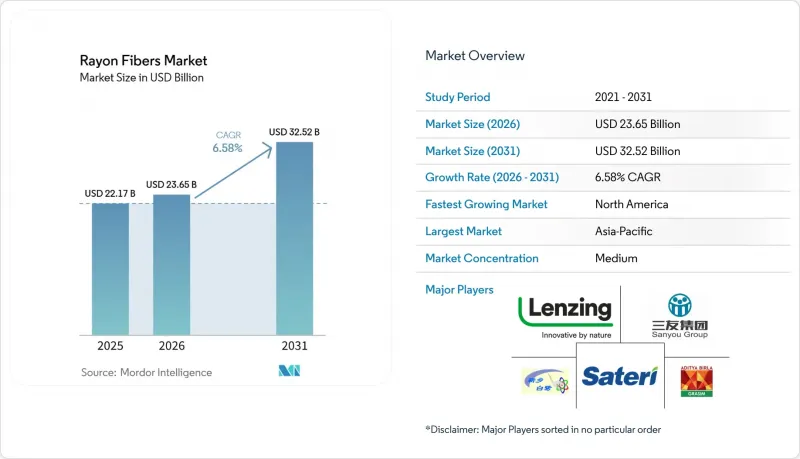
本報告按產品類型(粘膠纖維、Lyocell纖維等)、纖維形態(短纖維和長絲纖維)、應用領域(服裝、家用紡織品等)和地區(亞太地區、北美地區、歐洲地區、南美地區、中東和非洲地區)進行細分。市場預測以美元計價。
全球人造絲纖維市場趨勢及洞察
對永續和可生物分解纖維的需求日益成長
人造絲纖維市場正受益於買家對可生物分解性日益成長的興趣以及減少對化石燃料衍生材料依賴的趨勢。對合成微塑膠污染的擔憂促使永續發展團隊將纖維選擇納入正式的採購標準,而不再僅僅將其視為品牌的自願之舉。此外,隨著買家不再將所有再生閉合迴路纖維混為一談,而是根據化學品使用量和Lyocell纖維回收率等具體標準進行評估,傳統黏膠纖維和閉迴路萊賽爾纖維之間的差異也變得愈發清晰。 Birla Cellulose 公司的「Livaeco Lyocell纖維」擁有高達 99.7% 的溶劑回收率,其木漿 100% 獲得 FSC 認證,這表明閉合迴路加工和採購過程的透明度正成為高品質纖維素纖維的採購標準。隨著採購標準的日益嚴格,這種需求趨勢正從服裝業擴展到家用紡織品和衛生用品領域,在這些領域,可追溯的原料變得越來越重要。
擴大Lyocell纖維和莫代爾纖維的產能。
隨著Lyocell纖維生產從特殊用途規模轉向更大規模、標準化生產,人造絲纖維市場正在改變。到2025年,全球Lyocell纖維產能將超過130萬噸。隨著山東省宇台工廠投產,到2026年,賽特利公司四個生產基地的Lyocell纖維總合將達到60萬噸。格拉西姆工業有限公司2026會計年度的纖維素短Lyocell纖維年產能為89萬噸,運轉率97%。該公司已批准哈里哈爾工廠的二期Lyocell纖維擴建計劃,投資額為309.4萬印度盧比(約3.24億美元)。第一期和第二期工程完成後,Lyocell纖維總產能預計將增加至每年21萬噸。預計這一轉變將降低單位成本,並促進中端服飾品類更廣泛地採用萊賽爾纖維,這些品類先前認為Lyocell纖維價格過高。莫代爾纖維預計也將受益,因為買家擴大採用分級採購策略,根據成本和永續性表現對粘膠纖維、莫代爾纖維和Lyocell纖維進行明確排序。
二硫化碳和廢水排放法規正在推高生產成本。
人造絲纖維市場在傳統黏膠生產中面臨成本挑戰。這是由於需要持續投資於二硫化碳 (CS2) 回收和硫相關處理系統。美國環保署 (EPA) 根據其《有機化學品、塑膠和合成纖維廢水指南》對黏膠人造絲工廠的廢水排放進行監管,使得污染控制與工廠的經濟可行性密切相關。根據亞太人造絲協會發布的《2025 年歐盟最佳利用技術 (BAT) 評估報告》,透過實施先進的減排系統,可以將每噸纖維的硫排放量降低到 20 公斤以下,並達到歐盟 BAT 標準。然而,這種程度的排放控制需要大量資金,並非所有中型生產商都能負擔得起。此外,值得注意的是,在歐洲人造絲纖維市場中,凱爾海姆纖維公司 (Kelheim Fibers) 在破產程序中未能找到可行的長期解決方案後,於 2026 年 3 月 31 日停止營運。 MMCF 的「零有害化學物質排放 (ZDHC)」指南擴大了對整個再生纖維素價值鏈合規性的期望,成本壓力不再局限於少數黏膠生產商。
細分市場分析
到2025年,粘膠纖維將佔據人造絲纖維市場67.38%的佔有率。這反映了其低成本定位、濕式紡絲製程的規模優勢,以及與亞洲紡織工業中心標準紡絲和後整理設備的廣泛相容性。人造絲纖維市場繼續依賴黏膠纖維作為其大規模生產的基礎,因為與價格更高的再生纖維素纖維相比,黏膠纖維更符合服裝和家用紡織品大規模生產的中階。莫代爾纖維介於通用黏膠纖維和高階Lyocell纖維之間,其柔軟的手感和高吸濕性使其適用於內衣、運動服和高階床上用品。Lyocell纖維是成長最快的產品類型,預計到2031年將保持8.52%的年複合成長率(CAGR) ,這主要得益於品牌永續發展的要求、閉合迴路工藝的吸引力以及隨著新產能的投產,其與運作的成本差距正在縮小。
銅氨纖維(Cupramion)在日本高階服裝領域佔據著獨特的市場地位,其超細纖維的特性賦予了布料絲滑般的垂墜感和表面光澤。高強度和超高強度人造絲則繼續應用於工業領域,在這些領域,拉伸強度和熱穩定性比柔軟度更為重要,例如輪胎簾布加固、工業皮帶和過濾織物。人造絲纖維市場正呈現出兩極化的趨勢:一方面是規模大規模的黏膠纖維,支撐著市場規模;小規模的Lyocell纖維纖維,佔據高階成長領域。 Birla Cellulose公司的「Livaeco Lyocell」產品溶劑回收率高達99.7%,並採用100%經FSC(森林管理委員會)認證的木漿生產,提高了人造絲纖維產品系列日益需要達到的永續性標準。
區域分析
到2025年,亞太地區將佔全球人造絲纖維市場62.44%的佔有率,成為生產和消費量最大的地區。中國仍然是最大的單一生產基地,唐山三友、賽特利和宜賓格蕾絲集團的年產量均達數十萬噸。印度也扮演重要角色,格拉西姆工業公司在2026會計年度纖維素短纖維的年產量為89萬噸,運轉率高達97%。這顯示市場需求強勁,而剩餘產能有限。日本的產量雖然仍然小規模,但在高階服裝和懸垂性極佳的特種長絲和銅銨纖維應用領域佔據著重要地位。韓國則貢獻了下游紡絲產能,而越南、孟加拉和印尼則繼續透過其服裝組裝網路吸收來自中國和印度的大量纖維。
預計到2031年,北美將以7.13%的複合年成長率成長,成為人造絲纖維市場成長最快的地區。這一成長並非主要得益於國內龐大的纖維產量,而是源自於對經認證的永續纖維素材料的採購需求不斷成長。蘭精公司與Edgewell Personal Care合作,於2025年在北美推出VEOCELLyocell纖維衛生用品,顯示優質不織布可以進入長期以來由化石燃料基材料主導的市場。此外,隨著《美國-墨西哥-加拿大協定》(USMCA)框架下的近岸外包政策的實施,墨西哥的重要性也日益凸顯。該政策支持美國品牌縮短供應鏈,從而促進人造絲服飾的組裝。
2025年,歐洲將佔據全球人造絲纖維需求的重要佔有率,其市場格局受時尚、衛生不織布和永續性合規要求的影響。歐盟的紡織政策議程正引導品牌公司採購具有更強可追溯性和更完善生產流程文件的認證纖維素纖維。德國和英國繼續保持其作為歐洲最大國內市場的地位,兩國擁有強勁的紡織品需求和高度集中的時尚零售活動。以巴西和阿根廷為首的南美市場規模仍然小規模,但隨著都市化和紡織製造業投資的增加,其需求正在不斷成長。中東和非洲仍然是亞洲出口商尋求擺脫現有亞洲內部貿易路線、實現多元化的早期目標市場。
其他好處:
- Excel格式的市場預測(ME)表
- 3個月的分析師支持
目錄
第1章:引言
- 研究假設和市場定義
- 調查範圍
第2章:調查方法
第3章執行摘要
第4章 市場狀況
- 市場概覽
- 市場促進因素
- 對永續和可生物分解纖維的需求日益成長
- 服裝和家用紡織品消費量不斷成長
- 擴大Lyocell纖維和莫代爾纖維的生產
- 擴大環保時尚計劃
- 擴大再生纖維素纖維作為合成纖維替代品的應用。
- 市場限制因素
- 遵守二硫化碳和廢水排放法規會增加營運成本。
- 有關黏膠生產的環境法規
- 先進的Lyocell纖維生產需要大量的資金投入。
- 價值鏈分析
- 波特五力分析
第5章 市場規模與成長預測
- 依產品類型
- 黏膠人造絲
- 莫代爾人造絲
- Lyocell纖維
- 銅基人造絲
- 高強度人造絲
- 超高強度人造絲
- 其他產品類型
- 纖維形態
- 短纖維
- 長絲纖維
- 透過使用
- 服飾
- 家用紡織品
- 工業紡織品
- 醫用紡織品
- 其他用途
- 按地區
- 亞太地區
- 中國
- 印度
- 日本
- 韓國
- 其他亞太國家
- 北美洲
- 美國
- 加拿大
- 墨西哥
- 歐洲
- 德國
- 英國
- 法國
- 義大利
- 俄羅斯
- 其他歐洲國家
- 南美洲
- 巴西
- 阿根廷
- 其他南美國家
- 中東和非洲
- 沙烏地阿拉伯
- 南非
- 其他中東和非洲國家
- 亞太地區
第6章 競爭情勢
- 市場集中度
- 策略趨勢
- 市佔率和排名分析
- 公司簡介
- Asia Pacific Rayon Limited
- Bohi Industry
- CHTC Helon
- Grasim Industries Limited
- Kelheim Fibres GmbH
- Lenzing AG
- Sateri
- Tangshan Sanyou Group Xingda Chemical Fibre Co., Ltd.
- Xinxiang Bailu Chemical Fibre Group Co., Ltd.
- Yibin Grace Group
- Yibin Grace Group
- Zhejiang Fulida Holding Co., Ltd.
第7章 市場機會與未來展望
According to Mordor Intelligence, the rayon fibers market size is expected to increase from USD 22.17 billion in 2025 to USD 23.65 billion in 2026 and reach USD 32.52 billion by 2031, and is expected to grow at a CAGR of 6.58% over 2026-2031.
This report is Segmented by Product Type (Viscose Rayon, Lyocell, and More), Fiber Form (Staple Fiber and Filament Fiber), Application (Apparel, Home Textiles, and More), and Geography (Asia-Pacific, North America, Europe, South America, and Middle-East and Africa). The Market Forecasts are Provided in Terms of Value (USD).
Global Rayon Fibers Market Trends and Insights
Rising Demand for Sustainable and Biodegradable Fibers
The rayon fibers market is benefiting from greater buyer focus on fiber biodegradability and reduced dependence on fossil-derived materials. Concerns over synthetic microplastic contamination are prompting sustainability teams to incorporate fiber selection into formal sourcing standards, rather than treating it as a voluntary brand commitment. The market is also seeing a clearer distinction between conventional viscose and closed-loop lyocell, as buyers now evaluate chemical intensity and solvent recovery as separate criteria rather than grouping all regenerated cellulosics together. Birla Cellulose's Livaeco Lyocell, with up to 99.7% solvent recovery and 100% Forest Stewardship Council (FSC)-certified wood pulp, illustrates how closed-loop processing and documented sourcing are becoming purchasing criteria for premium cellulosics. As procurement standards tighten, this demand pattern is extending beyond apparel into home textiles and hygiene applications, where traceable raw materials are increasingly important.
Expansion of Lyocell and Modal Fiber Production Capacity
The rayon fibers market is shifting as lyocell production moves from specialty-scale output to larger, more standardized volumes. Global lyocell capacity exceeded 1.3 million tons by 2025, and Sateri's lyocell capacity reached 600,000 metric tons across four sites in 2026 following the start of production at its Yutai facility in Shandong province. Grasim Industries Limited operates 890,000 tons per annum (TPA) of cellulosic staple fiber at 97% utilization in fiscal year 2026 and has approved a Phase II lyocell expansion at Harihar for INR 3,094 crore (USD 324 million), building toward 210,000 TPA of total lyocell capacity upon completion of Phase I and Phase II. This shift is expected to result in lower unit costs and broader adoption in mid-market apparel categories that had previously considered lyocell too expensive. Modal is also expected to benefit, as buyers increasingly apply tiered sourcing policies that place viscose, modal, and lyocell on a defined scale of cost and sustainability performance.
Carbon Disulfide and Effluent Compliance Raising Production Costs
The rayon fibers market faces a cost challenge in conventional viscose production, as CS2 recovery and sulfur-related treatment systems require sustained investment. The U.S. Environmental Protection Agency regulates effluent discharge from viscose rayon plants under the Organic Chemicals, Plastics, and Synthetic Fibers Effluent Guidelines, keeping pollution control closely tied to plant economics. Asia Pacific Rayon's 2025 EU Best Available Techniques (BAT) Assessment Report showed that advanced abatement systems can reduce sulfur-to-air emissions below 20 kg per ton of fiber to meet EU BAT benchmarks, but this level of control requires capital that not every mid-scale producer can sustain. The rayon fibers market also recorded a notable development in Europe when Kelheim Fibres closed operations as of March 31, 2026, after insolvency proceedings failed to secure a viable long-term solution. The Zero Discharge of Hazardous Chemicals (ZDHC) MMCF Guidelines broaden compliance expectations across regenerated cellulose value chains, meaning cost pressure is no longer limited to a narrow group of viscose producers.
Other drivers and restraints analyzed in the detailed report include:
- Growth of Eco-Friendly Fashion Initiatives
- Increasing Use of Regenerated Cellulose Fibers Across Sectors
- Environmental Regulations Governing Viscose Production Methods
For complete list of drivers and restraints, kindly check the Table Of Contents.
Segment Analysis
Viscose rayon held 67.38% of the rayon fibers market share in 2025, reflecting its low-cost position, the scale of wet-spinning processes, and wide compatibility with standard spinning and finishing equipment across Asian textile hubs. The rayon fibers market continues to rely on viscose as the volume base because it aligns better with the economics of mass apparel and home textiles than higher-priced regenerated cellulosics. Modal occupied a middle tier between commodity viscose and premium lyocell, with its softer hand-feel and higher moisture absorption supporting use in intimate apparel, sportswear, and premium bedding. Lyocell was the fastest-growing product type, with an 8.52% CAGR through 2031, supported by brand sustainability requirements, the appeal of its closed-loop process, and a narrowing cost gap with viscose as new capacity comes online.
Cuprammonium rayon retained a niche role, mainly in the Japanese luxury apparel segment, where ultra-fine filament characteristics support silk-like drape and surface finish. High tenacity rayon and super high tenacity rayon remained tied to industrial uses such as tire cord reinforcement, industrial belting, and filtration fabrics, where tensile performance and thermal stability matter more than softness. The rayon fibers market is separating more clearly between a large viscose base that supports scale and a smaller lyocell segment that is capturing premium growth. Birla Cellulose's Livaeco Lyocell, made with up to 99.7% solvent recovery and 100% Forest Stewardship Council (FSC)-certified wood pulp, raises the sustainability benchmark that product portfolios in the rayon fibers market increasingly need to meet.
Complete Report Scope:
- By Product Type
- Viscose Rayon
- Modal Rayon
- Lyocell
- Cuprammonium Rayon
- High Tenacity Rayon
- Super High Tenacity Rayon
- Other Product Types
- By Fiber Form
- Staple Fiber
- Filament Fiber
- By Application
- Apparel
- Home Textiles
- Industrial Textiles
- Medical Textiles
- Other Applications
- By Geography
- Asia-Pacific
- China
- India
- Japan
- South Korea
- Rest of Asia-Pacific
- North America
- United States
- Canada
- Mexico
- Europe
- Germany
- United Kingdom
- France
- Italy
- Russia
- Rest of Europe
- South America
- Brazil
- Argentina
- Rest of South America
- Middle-East and Africa
- Saudi Arabia
- South Africa
- Rest of Middle-East and Africa
- Asia-Pacific
Geography Analysis
Asia-Pacific accounted for 62.44% of the global rayon fibers market in 2025, making it the largest region for both production and consumption. China remained the largest single production base, with Tangshan Sanyou, Sateri, and Yibin Grace Group operating at multi-hundred-thousand-ton annual scales. India also played a notable role, as Grasim Industries operated 890,000 tons per annum (TPA) of cellulosic staple fiber at 97% utilization in fiscal year 2026, indicating strong demand and limited spare capacity. Japan remained smaller in volume but relevant in specialty filament and cuprammonium applications tied to luxury apparel and fine drape. South Korea contributed downstream spinning capacity, while Vietnam, Bangladesh, and Indonesia continued to absorb greater volumes of Chinese and Indian fiber through garment assembly networks.
North America is projected to grow at a 7.13% CAGR through 2031, making it the fastest-growing region in the rayon fibers market. Growth is driven less by large domestic fiber output and more by sourcing shifts toward certified sustainable cellulosics. Lenzing's 2025 launch of VEOCEL lyocell-based hygiene products in North America with Edgewell Personal Care demonstrated that premium nonwovens can enter categories long dominated by fossil-derived materials. Mexico is also becoming more relevant, as nearshoring under the United States-Mexico-Canada Agreement (USMCA) framework supports rayon-based garment assembly for U.S. brands seeking shorter supply chains.
Europe represented a meaningful share of global rayon fiber demand in 2025, with the market shaped by fashion, hygiene nonwovens, and sustainability compliance requirements. The EU textiles policy agenda is directing brand procurement toward certified cellulosic fibers with stronger traceability and process documentation. Germany and the United Kingdom remained the largest national markets in Europe, combining strong textile demand with concentrated fashion retail activity. South America, led by Brazil and Argentina, remains a smaller market but is building demand through urbanization and investment in textile manufacturing. The Middle East and Africa also remain early-stage targets for Asian exporters seeking to diversify beyond established intra-Asia trade routes.
- Asia Pacific Rayon Limited
- Bohi Industry
- CHTC Helon
- Grasim Industries Limited
- Kelheim Fibres GmbH
- Lenzing AG
- Sateri
- Tangshan Sanyou Group Xingda Chemical Fibre Co., Ltd.
- Xinxiang Bailu Chemical Fibre Group Co., Ltd.
- Yibin Grace Group
- Yibin Grace Group
- Zhejiang Fulida Holding Co., Ltd.
Additional Benefits:
- The market estimate (ME) sheet in Excel format
- 3 months of analyst support
TABLE OF CONTENTS
1 Introduction
- 1.1 Study Assumptions and Market Definition
- 1.2 Scope of the Study
2 Research Methodology
3 Executive Summary
4 Market Landscape
- 4.1 Market Overview
- 4.2 Market Drivers
- 4.2.1 Rising demand for sustainable and biodegradable fibers
- 4.2.2 Increasing consumption in apparel and home textiles
- 4.2.3 Expansion of lyocell and modal fiber production
- 4.2.4 Growth of eco-friendly fashion initiatives
- 4.2.5 Increasing use of regenerated cellulose fibers as alternatives to synthetic fibers
- 4.3 Market Restraints
- 4.3.1 Carbon Disulfide And Effluent Compliance Raise Operating Costs
- 4.3.2 Environmental regulations governing viscose production
- 4.3.3 High capital investment for advanced lyocell manufacturing
- 4.4 Value Chain Analysis
- 4.5 Porter's Five Forces Analysis
- 4.5.1 Threat of New Entrants
- 4.5.2 Bargaining Power of Suppliers
- 4.5.3 Bargaining Power of Buyers
- 4.5.4 Threat of Substitutes
- 4.5.5 Competitive Rivalry
5 Market Size and Growth Forecasts (Value)
- 5.1 By Product Type
- 5.1.1 Viscose Rayon
- 5.1.2 Modal Rayon
- 5.1.3 Lyocell
- 5.1.4 Cuprammonium Rayon
- 5.1.5 High Tenacity Rayon
- 5.1.6 Super High Tenacity Rayon
- 5.1.7 Other Product Types
- 5.2 By Fiber Form
- 5.2.1 Staple Fiber
- 5.2.2 Filament Fiber
- 5.3 By Application
- 5.3.1 Apparel
- 5.3.2 Home Textiles
- 5.3.3 Industrial Textiles
- 5.3.4 Medical Textiles
- 5.3.5 Other Applications
- 5.4 By Geography
- 5.4.1 Asia-Pacific
- 5.4.1.1 China
- 5.4.1.2 India
- 5.4.1.3 Japan
- 5.4.1.4 South Korea
- 5.4.1.5 Rest of Asia-Pacific
- 5.4.2 North America
- 5.4.2.1 United States
- 5.4.2.2 Canada
- 5.4.2.3 Mexico
- 5.4.3 Europe
- 5.4.3.1 Germany
- 5.4.3.2 United Kingdom
- 5.4.3.3 France
- 5.4.3.4 Italy
- 5.4.3.5 Russia
- 5.4.3.6 Rest of Europe
- 5.4.4 South America
- 5.4.4.1 Brazil
- 5.4.4.2 Argentina
- 5.4.4.3 Rest of South America
- 5.4.5 Middle-East and Africa
- 5.4.5.1 Saudi Arabia
- 5.4.5.2 South Africa
- 5.4.5.3 Rest of Middle-East and Africa
- 5.4.1 Asia-Pacific
6 Competitive Landscape
- 6.1 Market Concentration
- 6.2 Strategic Moves
- 6.3 Market Share (%)/Ranking Analysis
- 6.4 Company Profiles (includes Global Overview, Market Overview, Core Segments, Financials as available, Strategic Information, Products and Services, and Recent Developments)
- 6.4.1 Asia Pacific Rayon Limited
- 6.4.2 Bohi Industry
- 6.4.3 CHTC Helon
- 6.4.4 Grasim Industries Limited
- 6.4.5 Kelheim Fibres GmbH
- 6.4.6 Lenzing AG
- 6.4.7 Sateri
- 6.4.8 Tangshan Sanyou Group Xingda Chemical Fibre Co., Ltd.
- 6.4.9 Xinxiang Bailu Chemical Fibre Group Co., Ltd.
- 6.4.10 Yibin Grace Group
- 6.4.11 Yibin Grace Group
- 6.4.12 Zhejiang Fulida Holding Co., Ltd.
7 Market Opportunities and Future Outlook
- 7.1 White-Space and Unmet-Need Assessment

 全球人造絲纖維市場規模、佔有率、趨勢和成長分析報告(2026-2034年)
 人造絲纖維市場規模、佔有率、趨勢和預測:按類型、應用和地區分類,2026-2034年
 人造絲纖維市場:按類型、原料來源、製造技術、纖維形態、應用和通路分類-2026-2032年全球預測全球人造絲纖維市場:市場規模、佔有率、成長率、產業分析、按類型、應用和地區劃分的考量、未來預測(2026-2034)
 2032 年人造絲纖維市場預測:按類型、生產流程、應用、最終用戶和地區進行的全球分析
 人造絲纖維市場規模、佔有率、趨勢分析報告:按材料類型、應用、地區、細分市場預測,2025-2030 年