


 |
市場調查報告書
商品編碼
2117493
結構芯材:市場佔有率分析、產業趨勢與統計、成長預測(2026-2031)Structural Core Materials - Market Share Analysis, Industry Trends & Statistics, Growth Forecasts (2026 - 2031) |
||||||

※ 本網頁內容可能與最新版本有所差異。詳細情況請與我們聯繫。
根據 Mordor Intelligence 預測,結構核心材料市場將從 2025 年的 26.8 億美元成長到 2026 年的 28.5 億美元,到 2031 年達到 39.3 億美元,2026 年至 2031 年的複合年成長率預計為 6.64%。
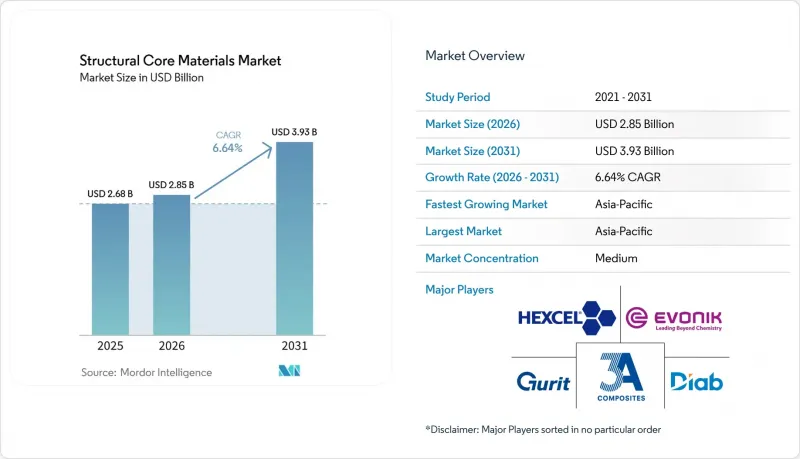
本報告發泡材(PET發泡材、PVC發泡材等)、蜂窩結構(鋁蜂窩、Nomex蜂窩等)、外殼類型(玻璃纖維增強塑膠(GFRP)等)、終端應用行業(航太、船舶及其他)和地區(亞太、北美、歐洲、南美、中東和非洲)進行細分。市場預測以美元計價。
全球結構芯材市場趨勢及洞察
風力渦輪機葉片需求不斷成長:結構發泡材和蜂窩芯材需求持續旺盛
風力發電仍是結構芯材市場最大的終端用戶領域。這是因為夾層結構對於現代葉片設計至關重要,它能確保葉片的剛性、抗疲勞性和重量控制。隨著離岸風力發電機葉片長度的增加,以及每片葉片所需芯材用量的增加,市場需求不斷成長,儘管裝機量的成長並未跟上。葉片內部材料的選擇也在變化,聚對苯二甲酸乙二醇酯(PET)泡沫材料在葉片根部越來越受歡迎。這是因為PET泡沫材料的高密度性能和閉孔結構帶來的可回收性,使其比傳統的天然材料芯材更符合採購優先考慮的因素。因此,結構芯材市場不僅與新裝機量相關,還與大型平台所需的結構材料用量不斷增加有關。因此,能夠滿足風力發電目的地設備製造商(OEM)在一致性、可加工性和永續性要求的發泡材和蜂窩材料供應商,其銷售量基礎正在逐漸穩定。
航太領域的輕量化:複合材料夾層結構規範確立新的結構標準
航太領域的需求支撐著結構核心材料市場。這是因為複合材料夾層結構在民航機研發中正逐漸普及,而不再僅僅被視為一種特殊解決方案。空中巴士A350 XWB的結構品質中超過54%由複合材料構成,與同等鋁製機身相比,燃油消耗降低了25%。波音787的結構品質中也有近50%由複合材料構成,類似的設計趨勢正在整個下一代飛機專案中得到強化。這使得客艙和輔助結構對Nomex和鋁蜂窩材料的需求保持強勁,而Polymethacrylimide(PMI)泡沫材料在對低密度和尺寸精度要求極高的應用中也備受青睞。贏創也將「ROHACELL」定位為電動垂直起降(eVTOL)應用材料,在這些應用中,傳統材料難以實現減重和提高結構效率,而ROHACELL的應用範圍也已擴展到傳統機身結構之外。
高昂的認證和核准成本:這種結構性障礙保護了現有公司,但代價是發展速度。
高昂的認證成本限制了新供應商進入結構芯材市場的速度,尤其是在航太領域,因為每種材料體係都必須經過漫長的核准流程。業內人士表示,根據材料和平台組合的不同,認證可能需要 18 到 36 個月。此外,主要原始設備製造商 (OEM) 維護獨立的認證資料庫,需要同時進行文件編制和測試。這種結構有利於現有供應商,他們可以透過長期生產計劃和已建立的客戶關係分攤測試和合規成本。即使是技術前景廣闊的新型發泡材和蜂窩產品,如果認證流程仍然昂貴且分散,其市場推廣速度也可能緩慢。在這方面,東麗公司在 NCAMP 專案上取得的成就意義重大,因為 FAA 批准的設計公差的公開性減少了新型熱塑性解決方案所需的客製化測試。
細分市場分析
到2025年,聚氯乙烯(PVC)泡沫將佔泡沫材料市場佔有率的46.13%,成為泡沫材料中最大的類別。這一地位反映了PVC在船舶船體、風力渦輪機截面和運輸面板等應用領域的長期使用,這些應用領域對PVC的加工性能、成本和抗動態應力性能均有很高的要求。苯乙烯-丙烯腈(SAN)泡沫的性能介於PVC和聚甲基丙烯酸甲酯(PMI)之間,用於船舶模具、賽車運動以及某些對熱性能要求更高的運輸部件。 PMI發泡體是航太和先進行動應用領域的首選,贏創的「ROHACELL」系列產品憑藉其長期的認證記錄、低密度和在高壓釜條件下的穩定性,成為業界翹楚。結構芯材市場的泡棉材料分為兩類:一類是產量較大的現有等級,小規模、一旦獲得認證就難以取代的高階產品。
預計到2031年,聚對苯二甲酸乙二醇酯(PET)泡沫將以7.23%的複合年成長率成長,成為結構芯材市場中成長最快的泡沫類型。 2024年的一項同行評審研究表明,用於玻璃纖維夾芯板的完全回收PET泡沫芯材的彎曲性能與PVC基替代品相當,證明了這種替代方案的科學合理性。 PET泡沫能夠同時滿足機械性能要求和循環採購標準。 「其他發泡材」類別(包括聚氨酯和聚苯乙烯泡沫)目前仍主要應用於結構要求較低、成本敏感性較高的建築板材、圍護結構和保溫材料等領域。預計到2031年,PET發泡材仍將是結構芯材市場規模成長要素,而PVC泡沫預計仍將維持目前的收入基礎。
到2025年,鋁蜂窩將佔蜂窩材料市場佔有率的47.36%,成為該類別中最大的市場佔有率。這一地位反映了其在航太領域的成熟應用,例如地板、引擎室整流罩和幕牆系統,其優異的耐壓性、尺寸穩定性和成熟的認證使其難以被替代。 Nomex蜂巢在飛機內飾中繼續發揮至關重要的作用,其符合阻燃法規,可用於儲物架、天花板和側壁板。其他類型的蜂窩,例如不銹鋼和鈦,則僅限於國防和航空航太等特殊應用領域,這些領域的結構要求無法透過普通替代品來滿足。結構芯材市場的蜂巢材料成熟可靠,並擁有完善的認證記錄。
預計到2031年,熱塑性蜂巢材料將以7.83%的複合年成長率成長,成為結構芯材市場中成長最快的蜂巢類型。這一成長主要得益於其與可回收內飾系統的兼容性,以及適用於特定應用領域現代製造要求的加工流程。 Composites United重點介紹了EconCore公司用於飛機內飾的ThermHexWAVY聚醚醯亞胺蜂窩芯材技術。該技術旨在滿足防火、防煙和無毒要求,同時透過其波紋狀的蜂巢壁結構提高面外屈曲強度。熱塑性蜂窩材料如今已成為一種技術可靠的航太解決方案,且具有可回收性。在蜂窩材料類別中,熱塑性蜂窩材料預計將成為未來結構芯材市場成長的最大貢獻者。
區域分析
預計到2025年,亞太地區將佔全球銷售額的42.83%,並在2031年之前以7.12%的複合年成長率成長。中國是該地區的主要需求支柱,其風力發電機葉片製造地消耗了大量的發泡芯材,並支撐著廣泛的複合材料供應鏈。日本透過製造蜂巢和複合材料零件為航太領域做出貢獻,而韓國則透過商業造船應用來滿足需求,輕質夾芯板被用於船體和上層建築的設計。印度是一個規模較小但成長迅速的市場,由於對航太製造業的投資和風電裝置容量的擴張,對認證和半認證芯材的需求不斷成長。這些因素使亞太地區成為結構芯材市場最大的生產和消費中心。
北美和歐洲是結構芯材市場接下來的主要細分市場,各自擁有獨特的市場需求趨勢。北美市場主要由民用和國防領域的航太工業、複合材料加工商網路以及像Hexcel這樣在美國設有製造地的供應商所支持。 Hexcel公佈2025年淨銷售額為19億美元,預計2026年將達到20億至21億美元,反映出市場對航太工業產量復甦以及對先進芯材持續需求的信心。在歐洲,對材料永續性的監管壓力日益加大,加速了風電和交通運輸供應鏈中再生PET泡沫和熱塑性蜂窩材料的採用。贏創計畫於2024年9月將其位於達姆施塔特的ROHACELL生產線完全轉型為使用再生能源,這清楚地表明了該地區的生產商如何調整其營運以滿足碳排放揭露和採購要求。
儘管南美洲在結構芯材市場仍處於起步階段,但巴西憑藉陸上風電的發展及其對葉片材料的相關需求,展現出最清晰的需求基礎。阿根廷及其周邊市場主要透過海洋和基礎設施應用貢獻相對有限,這些應用領域仍然嚴重依賴進口材料和成品板材系統。預計中東和非洲將迎來與基礎設施投資、建設活動以及公用事業規模可再生能源項目的分階段部署相關的機會。這些地區目前仍依賴進口,但由於熟練勞動力有限且模組化施工可以降低現場施工的複雜性,輕質夾芯板可能更具吸引力。儘管這些地區的市場准入仍然有限,但預計這些成長區域將在預測期的後半段佔據更重要的地位。
其他好處:
- Excel格式的市場預測(ME)表
- 3個月的分析師支持
目錄
第1章:引言
- 研究假設和市場定義
- 調查範圍
第2章:調查方法
第3章執行摘要
第4章 市場狀況
- 市場概覽
- 市場促進因素
- 增大風力渦輪機葉片的尺寸需要輕質結構芯材。
- 航太領域優先考慮減輕重量,這推動了對高規格核心產品的需求。
- 向可回收PET和生物基核心材料過渡
- 對輕質複合複合材料的需求日益成長
- 模組化施工方法和夾芯板正在拓展結構芯材的應用範圍。
- 市場限制因素
- 航太和風電產業的高額資格認證成本
- 聚合物和鋁等原料價格的波動
- 某些熱固性複合材料系統的可回收性限制
- 價值鏈分析
- 波特五力分析
第5章 市場規模與成長預測
- 按形式
- PET泡棉
- 聚氯乙烯泡沫
- SAN 表格
- PMI表格
- 其他形式
- 蜂巢狀
- 鋁蜂巢
- Nomex蜂窩
- 熱塑性蜂窩
- 其他蜂巢
- 按覆材類型
- 玻璃纖維增強塑膠(GFRP)
- 碳纖維增強塑膠(CFRP)
- NFRP
- 其他外殼類型
- 按最終用途行業分類
- 航太
- 風力
- 海上
- 運輸
- 建造
- 其他終端用戶產業
- 按地區
- 亞太地區
- 中國
- 印度
- 日本
- 韓國
- 其他亞太國家
- 北美洲
- 美國
- 加拿大
- 墨西哥
- 歐洲
- 德國
- 英國
- 法國
- 義大利
- 俄羅斯
- 其他歐洲國家
- 南美洲
- 巴西
- 阿根廷
- 其他南美國家
- 中東和非洲
- 沙烏地阿拉伯
- 南非
- 其他中東和非洲國家
- 亞太地區
第6章 競爭情勢
- 市場集中度
- 策略趨勢
- 市佔率和排名分析
- 公司簡介
- 3A Composites GmbH(SCHWEITER TECHNOLOGIES AG)
- Armacell International SA
- Carbon-Core Corp.
- Changzhou Tiansheng New Materials Co., Ltd.
- Diab Group
- EconCore NV
- Euro-Composites SA
- Evonik Industries AG
- Gurit Services AG
- Hexcel Corporation
- Maricell Srl
- NGM Europe Srl
- Plascore, Inc.
- Polyumac USA, Inc.
- Showa Aircraft Industry Co., Ltd.
- The Gill Corporation
第7章 市場機會與未來展望
According to Mordor Intelligence, the structural core materials market size is expected to increase from USD 2.68 billion in 2025 to USD 2.85 billion in 2026 and reach USD 3.93 billion by 2031, and is expected to grow at a CAGR of 6.64% over 2026-2031.
This report is Segmented by Foam (PET Foam, PVC Foam and More), Honeycomb (Aluminum Honeycomb, Nomex Honeycomb, and More), Outer Skin Type (Glass Fiber Reinforced Polymer (GFRP) and More), End-Use Industry (Aerospace, Marine, and More), and Geography (Asia-Pacific, North America, Europe, South America, and Middle-East and Africa). The Market Forecasts are Provided in Terms of Value (USD).
Global Structural Core Materials Market Trends and Insights
Wind Energy Blade Expansion: Sustained Volume Pull for Structural Foam and Honeycomb Cores
Wind energy remains the largest end-use segment in the structural core materials market because modern blade design depends on sandwich structures for stiffness, fatigue resistance, and weight control. Demand is rising as offshore blades grow longer, increasing the amount of core material required per blade even when installation growth is not keeping pace. Material selection within blades is also shifting, with polyethylene terephthalate (PET) foam gaining preference in root sections where closed-cell density performance and recyclability align with procurement priorities over traditional natural core options. This is keeping the structural core materials market tied not only to new turbine counts, but also to the growing structural content required in larger platforms. The result is a steadier volume base for foam and honeycomb suppliers that can meet wind Original Equipment Manufacturer (OEM) requirements on consistency, processing, and sustainability.
Aerospace Weight Reduction: Composite Sandwich Specifications Set a New Structural Baseline
Aerospace demand is supporting the structural core materials market as composite sandwich designs are now embedded in commercial aircraft development rather than treated as specialty solutions. The Airbus A350 XWB incorporated more than 54% composites by structural mass and delivered a 25% fuel consumption reduction compared to equivalent aluminum-airframe aircraft. The Boeing 787 also reached close to 50% composite content by structural mass, reinforcing the same design direction across the next generation of aircraft programs. This keeps demand active for Nomex and aluminum honeycomb in cabin and secondary structures, and for Polymethacrylimide (PMI) foam in applications where low density and dimensional precision are essential. Growth is also broadening beyond legacy airframes, as Evonik is positioning ROHACELL for electric Vertical Take-Off and Landing (eVTOL) applications where low mass and structural efficiency are difficult to achieve with conventional materials.
High Qualification and Certification Costs: A Structural Barrier Protecting Incumbents at the Expense of Pace
High certification costs restrict the pace at which new suppliers can enter the structural core materials market, particularly in aerospace grades where each material system must complete lengthy approval cycles. Industry sources indicate that qualification can take 18 to 36 months for each material and platform combination. Major OEMs also maintain separate approval databases that require parallel documentation and testing. This structure favors incumbent suppliers that can distribute testing and compliance costs across long production programs and established customer relationships. A technically promising new foam or honeycomb product may face slow adoption if the certification pathway remains expensive or fragmented. Toray's NCAMP milestone is relevant in this context because publicly available FAA-accepted design allowables reduce the custom testing required for newer thermoplastic solutions.
Other drivers and restraints analyzed in the detailed report include:
- Lightweighting Demand for Electric Vehicles and Commercial Transport: A New Volume Tier
- Shift Toward Recyclable and Thermoplastic Core Materials: Circular Economy Mandates Reshaping Procurement
- Raw Material Price Volatility: Margin Compression Across Foam and Resin Systems
For complete list of drivers and restraints, kindly check the Table Of Contents.
Segment Analysis
Polyvinyl Chloride (PVC) Foam held 46.13% of the foam segment in 2025, making it the largest material class in the foam category. This position reflects long-term use in marine hulls, wind blade sections, and transport panels, where machinability, cost, and resistance to dynamic stress support specification. Styrene Acrylonitrile (SAN) Foam sits between PVC and PMI on the performance scale and is used in marine tooling, motorsport, and selected transportation components requiring stronger thermal performance. PMI Foam is the preferred option for aerospace and advanced mobility applications, with Evonik's ROHACELL line supported by a long certification history, low density, and stable behavior under autoclave conditions. The foam segment of the structural core materials market is divided between high-volume incumbent grades and smaller premium formats that are difficult to substitute once qualified.
Polyethylene Terephthalate (PET) Foam is projected to expand at a 7.23% CAGR through 2031, making it the fastest-growing foam type in the structural core materials market. A 2024 peer-reviewed study found that fully recycled PET foam cores used in glass fiber sandwich panels delivered flexural behavior comparable to PVC-based alternatives, providing scientific support for substitution. PET addresses both mechanical requirements and circular procurement criteria in a single solution. The Other Foam category, including polyurethane and polystyrene grades, remains tied to construction panels, enclosures, and insulation applications where structural demands are lower and cost sensitivity is higher. PET Foam represents the primary growth driver for structural core materials market size through 2031, while PVC continues to define the current revenue base.
Aluminum Honeycomb represented 47.36% of the honeycomb segment in 2025, giving it the largest share in the category. Its position reflects established use in aerospace floor panels, nacelle fairings, and facade systems where crush resistance, dimensional stability, and qualification history make replacement difficult. Nomex Honeycomb remains relevant in aircraft interiors, where flammability compliance supports its role in bins, ceilings, and sidewall panels. Other Honeycomb types, including stainless steel and titanium variants, remain limited to specialized defense and space applications where structural demands exceed what more common alternatives can deliver. The honeycomb segment of the structural core materials market is anchored by mature materials with established qualification records.
Thermoplastic Honeycomb is growing at a 7.83% CAGR through 2031, making it the fastest-growing honeycomb type in the structural core materials market. Its growth is driven by compatibility with recyclable interior systems and processing routes that suit modern manufacturing requirements in certain applications. Composites United highlighted this through EconCore's ThermHexWAVY polyetherimide honeycomb core technology for aircraft interiors, designed to meet fire, smoke, and toxicity requirements while improving out-of-plane buckling resistance through a wavy cell wall geometry. Thermoplastic Honeycomb is now positioned as a technically credible aerospace option alongside its recyclability attributes. Within the honeycomb category, Thermoplastic Honeycomb is the strongest contributor to future growth in the structural core materials market.
Complete Report Scope:
- By Foam
- PET Foam
- PVC Foam
- SAN Foam
- PMI Foam
- Other Foam
- By Honeycomb
- Aluminum Honeycomb
- Nomex Honeycomb
- Thermoplastic Honeycomb
- Other Honeycomb
- By Outer Skin Type
- Glass Fiber Reinforced Polymer (GFRP)
- Carbon Fiber Reinforced Polymer (CFRP)
- NFRP
- Other Outer Skin Types
- By End-Use Industry
- Aerospace
- Wind Energy
- Marine
- Transportation
- Construction
- Other End Use Industries
- By Geography
- Asia-Pacific
- China
- India
- Japan
- South Korea
- Rest of Asia-Pacific
- North America
- United States
- Canada
- Mexico
- Europe
- Germany
- United Kingdom
- France
- Italy
- Russia
- Rest of Europe
- South America
- Brazil
- Argentina
- Rest of South America
- Middle-East and Africa
- Saudi Arabia
- South Africa
- Rest of Middle-East and Africa
- Asia-Pacific
Geography Analysis
Asia-Pacific accounted for 42.83% of revenue in 2025 and is projected to grow at a 7.12% CAGR through 2031. China is the region's primary demand anchor, as its wind turbine blade manufacturing base absorbs significant foam core volume and supports a broad composite materials supply chain. Japan contributes aerospace content through honeycomb and composite component activity, while South Korea supports demand through commercial shipbuilding applications, where lightweight sandwich panels are used in hull and superstructure design. India represents a smaller but growing source of demand as aerospace manufacturing investment and wind installations expand the need for certified and semi-certified core grades. These factors position Asia-Pacific as the largest regional production and consumption base in the structural core materials market.
North America and Europe form the next major tier of the structural core materials market, each shaped by distinct demand dynamics. North America is anchored by commercial and defense aerospace activity, a network of composite fabricators, and suppliers such as Hexcel with manufacturing operations in the United States. Hexcel reported USD 1.9 billion in 2025 net sales and guided to USD 2.0 billion to USD 2.1 billion for 2026, reflecting confidence in recovering aerospace build rates and continued demand for advanced core materials. Europe is more strongly shaped by regulatory pressure on material sustainability, which is accelerating the adoption of recycled PET foam and thermoplastic honeycomb in wind energy and transportation supply chains. Evonik's shift of ROHACELL production in Darmstadt to 100% renewable electricity in September 2024 illustrates how producers in the region are aligning operations with carbon disclosure and procurement requirements.
South America remains an early-stage part of the structural core materials market, with Brazil offering the clearest demand base through onshore wind development and related blade-material needs. Argentina and neighboring markets contribute more modestly through marine and infrastructure applications that still depend heavily on imported materials and finished panel systems. The Middle East and Africa present an opportunity tied to infrastructure investment, construction activity, and the gradual development of utility-scale renewable energy programs. These regions remain import-dependent, but lightweight sandwich panels may become more attractive where skilled labor is limited and modular construction can reduce site complexity. Regional participation remains limited, but these markets represent a growth layer expected to become more relevant later in the forecast period.
- 3A Composites GmbH (SCHWEITER TECHNOLOGIES AG)
- Armacell International S.A.
- Carbon-Core Corp.
- Changzhou Tiansheng New Materials Co., Ltd.
- Diab Group
- EconCore N.V.
- Euro-Composites S.A.
- Evonik Industries AG
- Gurit Services AG
- Hexcel Corporation
- Maricell S.r.l.
- NGM Europe S.r.l.
- Plascore, Inc.
- Polyumac USA, Inc.
- Showa Aircraft Industry Co., Ltd.
- The Gill Corporation
Additional Benefits:
- The market estimate (ME) sheet in Excel format
- 3 months of analyst support
TABLE OF CONTENTS
1 Introduction
- 1.1 Study Assumptions and Market Definition
- 1.2 Scope of the Study
2 Research Methodology
3 Executive Summary
4 Market Landscape
- 4.1 Market Overview
- 4.2 Market Drivers
- 4.2.1 Wind Energy Blade Upscaling Requires Lightweight Structural Cores
- 4.2.2 Aerospace Weight Reduction Priorities Sustain High-Spec Core Demand
- 4.2.3 Shift Toward Recyclable PET and Bio-Based Core Materials
- 4.2.4 Rising demand for lightweight composite structures
- 4.2.5 Modular Construction and Sandwich Panels Expand Structural Core Use
- 4.3 Market Restraints
- 4.3.1 High Qualification Cost in Aerospace and Wind Applications
- 4.3.2 Volatility in polymer and aluminum raw material prices
- 4.3.3 Limited recyclability of certain thermoset composite systems
- 4.4 Value Chain Analysis
- 4.5 Porter's Five Forces Analysis
- 4.5.1 Threat of New Entrants
- 4.5.2 Bargaining Power of Suppliers
- 4.5.3 Bargaining Power of Buyers
- 4.5.4 Threat of Substitutes
- 4.5.5 Competitive Rivalry
5 Market Size and Growth Forecasts (Value)
- 5.1 By Foam
- 5.1.1 PET Foam
- 5.1.2 PVC Foam
- 5.1.3 SAN Foam
- 5.1.4 PMI Foam
- 5.1.5 Other Foam
- 5.2 By Honeycomb
- 5.2.1 Aluminum Honeycomb
- 5.2.2 Nomex Honeycomb
- 5.2.3 Thermoplastic Honeycomb
- 5.2.4 Other Honeycomb
- 5.3 By Outer Skin Type
- 5.3.1 Glass Fiber Reinforced Polymer (GFRP)
- 5.3.2 Carbon Fiber Reinforced Polymer (CFRP)
- 5.3.3 NFRP
- 5.3.4 Other Outer Skin Types
- 5.4 By End-Use Industry
- 5.4.1 Aerospace
- 5.4.2 Wind Energy
- 5.4.3 Marine
- 5.4.4 Transportation
- 5.4.5 Construction
- 5.4.6 Other End Use Industries
- 5.5 By Geography
- 5.5.1 Asia-Pacific
- 5.5.1.1 China
- 5.5.1.2 India
- 5.5.1.3 Japan
- 5.5.1.4 South Korea
- 5.5.1.5 Rest of Asia-Pacific
- 5.5.2 North America
- 5.5.2.1 United States
- 5.5.2.2 Canada
- 5.5.2.3 Mexico
- 5.5.3 Europe
- 5.5.3.1 Germany
- 5.5.3.2 United Kingdom
- 5.5.3.3 France
- 5.5.3.4 Italy
- 5.5.3.5 Russia
- 5.5.3.6 Rest of Europe
- 5.5.4 South America
- 5.5.4.1 Brazil
- 5.5.4.2 Argentina
- 5.5.4.3 Rest of South America
- 5.5.5 Middle-East and Africa
- 5.5.5.1 Saudi Arabia
- 5.5.5.2 South Africa
- 5.5.5.3 Rest of Middle-East and Africa
- 5.5.1 Asia-Pacific
6 Competitive Landscape
- 6.1 Market Concentration
- 6.2 Strategic Moves
- 6.3 Market Share (%)/Ranking Analysis
- 6.4 Company Profiles (includes Global Overview, Market Overview, Core Segments, Financials as available, Strategic Information, Products and Services, and Recent Developments)
- 6.4.1 3A Composites GmbH (SCHWEITER TECHNOLOGIES AG)
- 6.4.2 Armacell International S.A.
- 6.4.3 Carbon-Core Corp.
- 6.4.4 Changzhou Tiansheng New Materials Co., Ltd.
- 6.4.5 Diab Group
- 6.4.6 EconCore N.V.
- 6.4.7 Euro-Composites S.A.
- 6.4.8 Evonik Industries AG
- 6.4.9 Gurit Services AG
- 6.4.10 Hexcel Corporation
- 6.4.11 Maricell S.r.l.
- 6.4.12 NGM Europe S.r.l.
- 6.4.13 Plascore, Inc.
- 6.4.14 Polyumac USA, Inc.
- 6.4.15 Showa Aircraft Industry Co., Ltd.
- 6.4.16 The Gill Corporation
7 Market Opportunities and Future Outlook
- 7.1 White-Space and Unmet-Need Assessment

 2026年全球航太與國防核心材料市場報告
 2026-2030年全球複合材料核心材料市場
 核心材料市場:2026-2032年全球市場預測(依材料、產品形式、製造流程、密度等級、終端用戶產業及分銷通路分類)
 航太與國防核心材料市場規模、佔有率及成長分析:依材料類型、最終用途平台、應用、銷售管道及地區分類-2026-2033年產業預測
 全球核心材料市場:按類型、最終用途產業和地區分類-預測至2031年
 芯材市場規模、佔有率和成長分析:按材料類型、芯材類型、應用、終端用戶產業、形式、分銷管道和地區分類-2026-2033年產業預測
 發泡芯材市場規模、佔有率及成長分析:1.1. 依聚氨酯、密度、形狀、製造流程、應用、終端用戶產業及地區分類-2026-2033年產業預測
 非晶質和奈米晶核市場報告:趨勢、預測和競爭分析(至2035年)
 核心材料市場:依材料類型、應用、終端使用者產業和地區分類
 全球結構芯材市場規模、佔有率、趨勢及成長分析報告(2026-2034)