


 |
市場調查報告書
商品編碼
2117489
菸鹼醯胺:市場佔有率分析、產業趨勢和統計數據、成長預測(2026-2031)Niacinamide - Market Share Analysis, Industry Trends & Statistics, Growth Forecasts (2026 - 2031) |
||||||

※ 本網頁內容可能與最新版本有所差異。詳細情況請與我們聯繫。
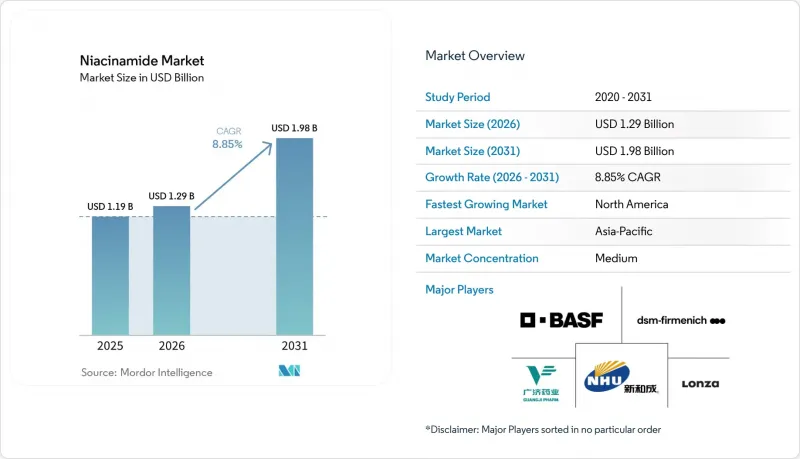
預計菸鹼醯胺市場將從 2025 年的 11.9 億美元成長到 2026 年的 12.9 億美元,然後在 2031 年達到 19.8 億美元,2026 年至 2031 年的複合年成長率為 8.85%。
本報告按形態(粉末、顆粒、液體)、等級(醫藥級、飼料級等)、應用領域(化妝品/個人護理、藥品等)、最終用戶(製藥公司、化妝品製造商等)和地區(北美、歐洲、亞太、中東和非洲、南美)進行細分。市場預測以美元計價。
全球菸鹼醯胺市場趨勢與洞察
廣泛採用皮膚科醫生認可的護膚產品
隨著菸鹼醯胺不再只是被視為護膚中的維生素添加劑,其市場正獲得皮膚科醫生的更多支持。 2025年發表在《皮膚病學與治療》(Dermatology and Therapy)雜誌上的一項隨機試驗進一步證實了煙醯胺在預防有色人種炎症後色素沉著方面的功效,從而擴大了該成分的臨床應用範圍,使其惠及更廣泛的消費者群體。這些因素——包括增強皮膚屏障功能、改善色素沉著以及適用於廣泛的患者群體——共同維持了菸鹼醯胺在產品配方中的地位,即便其他活性成分也獲得了大量的市場關注。此外,化妝品行業對煙鹼醯胺的高度監管認可也為其市場提供了支持,這降低了品牌重新配方的風險,並簡化了供應商的選擇。隨著品牌圍繞臨床認可的活性成分建立產品線,菸鹼醯胺市場正受益於其在精華液、保濕霜、防曬油及相關個人保健產品的持續應用。
擴大菸鹼醯胺在藥物應用的使用
菸鹼醯胺市場也受惠於其在醫藥領域的應用,在這些領域,買家更加重視合規性、純度和供應可靠性。分析顯示,菸鹼醯胺的應用範圍已從傳統的缺乏症治療擴展到NAD+相關用途、癌症治療輔助以及處方箋皮膚科,從而提升了醫藥級原料在菸鹼醯胺市場的價值。這一趨勢意義重大,因為與消費品化妝品和飼料行業相比,醫藥行業的需求往往對價格有著更嚴格的把控,尤其是在供應商核准需要符合cGMP規範並提供批次文件的情況下。因此,菸鹼醯胺市場呈現出更為明顯的兩極化,即通用產品與用於受監管或嚴格控制應用的高規格產品之間存在著明顯的差異。隨著下游買家逐漸減少採購非專利產品,對可追溯通路和更高級生產商的需求進一步加劇了這種兩極化。整體而言,醫藥產業的定位既支撐了菸鹼醯胺市場的深厚需求,也支撐了更強勁的高階市場。
通用等級石油生產商施加的價格壓力
由於菸鹼醯胺供應仍集中在通用級產品,生產商主要透過價格競爭,因此菸鹼醯胺市場正面臨壓力。這種趨勢在飼料級和標準化妝品級菸鹼醯胺供應中最為明顯,這些產品的利潤率保障仍然脆弱,需求下降可能立即引發整個菸鹼醯胺市場的價格壓力。這也是為什麼中型生產商的處境比中國的大型供應商或更具差異化的優質級生產商更為艱難的原因。 DSM-Firmenich 於 2026 年 2 月同意徵兆22 億歐元的價格將其動物營養和保健業務(包括維生素)出售給 CVC Capital Partners,就是一個重要的佐證。這表明歐洲大型企業對低利潤率的維生素業務的興趣正在減弱。因此,菸鹼醯胺市場存在一個清晰的大宗商品細分市場,即使整體需求看起來強勁,價格復甦也可能仍然波動不定。這種壓力促使採購團隊專注於擴大規模、穩定成本以及應對低附加價值細分市場供應商集中所帶來的風險。
細分市場分析
截至2025年,粉狀菸鹼醯胺將佔市場佔有率的52.76%,並將成為菸鹼醯胺市場的主導形態,這主要歸功於其適用於製藥、營養補充劑和食品加工等行業成熟的生產過程。粉末狀菸鹼醯胺的優點在於其較長的保存期限、易於混合以及與廣泛使用的壓片和噴霧乾燥封裝系統的兼容性。顆粒狀菸鹼醯胺仍是次要形態,在飼料應用中發揮更重要的作用,因為飼料應用需要在大規模混合過程中保持無塵操作。液體狀菸鹼醯胺目前的銷售量小規模,但預計到2031年將以9.77%的複合年成長率成長,因為菸鹼醯胺市場正向更精準的化妝品和注射應用領域轉型。這一成長趨勢表明,菸鹼醯胺市場價值的成長未必完全來自主流形態,而是往往來自滿足更專業配方需求的形態。
由於精華液和溶液型產品需要比許多粉末系統更穩定的溶解度和更精確的濃度控制,液態製劑的重要性日益凸顯。這一點尤其重要,因為品牌商正在追求更純淨的配方和設計,盡可能減少添加劑,而直接使用液態製劑可以減少生產步驟,並最大限度地降低批次間差異的可能性。 2026 年發表在《藥物創新雜誌》(Journal of Pharmaceutical Innovation) 上的一項關於脂質體遞送的研究也支持了液相系統在高級皮膚病學應用中的長期吸引力,因為更優的載體設計能夠提高滲透性和成分穩定性。雖然在操作效率比配方性能更重要的情況下,顆粒狀物料仍然有用,但在菸鹼醯胺市場創造價值的領域,其重要性正在下降。從這個意義上講,預計菸鹼醯胺市場將以粉末形式繼續保持其核心地位,而液態製劑將佔據高成長領域。
到2025年,藥用級菸鹼醯胺將佔市場價值的38.13%,在所有等級中佔據最大佔有率,並為菸鹼醯胺市場的銷售量提供關鍵支撐。其地位得益於已確立的治療應用以及與NAD+相關應用的新興研究興趣,從而有助於維持除基礎缺乏症治療之外的需求。此外,由於cGMP合規性和文件記錄構成了相當大的進入門檻,認證來源不像學名藥那樣容易被替代,這也有利於藥用級菸鹼醯胺的發展。雖然飼料級菸鹼醯胺的銷售量仍然可觀,但其價格最低,因此對維持菸鹼醯胺市場整體價值的貢獻較小。因此,藥用級菸鹼醯胺不僅在維持當前市場規模方面發揮至關重要的作用,而且在維持菸鹼醯胺市場更穩定的價格地位方面也發揮關鍵作用。
化妝品級菸鹼醯胺是成長最快的等級,預計到2031年將以10.23%的複合年成長率成長。這顯示市場正朝著高階價值方向發展。該細分市場的買家不僅更加重視數量,還更加重視殘留物控制、純度證書、原產地標籤以及符合審核要求的文件。這一趨勢意義重大,因為在菸鹼醯胺市場,能夠滿足大宗原料需求並提供品牌差異化服務的供應商越來越受到青睞。分析也顯示,市場對生物合成來源證明和永續性記錄的需求日益成長,這也是高階化妝品級菸鹼醯胺即使整體供應量較低,也能超越傳統原料的原因之一。因此,菸鹼醯胺市場正日益呈現等級分化的趨勢,醫藥級菸鹼醯胺保持其市場地位,而化妝品級菸鹼醯胺似乎正在推動價值的顯著提升。
區域分析
2025年,亞太地區佔據了全球菸鹼醯胺市場42.15%的佔有率,並持續保持其最大區域市場的地位。這一主導地位源於其強大的生產體係以及涵蓋化妝品、營養補充劑和醫藥等廣泛下游應用的消費模式。該地區還擁有從通用型產品到高階高級產品的全系列供應體系,使其能夠同時滿足菸鹼醯胺市場的多個細分領域。業內相關人員指出,中國是主要的生產基地和具有成本競爭力的主要供應來源,並且在這一市場結構中仍然佔據核心地位。同時,韓國和日本則扮演不同的角色,推動皮膚科和高階護膚領域對高純度原料的需求。
這種組合使亞太地區在菸鹼醯胺市場擁有雙重優勢,既支持擴大生產規模,又促進高階需求的形成。北美是成長最快的地區,預計到2031年將以9.69%的複合年成長率成長。這反映了臨床護膚、膳食補充劑和藥品製劑領域強勁的需求動能。由於FDA 2026年「人類食品計畫」優先事項的實施,企業對文件和合規品質的關注度日益提高,美國法規環境在供應商選擇中的重要性也隨之增加。 FDA根據21 CFR 184.1535核准菸鹼醯胺,也凸顯了其在食品相關應用中的既有地位。在菸鹼醯胺市場,北美擁有最清晰的市場環境之一,更嚴格的監管和高階定位支撐著價值的快速成長。
歐洲仍然是菸鹼醯胺的重要市場,擁有穩定的法律規範和規範的膳食補充劑及化妝品管道。該地區基於歐盟法規的食品強化框架,以及2023年菸鹼酸製劑的相關更新表明,菸鹼醯胺市場並非一成不變,而是仍在積極監管中。此外,德國聯邦風險評估研究所提案膳食補充劑中菸鹼醯胺的每日攝取量上限為160毫克,這正在影響膳食補充劑管道的配方規範。
其他好處:
- Excel格式的市場預測(ME)表
- 3個月的分析師支持
目錄
第1章:引言
- 研究假設和市場定義
- 調查範圍
第2章:調查方法
第3章執行摘要
第4章 市場狀況
- 市場概覽
- 市場促進因素
- 皮膚科醫生推薦的護膚產品被廣泛採用
- 煙鹼醯胺在藥物應用上的擴展用途
- 食品營養強化及擴大營養保健品標章範圍
- 擴大亞洲製造業叢集的生產能力
- 消費者級原料的故事敘述與臨床功效檢驗
- 透過多通路採購和區域庫存降低供應鏈風險。
- 市場限制因素
- 來自大宗商品生產商的價格壓力
- 配方穩定性和pH相容性的限制
- 化妝品和保健品功效聲明相關法規的差異
- 取代其他屏障修復活性成分的風險
- 供應鏈分析
- 監理情勢
- 技術展望
- 波特五力分析
第5章 市場規模與成長預測
- 按形式
- 粉末
- 顆粒狀
- 液體
- 按年級
- 醫藥級
- 飼料級
- 食品級
- 化妝品級
- 透過使用
- 化妝品和個人護理
- 護膚品
- 護髮產品
- 製藥
- 維生素缺乏症的治療
- 心血管支持
- 食品/飲料
- 人類營養
- 動物營養
- 化妝品和個人護理
- 最終用戶
- 製藥公司
- 化妝品製造商
- 食品和飲料公司
- 營養保健品公司
- 飼料生產商
- 按地區
- 北美洲
- 美國
- 加拿大
- 墨西哥
- 歐洲
- 德國
- 英國
- 法國
- 義大利
- 西班牙
- 其他歐洲國家
- 亞太地區
- 中國
- 印度
- 日本
- 韓國
- 澳洲
- 其他亞太國家
- 中東和非洲
- GCC
- 南非
- 其他中東和非洲國家
- 南美洲
- 巴西
- 阿根廷
- 其他南美國家
- 北美洲
第6章 競爭情勢
- 市場集中度
- 市佔率分析
- 公司簡介
- Aurorium
- Bactolac Pharmaceutical, Inc.
- BASF SE
- dsm-firmenich AG
- Evonik Industries AG
- Fagron NV
- Foodchem International Corporation
- Hubei Guangji Pharmaceutical Co., Ltd.
- Jubilant Life Sciences Limited
- Kyowa Hakko Bio Co., Ltd.
- Lasons India Pvt. Ltd.
- Lonza Group AG
- Merck KGaA
- Shandong Hongda Biotechnology Co., Ltd.
- Vanetta
- Vertellus Holdings LLC
- Zhejiang Lanbo Biotechnology Co., Ltd.
- Zhejiang NHU Co., Ltd.
第7章 市場機會與未來展望
According to Mordor Intelligence, the niacinamide market size is expected to grow from USD 1.19 billion in 2025 to USD 1.29 billion in 2026 and is forecast to reach USD 1.98 billion by 2031 at 8.85% CAGR over 2026-2031.
This report is Segmented by Form (Powder, Granular, Liquid), by Grade (Pharmaceutical Grade, Feed Grade, and More), by Application (Cosmetics and Personal Care, Pharmaceuticals, and More), by End User (Pharmaceutical Companies, Cosmetic Manufacturers, and More), and Geography (North America, Europe, Asia-Pacific, Middle East & Africa, South America). The Market Forecasts are Provided in Terms of Value (USD).
Global Niacinamide Market Trends and Insights
Expanding Dermatology-Backed Skincare Adoption
The Niacinamide market is benefiting from stronger dermatology support because the ingredient is no longer treated as a simple vitamin additive in skincare. A 2025 randomized trial in Dermatology and Therapy also supported niacinamide use for preventing post inflammatory hyperpigmentation in skin of color populations, which broadens the clinical relevance of the ingredient across more consumer groups. That combination of barrier support, pigment management, and broad patient relevance helps the Niacinamide market retain formulation space even as other actives receive strong marketing attention. The Niacinamide market is also supported by regulatory familiarity in cosmetics, which lowers reformulation risk for brands and makes supplier qualification more straightforward. As brands build lines around clinically recognized actives, the Niacinamide market gains from repeat use in serums, moisturizers, sunscreens, and adjacent personal care formats.
Growth in Pharmaceutically Positioned Niacinamide Use
The Niacinamide market is also being supported by its role in more pharmaceutically positioned applications, where buyers place greater weight on compliance, purity, and supply assurance. The analysis indicates growth beyond traditional deficiency treatment into NAD+-related uses, oncology support settings, and prescription dermatology, increasing the value profile of pharmaceutical-grade material within the niacinamide market. This trend matters because pharmaceutical demand typically supports stronger pricing discipline than mass cosmetic or feed channels, especially when supplier approval requires cGMP status and batch documentation. As a result, the niacinamide market is showing a clearer split between commodity output and higher-specification supply for regulated or closely supervised applications. The need for traceable distribution channels and better-qualified manufacturers further reinforces this split as downstream buyers move away from generic sourcing. Overall, pharmaceutical positioning supports both demand depth and a more defensible premium tier in the niacinamide market.
Price Pressure from Commodity-Grade Producers
The niacinamide market faces pressure as supply remains concentrated in commodity-grade output, with producers competing primarily on price. This trend is most evident in feed-grade and standard cosmetic-grade supply, where margin protection remains weaker, and any downturn in demand can quickly renew pricing pressure across the niacinamide market. This is also why mid-scale producers face a harder position than either very large Chinese suppliers or better differentiated premium-grade manufacturers. A major sign of this pressure was DSM-Firmenich's February 2026 agreement to divest its Animal Nutrition and Health business, including vitamins, to CVC Capital Partners for an enterprise value of EUR 2.2 billion, which signals less appetite among European majors for lower margin vitamin exposure. The Niacinamide market, therefore, has a clear commodity segment where price recovery can remain fragile even when broader demand looks solid. That pressure keeps procurement teams focused on scale, cost stability, and the risk of supplier concentration in lower-value segments.
Other drivers and restraints analyzed in the detailed report include:
- Food Fortification and Nutraceutical Label Expansion
- Capacity Expansion in Asia-Based Manufacturing Clusters
- Formulation Stability and pH Compatibility Constraints
For complete list of drivers and restraints, kindly check the Table Of Contents.
Segment Analysis
Powder held 52.76% of market value in 2025, which makes it the core volume format in the Niacinamide market because it fits established manufacturing routines across pharmaceuticals, nutraceuticals, and food processing. Its position is supported by long shelf life, easy blending, and compatibility with tablet compression and spray dry encapsulation systems used at scale. Granular form remained a secondary format and stayed more relevant in feed applications where dust-free handling is useful in large volume mixing. Liquid form was smaller in current volume terms, but it is forecast to grow at a 9.77% CAGR through 2031 as the Niacinamide market shifts toward more precise cosmetic and injectable uses. That growth profile shows that value expansion in the Niacinamide market is not always coming from the dominant format, but often from the one that solves more specialized formulation needs.
Liquid form is gaining importance because serum and solution-based products need consistent dissolution and tighter concentration control than many powder systems provide. This is especially relevant as brands pursue cleaner formulas and minimal excipient designs, where direct liquid incorporation can reduce processing steps and lower the chance of batch inconsistency. The 2026 liposomal delivery work in the Journal of Pharmaceutical Innovation also supports the longer-term appeal of liquid phase systems for advanced dermatological use, since better carrier design can improve permeation and ingredient stability. Granular material should remain useful where handling efficiency matters more than premium formulation performance, but it is less central to where the Niacinamide market is creating value. In that sense, the Niacinamide market is likely to keep powder as the anchor format while allowing liquid to capture the higher growth lane.
Pharmaceutical grade held 38.13% of the market value in 2025, which gave it the largest grade position and established an important volume floor for the Niacinamide market. Its role is supported by both established therapeutic use and newer research interest linked to NAD+ related applications, which helps maintain demand beyond basic deficiency treatment. This segment also benefits from the fact that cGMP compliance and documentation create practical entry barriers, so qualified supply is not as easily replaced as commodity output. Feed grade still absorbed meaningful tonnage, but it sat at the lowest end of pricing and contributed less to value protection across the Niacinamide market. That makes pharmaceutical grade important not only for current size, but also for holding a more stable pricing position inside the Niacinamide market.
Cosmetic grade is the fastest-growing grade and is projected to expand at a 10.23% CAGR through 2031, which shows where much of the premium value shift is occurring. Buyers in this segment place more weight on residual controls, purity certificates, origin claims, and audit-ready documentation than on volume alone. That preference matters because the Niacinamide market is increasingly rewarding suppliers that can serve brand-level differentiation rather than only bulk ingredient demand. The analysis also indicated stronger demand for biosynthetic origin credentials and sustainability records, which helps explain why premium cosmetic supply can outperform ordinary material, even when overall volumes are smaller. The niacinamide market, therefore, appears increasingly two-tiered by grade, with pharmaceutical supply preserving the base and cosmetic grade driving stronger value uplift.
Complete Report Scope:
- By Form
- Powder
- Granular
- Liquid
- By Grade
- Pharmaceutical Grade
- Feed Grade
- Food Grade
- Cosmetic Grade
- By Application
- Cosmetics and Personal Care
- Skincare Products
- Haircare Products
- Pharmaceuticals
- Vitamin Deficiency Treatment
- Cardiovascular Support
- Food and Beverages
- Human Nutrition
- Animal Nutrition
- Cosmetics and Personal Care
- By End User
- Pharmaceutical Companies
- Cosmetic Manufacturers
- Food and Beverage Companies
- Nutraceutical Companies
- Animal Feed Producers
- By Geography
- North America
- United States
- Canada
- Mexico
- Europe
- Germany
- United Kingdom
- France
- Italy
- Spain
- Rest of Europe
- Asia-Pacific
- China
- India
- Japan
- South Korea
- Australia
- Rest of Asia-Pacific
- Middle East and Africa
- GCC
- South Africa
- Rest of Middle East and Africa
- South America
- Brazil
- Argentina
- Rest of South America
- North America
Geography Analysis
Asia-Pacific held 42.15% of the Niacinamide market size in 2025, which kept it as the largest regional block in the Niacinamide market. Its lead comes from the combination of production depth and broad downstream consumption across cosmetics, nutrition, and pharmaceutical uses. The region also benefits from a supply base that ranges from commodity volume to more qualified premium output, which allows it to serve several tiers of the Niacinamide market at once. China remains central to this structure, as industry sources identify it as the leading production hub and a major source of cost-competitive supply. South Korea and Japan play a different role, driving demand for high-purity materials used in dermatology-linked and prestige skincare channels.
That combination gives Asia-Pacific a dual advantage in the Niacinamide market because it supports both manufacturing scale and premium demand formation. North America is the fastest-growing geography and is projected to expand at a 9.69% CAGR through 2031, which reflects strong momentum in clinical skincare, supplements, and pharmaceutical compounding demand. The U.S. regulatory environment is becoming more important in supplier selection because implementation activity tied to the FDA's 2026 Human Foods Program priorities is raising attention on documentation and compliance quality. The FDA's recognition of niacinamide under 21 CFR 184.1535 also supports its established role in food-related applications. For the Niacinamide market, North America offers one of the clearest settings where stronger regulation and premium positioning support faster value growth.
Europe remains important because it brings stable regulatory frameworks and disciplined supplement and cosmetic channels to the Niacinamide market. The region's food fortification structure under EU regulation and its 2023 update on niacin forms show that the category remains actively governed rather than mature and static. Germany's Federal Institute for Risk Assessment has also proposed a maximum of 160 mg per day for nicotinamide in food supplements, which influences formulation discipline in the supplement channel.
- Aurorium
- Bactolac Pharmaceutical, Inc.
- BASF
- dsm-firmenich AG
- Evonik Industries
- Fagron
- Foodchem International
- Hubei Guangji Pharmaceutical Co., Ltd.
- Jubilant Group
- Kyowa Hakko Bio Co., Ltd.
- Lasons India Pvt. Ltd.
- Lonza Group
- Merck
- Shandong Hongda Biotechnology Co., Ltd.
- Vanetta
- Vertellus Holdings
- Zhejiang Lanbo Biotechnology Co., Ltd.
- Zhejiang NHU
Additional Benefits:
- The market estimate (ME) sheet in Excel format
- 3 months of analyst support
TABLE OF CONTENTS
1 INTRODUCTION
- 1.1 Study Assumptions and Market Definition
- 1.2 Scope of the Study
2 RESEARCH METHODOLOGY
3 EXECUTIVE SUMMARY
4 MARKET LANDSCAPE
- 4.1 Market Overview
- 4.2 Market Drivers
- 4.2.1 Expanding Dermatology-Backed Skincare Adoption
- 4.2.2 Growth in Pharmaceutically Positioned Niacinamide Use
- 4.2.3 Food Fortification and Nutraceutical Label Expansion
- 4.2.4 Capacity Expansion in Asia-Based Manufacturing Clusters
- 4.2.5 Direct-to-Consumer Ingredient Storytelling and Clinical Claim Validation
- 4.2.6 Supply-Chain De-Risking Through Multi-Sourcing and Regional Stocking
- 4.3 Market Restraints
- 4.3.1 Price Pressure From Commodity-Grade Producers
- 4.3.2 Formulation Stability and pH Compatibility Constraints
- 4.3.3 Regulatory Fragmentation Across Cosmetic and Supplement Claims
- 4.3.4 Substitution Risk From Alternative Barrier-Repair Actives
- 4.4 Supply Chain Analysis
- 4.5 Regulatory Landscape
- 4.6 Technological Outlook
- 4.7 Porter's Five Forces Analysis
- 4.7.1 Bargaining Power of Suppliers
- 4.7.2 Bargaining Power of Buyers
- 4.7.3 Threat of New Entrants
- 4.7.4 Threat of Substitutes
- 4.7.5 Competitive Rivalry
5 MARKET SIZE AND GROWTH FORECASTS (VALUE, USD)
- 5.1 By Form
- 5.1.1 Powder
- 5.1.2 Granular
- 5.1.3 Liquid
- 5.2 By Grade
- 5.2.1 Pharmaceutical Grade
- 5.2.2 Feed Grade
- 5.2.3 Food Grade
- 5.2.4 Cosmetic Grade
- 5.3 By Application
- 5.3.1 Cosmetics and Personal Care
- 5.3.1.1 Skincare Products
- 5.3.1.2 Haircare Products
- 5.3.2 Pharmaceuticals
- 5.3.2.1 Vitamin Deficiency Treatment
- 5.3.2.2 Cardiovascular Support
- 5.3.3 Food and Beverages
- 5.3.4 Human Nutrition
- 5.3.5 Animal Nutrition
- 5.3.1 Cosmetics and Personal Care
- 5.4 By End User
- 5.4.1 Pharmaceutical Companies
- 5.4.2 Cosmetic Manufacturers
- 5.4.3 Food and Beverage Companies
- 5.4.4 Nutraceutical Companies
- 5.4.5 Animal Feed Producers
- 5.5 By Geography
- 5.5.1 North America
- 5.5.1.1 United States
- 5.5.1.2 Canada
- 5.5.1.3 Mexico
- 5.5.2 Europe
- 5.5.2.1 Germany
- 5.5.2.2 United Kingdom
- 5.5.2.3 France
- 5.5.2.4 Italy
- 5.5.2.5 Spain
- 5.5.2.6 Rest of Europe
- 5.5.3 Asia-Pacific
- 5.5.3.1 China
- 5.5.3.2 India
- 5.5.3.3 Japan
- 5.5.3.4 South Korea
- 5.5.3.5 Australia
- 5.5.3.6 Rest of Asia-Pacific
- 5.5.4 Middle East and Africa
- 5.5.4.1 GCC
- 5.5.4.2 South Africa
- 5.5.4.3 Rest of Middle East and Africa
- 5.5.5 South America
- 5.5.5.1 Brazil
- 5.5.5.2 Argentina
- 5.5.5.3 Rest of South America
- 5.5.1 North America
6 COMPETITIVE LANDSCAPE
- 6.1 Market Concentration
- 6.2 Market Share Analysis
- 6.3 Company Profiles (includes Global Level Overview, Market Level Overview, Core Segments, Financials as available, Strategic Information, Market Rank/Share, Products and Services, Recent Developments)
- 6.3.1 Aurorium
- 6.3.2 Bactolac Pharmaceutical, Inc.
- 6.3.3 BASF SE
- 6.3.4 dsm-firmenich AG
- 6.3.5 Evonik Industries AG
- 6.3.6 Fagron NV
- 6.3.7 Foodchem International Corporation
- 6.3.8 Hubei Guangji Pharmaceutical Co., Ltd.
- 6.3.9 Jubilant Life Sciences Limited
- 6.3.10 Kyowa Hakko Bio Co., Ltd.
- 6.3.11 Lasons India Pvt. Ltd.
- 6.3.12 Lonza Group AG
- 6.3.13 Merck KGaA
- 6.3.14 Shandong Hongda Biotechnology Co., Ltd.
- 6.3.15 Vanetta
- 6.3.16 Vertellus Holdings LLC
- 6.3.17 Zhejiang Lanbo Biotechnology Co., Ltd.
- 6.3.18 Zhejiang NHU Co., Ltd.
7 MARKET OPPORTUNITIES AND FUTURE OUTLOOK
- 7.1 White-Space and Unmet-Need Assessment

 菸鹼醯胺市場-2026-2032年全球市場預測
 煙醯胺腺嘌呤二核苷酸 (NAD) 市場規模、佔有率和成長分析:按產品類型、劑型、應用和地區分類-2026-2033 年產業預測
 菸鹼醯胺市場 - 全球產業規模、佔有率、趨勢、機會、預測:銷售管道、最終用途、地區和競爭格局,2021-2031年
 2026年煙醯胺腺嘌呤二核苷酸全球市場報告2026年菸鹼醯胺核苷(NR)全球市場報告
 全球菸鹼酸(維生素B3)市場規模、佔有率、趨勢和成長分析報告(2026-2034年)菸鹼醯胺市場-全球產業規模、佔有率、趨勢、機會、預測:按類型、最終用戶、地區和競爭格局分類,2021-2031年
 煙醯胺腺嘌呤二核苷酸市場規模、佔有率和趨勢分析報告:按產品、分銷管道、地區和細分市場預測(2025-2033 年)
 全球經皮菸鹼醯胺市場:2032 年預測 - 按產品形式、分銷管道、應用和地區分析
 全球煙醯胺腺嘌呤二核苷酸市場