


 |
市場調查報告書
商品編碼
2117464
燃料電池動力傳動系統:市場佔有率分析、產業趨勢與統計、成長預測(2026-2031)Fuel Cell Powertrain - Market Share Analysis, Industry Trends & Statistics, Growth Forecasts (2026 - 2031) |
||||||

※ 本網頁內容可能與最新版本有所差異。詳細情況請與我們聯繫。
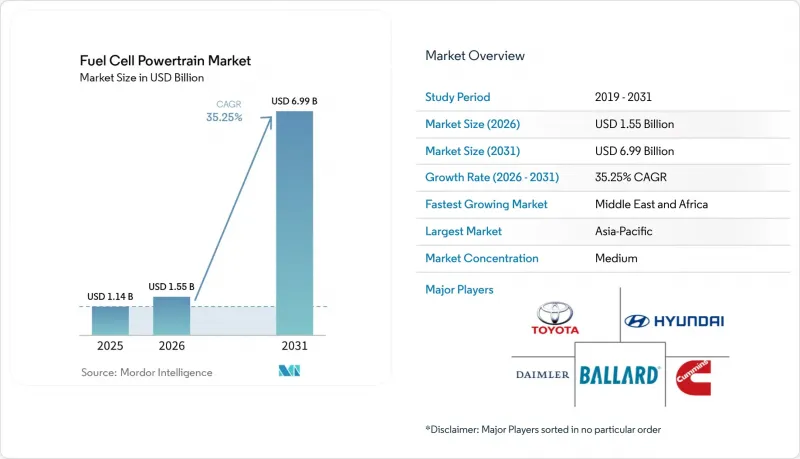
據 Mordor Intelligence 稱,燃料電池動力傳動系統市場在 2025 年的價值為 11.4 億美元,預計到 2026 年將達到 15.5 億美元,到 2031 年將達到 69.9 億美元,從 2026 年到 2031 年的複合年成長率為 35.25%。
本報告按組件類型(燃料電池系統、電池系統等)、驅動方式(後輪驅動、前輪驅動等)、車輛類型(乘用車、輕型商用車等)、功率輸出(150千瓦以下、150-250千瓦、其他)和地區進行細分。市場預測以美元計價。
全球燃料電池動力傳動系統市場趨勢及洞察
政府排放氣體法規旨在加速零排放車輛的普及
加州的「先進清潔汽車II」法規要求到2035年,所有輕型車輛銷售必須為零排放車輛;美國環保署的「重型車輛綜合排放標準」限制了2027款卡車的氮氧化物排放量;中國已將購置稅豁免期限延長至2027年。所有這些措施都在壓縮整車製造商的生產週期,並推動車輛在負載容量至關重要的領域轉向氫能解決方案。歐盟的「替代燃料基礎設施法規」要求到2030年,在整個泛歐交通運輸網路(TEN-T)走廊沿線每200公里設置一座加氫站,從而緩解跨境貨運對續航里程的擔憂。 2025年,德國制定了一項願景,計劃在2030年大幅增加公共加氫站的數量,並撥款大量資金以促進國內加氫技術的普及。因此,燃料電池動力傳動系統市場的相關人員意識到,監管措施對塑造中期需求趨勢的影響比技術進步更為顯著。
燃料電池堆耐久性和成本的突破性進展
本田公司發布了新一代燃料電池模組,透過最佳化膜電極組件提高了效率。這項創新不僅延長了模組的使用壽命,還顯著降低了成本。同樣,豐田的第三代燃料電池堆透過材料應用的技術進步,在耐久性方面取得了顯著成果。此外,CelCentric 的最新型號提高了功率密度,並展現出卓越的耐久性。這些技術進步的結合,正在縮小燃料電池汽車與柴油汽車的總擁有成本 (TCO) 差距,並增強人們對燃料電池動力傳動系統市場的信心。
與純電動車相比,初始成本差異
塔塔汽車公司發現,印度公車市場存在顯著的成本溢價,並估計需要數年營運才能實現與氫燃料電池公車價格持平。同時,阿貢國家實驗室指出,只有在實現一定程度的成本降低(取決於大規模生產)後,才能實現價格持平。因此,車輛管理方將氫燃料電池公車的使用限制在電池安裝額外成本超過成本溢價的線路上。
細分市場分析
700巴IV型儲氫槽的重量比提升了6.8%,從而擴大了負載容量裕度,預計氫氣儲存系統將以35.88%的複合年成長率成長,超過燃料電池動力傳動系統市場的整體成長率。儘管燃料電池系統預計到2025年仍將佔銷售額的48.17%,因為電堆仍然是其價值基礎,但Cellcentric的模組化設計將製造複雜性降低了40%,這意味著燃料電池的商品化將很快成為現實。
NPROXX的軟性儲氫罐在不增加軸距的情況下,可將可用氫氣量提高18%;博世的碳化矽逆變器可將開關損耗降低30%,這標誌著燃料電池動力傳動系統市場子系統創新取得了豐碩成果。康明斯在電解槽和電堆方面的垂直整合預示著承包工程的出現,這將簡化OEM採購流程並加快保固回應速度。
到2025年,後輪驅動將佔據主導地位,市場佔有率達到54.22%,因為單軸佈局能夠以最低的成本滿足城市和區域間運輸的需求。至2031年,全輪驅動的複合年成長率將達到36.01%。這主要是由於垃圾車、礦用車輛和軍用車輛需要扭矩向量控制來應對惡劣地形,從而擴大了燃料電池動力傳動系統的潛在市場。
戴姆勒正在測試其液氫動力牽引車的雙軸6x4配置,以確保其在冰雪路面上的牽引力。同時,Volvo認為,考慮到車輛陷車造成的停機時間,投資增設馬達是合理的。雖然後輪驅動配置在長途運輸車隊中仍然佔據主導地位,但到2031年,全輪驅動配置預計將獲得顯著的市場佔有率。這種轉變源自於燃料電池動力傳動系統市場開始適應先前由柴油引擎驅動的4x4和6x6底盤主導的營運週期。
區域分析
到2025年,亞太地區將佔全球銷售量的40.12%。這主要得益於中國和日本等國政府的補貼政策,這些政策支持了燃料電池卡車和乘用車的推廣應用。這些支持鞏固了亞太地區在燃料電池動力傳動系統市場的領先地位。現代汽車已設定了雄心勃勃的目標,並規劃2030年實現商用燃料電池電動車(FCEV)的年銷售目標。同時,印度正投入巨資設立專款,以促進電解槽的在地化生產,凸顯了多國之間的協同努力。在中國,示範叢集透過營運補貼鼓勵早期車輛部署,進一步鞏固了中國在燃料電池動力傳動系統市場的主導地位。
同時,中東和非洲正崛起為成長最快的地區,年複合成長率高達36.41%,主要得益於產油國將重心轉向綠色氫能。 NEOM的電解槽計畫預計到2026年將實現顯著的產量,滿足國內工程車輛和出口需求,從而推動該地區燃料電池市場的發展。阿拉伯聯合大公國、埃及和南非等國不僅投入公共資金開展試點公車項目,還利用其國內鉑金蘊藏量來確保催化劑的穩定供應,有效填補了燃料電池生態系統的缺口。
在歐洲,「替代燃料基礎設施法規」取得了成功,該法規強制要求定期建造加氫站。這項措施不僅促進了跨境貨運,也刺激了歐洲燃料電池市場的發展。德國正因其旨在2030年大幅擴展公共交通的投資而備受關注。同時,英國的「Element 2」計畫將建造多個樞紐,進一步提高網路密度。在北美,能源部提供的樞紐津貼金和加州的低碳燃料標準(LCFS)積分使洛杉磯港和長灘港處於關鍵地位。南美洲仍處於起步階段,但巴西和智利已製定了雄心勃勃的目標,這表明燃料電池動力傳動系統市場具有巨大的成長潛力。
其他好處:
- Excel格式的市場預測(ME)表
- 3個月的分析師支持
目錄
第1章:引言
- 研究假設和市場定義
- 調查範圍
第2章:調查方法
第3章執行摘要
第4章 市場狀況
- 市場概覽
- 市場促進因素
- 政府的排放法規正在加速零排放汽車的普及。
- 燃料電池堆耐久性和成本的突破性進展
- 氫氣加註通道的快速發展
- 原始設備製造商為燃料電池重型車輛車隊所做的努力
- 車載綠色氨裂解氫氣的綜效
- 國防部門對無人地面系統靜音動力傳動系統的需求
- 市場限制因素
- 純電動車的資本成本溢價
- 氫氣生產和物流方面的限制因素
- 車載氫氣儲存的安全性和監管挑戰
- 鎳價波動對PT-NI催化劑的影響
- 價值供應鏈分析
- 監理情勢
- 技術展望
- 波特五力模型
第5章 市場規模與成長預測
- 依組件類型
- 燃料電池系統
- 電池系統
- 驅動系統
- 氫氣儲存系統
- 其他
- 透過驅動系統
- 後輪驅動(RWD)
- 前輪驅動(FWD)
- 全輪驅動(AWD)
- 按車輛類型
- 搭乘用車
- 輕型商用車(LCV)
- 公車
- 追蹤
- 依輸出類型
- 小於150千瓦
- 150~250 kW
- 250度或以上
- 按地區
- 北美洲
- 美國
- 加拿大
- 其他北美國家
- 南美洲
- 巴西
- 阿根廷
- 其他南美國家
- 歐洲
- 英國
- 德國
- 西班牙
- 義大利
- 法國
- 俄羅斯
- 其他歐洲國家
- 亞太地區
- 印度
- 中國
- 日本
- 韓國
- 其他亞太國家
- 中東和非洲
- 阿拉伯聯合大公國
- 沙烏地阿拉伯
- 土耳其
- 埃及
- 南非
- 其他中東和非洲國家
- 北美洲
第6章 競爭情勢
- 市場集中度
- 策略趨勢
- 市佔率分析
- 公司簡介
- Toyota Motor Corporation
- Hyundai Motor Company
- Honda Motor Co., Ltd.
- Daimler Truck AG
- Ballard Power Systems Inc.
- Cummins Inc.
- General Motors Company
- Nikola Corporation
- Robert Bosch GmbH
- Plug Power Inc.
- Doosan Fuel Cell Co., Ltd.
- Horizon Fuel Cell Technologies
- Proton Motor Power Systems plc
- Tata Motors Limited
- Wrightbus
第7章 市場機會與未來展望
According to Mordor Intelligence, the fuel cell powertrain market size was valued at USD 1.14 billion in 2025, is expected to reach USD 1.55 billion in 2026, and to reach USD 6.99 billion by 2031, growing at a CAGR of 35.25% over 2026-2031.
This report is Segmented by Component Type (Fuel Cell System, Battery System, and More), Drive Type (Rear Wheel Drive (RWD), Front Wheel Drive (FWD), and More), Vehicle Type (Passenger Cars, Light Commercial Vehicles (LCV), and More), Power Output (Less Than 150 KW, 150-250 KW, and More), and Geography. The Market Forecasts are Provided in Terms of Value (USD).
Global Fuel Cell Powertrain Market Trends and Insights
Government Emission Mandates Accelerating Zero-Emission Adoption
California's Advanced Clean Cars II rule locks in 100% zero-emission light-duty sales by 2035, the EPA's Heavy-Duty Omnibus limits NOx for 2027 trucks, and China extends purchase-tax exemptions through 2027, all compressing OEM timelines and driving fleets toward hydrogen solutions for payload-sensitive segments . The EU's Alternative Fuels Infrastructure Regulation requires hydrogen stations every 200 km across TEN-T corridors by 2030, mitigating range anxiety for cross-border freight. In 2025, Germany allocated significant funding with a vision to substantially increase its public stations by 2030, bolstering domestic adoption. As a result, players in the fuel cell powertrain market discern a stronger influence from regulatory measures over technological advancements in shaping medium-term demand trends.
Breakthroughs in Fuel-Cell Stack Durability and Cost
Honda has introduced its next-generation module, delivering improved efficiency through optimized membrane-electrode assemblies. This innovation significantly reduces costs while extending the module's lifespan. Similarly, Toyota's third-generation stack has achieved a notable milestone in durability by implementing advancements in material usage. Additionally, Cellcentric's latest model enhances power density and demonstrates impressive durability. These technological developments collectively narrow the total-cost-of-ownership gap with diesel, strengthening confidence in the fuel cell powertrain market.
Capital Cost Premium Vs. BEVs
Tata Motors has identified a significant bus premium in India, estimating that it would take several years of service to achieve price parity with hydrogen. Meanwhile, Argonne National Laboratory suggests that purchase-price parity is possible only if certain cost reductions are achieved, which depend on large-scale production volumes. As a result, fleet managers are limiting hydrogen use to routes where the added costs of battery payloads are more significant than the premium.
Other drivers and restraints analyzed in the detailed report include:
- Rapid Build-Out of Hydrogen Refueling Corridors
- OEM Commitments to Fuel-Cell Heavy-Duty Fleets
- Constrained Hydrogen Production and Logistics
For complete list of drivers and restraints, kindly check the Table Of Contents.
Segment Analysis
Hydrogen storage systems will expand at a 35.88% CAGR, surpassing overall fuel cell powertrain market growth, as 700-bar Type IV tanks achieve 6.8 wt% gravimetric capacity and unlock higher payload margins. Fuel cell systems still captured 48.17% 2025 revenue because stacks remain the value anchor, yet modular designs from Cellcentric slash manufacturing complexity 40%, signaling imminent commoditization.
NPROXX's conformable tanks add 18% usable hydrogen without wheelbase stretch, and silicon-carbide inverters from Bosch cut switching losses 30%, demonstrating the fertility of subsystem innovation inside the fuel cell powertrain market. Cummins' vertical integration across electrolyzers and stacks foreshadows turnkey packages that streamline OEM sourcing and expedite warranty coverage.
Rear-wheel drive dominated 2025 with 54.22% share because single-axle layouts satisfy transit and regional-haul duty cycles at the lowest cost. All-wheel drive grows 36.01% CAGR through 2031 as refuse, mining, and military vehicles demand torque vectoring for challenging terrain, widening the addressable fuel cell powertrain market.
Daimler's liquid-hydrogen tractors are testing tandem-axle 6X4 setups to ensure traction on icy slopes. Meanwhile, Volvo has identified that downtime for stuck vehicles justifies the investment in additional motors. While rear-wheel configurations will dominate line-haul fleets, there's potential for all-wheel setups to capture a significant share of the market by 2031. This shift comes as the fuel cell powertrain market begins to take on duty cycles that have historically been the domain of diesel-powered 4X4 and 6X6 chassis.
Complete Report Scope:
- By Component Type
- Fuel Cell System
- Battery System
- Drive System
- Hydrogen Storage System
- Others
- By Drive Type
- Rear Wheel Drive (RWD)
- Front Wheel Drive (FWD)
- All-Wheel Drive (AWD)
- By Vehicle Type
- Passenger Cars
- Light Commercial Vehicles (LCV)
- Buses
- Trucks
- By Power Output
- Less than 150 kW
- 150-250 kW
- More than 250 kW
- By Geography
- North America
- United States
- Canada
- Rest of North America
- South America
- Brazil
- Argentina
- Rest of South America
- Europe
- United Kingdom
- Germany
- Spain
- Italy
- France
- Russia
- Rest of Europe
- Asia-Pacific
- India
- China
- Japan
- South Korea
- Rest of Asia-Pacific
- Middle East and Africa
- United Arab Emirates
- Saudi Arabia
- Turkey
- Egypt
- South Africa
- Rest of Middle East and Africa
- North America
Geography Analysis
In 2025, Asia-Pacific accounted for 40.12% of global revenue, driven by government subsidies in countries like China and Japan, which supported the adoption of fuel-cell trucks and passenger cars. This support solidified Asia-Pacific's dominance in the fuel cell powertrain market. Hyundai aims for an ambitious target of commercial fuel cell electric vehicles (FCEVs) annually by 2030. Concurrently, India is backing electrolyzer localization with a significant mission fund, underscoring a concerted push across multiple nations. In China, demonstration clusters are incentivizing early fleets with operating subsidies, cementing the country's leadership in the fuel cell powertrain market.
Meanwhile, the Middle East and Africa are emerging as the fastest-growing regions, boasting a robust CAGR of 36.41%, as oil-rich nations pivot towards green hydrogen. NEOM's electrolyzer project is set to produce significant output by 2026, catering to both in-house construction fleets and export needs, thereby bolstering the regional fuel cell market. Countries like the UAE, Egypt, and South Africa are not just investing state funds into pilot bus projects but are also leveraging their domestic platinum reserves to ensure a steady catalyst supply, effectively bridging ecosystem gaps.
Europe is reaping benefits from the Alternative Fuels Infrastructure Regulation, which mandates fuel stations at regular intervals . This initiative not only facilitates cross-border freight but also boosts Europe's fuel cell market. Germany is making headlines with investments aimed at significantly increasing public transport by 2030. Simultaneously, the UK's Element 2 program is set to establish a large number of sites, further densifying the network. In North America, the Department of Energy's hub grants, coupled with California's Low Carbon Fuel Standard credits, are positioning the ports of Los Angeles and Long Beach as pivotal players. While South America is still in its nascent stages, Brazil and Chile are setting ambitious targets, signaling a burgeoning potential for the fuel cell powertrain market.
- Toyota Motor Corporation
- Hyundai Motor Company
- Honda Motor Co., Ltd.
- Daimler Truck AG
- Ballard Power Systems Inc.
- Cummins Inc.
- General Motors Company
- Nikola Corporation
- Robert Bosch GmbH
- Plug Power Inc.
- Doosan Fuel Cell Co., Ltd.
- Horizon Fuel Cell Technologies
- Proton Motor Power Systems plc
- Tata Motors Limited
- Wrightbus
Additional Benefits:
- The market estimate (ME) sheet in Excel format
- 3 months of analyst support
TABLE OF CONTENTS
1 Introduction
- 1.1 Study Assumptions & Market Definition
- 1.2 Scope of the Study
2 Research Methodology
3 Executive Summary
4 Market Landscape
- 4.1 Market Overview
- 4.2 Market Drivers
- 4.2.1 Government Emission Mandates Accelerating Zero-Emission Adoption
- 4.2.2 Breakthroughs in Fuel-Cell Stack Durability and Cost
- 4.2.3 Rapid Build-Out of Hydrogen Refueling Corridors
- 4.2.4 OEM Commitments to Fuel-Cell Heavy-Duty Fleets
- 4.2.5 Green-Ammonia-to-H2 Onboard Cracking Synergies
- 4.2.6 Defense Demand for Silent Powertrains in Unmanned Ground Systems
- 4.3 Market Restraints
- 4.3.1 Capital Cost Premium Vs. BEVs
- 4.3.2 Constrained Hydrogen Production and Logistics
- 4.3.3 Safety and Regulatory Hurdles for Onboard H2 Storage
- 4.3.4 Nickel Price Volatility Impacting PT-NI Catalysts
- 4.4 Value / Supply-Chain Analysis
- 4.5 Regulatory Landscape
- 4.6 Technological Outlook
- 4.7 Porter's Five Forces
- 4.7.1 Threat of New Entrants
- 4.7.2 Bargaining Power of Suppliers
- 4.7.3 Bargaining Power of Buyers
- 4.7.4 Threat of Substitutes
- 4.7.5 Competitive Rivalry
5 Market Size & Growth Forecasts (Value (USD))
- 5.1 By Component Type
- 5.1.1 Fuel Cell System
- 5.1.2 Battery System
- 5.1.3 Drive System
- 5.1.4 Hydrogen Storage System
- 5.1.5 Others
- 5.2 By Drive Type
- 5.2.1 Rear Wheel Drive (RWD)
- 5.2.2 Front Wheel Drive (FWD)
- 5.2.3 All-Wheel Drive (AWD)
- 5.3 By Vehicle Type
- 5.3.1 Passenger Cars
- 5.3.2 Light Commercial Vehicles (LCV)
- 5.3.3 Buses
- 5.3.4 Trucks
- 5.4 By Power Output
- 5.4.1 Less than 150 kW
- 5.4.2 150-250 kW
- 5.4.3 More than 250 kW
- 5.5 By Geography
- 5.5.1 North America
- 5.5.1.1 United States
- 5.5.1.2 Canada
- 5.5.1.3 Rest of North America
- 5.5.2 South America
- 5.5.2.1 Brazil
- 5.5.2.2 Argentina
- 5.5.2.3 Rest of South America
- 5.5.3 Europe
- 5.5.3.1 United Kingdom
- 5.5.3.2 Germany
- 5.5.3.3 Spain
- 5.5.3.4 Italy
- 5.5.3.5 France
- 5.5.3.6 Russia
- 5.5.3.7 Rest of Europe
- 5.5.4 Asia-Pacific
- 5.5.4.1 India
- 5.5.4.2 China
- 5.5.4.3 Japan
- 5.5.4.4 South Korea
- 5.5.4.5 Rest of Asia-Pacific
- 5.5.5 Middle East and Africa
- 5.5.5.1 United Arab Emirates
- 5.5.5.2 Saudi Arabia
- 5.5.5.3 Turkey
- 5.5.5.4 Egypt
- 5.5.5.5 South Africa
- 5.5.5.6 Rest of Middle East and Africa
- 5.5.1 North America
6 Competitive Landscape
- 6.1 Market Concentration
- 6.2 Strategic Moves
- 6.3 Market Share Analysis
- 6.4 Company Profiles (includes Global Level Overview, Market Level Overview, Core Segments, Financials as Available, Strategic Information, Market Rank/Share for Key Companies, Products and Services, SWOT Analysis, and Recent Developments)
- 6.4.1 Toyota Motor Corporation
- 6.4.2 Hyundai Motor Company
- 6.4.3 Honda Motor Co., Ltd.
- 6.4.4 Daimler Truck AG
- 6.4.5 Ballard Power Systems Inc.
- 6.4.6 Cummins Inc.
- 6.4.7 General Motors Company
- 6.4.8 Nikola Corporation
- 6.4.9 Robert Bosch GmbH
- 6.4.10 Plug Power Inc.
- 6.4.11 Doosan Fuel Cell Co., Ltd.
- 6.4.12 Horizon Fuel Cell Technologies
- 6.4.13 Proton Motor Power Systems plc
- 6.4.14 Tata Motors Limited
- 6.4.15 Wrightbus
7 Market Opportunities & Future Outlook
- 7.1 White-space & Unmet-Need Assessment

 燃料電池動力傳動系統市場-2026-2032年全球市場預測
 燃料電池動力系統市場分析及預測(至2035年):類型、產品類型、技術、組件、應用、材料類型、最終用戶、安裝方式、解決方案
 2026年全球燃料電池動力傳動系統市場報告
 燃料電池動力傳動系統市場-全球產業規模、佔有率、趨勢、機會、預測:按車輛類型、零件類型、驅動類型、地區和競爭格局分類,2021-2031年
 燃料電池動力傳動系統市場規模、佔有率和成長分析(按組件、車輛類型、驅動系統、功率輸出、加氫站和地區分類)-2026-2033年產業預測
 燃料電池動力動力傳動系統市場規模、佔有率和趨勢分析報告:按組件、產品、應用、最終用途、地區和細分市場預測,2025 年至 2033 年
 全球燃料電池動力傳動系統市場
 全球燃料電池動力系統市場規模研究與預測(按組件、車輛類型、功率輸出、驅動類型、H2 加氫站和區域預測,2022-2032 年)
 汽車用燃料電池動力傳動的全球市場:各車輛類型,各元件類型,各驅動類型,各地區,機會,預測,2018年~2032年