


 |
市場調查報告書
商品編碼
2117461
美國電動汽車馬達疊片:市場佔有率分析、產業趨勢與統計、成長預測(2026-2031)United States Electric Vehicle Motor Lamination - Market Share Analysis, Industry Trends & Statistics, Growth Forecasts (2026 - 2031) |
||||||

※ 本網頁內容可能與最新版本有所差異。詳細情況請與我們聯繫。
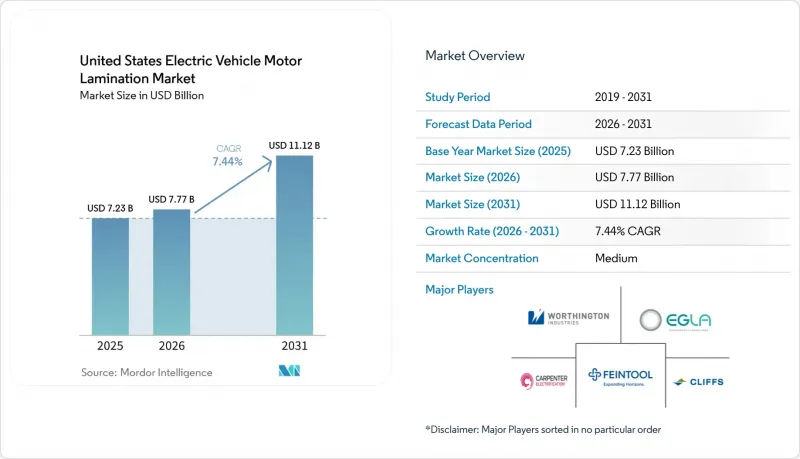
據 Mordor Intelligence 稱,2025 年美國電動車馬達疊片市值為 72.3 億美元,預計到 2031 年將達到 111.2 億美元,而 2026 年為 77.7 億美元,2026 年至 2031 年預測期內的複合年成長率為 7.4%。
本報告依疊片類型(電工鋼片、矽鋼片等)、馬達類型(永磁同步馬達(PMSM)、感應馬達等)、車輛類型(乘用車、商用車等)及應用(定子疊片、轉子疊片)分類。市場預測以美元計價。
美國電動汽車電機疊片市場的趨勢與洞察
國內電動車產量快速成長,IRA 推動了這一成長。
美國電動車馬達疊片市場與國內電動車生產基地密切相關,而該基地得益於《工業改革法案》(IRA)透過製造業稅額扣抵和工廠投資決策所推動的發展。目前的IRA條款預計將在2030年前大幅提升美國電動車的銷售量。這一成長將帶動電機裝置的大幅提升,為未來的馬達需求奠定基礎。這種規模對疊片產業意義重大,因為每增加一套動力系統,都會增加馬達核心層面精密鋼板疊層、塗層和黏合製程的需求。儘管隨著聯邦電動車消費稅額扣抵政策於2025年9月結束,純電池式電動車的發展勢頭有所放緩,但由於混合動力系統仍需要大量電力驅動部件,因此對馬達疊片的需求並未消失。因此,即使車輛配置在純電池式電動車和混合動力平台之間轉換,美國電動車馬達疊片市場仍保持著強勁的銷售基礎。
美國能源部效率目標要求採用超薄層壓技術。
美國電動車馬達疊片市場也正受到日益嚴格的馬達能源效率標準的衝擊,這將迫使整個供應鏈重新設計。美國能源部 (DOE) 於 2023 年 10 月制定的規則規定,100-250 馬力電機必須在 2027 年 6 月 1 日前達到“超高能效”標準;2025 年 1 月的規則將適用範圍擴大到功率更小的電機,並於 2029 年 1 月 1 月 1 月生效。達到 IE4 能源效率等級需要降低鐵芯損耗、使用更薄的疊片以及提高沖壓精度,這直接提高了電動車馬達所用鋼材的加工要求。美國能源部也指出,這種能源效率轉型需要更薄的疊片以及製造商的大量資本投入,這表明應對措施是結構性的,而非臨時性的。評估表明,相當一部分電動車馬達鋼板 (ESEM) 出貨量需要重新設計,這意味著無論電動車的普及程度如何,疊片沖壓產業都將面臨廣泛的產品更新週期。美國電動車馬達疊片市場將受益於此重新設計週期,這將為其提供穩定的需求基礎。這是因為供應商必須在新法規生效期限到來之前獲得低損耗疊片和改進材料等級的認證。
電工鋼板價格波動
儘管貿易措施在一定程度上緩解了進口壓力,但美國電動車馬達疊片市場仍容易受到電工鋼板價格波動的影響。根據美國鋼鐵協會(AISI)預測,未來幾年中國的鋼鐵出口預計將大幅成長,這將進一步扭曲全球基準價格。美國國際貿易委員會(USITC)於2026年發布的一項決定維持了對多個出口國的非電工鋼板(NOES)徵收的反補貼稅和反傾銷令。雖然這有助於穩定國內價格,但並不能消除原物料價格的波動。對於疊片壓製商而言,與原始設備製造商(OEM)簽訂的供應合約通常為期多年,因此成本轉嫁往往落後於投入價格的波動。這會在價格上漲期間給利潤率帶來壓力,尤其是在客戶不願意在合約期間修改條款的情況下。因此,即使終端需求強勁,美國電動車馬達疊片市場仍屢屢面臨盈利。
細分市場分析
預計到2025年,電工鋼板疊片將佔據美國電動車馬達疊片市場79.12%的佔有率,凸顯其在主流電動車馬達專案中的核心地位。這一主導地位源於其在成本、磁性和大規模生產牽引馬達製造技術方面的卓越平衡。美國電動車馬達疊片市場仍然高度依賴電工鋼板,因為大多數OEM平台優先考慮的是可靠的大規模沖壓成型和可預測的認證週期,而非最大功率密度。克利夫蘭克里夫斯公司的“MOTOR-MAX”產品線針對高頻汽車牽引應用進行了最佳化,從而鞏固了其市場地位。此外,該材料已被眾多擁有汽車生產級加工、塗層和疊片技術訣竅的供應商廣泛接受,這也是其另一個優勢。
其他類型的層壓板,主要是鎳鐵合金和鈷鐵合金,預計到2031年將以13.55%的複合年成長率成長,成為該領域成長最快的材料類別。據Carpenter Electrification公司稱,與傳統矽鋼相比,Hiperco 50合金的功率密度提高了30%,扭矩提高了25%,並且能夠將馬達動作溫度度C10至20度C。這些特性進一步提升了先進合金在高階電動車和其他應用中的重要性,在這些應用中,小型馬達封裝比原料成本更為重要。矽鋼目前仍處於中間位置,因為像Waelzholz NO 30-15這樣的新型鋼材在提升性能的同時,無需使用價格顯著更高的合金。此外,Feintool公司的Glulock製程據稱可以將層壓板厚度減少到0.1毫米,並將馬達效率提高高達15%,使電工鋼板和矽鋼能夠保持更長時間的競爭力。
預計到2025年,永磁同步馬達(PMSM)將佔據美國電動車馬達疊片市場68.22%的佔有率,這反映了其在當前電動車動力傳動系統中的強勢地位。研究表明,PMSM能夠持續保持高效率和高功率密度,這也是原始設備製造商(OEM)在搭乘用電動車中繼續青睞這種架構的原因。美國電動車馬達疊片市場也受惠於這種配置,因為隨著運作頻率的提高,PMSM的設計更加重視使用更薄、損耗更低的疊片。 BMW第六代eDrive和Lucid的自主研發驅動單元表明,高效率馬達的發展正在提高材料和沖壓公差的要求。能夠持續滿足這些公差要求的供應商將更有利於獲得OEM的長期訂單。
預計到2031年,開關磁阻馬達(SRM)的複合年成長率將達到12.27%,成為市場上成長最快的馬達類型。其成長與人們對性能提升重點轉向轉子幾何形狀和稀土元素加工,以及不使用或減少稀土元素的電機設計日益成長的興趣密切相關。 Astemo公司推出了一款功率輸出為180千瓦的磁輔助同步磁阻馬達,其尺寸僅比傳統的永磁同步馬達(PMSM)大30%,這表明性能和尺寸之間的權衡正在縮小。無刷直流馬達(BLDC)在小型豪華車和輔助應用中繼續發揮重要作用,而感應馬達在那些優先考慮耐用性和成熟供應鏈而非最高效率的領域仍然佔據著重要地位。因此,美國電動車馬達疊片市場正在朝著更廣泛的定子和轉子規格方向發展,而這並非單一架構轉型所能實現的。
其他好處:
- Excel格式的市場預測(ME)表
- 3個月的分析師支持
目錄
第1章:引言
- 市場分析與定義的前提條件
- 分析範圍
第2章 分析方法
第3章執行摘要
第4章 市場狀況
- 市場概覽
- 市場促進因素
- 愛爾蘭共和國國內電動車生產熱潮
- 美國能源部提高能源效率的目標要求採用超薄層壓技術。
- 汽車製造商對馬達進行垂直整合
- 國內NOES產能擴充(InduX、克里夫蘭-克里夫斯)
- 不使用稀土元素的馬達設計正在推高鋼鐵需求。
- 各州強制推行零排放車輛(ZEV)政策,正加速電動車的普及。
- 市場限制因素
- 電工鋼板價格波動
- 供應鏈集中化與生產能力瓶頸
- 精密沖壓作業缺陷率高
- 新建煉鋼生產線環境許可審核延誤
- 價值鍊和供應鏈分析
- 監理情勢
- 技術展望
- 波特五力分析
第5章:預測市場規模與成長率
- 按類型進行層壓
- 電磁鋼片疊層
- 矽鋼層壓板
- 其他類型的疊片(鎳鐵合金、鈷鐵合金等)
- 依馬達類型
- 永磁同步馬達(PMSM)
- 感應電動機
- 開關磁阻馬達(SRM)
- 無刷直流馬達(BLDC)
- 按車輛類型
- 搭乘用車
- 商用車輛
- 摩托車
- 透過使用
- 定子疊片
- 轉子疊片
第6章 競爭情勢
- 市場集中度
- 策略趨勢
- 市佔率分析
- 公司簡介
- Worthington Industries
- EuroGroup Laminations
- Carpenter Electrification
- Feintool International
- Cleveland-Cliffs Inc.
- United States Steel Corporation
- Thyssenkrupp Steel
- ArcelorMittal SA
- POSCO Mobility Solution
- Nippon Steel Corporation
- JFE Steel Corporation
- Waelzholz Group
- Lamination Specialties Corp.
- Pitti Engineering Limited
第7章 市場機會與未來展望
According to Mordor Intelligence, the United States electric vehicle motor lamination market size was valued at USD 7.23 billion in 2025 and is estimated to grow from USD 7.77 billion in 2026 to reach USD 11.12 billion by 2031, at a CAGR of 7.44% during the forecast period 2026 to 2031.
This report is Segmented by Laminates Type (Electrical Steel Laminates, Silicon Steel Laminates, and More), Motor Type (Permanent Magnet Synchronous Motors (PMSM), Induction Motors, and More), Vehicle Type (Passenger Vehicles, Commercial Vehicles, and More), and Application (Stator Laminations and Rotor Laminations). The Market Forecasts are Provided in Terms of Value (USD).
United States Electric Vehicle Motor Lamination Market Trends and Insights
IRA-Fueled Domestic EV Production Boom
The United States electric vehicle motor lamination market is closely tied to the domestic EV production base that the IRA helped expand through manufacturing credits and plant investment decisions. Ongoing IRA provisions are expected to drive significant growth in EV sales in the United States by 2030. This surge sets the stage for a substantially larger installed base, fueling future motor demand. That scale matters for laminations because each additional drivetrain raises demand for precision steel stacks, coatings, and joining processes at the motor core level. The September 2025 end of the federal consumer EV credit has moderated some pure battery-electric momentum. However, it has not eliminated demand for motor laminations because hybrid systems still use substantial electric-drive content. The United States electric vehicle motor lamination market, therefore, keeps a durable volume base even when the vehicle mix shifts between full battery electric and hybrid platforms.
DOE Efficiency Targets Mandating Ultra-Thin Laminations
The United States electric vehicle motor lamination market is also being shaped by stricter motor efficiency standards that are forcing redesign across the supply chain. The DOE's October 2023 rule set June 1, 2027, compliance for super-premium efficiency standards in 100 to 250 hp motors, and the January 2025 rule extended coverage to smaller motors from January 1, 2029 . Reaching IE4 efficiency levels requires lower core loss, thinner laminations, and more precise punching quality, which directly increases processing demands on the steel grades used in EV motors. The DOE also noted that these efficiency shifts require thinner laminations and meaningful capital spending by manufacturers, which means the response is structural rather than temporary. The same review indicated that a notable share of ESEM shipments would need redesign, so the lamination stamping base faces a wide product refresh cycle even outside direct EV adoption. The United States electric vehicle motor lamination market gains a steady floor in demand from this redesign cycle because suppliers must qualify lower-loss stacks and upgraded material grades before the new compliance dates arrive.
Electrical-Steel Price Volatility
The United States electric vehicle motor lamination market remains exposed to swings in electrical steel prices, even though trade actions limit some import pressure. According to the American Iron and Steel Institute, China's steel exports are expected to increase significantly in the coming years, further distorting global reference pricing. The USITC decision published in 2026 kept countervailing and anti-dumping orders on NOES from several exporting countries, which supports domestic pricing discipline but does not remove raw material volatility. For lamination stampers, cost pass-through is often slower than input price changes because supply agreements with OEMs are negotiated over multiple years. That creates margin pressure during price spikes, especially when customers are unwilling to reopen terms mid-contract. The United States electric vehicle motor lamination market, therefore, faces a recurring profitability constraint even when end demand remains healthy.
Other drivers and restraints analyzed in the detailed report include:
- Automaker Vertical Integration of E-Motors
- Domestic NOES Capacity Expansions (InduX, Cleveland-Cliffs)
- Supply-Chain Concentration and Capacity Bottlenecks
For complete list of drivers and restraints, kindly check the Table Of Contents.
Segment Analysis
Electrical steel laminates held 79.12% of the United States electric vehicle motor lamination market share in 2025, which confirmed their central role in mainstream EV motor programs. This leadership comes from their balance of cost, magnetic performance, and manufacturing familiarity across high-volume traction motor designs. The United States electric vehicle motor lamination market still depends heavily on electrical steel because most OEM platforms need reliable, large-scale stamping and predictable qualification cycles more than they need maximum power density. Cleveland-Cliffs' MOTOR-MAX product line supports this position because it is tailored for high-frequency automotive traction applications. The material also benefits from broad acceptance across suppliers that already know how to process, coat, and stack it at automotive volumes.
Other laminate types, mainly nickel-iron and cobalt-iron alloys, are projected to grow at a 13.55% CAGR through 2031, making them the fastest-moving material class in this segment. Carpenter Electrification states that Hiperco 50 alloys can deliver 30% higher power density, 25% more torque, and motor operation that is 10°C to 20°C cooler than conventional silicon steels. That profile makes advanced alloys more relevant in premium EVs and other applications where compact motor packaging matters more than raw material cost. Silicon steel still occupies the middle ground because newer grades such as Waelzholz NO 30-15 are extending performance without moving to much higher-cost alloys. Feintool's glulock process, which enables stack thicknesses down to 0.1 mm and claims up to 15% greater motor efficiency, also helps electrical and silicon steel remain competitive for longer.
Permanent Magnet Synchronous Motors (PMSM) accounted for 68.22% of the United States electric vehicle motor lamination market in 2025, reflecting their strong position in current EV powertrains. Research indicates that PMSM efficiency and power density have consistently remained high, which explains why OEMs continue to favor the architecture in passenger EVs. The United States electric vehicle motor lamination market also benefits from this mix because PMSM designs place a premium on thinner and lower-loss laminations as operating frequencies rise. BMW's sixth-generation eDrive and Lucid's in-house drive units show how high-efficiency motor programs are pushing material and punching tolerances upward. Suppliers that can consistently meet those tolerances are better positioned to secure long-cycle OEM awards.
Switch Reluctance Motors (SRMs) are forecast to grow at a 12.27% CAGR through 2031, making them the fastest-growing motor type in the market. Its rise is tied to a stronger interest in rare-earth-free or reduced-rare-earth designs that shift performance emphasis toward rotor geometry and steel processing. Astemo announced a magnet-assisted synchronous reluctance motor with 180 kW output and only a 30% increase in size compared with conventional PMSM designs, indicating the trade-off is narrowing. BLDC motors continue to play a role in smaller premium and auxiliary applications, while induction motors remain relevant where durability and established sourcing are valued over maximum efficiency. The United States electric vehicle motor lamination market is therefore shifting toward a broader set of stator and rotor specifications than a single-architecture transition would have created.
Complete Report Scope:
- By Laminates Type
- Electrical Steel Laminates
- Silicon Steel Laminates
- Other Laminates Types (Nickel-iron, Cobalt-iron, etc.)
- By Motor Type
- Permanent Magnet Synchronous Motors (PMSM)
- Induction Motors
- Switch Reluctance Motors (SRM)
- Brushless DC Motors (BLDC)
- By Vehicle Type
- Passenger Vehicles
- Commercial Vehicles
- Two-wheelers
- By Application
- Stator Laminations
- Rotor Laminations
List of Companies Covered in this Report:
- Worthington Industries
- EuroGroup Laminations
- Carpenter Electrification
- Feintool International
- Cleveland-Cliffs Inc.
- United States Steel Corporation
- Thyssenkrupp Steel
- ArcelorMittal S.A.
- POSCO Mobility Solution
- Nippon Steel Corporation
- JFE Steel Corporation
- Waelzholz Group
- Lamination Specialties Corp.
- Pitti Engineering Limited
Additional Benefits:
- The market estimate (ME) sheet in Excel format
- 3 months of analyst support
TABLE OF CONTENTS
1 Introduction
- 1.1 Study Assumptions and Market Definition
- 1.2 Scope of the Study
2 Research Methodology
3 Executive Summary
4 Market Landscape
- 4.1 Market Overview
- 4.2 Market Drivers
- 4.2.1 IRA-Fueled Domestic EV Production Boom
- 4.2.2 DOE Efficiency Targets Mandating Ultra-Thin Laminations
- 4.2.3 Automaker Vertical Integration of E-Motors
- 4.2.4 Domestic NOES Capacity Expansions (InduX, Cleveland-Cliffs)
- 4.2.5 Rare-Earth-Free Motor Topologies Boosting Steel Demand
- 4.2.6 State-Level Zero-Emission Vehicle (ZEV) Mandates Accelerate EV Uptake
- 4.3 Market Restraints
- 4.3.1 Electrical-Steel Price Volatility
- 4.3.2 Supply-Chain Concentration and Capacity Bottlenecks
- 4.3.3 High Scrap Rates from Precision Stamping
- 4.3.4 Environmental-Permit Delays for New Steel Lines
- 4.4 Value/Supply-Chain Analysis
- 4.5 Technological Outlook
- 4.6 Regulatory Landscape
- 4.7 Porter's Five Forces
- 4.7.1 Threat of New Entrants
- 4.7.2 Bargaining Power of Suppliers
- 4.7.3 Bargaining Power of Buyers
- 4.7.4 Threat of Substitutes
- 4.7.5 Competitive Rivalry
5 Market Size and Growth Forecasts (Value (USD))
- 5.1 By Laminates Type
- 5.1.1 Electrical Steel Laminates
- 5.1.2 Silicon Steel Laminates
- 5.1.3 Other Laminates Types (Nickel-iron, Cobalt-iron, etc.)
- 5.2 By Motor Type
- 5.2.1 Permanent Magnet Synchronous Motors (PMSM)
- 5.2.2 Induction Motors
- 5.2.3 Switch Reluctance Motors (SRM)
- 5.2.4 Brushless DC Motors (BLDC)
- 5.3 By Vehicle Type
- 5.3.1 Passenger Vehicles
- 5.3.2 Commercial Vehicles
- 5.3.3 Two-wheelers
- 5.4 By Application
- 5.4.1 Stator Laminations
- 5.4.2 Rotor Laminations
6 Competitive Landscape
- 6.1 Market Concentration
- 6.2 Strategic Moves
- 6.3 Market Share Analysis
- 6.4 Company Profiles (includes Global Level Overview, Market Level Overview, Core Segments, Financials as Available, Strategic Information, Market Rank/Share for Key Companies, Products and Services, SWOT Analysis, and Recent Developments)
- 6.4.1 Worthington Industries
- 6.4.2 EuroGroup Laminations
- 6.4.3 Carpenter Electrification
- 6.4.4 Feintool International
- 6.4.5 Cleveland-Cliffs Inc.
- 6.4.6 United States Steel Corporation
- 6.4.7 Thyssenkrupp Steel
- 6.4.8 ArcelorMittal S.A.
- 6.4.9 POSCO Mobility Solution
- 6.4.10 Nippon Steel Corporation
- 6.4.11 JFE Steel Corporation
- 6.4.12 Waelzholz Group
- 6.4.13 Lamination Specialties Corp.
- 6.4.14 Pitti Engineering Limited
7 Market Opportunities and Future Outlook

 馬達疊片市場:全球市場預測,2026-2032年
 馬達疊片市場分析及至2035年預測:類型、產品類型、技術、應用、材料類型、製造流程、最終用戶、功能、安裝配置
 馬達疊片市場規模、佔有率、成長及全球產業分析:按類型、應用和地區分類,並預測至2026-2034年
 2026年全球馬達疊片市場報告
 馬達疊片市場規模、佔有率和成長分析(按馬達類型、材料、技術、車輛類型、應用和地區分類)-2026-2033年產業預測
 電機鐵芯市場,按材料、按技術、按應用、按最終用途、按國家和地區 - 2025 年至 2032 年全球行業分析、市場規模、市場佔有率和預測