

 |
市場調查報告書
商品編碼
2117460
汽車燃油噴射幫浦:市場佔有率分析、產業趨勢與統計、成長預測(2026-2031)Automotive Fuel Injection Pump - Market Share Analysis, Industry Trends & Statistics, Growth Forecasts (2026 - 2031) |
||||||

※ 本網頁內容可能與最新版本有所差異。詳細情況請與我們聯繫。
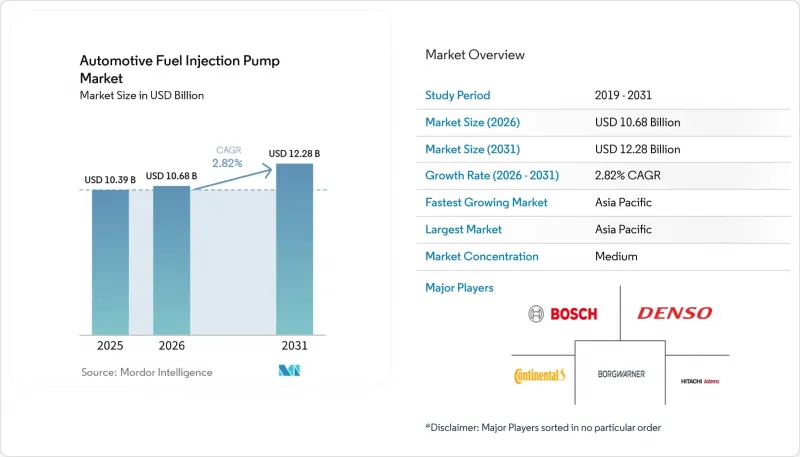
根據 Mordor Intelligence 預測,汽車燃油噴射幫浦市場規模將從 2025 年的 103.9 億美元和 2026 年的 106.8 億美元成長到 2031 年的 122.8 億美元,2026 年至 2031 年的年複合成長率(CAGR)為 2.82%。
本報告按泵浦類型(共軌燃油噴射泵浦、旋轉式燃油噴射泵浦等)、壓力類型(低壓、高壓)、應用(缸內直噴系統、多點燃油噴射系統)、燃油類型(汽油、柴油等)、車輛類型、分銷管道和地區進行細分。市場預測以價值(美元)和銷售量(單位)表示。
全球汽車燃油噴射幫浦市場趨勢及洞察
全球更嚴格的排放氣體法規
將於2025年立法實施的歐盟7排放標準增加了實際道路排放氣體測試,要求無論海拔或溫度如何,鐵路壓力都必須保持一致。將於2026年全面實施的中國VI-B排放標準也反映了類似的嚴格性,要求內燃機車必須通過超過3萬公里的耐久性認證。計劃於2027年推出的印度「Bharat Stage VII」排放標準將符合有關氨洩漏和車載監測的規定。這三個地區的排放標準共同迫使供應商採用先進材料並遵守更嚴格的製造公差。在認證審核中,實際道路資料比實驗室原型資料越來越受到重視,而那些將硬體與自診斷功能結合的供應商則更受青睞。
亞洲GDI乘用車產量增加
中國已設定目標,到2030年將企業平均燃油消耗量控制在3.3公升/百公里以內,各省監管機構也在鼓勵靈活燃料的使用,這推動了缸內直噴(GDI)引擎的普及。印度乘用車製造商也正朝著GDI方向發展,以滿足BS-VII排放標準。當地一級供應商正在擴大產能並引入相容乙醇的密封件,而跨國供應商則專注於模組化設計,以平衡成本和法規遵循。這一趨勢正在加速平台同質化,並在整個中檔車型領域實現規模經濟。
加速電動車普及
目前,在多個歐洲成員國,純電池式電動車( VEV)的銷量已超過柴油車,北美主要汽車製造商也正將未來大部分資本投資投入電氣化平台。這種轉型正在壓縮內燃機的額外研發預算,並減少輕型車領域的燃油泵產量。供應商正透過剝離和出售傳統資產、專注於氫燃料項目以及集中精力發展售後市場產品線來規避風險,以確保老舊車輛的運作。
細分市場分析
共軌燃油噴射幫浦佔汽車燃油噴射幫浦市場57.33%的佔有率。其「壓力解耦」設計使工程師能夠對多次噴射事件進行精細調整,這是旋轉式或缸內噴射系統難以實現的。在應對日益嚴格的排放氣體法規和混合動力循環時,OEM標定團隊高度重視這種柔軟性。此外,此架構非常適合模組化軟體更新,從而能夠隨著內燃機策略的演進而持續利用硬體。因此,供應商正透過將共軌硬體與先進的分析功能相結合,來加強其在該平台上的市場佔有率。
預計該細分市場在此期間將以3.91%的複合年成長率實現最高成長。材料的持續改進、高性能電磁閥的研發以及製造公差的日益嚴格是支撐此成長預測的關鍵因素。新參與企業傾向於獲得基準的許可,而不是從零開始開發競爭性設計,這減少了直接競爭並維持了利潤率。此外,對於正在過渡到合成柴油混合燃料的車隊而言,共軌泵浦在耐久性審核中更容易獲得認證。這些因素共同鞏固了該技術在未來內燃機專案中的首選地位。
到2025年,高壓幫浦將佔據汽車燃油噴射幫浦市場66.11%的佔有率。它們能夠將燃油霧化得非常細密,因此對於控制顆粒物數量至關重要。汽車製造商正在將這些高壓泵與閉合迴路感測器整合,以確保燃油管路能夠對海拔、溫度和負載的突變做出即時響應。研發合作夥伴正致力於研發用於密封件的化學成分和用於軸的塗層技術,以在不增加體積的情況下延長使用壽命。隨著法規的不斷完善,高壓系統正逐漸成為乘用車和商用車清潔燃燒的代名詞。
此外,預計該類別將實現最高的複合年成長率(CAGR),達到3.81%。推動這一成長的關鍵在於向缸內噴油和低碳柴油替代燃料的轉變,這兩種燃料都需要更高的噴射能量。泵浦製造商和鋼鐵供應商之間的聯合研發項目旨在減輕泵芯重量,同時保持壓力穩定性,這種組合將擴大其在車輛中的應用範圍。混合動力汽車也進一步推動了需求,因為高壓系統提供的即時壓力反應在頻繁重啟的情況下具有優勢。因此,投資計劃仍然高度專注於此壓力等級。
區域分析
預計到2025年,亞太地區將佔汽車燃油噴射幫浦銷量的46.25%,以3.22%的複合年成長率進一步擴大其領先優勢。中國實施的「VI-B」排放標準要求內燃機(ICE)的耐久性達到3萬公里以上,且顆粒物排放量必須較低,這促使中國本土汽車製造商(OEM)向國內供應商和合資企業訂購高壓共軌相關產品。印度的「Bharat Stage VII」藍圖也確認了類似的基準值,並要求即時監測氨洩漏。日本在混合動力汽車市場的主導地位穩定了精密低流量汽油幫浦的訂單,在可預見的未來緩解了電動車對該地區市場的侵蝕。
歐洲正面臨雙重壓力:一是歐7排放標準的實施,二是電池式電動車的加速普及。儘管柴油乘用車的銷量正在下滑,但豪華車製造商仍然依賴高壓燃油系統來生產有效距離式混合動力汽車和高性能汽油車。德國、法國和捷克的供應商正在調整生產線,以同時生產內燃機和電力驅動組件,以穩定運轉率。在歐洲綠色交易框架下資助的氫燃料公車原型車,正在為加氫專家創造一個新的細分市場,這需要對用於乾燃料的密封劑進行改造。
在北美,各州的零排放法規與大型皮卡和SUV的市場支持之間保持平衡。即使沿海各州收緊了零排放車輛的銷售目標,全尺寸混合動力卡車和乙醇靈活燃料車型仍然支撐著汽油需求。墨西哥的二級區域供應商正透過拓展售後市場出口業務來彌補整車製造商訂單的下降。此外,美國正在成為長途貨運中可再生柴油的試驗場,這為未來幾年高壓柴油泵市場的成長留下了空間。
其他好處:
- Excel格式的市場預測(ME)表
- 3個月的分析師支持
目錄
第1章:引言
- 研究假設和市場定義
- 調查範圍
第2章:調查方法
第3章執行摘要
第4章 市場狀況
- 市場概覽
- 市場促進因素
- 全球更嚴格的排放法規
- 亞洲GDI乘用車產量增加
- 對小型渦輪渦輪增壓引擎的需求
- 混合動力汽車對電動幫浦的需求
- 氫氣相容型高壓幫浦的研究與開發;
- 人工智慧驅動的車隊預測性維護
- 市場限制因素
- 加速推廣電動車
- 高壓幫浦高成本、結構複雜
- 精密零件供應鏈風險
- 熟練泵浦技術人員短缺
- 價值供應鏈分析
- 技術展望
- 監理情勢
- 波特五力模型
第5章 市場規模與成長預測
- 泵浦類型
- 共軌燃油噴射泵
- 旋轉式燃油噴射泵
- 汽缸泵浦
- 外缸式泵浦
- 按壓力類型
- 低壓
- 高壓
- 透過使用
- 缸內直噴系統
- 多點式燃油噴射系統
- 按燃料類型
- 汽油
- 柴油引擎
- 替代燃料
- 按車輛類型
- 搭乘用車
- 輕型商用車
- 中型和大型商用車輛
- 透過分銷管道
- OEM
- 售後市場
- 按地區
- 北美洲
- 美國
- 加拿大
- 其他北美國家
- 南美洲
- 巴西
- 阿根廷
- 其他南美國家
- 歐洲
- 英國
- 德國
- 西班牙
- 義大利
- 法國
- 俄羅斯
- 其他歐洲國家
- 亞太地區
- 印度
- 中國
- 日本
- 韓國
- 其他亞太國家
- 中東和非洲
- 阿拉伯聯合大公國
- 沙烏地阿拉伯
- 土耳其
- 埃及
- 南非
- 其他中東和非洲國家
- 北美洲
第6章 競爭情勢
- 市場集中度
- 策略趨勢
- 市佔率分析
- 公司簡介
- Robert Bosch GmbH
- Denso Corporation
- Continental AG
- Hitachi Astemo Ltd.
- Aisin Corporation
- Stanadyne LLC
- Cummins Inc.
- Woodward Inc.
- Weifu Group
- BorgWarner Inc.(Phinia Inc.)
- Magna International Inc.
- Mikuni Corporation
- SHW AG
- Marelli Holdings
第7章 市場機會與未來展望
According to Mordor Intelligence, the automotive fuel injection pump market size is projected to expand from USD 10.39 billion in 2025 and USD 10.68 billion in 2026 to USD 12.28 billion by 2031, registering a CAGR of 2.82% between 2026 and 2031.
This report is Segmented by Pump Type (Common Rail Fuel Injection Pump, Rotary Fuel Injection Pump, and More), Pressure Type (Low Pressure, High Pressure), Application (Direct Injection System, Multi-Point Fuel Injection System), Fuel Type (Gasoline, Diesel, and More), Vehicle Type, Distribution Channel, and Geography. Market Forecasts are Provided in Terms of Value (USD) and Volume (Units).
Global Automotive Fuel Injection Pump Market Trends and Insights
Stringent Global Emission Regulations
Euro 7 became law in 2025 and adds real-driving-emissions checks that demand consistent rail pressure across altitude and temperature bands. China VI-B, fully enforced in 2026, mirrors those stringencies and requires durability proof beyond 30,000km for ICE vehicles. India's Bharat Stage VII framework, due in 2027, will align with ammonia-slip and onboard monitoring clauses. Together, the three regions force suppliers to adopt advanced materials and tighter machining tolerances. Certification audits increasingly emphasize real-world data rather than laboratory prototypes, rewarding vendors that couple hardware with self-diagnostics.
Rising GDI Passenger-Car Production in Asia
China aims for a corporate-average fuel-consumption ceiling of 3.3 L/100 km by 2030, and provincial regulators encourage flex-fuel compatibility, pushing GDI penetration upward. Indian passenger-car makers likewise pivot toward GDI to meet BS-VII. Local tier-ones ramp capacity and introduce ethanol-compatible seals, while multinational suppliers underscore modular designs to balance cost and compliance. The trend accelerates platform homogenization, enabling scale economics across mid-range models.
Accelerating EV Penetration
Pure battery-electric models now out-sell diesel cars in several European member states, and large North American OEMs allocate the bulk of future capex to electrified platforms. The shift curbs incremental combustion-engine development budgets and compresses pump volumes in light-duty segments. Suppliers hedge by spinning off legacy assets, courting hydrogen-ready programs, or doubling down on aftermarket lines that keep aging fleets running.
Other drivers and restraints analyzed in the detailed report include:
- Demand for Downsized Turbo-Turbo Engines
- Hybrid-Vehicle Electrified Pumps Demand
- High Cost and Complexity of HP Pumps
For complete list of drivers and restraints, kindly check the Table Of Contents.
Segment Analysis
Common-rail pumps captured 57.33% of the automotive fuel injection pump market share. Their decoupled-pressure design lets engineers tune multiple injection events in ways rotary and in-cylinder formats struggle to match. OEM calibration teams value that flexibility when navigating ever-tighter emissions files and hybrid cycles. The architecture also lends itself to modular software updates that keep hardware viable as combustion strategies evolve. Suppliers therefore bundle common-rail hardware with advanced analytics, reinforcing a lock-in effect around this platform.
The same sub-segment is forecast to post the fastest CAGR of 3.91% over the period. Continuous material upgrades, smarter solenoids, and tighter machining tolerances underpin that growth projection. New entrants tend to license baseline patents rather than build competing designs from scratch, reducing direct rivalry and sustaining margins. Fleets migrating to synthetic diesel blends also find common-rail pumps easier to certify under durability audits. Taken together, these factors cement the technology as the default choice for future internal-combustion programs.
High-pressure pumps commanded 66.11% of the automotive fuel injection pump market share in 2025. Their ability to atomize fuel finely makes them indispensable for controlling particulate numbers. Automakers integrate them with closed-loop sensors so the rail adjusts instantly to altitude, temperature, and load transients. Development partners focus on seal chemistry and shaft coatings that extend life without adding bulk. As regulations spread, the high-pressure format has become synonymous with clean combustion across passenger and commercial platforms.
This category is also expected to deliver the quickest 3.81% CAGR. Growth hinges on the move toward direct-injection gasoline and low-carbon diesel substitutes, both of which demand higher spray energy. Collaborative R&D projects between pump makers and steel suppliers aim to reduce core weight while holding pressure stability, a combination that broadens vehicle fitment. Hybrid vehicles further reinforce demand because frequent restarts benefit from the immediate pressure readiness that high-bar systems provide. Consequently, investment pipelines remain heavily skewed toward this pressure class.
Complete Report Scope:
- By Pump Type
- Common Rail Fuel Injection Pump
- Rotary Fuel Injection Pump
- In-Cylinder Pump
- Outside-Cylinder Pump
- By Pressure Type
- Low Pressure
- High Pressure
- By Application
- Direct Injection System
- Multi-Point Fuel Injection System
- By Fuel Type
- Gasoline
- Diesel
- Alternative Fuels
- By Vehicle Type
- Passenger Vehicles
- Light Commercial Vehicles
- Medium and Heavy Commercial Vehicles
- By Distribution Channel
- OEM
- Aftermarket
- By Geography
- North America
- United States
- Canada
- Rest of North America
- South America
- Brazil
- Argentina
- Rest of South America
- Europe
- United Kingdom
- Germany
- Spain
- Italy
- France
- Russia
- Rest of Europe
- Asia-Pacific
- India
- China
- Japan
- South Korea
- Rest of Asia-Pacific
- Middle East and Africa
- United Arab Emirates
- Saudi Arabia
- Turkey
- Egypt
- South Africa
- Rest of Middle-East and Africa
- North America
Geography Analysis
Asia-Pacific claimed 46.25% of 2025 revenue for the automotive fuel injection pump market and is projected to extend that lead at a 3.22% CAGR. China's VI-B enforcement obliges over 30,000km durability and low particulate counts for ICEs, spurring local OEMs to award high-pressure common-rail contracts to domestic and joint-venture suppliers. India's Bharat Stage VII roadmap confirms similar thresholds and real-time ammonia-slip monitoring. Japanese hybrid dominance sustains steady order books for precision low-flow gasoline pumps, buffering the region from near-term EV cannibalization.
Europe navigates the twin pressures of the introduction of Euro 7 and accelerated battery-electric adoption. While passenger-car diesel volumes contract, premium makers still rely on high-bar fuel systems for range-extended hybrids and performance gasoline models. Supplier plants in Germany, France, and the Czech Republic recalibrate lines to juggle combustion and e-drive sub-assemblies, keeping capacity utilization stable. Hydrogen bus prototypes funded under the European Green Deal create a new niche for pump specialists, requiring the adaptation of sealing materials to dry fuels.
North America balances state-level zero-emission mandates with market loyalty to large pickups and SUVs. Full-size hybrid trucks and ethanol-flex models preserve pump demand even as coastal states push stricter sales targets for zero-tail-pipe vehicles. Regional tier-twos in Mexico diversify toward aftermarket exports, offsetting lower OEM call-offs. The United States also acts as a testbed for renewable diesel in long-haul freight, giving high-pressure diesel pumps a multi-year runway.
- Robert Bosch GmbH
- Denso Corporation
- Continental AG
- Hitachi Astemo Ltd.
- Aisin Corporation
- Stanadyne LLC
- Cummins Inc.
- Woodward Inc.
- Weifu Group
- BorgWarner Inc. (Phinia Inc.)
- Magna International Inc.
- Mikuni Corporation
- SHW AG
- Marelli Holdings
Additional Benefits:
- The market estimate (ME) sheet in Excel format
- 3 months of analyst support
TABLE OF CONTENTS
1 Introduction
- 1.1 Study Assumptions & Market Definition
- 1.2 Scope of the Study
2 Research Methodology
3 Executive Summary
4 Market Landscape
- 4.1 Market Overview
- 4.2 Market Drivers
- 4.2.1 Stringent Global Emission Regulations
- 4.2.2 Rising GDI Passenger-Car Production in Asia
- 4.2.3 Demand for Downsized Turbo-Turbo Engines
- 4.2.4 Hybrid-Vehicle Electrified Pumps Demand
- 4.2.5 Hydrogen-Ready High-Pressure Pump R&D
- 4.2.6 AI-Enabled Fleet Predictive Maintenance
- 4.3 Market Restraints
- 4.3.1 Accelerating EV Penetration
- 4.3.2 High Cost and Complexity of HP Pumps
- 4.3.3 Precision-Component Supply-Chain Risks
- 4.3.4 Shortage of Skilled Pump Technicians
- 4.4 Value / Supply-Chain Analysis
- 4.5 Technological Outlook
- 4.6 Regulatory Landscape
- 4.7 Porter's Five Forces
- 4.7.1 Threat of New Entrants
- 4.7.2 Bargaining Power of Buyers
- 4.7.3 Bargaining Power of Suppliers
- 4.7.4 Threat of Substitutes
- 4.7.5 Competitive Rivalry
5 Market Size & Growth Forecasts (Value (USD) and Volume (Units))
- 5.1 By Pump Type
- 5.1.1 Common Rail Fuel Injection Pump
- 5.1.2 Rotary Fuel Injection Pump
- 5.1.3 In-Cylinder Pump
- 5.1.4 Outside-Cylinder Pump
- 5.2 By Pressure Type
- 5.2.1 Low Pressure
- 5.2.2 High Pressure
- 5.3 By Application
- 5.3.1 Direct Injection System
- 5.3.2 Multi-Point Fuel Injection System
- 5.4 By Fuel Type
- 5.4.1 Gasoline
- 5.4.2 Diesel
- 5.4.3 Alternative Fuels
- 5.5 By Vehicle Type
- 5.5.1 Passenger Vehicles
- 5.5.2 Light Commercial Vehicles
- 5.5.3 Medium and Heavy Commercial Vehicles
- 5.6 By Distribution Channel
- 5.6.1 OEM
- 5.6.2 Aftermarket
- 5.7 By Geography
- 5.7.1 North America
- 5.7.1.1 United States
- 5.7.1.2 Canada
- 5.7.1.3 Rest of North America
- 5.7.2 South America
- 5.7.2.1 Brazil
- 5.7.2.2 Argentina
- 5.7.2.3 Rest of South America
- 5.7.3 Europe
- 5.7.3.1 United Kingdom
- 5.7.3.2 Germany
- 5.7.3.3 Spain
- 5.7.3.4 Italy
- 5.7.3.5 France
- 5.7.3.6 Russia
- 5.7.3.7 Rest of Europe
- 5.7.4 Asia-Pacific
- 5.7.4.1 India
- 5.7.4.2 China
- 5.7.4.3 Japan
- 5.7.4.4 South Korea
- 5.7.4.5 Rest of Asia-Pacific
- 5.7.5 Middle East and Africa
- 5.7.5.1 United Arab Emirates
- 5.7.5.2 Saudi Arabia
- 5.7.5.3 Turkey
- 5.7.5.4 Egypt
- 5.7.5.5 South Africa
- 5.7.5.6 Rest of Middle-East and Africa
- 5.7.1 North America
6 Competitive Landscape
- 6.1 Market Concentration
- 6.2 Strategic Moves
- 6.3 Market Share Analysis
- 6.4 Company Profiles (Includes Global Level Overview, Market Level Overview, Core Segments, Financials as Available, Strategic Information, Market Rank/Share for Key Companies, Products and Services, SWOT Analysis, and Recent Developments)
- 6.4.1 Robert Bosch GmbH
- 6.4.2 Denso Corporation
- 6.4.3 Continental AG
- 6.4.4 Hitachi Astemo Ltd.
- 6.4.5 Aisin Corporation
- 6.4.6 Stanadyne LLC
- 6.4.7 Cummins Inc.
- 6.4.8 Woodward Inc.
- 6.4.9 Weifu Group
- 6.4.10 BorgWarner Inc. (Phinia Inc.)
- 6.4.11 Magna International Inc.
- 6.4.12 Mikuni Corporation
- 6.4.13 SHW AG
- 6.4.14 Marelli Holdings
7 Market Opportunities & Future Outlook
- 7.1 White-space & Unmet-Need Assessment

 汽車燃油噴射系統市場:2026-2032年全球市場預測(依噴射方式、系統類型、車輛類型、壓力範圍、燃油類型和應用分類)汽車燃油供應與噴射系統市場:2026-2032年全球市場預測(按噴射技術、系統組件、燃油類型、應用和分銷管道分類)汽車燃油噴射幫浦市場:依技術、燃油類型、應用和分銷管道分類-2026-2032年全球市場預測
 汽車燃油噴射系統市場預測至2034年-按系統類型、燃油類型、組件、車輛類型、技術、銷售管道和地區分類的全球分析
 汽車燃油噴射系統市場:按引擎類型、車輛類型、技術、組件、國家和地區分類-全球產業分析、市場規模、市場佔有率和預測(2025-2032 年)
 摩托車燃油噴射系統市場-全球產業規模、佔有率、趨勢、機會、預測:依引擎排氣量、車輛類型、需求類別、地區和競爭格局分類,2021-2031年汽車燃油噴射系統市場-全球產業規模、佔有率、趨勢、機會及預測(依車輛類型、技術、地區及競爭格局分類,2021-2031年)
 汽車燃油噴射幫浦市場規模、佔有率及成長分析(按泵浦類型、燃油類型、車輛類型、最終用戶和地區分類)-2026-2033年產業預測
 摩托車電子控制燃油噴射系統的全球市場