

 |
市場調查報告書
商品編碼
2117455
汽車電動燃油幫浦:市場佔有率分析、產業趨勢與統計、成長預測(2026-2031)Automotive Electric Fuel Pumps - Market Share Analysis, Industry Trends & Statistics, Growth Forecasts (2026 - 2031) |
||||||

※ 本網頁內容可能與最新版本有所差異。詳細情況請與我們聯繫。
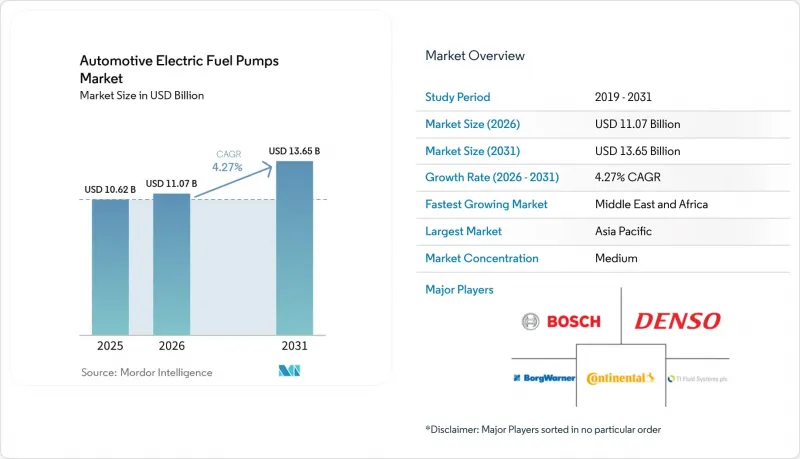
根據 Mordor Intelligence 預測,汽車電動燃油泵的市場規模預計將從 2025 年的 106.2 億美元和 2026 年的 110.7 億美元成長到 2031 年的 136.5 億美元,2026 年至 2031 年的年複合成長率(CAGR)為 4.27%。
本報告按產品類型(例如,有刷直流電動燃油泵)、技術(例如,渦輪泵)、車輛類型(乘用車和商用車)、燃料類型(例如,汽油、柴油)、分銷管道(OEM 和售後市場)以及地區進行細分。市場預測以美元計價。
全球汽車電動燃油幫浦市場趨勢及洞察
更嚴格的全球內燃機動力傳動系統排放氣體法規
歐7耐久性標準要求泵浦在20萬公里或10年內無故障運行,而傳統的有刷馬達很少能達到此標準。北美標準和加州混合動力汽車政策進一步推動了汽油混合動力汽車的生產,使得高規格泵成為合規策略的關鍵要素。這些相互交織的政策提高了最低技術標準,要求配備整合式壓力感測器和耐腐蝕合金等功能。與法規相關的延長保固期也迫使原始設備製造商(OEM)實施預測性維護功能,以便及早發現故障。總而言之,這些更嚴格的法規正在建立一個多年更換和升級週期,這有利於技術領先者。
汽油缸內直噴系統的快速普及
目前,汽油缸內直噴(GDI)技術已成為新型汽油引擎專案的主流,所有GDI引擎都需要電子控制的高壓燃油泵。汽車製造商正在標準化配備感測器的模組,這些模組透過CAN網路記錄壓力數據,並符合歐盟7排放標準規定的車載燃油監控要求。供應商將此監管措施視為提升銷售的良機,而非僅保護利潤微薄的傳統燃油泵。電子元件的加入提高了材料清單(BOM)的價值,即使在內燃機(ICE)汽車保有量下降的情況下,也能支撐利潤。隨著GDI技術從高階車型擴展到更經濟實惠的細分市場,產量的增加對能夠維持嚴格流量控制的無刷設計產生了穩定的需求。反過來,這又構成了一種結構性利好,推高了整個市場的平均售價。
電池式電動車(BEV)的日益普及將減少受影響的內燃機汽車的數量。
2026年第一季,電池式電動車(BEV)對歐洲銷售產生了顯著影響,導致對內燃機(ICE)幫浦的需求下降。在中國,純電動車已完全退出換代週期,但北美電動車市場的放緩是由於關稅的影響,只是暫時的。高階市場的電氣化進程正在快速推進,導致對無刷直流(BLDC)模組的需求下降。
細分市場分析
預計到2025年,無刷直流幫浦的銷售量將佔總銷售量的53.47%,這反映出原始設備製造商(OEM)對其長壽命和低噪音水平的高度認可。工程師們讚賞電子整流技術能夠在混合動力汽車重啟時實現快速壓力提升,且不會產生火花干擾。模組化設計使得同一無刷泵芯可以重複用於鞍形油箱、低矮型電池和內置式模組,從而降低平台成本。供應商正利用這種模組化設計來縮短檢驗週期,即使在對成本高度敏感的車型系列中也能訂單。售後市場安裝商也傾向於無刷升級,因為這可以減少因電刷過早磨損而導致的返修需求。
有刷泵在傳統動力系統中仍然很常見,但其市場定位越來越傾向於價格較低的細分市場,並且在新車型中市場佔有率正在下降。雖然在一些對成本敏感、更注重經濟性而非耐用性的市場中,有刷泵仍然存在需求,但其較短的使用壽命引發了出口到法定保固期較長地區的車型的保固問題。一些汽車製造商僅指定在針對耐用性法規較為寬鬆的市場的車輛中使用有刷泵。由於剩餘的需求集中在價格上,零件製造商面臨利潤率壓力,技術差異化的空間有限。從長遠來看,以4.34%的複合年成長率成長的無刷泵正在蠶食現有的有刷泵市場佔有率,迫使供應商減少對有刷泵生產的投資。
到2025年,渦輪泵將佔據61.21%的市場佔有率。這主要歸功於其流量,能夠為當今精準的噴射策略提供足夠的平穩性。由於原始設備製造商(OEM)很少在車型週期中途重新檢驗整個燃油系統,一旦渦輪泵設計得到驗證,其架構往往會在後續車型中沿用。緊湊的封裝和低脈動使得渦輪泵易於與歐7排放標準要求的壓力感測器整合。零件供應商將液位感測器和蒸氣管理閥整合到渦輪泵中,提供即插即用的模組。這種捆綁式設計增加了轉換成本,並鞏固了現有製造商的市場地位。
儘管滑片泵目前仍佔少數,但其穩健性正使其在卡車和非公路用車輛市場中佔據越來越大的佔有率,並在所有技術中實現了最高的複合年成長率(CAGR),達到4.46%。滑片幫浦對燃油品質變化的容忍度使其在新興市場極具吸引力,因為這些市場的過濾標準往往不盡相同。製造商正在改進葉片形狀以降低噪音,縮小了曾經阻礙其在乘用車領域應用的NVH(噪音、振動和聲振粗糙度)差距。在混合動力傳動系統中,由於需要更高的進氣壓力,能夠從複雜形狀的燃料箱中抽取燃油的滑片幫浦往往成為預設選擇。隨著重型車輛領域法規的日益嚴格,供應商預計滑片泵浦的應用將持續成長,儘管其初始應用基數小於渦輪泵浦。
區域分析
到2025年,亞太地區將佔全球銷售額的38.26%,這反映了其作為全球最大汽車生產中心和燃油系統模組主要出口市場的地位。地方政府正積極吸引對零件工廠的投資,形成供應商密集叢集,從而縮短汽車製造商的前置作業時間。當地生產商利用規模經濟優勢,為國內和出口項目提供產品,但品質差異也帶來了假冒仿冒品的風險。為此,整車製造商(OEM)強制要求在燃油泵控制器中加入可追溯的序號和加密軟體。這些管控措施進一步提升了該地區的重要性,同時也逐步提高了整個供應鏈的技術標準。
在歐洲,更嚴格的排放氣體法規導致配備內燃機(ICE)的新車數量下降,但由於歐7排放標準對感測器和耐久性的要求,燃油泵單元的價值卻在上升。德國氫能基礎設施和寶馬eFuel工廠的資金投入將確保替代燃料的持續試驗。同時,由於嚴格的零件認證體系,假冒燃油泵仍然相對較少,高階售後市場需求得以維持。
預計中東和非洲地區將錄得最高成長率,到2031年複合年成長率將達到4.39%,這主要受老舊車輛(其中大部分仍依賴內燃機進行日常交通運輸)的推動。由於電池式電動車的普及率較低,泵浦的更換仍然是“必要的措施”,而不是“可選的升級”。惡劣的運作環境促使擁有者選擇堅固耐用的產品而非最便宜的方案,推高了平均售價。零件經銷商正在擴大宣傳宣傳活動,提醒消費者註意仿冒品的風險,以保護客戶安全和品牌聲譽。這些努力,加上基礎設施投資,正逐步提高全部區域高規格泵浦的接受度。
其他好處:
- Excel格式的市場預測(ME)表
- 3個月的分析師支持
目錄
第1章:引言
- 研究假設和市場定義
- 調查範圍
第2章:調查方法
第3章執行摘要
第4章 市場狀況
- 市場概覽
- 市場促進因素
- 加強內燃機動力傳動系統的全球排放氣體法規
- 汽油缸內直噴系統的快速普及
- 節能型乘用車的需求不斷成長
- 為了提高耐用性和 NVH(噪音、振動和不平順性),OEM 廠商正在轉向無刷直流幫浦。
- 將人工智慧驅動的預測性維護整合到泵浦系統中
- 新興的低碳電子燃料正在加速維修的需求。
- 市場限制因素
- 由於電池式電動車。
- 假冒偽劣產品威脅到原廠設備的銷售。
- 原物料價格波動(銅、稀土元素磁鐵)
- 內建智慧感測器的幫浦模組初始成本較高
- 價值供應鏈分析
- 監理情勢
- 技術展望
- 波特五力模型
第5章 市場規模與成長預測
- 依產品類型
- 直流電動燃油幫浦(帶刷)
- 無刷直流燃油泵
- 透過技術
- 渦輪泵
- 滑片泵浦
- 滾柱泵
- 按車輛類型
- 搭乘用車
- 掀背車
- 轎車
- 跑車和小轎車
- SUV 與跨界車
- 商用車輛
- 輕型商用車(LCV)
- 中型和重型商用車輛(MCV 和 HCV)
- 搭乘用車
- 按燃料類型
- 汽油
- 柴油引擎
- 壓縮天然氣和液化石油氣
- 氫
- 透過分銷管道
- OEM
- 售後市場
- 按地區
- 北美洲
- 美國
- 加拿大
- 其他北美國家
- 南美洲
- 巴西
- 阿根廷
- 其他南美國家
- 歐洲
- 英國
- 德國
- 西班牙
- 義大利
- 法國
- 俄羅斯
- 其他歐洲國家
- 亞太地區
- 印度
- 中國
- 日本
- 韓國
- 其他亞太國家
- 中東和非洲
- 阿拉伯聯合大公國
- 沙烏地阿拉伯
- 土耳其
- 埃及
- 南非
- 其他中東和非洲國家
- 北美洲
第6章 競爭情勢
- 市場集中度
- 策略趨勢
- 市佔率分析
- 公司簡介
- Robert Bosch GmbH
- Denso Corporation
- Continental AG
- Aisin Seiki Co., Ltd.
- Johnson Electric Holdings Ltd.
- Magna International Inc.
- Hitachi Astemo Ltd.
- BorgWarner(Aptiv/Delphi Technologies)
- TI Fluid Systems Plc
- Valeo SA
- MAHLE GmbH
- Stanadyne LLC
- Carter Fuel Systems LLC
- Airtex(Trico Group)
- Pricol Limited
- Weifu High-Technology Group Co.
- ZF Friedrichshafen AG
- AC Delco
- Pierburg(Rheinmetall AG)
- Keihin Corp.
第7章 市場機會與未來展望
According to Mordor Intelligence, the automotive electric fuel pumps market size is projected to expand from USD 10.62 billion in 2025 and USD 11.07 billion in 2026 to USD 13.65 billion by 2031, registering a CAGR of 4.27% between 2026 and 2031.
This report is Segmented by Product Type (Brushed DC Electric Fuel Pumps and More), Technology (Turbine Style Pumps and More), Vehicle Type (Passenger Cars and Commercial Vehicles), Fuel Type (Gasoline, Diesel, and More), Distribution Channel (OEM and Aftermarket), and Geography. The Market Forecasts are Provided in Terms of Value (USD).
Global Automotive Electric Fuel Pumps Market Trends and Insights
Stricter Global Emission Regulations For ICE Powertrains
Euro 7 durability rules require pumps to operate fault-free for 200,000 km or ten years, a specification that legacy brushed motors rarely meet. North American standards and California's hybrid pathway add further impetus by keeping gasoline hybrids in production, so high-spec pumps stay integral to adherence strategies. These overlapping policies raise the minimum technical baseline and pull in features such as integrated pressure sensors and corrosion-resistant alloys. Longer warranties tied to the rules also push OEMs to demand predictive maintenance capabilities for early fault detection. Collectively, the stepped-up legislation locks in a multi-year replacement and upgrade cycle that favors technology leaders.
Rapid Growth of Gasoline Direct-Injection Systems
Gasoline direct-injection (GDI) now dominates new gasoline-engine programs, and every GDI engine requires a high-pressure, electronically controlled feed pump. Automakers are standardizing on sensor-equipped modules that log pressure data over CAN networks and comply with on-board fuel-monitoring rules mandated under Euro 7. Suppliers view this regulatory push as a chance to upsell premium pumps rather than defend low-margin legacy units. Added electronics increase bill-of-materials value, which cushions revenue even while the ICE parc contracts. As GDI spreads from premium vehicles into affordable segments, volume leverage is generating steady demand for brushless designs that maintain tight flow control. The net effect is a structural tailwind that lifts average selling prices across the market.
Proliferation of Battery-Electric Vehicles Reducing Addressable ICE PARC
In Q1 2026, battery electric vehicles (BEVs) significantly impacted European sales, reducing the need for internal combustion engine (ICE) pump installations. In China, BEVs have exited the replacement cycle permanently, while North America's EV market slowdown, driven by tariffs, is temporary. Premium segments are electrifying rapidly, leading to decreased demand for brushless DC (BLDC) modules.
Other drivers and restraints analyzed in the detailed report include:
- Rising Demand For Fuel-Efficient Passenger Vehicles
- OEM Shift Toward Brushless DC Pumps For Durability & NVH
- Counterfeit Aftermarket Pumps Undermining OEM Volumes
For complete list of drivers and restraints, kindly check the Table Of Contents.
Segment Analysis
Brushless DC pumps accounted for 53.47% of 2025 revenue, reflecting OEM confidence in their long life and low noise. Engineers appreciate that electronic commutation supports rapid pressure ramp-up during hybrid restarts without spark interference. Design modularity lets the same brushless core serve saddle tanks, low-profile cells, and in-tank modules, trimming platform costs. Suppliers exploit the modularity to shorten validation cycles, winning business even on value-oriented vehicle lines. Aftermarket installers also favor brushless upgrades because they reduce comebacks linked to premature brush wear.
Brushed pumps remain common in legacy programs but increasingly occupy the budget tier while conceding new-model share. Cost sensitivity keeps them viable in markets where affordability trumps durability; however, their shorter life invites warranty tension for export models shipped to regions with longer statutory coverage. Some automakers specify brushed units only for variants aimed at markets with lenient durability laws. As residual demand focuses on price, component makers face margin pressure and little room for technical differentiation. Over time, brushless growth at a 4.34% CAGR erodes the brushed installed base and nudges suppliers to scale down investment in brushed production.
Turbine pumps held 61.21% share in 2025, primarily because their flow is smooth enough for today's precise injection strategies. OEMs rarely revalidate entire fuel systems mid-cycle, so once a turbine design proves itself, follow-on models tend to retain the architecture. Tight packaging and low pulsation make turbines easy to integrate with pressure sensors mandated under Euro 7. Component suppliers bundle turbines with integrated level senders and vapor-management valves to create plug-and-play modules. That bundling increases switching costs and cements incumbent positions.
Sliding-vane pumps, although a minority, are gaining ground on trucks and off-highway vehicles because of their robustness, posting the fastest 4.46% CAGR within the technology mix. Their tolerance for fuel quality variations appeals in developing markets where filtration standards can be inconsistent. Manufacturers refine vane geometries to lower noise, narrowing an NVH gap that once disqualified them from passenger cars. Hybrid powertrains seeking higher inlet suction often default to vane units that can draw fuel from complex tank shapes. As regulations tighten for heavy-duty segments, suppliers expect vane adoption to keep expanding, albeit off a smaller base than turbines.
Complete Report Scope:
- By Product Type
- Brushed DC Electric Fuel Pumps
- Brushless DC Electric Fuel Pumps
- By Technology
- Turbine Style Pumps
- Sliding Vane Pumps
- Roller Cell Pumps
- By Vehicle Type
- Passenger Cars
- Hatchback
- Sedan
- Sports Car and Coupe
- SUV and Crossover
- Commercial Vehicles
- Light Commercial Vehicles (LCV)
- Medium & Heavy Commercial Vehicles (MCV & HCV)
- Passenger Cars
- By Fuel Type
- Gasoline
- Diesel
- CNG & LPG
- Hydrogen
- By Distribution Channel
- OEM
- Aftermarket
- By Region
- North America
- United States
- Canada
- Rest of North America
- South America
- Brazil
- Argentina
- Rest of South America
- Europe
- United Kingdom
- Germany
- Spain
- Italy
- France
- Russia
- Rest of Europe
- Asia Pacific
- India
- China
- Japan
- South Korea
- Rest of Asia Pacific
- Middle East and Africa
- United Arab Emirates
- Saudi Arabia
- Turkey
- Egypt
- South Africa
- Rest of Middle East and Africa
- North America
Geography Analysis
Asia Pacific accounted for 38.26% of global revenue in 2025, reflecting its status as both the largest vehicle-production hub and a key exporter of fuel-system modules. Regional governments actively court investment in component plants, creating dense supplier clusters that shorten automakers' lead times. Local producers leverage economies of scale to supply domestic and export programs, but quality variability poses a risk of counterfeiting. OEMs respond by requiring traceable serial numbers and encrypted software in pump controllers. These controls reinforce the region's importance while gradually raising technical standards across supply chains.
Europe's tightening emission landscape shrinks new-ICE installations, yet Euro 7's sensor and durability mandates elevate pump unit value. Germany's hydrogen infrastructure funding and BMW's eFuel factory will ensure continued experimentation in alternative fuels. Meanwhile, counterfeit pumps remain scarce thanks to stringent parts-approval regimes, sustaining premium aftermarket demand.
The Middle East and Africa record the fastest 4.39% CAGR through 2031, propelled by an aging fleet that still relies on internal-combustion engines for everyday mobility. Low battery-electric penetration means replacement pumps remain a necessity, not a discretionary upgrade. Harsh operating conditions encourage fleets to choose robust designs over the cheapest option, lifting average selling price. Parts distributors expand education campaigns warning against counterfeit risks to protect customer safety and brand reputation. These efforts, coupled with infrastructure investments, gradually increase acceptance of higher-spec pumps across the region.
- Robert Bosch GmbH
- Denso Corporation
- Continental AG
- Aisin Seiki Co., Ltd.
- Johnson Electric Holdings Ltd.
- Magna International Inc.
- Hitachi Astemo Ltd.
- BorgWarner (Aptiv/Delphi Technologies)
- TI Fluid Systems Plc
- Valeo SA
- MAHLE GmbH
- Stanadyne LLC
- Carter Fuel Systems LLC
- Airtex (Trico Group)
- Pricol Limited
- Weifu High-Technology Group Co.
- ZF Friedrichshafen AG
- AC Delco
- Pierburg (Rheinmetall AG)
- Keihin Corp.
Additional Benefits:
- The market estimate (ME) sheet in Excel format
- 3 months of analyst support
TABLE OF CONTENTS
1 Introduction
- 1.1 Study Assumptions & Market Definition
- 1.2 Scope of the Study
2 Research Methodology
3 Executive Summary
4 Market Landscape
- 4.1 Market Overview
- 4.2 Market Drivers
- 4.2.1 Stricter Global Emission Regulations For ICE Powertrains
- 4.2.2 Rapid Growth Of Gasoline Direct-Injection Systems
- 4.2.3 Rising Demand For Fuel-Efficient Passenger Vehicles
- 4.2.4 OEM Shift Toward Brushless DC Pumps For Durability & NVH
- 4.2.5 Integration Of AI-Enabled Predictive Maintenance In Pumps
- 4.2.6 Emerging Low-Carbon E-Fuels Accelerating Retrofit Demand
- 4.3 Market Restraints
- 4.3.1 Proliferation Of Battery-Electric Vehicles Reducing Addressable ICE PARC
- 4.3.2 Counterfeit Aftermarket Pumps Undermining OEM Volumes
- 4.3.3 Raw-Material Price Volatility (Copper, Rare-Earth Magnets)
- 4.3.4 High Upfront Cost Of Smart Sensor-Integrated Pump Modules
- 4.4 Value / Supply-Chain Analysis
- 4.5 Regulatory Landscape
- 4.6 Technological Outlook
- 4.7 Porter's Five Forces
- 4.7.1 Supplier Power
- 4.7.2 Buyer Power
- 4.7.3 Threat of Substitutes
- 4.7.4 Threat of New Entrants
- 4.7.5 Competitive Rivalry
5 Market Size & Growth Forecasts
- 5.1 By Product Type
- 5.1.1 Brushed DC Electric Fuel Pumps
- 5.1.2 Brushless DC Electric Fuel Pumps
- 5.2 By Technology
- 5.2.1 Turbine Style Pumps
- 5.2.2 Sliding Vane Pumps
- 5.2.3 Roller Cell Pumps
- 5.3 By Vehicle Type
- 5.3.1 Passenger Cars
- 5.3.1.1 Hatchback
- 5.3.1.2 Sedan
- 5.3.1.3 Sports Car and Coupe
- 5.3.1.4 SUV and Crossover
- 5.3.2 Commercial Vehicles
- 5.3.2.1 Light Commercial Vehicles (LCV)
- 5.3.2.2 Medium & Heavy Commercial Vehicles (MCV & HCV)
- 5.3.1 Passenger Cars
- 5.4 By Fuel Type
- 5.4.1 Gasoline
- 5.4.2 Diesel
- 5.4.3 CNG & LPG
- 5.4.4 Hydrogen
- 5.5 By Distribution Channel
- 5.5.1 OEM
- 5.5.2 Aftermarket
- 5.6 By Region
- 5.6.1 North America
- 5.6.1.1 United States
- 5.6.1.2 Canada
- 5.6.1.3 Rest of North America
- 5.6.2 South America
- 5.6.2.1 Brazil
- 5.6.2.2 Argentina
- 5.6.2.3 Rest of South America
- 5.6.3 Europe
- 5.6.3.1 United Kingdom
- 5.6.3.2 Germany
- 5.6.3.3 Spain
- 5.6.3.4 Italy
- 5.6.3.5 France
- 5.6.3.6 Russia
- 5.6.3.7 Rest of Europe
- 5.6.4 Asia Pacific
- 5.6.4.1 India
- 5.6.4.2 China
- 5.6.4.3 Japan
- 5.6.4.4 South Korea
- 5.6.4.5 Rest of Asia Pacific
- 5.6.5 Middle East and Africa
- 5.6.5.1 United Arab Emirates
- 5.6.5.2 Saudi Arabia
- 5.6.5.3 Turkey
- 5.6.5.4 Egypt
- 5.6.5.5 South Africa
- 5.6.5.6 Rest of Middle East and Africa
- 5.6.1 North America
6 Competitive Landscape
- 6.1 Market Concentration
- 6.2 Strategic Moves
- 6.3 Market Share Analysis
- 6.4 Company Profiles (Includes Global level Overview, Market level overview, Core Segments, Financials as available, Strategic Information, Market Rank/Share for key companies, Products & Services, and Recent Developments)
- 6.4.1 Robert Bosch GmbH
- 6.4.2 Denso Corporation
- 6.4.3 Continental AG
- 6.4.4 Aisin Seiki Co., Ltd.
- 6.4.5 Johnson Electric Holdings Ltd.
- 6.4.6 Magna International Inc.
- 6.4.7 Hitachi Astemo Ltd.
- 6.4.8 BorgWarner (Aptiv/Delphi Technologies)
- 6.4.9 TI Fluid Systems Plc
- 6.4.10 Valeo SA
- 6.4.11 MAHLE GmbH
- 6.4.12 Stanadyne LLC
- 6.4.13 Carter Fuel Systems LLC
- 6.4.14 Airtex (Trico Group)
- 6.4.15 Pricol Limited
- 6.4.16 Weifu High-Technology Group Co.
- 6.4.17 ZF Friedrichshafen AG
- 6.4.18 AC Delco
- 6.4.19 Pierburg (Rheinmetall AG)
- 6.4.20 Keihin Corp.
7 Market Opportunities & Future Outlook
- 7.1 White-space & Unmet-Need Assessment

 汽車電動燃油幫浦市場報告:按馬達類型、技術、幫浦類型、應用和地區分類(2026-2034 年)
 汽車電動燃油幫浦市場:依燃料類型、產品類型、車輛類型和通路分類-2026-2032年全球預測
 汽車電動燃油泵市場 - 全球產業規模、佔有率、趨勢、機會、預測:按產品類型、車輛類型、技術、地區和競爭格局分類,2021-2031年全球無刷無刷燃油泵市場(按燃油類型、安裝類型、功率、車輛類型和最終用戶分類)預測(2026-2032年)全球無刷燃油泵市場(依燃油類型、應用、最終用戶和銷售管道在線連續),2026-2032年預測汽車無刷燃油泵市場按產品類型、燃油類型、電壓、車輛類型和分銷管道分類,全球預測(2026-2032年)
 汽車電動燃油幫浦全球市場規模、佔有率和趨勢分析報告:按產品、技術、應用、地區和細分市場預測(2025-2030 年)
 汽車電動燃油幫浦市場規模、佔有率、成長分析(按馬達類型、技術、地區)- 產業預測,2024-2031 年
 汽車電動燃油幫浦市場報告:2030 年趨勢、預測與競爭分析