


 |
市場調查報告書
商品編碼
2117439
多用途地形車(UTV):市場佔有率分析、產業趨勢與統計、成長預測(2026-2031)Utility Terrain Vehicles - Market Share Analysis, Industry Trends & Statistics, Growth Forecasts (2026 - 2031) |
||||||

※ 本網頁內容可能與最新版本有所差異。詳細情況請與我們聯繫。
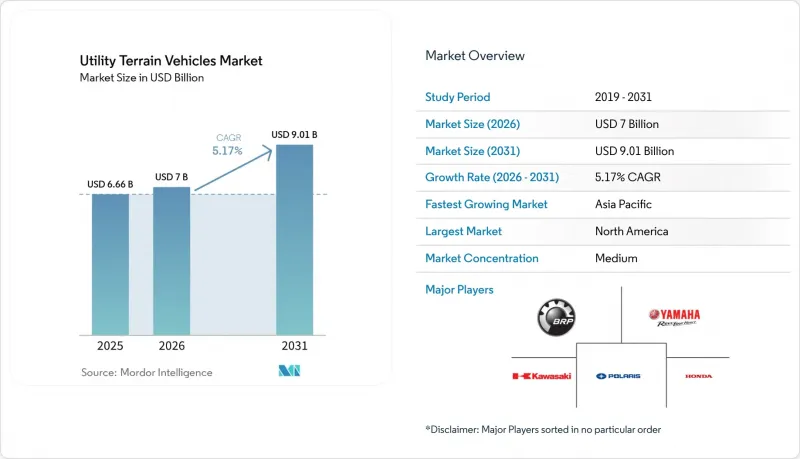
據 Mordor Intelligence 稱,2025 年多用途地形車 (UTV) 市場價值為 66.6 億美元,預計到 2031 年將達到 90.1 億美元,而 2026 年為 70 億美元,預測期(2026-2031 年)的複合年成長率為 5.17%。
本報告按應用領域(運動休閒等)、動力系統(內燃機等)、驅動方式(兩輪驅動、四輪驅動/全輪驅動)、載客量(少於兩座等)和地區進行分類。市場預測以貨幣價值(美元)和銷售(輛)兩種形式呈現。
全球多用途地形車(UTV)市場趨勢與洞察
在農業和林業部門迅速蔓延
農業和林業企業正採用UTV(多用途越野車)替代皮卡和小型曳引機,以應對需要頻繁停車、小半徑轉彎以及連接輕型農具的作業。久保田正在其所有RTV(多功能越野車)產品線中整合KubotaNOW遠端資訊處理套件,免費提供三年GPS追蹤和地理圍欄功能。這降低了車輛被盜風險,並簡化了車輛管理。約翰迪爾的Gator平台現在支援噴桿和土壤採樣設備等精密農業設備,與全尺寸曳引機相比,可最大限度地減少土壤壓實。 FarmX Perceptive Navigation等自主導航解決方案允許一名操作員在播種和收割期間監控多輛UTV,從而在大面積農田上節省20-30%的人事費用。林業承包商更傾向於四輪驅動車型,因為它們可以在陡峭的道路上運輸鏈鋸和燃料,這導致對可容納三至四人的駕駛室的需求增加,以便為伐木場的工人提供便利。
越野休閒需求不斷成長
儘管2024年北美多用途越野車(UTV)總銷量下降7.2%至約52萬輛,但休閒越野和沙丘探險仍然是該市場的主要銷售支柱。為了應對銷售成長放緩,製造商推出了高規格車型,例如北極星(Polaris)的RANGER XP Kinetic,這款車型擁有110匹馬力、140磅英尺的扭力和80英里的最大續航里程,售價為28,999美元。本田(Honda)十年來首次對其Pioneer 1000系列進行更新,並計劃在2026年下半年推出配備密封駕駛室和HVAC系統的精英車型。這凸顯了市場對舒適性配置的重視,以吸引那些進行多日野外探險的用戶。這些高階產品線有助於維持銷售成長,並凸顯了品牌忠誠度對消費者自願購買行為的影響。此外,透過擴大金融方案和提供配件套裝,該公司進一步提高了其在注重性能而非價格的發燒友中的錢包市場佔有率。
與全地形車相比,初始成本和維護成本更高。
多用途地形車 (UTV) 的價格遠高於全地形車 (ATV),這令新興市場中注重預算的買家望而卻步。北極星 (Polaris) 將其入門級 Ranger 500 的定價高於牽引能力相近的中檔 ATV。 UTV 採用類似汽車的變速箱和差速器,需要專門的維護,這在經銷商網路有限的地區尤其成本高昂。因此,亞太和南美洲的許多小規模農戶選擇繼續使用 ATV 或皮卡,阻礙了這些地區 UTV 市場的成長。
細分市場分析
預計到2025年,體育和休閒產業將佔銷售額的45.15%,主要得益於北美日益興盛的越野文化和歐洲探險旅遊的蓬勃發展。到2031年,執法機關車輛的年複合成長率預計將達到5.19%,因為國防負責人優先考慮模組化、可空運的機動性裝備。作為向穩健的商用平台轉型的一部分,美國海軍陸戰隊已簽署多份超輕型戰術車輛的採購合約。同時,英國國防部計劃採購大量輕型多用途越野車(UTV)。此外,阿布奎基市消防救援局(一家搜救機構)也對高性能車輛進行了大量投資,進一步印證了這一趨勢。這表明,在專業的公共安全領域,原始設備製造商(OEM)擁有巨大的盈利機會。
在農業和林業領域,遠端資訊處理功能的整合已被證明有助於降低盜竊風險並實現資料驅動型農業。久保田為所有RTV標配三年「KubotaNOW」服務,簡化了車輛管理流程並增強了客戶忠誠度。工業和建築領域的應用案例持續成長,但來自緊湊型履帶裝載機的競爭給價格帶來了壓力。整體而言,多用途地形車(UTV)市場在應用層面呈現均衡成長,國防和公共安全領域的採購增強了市場穩定性,而休閒和農業領域的需求則支撐了銷售。
2025年,內燃機(汽油和柴油)動力傳動系統佔出貨量的83.14%,這主要得益於其較低的初始成本和廣泛的服務網路。隨著獎勵計畫縮小價格差距,預計到2031年,純電動車型的複合年成長率將達到5.28%。加州每輛車最高可獲得13,500美元的補貼,紐約州擴大了退稅計劃,這些措施降低了公園管理部門採用電動車的門檻。北極星Pro XD Kinetic和龐巴迪Outlander Electric展示了汽車製造商如何針對政府車輛最佳化續航里程和負載容量,以滿足電動車在運作週期方面的限制。
混合動力汽車和氫燃料汽車原型車目前仍處於示範階段。 HySE聯盟為2025年達卡拉力賽開發的氫燃料UTV以及豐田的Tacoma H2-Overlander概念車,都展現了能夠規避鋰電池局限性的長期替代方案。雖然距離商業化尚需時日,但這些先導計畫正在重振研發領域,並幫助汽車製造商為未來UTV產業能源結構的變化做好準備。
區域分析
北美地區憑藉其龐大的越野車道網路、機械化農業和軍事契約,預計到2025年將佔全球銷量的36.24%。儘管2024年銷量大幅下滑,但北極星(Polaris)和本田(Honda)等汽車製造商仍推出了XPEDITION和Pioneer 1000 Elite等高階車型以維持利潤率。在不久的將來,根據第232條款進行的關稅修訂將對進口車輛徵收高額關稅,這將顯著增加BRP等製造商的成本,並迫使它們將生產遷回國內。
預計到2031年,亞太地區將以5.25%的複合年成長率成長,主要驅動力來自印度和印尼的農業機械化以及中國的建築流。馬恆達在馬哈拉斯特拉邦的雄心勃勃的投資旨在大幅提升產能,以滿足國內外市場需求。儘管來自中國微型電動車的競爭抑制了高階市場的成長,但受陡峭地形人工林和大規模基礎設施項目的推動,市場對堅固耐用的四驅全地形車的需求仍然強勁。
預計歐洲和南美洲將保持溫和成長。英國的大規模國防相關合約提振了歐洲的銷售額,而巴西和阿根廷的農業相關企業為了對沖外匯波動風險,正在增加採購。中東和非洲正在崛起為新興市場,其需求主要由石油天然氣、採礦和狩獵旅遊業所驅動。
其他好處:
- Excel格式的市場預測(ME)表
- 3個月的分析師支持
目錄
第1章:引言
- 市場分析與定義的前提條件
- 分析範圍
第2章 分析方法
第3章執行摘要
第4章 市場狀況
- 市場概覽
- 市場促進因素
- 在農業和林業部門迅速蔓延
- 越野休閒的需求日益成長
- 在工業和建築工地中的應用日益廣泛
- 輕型機動車輛軍事現代化計劃
- 具備遠端資訊處理功能的自主「跟隨我」UTV車隊
- 在保護區內獎勵零排放車輛
- 市場限制因素
- 與全地形車相比,初始成本和維護費用較高。
- 來自小型履帶裝載機和小型電動車的競爭
- 由於安全事故,通往步道的通行限制已收緊。
- 電動UTV鋰供應受限
- 價值鍊和供應鏈分析
- 監理情勢
- 技術展望
- 波特五力分析
第5章:預測市場規模與成長率
- 透過使用
- 體育和休閒
- 農業和林業
- 工業與建築
- 軍事和執法機關
- 其他商業用途(旅遊、搜救)
- 透過推進方法
- 內燃機(汽油/柴油)
- 混合
- 電池供電
- 氫燃料電池
- 透過驅動系統
- 兩輪驅動
- 四輪驅動/全輪驅動
- 按座位數
- 少於2人
- 3-4座
- 4座或以上
- 按地區
- 北美洲
- 美國
- 加拿大
- 其他北美國家
- 南美洲
- 巴西
- 阿根廷
- 其他南美國家
- 歐洲
- 英國
- 德國
- 西班牙
- 義大利
- 法國
- 俄羅斯
- 其他歐洲國家
- 亞太地區
- 印度
- 中國
- 日本
- 印尼
- 馬來西亞
- 新加坡
- 越南
- 菲律賓
- 韓國
- 其他亞太國家
- 中東和非洲
- 阿拉伯聯合大公國
- 沙烏地阿拉伯
- 土耳其
- 埃及
- 南非
- 其他中東和非洲國家
- 北美洲
第6章 競爭情勢
- 市場集中度
- 策略趨勢
- 市佔率分析
- 公司簡介
- Polaris Inc.
- BRP Inc.(Can-Am)
- Honda Motor Co.
- Yamaha Motor Co.
- Kawasaki Heavy Industries
- John Deere
- Kubota Corporation
- CF Moto
- Textron(Arctic Cat)
- Hisun Motors
- Mahindra(mPact)
- Kioti/Daedong
- Bobcat/Doosan
- LINHAI
- Segway Powersports
- Tao Motor
- BMS Motorsports
- Massimo Motor
- Volcon ePowersports
- Intimidator UTV
第7章 市場機會與未來展望
According to Mordor Intelligence, the utility terrain vehicles market size was valued at USD 6.66 billion in 2025 and is estimated to grow from USD 7.00 billion in 2026 to reach USD 9.01 billion by 2031, at a CAGR of 5.17% during the forecast period (2026-2031).
This report is Segmented by Application (Sports & Recreation and More), Propulsion Type (Internal-Combustion and More), Drive Type (2-Wheel Drive and 4-Wheel / All-Wheel Drive), Seating Capacity (Less Than 2 Seater and More), and Geography. The Market Forecasts are Provided in Terms of Value (USD) and Volume (Units).
Global Utility Terrain Vehicles Market Trends and Insights
Rapid Adoption in Agriculture & Forestry
Farm operators are substituting pickups and small tractors with UTVs for chores that demand frequent stops, tight turning radii, and light implement mounting. Kubota integrated its KubotaNOW telematics suite across its RTV lines, offering three years of GPS tracking and geofencing at no additional cost, which lowers theft risk and streamlines fleet oversight. John Deere Gator platforms now support precision-ag payloads such as spray booms and soil-sampling rigs, thereby minimizing soil compaction compared with full-size tractors. Autonomous guidance solutions like FarmX Perceptive Navigation enable a single operator to supervise several UTVs during planting and harvest, resulting in labor savings of 20-30% on large acreages. Forestry contractors prefer four-wheel-drive layouts that haul chainsaws and fuel over steep trails, thereby reinforcing demand for 3- to 4-seater cabins that accommodate crews at logging sites .
Rising Demand for Off-Road Recreation
Recreational trail riding and dune exploration continue to anchor sales across the utility terrain vehicles market in North America, even though overall unit volume fell 7.2% to about 520,000 units in 2024. Manufacturers are countering softer volume with higher-spec launches such as Polaris RANGER XP Kinetic, which delivers 110 horsepower, 140 pound-feet of torque, and up to 80 miles of range at a USD 28,999 price point. Honda refreshed its Pioneer 1000 line for the first time in a decade and will introduce a sealed-cab Elite variant with HVAC in late 2026, underscoring a shift toward comfort features that appeal to multi-day backcountry users. These premium offerings help sustain revenue growth and highlight how brand loyalty influences discretionary purchases. Expanding financing programs and bundled accessories further improve wallet share among enthusiasts who prioritize performance over price .
High Upfront & Maintenance Cost vs. ATVs
Utility terrain vehicles (UTVs) are significantly more expensive than their all-terrain vehicle (ATV) counterparts, a factor that deters budget-conscious buyers in emerging markets. Polaris has priced its entry-level RANGER 500 at a price point that positions it above mid-tier ATVs with similar towing capacities. The automotive-style transmissions and differentials in UTVs require specialized servicing, leading to higher maintenance costs, especially in areas with limited dealer networks. Consequently, many smallholders in the Asia-Pacific and South America are opting to stick with ATVs or pickup trucks, hindering the growth of the UTV market in these regions.
Other drivers and restraints analyzed in the detailed report include:
- Growing Use on Industrial & Construction Sites
- Military Modernization Programs for Light Mobility
- Competition from Compact Track Loaders & Mini-EVs
For complete list of drivers and restraints, kindly check the Table Of Contents.
Segment Analysis
Sports and recreation held 45.15% of 2025 revenue, reflecting entrenched trail culture in North America and a growing adventure-tourism scene in Europe. Military and law-enforcement fleets will grow at a 5.19% CAGR to 2031 as defense planners prioritize modular, air-transportable mobility. In a clear shift towards ruggedized commercial platforms, the United States Marine Corps has contracted for several ultra-light tactical vehicle units. Meanwhile, the UK Ministry of Defense is set to acquire a significant number of light-mobility UTVs. Highlighting the trend further, Albuquerque Fire Rescue, a search-and-rescue agency, has invested in high-spec units with substantial costs. This underscores the lucrative opportunities for OEMs in specialized public-safety roles.
Agriculture and forestry applications benefit from bundled telematics that lower theft risk and enable data-driven agronomy. Kubota's inclusion of three-year KubotaNOW service on every RTV streamlines fleet management and solidifies loyalty. Industrial and construction use cases continue to expand, yet competition from compact track loaders pressures price realization. Overall, defense and public-safety procurement add stability, while recreational and agricultural demand maintain volume, ensuring balanced growth in the utility terrain vehicles market size at the application level.
Internal-combustion gasoline and diesel powertrains captured 83.14% of 2025 shipments, anchored by low upfront cost and expansive service networks. Battery-electric models will post a 5.28% CAGR through 2031 as incentive programs bridge price gaps. California's voucher covering up to USD 13,500 per vehicle and New York's replenished rebates lower acquisition hurdles for park services. Polaris Pro XD Kinetic and Can-Am Outlander Electric illustrate how OEMs are tailoring range and payload to government fleets where duty cycles align with electric constraints.
Hybrid and hydrogen prototypes remain exploratory. The HySE consortium's hydrogen UTV for Dakar 2025 and Toyota's Tacoma H2-Overlander concept highlight long-horizon alternatives that bypass lithium constraints. Although commercialization is still distant, these pilots keep R&D pipelines active and position OEMs for future shifts in the utility terrain-vehicle industry's energy mix.
Complete Report Scope:
- By Application
- Sports & Recreation
- Agriculture & Forestry
- Industrial & Construction
- Military & Law-Enforcement
- Other Commercial (Tourism, Search-and-Rescue)
- By Propulsion Type
- Internal-Combustion (Gasoline / Diesel)
- Hybrid
- Battery-Electric
- Hydrogen Fuel-Cell
- By Drive Type
- 2-Wheel Drive
- 4-Wheel / All-Wheel Drive
- By Seating Capacity
- Less than 2 Seater
- 3-4 Seater
- More than 4 Seater
- By Geography
- North America
- United States
- Canada
- Rest of North America
- South America
- Brazil
- Argentina
- Rest of South America
- Europe
- United Kingdom
- Germany
- Spain
- Italy
- France
- Russia
- Rest of Europe
- Asia-Pacific
- India
- China
- Japan
- Indonesia
- Malaysia
- Singapore
- Vietnam
- Philippines
- South Korea
- Rest of Asia-Pacific
- Middle East and Africa
- United Arab Emirates
- Saudi Arabia
- Turkey
- Egypt
- South Africa
- Rest of Middle East and Africa
- North America
Geography Analysis
North America generated 36.24% of 2025 revenue, driven by its extensive trail networks, mechanized agriculture, and military contracts. Despite a notable sales dip in 2024, OEMs like Polaris and Honda introduced premium models, such as the XPEDITION and Pioneer 1000 Elite, to safeguard their profit margins. Starting in the near future, Section 232 tariff revisions will impose a substantial duty on imported vehicles, significantly increasing costs for manufacturers like BRP and pushing them towards reshoring production.
Asia-Pacific is set to grow at a 5.25% CAGR through 2031, driven by agricultural mechanization in India and Indonesia, as well as construction logistics in China. Mahindra's ambitious investment in Maharashtra aims to significantly boost its capacity, catering to both domestic and international markets. While competition from Chinese mini-EVs curtails premium growth, the demand for robust 4X4 UTVs persists, fueled by steep-terrain plantations and vast infrastructure projects.
Europe and South America experience moderate growth. A major defense deal in the UK bolsters European sales, and agribusinesses in Brazil and Argentina are countering currency fluctuations by purchasing. The Middle East and Africa are emerging as new frontiers, with demand primarily driven by the oil and gas sector, mining, and safari tourism.
- Polaris Inc.
- BRP Inc. (Can-Am)
- Honda Motor Co.
- Yamaha Motor Co.
- Kawasaki Heavy Industries
- John Deere
- Kubota Corporation
- CF Moto
- Textron (Arctic Cat)
- Hisun Motors
- Mahindra (mPact)
- Kioti / Daedong
- Bobcat / Doosan
- LINHAI
- Segway Powersports
- Tao Motor
- BMS Motorsports
- Massimo Motor
- Volcon ePowersports
- Intimidator UTV
Additional Benefits:
- The market estimate (ME) sheet in Excel format
- 3 months of analyst support
TABLE OF CONTENTS
1 Introduction
- 1.1 Study Assumptions & Market Definition
- 1.2 Scope of the Study
2 Research Methodology
3 Executive Summary
4 Market Landscape
- 4.1 Market Overview
- 4.2 Market Drivers
- 4.2.1 Rapid Adoption In Agriculture & Forestry
- 4.2.2 Rising Demand For Off-Road Recreation
- 4.2.3 Growing Use On Industrial & Construction Sites
- 4.2.4 Military Modernization Programs For Light Mobility
- 4.2.5 Telematics-Enabled Autonomous "Follow-Me" Utv Fleets
- 4.2.6 Incentives For Zero-Emission Vehicles In Protected Parks
- 4.3 Market Restraints
- 4.3.1 High Upfront & Maintenance Cost Vs. Atvs
- 4.3.2 Competition From Compact Track Loaders & Mini-Evs
- 4.3.3 Safety Incidents Tightening Trail-Access Rules
- 4.3.4 Lithium Supply Constraints For Electrified Utvs
- 4.4 Value / Supply-Chain Analysis
- 4.5 Regulatory Landscape
- 4.6 Technological Outlook
- 4.7 Porter's Five Forces
- 4.7.1 Threat of New Entrants
- 4.7.2 Bargaining Power of Suppliers
- 4.7.3 Bargaining Power of Buyers
- 4.7.4 Threat of Substitutes
- 4.7.5 Competitive Rivalry
5 Market Size & Growth Forecasts (Value (USD) and Volume (Units))
- 5.1 By Application
- 5.1.1 Sports & Recreation
- 5.1.2 Agriculture & Forestry
- 5.1.3 Industrial & Construction
- 5.1.4 Military & Law-Enforcement
- 5.1.5 Other Commercial (Tourism, Search-and-Rescue)
- 5.2 By Propulsion Type
- 5.2.1 Internal-Combustion (Gasoline / Diesel)
- 5.2.2 Hybrid
- 5.2.3 Battery-Electric
- 5.2.4 Hydrogen Fuel-Cell
- 5.3 By Drive Type
- 5.3.1 2-Wheel Drive
- 5.3.2 4-Wheel / All-Wheel Drive
- 5.4 By Seating Capacity
- 5.4.1 Less than 2 Seater
- 5.4.2 3-4 Seater
- 5.4.3 More than 4 Seater
- 5.5 By Geography
- 5.5.1 North America
- 5.5.1.1 United States
- 5.5.1.2 Canada
- 5.5.1.3 Rest of North America
- 5.5.2 South America
- 5.5.2.1 Brazil
- 5.5.2.2 Argentina
- 5.5.2.3 Rest of South America
- 5.5.3 Europe
- 5.5.3.1 United Kingdom
- 5.5.3.2 Germany
- 5.5.3.3 Spain
- 5.5.3.4 Italy
- 5.5.3.5 France
- 5.5.3.6 Russia
- 5.5.3.7 Rest of Europe
- 5.5.4 Asia-Pacific
- 5.5.4.1 India
- 5.5.4.2 China
- 5.5.4.3 Japan
- 5.5.4.4 Indonesia
- 5.5.4.5 Malaysia
- 5.5.4.6 Singapore
- 5.5.4.7 Vietnam
- 5.5.4.8 Philippines
- 5.5.4.9 South Korea
- 5.5.4.10 Rest of Asia-Pacific
- 5.5.5 Middle East and Africa
- 5.5.5.1 United Arab Emirates
- 5.5.5.2 Saudi Arabia
- 5.5.5.3 Turkey
- 5.5.5.4 Egypt
- 5.5.5.5 South Africa
- 5.5.5.6 Rest of Middle East and Africa
- 5.5.1 North America
6 Competitive Landscape
- 6.1 Market Concentration
- 6.2 Strategic Moves
- 6.3 Market Share Analysis
- 6.4 Company Profiles (includes Global Level Overview, Market Level Overview, Core Segments, Financials as Available, Strategic Information, Market Rank/Share for Key Companies, Products and Services, SWOT Analysis, and Recent Developments)
- 6.4.1 Polaris Inc.
- 6.4.2 BRP Inc. (Can-Am)
- 6.4.3 Honda Motor Co.
- 6.4.4 Yamaha Motor Co.
- 6.4.5 Kawasaki Heavy Industries
- 6.4.6 John Deere
- 6.4.7 Kubota Corporation
- 6.4.8 CF Moto
- 6.4.9 Textron (Arctic Cat)
- 6.4.10 Hisun Motors
- 6.4.11 Mahindra (mPact)
- 6.4.12 Kioti / Daedong
- 6.4.13 Bobcat / Doosan
- 6.4.14 LINHAI
- 6.4.15 Segway Powersports
- 6.4.16 Tao Motor
- 6.4.17 BMS Motorsports
- 6.4.18 Massimo Motor
- 6.4.19 Volcon ePowersports
- 6.4.20 Intimidator UTV
7 Market Opportunities & Future Outlook
- 7.1 White-space & Unmet-Need Assessment

 多用途地形車(UTV)市場機會、成長要素、產業趨勢分析及2026-2035年預測
 多用途越野車 (UTV) 市場分析及預測至 2035 年:按類型、產品、服務、技術、組件、應用、材料類型、部署和最終用戶分類
 全球多用途地形車(UTV)市場規模、佔有率、趨勢和成長分析報告(2026-2034年)
 2026年全球UTV零件及配件市場報告
 多用途地形車市場-全球產業規模、佔有率、趨勢、機會與預測:按引擎排氣量、推進系統、應用、地區和競爭格局分類,2021-2031年
 多用途作業車輛 (UTV) 市場規模、佔有率和成長分析(按車輛類型、燃料類型、引擎排氣量和地區分類)—2026-2033 年產業預測
 多功能車零件和配件的全球市場。全球多用途地形車(UTV)市場
 多用途地形車市場規模、佔有率、趨勢分析報告:按引擎排氣量、推進力、應用、地區、細分市場預測,2025-2030 年