


 |
市場調查報告書
商品編碼
2117438
氫燃料卡車:市場佔有率分析、產業趨勢與統計、成長預測(2026-2031)Hydrogen Truck - Market Share Analysis, Industry Trends & Statistics, Growth Forecasts (2026 - 2031) |
||||||

※ 本網頁內容可能與最新版本有所差異。詳細情況請與我們聯繫。
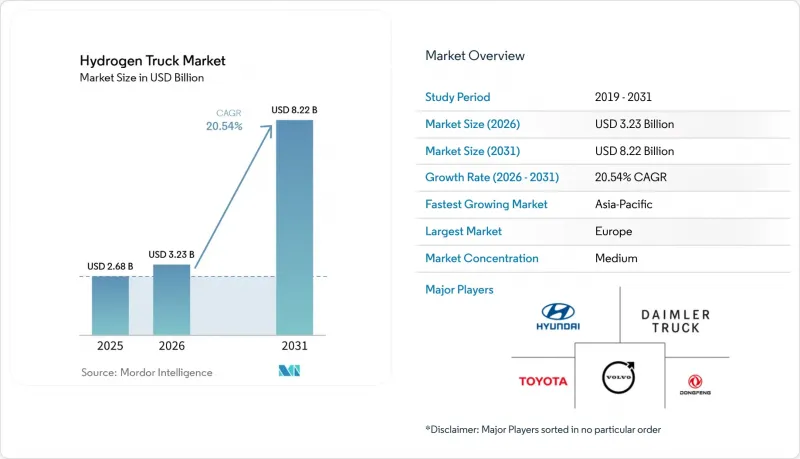
據 Mordor Intelligence 稱,2025 年氫燃料卡車市值為 26.8 億美元,預計 2026 年將達到 32.3 億美元,到 2031 年將達到 82.2 億美元,2026 年至 2031 年的複合年成長率為 20.54%。
本報告按負載容量(3.5-7.5噸、7.5-16噸及以上)、續航里程(小於300英里、300-500英里及以上)、應用領域(物流、建築及其他)、所有權類型(車隊運營商、私人車主)、車身類型(平板車、廂式貨車及其他)和地區進行分類。市場預測以價值(美元)和銷售(輛)為單位呈現。
全球氫燃料卡車市場趨勢及洞察
綠氫氣的 LCOH(氫氣均質成本)迅速下降。
隨著清潔氫的成本目標不再被視為遙遠的未來,氫燃料卡車市場的可行性正在不斷提高。美國能源局目前的目標是,透過擴大規模、提高效率和降低再生能源投入成本,在2026年實現每公斤2美元,到2031年實現每公斤1美元。這項轉變意義重大,因為燃料成本是卡車營運經濟的核心,即使氫氣交付價格僅取得部分進展,也能大幅縮小限制氫燃料卡車市場廣泛應用的成本差距。氫燃料卡車市場也存在明顯的區域差異。可再生能源豐富的地區比電力價格高昂或波動較大的地區更有可能更快地實現實際的經濟可行性,這意味著商業性應用更有可能集中在電力供應成本低的地區,而不是均勻地分佈在全國各地。這一趨勢凸顯了專用路線和走廊規劃的有效性,因為能夠利用當地有利氫氣生產的營運商可以比依賴從高成本地區運輸的營運商更快地實現更穩定的車輛營運經濟效益。因此,在氫燃料卡車市場,那些將車輛生產和供應與本地化生產和供應相結合的專案開發商,而不是將氫氣採購視為獨立的下游問題,更有可能取得成功。這也意味著,早期無需補貼的成功案例更有可能來自少數幾個具有優勢的物流樞紐,而不是遍布全國高速公路網路的大規模部署。
零排放貨運走廊的擴建
氫燃料卡車市場正受益於基於走廊的部署模式。這是因為各國政府越來越傾向於根據貨運密度和路線合理性來規劃基礎設施,而不是依賴分散的、無法容納重型車輛的公共加氫站。在美國,國家零排放貨運走廊戰略的第一階段涵蓋了12,000英里的國家公路貨運網路,這將為氫燃料卡車市場提供更清晰的基礎設施發展藍圖,以支持在高貨運量路線上開展7級和8級卡車的運營。在歐洲,《氫能基礎設施法規》(AFIR)要求到2030年,在泛歐交通網路(TEN-T)核心網路沿線定期建設加氫站,而由聯盟主導的部署項目正開始將政策框架與車輛和加氫站的部署計劃相協調。氫燃料卡車市場正從這種模式中受益。這是因為路線確定性的提高降低了資產閒置的風險,提高了加氫站的利用率,並使運營商能夠根據已知的加氫便利性來採購車輛,而無需等待全面覆蓋的基礎設施建成。這也改變了營運商的商業性決策,因為最佳的第一步往往並非只是選擇車型,而是確保在營運走廊上提供服務。因此,在氫燃料卡車市場,走廊所有權、加氫站夥伴關係和貨物整合的重要性正變得與卡車硬體本身不相上下。
公共加氫網路密度低
氫燃料卡車市場目前面臨的最緊迫障礙仍然是加氫站密度。這是因為重型車輛的加氫點數量遠不足以確保路線的柔軟性。在歐洲,商用車輛的公共加氫網路仍然稀疏,而且一些地區由於需要將原本為乘用車設計的舊加氫站改造為適合卡車的加氫站,導致在下一輪投資全面展開之前,部分地區的可用加氫站數量有所減少。在美國,聯邦政府的規劃文件仍然建議在長期內進行大規模的基礎設施建設,這表明政策目標與實際可用性之間存在顯著差距。此外,加氫方式的不確定性也阻礙了氫燃料卡車市場的發展。氣態氫和液態氫的不相容性導致投資者在決定投資哪些資產時猶豫不決。簡而言之,問題不僅在於加氫站的數量,還在於車輛業者能否相信這些加氫站能夠與未來的汽車平臺相容。在這種信任得到提升之前,氫燃料卡車市場將繼續傾向於私人車隊和封閉的運輸路線,而不是開放的國家級網路。
細分市場分析
到2025年,30噸以上車型將佔氫燃料卡車市場規模的42.15%,預計2031年將維持26.75%的複合年成長率,成為成長最快的細分市場。這個市場定位反映了氫燃料卡車在營運方面最明確的適用性,因為快速加氫、路線連續性和負載容量維持對於長途和重型貨物運輸至關重要。動力傳動系統重量權衡研究表明,在最重的車輛等級中,氫燃料系統比電池組增加的重量更少。這對貨櫃運輸、散貨運輸和長途牽引車的使用有直接影響。戴姆勒卡車致力於小批量生產氫燃料重型卡車,證實了30噸以上車型等級為製造商提供了最大的規模經濟潛力和營運意義。從實際角度來看,如果每輛車每天行駛很長的距離,運輸高價值或對重量敏感的貨物,並且可以避免因長時間充電而造成的停機時間,那麼引入氫燃料卡車就更有道理了。
16-30噸級卡車市場仍然具有重要的商業性價值,因為它適合混合循環運營,例如建築物流、本地配送和垃圾傾倒作業等,這類卡車的路線通常變化多端,且快速加氫極具吸引力。對於氫燃料卡車產業而言,這個中型卡車市場也十分有利,因為許多車隊營運商可以在全面部署長途牽引車之前,先在該級別進行氫燃料卡車的試點運作。相較之下,7.5-16噸和3.5-7.5噸級卡車的部署理由目前仍然不足,因為都市區和區域內的短途循環可以透過在基地台充電輕鬆實現電氣化。但這並不意味著這些等級的卡車將被排除在氫燃料卡車市場之外,只是它們目前在投資優先事項方面落後於更重型的等級。此外,聯合國歐洲經濟委員會(UNECE)氫燃料車輛法規的安全和認證要求將繼續影響所有負載容量等級的儲能系統的設計、整合方案和商業化進程。
到2025年,300-500英里(約480-800公里)的氫燃料卡車市場規模將佔54.33%,而500英里(約800公里)以上的氫燃料卡車市場預計到2031年將以33.45%的複合成長率年成長。目前300-500英里細分市場的領先地位反映了當前運輸走廊發展的結構,即基礎設施有限,但具有足夠的可預測性,能夠支持區域貨運網路並實現計劃內的加氫間隔。 500英里以上細分市場的快速成長表明,氫燃料卡車市場預計將在哪些領域創造下一波價值浪潮,尤其是在用於超長途運輸的液態和高密度儲氫解決方案日趨成熟之後。戴姆勒的「NextGenH2」平台旨在提供超過1000公里的液氫續航里程,這直接支持了氫燃料卡車應擴展到整個長途運輸服務領域,而不僅限於區域間運輸路線的觀點。此外,Elemental Trucks 在加拿大商業化部署了一輛 63.5 噸的氫動力 8 級卡車,這表明人們越來越相信長途貨運不僅可以透過原型實現,還可以透過商業產品實現。
在港口運輸、廢棄物管理和城市物流領域,300英里以下的短途運輸仍然至關重要。在這些領域,營運的規律性和當地的空氣品質法規正在推動零排放車輛的普及,儘管氫燃料的經濟性尚未達到理想水準。然而,由於可預測的返程時間通常允許在倉庫進行集中充電,因此這一短途運輸領域正面臨著來自純電動平台日益激烈的競爭。因此,氫燃料卡車市場呈現兩極化的格局:短途運輸用例主要用於滿足初期示範和監管合規需求,而長途運輸用例則代表未來成長的主要動力。隨著運輸路線密度的增加,部分需求可能會從中途運輸轉向長途運輸,因為承運商會優先考慮行程安排的柔軟性和減少加氫次數。這些發展趨勢可能會使氫燃料卡車市場繼續專注於氫燃料續航里程優勢最難被取代的運輸應用領域。
區域分析
到2025年,歐洲將佔據氫燃料卡車市場45.11%的佔有率,成為目前銷售量最大的區域市場。歐洲的主導地位得益於其多層次而非孤立的政策支持。具體而言,《聯邦工業發展法案》(AFIR)規定了在關鍵走廊上建造加氫站的要求,而《可再生氫在全經濟領域的推廣應用。這種政策深度對氫燃料卡車市場至關重要,使車隊營運商、原始設備製造商(OEM)和燃料供應商能夠基於更清晰的監管路徑做出投資決策。德國透過資助加氫站和車隊營運支援繼續發揮核心作用,並且部分商業用戶的氫氣淨價格下調,使其更接近卡車運營商實際可行的經濟可行性水平。法國正透過Hylik計畫累積車隊營運的實務經驗,而西班牙在低成本可再生氫方面的潛力正使南歐成為該地區未來成本曲線中日益重要的供應中心。
亞太地區是氫燃料卡車市場成長最快的地區,預計到2031年複合年成長率將達到24.65%。中國並非依靠自由市場競爭來推動氫燃料卡車的部署,而是透過建構一個生態系統模式來實現,該模式將示範叢集、公共獎勵、車隊擴張和里程累積等因素連結起來。到2025年底,這些叢集已部署超過2萬輛燃料電池汽車。徐工集團在耐久性方面的進步及其在新能源重型卡車領域的持續優勢也為該地區的擴張提供了支持,因為氫燃料卡車市場的商業性可行性很大程度上取決於實際營運績效和政策承諾。韓國憑藉現代汽車的「HTWO」一體化策略仍佔據重要地位。該策略涵蓋了生產、燃料供應和車輛部署,業務遍及多個國家,將其在亞太地區的影響力擴展到烏拉圭等出口市場。印度仍處於起步階段,但隨著氫燃料在採礦業的部署以及技術和經濟討論的進展,氫燃料卡車市場正從概念討論轉向系統的專案評估。
在北美,2026 年的走廊規劃、港口營運和車輛部署模式更加協調一致,從而進入了更明確的商業化階段。加州仍然是該地區氫燃料卡車市場的中心,Highroad Energy 在長灘港的大規模部署以及豐田汽車協調的供應網路構成了美國最具體的營運案例之一。聯邦政府的走廊策略提供了一個更長期的框架,尤其是在 5 號州際公路和其他主要貨運路線沿線,這些地區的高利用率可以支持分階段的基礎設施部署。在加拿大,市場正透過重型卡車的普及和租賃模式的引入而興起,而南美、中東和非洲仍處於起步階段。雖然專案活動已經顯現,但大規模部署仍取決於未來加氫站的建造和可靠的氫氣供應。
其他好處:
- Excel格式的市場預測(ME)表
- 3個月的分析師支持
目錄
第1章:引言
- 研究假設和市場定義
- 調查範圍
第2章:調查方法
第3章執行摘要
第4章 市場狀況
- 市場概覽
- 市場促進因素
- 綠氫氣的 LCOH(氫氣均質成本)迅速下降。
- 擴大零排放貨運走廊
- 純電動車在長途駕駛循環中的續航里程限制
- 全球托運人無污染燃料採購義務
- 透過減少能源消耗將剩餘可再生能源產量貨幣化
- 消除殘值風險的OEM租賃模式
- 市場限制因素
- 面向公眾的氫氣加註網路密度有限。
- 在補貼較少的地區,與柴油車相比,總擁有成本更高。
- 行駛里程超過50萬公里的動力傳動系統耐久性存在不確定性
- 氫氣價格波動與天然氣基準價格相關
- 價值供應鏈分析
- 監理情勢
- 技術展望
- 波特五力分析
第5章 市場規模與成長預測
- 按運輸能力
- 3.5至7.5噸
- 7.5至16噸
- 16-30噸
- 超過30噸
- 按範圍
- 不到300英里
- 300-500英里
- 超過500英里
- 透過使用
- 物流
- 建造
- 農業
- 礦業
- 公用事業
- 其他
- 依所有權類型
- 車隊營運商
- 個人所有者
- 依體型
- 平板
- 廂型車
- 冷藏
- 油船
- 翻斗車
- 按地區
- 北美洲
- 美國
- 加拿大
- 其他北美國家
- 南美洲
- 巴西
- 阿根廷
- 其他南美國家
- 歐洲
- 英國
- 德國
- 西班牙
- 義大利
- 法國
- 俄羅斯
- 其他歐洲國家
- 亞太地區
- 印度
- 中國
- 日本
- 韓國
- 其他亞太國家
- 中東和非洲
- 阿拉伯聯合大公國
- 沙烏地阿拉伯
- 土耳其
- 埃及
- 南非
- 其他中東和非洲國家
- 北美洲
第6章 競爭情勢
- 市場集中度
- 策略趨勢
- 市佔率分析
- 公司簡介
- Hyundai Motor Company
- Daimler Truck AG
- Toyota Motor Corporation
- Volvo Group
- Scania AB
- MAN Truck and Bus SE
- Iveco Group
- Kenworth(Paccar Inc.)
- Renault Trucks
- Quantron AG
- Tata Motors Limited
- FAW Jiefang
- SAIC Motor Corp., Ltd.
- Dongfeng Motor Corporation
- Foton Motor Co.
第7章 市場機會與未來展望
According to Mordor Intelligence, the hydrogen truck market size was valued at USD 2.68 billion in 2025 and is expected to reach USD 3.23 billion in 2026 and USD 8.22 billion by 2031, growing at a CAGR of 20.54% over 2026-2031.
This report is Segmented by Tonnage Capacity (3. 5 To 7. 5 Tons, 7. 5 To 16 Tons, and More), Range (Below 300 Miles, 300-500 Miles, and More), Application (Logistics, Construction, and More), Ownership (Fleet Operators, Individual Owners), Body Type (Flatbed, Box Truck, and More), and Geography. The Market Forecasts are Provided in Terms of Value (USD) and Volume (Units).
Global Hydrogen Truck Market Trends and Insights
Rapid Decline in Green-Hydrogen LCOH (Levelized Cost of Hydrogen)
The hydrogen truck market is becoming more viable because clean hydrogen cost targets are no longer framed only as distant ambitions, with the U.S. Department of Energy now pushing toward USD 2/kg by 2026 and USD 1/kg by 2031 through scale, efficiency, and lower renewable electricity input costs. That shift matters because fuel cost sits at the center of truck operating economics, and even partial progress on delivered hydrogen price can materially narrow the cost gap that has limited wider rollout in the hydrogen truck market. The hydrogen truck market is also seeing a clear geographic split, since renewable-rich regions can move faster toward workable economics than areas where electricity remains expensive or volatile, which means commercial adoption is likely to cluster first around low-cost power rather than spread evenly by country. This pattern strengthens the case for captive routes and corridor planning, because operators with access to favorable local hydrogen production can reach more stable fleet economics earlier than operators that depend on trucked-in supply from higher-cost regions. As a result, the hydrogen truck market is likely to reward project developers that pair vehicles with local production and dispensing rather than treat hydrogen sourcing as a separate downstream issue. It also means early unsubsidized wins are more likely to come from a handful of advantaged logistics zones than from national rollouts across full highway networks.
Expansion of Zero-Emission Freight Corridors
The hydrogen truck market is gaining support from corridor-based deployment models because governments are increasingly planning infrastructure around freight density and route logic rather than relying on scattered public stations that cannot support heavy-duty utilization. In the United States, the National Zero-Emission Freight Corridor Strategy targets 12,000 miles of the National Highway Freight Network in its first phase, which gives the hydrogen truck market a clearer infrastructure roadmap for Class 7 and Class 8 operations on high-volume routes. In Europe, AFIR requires hydrogen stations at regular intervals along the TEN-T core network by 2030, and consortium-led deployments are beginning to match that policy framework with vehicle and station commitments. The hydrogen truck market benefits from this approach because route certainty reduces the risk of idle assets, raises station utilization, and lets fleets match vehicle procurement to known refueling access instead of waiting for universal coverage. It also changes the commercial decision for operators, since the best first move is often to secure service on a viable corridor rather than simply choose a vehicle model. That is why corridor ownership, station partnerships, and freight aggregation are becoming as important as truck hardware in the hydrogen truck market.
Limited Public H2 Refueling Network Density
The hydrogen truck market still faces its most immediate barrier in station density, because the number of heavy-duty hydrogen refueling points remains far below the level needed for broad route flexibility. In Europe, the public network for commercial vehicles is still thin, and the reconfiguration of older passenger-focused stations into truck-suitable formats has reduced available locations in some areas before the next wave of investment fully arrives. In the United States, federal planning documents still imply a very large infrastructure buildout over time, which shows how wide the current gap remains between policy ambition and operational access. The hydrogen truck market is further slowed by uncertainty over refueling formats, because incompatible approaches for gaseous and liquid hydrogen create hesitation for investors deciding which assets to fund. This means the issue is not only the number of stations, but also whether fleets can trust those stations to match future vehicle platforms. Until that confidence improves, the hydrogen truck market will keep favoring captive fleets and closed corridors over open-access national networks.
Other drivers and restraints analyzed in the detailed report include:
- BEV-Range Limitations for Long-Haul Duty Cycles
- Clean-Fuel Procurement Mandates from Global Shippers
- Higher TCO Versus Diesel in Low-Subsidy Regions
For complete list of drivers and restraints, kindly check the Table Of Contents.
Segment Analysis
Above 30 Tons accounted for 42.15% of the hydrogen truck market size in 2025 and is projected to record the fastest CAGR of 26.75% through 2031. This position reflects the clearest operating fit in the hydrogen truck market, because long-haul and high-gross-weight freight places the greatest value on rapid refueling, route continuity, and preserved payload. Research on powertrain weight tradeoffs shows that hydrogen systems impose a smaller weight penalty than battery packs in the heaviest vehicle classes, which matters directly for container haulage, bulk freight, and line-haul tractor use. Daimler Truck's small-series commitment for its hydrogen heavy truck reinforces that the above-30-ton class is where manufacturers see the strongest path to series economics and operational relevance. In practical terms, the hydrogen truck market becomes easier to justify when each vehicle covers long daily distances, carries high-value or weight-sensitive loads, and avoids extended charging downtime.
The 16-30 Tons segment remains commercially important because it serves mixed-cycle operations in construction logistics, regional distribution, and tipping work, where route variability makes fast refueling attractive. The hydrogen truck industry also benefits from this middle band because many fleet operators can pilot hydrogen there before moving into full long-haul tractor deployment. By contrast, the 7.5-16 Tons and 3.5-7.5 Tons ranges still face a weaker immediate case, since shorter urban and regional cycles are easier to electrify with depot charging. That does not remove them from the hydrogen truck market, but it does place them behind heavier classes in the current investment queue. Safety and certification requirements under UNECE hydrogen vehicle rules also continue to shape storage design, integration choices, and commercialization pace across all tonnage classes.
The 300-500 miles category held 54.33% of the hydrogen truck market size in 2025, while above 500 miles is set to expand at a 33.45% CAGR through 2031. The current lead of the 300-500 miles bracket reflects the structure of today's corridor buildout, where infrastructure is limited but predictable enough to support regional freight networks with planned refueling intervals. The faster growth of the Above 500 miles segment shows where the hydrogen truck market is expected to generate its next wave of value, especially as liquid and high-density storage solutions mature for very long routes. Daimler's NextGenH2 platform is designed for more than 1,000 km of range with liquid hydrogen, which directly supports the case for expanding hydrogen into full long-haul service rather than keeping it inside regional corridors. Elemental Trucks' commercial introduction of a 63.5-tonne hydrogen Class 8 vehicle in Canada also points to growing confidence that longer-range freight operations can be addressed with commercially offered products rather than only prototypes.
The Below 300 miles segment remains relevant in port drayage, waste, and urban logistics, where route regularity and local air-quality rules support zero-emission adoption even when hydrogen economics are not yet ideal. Still, that lower-range bracket faces stronger competition from battery-electric platforms because charging can often be centralized at depots with predictable return schedules. The hydrogen truck market is therefore seeing a split in which lower-range use cases support early demonstration and compliance needs, while higher-range use cases carry the larger future growth pool. As corridor density improves, some demand is likely to move upward from the mid-range category into longer-range vehicles because fleets value schedule resilience and lower refueling frequency. That progression would keep the hydrogen truck market centered on the transport applications where hydrogen's range advantage is hardest to replace.
Complete Report Scope:
- By Tonnage Capacity
- 3.5 to 7.5 Tons
- 7.5 to 16 Tons
- 16 to 30 Tons
- Above 30 Tons
- By Range
- Below 300 miles
- 300 to 500 miles
- Above 500 miles
- By Application
- Logistics
- Construction
- Agriculture
- Mining
- Utility
- Others
- By Ownership
- Fleet Operators
- Individual Owners
- By Body Type
- Flatbed
- Box Truck
- Refrigerated
- Tanker
- Tipper
- By Geography
- North America
- United States
- Canada
- Rest of North America
- South America
- Brazil
- Argentina
- Rest of South America
- Europe
- United Kingdom
- Germany
- Spain
- Italy
- France
- Russia
- Rest of Europe
- Asia-Pacific
- India
- China
- Japan
- South Korea
- Rest of Asia-Pacific
- Middle East and Africa
- United Arab Emirates
- Saudi Arabia
- Turkey
- Egypt
- South Africa
- Rest of Middle East and Africa
- North America
Geography Analysis
Europe represented 45.11% of the hydrogen truck market size in 2025, which made it the leading regional bloc in current revenue terms. Europe leads because policy support is layered rather than isolated, with AFIR setting station requirements on core corridors while RED III strengthens the push toward renewable hydrogen use in the broader economy. That policy depth matters for the hydrogen truck market because fleets, OEMs, and fuel suppliers can all make investment decisions against a clearer regulatory path. Germany remains central through station funding and fleet support, while lower net hydrogen pricing for selected commercial users has brought the economics closer to workable utilization levels for truck operators. France is adding real fleet operating evidence through Hyliko, while Spain's lower-cost renewable hydrogen potential positions southern Europe as an increasingly important supply anchor for the region's future cost curve.
Asia-Pacific is the fastest-growing region in the hydrogen truck market, with a projected CAGR of 24.65% through 2031. China is advancing through an ecosystem model that ties demonstration clusters, public incentives, fleet buildout, and mileage accumulation together rather than leaving adoption to open-market competition, and those clusters had already promoted more than 20,000 fuel cell vehicles by the end of 2025. XCMG's durability progress and continued strength in new-energy heavy trucks also support the region's scale story, because commercial credibility in the hydrogen truck market depends on real operating proof as much as on policy commitments. South Korea remains important through Hyundai's integrated HTWO approach, which spans production, fueling, and vehicle deployment across multiple countries and extends Asia-Pacific influence into export markets such as Uruguay. India is still early, but mining deployment and techno-economic debate are moving the hydrogen truck market from concept discussion into structured project evaluation.
North America entered a clearer commercial phase in 2026 as corridor planning, port operations, and integrated fleet models began to align more visibly. California remains the center of gravity for the hydrogen truck market in the region, with Hyroad Energy's large Port of Long Beach deployment and Toyota's linked supply arrangement creating one of the most concrete operating examples in the United States. Federal corridor strategy adds longer-term structure, especially along Interstate 5 and other major freight routes where utilization density can support staged infrastructure rollout. Canada is emerging through heavy-truck launches and lease-based access, while South America and the Middle East and Africa remain earlier-stage regions where project activity is visible but large-scale adoption still depends on future station buildout and dependable hydrogen supply.
- Hyundai Motor Company
- Daimler Truck AG
- Toyota Motor Corporation
- Volvo Group
- Scania AB
- MAN Truck and Bus SE
- Iveco Group
- Kenworth (Paccar Inc.)
- Renault Trucks
- Quantron AG
- Tata Motors Limited
- FAW Jiefang
- SAIC Motor Corp., Ltd.
- Dongfeng Motor Corporation
- Foton Motor Co.
Additional Benefits:
- The market estimate (ME) sheet in Excel format
- 3 months of analyst support
TABLE OF CONTENTS
1 Introduction
- 1.1 Study Assumptions and Market Definition
- 1.2 Scope of the Study
2 Research Methodology
3 Executive Summary
4 Market Landscape
- 4.1 Market Overview
- 4.2 Market Drivers
- 4.2.1 Rapid Decline in Green-Hydrogen LCOH (Levelized Cost of Hydrogen)
- 4.2.2 Expansion of Zero-Emission Freight Corridors
- 4.2.3 BEV-Range Limitations for Long-Haul Duty Cycles
- 4.2.4 Clean-Fuel Procurement Mandates from Global Shippers
- 4.2.5 Surplus Renewable-Energy Curtailment Monetization
- 4.2.6 OEM Leasing Models that Eliminate Residual-Value Risk
- 4.3 Market Restraints
- 4.3.1 Limited Public H2 Refueling Network Density
- 4.3.2 Higher TCO Versus Diesel in Low-Subsidy Regions
- 4.3.3 Powertrain Durability Unknowns beyond 500,000 Km
- 4.3.4 H2 Price Volatility Linked to Natural-Gas Benchmarks
- 4.4 Value / Supply-Chain Analysis
- 4.5 Regulatory Landscape
- 4.6 Technological Outlook
- 4.7 Porter's Five Forces Analysis
- 4.7.1 Threat of New Entrants
- 4.7.2 Bargaining Power of Suppliers
- 4.7.3 Bargaining Power of Buyers
- 4.7.4 Threat of Substitutes
- 4.7.5 Intensity of Competitive Rivalry
5 Market Size and Growth Forecast (Value (USD) and Volume (Units))
- 5.1 By Tonnage Capacity
- 5.1.1 3.5 to 7.5 Tons
- 5.1.2 7.5 to 16 Tons
- 5.1.3 16 to 30 Tons
- 5.1.4 Above 30 Tons
- 5.2 By Range
- 5.2.1 Below 300 miles
- 5.2.2 300 to 500 miles
- 5.2.3 Above 500 miles
- 5.3 By Application
- 5.3.1 Logistics
- 5.3.2 Construction
- 5.3.3 Agriculture
- 5.3.4 Mining
- 5.3.5 Utility
- 5.3.6 Others
- 5.4 By Ownership
- 5.4.1 Fleet Operators
- 5.4.2 Individual Owners
- 5.5 By Body Type
- 5.5.1 Flatbed
- 5.5.2 Box Truck
- 5.5.3 Refrigerated
- 5.5.4 Tanker
- 5.5.5 Tipper
- 5.6 By Geography
- 5.6.1 North America
- 5.6.1.1 United States
- 5.6.1.2 Canada
- 5.6.1.3 Rest of North America
- 5.6.2 South America
- 5.6.2.1 Brazil
- 5.6.2.2 Argentina
- 5.6.2.3 Rest of South America
- 5.6.3 Europe
- 5.6.3.1 United Kingdom
- 5.6.3.2 Germany
- 5.6.3.3 Spain
- 5.6.3.4 Italy
- 5.6.3.5 France
- 5.6.3.6 Russia
- 5.6.3.7 Rest of Europe
- 5.6.4 Asia-Pacific
- 5.6.4.1 India
- 5.6.4.2 China
- 5.6.4.3 Japan
- 5.6.4.4 South Korea
- 5.6.4.5 Rest of Asia-Pacific
- 5.6.5 Middle East and Africa
- 5.6.5.1 United Arab Emirates
- 5.6.5.2 Saudi Arabia
- 5.6.5.3 Turkey
- 5.6.5.4 Egypt
- 5.6.5.5 South Africa
- 5.6.5.6 Rest of Middle East and Africa
- 5.6.1 North America
6 Competitive Landscape
- 6.1 Market Concentration
- 6.2 Strategic Moves
- 6.3 Market Share Analysis
- 6.4 Company Profiles (includes Global Level Overview, Market Level Overview, Core Segments, Financials as Available, Strategic Information, Market Rank/Share for Key Companies, Products and Services, SWOT Analysis, and Recent Developments)
- 6.4.1 Hyundai Motor Company
- 6.4.2 Daimler Truck AG
- 6.4.3 Toyota Motor Corporation
- 6.4.4 Volvo Group
- 6.4.5 Scania AB
- 6.4.6 MAN Truck and Bus SE
- 6.4.7 Iveco Group
- 6.4.8 Kenworth (Paccar Inc.)
- 6.4.9 Renault Trucks
- 6.4.10 Quantron AG
- 6.4.11 Tata Motors Limited
- 6.4.12 FAW Jiefang
- 6.4.13 SAIC Motor Corp., Ltd.
- 6.4.14 Dongfeng Motor Corporation
- 6.4.15 Foton Motor Co.
7 Market Opportunities and Future Outlook
- 7.1 White-space and Unmet-Need Assessment

 氫燃料卡車市場規模、佔有率、成長、全球產業分析、區域趨勢及2026年至2034年預測。
 氫燃料卡車市場分析及預測(至2035年):類型、產品、技術、組件、應用、部署、最終用戶、功能、安裝類型、解決方案
 氫燃料卡車市場-全球及區域分析:按應用、產品和國家分類-分析與預測(2026-2035)
 氫燃料卡車市場規模、佔有率和成長分析:按車輛類型、技術、續航里程、應用、最終用戶、氫氣儲存方式和地區分類-2026-2033年產業預測
 氫燃料卡車市場:按產品類型、負載容量、應用和地區分類
 氫燃料卡車市場:按重量等級、續航里程、動力傳動系統類型、應用和最終用途分類-全球預測,2026-2032年
 2025年全球氫動力卡車市場
 氫動力卡車的全球市場
 氫動力卡車市場-全球產業規模、佔有率、趨勢、機會及預測(按範圍、車型、應用、地區及競爭情況分類,2020-2030 年)
 全球氫動力卡車市場規模、佔有率及趨勢分析報告:按車輛、燃料電池技術、行駛里程、馬達功率、應用、地區和細分市場進行預測(2025-2030 年)