

 |
市場調查報告書
商品編碼
2117434
汽車車橋:市場佔有率分析、產業趨勢與統計、成長預測(2026-2031)Automotive Axle - Market Share Analysis, Industry Trends & Statistics, Growth Forecasts (2026 - 2031) |
||||||

※ 本網頁內容可能與最新版本有所差異。詳細情況請與我們聯繫。
根據Mordor Intelligence的數據顯示,2025年汽車車軸市值為217.7億美元,預計到2026年將達到227.1億美元。預計從2026年到2031年,該市場將以4.35%的複合年成長率成長,到2031年達到281.1億美元。
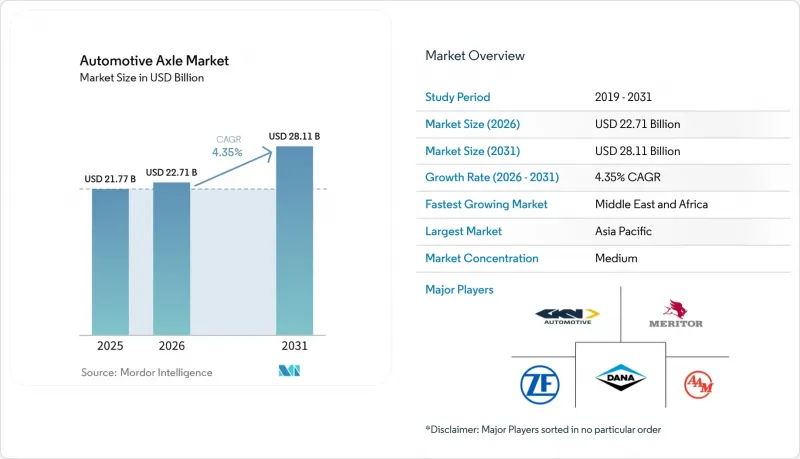
本報告按車軸類型(例如,驅動軸)、位置(例如,前軸)、材質(鋼、鋁、複合材料)、車輛類型(乘用車和商用車)、動力系統(例如,內燃機)、銷售管道(OEM 和售後市場)以及地區進行細分。市場預測以貨幣價值(美元)和銷售(輛)兩種形式呈現。
全球汽車車橋市場趨勢及洞察
快速的電氣化進程正在推動電動橋的普及。
博格華納與一家中國大型汽車製造商於2026年2月簽訂的48伏電動交叉差速器契約,標誌著該公司輕型車產品銷售額在2026年同比成長23%。來自北美和歐洲製造商的800伏特整合驅動模組訂單表明,機械式驅動橋正向高功率密度組件轉變,這些組件將馬達、逆變器、離合器和隔離支架整合到一個鑄件中。由於汽車製造商將採購重點放在整合動力傳動系統合作夥伴身上,缺乏逆變器和馬達專業知識的一級供應商正面臨每輛車零件數量減少的困境。博格華納最大的項目計劃於2029年實現量產,用於加工定子疊片和電機殼體的短期模具訂單已經提振了資本財和供應商的需求。
新興國家汽車產量快速成長
近年來,印度輕型汽車產量顯著成長,反映出汽車產業的持續發展。這一成長為GNA Axle的大規模現代化改造舉措提供了支持,並為Cross Limited的車軸梁擠壓生產線項目創造了有利條件,該項目預計不久後即可投產。同時,埃及MAC Automotive在大量投資的支持下,並受在地採購需求的驅動,計劃在未來十年內大幅提升年產能。供應商在這些汽車產業中心附近建立加工中心,可以降低運輸成本,滿足原產地規則要求,並減輕近年來金屬價格波動的風險。
鋼鐵和鋁價格波動劇烈
2026年,霍爾木茲海峽危機嚴重擾亂了巴林的部分鋁生產。這次中斷導致其他海灣合作理事會(GCC)成員國的冶煉廠宣布不可抗力條款,造成倫敦金屬交易所(LME)鋁價飆升。數週內,歐盟鋼鐵製造商隨即加收了巨額附加費。同時,受固定價格合約約束的車軸供應商被迫承擔價格上漲的影響,導致用於支持輕量化的可自由支配資本投資被推遲。儘管冶煉廠已恢復運營,但由於持續的襯裡更換工作和能源價格調整,鋼坯溢價依然居高不下,並持續到2026年下半年。
細分市場分析
2025年,驅動橋佔汽車車橋市場的61.37%,反映出其在乘用車和商用車平台上的廣泛應用。雖然提升橋在2025年仍屬於小眾市場,但預計到2031年,隨著車輛業者採用更多車橋,其市場將以4.37%的複合年成長率成長。這主要是由於歐洲電池式電動車佈局重量的增加,導致車輛總重上限提高了4噸。
此次放鬆管制正在改變長途運輸公司在主要線路(例如鹿特丹至杜伊斯堡)上的採購趨勢,在這些線路上,負載容量對盈利至關重要。曾經作為售後配件的提升軸套件,如今正日益成為工廠的標準配置,這些套件整合了空氣懸吊、電子負載監控和「起步保護」功能,該功能可在車輛存儲時收回車軸,從而減少輪胎磨損。隨著零排放卡車的普及,能夠將煞車、感測器線束和閥門模組整合到輕質複合複合材料梁中的一級供應商,其產品在每輛車上的採用率可能會更高。
到2025年,後軸將佔汽車車橋市場的37.63%。這主要得益於後輪驅動皮卡和雙馬達純電動跨界車的普及。隨著電池底置式安裝的日益普遍,汽車製造商被迫降低簧下品質以提升乘坐舒適性,預計複合材料後扭力樑的複合年成長率將達到4.39%。
由於供應鏈慣性,目前更傾向於使用成本更低、減重效果與複合材料相當的先進高抗張強度鋼材。然而,正如碳纖維副車架在中型量產電動車中的成功應用所顯示的那樣,這種材料不再局限於超級跑車。 2028 年後啟動的計畫將揭示耐久性和成本等障礙是否已充分克服,以實現更廣泛的應用。短期內,後軸製造商透過最佳化壁厚、採用真空壓鑄製程以及引入中空半軸,在不改變合金體系的情況下實現了輕微的減重。
區域分析
預計到2025年,亞太地區將佔據42.37%的市場。中國汽車產量預計將略有成長,而印度預計將實現溫和成長。在日本,受市場對配備全輪驅動軸的混合動力小型貨車強勁需求的推動,預計產量將有所成長。相較之下,由於出口需求下降,韓國的產量預計將會下降。鑑於該地區的吸引力,索納康斯達已在中國成立合資企業,並在精密鍛造領域進行了大量投資。在印度,克羅斯有限公司新增了一條擠壓生產線,以擴大其拖車車軸的產能。
儘管預計2025年北美和歐洲的汽車產量將萎縮,但這兩個地區仍將在電氣化過程中發揮關鍵作用。歐盟對傳動軸重量的限制以及美國環保署(EPA)嚴格的二氧化碳減排目標等監管措施,正迫使汽車製造商採用先進的傳動軸和電力驅動模組。在德國,受廂型車銷售的推動,市場預計將實現溫和成長;而在法國,由於雷諾5 E-Tech即將上市,預計將顯著成長。然而,義大利和英國的市場預計將大幅下滑。在大西洋兩岸運作且擁有有效外匯對沖策略的供應商,能夠透過確保下一代電力驅動軸的訂單來抵消產量下降的影響。
預計南美洲和中東及非洲將成為成長最快的地區,其中中東及非洲預計到2031年將達到4.52%的複合年成長率。在巴西,數十億美元的「Mover」計畫以及豐田索羅卡巴2號工廠的擴建(在大量投資的支持下)預計將在中長期內推動混合動力汽車的產量成長。在埃及,MAC Automotive的工廠旨在長期實現可觀的年產量,同時嚴格遵守在地採購要求。同時,在塞內加爾,正與戴姆勒卡車公司合作,籌備在中期內啟動本地卡車組裝。這些在地採購要求也為區域內的車橋加工和熱處理廠創造了商機。
其他好處:
- Excel格式的市場預測(ME)表
- 3個月的分析師支持
目錄
第1章:引言
- 研究假設和市場定義
- 調查範圍
第2章:調查方法
第3章執行摘要
第4章 市場狀況
- 市場概覽
- 市場促進因素
- 車輛的快速電氣化正在推動電力驅動橋的廣泛應用。
- 新興國家汽車產量快速成長
- 為滿足燃油效率標準,對輕型車軸的需求日益成長
- 嚴格的安全和載重規定要求車軸設計必須堅固耐用。
- OEM廠商向模組化滑板平台轉型
- 車橋殼體的積層製造
- 市場限制因素
- 鋼鐵和鋁價格波動
- 對電動橋生產線的高資本投入
- 複合材料車軸的耐久性問題
- 軸荷標準尚未在全球統一。
- 價值供應鏈分析
- 監理情勢
- 技術展望
- 波特五力模型
第5章 市場規模與成長預測
- 按軸型
- 驅動軸
- 死軸
- 提升軸
- 按位置
- 前軸
- 後軸
- 轉向軸
- 複合軸
- 材料
- 鋼
- 鋁
- 複合材料
- 按車輛類型
- 搭乘用車
- 商用車輛
- 依推進類型
- 內燃機
- 電池式電動車(BEV)
- 插電式混合動力車(PHEV)
- 燃料電池電動車(FCEV)
- 混合動力電動車(HEV)
- 按銷售管道
- OEM
- 售後市場
- 按地區
- 北美洲
- 美國
- 加拿大
- 其他北美國家
- 南美洲
- 巴西
- 阿根廷
- 其他南美國家
- 歐洲
- 英國
- 德國
- 西班牙
- 義大利
- 法國
- 俄羅斯
- 其他歐洲國家
- 亞太地區
- 印度
- 中國
- 日本
- 韓國
- 其他亞太國家
- 中東和非洲
- 阿拉伯聯合大公國
- 沙烏地阿拉伯
- 土耳其
- 埃及
- 南非
- 其他中東和非洲國家
- 北美洲
第6章 競爭情勢
- 市場集中度
- 策略趨勢
- 市佔率分析
- 公司簡介
- Dana Incorporated
- American Axle and Manufacturing(AAM)
- ZF Friedrichshafen AG
- Meritor(Cummins)
- GKN Automotive
- Hyundai Wia
- Automotive Axles Ltd.
- JTEKT Corporation
- Gestamp
- Hitachi Astemo
- IFA Rotorion
- RSB Transmissions
- Musashi Seimitsu
- Rane(Madras)Ltd.
- Linamar Corporation
- Sona Comstar
- BorgWarner Inc.
- Magneti Marelli(Calsonic Kansei)
- Knorr-Bremse AG
- Schaeffler Group
第7章 市場機會與未來展望
According to Mordor Intelligence, the automotive axle market size was valued at USD 21.77 billion in 2025 and expected to reach USD 22.71 billion by 2026, and is expected to reach USD 28.11 billion by 2031, growing at a CAGR of 4.35% over 2026-2031.
This report is Segmented by Axle Type (Drive Axle and More), Position (Front Axle and More), Material (Steel, Aluminum, and Composite Materials), Vehicle Type (Passenger Cars and Commercial Vehicles), Propulsion Type (ICE and More), Sales Channel (OEM and Aftermarket), and Geography. The Market Forecasts are Provided in Terms of Value (USD) and Volume (Units).
Global Automotive Axle Market Trends and Insights
Rapid Electrification Increasing E-axle Adoption
BorgWarner's February 2026 contract for 48-volt electric cross differentials with a leading Chinese OEM caps a year in which the supplier's light-vehicle products revenue jumped 23% versus 2024 . Additional awards for 800-volt integrated drive modules from North American and European manufacturers signal a shift away from mechanical axles toward power-dense assemblies that pair motors, inverters, clutches, and isolation mounts in a single casting. Tier-1s lacking inverter or motor expertise face diminished content per vehicle as OEMs consolidate purchasing around integrated driveline partners. With mass production on the largest BorgWarner program slated for 2029, near-term tooling orders for stator lamination and motor housing machining have already buoyed capital goods and suppliers.
Surging Vehicle Production in Emerging Economies
In recent years, India has experienced a notable increase in light vehicle production, reflecting sustained growth in its automotive sector. This expansion supports GNA Axles' major modernization initiative and creates favorable conditions for Kross Limited's planned axle-beam extrusion line, which is expected to commence operations in the near future. Meanwhile, Egypt's MAC Automotive, supported by substantial investment, aims to achieve significant annual production capacity over the next decade, driven by local-content requirements. Suppliers that establish machining centers near these automotive hubs can reduce shipping costs, comply with rules-of-origin requirements, and mitigate exposure to the metal price volatility observed in recent years.
Volatile Steel and Aluminum Prices
In 2026, the Hormuz crisis significantly disrupted a portion of Aluminum Bahrain's production. This disruption prompted force majeure declarations at other GCC smelters, leading to a substantial increase in LME aluminum prices. Within weeks, EU steelmakers responded by imposing notable surcharges. Meanwhile, axle suppliers, bound by fixed-price contracts, absorbed the impact of the price surge, leading them to delay discretionary capital expenditures intended to support lightweighting. Even with smelters resuming operations, ongoing re-lining processes and energy price adjustments have kept billet premiums elevated, extending into late 2026.
Other drivers and restraints analyzed in the detailed report include:
- Rising Demand for Lightweight Axles to Meet Fuel-Efficiency Norms
- Stringent Safety and Load Regulations Mandating Robust Axle Designs
- High CAPEX for E-axle Production Lines
For complete list of drivers and restraints, kindly check the Table Of Contents.
Segment Analysis
Drive axles accounted for 61.37% of the automotive axle market share in 2025, reflecting their universal presence across passenger and commercial platforms. Lift axles, though niche in 2025, are projected to grow at 4.37% CAGR through 2031 as fleets adopt extra axles to manage the heavier battery-electric layouts that now qualify for an additional 4-tonne gross vehicle weight allowance in Europe.
The regulatory uplift translates into procurement shifts among long-haul operators on key corridors such as Rotterdam-Duisburg, where payload dictates profitability. Lift-axle kits, once an aftermarket retrofit, increasingly arrive factory-installed, bundling air suspension, electronic load monitoring, and drive-off protection that retracts the axle when unladen to save tire wear. As zero-emission truck adoption scales, tier-1s that can integrate braking, sensor harnesses, and valve modules into light composite beams will capture incremental content per vehicle.
Rear axles held 37.63% of the automotive axle market size in 2025, anchored by rear-wheel-drive pickups and dual-motor battery-electric crossovers. Composite rear torsion beams are forecast to grow at a 4.39% CAGR as battery-floor packaging pushes OEMs to curb unsprung mass to improve ride quality.
Supply chain inertia favors advanced high-strength steel variants that replicate the weight savings of composites at lower cost. Still, demonstrations of carbon-fiber subframes in high-volume mid-segment EVs show that the material is no longer confined to supercars. Programs launching after 2028 will reveal whether durability and cost hurdles have eased enough for broader adoption. In the near term, rear axle makers are optimizing wall thickness, employing vacuum die casting, and adopting hollow half-shafts to claim incremental grams without changing alloy families.
Complete Report Scope:
- By Axle Type
- Drive Axle
- Dead Axle
- Lift Axle
- By Position
- Front Axle
- Rear Axle
- Steering Axle
- Composite Axle
- By Material
- Steel
- Aluminum
- Composite Materials
- By Vehicle Type
- Passenger Cars
- Commercial Vehicles
- By Propulsion Type
- Internal Combustion Engine
- Battery Electric Vehicle (BEV)
- Plug-in Hybrid Electric Vehicle (PHEV)
- Fuel Cell Electric Vehicle (FCEV)
- Hybrid Electric Vehicle (HEV)
- By Sales Channel
- OEM
- Aftermarket
- By Geography
- North America
- United States
- Canada
- Rest of North America
- South America
- Brazil
- Argentina
- Rest of South America
- Europe
- United Kingdom
- Germany
- Spain
- Italy
- France
- Russia
- Rest of Europe
- Asia-Pacific
- India
- China
- Japan
- South Korea
- Rest of Asia-Pacific
- Middle East and Africa
- United Arab Emirates
- Saudi Arabia
- Turkey
- Egypt
- South Africa
- Rest of Middle East and Africa
- North America
Geography Analysis
Asia-Pacific held 42.37% share in 2025. Vehicle production in China is expected to increase slightly, while India is anticipated to record moderate output growth. Japan's production is forecast to rise, supported by strong demand for hybrid minivans equipped with all-wheel-drive axles. In contrast, South Korea's production is expected to decline due to lower export demand. Reflecting the region's attractiveness, Sona Comstar has entered a joint venture in China and made significant investments in precision forging. In India, Kross Limited has expanded its trailer-axle capacity by adding a new extrusion line.
North America and Europe are expected to experience contractions in vehicle production in 2025; however, both regions will continue to play a critical role in electrification efforts. Regulatory measures, including the European Union's restrictions on drive-axle weight and the U.S. Environmental Protection Agency's stringent CO2-reduction targets, are driving OEMs to adopt advanced axles and e-drive modules. Germany is expected to record modest market growth, supported by van sales, while France is projected to post a notable increase driven by preparations for the Renault 5 E-Tech. However, Italy and the United Kingdom are expected to experience significant declines. Suppliers with operations on both sides of the Atlantic and effective currency-hedging strategies have been able to offset production declines by securing contracts for next-generation e-axles.
South America and the Middle East & Africa are expected to be the fastest-growing regions, with the Middle East & Africa forecast to register a 4.52% CAGR through 2031. Brazil's multibillion-valued Mover program and Toyota's expansion of the Sorocaba 2 plant, supported by a significant investment, are expected to boost hybrid-ready production from the mid-term onward. In Egypt, the MAC Automotive factory aims to achieve substantial long-term annual output while complying with a notable local-content mandate. Meanwhile, Senegal is preparing to launch local truck assembly in collaboration with Daimler Truck in the medium term. These local-sourcing mandates are also creating opportunities for regional axle-machining and heat-treatment workshops.
- Dana Incorporated
- American Axle and Manufacturing (AAM)
- ZF Friedrichshafen AG
- Meritor (Cummins)
- GKN Automotive
- Hyundai Wia
- Automotive Axles Ltd.
- JTEKT Corporation
- Gestamp
- Hitachi Astemo
- IFA Rotorion
- RSB Transmissions
- Musashi Seimitsu
- Rane (Madras) Ltd.
- Linamar Corporation
- Sona Comstar
- BorgWarner Inc.
- Magneti Marelli (Calsonic Kansei)
- Knorr-Bremse AG
- Schaeffler Group
Additional Benefits:
- The market estimate (ME) sheet in Excel format
- 3 months of analyst support
TABLE OF CONTENTS
1 Introduction
- 1.1 Study Assumptions & Market Definition
- 1.2 Scope of the Study
2 Research Methodology
3 Executive Summary
4 Market Landscape
- 4.1 Market Overview
- 4.2 Market Drivers
- 4.2.1 Rapid Electrification Increasing E-axle Adoption
- 4.2.2 Surging Vehicle Production in Emerging Economies
- 4.2.3 Rising Demand for Lightweight Axles to Meet Fuel-efficiency Norms
- 4.2.4 Stringent Safety and Load Regulations Mandating Robust Axle Designs
- 4.2.5 OEM Shift Toward Modular Skateboard Platforms
- 4.2.6 Additive Manufacturing of Axle Housings
- 4.3 Market Restraints
- 4.3.1 Volatile Steel and Aluminum Prices
- 4.3.2 High CAPEX for E-axle Production Lines
- 4.3.3 Durability Concerns around Composite Axles
- 4.3.4 Non-uniform Global Axle Load Standards
- 4.4 Value / Supply-Chain Analysis
- 4.5 Regulatory Landscape
- 4.6 Technological Outlook
- 4.7 Porter's Five Forces
- 4.7.1 Threat of New Entrants
- 4.7.2 Bargaining Power of Suppliers
- 4.7.3 Bargaining Power of Buyers
- 4.7.4 Threat of Substitutes
- 4.7.5 Competitive Rivalry
5 Market Size & Growth Forecasts (Value (USD) and Volume (Units))
- 5.1 By Axle Type
- 5.1.1 Drive Axle
- 5.1.2 Dead Axle
- 5.1.3 Lift Axle
- 5.2 By Position
- 5.2.1 Front Axle
- 5.2.2 Rear Axle
- 5.2.3 Steering Axle
- 5.2.4 Composite Axle
- 5.3 By Material
- 5.3.1 Steel
- 5.3.2 Aluminum
- 5.3.3 Composite Materials
- 5.4 By Vehicle Type
- 5.4.1 Passenger Cars
- 5.4.2 Commercial Vehicles
- 5.5 By Propulsion Type
- 5.5.1 Internal Combustion Engine
- 5.5.2 Battery Electric Vehicle (BEV)
- 5.5.3 Plug-in Hybrid Electric Vehicle (PHEV)
- 5.5.4 Fuel Cell Electric Vehicle (FCEV)
- 5.5.5 Hybrid Electric Vehicle (HEV)
- 5.6 By Sales Channel
- 5.6.1 OEM
- 5.6.2 Aftermarket
- 5.7 By Geography
- 5.7.1 North America
- 5.7.1.1 United States
- 5.7.1.2 Canada
- 5.7.1.3 Rest of North America
- 5.7.2 South America
- 5.7.2.1 Brazil
- 5.7.2.2 Argentina
- 5.7.2.3 Rest of South America
- 5.7.3 Europe
- 5.7.3.1 United Kingdom
- 5.7.3.2 Germany
- 5.7.3.3 Spain
- 5.7.3.4 Italy
- 5.7.3.5 France
- 5.7.3.6 Russia
- 5.7.3.7 Rest of Europe
- 5.7.4 Asia-Pacific
- 5.7.4.1 India
- 5.7.4.2 China
- 5.7.4.3 Japan
- 5.7.4.4 South Korea
- 5.7.4.5 Rest of Asia-Pacific
- 5.7.5 Middle East and Africa
- 5.7.5.1 United Arab Emirates
- 5.7.5.2 Saudi Arabia
- 5.7.5.3 Turkey
- 5.7.5.4 Egypt
- 5.7.5.5 South Africa
- 5.7.5.6 Rest of Middle East and Africa
- 5.7.1 North America
6 Competitive Landscape
- 6.1 Market Concentration
- 6.2 Strategic Moves
- 6.3 Market Share Analysis
- 6.4 Company Profiles (includes Global Level Overview, Market Level Overview, Core Segments, Financials as Available, Strategic Information, Market Rank/Share for Key Companies, Products and Services, SWOT Analysis, and Recent Developments)
- 6.4.1 Dana Incorporated
- 6.4.2 American Axle and Manufacturing (AAM)
- 6.4.3 ZF Friedrichshafen AG
- 6.4.4 Meritor (Cummins)
- 6.4.5 GKN Automotive
- 6.4.6 Hyundai Wia
- 6.4.7 Automotive Axles Ltd.
- 6.4.8 JTEKT Corporation
- 6.4.9 Gestamp
- 6.4.10 Hitachi Astemo
- 6.4.11 IFA Rotorion
- 6.4.12 RSB Transmissions
- 6.4.13 Musashi Seimitsu
- 6.4.14 Rane (Madras) Ltd.
- 6.4.15 Linamar Corporation
- 6.4.16 Sona Comstar
- 6.4.17 BorgWarner Inc.
- 6.4.18 Magneti Marelli (Calsonic Kansei)
- 6.4.19 Knorr-Bremse AG
- 6.4.20 Schaeffler Group
7 Market Opportunities & Future Outlook
- 7.1 White-space & Unmet-Need Assessment

 後軸零件市場:2026-2032年全球市場預測(按車輛類型、材料類型、車橋配置、差速器類型、煞車技術和分銷管道分類)
 汽車電力驅動橋市場分析及至2035年的預測:依類型、產品、技術、組件、應用、材料類型、最終用戶、功能及安裝方式
 2026年全球後軸市場報告汽車車橋市場:按車橋類型、驅動類型、車橋數量、負載容量、材料、車輛類型和銷售管道-全球預測,2026-2032年軸重設備市場:依產品類型、安裝方式、量程範圍、應用、最終用戶和銷售管道分類-2026-2032年全球預測全球平行驅動橋市場(按產品類型、最終用途、車輛類型、分銷管道、材料類型和技術分類)預測(2026-2032年)
 全球車軸市場規模、佔有率、趨勢和成長分析報告(2026-2034年)全球電子KYB市場規模、佔有率、趨勢和成長分析報告(2026-2034年)後軸電驅動橋市場按產品類型、馬達類型、車輛類型、電壓等級和最終用途應用分類,全球預測,2026-2032年汽車平行驅動橋市場按類型、傳動系統、位置、材料、最終用戶和應用分類-全球預測,2026-2032年