


 |
市場調查報告書
商品編碼
2117433
智慧輪胎:市場佔有率分析、產業趨勢與統計、成長預測(2026-2031)Connected Tires - Market Share Analysis, Industry Trends & Statistics, Growth Forecasts (2026 - 2031) |
||||||

※ 本網頁內容可能與最新版本有所差異。詳細情況請與我們聯繫。
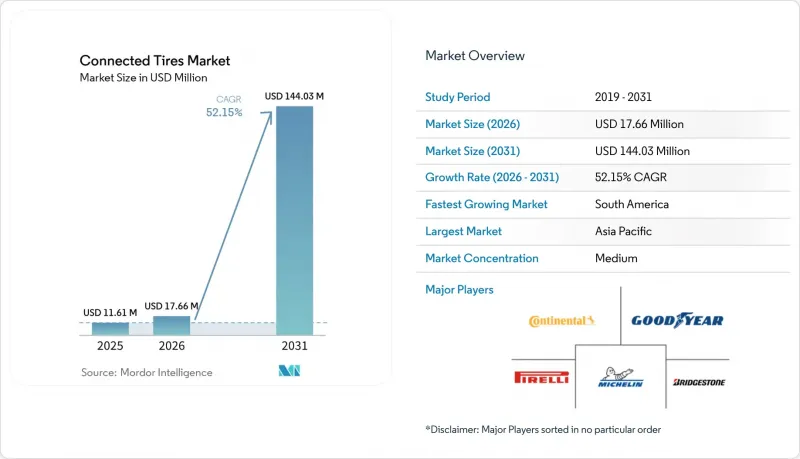
根據 Mordor Intelligence 預測,連網輪胎市場規模將從 2025 年的 1,161 萬美元成長到 2026 年的 1,766 萬美元,然後在 2031 年達到 1.4403 億美元,2026 年至 2031 年的複合年成長率為 52.15%。
本報告按組件(例如胎壓監測系統)、連接技術(例如藍牙)、輪圈尺寸(例如 12-17 吋)、驅動系統(例如內燃機)、車輛類型(例如乘用車)、銷售管道(原廠配套和售後市場)以及地區進行細分。市場預測以價值(美元)和銷售(輛)為單位呈現。
全球智慧輪胎市場趨勢及洞察
電動車推動了對承重智慧輪胎的需求
由於電池式電動車(BEV) 比同等級的內燃機汽車平台重 20-30%,輪胎負載增加,更容易出現不對稱磨損。整合式應變計和三軸加速計每 5 毫秒向車輛的電子控制單元 (ECU) 傳輸一次形變數據,使軟體能夠在磨損加劇之前調整扭矩和阻尼。倍耐力的「Cyber Tire」輪胎在實際道路測試中,將時速 70 英里(約 113 公里)的緊急煞車距離縮短了 10 英尺(約 3 公尺),並計劃在阿斯頓馬丁 2027 年車型上首次亮相。隨著高階電動車在全球的普及,輪胎遙測技術正成為延長續航里程和降低保固成本的關鍵差異化技術。
重點關注車隊的預測性維護和運轉率
營運7-8級車輛的車隊營運商,每次輪胎違規都將面臨巨額罰款,即使一次路邊拋錨也會大幅提高保險費。米其林於2026年3月發布的「智慧預測輪胎」在美國州際公路進行的前導測試中,顯著降低了道路交通事故發生率,並提高了燃油效率。大陸集團的「ContiConnect」系統目前可監控大量連網輪胎,投資回收期相對較短。這使得長途運輸公司能夠從被動更換輪胎轉變為人工智慧驅動的定期輪換,從而大幅減少停機時間。
昂貴的感測器組件和在惡劣工作環境下的可靠性。
雖然成本仍處於中等水平,但多功能胎壓監測系統(TPMS)模組略微提高了中檔輪胎的價格,這對於對成本敏感的原始設備製造商(OEM)來說構成了一定的障礙。在極端溫差變化的惡劣氣候條件下,電池壽命會縮短,老款感測器的故障率也較高。 TDK和固特異已開發出一種壓電能源採集原型,旨在減少對電池的依賴,但其商業性成功與否取決於能否實現極具競爭力的價格。
細分市場分析
歐盟的「數位產品護照」計畫強制要求在2028年前透過序號追蹤輪胎,預計RFID晶片在預測期(2026-2031年)內將實現52.17%的複合年成長率,成為所有零組件中成長最快的。米其林和Beontag已採用超過5,000萬個第四代UHF TireTag單元,並計劃在2026年底前達到1億個。雖然胎壓監測系統(TPMS)在2025年佔總銷售量的63.37%,但由於電池更換週期和單位成本壓力,預計未來的成長將轉向被動式、免維護的RFID技術。預計在預測期後半段,採用RFID技術的連網輪胎市場規模將超過TPMS的銷量,這反映出原始設備製造商(OEM)傾向於將識別和遙測功能雙重應用於輪胎。雖然加速感應器和應變計組件在電動車中仍屬於高階配置,但隨著系統晶片(SoC)設計降低平均售價(ASP),它們的普及率將會提高。隨著整合整合電路將壓力、溫度和運動測量功能整合到 4 毫米的尺寸內,組件邊界將變得模糊,用於識別的 RFID 和用於即時資料流的 TPMS 模組將成為標準配置。
感測器整合正在減少產品種類。英飛凌的SP490-01-11整合了Cortex-M0+核心、MEMS壓力晶片、Z軸加速感應器和315 MHz發送器,即使在加密處理負載下也能實現長達10年的電池壽命。恩智浦的NTM88Kxx5S將雙軸容差擴展至±550 g,使其適用於垃圾車和曳引機等高G值快速加速的應用場景。同時,經800%拉伸測試的石墨烯基應變計正引領超軟性外殼的發展,但預計商業化要到2030年以後才能實現。卓越的組件將多功能矽與被動RFID相結合,使單一輪胎即可滿足監管和車輛資產追蹤的雙重要求。
隨著車隊對OTA韌體更新、地理圍欄警報和雲端分析的需求不斷成長,4G/5G蜂窩通訊預計將以52.21%的複合年成長率成長。所有這些都無法在藍牙10米通訊範圍的限制下實現。到2025年,藍牙將佔38.71%的銷售額,但其中大部分佔有率將來自與智慧型手機配對的乘用車胎壓監測系統(TPMS)。倍耐力在巴里的先導計畫正在透過5G網路將摩擦數據流傳輸到1.5英里外的交通控制中心,從而驗證廣域V2X警報的有效性。學術對比測試表明,LoRa在低頻寬壓力ping測試中實現了98%的資料包投遞率,但其處理能力不足以處理加速計影片串流,而5G則可以流暢地處理此類資料。 Wi-Fi仍處於實驗室階段,DSRC在北美地區的使用率正在下降,而C-V2X正在重新頻寬以取代。
混合晶片現在具備多模無線電功能。英飛凌的SP490整合了315MHz射頻和低功耗藍牙,而Quecktel的AG35 4G Cat 4模組則整合了胎壓監測系統(TPMS)API,OEM廠商可以透過韌體啟用此API。隨著共用SIM卡的用戶成本降至每月1美元以下,連網輪胎市場正朝著車隊使用蜂窩網路和成本受限的私家車使用藍牙的方向發展。傳統的315MHz解決方案可能會作為超低功耗方案繼續存在一段時間,但一旦5G RedCap模組的價格降至每月4美元以下,它們將逐漸淘汰。
區域分析
預計到2025年,亞太地區將引領市場,佔據38.81%的銷售佔有率,這主要得益於中國全國範圍內的胎壓監測系統(TPMS)強制安裝以及全球最高的電動車產量。Bridgestone和Yokohama Rubber正在工廠內整合RFID標籤,以符合未來的循環經濟法規。與此同時,耐吉森正在試行基於里程的合約模式,該模式已使韓國車隊的輪胎預算降低了高達18%。在印度,由於監管方面的延誤,感測器的應用僅限於豪華SUV和高流量物流卡車。儘管如此,政策草案建議直接強制安裝感測器,這可能會在2028年之前刺激潛在需求。中國互聯互通的碎片化和數據本地化法規導致了區域性韌體的出現,但這並不會減緩感測器總出貨量的成長。
南美洲是成長最快的地區,預計到2031年複合年成長率將達到52.33%。大陸集團已將巴西打造為智慧輪胎最大的市場之一,為數千輛汽車配備了連網輪胎,並建立了多個「ContiConnect」卡車樞紐。米其林計劃近期在聖保羅推出「SmartLoad AI」系統,該系統將基於數位孿生技術的輪胎壽命預測與基於里程(車道公里)的收費系統相結合。此舉引起了在該地區熱帶氣候下苦苦掙扎的運輸企業的廣泛關注。在礦業重鎮阿根廷,即使是偏遠地區的一次輪胎爆胎也可能導致長時間的停工,儘管該國經濟波動,但感測器仍在迅速部署。
雖然胎壓監測系統 (TPMS) 在北美和歐洲幾乎普及,但人們的關注點正轉向胎紋深度監測、車聯網 (V2X) 通訊和空中下載 (OTA) 安全等高級功能。預計在未來幾年內生效的歐盟數據法規將賦予駕駛員導出原始感測器數據的權利,從而為第三方分析業務鋪平道路。在美國,車隊擴大採用主要製造商提供的「輪胎即服務 (TaaS)」模式,財務負責人們也在推動對大型車輛進行改裝,因為短期投資回報已得到證實。在中東和非洲,TPMS 的普及速度較慢,但感測器正被用於應對極端溫度帶來的挑戰,因為在這些地區,輪胎被刺破會構成重大的安全隱患。區域差異反映了法規、車隊成熟度和行動電話覆蓋的經濟性等因素的相互作用。
其他好處:
- Excel格式的市場預測(ME)表
- 3個月的分析師支持
目錄
第1章:引言
- 研究假設和市場定義
- 調查範圍
第2章:調查方法
第3章執行摘要
第4章 市場狀況
- 市場概覽
- 市場促進因素
- 電動車推動了對載重智慧輪胎的需求
- 該機隊著重預測性維護和運轉率。
- 關於胎壓監測系統實施的監理義務
- 原始設備製造商向基於里程的“輪胎即服務”模式過渡
- 透過輪內馬達實現扭力向量控制
- 無氣/SMA輪胎可實現連續感測。
- 市場限制因素
- 高成本感測器封裝和在惡劣工作環境下的可靠性。
- 連接標準和介面碎片化
- TireEdge的網路安全職責
- 數據所有權之爭正在減緩生態系統的普及。
- 價值供應鏈分析
- 監理情勢
- 技術展望
- 波特五力模型
第5章 市場規模與成長預測
- 按組件
- TPMS
- 加速感應器
- 應變式感測器
- RFID晶片
- 透過連接技術
- Bluetooth
- 蜂窩網路(4G/5G)
- Wi-Fi
- V2X
- 按輪圈尺寸
- 12-17英寸
- 18-22英寸
- 22吋或更大
- 依推進類型
- 內燃機
- 電池式電動車(BEV)
- 插電式混合動力汽車(PHEV)
- 混合動力電動車(HEV)
- 燃料電池電動車(FCEV)
- 按車輛類型
- 搭乘用車
- 輕型商用車(LCV)
- 重型商用車(HCV)
- 巴士和長途汽車
- 按銷售管道
- OEM
- 售後市場
- 按地區
- 北美洲
- 美國
- 加拿大
- 其他北美國家
- 南美洲
- 巴西
- 阿根廷
- 其他南美國家
- 歐洲
- 英國
- 德國
- 西班牙
- 義大利
- 法國
- 俄羅斯
- 其他歐洲國家
- 亞太地區
- 印度
- 中國
- 日本
- 韓國
- 其他亞太國家
- 中東和非洲
- 阿拉伯聯合大公國
- 沙烏地阿拉伯
- 土耳其
- 埃及
- 南非
- 其他中東和非洲國家
- 北美洲
第6章 競爭情勢
- 市場集中度
- 策略趨勢
- 市佔率分析
- 公司簡介
- Bridgestone
- Michelin
- Continental
- Goodyear
- Pirelli
- Hankook
- Yokohama
- Sumitomo Rubber(SRI)
- Sensata Technologies
- Schrader Electronics
- NXP Semiconductors
- DENSO
- Huf Hulsbeck & Furst
- Aptiv
- Infineon
- NIRA Dynamics
- Revvo Technologies
- The SMART Tire Company
- BANF
- Alligator Ventilfabrik
第7章 市場機會與未來展望
According to Mordor Intelligence, the connected tires market size is expected to grow from USD 11.61 million in 2025 to USD 17.66 million in 2026, and is forecast to reach USD 144.03 million by 2031, at a 52.15% CAGR over 2026-2031.
This report is Segmented by Component (TPMS and More), Connectivity Technology (Bluetooth and More), Rim Size (12-17 Inches and More), Propulsion Type (ICE and More), Vehicle Type (Passenger Cars and More), Sales Channel (OEM and Aftermarket), and Geography. The Market Forecasts are Provided in Terms of Value (USD) and Volume (Units).
Global Connected Tires Market Trends and Insights
EV-Driven Demand for Load-Bearing Smart Tires
Battery electric vehicles add 20-30% weight compared with comparable ICE platforms, increasing tire stress and asymmetric wear. Embedded strain gauges and tri-axial accelerometers now stream deformation data every 5 milliseconds to vehicle ECUs, letting software adjust torque and damping before wear accelerates. Pirelli's Cyber Tire cut emergency stopping distances by 10 feet at 70 mph in road tests and will debut on Aston Martin's 2027 lineup . As premium EVs scale globally, tire telemetry emerges as a frontline differentiator for extending range and curbing warranty costs.
Fleet Focus on Predictive Maintenance & Uptime
Fleets operating Class 7-8 vehicles face significant fines for each tire violation, and a single roadside failure leads to a noticeable increase in their insurance premiums. Michelin's Smart Predictive Tire, unveiled in March 2026, demonstrated a substantial reduction in on-road incidents and improved fuel efficiency during pilot tests on U.S. interstates . Continental's ContiConnect, now monitoring a large number of connected tires, offers a relatively short payback period. This has encouraged long-haul carriers to shift from reactive tire replacements to AI-scheduled rotations, significantly reducing their downtime.
High Sensor-Package Cost & Harsh-Duty Reliability
Costing within a moderate range, multifunction TPMS modules increase the price of a mid-tier tire by a small percentage, which dissuades cost-sensitive OEMs. In extreme climates with significant temperature fluctuations, battery lives diminish, leading to a notable failure rate in older sensors. TDK and Goodyear have developed a piezoelectric energy-harvesting prototype to reduce reliance on batteries, but its commercial success is contingent on achieving highly competitive price points.
Other drivers and restraints analyzed in the detailed report include:
- Regulatory Mandates for TPMS Adoption
- OEM Shift to Mileage-Based "Tire-as-a-Service"
- Fragmented Connectivity Standards & Interfaces
For complete list of drivers and restraints, kindly check the Table Of Contents.
Segment Analysis
RFID chips are on track for a 52.17% CAGR during the forecast period (2026-2031), the fastest in the component mix, as the EU Digital Product Passport mandates serialized tire tracking by 2028. Michelin and Beontag have embedded more than 50 million Gen4 UHF TireTags, with a target of 100 million by year-end 2026. TPMS still commands 63.37% of 2025 revenue, yet battery replacement cycles and unit-cost pressures tilt future gains toward passive, maintenance-free RFID. The connected tires market size for RFID is expected to outpace TPMS revenues in the latter half of the forecast window, reflecting OEM preference for dual-purpose identification and telemetry. Accelerometer and strain-gauge packages remain premium EV features but will proliferate once system-on-chip designs lower ASPs. As integrated ICs merge pressure, temperature, and motion in 4 mm footprints, the component boundary blurs, anchoring RFID for identity and TPMS modules for live data streams.
Sensor convergence is shrinking SKU counts; Infineon's SP490-01-11 embeds a Cortex-M0+, a MEMS pressure die, a z-axis accelerometer, and a 315-MHz transmitter, promising 10-year battery life under cryptographic load. NXP's NTM88Kxx5S ups dual-axis tolerance to +-550 g, suiting waste-haulers and tractors that generate high-g spikes. At the same time, graphene-based strain gauges tested at 800% stretch open pathways for ultra-flexible casings, though commercialization remains post-2030. Component winners will fuse multifunction silicon with passive RFID, a model that addresses regulatory and fleet asset-tracking requirements in a single tire.
Cellular 4G/5G will post a 52.21% CAGR as fleets demand OTA firmware updates, geofenced alerts, and cloud analytics, all of which are unsupported by Bluetooth's 10-meter ceiling. Although Bluetooth led 38.71% 2025 revenue, its foothold is mostly smartphone-paired passenger TPMS. Pirelli's Bari pilot streams friction data over 5G to traffic-control centers 1.5 miles away, validating wide-area V2X alerts. Academic head-to-heads show LoRa achieves 98% packet delivery on low-bandwidth pressure pings but chokes on accelerometer video streams, which 5G handles elegantly. Wi-Fi remains workshop-bound, while DSRC recedes in North America, where C-V2X garners spectrum re-allocations.
Hybrid chips now ship with multi-mode radios. Infineon's SP490 integrates RF 315-MHz and Bluetooth LE; Quectel's AG35 4G Cat 4 module nests a TPMS API that OEMs can unlock via firmware. As subscriber price curves drop below USD 1 per month for pooled SIMs, the connected tires market converges on cellular for fleets and on Bluetooth for cost-constrained private cars. Legacy 315-MHz solutions will linger as ultra-low-power fallbacks but face de facto obsolescence once 5G RedCap modules hit sub-USD 4 pricing.
Complete Report Scope:
- By Component
- TPMS
- Accelerometer Sensors
- Strain-Gauge Sensors
- RFID Chips
- By Connectivity Technology
- Bluetooth
- Cellular (4G/5G)
- Wi-Fi
- V2X
- By Rim Size
- 12-17 Inches
- 18-22 Inches
- Above 22 Inches
- By Propulsion Type
- Internal Combustion Engine
- Battery Electric Vehicle (BEV)
- Plug-in Hybrid EV (PHEV)
- Hybrid EV (HEV)
- Fuel Cell EV (FCEV)
- By Vehicle Type
- Passenger Cars
- Light Commercial Vehicles (LCVs)
- Heavy Commercial Vehicles (HCVs)
- Buses & Coaches
- By Sales Channel
- OEM
- Aftermarket
- By Geography
- North America
- United States
- Canada
- Rest of North America
- South America
- Brazil
- Argentina
- Rest of South America
- Europe
- United Kingdom
- Germany
- Spain
- Italy
- France
- Russia
- Rest of Europe
- Asia-Pacific
- India
- China
- Japan
- South Korea
- Rest of Asia-Pacific
- Middle East and Africa
- United Arab Emirates
- Saudi Arabia
- Turkey
- Egypt
- South Africa
- Rest of Middle East and Africa
- North America
Geography Analysis
Asia-Pacific led with 38.81% revenue in 2025, propelled by China's nationwide TPMS mandate and the world's highest EV production rates. Bridgestone and Yokohama embed RFID tags at the factory to comply with future circular-economy rules. At the same time, Nexen pilots mileage-based contracts that cut South Korean fleet tire budgets by up to 18%. India's regulatory lag confines adoption to premium SUVs and high-utilization logistics trucks; nonetheless, policy drafts signal a forthcoming direct-sensor requirement that could unlock latent demand by 2028. Connectivity fragmentation and data-localization laws in China spawn region-specific firmware but do not slow net sensor volumes.
South America is the fastest climber, forecast for 52.33% CAGR to 2031. Continental has equipped several thousand connected tires on numerous vehicles in Brazil and established multiple ContiConnect truck hubs, positioning Brazil as one of its largest markets for smart tires. Michelin is set to launch its SmartLoad AI in Sao Paulo in the near future, introducing digital-twin lifespan forecasts to lane-kilometer billing, a move that resonates with haulers contending with the region's tropical heat. In Argentina, with its mining-centric focus, a single remote blowout can halt operations for extended periods, driving the swift adoption of sensors despite the nation's economic fluctuations.
While North America and Europe boast nearly universal adoption of TPMS, the focus is shifting towards advanced features like tread-depth monitoring, V2X communication, and over-the-air security. The EU Data Act, set to take effect in the coming years, grants drivers the right to export raw sensor data, paving the way for third-party analytics ventures. In the United States, fleets are increasingly adopting tire-as-a-service models offered by major manufacturers, with documented short-term paybacks prompting financial decision-makers to retrofit heavy-duty vehicles. The Middle East and Africa, while trailing in volume, utilize sensors to address challenges posed by extreme temperatures, where blowouts pose significant safety risks. Regional differences reflect the interplay among regulation, fleet maturity, and cellular coverage economics.
- Bridgestone
- Michelin
- Continental
- Goodyear
- Pirelli
- Hankook
- Yokohama
- Sumitomo Rubber (SRI)
- Sensata Technologies
- Schrader Electronics
- NXP Semiconductors
- DENSO
- Huf Hulsbeck & Furst
- Aptiv
- Infineon
- NIRA Dynamics
- Revvo Technologies
- The SMART Tire Company
- BANF
- Alligator Ventilfabrik
Additional Benefits:
- The market estimate (ME) sheet in Excel format
- 3 months of analyst support
TABLE OF CONTENTS
1 Introduction
- 1.1 Study Assumptions & Market Definition
- 1.2 Scope of the Study
2 Research Methodology
3 Executive Summary
4 Market Landscape
- 4.1 Market Overview
- 4.2 Market Drivers
- 4.2.1 EV-Driven Demand For Load-Bearing Smart Tires
- 4.2.2 Fleet Focus On Predictive Maintenance & Uptime
- 4.2.3 Regulatory Mandates For Tpms Adoption
- 4.2.4 OEM Shift To Mileage-Based "Tire-As-A-Service"
- 4.2.5 Integration With In-Wheel Motor Torque-Vectoring
- 4.2.6 Airless/Sma Tires Enable Persistent Sensing
- 4.3 Market Restraints
- 4.3.1 High Sensor-Package Cost & Harsh-Duty Reliability
- 4.3.2 Fragmented Connectivity Standards & Interfaces
- 4.3.3 Cyber-Security Liability At The Tire Edge
- 4.3.4 Data-Ownership Disputes Slow Ecosystem Uptake
- 4.4 Value / Supply-Chain Analysis
- 4.5 Regulatory Landscape
- 4.6 Technological Outlook
- 4.7 Porter's Five Forces
- 4.7.1 Threat of New Entrants
- 4.7.2 Bargaining Power of Suppliers
- 4.7.3 Bargaining Power of Buyers
- 4.7.4 Threat of Substitutes
- 4.7.5 Competitive Rivalry
5 Market Size & Growth Forecasts (Value (USD) and Volume (Units))
- 5.1 By Component
- 5.1.1 TPMS
- 5.1.2 Accelerometer Sensors
- 5.1.3 Strain-Gauge Sensors
- 5.1.4 RFID Chips
- 5.2 By Connectivity Technology
- 5.2.1 Bluetooth
- 5.2.2 Cellular (4G/5G)
- 5.2.3 Wi-Fi
- 5.2.4 V2X
- 5.3 By Rim Size
- 5.3.1 12-17 Inches
- 5.3.2 18-22 Inches
- 5.3.3 Above 22 Inches
- 5.4 By Propulsion Type
- 5.4.1 Internal Combustion Engine
- 5.4.2 Battery Electric Vehicle (BEV)
- 5.4.3 Plug-in Hybrid EV (PHEV)
- 5.4.4 Hybrid EV (HEV)
- 5.4.5 Fuel Cell EV (FCEV)
- 5.5 By Vehicle Type
- 5.5.1 Passenger Cars
- 5.5.2 Light Commercial Vehicles (LCVs)
- 5.5.3 Heavy Commercial Vehicles (HCVs)
- 5.5.4 Buses & Coaches
- 5.6 By Sales Channel
- 5.6.1 OEM
- 5.6.2 Aftermarket
- 5.7 By Geography
- 5.7.1 North America
- 5.7.1.1 United States
- 5.7.1.2 Canada
- 5.7.1.3 Rest of North America
- 5.7.2 South America
- 5.7.2.1 Brazil
- 5.7.2.2 Argentina
- 5.7.2.3 Rest of South America
- 5.7.3 Europe
- 5.7.3.1 United Kingdom
- 5.7.3.2 Germany
- 5.7.3.3 Spain
- 5.7.3.4 Italy
- 5.7.3.5 France
- 5.7.3.6 Russia
- 5.7.3.7 Rest of Europe
- 5.7.4 Asia-Pacific
- 5.7.4.1 India
- 5.7.4.2 China
- 5.7.4.3 Japan
- 5.7.4.4 South Korea
- 5.7.4.5 Rest of Asia-Pacific
- 5.7.5 Middle East and Africa
- 5.7.5.1 United Arab Emirates
- 5.7.5.2 Saudi Arabia
- 5.7.5.3 Turkey
- 5.7.5.4 Egypt
- 5.7.5.5 South Africa
- 5.7.5.6 Rest of Middle East and Africa
- 5.7.1 North America
6 Competitive Landscape
- 6.1 Market Concentration
- 6.2 Strategic Moves
- 6.3 Market Share Analysis
- 6.4 Company Profiles (includes Global Level Overview, Market Level Overview, Core Segments, Financials as Available, Strategic Information, Market Rank/Share for Key Companies, Products and Services, SWOT Analysis, and Recent Developments)
- 6.4.1 Bridgestone
- 6.4.2 Michelin
- 6.4.3 Continental
- 6.4.4 Goodyear
- 6.4.5 Pirelli
- 6.4.6 Hankook
- 6.4.7 Yokohama
- 6.4.8 Sumitomo Rubber (SRI)
- 6.4.9 Sensata Technologies
- 6.4.10 Schrader Electronics
- 6.4.11 NXP Semiconductors
- 6.4.12 DENSO
- 6.4.13 Huf Hulsbeck & Furst
- 6.4.14 Aptiv
- 6.4.15 Infineon
- 6.4.16 NIRA Dynamics
- 6.4.17 Revvo Technologies
- 6.4.18 The SMART Tire Company
- 6.4.19 BANF
- 6.4.20 Alligator Ventilfabrik
7 Market Opportunities & Future Outlook
- 7.1 White-space & Unmet-Need Assessment


