


 |
市場調查報告書
商品編碼
2117422
電動車輪胎:市場佔有率分析、產業趨勢與統計及成長預測(2026-2031)Electric Vehicle Tires - Market Share Analysis, Industry Trends & Statistics, Growth Forecasts (2026 - 2031) |
||||||

※ 本網頁內容可能與最新版本有所差異。詳細情況請與我們聯繫。
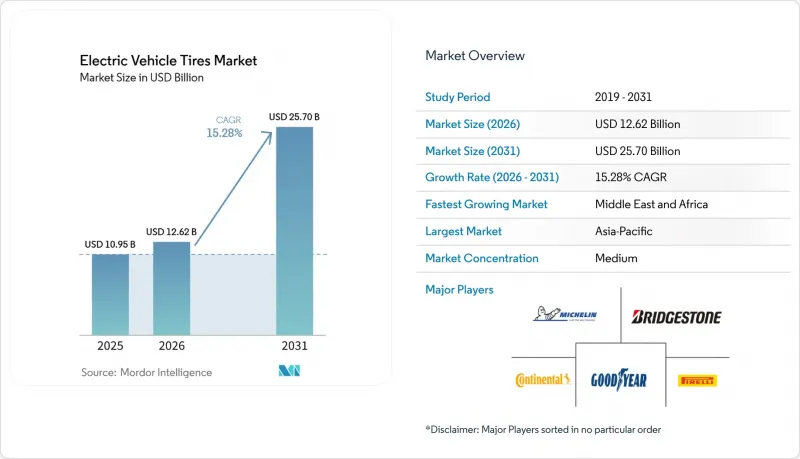
根據 Mordor Intelligence 預測,電動車輪胎市場規模預計到 2025 年將達到 109.5 億美元,到 2026 年將達到 126.2 億美元,到 2031 年將達到 257 億美元。
預計從 2026 年到 2031 年,其複合年成長率將達到 15.28%。
本報告按動力系統(電池式電動車(BEV)、插電式混合動力車 (PHEV) 等)、車輛類型(乘用車、輕型商用車 (LCV) 等)、應用領域(公路和非公路)、輪圈尺寸(13-15 吋、16-18 吋及其他)、銷售管道和地區進行細分。市場預測以貨幣價值(美元)和銷售(輛)兩種形式呈現。
全球電動汽車輪胎市場趨勢與洞察
全球電動車產量和銷量激增
全球電動車 (EV) 產量正經歷顯著成長,其中中國佔最大佔有率,其次是歐洲。國際能源總署 (IEA) 預測,未來幾年電動車將佔新註冊乘用車的大部分,這將推動電動車輪胎市場的長期成長。由於每輛車(包括備胎)需要五個輪胎,因此產量增加將直接轉化為輪胎需求的成長。近期的生產趨勢表明,短期庫存調整正在進行中。儘管如此,目的地設備組裝商 (OEM) 仍在精簡其供應商名單。特別是大陸集團,目前已為大多數大批量電動車製造商供貨,從而擴大了其經濟規模。隨著生產基地在東南亞和墨西哥等地區的擴張,物流變得日益複雜。這種變化使擁有本地硫化設施的全球供應商獲得了競爭優勢。
降低滾動阻力、延長續航里程的輪胎是各汽車製造商關注的重點。
滾動阻力在高速公路行駛中佔比高達30%,因此輪胎選擇是緩解續航里程擔憂的關鍵手段。德國馬牌的「EcoContact 7」輪胎已獲得歐盟2020/740號法規的「A」級認證,與上一代產品相比,滾動阻力降低了15%。相較之下,米其林將於2026年3月推出的「Primacy 5 Energy」輪胎,透過富含二氧化矽的胎面化學成分,將續航里程提升了10%。歐盟的輪胎標籤體系能夠有效降低能耗,預計未來也將持續發揮節能作用。同時,在美國,國家公路交通安全管理局(NHTSA)已認證ROLL10和ROLL20技術為實現企業平均燃油經濟性(CAFE)目標的經濟高效解決方案。這些政策確保了先進計算建模的預算得到保障,並促使供應商專注於配方最佳化,從而確保胎面深度不會影響抓地力或耐久性。
原物料價格波動與供應鏈風險
由於東南亞風暴擾亂了乳膠供應,以及人工林轉為棕櫚油生產導致可面積減少,天然橡膠價格已達到一年多來的最高水平。持續的供不應求造成供需失衡,對利潤率造成壓力。同時,與原油價格密切相關的合成橡膠價格也出現了大幅波動。印度製造商的成本主要與原油原料掛鉤,隨著原油價格上漲,他們的利潤率也隨之下降。為了應對這些價格波動,各公司正在實施避險策略並實現原料多元化。為了因應這些大宗商品價格波動,大陸集團設定了提高可再生材料比例的目標,以此作為抵禦市場波動的緩衝。
細分市場分析
到2025年,電池式電動車(BEV)將佔電動車輪胎市場72.34%的佔有率,佔據市場主導地位,反映出其在乘用車和輕型商用車領域日益成長的普及度。由於日本和韓國對氫氣供應網路的津貼,燃料電池電動車(FCEV)預計到2031年將以17.12%的複合年成長率成長。
HondaCR-V e:FCEV採用了精密的氫氣罐設計,氫氣罐位於支撐車輛重量的車軸和輪胎後方。雖然全球電池式電動車(BEV)輪胎的供應量可以擴大,但燃料電池電動車(FCEV)的產量有限,因此不值得推出專用模具。這種限制迫使供應商透過對BEV輪胎胎體進行少量化學成分改良來適應FCEV的需求。然而,隨著基礎設施的完善,由FCEV驅動的電動車輪胎市場可能為高階品牌進入氫燃料電池輪胎市場提供絕佳機會。儘管ISO認證的延遲給全球型式認證帶來了挑戰,但聯合國歐洲經濟委員會(UNECE)的「車隊對齊規則」在統一所有電動動力系統的滾動阻力和磨損標準方面正在取得進展。
雖然預計到 2025 年乘用車銷量將佔總銷量的 64.18%,但重型商用車預計將以 16.06% 的複合年成長率成長,並提高其市場佔有率,尤其是在歐盟呼籲到 2030 年將二氧化碳排放量減少 45% 的情況下。
大陸集團的「Conti Efficient Pro」輪胎展現了在不犧牲效率的前提下,為比柴油車重30%的牽引車提供動力所需的技術飛躍。此外,隨著大型電商公司追求碳中和物流,輕型商用車正迅速普及,亞馬遜、DHL和UPS等公司已強制要求在歐洲和北美地區採用電動驅動系統。雖然更大的輪圈直徑(18-20英寸)和更高的載重指數會導致熱量增加,但每條輪胎400-800美元的溢價彌補了銷量的下滑。儘管早期採用市場的乘用車成長正在放緩,但跨界車和SUV的需求推動了替換需求,使電動車輪胎市場在經濟週期之外保持強勁成長。
區域分析
以中國為中心的亞太地區預計到2025年將佔據全球電動車輪胎市場54.63%的佔有率。國內輪胎產量顯著成長,提振了市場。為因應貿易緊張局勢,中策、佳通、賽輪等中國企業正在擴大其海外硫化能力。然而,由於國內庫存增加,它們正面臨價格壓力。隨著印度電動車銷售持續成長,Bridgestone正在投資普納的工廠,大陸集團也正在為一條新的生產線投入資金。 MRF正在為塔塔、馬恆達以及許多新興摩托車項目提供服務。同時,JK Tire正與EKA Mobility合作,將先進的互聯感測器整合到商用電動車輪胎胎體中。
北美和歐洲佔據了較大的市場佔有率,在高階A級橡膠市場中扮演著至關重要的角色。歐盟標籤標準和加州先進清潔軌道(ACT)法規提高了橡膠的性能標準,這一點尤其明顯。為了符合歐盟微塑膠法規和美國6PPD法規的要求,供應商擴大在其產品藍圖中加入再生橡膠和生物基填料。這種轉變也導致了認證週期縮短和前置作業時間延長的趨勢。
儘管規模較小,但中東和非洲預計將呈現最高的成長率,到2031年複合年成長率將達到15.74%,這主要得益於阿拉伯聯合大公國和沙烏地阿拉伯政府對充電網路的投資以及強制性的零排放配額。超過50 度C的高溫環境會促進氧化,因此需要調整配方,優先使用耐臭氧聚合物。南美洲先前發展落後,但由於巴西為中國汽車製造商在當地組裝純電動車提供稅收優惠,該地區正在加速成長。然而,基礎設施和價格問題仍然限制短期成長。這些區域因素共同造就了一個多元化的電動車輪胎市場,不受經濟週期或管理體制的影響。
其他好處:
- Excel格式的市場預測(ME)表
- 3個月的分析師支持
目錄
第1章:引言
- 研究假設和市場定義
- 調查範圍
第2章:調查方法
第3章執行摘要
第4章 市場狀況
- 市場概覽
- 市場促進因素
- 全球電動車產量和銷量激增
- 原始設備製造商正致力於研發低滾動阻力輪胎,以延長行駛里程。
- 電動車輪胎磨損加劇,導致更換需求上升。
- 加強對輪胎能量標籤和噪音的監管。
- 高負荷電動車輪胎設計中對原廠保固的需求
- 智慧感測器輪胎的廣泛應用將開啟新的收入來源。
- 市場限制因素
- 原物料價格波動與供應鏈風險
- 電動車專用化合物的研發成本和模具成本都很高。
- 檢驗合成橡膠在其整個生命週期中的永續性
- 電動車輪胎性能缺乏統一的認證體系
- 價值供應鏈分析
- 監理情勢
- 技術展望
- 波特五力模型
第5章 市場規模與成長預測
- 依推進類型
- 電池式電動車(BEV)
- 插電式混合動力車(PHEV)
- 混合動力電動車(HEV)
- 燃料電池電動車(FCEV)
- 按車輛類型
- 搭乘用車
- 輕型商用車(LCV)
- 重型商用車(HCV)
- 巴士和長途汽車
- 透過使用
- 公路
- 越野
- 按輪圈尺寸
- 13-15英寸
- 16-18英寸
- 19-21英寸
- 21吋或更大
- 按銷售管道
- OEM
- 售後市場
- 按地區
- 北美洲
- 美國
- 加拿大
- 其他北美國家
- 南美洲
- 巴西
- 阿根廷
- 其他南美國家
- 歐洲
- 英國
- 德國
- 西班牙
- 義大利
- 法國
- 俄羅斯
- 其他歐洲國家
- 亞太地區
- 印度
- 中國
- 日本
- 韓國
- 其他亞太國家
- 中東和非洲
- 阿拉伯聯合大公國
- 沙烏地阿拉伯
- 土耳其
- 埃及
- 南非
- 其他中東和非洲國家
- 北美洲
第6章 競爭情勢
- 市場集中度
- 策略趨勢
- 市佔率分析
- 公司簡介
- Michelin
- Bridgestone Corporation
- Continental Tires
- Goodyear Tire and Rubber Company
- Pirelli & C SpA
- Yokohama Rubber Co., Ltd.
- Hankook Tire and Technology Co., Ltd.
- Sumitomo Rubber Industries, Ltd.
- Nokian Tyres
- Apollo Tyres Limited
- MRF Ltd
- Zhongce Rubber(ZC Rubber)
- Giti Tire
- Sailun Group Co., Ltd.
- Kumho Tire
- Triangle Tire
- Toyo Tires
- Maxxis Tyres(Cheng Shin Rubber Industry Co.)
- CEAT Limited
第7章 市場機會與未來展望
According to Mordor Intelligence, the electric vehicle tires market size is expected to be USD 10.95 billion in 2025, USD 12.62 billion in 2026, and reach USD 25.70 billion by 2031, growing at a CAGR of 15.28% from 2026 to 2031.
This report is Segmented by Propulsion Type (Battery Electric Vehicle (BEV), Plug-In Hybrid Electric Vehicle (PHEV), and More), Vehicle Type (Passenger Cars, Light Commercial Vehicles (LCVs), and More), Application (On-Road and Off-Road), Rim Size (13-15 Inches, 16-18 Inches, and More), Sales Channel, and Geography. The Market Forecasts are Provided in Terms of Value (USD) and Volume (Units).
Global Electric Vehicle Tires Market Trends and Insights
Surge in Global EV Production and Sales
Global electric vehicle (EV) production has seen significant growth, with China contributing the largest share and Europe following. The International Energy Agency forecasts that EVs will dominate new passenger-car registrations in the coming years, driving long-term growth in the electric vehicle tires market. Assembly plants require five tires per vehicle, including spares, which directly translates production increases into higher tire demand. Recent production trends indicate short-term inventory adjustments. Despite this, original equipment manufacturers (OEMs) are narrowing their supplier lists. Notably, Continental now serves most of the high-volume EV producers, improving its economic scale. As production hubs expand in regions like Southeast Asia and Mexico, logistics are becoming increasingly complex. This shift provides a competitive advantage to global suppliers with localized curing facilities.
OEM Focus on Range-Boosting Low-Rolling-Resistance Tires
Rolling resistance accounts for as much as 30% of highway energy draw, making tire selection a prime lever in easing range anxiety. Continental's EcoContact 7 received an A label under EU Regulation 2020/740, achieving a 15% reduction in rolling resistance compared to its predecessor . Michelin responded with the Primacy 5 Energy, launched in March 2026, delivering up to a 10% range uplift through silica-rich tread chemistry . The EU label program has effectively reduced energy consumption and is projected to continue saving energy over time. Meanwhile, in the U.S., the NHTSA has identified ROLL10 and ROLL20 technologies as cost-effective solutions for meeting Corporate Average Fuel Economy targets. These policies sustain high computational modeling budgets and encourage suppliers to focus on compound optimization, ensuring tread depth does not compromise grip or longevity.
Raw Material Price Volatility and Supply-Chain Risk
Natural rubber prices reached their highest level in over a year due to storms in Southeast Asia disrupting latex flows and a shift in plantations towards palm oil, which reduced available acreage. Continuous supply deficits have created a demand-supply imbalance, putting pressure on profit margins. Meanwhile, synthetic rubber prices, closely tied to crude oil volatility, have fluctuated significantly. Indian producers, with crude-linked inputs accounting for a substantial portion of their costs, experienced margin declines as oil prices rose. This volatility has prompted them to adopt hedging strategies and diversify their feedstock. In response to such commodity fluctuations, Continental has set a target to increase its renewable content to buffer against market swings.
Other drivers and restraints analyzed in the detailed report include:
- Accelerated EV Tire-Wear Boosting Replacement Demand
- Stricter Tire Energy-Label and Noise Regulations
- High R&D and Tooling Cost for EV-Specific Compounds
For complete list of drivers and restraints, kindly check the Table Of Contents.
Segment Analysis
Battery Electric Vehicles (BEVs) dominated the electric vehicle tires market with a 72.34% share in 2025, reflecting their prevalence in passenger and light-commercial applications. Fuel-Cell Electric Vehicles (FCEVs) are forecast to grow at a 17.12% CAGR through 2031 as Japan and South Korea subsidize hydrogen dispensing corridors.
Honda's CR-V e:FCEV showcases design nuances, utilizing tires to handle a curb weight, with hydrogen tanks positioned behind the axle. While tire supply for Battery Electric Vehicles (BEVs) is scalable globally, the limited volume of Fuel Cell Electric Vehicles (FCEVs) hasn't justified specialized tooling. This constraint nudges suppliers to adapt BEV casings with minor chemical modifications. Yet, if infrastructure advancements keep pace, the electric vehicle tires market, driven by FCEVs, could present a prime opportunity for premium brands to delve into hydrogen-compatible compounds. While a lag in ISO cohesion poses challenges for global homologation, UNECE's convoy alignment rule marks progress in standardizing rolling-resistance and abrasion benchmarks across all electrified drivetrains.
Passenger cars accounted for 64.18% of revenues in 2025, yet heavy commercial vehicles are expected to expand at a 16.06% CAGR, lifting their market share amid EU demands for a 45% CO2 cut by 2030.
Continental's Conti Efficient Pro demonstrates the engineering leap needed to support tractors weighing 30% more than diesel peers without eroding efficiency. Light commercial vans are also being rapidly adopted as e-commerce leaders pursue carbon-neutral logistics, with Amazon, DHL, and UPS specifying electric drivetrains across Europe and North America. Higher rim diameters (18-20 inches) and load indices intensify heat build-up, but premium pricing-USD 400-800 per tire-offsets lower unit volumes. While passenger-car growth is moderating in early-adopter markets, crossovers and SUVs anchor replacement demand, keeping the electric vehicle tires market resilient across cycles.
Complete Report Scope:
- By Propulsion Type
- Battery Electric Vehicle (BEV)
- Plug-in Hybrid Electric Vehicle (PHEV)
- Hybrid Electric Vehicle (HEV)
- Fuel-Cell Electric Vehicle (FCEV)
- By Vehicle Type
- Passenger Cars
- Light Commercial Vehicles (LCVs)
- Heavy Commercial Vehicles (HCVs)
- Buses and Coaches
- By Application
- On-Road
- Off-Road
- By Rim Size
- 13-15 Inches
- 16-18 Inches
- 19-21 Inches
- Above 21 Inches
- By Sales Channel
- OEM
- Aftermarket
- By Geography
- North America
- United States
- Canada
- Rest of North America
- South America
- Brazil
- Argentina
- Rest of South America
- Europe
- United Kingdom
- Germany
- Spain
- Italy
- France
- Russia
- Rest of Europe
- Asia-Pacific
- India
- China
- Japan
- South Korea
- Rest of Asia-Pacific
- Middle East and Africa
- United Arab Emirates
- Saudi Arabia
- Turkey
- Egypt
- South Africa
- Rest of Middle East and Africa
- North America
Geography Analysis
Asia-Pacific, anchored by China, secured 54.63% of the electric vehicle tires market in 2025. Domestic production of tire units has significantly increased, energizing the market. To navigate trade frictions, Chinese firms like Zhongce, Giti, and Sailun are expanding their overseas curing capacities. However, with domestic inventories on the rise, they're feeling the squeeze of rising prices. As India's EV sales continue to grow, Bridgestone has invested in its Pune facility, while Continental has allocated funds for new production lines. MRF is catering to Tata, Mahindra, and a host of emerging two-wheeler initiatives. Meanwhile, JK Tire has partnered with EKA Mobility, integrating advanced connected sensors into commercial EV casings .
North America and Europe, together accounting for a significant share of the market, play a pivotal role in the premium A-rated segment. This is especially true as EU labeling standards and California's Advanced Clean Trucks regulation elevate performance benchmarks. To align with EU microplastic mandates and U.S. 6PPD restrictions, suppliers are increasingly incorporating recycled rubber and bio-based fillers into their roadmaps. This shift is also leading to tighter qualification cycles and extended lead times.
The Middle East and Africa, though small, are forecast to post the fastest CAGR of 15.74% through 2031, as the UAE and Saudi Arabia allocate sovereign funds to charging networks and mandate zero-emission quotas. Elevated ambient temperatures above 50 °C hasten oxidation, forcing compound tweaks that favor ozone-resistant polymers. South America lags but gains momentum via Brazilian tax waivers for local BEV assembly by Chinese OEMs, although infrastructure and affordability still curb near-term upside. Together, these regional vectors keep the electric vehicle tires market diversified across economic cycles and regulatory regimes.
- Michelin
- Bridgestone Corporation
- Continental Tires
- Goodyear Tire and Rubber Company
- Pirelli & C S.p.A.
- Yokohama Rubber Co., Ltd.
- Hankook Tire and Technology Co., Ltd.
- Sumitomo Rubber Industries, Ltd.
- Nokian Tyres
- Apollo Tyres Limited
- MRF Ltd
- Zhongce Rubber (ZC Rubber)
- Giti Tire
- Sailun Group Co., Ltd.
- Kumho Tire
- Triangle Tire
- Toyo Tires
- Maxxis Tyres (Cheng Shin Rubber Industry Co.)
- CEAT Limited
Additional Benefits:
- The market estimate (ME) sheet in Excel format
- 3 months of analyst support
TABLE OF CONTENTS
1 Introduction
- 1.1 Study Assumptions & Market Definition
- 1.2 Scope of the Study
2 Research Methodology
3 Executive Summary
4 Market Landscape
- 4.1 Market Overview
- 4.2 Market Drivers
- 4.2.1 Surge in Global EV Production and Sales
- 4.2.2 OEM Focus on Range-Boosting Low-Rolling-Resistance Tires
- 4.2.3 Accelerated EV Tire-Wear Boosting Replacement Demand
- 4.2.4 Stricter Tire Energy-Label and Noise Regulations
- 4.2.5 OEM Warranty Need for High-Load EV Tire Designs
- 4.2.6 Smart-Sensor Tire Adoption Unlocking New Revenue Streams
- 4.3 Market Restraints
- 4.3.1 Raw Material Price Volatility and Supply-Chain Risk
- 4.3.2 High R&D and Tooling Cost for EV-Specific Compounds
- 4.3.3 Sustainability Scrutiny on Synthetic-Rubber Lifecycle
- 4.3.4 Absence of Unified EV-Tire Performance Certification
- 4.4 Value / Supply-Chain Analysis
- 4.5 Regulatory Landscape
- 4.6 Technological Outlook
- 4.7 Porter's Five Forces
- 4.7.1 Threat of New Entrants
- 4.7.2 Bargaining Power of Suppliers
- 4.7.3 Bargaining Power of Buyers
- 4.7.4 Threat of Substitutes
- 4.7.5 Competitive Rivalry
5 Market Size & Growth Forecasts (Value (USD) and Volume (Units))
- 5.1 By Propulsion Type
- 5.1.1 Battery Electric Vehicle (BEV)
- 5.1.2 Plug-in Hybrid Electric Vehicle (PHEV)
- 5.1.3 Hybrid Electric Vehicle (HEV)
- 5.1.4 Fuel-Cell Electric Vehicle (FCEV)
- 5.2 By Vehicle Type
- 5.2.1 Passenger Cars
- 5.2.2 Light Commercial Vehicles (LCVs)
- 5.2.3 Heavy Commercial Vehicles (HCVs)
- 5.2.4 Buses and Coaches
- 5.3 By Application
- 5.3.1 On-Road
- 5.3.2 Off-Road
- 5.4 By Rim Size
- 5.4.1 13-15 Inches
- 5.4.2 16-18 Inches
- 5.4.3 19-21 Inches
- 5.4.4 Above 21 Inches
- 5.5 By Sales Channel
- 5.5.1 OEM
- 5.5.2 Aftermarket
- 5.6 By Geography
- 5.6.1 North America
- 5.6.1.1 United States
- 5.6.1.2 Canada
- 5.6.1.3 Rest of North America
- 5.6.2 South America
- 5.6.2.1 Brazil
- 5.6.2.2 Argentina
- 5.6.2.3 Rest of South America
- 5.6.3 Europe
- 5.6.3.1 United Kingdom
- 5.6.3.2 Germany
- 5.6.3.3 Spain
- 5.6.3.4 Italy
- 5.6.3.5 France
- 5.6.3.6 Russia
- 5.6.3.7 Rest of Europe
- 5.6.4 Asia-Pacific
- 5.6.4.1 India
- 5.6.4.2 China
- 5.6.4.3 Japan
- 5.6.4.4 South Korea
- 5.6.4.5 Rest of Asia-Pacific
- 5.6.5 Middle East and Africa
- 5.6.5.1 United Arab Emirates
- 5.6.5.2 Saudi Arabia
- 5.6.5.3 Turkey
- 5.6.5.4 Egypt
- 5.6.5.5 South Africa
- 5.6.5.6 Rest of Middle East and Africa
- 5.6.1 North America
6 Competitive Landscape
- 6.1 Market Concentration
- 6.2 Strategic Moves
- 6.3 Market Share Analysis
- 6.4 Company Profiles (Includes Global Level Overview, Market Level Overview, Core Segments, Financials as Available, Strategic Information, Market Rank/Share for Key Companies, Products and Services, SWOT Analysis, and Recent Developments)
- 6.4.1 Michelin
- 6.4.2 Bridgestone Corporation
- 6.4.3 Continental Tires
- 6.4.4 Goodyear Tire and Rubber Company
- 6.4.5 Pirelli & C S.p.A.
- 6.4.6 Yokohama Rubber Co., Ltd.
- 6.4.7 Hankook Tire and Technology Co., Ltd.
- 6.4.8 Sumitomo Rubber Industries, Ltd.
- 6.4.9 Nokian Tyres
- 6.4.10 Apollo Tyres Limited
- 6.4.11 MRF Ltd
- 6.4.12 Zhongce Rubber (ZC Rubber)
- 6.4.13 Giti Tire
- 6.4.14 Sailun Group Co., Ltd.
- 6.4.15 Kumho Tire
- 6.4.16 Triangle Tire
- 6.4.17 Toyo Tires
- 6.4.18 Maxxis Tyres (Cheng Shin Rubber Industry Co.)
- 6.4.19 CEAT Limited
7 Market Opportunities & Future Outlook
- 7.1 White-Space & Unmet-Need Assessment

 電動車輪胎市場分析及至2035年的預測:類型、產品類型、技術、應用、材料、最終用戶、功能、安裝方式、解決方案與運輸
 電動車輪胎市場規模、佔有率和成長分析:按車輛類型、輪胎尺寸、銷售管道和地區分類-2026-2033年產業預測
 電動車輪胎市場-全球產業規模、佔有率、趨勢、機會與預測:按車輛類型、需求類別、輪胎結構類型、動力系統、地區和競爭格局分類,2021-2031年
 電動車輪胎市場規模、佔有率、成長率及全球產業分析:按類型、應用和地區分類,並提供2026-2034年的洞察和預測
 2026年全球電動汽車輪胎市場報告
 電動車輪胎市場(按輪胎類型、輪胎尺寸、輪胎類別、車輛類型、最終用途和分銷管道)—2025-2030 年全球預測
 全球電動車輪胎市場(按推進方式、車輛類型、載重指數、應用、輪圈尺寸、銷售管道和地區分類)- 預測至 2032 年
 全球電動汽車輪胎市場