


 |
市場調查報告書
商品編碼
2117413
太陽能電動車充電站:市場佔有率分析、行業趨勢和統計數據、成長預測(2026-2031 年)Solar Powered EV Charging Station - Market Share Analysis, Industry Trends & Statistics, Growth Forecasts (2026 - 2031) |
||||||

※ 本網頁內容可能與最新版本有所差異。詳細情況請與我們聯繫。
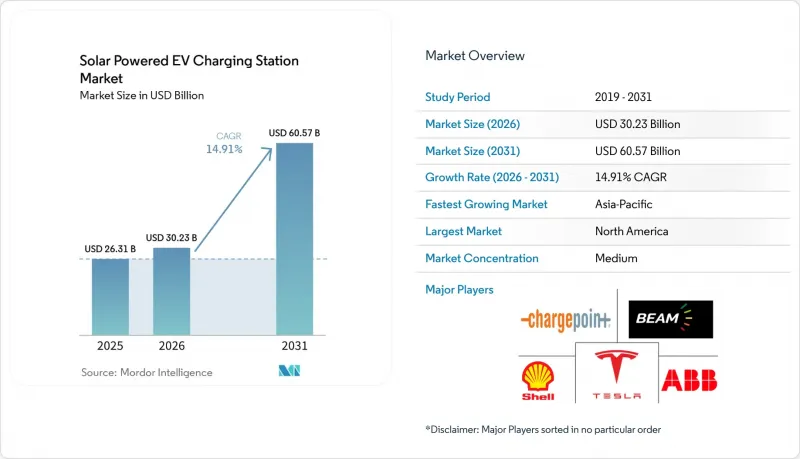
據 Mordor Intelligence 稱,2025 年太陽能電動車充電站的市場規模為 263.1 億美元,預計到 2031 年將達到 605.7 億美元,而 2026 年為 302.3 億美元,預測期(2026-2031 年)的複合成長率為 14.91%。
本報告按類型(小型和中型太陽能充電站、大型太陽能充電站)、應用(住宅、商業和公共)、充電站類型(併網太陽能充電站、離網太陽能充電站)、組件(電動汽車充電硬體、太陽能電池陣列等)和地區進行細分。市場預測以美元(USD)為單位。
全球太陽能電動車充電站市場趨勢與洞察
太陽能發電的平準化電力成本(LCOE)正在下降。
預計光學模組成本將持續下降,這將使自發電成本遠低於零售電費。在美國越來越多的州,營運電動貨車車隊的倉儲業者正看到淨現值(NPV)的提升。在美國西南部,雙面陣列和單軸追蹤器的組合提高了容量係數,即使沒有稅額扣抵也能縮短投資回收期。然而,高緯度地區的太陽能系統安裝仍依賴上網電價補貼(FIT),形成雙層成本結構。此外,大容量電池承擔了相當一部分日常用電負荷,可以緩衝需求費用,而需求費用在紐約和德國等地區可能佔商業電費的很大一部分。
由於電網堵塞而產生的額外費用正在推動表後發電。
PJM的壅塞費大幅上漲,迫使設施業主安裝太陽能電動車充電站,以繞過過載的變電站,轉而使用現場發電。同時,加州電力公司推出了無法繞過的每千瓦時收費,進一步擴大了電網輸入電力與現場太陽能發電之間的差距。歐洲也面臨類似的困境。西班牙可再生能源併網等待時間過長,德國則在用電高峰時段限制了部分太陽能發電量。這加速了微電網的普及,尤其是在物流樞紐地區。在紐約市,併網延遲導致人們對無需電力公司批准即可供電力的貨櫃式太陽能艙的需求激增。在電網升級成本巨大的地區,這些財政獎勵尤其具有吸引力。
日常太陽能發電量的不穩定性以及對過剩儲能設施的需求。
日照適中的地區,業者不得不加大電池容量,因為傍晚的充電高峰與中午的太陽能發電量並不重疊。這種過度設計導致每千瓦時電能的額外資本投入。在德國,冬季太陽能運轉率率低意味著很大一部分電力需求依賴電網供電。在美國,磷酸鋰鐵鋰電池是大多數併網計畫的組成部分,雖然其劣化有所降低,但仍有往返損耗。在撒哈拉以南非洲,長時間的陰天使得電力系統不得不依賴柴油備用電源,這引發了人們對該地區「零排放」說法的質疑。
細分市場分析
預計到2025年,功率超過150千瓦的大型充電站將以每年15.22%的速度成長,超過功率低於150千瓦的充電站58.12%的收入佔有率。大規模物流樞紐的太陽能電動車充電站市場預計將迎來顯著成長。這一成長主要受物流車輛對更快充電速度的需求不斷成長的驅動。 ChargePoint公司推出的「Express Solo」產品可大幅降低資本支出(CAPEX)。這款創新產品為兆瓦級物流樞紐的建設鋪平了道路,使亞馬遜和UPS等大型企業能夠輕鬆部署。由於組件的規模經濟效應,高功率充電站所需的資本支出遠低於小規模充電站。
儘管大規模充電站數量不斷增加,但小規模充電樁仍能滿足住宅和小規模商業場所的需求,因為在這些場所,交流電足以滿足夜間充電的需求。 SolarEdge 的「ONE」充電器可直接將屋頂的剩餘電力輸送給電動車,無需經過電池。這項創新技術對佔據市場主導地位的家庭用戶尤其具有吸引力。然而,對大規模設施日益嚴格的監管審查,尤其是在加州,某些設施已開始接受《加州環境品質法案》(CEQA) 的審查,這在一定程度上抵消了預期的規模經濟效益。值得慶幸的是,像西門子「SICHARGE Flex」這樣的模組化系統允許營運商從小小規模安裝開始,逐步擴大規模,從而簡化了授權流程。
預計到2025年,家庭用戶將佔電動車充電樁銷售額的64.33%,而商業和公共設施的普及率預計將以每年16.92%的速度成長。太陽能電動車充電站市場預計將迎來顯著成長。主要促進因素包括雇主強制要求和加州建築規範第24條,而「充電即服務」合約則有助於規避資本投資障礙。在電費較高的州,配備大量充電位的職場停車棚能夠帶來較高的內部效益。
住宅領域的普及得益於《通貨膨脹抑制法案》(IRA) 的稅額扣抵抵免和德國復興信貸銀行 (KfW) 的補貼。然而,沒有私人道路的都市區往往必須依賴公共充電樁或工作場所的充電樁。像 Enphase 的「IQ」這樣的雙向家用充電樁對英國和美國的城市居民頗具吸引力,因為它們能夠增強電網的穩定性,而這些電網又容易發生停電。同時,商業機構受益於抑低尖峰負載和輔助服務,而住宅則主要專注於降低電費,這可能會限制未來的成長。
區域分析
北美地區受益於IRA獎勵,這些措施顯著降低了資本需求,並催生了大量強勁的交易項目,預計到2025年,北美地區的收入將佔全球總收入的38.92%。該地區已成功整合了大規模儲能容量,並尋求進一步擴張。加州的堵塞收費和NEM 3.0正在鼓勵營運商轉向結合太陽能和儲能的綜合站點。然而,值得注意的是,目前只有少數幾個州為V2G(車輛到電網)供電提供激勵措施。在加拿大,供需缺口龐大,職場充電樁短缺。同時,特斯拉和PG&E的先導計畫表明,該行業已準備好迎接雙向電力流動。
亞太地區是成長最快的地區,年複合成長率達15.86%。中國為充電站數量設定了雄心勃勃的目標,並且已經在增加。此外,中國公共充電站的平均輸出功率也呈現顯著成長。在印度,總理電動車發展計畫(PM E-DRIVE)已為許多充電站撥款,但實際部署進度落後。比亞迪的快速充電器已在主要城市(一線城市)部署了大量設備,為充電速度樹立了新的標竿。日本和韓國正在大力推進職場充電站的部署,而在東南亞,離網充電樁正逐漸成為主流,以應對電網不穩定的問題。
歐洲電動車充電的未來與併網建設密切相關。德國已製定雄心勃勃的充電樁建設目標,法國也承諾提供大量補貼。然而,挑戰依然存在,西班牙和義大利在太陽能電動車充電站的部署方面仍落後於其他國家。值得欣慰的是,ISO 15118-20 等指南和歐盟建築法規可望加速職場充電基礎設施的建設。在英國,由於數百萬家庭缺乏停車位,公共太陽能發電廠的需求激增。此外,BMW和 E.ON 正在共同開展一項試點項目,每年投資於 V2G(車輛到電網)頻率調節服務。
在南美洲,快速充電樁的安裝速度驚人,尤其是在巴西,如今已在許多城市普及。比亞迪不僅在擴大快速充電樁的部署,還在阿根廷建造一座工廠。該工廠預計將大幅擴展阿根廷現有的充電網路。此外,貨櫃式太陽能充電樁正在農村地區推廣,有效緩解了電網不穩定帶來的挑戰。
在中東和非洲,太陽能發電設施策略性地集中在日照充足的地區。阿拉伯聯合大公國和沙烏地阿拉伯透過在主要旅遊目的地部署設施來彰顯其在太陽能領域的努力。在南非,持續的計劃性停電正在加速離網解決方案的普及。儘管相關政策框架仍處於起步階段,但肯亞的Enzi和ABB的Terra 360等項目已引起廣泛關注,顯示該地區太陽能發電的發展勢頭強勁。
其他好處:
- Excel格式的市場預測(ME)表
- 3個月的分析師支持
目錄
第1章:引言
- 市場分析與定義的前提條件
- 分析範圍
第2章 分析方法
第3章執行摘要
第4章 市場狀況
- 市場概覽
- 市場促進因素
- 降低太陽能發電的平準化成本
- 電網擁塞導致的額外費用促進了表後發電(BTM)。
- 政府主導的淨計量和類似個人退休帳戶的獎勵
- 職場充電計畫的迅速普及
- 車聯網(V2X)的商業化潛力
- 貨櫃式預製太陽能充電艙的出現。
- 市場限制因素
- 日常太陽能發電量的不穩定性以及對大容量儲能的需求。
- 都市區土地使用許可的瓶頸
- 雙向向電網輸出電力的費用存在不確定性。
- 鋰離子儲能系統原料價格的波動
- 價值鍊和供應鏈分析
- 監理情勢
- 技術展望
- 波特五力分析
第5章:預測市場規模與成長率
- 按類型
- 小型和中型太陽能充電站(小於150千瓦)
- 大型太陽能充電站(150千瓦或以上)
- 透過使用
- 家用
- 商業/公共用途
- 依站點類型
- 併網太陽能充電站
- 離網太陽能充電站
- 按組件
- 電動車充電硬體
- 太陽能電池陣列
- 電池能源儲存系統(BESS)
- 功率轉換與控制
- 按地區
- 北美洲
- 美國
- 加拿大
- 其他北美國家
- 南美洲
- 巴西
- 阿根廷
- 其他南美國家
- 歐洲
- 德國
- 法國
- 英國
- 義大利
- 西班牙
- 其他歐洲國家
- 亞太地區
- 中國
- 日本
- 韓國
- 印度
- 其他亞太國家
- 中東和非洲
- 南非
- 阿拉伯聯合大公國
- 沙烏地阿拉伯
- 其他中東和非洲國家
- 北美洲
第6章 競爭情勢
- 市場集中度
- 策略趨勢
- 市佔率分析
- 公司簡介
- ABB Ltd.
- Beam Global
- Tesla Inc.
- ChargePoint, Inc.
- Siemens AG
- Shell plc
- Tritium
- Delta Electronics
- Schneider Electric
- SolarEdge
- Enphase Energy
- Wallbox
- Alfen NV
- EVgo
- Volta Charging
第7章 市場機會與未來展望
According to Mordor Intelligence, the solar powered EV charging station market size was valued at USD 26.31 billion in 2025 and estimated to grow from USD 30.23 billion in 2026 to reach USD 60.57 billion by 2031, at a CAGR of 14.91% during the forecast period (2026-2031).
This report is Segmented by Type (Small and Medium Solar Charging Station, Large Solar Charging Station), Application (Household and Commercial/Public), Station Type (On-Grid Solar Charging Station, Off-Grid Solar Charging Station), Component (EV Charger Hardware, Solar PV Array, and More), and Geography. The Market Forecasts are Provided in Terms of Value (USD).
Global Solar Powered EV Charging Station Market Trends and Insights
Declining Levelized Cost of Solar PV
Solar modules are expected to continue declining in cost, positioning on-site generation significantly below retail tariffs. Depot operators managing fleets of electric vans have seen their positive net present value expand across more U.S. states. In the U.S. Southwest, combining bifacial arrays with single-axis trackers boosts capacity factors, reducing payback periods even without tax credits. However, installations situated in northern latitudes still depend on feed-in premiums, creating a two-tier cost structure. Additionally, oversized battery storage, accounting for a significant percentage of daily load, provides a buffer against demand charges, which can constitute a substantial portion of commercial bills in regions like New York and Germany.
Grid-Congestion Surcharges Driving Behind-the-Meter Generation
PJM congestion fees have increased significantly, prompting site hosts to pivot to self-generation by deploying solar-powered EV charging stations to bypass overloaded substations. Meanwhile, California utilities introduced non-bypassable charges per kilowatt-hour, amplifying the disparity between grid imports and on-site solar. Europe is also experiencing strain: Spain is facing extended wait times for renewables, and Germany curtailed a portion of its solar output during peak hours. This has accelerated the adoption of micro-grids, particularly in logistics hubs. In New York City, delays in interconnection have driven demand for containerized solar pods that can be energized without utility approval. The financial incentives are especially compelling in areas where grid reinforcement costs are substantial per site.
Inter-Day Solar Intermittency and Need for Oversized Storage
Operators in regions with moderate sunlight are compelled to oversize batteries due to the misalignment of evening charging peaks and midday PV output. This oversizing results in an additional capital expenditure per kWh. In Germany, the solar capacity factor during winter means a significant portion of demand depends on the grid supply. While lithium-iron-phosphate chemistries, which constitute a substantial share of U.S. co-located projects, mitigate degradation, they still experience round-trip losses. In sub-Saharan Africa, extended cloudy periods necessitate reliance on diesel backup, casting doubt on the region's zero-emission assertions.
Other drivers and restraints analyzed in the detailed report include:
- Government Net-Metering and IRA-Like Incentives
- Rapid Uptake of Workplace Charging Programs
- Land-Use Permitting Bottlenecks in Urban Areas
For complete list of drivers and restraints, kindly check the Table Of Contents.
Segment Analysis
Large stations above 150 kW are set to grow at 15.22% annually, eclipsing the 58.12% revenue held by sub-150 kW sites in 2025. The market for solar-powered EV charging stations at large depots is set to grow significantly. This growth is largely fueled by logistics fleets increasingly demanding higher charge rates. ChargePoint has introduced the Express Solo, which significantly reduces capital expenditure (capex). This innovation paves the way for megawatt-class hubs, making them feasible for major players like Amazon and UPS. Due to economies of scale in components, capex is considerably lower for higher-rated installations compared to smaller ones.
While larger stations are on the rise, smaller units continue to cater to residential and light-commercial demands, with AC units being adequate for overnight charging. SolarEdge's ONE charger directly channels surplus rooftop energy to the EV, bypassing the need for batteries. This innovation is particularly enticing for households that dominate the market. However, as larger builds face tightening regulatory scrutiny-especially with California's CEQA reviews kicking in for certain installations-some of the anticipated scale advantages are offset. On a brighter note, modular systems like Siemens' SICHARGE Flex allow operators to kick off with a smaller setup and gradually expand, simplifying the permitting process.
Households accounted for 64.33% of 2025 revenue, yet commercial and public deployments are forecast to grow 16.92% per year. The solar-powered EV charging station market is projected to grow significantly. Key drivers include employer mandates and Title 24 codes, while "charging-as-a-service" contracts help sidestep capital expenditure hurdles. In tariff-heavy states, workplace canopies accommodating large numbers of stalls achieve high internal rates.
Residential adoption is bolstered by IRA tax credits and KfW rebates in Germany. However, urban residents without driveways often rely on public or employer chargers. Bidirectional home units, like Enphase's IQ, offer resilience in grids prone to outages, making them appealing to urbanites in the U.K. and U.S. While commercial sites benefit from peak shaving and ancillary services, homeowners primarily value retail bill savings, which may temper future growth rates.
Complete Report Scope:
- By Type
- Small and Medium Solar Charging Station (Less than 150 kW)
- Large Solar Charging Station (More than 150 kW)
- By Application
- Household
- Commercial/Public
- By Station Type
- On-Grid Solar Charging Station
- Off-Grid Solar Charging Station
- By Component
- EV Charger Hardware
- Solar PV Array
- Battery Energy-Storage System (BESS)
- Power Conversion and Controls
- By Geography
- North America
- United States
- Canada
- Rest of North America
- South America
- Brazil
- Argentina
- Rest of South America
- Europe
- Germany
- France
- United Kingdom
- Italy
- Spain
- Rest of Europe
- Asia-Pacific
- China
- Japan
- South Korea
- India
- Rest of Asia-Pacific
- Middle East and Africa
- South Africa
- United Arab Emirates
- Saudi Arabia
- Rest of Middle East and Africa
- North America
Geography Analysis
North America contributed 38.92% of 2025 revenue, buoyed by IRA incentives that slashed capital requirements and led to a robust pipeline. The region successfully integrated substantial storage capacity and has ambitions to further increase it. California's congestion fees, alongside NEM 3.0, have nudged operators towards integrated solar-plus-storage sites. However, it's noteworthy that only a few states currently offer remuneration for V2G exports. Highlighting a significant demand gap, Canada faces a shortfall in workplace chargers. Meanwhile, Tesla and PG&E's pilot projects underscore the industry's readiness for bidirectional flow.
Asia-Pacific is the fastest-growing region, with a 15.86% CAGR. China, eyeing a significant target for chargers, has already increased its count. Additionally, the nation has seen a commendable uptick in the average power of public chargers. In India, while PM E-DRIVE has earmarked funds for numerous stations, the actual rollout is lagging. BYD's flash charger, with an impressive number of units already deployed, is setting new speed standards in Tier-1 cities. Japan and South Korea are advancing workplace charger rollouts, while Southeast Asia is leaning towards off-grid pods to address unreliable grid conditions.
Europe's future in the EV charging landscape is closely tied to grid integration efforts. Germany has set an ambitious goal for chargers, while France has committed substantial subsidies. However, challenges persist as Spain and Italy grapple with delays in deploying their solar-powered EV charging stations. On a brighter note, directives like ISO 15118-20 and EU building regulations are poised to catalyze workplace growth. In the U.K., with millions of households lacking home parking, there's a burgeoning demand for public solar hubs. Additionally, BMW and E.ON's collaborative pilots are investing annually in V2G frequency services.
In South America, Brazil witnessed a staggering surge in fast-charger installations, now reaching numerous municipalities. BYD is not only expanding its footprint with flash chargers but is also setting up a plant in Argentina. This facility is projected to significantly amplify the nation's current network. Furthermore, containerized solar pods are being deployed in rural provinces, effectively sidestepping the challenges posed by unstable grids.
In the Middle East and Africa, installations are strategically concentrated in regions with high solar irradiance. The UAE and Saudi Arabia are showcasing their commitment by deploying sites in prominent tourist hubs. In South Africa, persistent load shedding has accelerated the adoption of off-grid solutions. Despite nascent policy frameworks, networks such as Enzi in Kenya and ABB's Terra 360 are gaining traction, signaling growing momentum in the region.
- ABB Ltd.
- Beam Global
- Tesla Inc.
- ChargePoint, Inc.
- Siemens AG
- Shell plc
- Tritium
- Delta Electronics
- Schneider Electric
- SolarEdge
- Enphase Energy
- Wallbox
- Alfen N.V.
- EVgo
- Volta Charging
Additional Benefits:
- The market estimate (ME) sheet in Excel format
- 3 months of analyst support
TABLE OF CONTENTS
1 Introduction
- 1.1 Study Assumptions and Market Definition
- 1.2 Scope of the Study
2 Research Methodology
3 Executive Summary
4 Market Landscape
- 4.1 Market Overview
- 4.2 Market Drivers
- 4.2.1 Declining Levelized Cost of Solar PV
- 4.2.2 Grid-Congestion Surcharges Driving Behind-the-Meter Generation
- 4.2.3 Government Net-Metering and IRA-Like Incentives
- 4.2.4 Rapid Uptake of Workplace Charging Programs
- 4.2.5 Vehicle-to-Everything (V2X) Monetization Potential
- 4.2.6 Emergence of Containerized, Pre-Fab Solar Charging Pods
- 4.3 Market Restraints
- 4.3.1 Inter-Day Solar Intermittency and Need for Oversized Storage
- 4.3.2 Land-Use Permitting Bottlenecks in Urban Areas
- 4.3.3 Tariff Uncertainty for Bidirectional Export to Grid
- 4.3.4 Raw-Material Price Volatility for Li-ion ESS
- 4.4 Value/Supply-Chain Analysis
- 4.5 Regulatory Landscape
- 4.6 Technological Outlook
- 4.7 Porter's Five Forces
- 4.7.1 Threat of New Entrants
- 4.7.2 Bargaining Power of Suppliers
- 4.7.3 Bargaining Power of Buyers
- 4.7.4 Threat of Substitutes
- 4.7.5 Competitive Rivalry
5 Market Size and Growth Forecasts (Value, USD)
- 5.1 By Type
- 5.1.1 Small and Medium Solar Charging Station (Less than 150 kW)
- 5.1.2 Large Solar Charging Station (More than 150 kW)
- 5.2 By Application
- 5.2.1 Household
- 5.2.2 Commercial/Public
- 5.3 By Station Type
- 5.3.1 On-Grid Solar Charging Station
- 5.3.2 Off-Grid Solar Charging Station
- 5.4 By Component
- 5.4.1 EV Charger Hardware
- 5.4.2 Solar PV Array
- 5.4.3 Battery Energy-Storage System (BESS)
- 5.4.4 Power Conversion and Controls
- 5.5 By Geography
- 5.5.1 North America
- 5.5.1.1 United States
- 5.5.1.2 Canada
- 5.5.1.3 Rest of North America
- 5.5.2 South America
- 5.5.2.1 Brazil
- 5.5.2.2 Argentina
- 5.5.2.3 Rest of South America
- 5.5.3 Europe
- 5.5.3.1 Germany
- 5.5.3.2 France
- 5.5.3.3 United Kingdom
- 5.5.3.4 Italy
- 5.5.3.5 Spain
- 5.5.3.6 Rest of Europe
- 5.5.4 Asia-Pacific
- 5.5.4.1 China
- 5.5.4.2 Japan
- 5.5.4.3 South Korea
- 5.5.4.4 India
- 5.5.4.5 Rest of Asia-Pacific
- 5.5.5 Middle East and Africa
- 5.5.5.1 South Africa
- 5.5.5.2 United Arab Emirates
- 5.5.5.3 Saudi Arabia
- 5.5.5.4 Rest of Middle East and Africa
- 5.5.1 North America
6 Competitive Landscape
- 6.1 Market Concentration
- 6.2 Strategic Moves
- 6.3 Market Share Analysis
- 6.4 Company Profiles (Includes Global Level Overview, Market Level Overview, Core Segments, Financials as Available, Strategic Information, Market Rank/Share for Key Companies, Products and Services, SWOT Analysis, and Recent Developments)
- 6.4.1 ABB Ltd.
- 6.4.2 Beam Global
- 6.4.3 Tesla Inc.
- 6.4.4 ChargePoint, Inc.
- 6.4.5 Siemens AG
- 6.4.6 Shell plc
- 6.4.7 Tritium
- 6.4.8 Delta Electronics
- 6.4.9 Schneider Electric
- 6.4.10 SolarEdge
- 6.4.11 Enphase Energy
- 6.4.12 Wallbox
- 6.4.13 Alfen N.V.
- 6.4.14 EVgo
- 6.4.15 Volta Charging
7 Market Opportunities and Future Outlook
- 7.1 White-Space and Unmet-Need Assessment


