


 |
市場調查報告書
商品編碼
2117373
印尼履帶式土木工程機具:市場佔有率分析、產業趨勢與統計及成長預測(2026-2031 年)Indonesia Crawler Earthmoving Machines - Market Share Analysis, Industry Trends & Statistics, Growth Forecasts (2026 - 2031) |
||||||

※ 本網頁內容可能與最新版本有所差異。詳細情況請與我們聯繫。
據 Mordor Intelligence 稱,2025 年印尼履帶式土木工程機具市場價值為 11.2 億美元,預計到 2031 年將從 2026 年的 11.7 億美元成長至 14.4 億美元,2026 年至 2031 年的複合年成長率為 4.32%。
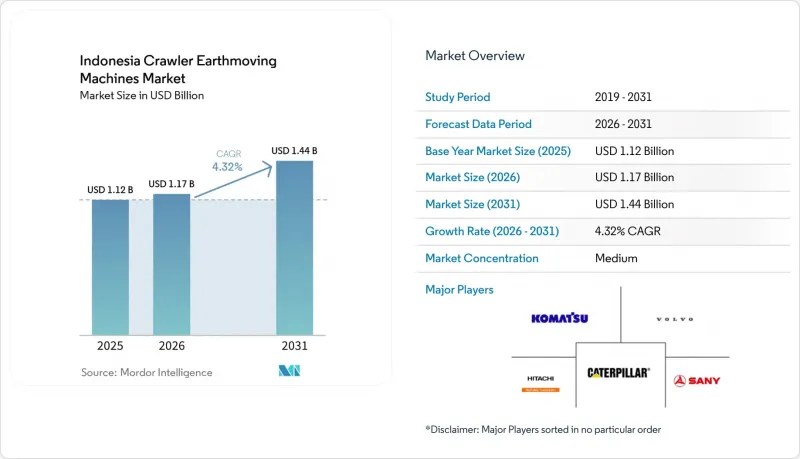
本報告按設備類型(挖土機、推土機、平土機、自動卸貨卡車等)、驅動系統(內燃機等)、分銷通路(直銷、經銷商/經銷商網路)、終端用戶產業(建設業、採礦/採石、其他)和地區細分。市場預測以價值(美元)和數量(台)兩種形式呈現。
印尼履帶式土木工程機具市場趨勢與洞察
大規模公共部門基礎設施發展計劃
努桑塔拉地區已獲得大量預算,近期又新增了土方工程預算,標誌著該計畫進入新階段。儘管收費公路的整體擴建計劃有所縮減,但產業向集中式大型企劃轉型,使得大型挖土機和推土機的需求依然強勁,這些設備對於在狹小空間內持續作業至關重要。邁卡塔雄心勃勃的住宅項目是「300萬住宅計畫」的一部分,該計畫開創了高層住宅的先河,並進一步擴大了對適用於深基礎作業的履帶式重型機械的需求。爪哇天然氣管道的完工凸顯了大型溝槽挖土機的重要性,並為即將啟動的馬塞拉液化天然氣計畫的土木工程樹立了標竿。這些項目共同抵消了高速公路建設成本下降的影響,並確保了高容量履帶式重型機械的穩定訂單來源。
鎳礦和銅礦的擴張正在加速。
淡水河谷印尼公司已獲得大量貸款承諾,CNGR也成功資金籌措。這凸顯了採礦週期的漫長,而採礦週期又與電動車供應鏈緊密相連。儘管RKAB(富鋁鎳礦)的生產配額有所下調,但印尼仍有望將鎳產量提升至高水準。要實現這一目標需要使用能夠應對高強度運作週期和高效清除回填土的鑽機。雖然政策主導的供應限制造成了短期波動,但下游產業的監管要求,加上數十億美元的高壓酸浸(HPAL)項目,確保了機械設備的強勁需求將遠遠超出預測期。
大宗商品價格波動會抑制資本投資週期。
重型設備銷售呈現下滑趨勢,這可能與煤炭和鎳價波動有關。經濟低迷時期,中小承包商往往難以償還重型設備貸款,被迫販售履帶式重型機械。這不僅導致二手設備貶值,也凸顯了市場的波動性。相較之下,大型礦業公司擴大選擇可在不同礦床靈活部署的多功能挖土機-推土機組合。然而,這些公司的總支出仍與大宗商品價格預測密切相關。同時,原始設備製造商(OEM)正策略性地向施工機械租賃業務多元化發展,此舉使得需求更多地與政府預算而非出口收入掛鉤。
細分市場分析
至2025年,挖土機仍佔印尼履帶式土木工程機具市場佔有率的53.82%。這主要得益於其在鎳礦表土清除、爪哇天然氣管道溝槽挖掘以及「300萬戶住宅」計畫塔架基礎建設的應用。預計到2031年,推土機的複合年成長率將達到7.76%,主要受食品園區項目土方工程、新首都(IKN)土地平整以及馬塞拉液化天然氣項目初期階段對高牽引力機械的需求驅動。推土機的發展與2025年第110號總統令密切相關,該總統令設定了碳排放配額上限,並鼓勵運營商逐步淘汰高耗能鏟運機,轉而使用電液式D8-D10級推土機,這些機型每次作業循環可減少高達10%的排放。
OEM廠商的創新重點在於為排放氣體法規嚴格的都市區提供電動小型挖土機,以及為礦場階梯作業提供配備遠端鏟刀控制的大馬力推土機。由於底盤總成進口關稅的限制,本地生產車架和卡車組的成本仍然較低。租賃車隊傾向於選擇30噸級的挖土機,因為它們兼具運輸便利性和廣泛的作業適應性,能夠最大限度地減少閒置時間。同時,礦業公司則直接採購70噸及以上的機型,以充分利用長壽命礦床帶來的較長開採週期。這種兩極化的市場格局使得印尼履帶式土木工程機具市場在不同重量等級之間呈現階梯式的需求。
2025年,由於完善的燃料供應網路和操作人員的熟悉程度,內燃機將在印尼履帶式土木工程機具市場佔據86.43%的佔有率。雖然Tier 3和Tier 4過渡標準引擎仍佔據主導地位,但從2022年起實施的碳定價將直接增加營運成本,從而提升人們對替代動力傳動系統的興趣。在排放法規嚴格的都市區,20噸級挖土機的需求推動了電池電動機械的複合年成長率達到8.42%。然而,驅動電池進口關稅的不確定性增加了前期成本,導致一些承包商在等待政策明朗化期間推遲採購。混合動力系統則處於中間位置,無需充電基礎設施即可達到15-20%的燃油節省。
這家國有電力公司計劃在努沙登加拉群島建造一個測試充電場,用於在輪班休息期間為履帶式重型機械供電,這表明未來擴充性。日本小松公司和現代等原始設備製造商(OEM)正在提案引入可互換電池組,以減少偏遠礦區因充電而造成的運作。然而,由於柴油引擎具有高能量密度和快速加油的特點,因此在加里曼丹等地進行表土移除等長週期作業時,柴油引擎仍然是首選。因此,預計到2030年,印尼履帶式土木工程機具市場仍將以內燃機(ICE)為主導,電氣化預計將領先在嚴格監管的都市區推進。
其他好處:
- Excel格式的市場預測(ME)表
- 3個月的分析師支持
目錄
第1章:引言
- 市場分析與定義的前提條件
- 分析範圍
第2章 分析方法
第3章執行摘要
第4章 市場狀況
- 市場概覽
- 市場促進因素
- 大規模公共部門基礎設施發展計畫(努桑塔拉,收費公路)
- 鎳礦和銅礦的擴張正在加速。
- 快速的都市化正在推動房地產項目的發展。
- OEM經銷商的信貸和租賃利用率
- 利用遠端資訊處理技術進行預測性維護的實施現狀
- 碳定價正在推動從鏟運機向挖土機的轉變。
- 市場限制因素
- 大宗商品價格波動正在抑制資本投資週期。
- 中小型承包商可選擇的資金籌措方案有限。
- 合格的機器操作員短缺
- 對電動車/混合動力汽車動力總成零件徵收不透明的進口關稅
- 價值鍊和供應鏈分析
- 監理情勢
- 技術展望
- 波特五力分析
第5章:預測市場規模與成長率
- 依設備類型
- 挖土機
- 推土機
- 平土機
- 自動卸貨卡車
- 滑移裝載機和其他設備
- 透過驅動系統
- 內燃機
- 混合
- 電池式電動車
- 透過分銷管道
- 直銷
- 經銷商、銷售代理網路
- 按最終用途行業分類
- 建設業
- 採礦和採石
- 石油和天然氣基礎設施
- 其他(農業和林業)
第6章 競爭情勢
- 市場集中度
- 策略趨勢
- 市佔率分析
- 公司簡介
- Caterpillar Inc.
- Komatsu Ltd.
- Hitachi Construction Machinery Co., Ltd.
- Volvo Construction Equipment
- Liebherr Group
- XCMG Group
- Sany Heavy Industry Co., Ltd.
- JCB Limited
- HD Hyundai Construction Equipment Co., Ltd.
- Case Construction Equipment
- Zoomlion Heavy Industry Science & Technology Co., Ltd.
- Sumitomo Heavy Industries Ltd.
- Doosan Infracore Co., Ltd.
- Yanmar Compact Equipment
- Kobelco Construction Machinery Co., Ltd.
- Shantui Construction Machinery Co., Ltd.
- LiuGong Machinery Co., Ltd.
第7章 市場機會與未來展望
According to Mordor Intelligence, the indonesian crawler earthmoving machines market size was valued at USD 1.12 billion in 2025 and is estimated to grow from USD 1.17 billion in 2026 to reach USD 1.44 billion by 2031, at a CAGR of 4.32% over 2026-2031.
This report is Segmented by Equipment Type (Excavators, Bulldozers, Graders, Dump Trucks, and More), Propulsion (Internal-Combustion Engine, and More), Distribution Channel (Direct and Dealer and Distributor Network), End-Use Industry (Construction, Mining and Quarrying, and Others), and Geography. The Market Forecasts are Provided in Terms of Value (USD) and Volume (Units).
Indonesia Crawler Earthmoving Machines Market Trends and Insights
Massive Public-Sector Infrastructure Pipeline
Nusantara has earmarked a significant budget, while a new phase recently commenced with additional allocations for earthworks . Despite a reduction in overall toll-road expansions, the industry's shift towards concentrated megaprojects has sustained a robust demand for large excavators and bulldozers, essential for continuous operation on compact sites. Meikarta's ambitious housing units under the 3 Million Homes Program, spearheading the vertical-housing initiative, further amplify demand for tracked equipment suited to deep foundation work. The completion of the Java gas pipeline underscored the importance of heavy trenching machines and established a benchmark for the upcoming civil packages of Masela LNG. Collectively, these ventures have counterbalanced a decline in highway expenditures, ensuring a steady order pipeline for high-capacity crawler equipment.
Accelerated Nickel and Copper Mine Expansions
Vale Indonesia secured financing commitments exceeding significant amounts, while CNGR garnered substantial funding, highlighting a prolonged mining cycle intricately linked to EV supply chains. Even with a downward revision to the RKAB production quota, Indonesia is poised to boost its nickel output to a high level. Achieving this will necessitate aggressive overburden removal, utilizing excavators designed for heavy-duty cycles. While policy-driven supply discipline has injected short-term volatility, downstream mandates, coupled with multi-billion-dollar HPAL projects, ensure robust equipment demand extending well beyond the forecast horizon.
Commodity-Price Volatility Suppresses Capex Cycles
The heavy equipment sales declined, likely due to fluctuations in coal and nickel prices. During downturns, smaller contractors often struggle to service equipment loans, leading them to liquidate crawler assets. This action not only shrinks the pool of used-machine values but also highlights the market's volatility. In response, tier-one miners are increasingly opting for versatile excavator-dozer combinations, allowing them to redeploy across different ore bodies. However, their overall spending remains closely tied to commodity price forecasts. Meanwhile, OEMs are strategically diversifying into construction rentals, a move that aligns their demand more with government budgets than with export earnings.
Other drivers and restraints analyzed in the detailed report include:
- Rapid Urbanization Fueling Real-Estate Projects
- OEM Dealer-Credit and Rental Penetration
- Shortage of Certified Machine Operators
For complete list of drivers and restraints, kindly check the Table Of Contents.
Segment Analysis
Excavators still held 53.82% of Indonesia's crawler earthmoving machine market share in 2025 because they are used for overburden removal at nickel pits, trenching for the Java gas pipeline, and foundation work for the 3 Million Homes towers. Bulldozers are projected to post a 7.76% CAGR through 2031 as food-estate projects, IKN site grading, and early-stage Masela LNG earthworks drive demand for high-drawbar-pull machines. Dozer advances are tied to Presidential Regulation No. 110/2025, which caps carbon allocations and pushes operators to retire fuel-hungry scrapers in favor of electro-hydraulic D8- to D10-class units that lower emissions by up to 10% per load cycle.
OEM innovation centers on electric mini-excavators for emissions-sensitive urban pockets and high-horsepower dozers with remote blade control for mining benches. Import tariffs on undercarriage assemblies keep the economics of localization favorable for the domestic fabrication of frames and track groups. Rental fleets skew toward 30-ton excavators because they balance transportability with broad job applicability, minimizing idle days. Meanwhile, mining firms acquire 70-ton-and-above models outright, leveraging longer payback horizons associated with long-life ore bodies. This dichotomy sustains tiered demand across weight classes within the Indonesian crawler earthmoving machines market.
Internal-combustion engines held 86.43% share of the Indonesian crawler earthmoving machines market in 2025 due to mature fueling networks and familiarity among operators. Tier 3 and Tier 4 interim engines remain prevalent, though carbon pricing since 2022 has introduced direct operating-cost penalties, sharpening interest in alternative powertrains. Battery-electric units exhibit an 8.42% CAGR, led by 20-ton excavators inside emission-restricted urban zones. However, uncertainty around import duties on traction batteries hinders upfront affordability, leading some contractors to defer purchases until policy clarity emerges. Hybrid systems occupy the middle ground by offering 15-20% fuel savings without a charging infrastructure.
State-owned utilities plan to build pilot charging yards at Nusantara to service crawler equipment during shift breaks, signaling future scalability. OEMs such as Komatsu and Hyundai propose swappable battery packs to mitigate charging downtimes on remote mining benches. Even so, long-cycle jobs in Kalimantan's overburden removal still favor diesel due to its higher energy density and faster refueling speed. Therefore, the Indonesian crawler earthmoving machines market size is expected to remain ICE-heavy through 2030, with electrification proceeding first in regulated urban clusters.
Complete Report Scope:
- By Equipment Type
- Excavators
- Bulldozers
- Graders
- Dump Trucks
- Skid-Steer Loaders and Others
- By Propulsion
- Internal-Combustion Engine
- Hybrid
- Battery-Electric
- By Distribution Channel
- Direct
- Dealer and Distributor Network
- By End-Use Industry
- Construction
- Mining and Quarrying
- Oil and Gas Infrastructure
- Others (Agriculture, Forestry)
List of Companies Covered in this Report:
- Caterpillar Inc.
- Komatsu Ltd.
- Hitachi Construction Machinery Co., Ltd.
- Volvo Construction Equipment
- Liebherr Group
- XCMG Group
- Sany Heavy Industry Co., Ltd.
- JCB Limited
- HD Hyundai Construction Equipment Co., Ltd.
- Case Construction Equipment
- Zoomlion Heavy Industry Science & Technology Co., Ltd.
- Sumitomo Heavy Industries Ltd.
- Doosan Infracore Co., Ltd.
- Yanmar Compact Equipment
- Kobelco Construction Machinery Co., Ltd.
- Shantui Construction Machinery Co., Ltd.
- LiuGong Machinery Co., Ltd.
Additional Benefits:
- The market estimate (ME) sheet in Excel format
- 3 months of analyst support
TABLE OF CONTENTS
1 Introduction
- 1.1 Study Assumptions and Market Definition
- 1.2 Scope of the Study
2 Research Methodology
3 Executive Summary
4 Market Landscape
- 4.1 Market Overview
- 4.2 Market Drivers
- 4.2.1 Massive Public-Sector Infrastructure Pipeline (Nusantara, Toll Roads)
- 4.2.2 Accelerated Nickel and Copper Mine Expansions
- 4.2.3 Rapid Urbanization Fueling Real-Estate Projects
- 4.2.4 OEM Dealer-Credit and Rental Penetration
- 4.2.5 Telematics-Enabled Predictive Maintenance Uptake
- 4.2.6 Carbon-Pricing Drives Scraper-To-Excavator Shift
- 4.3 Market Restraints
- 4.3.1 Commodity-Price Volatility Suppresses Capex Cycles
- 4.3.2 Limited SME Contractor Financing Options
- 4.3.3 Shortage of Certified Machine Operators
- 4.3.4 Uncertain Import Duties on EV/Hybrid Drivetrain Parts
- 4.4 Value/Supply-Chain Analysis
- 4.5 Regulatory Landscape
- 4.6 Technological Outlook
- 4.7 Porter's Five Forces
- 4.7.1 Threat of New Entrants
- 4.7.2 Bargaining Power of Buyers/Consumers
- 4.7.3 Bargaining Power of Suppliers
- 4.7.4 Threat of Substitute Products
- 4.7.5 Intensity of Competitive Rivalry
5 Market Size and Growth Forecasts
- 5.1 By Equipment Type
- 5.1.1 Excavators
- 5.1.2 Bulldozers
- 5.1.3 Graders
- 5.1.4 Dump Trucks
- 5.1.5 Skid-Steer Loaders and Others
- 5.2 By Propulsion
- 5.2.1 Internal-Combustion Engine
- 5.2.2 Hybrid
- 5.2.3 Battery-Electric
- 5.3 By Distribution Channel
- 5.3.1 Direct
- 5.3.2 Dealer and Distributor Network
- 5.4 By End-Use Industry
- 5.4.1 Construction
- 5.4.2 Mining and Quarrying
- 5.4.3 Oil and Gas Infrastructure
- 5.4.4 Others (Agriculture, Forestry)
6 Competitive Landscape
- 6.1 Market Concentration
- 6.2 Strategic Moves
- 6.3 Market Share Analysis
- 6.4 Company Profiles
- 6.4.1 Caterpillar Inc.
- 6.4.2 Komatsu Ltd.
- 6.4.3 Hitachi Construction Machinery Co., Ltd.
- 6.4.4 Volvo Construction Equipment
- 6.4.5 Liebherr Group
- 6.4.6 XCMG Group
- 6.4.7 Sany Heavy Industry Co., Ltd.
- 6.4.8 JCB Limited
- 6.4.9 HD Hyundai Construction Equipment Co., Ltd.
- 6.4.10 Case Construction Equipment
- 6.4.11 Zoomlion Heavy Industry Science & Technology Co., Ltd.
- 6.4.12 Sumitomo Heavy Industries Ltd.
- 6.4.13 Doosan Infracore Co., Ltd.
- 6.4.14 Yanmar Compact Equipment
- 6.4.15 Kobelco Construction Machinery Co., Ltd.
- 6.4.16 Shantui Construction Machinery Co., Ltd.
- 6.4.17 LiuGong Machinery Co., Ltd.
7 Market Opportunities and Future Outlook

 鑿式耕耘機市場:全球市場預測,2026-2032年乾草和飼料機械市場:全球市場預測,2026-2032年乾肥料儲存設備市場:全球市場預測,2026-2032年軟性室內筒倉市場:依材料、容量、配置、安裝類型和最終用途產業分類-全球預測,2026-2032年單螺旋式糧食運輸車市場按容量範圍、最終用戶、糧食類型和分銷管道分類,全球預測(2026-2032年)糧食螺旋輸送車市場按產品類型、動力來源、最終用途和銷售管道分類-2026-2032年全球預測
 農業機械維護服務市場機會、成長促進因素、產業趨勢分析及預測(2025-2034年)