


 |
市場調查報告書
商品編碼
2117361
汽車環景顯示系統:市場佔有率分析、產業趨勢與統計、成長預測(2026-2031)Automotive Surround View Systems - Market Share Analysis, Industry Trends & Statistics, Growth Forecasts (2026 - 2031) |
||||||

※ 本網頁內容可能與最新版本有所差異。詳細情況請與我們聯繫。
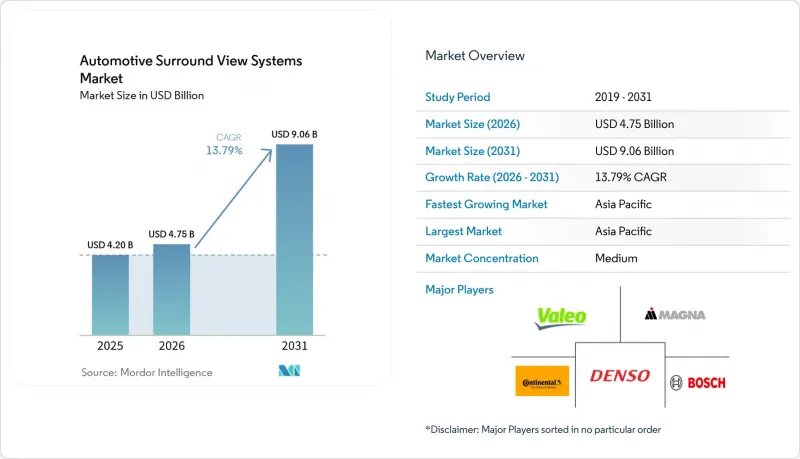
據 Mordor Intelligence 稱,2025 年汽車環景顯示系統市場價值 42 億美元,預計將從 2026 年的 47.5 億美元成長到 2031 年的 90.6 億美元,2026 年至 2031 年的複合年成長率為 13.79%。
本報告按攝影機數量(4攝影機系統、4攝影機系統(6攝影機、8攝影機、12攝影機系統))、攝影機功能(自動(自動切換/AI)、手動)、車輛類型(乘用車、商用車)、銷售管道(OEM安裝、售後改裝)、感測器技術、顯示器類型和地區進行細分。市場預測以美元計價。
全球汽車環景顯示系統市場趨勢及洞察
將3D環景顯示整合到ADAS網域控制器中
運行在共用SoC上的集中式網域控制器使得停車輔助、車道維持和交通堵塞輔助功能能夠重複使用單一多攝影機系統,從而顯著降低每個功能的成本。高通、博世和Mobileye已證明,在運行緊急煞車邏輯的同一晶片上,可以合成並評估四幅高解析度影像以進行目標偵測,從而減少線束和散熱硬體。到2025年,中國的新車將具備L2+級自動駕駛能力,中階電動車車型將採用先進的8攝影機配置。隨著網域控制器成為安全運算架構的全球標準,汽車環景顯示系統市場將持續保持強勁成長。
關於後方視野的強制性規定
美國、歐洲、中國和印度強制安裝倒車影像系統,已將原本可選的配置轉變為標配安全功能,縮短了汽車製造商的決策週期,並加快了生產速度。美國國家公路交通安全管理局 (NHTSA) 報告稱,2008 年至 2021 年間,五歲以下兒童因倒車造成的死亡人數顯著下降。為此,監管機構正在擴大安全要求,將視野範圍擴展至 360 度。在印度,Bharat NCAP 2.0 透過對盲點監測和後側路口交通警報等功能給予高分獎勵汽車製造商。因此,汽車製造商擴大採用多攝影機系統,以獲得夢寐以求的四星和五星評級。同時,中國 GB 標準與歐洲通用安全法規 (GER) 在可視性標準上的協調統一,正在推動亞太地區的成長。此外,保險公司為符合標準的商用車輛車隊提供折扣,進一步刺激了市場需求。
ECU散熱與車載網路瓶頸
整合高功率密度域控制器會顯著提高機殼溫度,因此汽車製造商需要主動散熱解決方案。這種做法會推高模組成本並影響整體效率。在炎熱氣候下,一些原始設備製造商 (OEM) 會降低影格速率以防止過熱關機,但這會對駕駛員的感知產生負面影響。同時,儘管現代資料流需要更高的頻寬,但許多車輛架構仍然依賴過時的乙太網路標準。升級到先進技術會增加每個節點的成本。
細分市場分析
到2025年,四攝影機配置的環景系統將佔據汽車環景顯示系統市場66.15%的佔有率,但隨著L2級及以上自動駕駛技術的普及,預計四攝影機以上的配置將以18.33%的複合年成長率成長。八鏡頭配置的環景顯示系統市場預計將快速擴張。在中國,隨著規模經濟的進一步發展,近期的趨勢是車輛上安裝六個攝影機系統。
來自冗餘觀點的影像被輸入到生成式人工智慧模型中,該模型可以消除視野中的障礙物,產生更清晰的鳥瞰圖,並實現十字路口的導航。博世的六攝影機視訊帶可提升環島行駛性能,而中國新能源汽車平均已配備8至13個鏡頭,汽車環景顯示系統市場鏡頭數量不斷增加的趨勢已成定局。
到 2025 年,自動化系統將佔汽車環景顯示系統市場的 74.36%,預計到 2031 年將以 15.03% 的複合年成長率成長。整合到網域控制器中的人工智慧演算法可根據車速和檔位切換到合適的觀點,從而防止駕駛員分心。
雖然手動系統作為售後配件仍佔小眾市場佔有率,但隨著擴增實境(AR)疊加技術需要無縫觀點切換,它們正逐漸被淘汰。 BMW的「全景視覺系統」(Panoramic Vision)和沃爾沃的「EX60」直接在3D環繞顯示器上顯示軌跡線,這證實了自動控制正在成為汽車環景顯示系統市場的主流體驗。
區域分析
預計到2025年,亞太地區將佔據汽車環景顯示系統市場48.17%的佔有率,並在2031年之前以14.45%的複合年成長率成長。中國新能源汽車的蓬勃發展(平均每輛車將配備八個或更多攝影機)正在推動該地區的需求,而印度的Bharat NCAP 2.0標準則將360度全景影像作為提高安全評級的必要條件。博世在中國率先推出的ADAS系統將於2025年中期開始量產,將進一步鞏固亞太地區作為具成本效益創新試驗場的地位。
預計到2026年,北美和歐洲合計將佔據全球總銷量的相當大一部分。 Mobileye在美國的合約以及大眾汽車在歐洲的契約,都印證了將環景顯示技術整合到大眾市場平台方面的進展。車道維持、駕駛員監控和緊急煞車等方面的監管要求正在推動多攝影機系統的應用。然而,網路安全認證的延遲延長了產品週期,並暫時減緩了成長速度。
儘管南美洲、中東和非洲的市場規模仍然較小,但隨著歐洲安全標準的日益普及,這些地區的市場正在迎頭趕上。在巴西,都市區配送車輛正在加裝售後套件以降低保險費用;沿岸地區的消費者也更青睞配備3D環景顯示的豪華SUV。中東地區的高溫對車輛的散熱設計提出了挑戰,但當地強勁的購買力推動了環視系統的普及,確保全球汽車環景顯示系統市場將呈現多元化的發展態勢。
其他好處:
- Excel格式的市場預測(ME)表
- 3個月的分析師支持
目錄
第1章:引言
- 市場分析與定義的前提條件
- 分析範圍
第2章 分析方法
第3章執行摘要
第4章 市場狀況
- 市場概覽
- 市場促進因素
- 將3D環景顯示整合到ADAS網域控制器中
- 關於後方視野的強制性規定
- 利用生成式人工智慧進行拼接,提升感知精度
- 多攝影機系統的平均售價(ASP)正在下降。
- OTA(空中下載)功能解鎖可啟動休眠硬體。
- 城市物流車輛將加裝改裝套件
- 市場限制因素
- ECU散熱與車載網路瓶頸
- 網路安全認證(UNECE R155/R156)延誤
- 入門級乘用車的價格敏感度
- 汽車廣角鏡頭供應商短缺
- 價值鍊和供應鏈分析
- 監理情勢
- 技術展望
- 波特五力分析
第5章:預測市場規模與成長率
- 按攝影機數量
- 四攝影機系統
- 4套攝影系統(6、8或12個攝影機)
- 相機功能
- 自動(自動切換/人工智慧)
- 手動的
- 按車輛類型
- 搭乘用車
- 商用車輛
- 按銷售管道
- 原廠(OEM)安裝
- 改裝
- 感測器技術
- CMOS
- CCD
- 按顯示類型
- 2D
- 3D/擴增實境(AR)
- 按地區
- 北美洲
- 美國
- 加拿大
- 其他北美國家
- 南美洲
- 巴西
- 阿根廷
- 其他南美國家
- 歐洲
- 德國
- 法國
- 英國
- 義大利
- 西班牙
- 其他歐洲國家
- 亞太地區
- 中國
- 日本
- 印度
- 韓國
- 其他亞太國家
- 中東和非洲
- 沙烏地阿拉伯
- 阿拉伯聯合大公國
- 南非
- 其他中東和非洲國家
- 北美洲
第6章 競爭情勢
- 市場集中度
- 策略趨勢
- 市佔率分析
- 公司簡介
- Magna International Inc.
- Valeo SA
- Continental AG
- Denso Corporation
- Robert Bosch GmbH
- Texas Instruments Inc.
- Renesas Electronics Corporation
- Aisin Corporation
- Mobileye NV
- Aptiv PLC
- NVIDIA Corporation
- ON Semiconductor Corporation
- Sunny Optical Technology
- OmniVision Technologies
- Stonkam Co. Ltd.
- STMicroelectronics
- NXP Semiconductors NV
- Hikvision Automotive
第7章 市場機會與未來展望
According to Mordor Intelligence, the automotive surround view systems market size was valued at USD 4.20 billion in 2025, and is projected to grow from USD 4.75 billion in 2026 to USD 9.06 billion by 2031, registering a 13.79% CAGR from 2026 to 2031.
This report is Segmented by Camera Count (4-Camera Systems, More Than 4-Camera (6, 8, 12) Systems), Camera Functioning (Automatic (auto Switching/AI), Manual), Vehicle Type (Passenger Cars, Commercial Vehicles), Sales Channel (OEM-Fitted, Aftermarket Retrofit), Sensor Technology, Display Type, and Geography. Market Forecasts are Provided in Terms of Value (USD).
Global Automotive Surround View Systems Market Trends and Insights
Integration of 3-D Surround-View in ADAS Domain Controllers
Centralized domain controllers running shared SoCs enable parking assistance, lane-keeping, and traffic-jam pilot to reuse a single multi-camera suite, dramatically lowering per-feature cost. Qualcomm, Bosch, and Mobileye demonstrate that four high-resolution feeds can be stitched and evaluated for object detection on the same silicon that executes emergency braking logic, thereby reducing wiring harnesses and cooling hardware. In 2025, new vehicles in China adopted Level 2+ features, with mid-tier electric models incorporating advanced eight-camera setups. As domain controllers become the global standard for safety-compute architecture, the Automotive Surround View Systems market continues to experience significant growth.
Mandated Rear-Visibility Regulations
Rear-view camera mandates in the United States, Europe, China, and India have transformed optional systems into baseline safety equipment, compressing OEM decision cycles and accelerating production volumes. Between 2008 and 2021, NHTSA noted a significant drop in back-over fatalities for children under five. This success has prompted regulators to expand safety requirements to encompass full 360-degree coverage. In India, the Bharat NCAP 2.0 is incentivizing automakers with higher safety scores for features such as blind-spot detection and rear cross-traffic alerts . As a result, automakers are increasingly adopting multi-camera systems to achieve coveted 4- and 5-star ratings. Meanwhile, China's GB standards and Europe's General Safety Regulation are harmonizing on visibility criteria, bolstering growth in the Asia-Pacific region. Additionally, insurance companies are offering discounts to compliant commercial fleets, further driving the demand.
ECU Heat-Dissipation and In-Vehicle Networking Bottlenecks
Consolidating domain controllers with high power densities significantly increases enclosure temperatures, necessitating active cooling solutions for automakers. This approach raises module costs and impacts overall efficiency. In hotter climates, certain OEMs reduce frame rates to prevent thermal shutdowns, which negatively affects driver perception. At the same time, while modern data streams demand higher bandwidth, many vehicle architectures still rely on older Ethernet standards. Upgrading to advanced technologies introduces additional costs per node.
Other drivers and restraints analyzed in the detailed report include:
- Generative-AI Based Stitching Boosting Perception Accuracy
- Falling Multi-Camera ASPs
- Cyber-Security Certification Delays (UNECE R155/R156)
For complete list of drivers and restraints, kindly check the Table Of Contents.
Segment Analysis
4-camera setups held 66.15% of the Automotive Surround View Systems market share in 2025, yet more-than-4-camera arrays are forecast to post an 18.33% CAGR as Level 2+ autonomy spreads. The automotive surround-view systems market for eight-camera configurations is projected to expand rapidly. In China, as economies of scale continue to advance, vehicles are now being equipped with six-camera systems, a trend that has been evolving over recent years.
Redundant viewpoints feed into generative AI models that resolve occlusions, producing cleaner bird's-eye imagery and enabling junction navigation. Bosch's six-camera video belt enhances roundabout handling, and NEVs in China already average eight to thirteen cameras, cementing a trend toward higher counts in the Automotive Surround View Systems market.
Automatic operation commanded 74.36% of the Automotive Surround View Systems market share in 2025 and is growing at 15.03% CAGR through 2031. AI algorithms embedded in domain controllers trigger the proper view based on speed and gear position, eliminating driver distraction.
Manual systems cling to the retrofit niche but face obsolescence as augmented-reality overlays need seamless viewpoint changes. BMW's Panoramic Vision and Volvo's EX60 embed trajectory lines directly in the 3-D surround display, reinforcing automatic control as the mainstream experience in the Automotive Surround View Systems market .
Complete Report Scope:
- By Camera Count
- 4-Camera Systems
- More than 4-Camera (6, 8, 12) Systems
- By Camera Functioning
- Automatic (Auto-Switching / AI)
- Manual
- By Vehicle Type
- Passenger Cars
- Commercial Vehicles
- By Sales Channel
- Original Equipment Manufacturer (OEM)-fitted
- Aftermarket Retrofit
- By Sensor Technology
- CMOS (Complementary Metal-Oxide-Semiconductor)
- CCD (Charge-Coupled Device)
- By Display Type
- 2-D
- 3-D / Augmented
- By Geography
- North America
- United States
- Canada
- Rest of North America
- South America
- Brazil
- Argentina
- Rest of South America
- Europe
- Germany
- France
- United Kingdom
- Italy
- Spain
- Rest of Europe
- Asia-Pacific
- China
- Japan
- India
- South Korea
- Rest of Asia-Pacific
- Middle East and Africa
- Saudi Arabia
- United Arab Emirates
- South Africa
- Rest of Middle East and Africa
- North America
Geography Analysis
Asia-Pacific contributed 48.17% of the Automotive Surround View Systems market share in 2025 and is growing at a 14.45% CAGR through 2031. China's NEV boom, with vehicles averaging eight or more cameras, anchors regional demand, while India's Bharat NCAP 2.0 ties higher safety ratings to 360-degree visibility. Bosch's China-first ADAS suite, beginning serial production in mid-2025, underscores the region's testbed status for cost-efficient innovation.
By 2026, North America and Europe are expected to collectively account for a significant share of total sales. Mobileye's U.S. contract and Volkswagen's European deal underscore the growing integration of surround-view technology across mass-market platforms. Regulatory mandates for lane keeping, driver monitoring, and emergency braking are driving the adoption of multi-camera systems. However, delays in cybersecurity certifications are extending product cycles, temporarily slowing growth.
South America, the Middle East, and Africa remain smaller but are catching up as Euro-style safety norms spread. Urban delivery fleets in Brazil retrofit kits to reduce insurance premiums, and Gulf consumers favor premium SUVs that already include 3-D surround-view. High ambient temperatures in the Middle East stress thermal design, yet robust purchasing power sustains adoption, ensuring that the Automotive Surround View Systems market gains a diversified global footprint.
- Magna International Inc.
- Valeo SA
- Continental AG
- Denso Corporation
- Robert Bosch GmbH
- Texas Instruments Inc.
- Renesas Electronics Corporation
- Aisin Corporation
- Mobileye NV
- Aptiv PLC
- NVIDIA Corporation
- ON Semiconductor Corporation
- Sunny Optical Technology
- OmniVision Technologies
- Stonkam Co. Ltd.
- STMicroelectronics
- NXP Semiconductors N.V.
- Hikvision Automotive
Additional Benefits:
- The market estimate (ME) sheet in Excel format
- 3 months of analyst support
TABLE OF CONTENTS
1 Introduction
- 1.1 Study Assumptions and Market Definition
- 1.2 Scope of the Study
2 Research Methodology
3 Executive Summary
4 Market Landscape
- 4.1 Market Overview
- 4.2 Market Drivers
- 4.2.1 Integration of 3-D Surround-View in ADAS Domain Controllers
- 4.2.2 Mandated Rear-Visibility Regulations
- 4.2.3 Generative-AI Based Stitching Boosting Perception Accuracy
- 4.2.4 Falling Multi-Camera ASPs
- 4.2.5 OTA-Driven Feature Unlocks for Dormant Hardware
- 4.2.6 Urban Logistics Fleets Adopting Retrofit Kits
- 4.3 Market Restraints
- 4.3.1 ECU Heat-Dissipation and In-Vehicle Networking Bottlenecks
- 4.3.2 Cyber-Security Certification Delays (UNECE R155/R156)
- 4.3.3 Price Sensitivity in Entry-Level Passenger Cars
- 4.3.4 Shortage of Automotive-Grade Wide-Angle Lens Suppliers
- 4.4 Value / Supply-Chain Analysis
- 4.5 Regulatory Landscape
- 4.6 Technological Outlook
- 4.7 Porter's Five Forces Analysis
- 4.7.1 Bargaining Power of Suppliers
- 4.7.2 Bargaining Power of Buyers
- 4.7.3 Threat of New Entrants
- 4.7.4 Threat of Substitutes
- 4.7.5 Competitive Rivalry
5 Market Size and Growth Forecasts (Value, USD)
- 5.1 By Camera Count
- 5.1.1 4-Camera Systems
- 5.1.2 More than 4-Camera (6, 8, 12) Systems
- 5.2 By Camera Functioning
- 5.2.1 Automatic (Auto-Switching / AI)
- 5.2.2 Manual
- 5.3 By Vehicle Type
- 5.3.1 Passenger Cars
- 5.3.2 Commercial Vehicles
- 5.4 By Sales Channel
- 5.4.1 Original Equipment Manufacturer (OEM)-fitted
- 5.4.2 Aftermarket Retrofit
- 5.5 By Sensor Technology
- 5.5.1 CMOS (Complementary Metal-Oxide-Semiconductor)
- 5.5.2 CCD (Charge-Coupled Device)
- 5.6 By Display Type
- 5.6.1 2-D
- 5.6.2 3-D / Augmented
- 5.7 By Geography
- 5.7.1 North America
- 5.7.1.1 United States
- 5.7.1.2 Canada
- 5.7.1.3 Rest of North America
- 5.7.2 South America
- 5.7.2.1 Brazil
- 5.7.2.2 Argentina
- 5.7.2.3 Rest of South America
- 5.7.3 Europe
- 5.7.3.1 Germany
- 5.7.3.2 France
- 5.7.3.3 United Kingdom
- 5.7.3.4 Italy
- 5.7.3.5 Spain
- 5.7.3.6 Rest of Europe
- 5.7.4 Asia-Pacific
- 5.7.4.1 China
- 5.7.4.2 Japan
- 5.7.4.3 India
- 5.7.4.4 South Korea
- 5.7.4.5 Rest of Asia-Pacific
- 5.7.5 Middle East and Africa
- 5.7.5.1 Saudi Arabia
- 5.7.5.2 United Arab Emirates
- 5.7.5.3 South Africa
- 5.7.5.4 Rest of Middle East and Africa
- 5.7.1 North America
6 Competitive Landscape
- 6.1 Market Concentration
- 6.2 Strategic Moves
- 6.3 Market Share Analysis
- 6.4 Company Profiles (Includes Global Level Overview, Market Level Overview, Core Segments, Financials as Available, Strategic Information, Market Rank/Share for Key Companies, Products and Services, SWOT Analysis, and Recent Developments)
- 6.4.1 Magna International Inc.
- 6.4.2 Valeo SA
- 6.4.3 Continental AG
- 6.4.4 Denso Corporation
- 6.4.5 Robert Bosch GmbH
- 6.4.6 Texas Instruments Inc.
- 6.4.7 Renesas Electronics Corporation
- 6.4.8 Aisin Corporation
- 6.4.9 Mobileye NV
- 6.4.10 Aptiv PLC
- 6.4.11 NVIDIA Corporation
- 6.4.12 ON Semiconductor Corporation
- 6.4.13 Sunny Optical Technology
- 6.4.14 OmniVision Technologies
- 6.4.15 Stonkam Co. Ltd.
- 6.4.16 STMicroelectronics
- 6.4.17 NXP Semiconductors N.V.
- 6.4.18 Hikvision Automotive
7 Market Opportunities and Future Outlook
- 7.1 White-space and Unmet-Need Assessment


