


 |
市場調查報告書
商品編碼
2117356
北美汽車碰撞維修:市場佔有率分析、行業趨勢和統計數據以及成長預測(2026-2031 年)North America Automotive Collision Repair - Market Share Analysis, Industry Trends & Statistics, Growth Forecasts (2026 - 2031) |
||||||

※ 本網頁內容可能與最新版本有所差異。詳細情況請與我們聯繫。
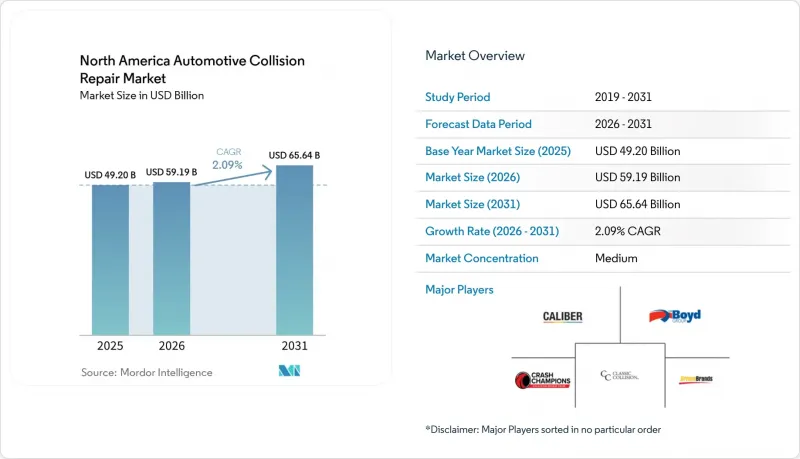
據 Mordor Intelligence 稱,2025 年北美汽車碰撞維修市場價值 492 億美元,預計到 2031 年將達到 656.4 億美元,而 2026 年為 591.9 億美元,預測期內(2026-2031 年)的複合年成長率為 2.09%預計。
本報告按車輛類型(乘用車、商用車)、產品(油漆和塗料、耗材等)、服務管道(DIY(自行維修)、DIFM(代工維修)等)、損壞類型(結構維修、外觀噴漆等)以及國家/地區(美國、加拿大等)進行細分。市場預測以美元計價。
北美汽車碰撞維修市場的趨勢與洞察
ADAS校正會增加維修發票金額。
到2025年,配備ADAS(高級駕駛輔助系統)的車輛在可維修車輛總數中佔比相當大。每次校準都會增加平均維修訂單成本,從而推高整體維修成本。診斷掃描在當年的維修估價中發揮了至關重要的作用,但由於許多獨立維修店沒有獲得原廠授權,服務市場呈現兩極化。在紐約州和麻薩諸塞州,擋風玻璃維修後必須進行原廠指定的重新校準,全國各地的保險公司也正在採用類似的流程來降低責任風險。產業報告顯示,涉及ADAS系統的輕微碰撞事故的維修成本遠高於未配備ADAS系統的車輛。雖然進入門檻很高,但獲得認證的企業受益於高昂的人事費用和大量的直接維修計劃(DRP)業務量,使其比未認證的競爭對手更具盈利。
車輛老化導致維修需求增加。
2025年,車輛平均使用壽命延長,延長了可能需要車身維修的車輛的經濟壽命。車齡6至11年的車輛(這類車輛通常維修頻繁)數量增加,部分原因是當年新車價格上漲。 2025年,聯邦電動車稅額扣抵到期,導致電動車銷量放緩,而混合動力汽車銷量激增,使得更多易發生事故的車輛類型出現在道路上。到2026年,里程趨勢顯示事故發生頻率下降,但事故的潛在風險基礎保持穩定。
透過ADAS和主動安全功能降低碰撞頻率
截至2025年8月,由於自動緊急煞車系統(AEB)和車道維持輔助技術的廣泛應用,可修復的保險索賠數量有所下降,這些技術有助於避免低速碰撞。小修索賠減少,曾經穩定的收入來源——外部維修業也隨之萎縮。隨著AEB系統計畫從2029年起強制安裝,預計這一趨勢將持續。 2025年10月,全損保險理賠增加,可修復車輛數量減少。同時,隨著駕駛逐漸適應電動動力傳動系統,車隊碰撞率也隨之上升,儘管維修數量減少,但每次事故的維修成本卻增加。
細分市場分析
雖然商用車市場規模較小,但預計其成長速度將更快,複合年成長率 (CAGR) 為 2.55%。這一成長將推動北美汽車碰撞維修市場對車隊服務的需求,而這些服務需要先進的 ADAS 和高壓技術。乘用車仍將佔據維修業務的大部分,預計到 2025 年將佔北美汽車碰撞維修市場佔有率的 74.15%,但對多點校準的需求正在增加。隨著車隊電氣化程度的提高,維修店需要儲備 7-8 級電動卡車的零件,並維護充電安全規程。遠端資訊處理技術導致的保險索賠增加推高了維修頻率,但停機造成的罰款使得認證維修中心更高的人事費用成為合理選擇。乘用車業者通常更傾向於選擇能夠提供當日校準服務的 MSO 網路,但獨立維修店可以透過專注於舊款非 ADAS 車輛來維持其市場佔有率。
在商用車隊中,電動卡車採用複合材料駕駛室、溫度控管系統和電池外殼,需要遵循製造商認證的流程,從而導致更高的維修成本。保險公司通常要求商用電動車必須在原廠認證的維修點進行維修,這促使保險公司透過指定維修計畫 (DRP) 來扶持多系統營運商 (MSO)。無法達到校準標準的乘用車維修店則可能被限制只能承接低於免賠額的外部維修工作。因此,北美汽車碰撞維修市場正向能夠同時處理大量乘用車事故維修和嚴重受損車隊維修的企業轉變,從而推動了對整合診斷系統的投資。
到2025年,油漆和塗料將成為北美汽車碰撞維修市場的主要驅動力,佔44.36%的市場佔有率。然而,隨著感測器、攝影機和雷達模組成為標準替換件,備件將成為成長最快的細分市場,複合年成長率將達到2.86%,從而擴大超音波組件等售價超過1000美元的零件的市場規模。加州的VOC(揮發性有機化合物)法規迫使維修店轉向價格更高的水性塗料,但單一雷達單元的相對價值正在發生變化,其價值已超過整套重新噴漆套件。
由於關稅和對海外供應的高度依賴,像LKQ這樣的聚合商正致力於擴大國內的再製造和電池回收項目,以確保老舊車輛和電動車的零件供應。塗料供應商也推出了低VOC(揮發性有機化合物)塗料系統,例如BASF的Glasurit和艾仕得的Cromax Gen,但它們的銷售成長並未跟上ADAS模組日益成長的需求。已實施先進庫存管理軟體的企業可以透過快速的零件供應來規避價格波動風險並保障利潤。
其他好處:
- Excel格式的市場預測(ME)表
- 3個月的分析師支持
目錄
第1章:引言
- 市場分析與定義的前提條件
- 分析範圍
第2章 分析方法
第3章執行摘要
第4章 市場狀況
- 市場概覽
- 市場促進因素
- ADAS校準導致維修成本上升。
- 車輛老化導致維修需求增加。
- 透過私募股權投資整合MSO
- 美國和加拿大有嚴格的安全法規
- 數位化優先的保險業務工作流程
- 北美車輛擁有量和行駛里程 (VMT) 的成長
- 市場限制因素
- 透過ADAS和主動式安全技術降低碰撞頻率。
- 合格技術人員短缺
- 零件供應波動
- 用於重新粉刷的塗料的VOC監管限值
- 價值鍊和供應鏈分析
- 監理情勢
- 技術展望
- 波特五力分析
第5章:預測市場規模與成長率
- 按車輛類型
- 搭乘用車
- 商用車輛
- 依產品
- 油漆和塗料
- 消耗品
- 備用零件
- 玻璃
- 其他產品
- 服務管道
- DIY(Do-It-Yourself)
- DIFM(Do-It-For-Me)
- 原廠配件
- 按損壞類型分類
- 結構修復
- 外觀和油漆
- 玻璃和ADAS校準
- 國家
- 美國
- 加拿大
- 其他北美國家
第6章 競爭情勢
- 市場集中度
- 策略趨勢
- 市佔率分析
- 公司簡介
- Caliber Holdings LLC
- Boyd Group Services Ltd.
- Crash Champions
- Classic Collision
- Safelite Group
- LKQ Corporation
- Driven Brands Holdings
- Axalta Coating Systems
- PPG Industries
- BASF SE
- Sherwin-Williams Automotive Finishes
- AkzoNobel
- 3M
- Dorman Products
第7章 市場機會與未來展望
According to Mordor Intelligence, the North America automotive collision repair market size was valued at USD 49.20 billion in 2025 and is estimated to grow from USD 59.19 billion in 2026 to reach USD 65.64 billion by 2031, at a CAGR of 2.09% during the forecast period (2026-2031).
This report is Segmented by Vehicle Type (Passenger Car, Commercial Vehicle), Product (Paints and Coatings, Consumables, and More), Service Channel (DIY (Do-It-Yourself), DIFM (Do-It-For-Me), and More), Damage Type (Structural Repair, Cosmetic and Paint, and More), and Country (United States, Canada, and More). The Market Forecasts are Provided in Terms of Value (USD).
North America Automotive Collision Repair Market Trends and Insights
ADAS Calibration Boosting Repair Ticket Size
In 2025, vehicles equipped with ADAS accounted for a significant share of the repairable fleet. Each calibration increased the average repair order cost, contributing to higher overall repair expenses. Diagnostic scans featured prominently in repair estimates during the year, yet many independent shops, lacking OEM-specific licenses, contributed to a divided service market. New York and Massachusetts require OEM-spec recalibration after windshield work, and national insurers are adopting identical protocols to reduce liability . According to industry reports, minor collisions involving ADAS systems incur significantly higher repair costs compared to non-ADAS repairs. While capital entry barriers are high, certified operators benefit from premium labor rates and a larger share of the Direct Repair Program (DRP) volume, thereby amplifying their profitability relative to uncertified competitors.
Aging Fleet Extending Repair Demand
In 2025, the average vehicle age increased, extending the economic life of units likely to visit body shops. Vehicles aged between 6 and 11 years, known for their high repair frequency, are seeing an expanding cohort, especially as new vehicle prices rose that year. While federal EV credits expired in 2025, dampening EV purchases, hybrid vehicle sales surged, resulting in more collision-prone platforms remaining on the road. By 2026, vehicle miles traveled indicated a stable exposure base, even with a dip in frequency.
ADAS and Active-Safety Lowering Collision Frequency
Through August 2025, repairable claims declined, driven by AEB and lane-keeping technologies that helped avoid low-speed impacts. Claims for minor repairs have reduced in volume, diminishing the once-reliable cosmetic repair segment. With mandatory AEB set to roll out post-2029, this trend is expected to persist. In October 2025, total-loss claims increased, reducing the number of repairable vehicles, while fleet collision rates rose as drivers adapted to electrified powertrains, resulting in fewer but more expensive repairs.
Other drivers and restraints analyzed in the detailed report include:
- PE-Backed MSO Consolidation
- Stringent U.S. and Canada Safety Regulations
- Certified-Technician Shortage
For complete list of drivers and restraints, kindly check the Table Of Contents.
Segment Analysis
Commercial vehicles represent a smaller segment but are projected to grow faster, at a CAGR of 2.55%. This growth will increase demand in the North American automotive collision repair market for fleet-focused services requiring specialized ADAS and high-voltage expertise. Passenger cars will continue to dominate repair volumes, accounting for 74.15% of the North American automotive collision repair market share in 2025, although they increasingly require multi-point calibration. As fleets electrify, repair shops must stock parts for electric Class 7-8 trucks and maintain safety protocols for charging. Telematics-triggered claims increase repair frequency, while downtime penalties support higher labor rates at certified repair centers. Passenger vehicle operators also favor MSO networks that can provide same-day calibration, although independent shops can retain niche share by specializing in older, non-ADAS-equipped vehicles.
Commercial fleets yield higher ticket values because electric trucks incorporate composite cabs, thermal systems, and battery enclosures needing manufacturer-approved procedures. Insurance underwriters often mandate OE-certified facilities for commercial EVs, boosting DRP steerage toward MSOs. Passenger-car repairers who cannot meet calibration standards risk being relegated to sub-deductible cosmetic work. Consequently, the North American automotive collision repair market is tilting toward businesses that service both high-volume passenger claims and high-severity fleet jobs, incentivizing investment in integrated diagnostics.
Paints and coatings led the North American automotive collision repair market in 2025, with a 44.36% share. Yet, spare parts will be the fastest-growing segment, with a 2.86% CAGR, as sensors, cameras, and radar modules become replacement staples, expanding the North American automotive collision repair market size for components such as ultrasonic assemblies priced above USD 1,000. California's VOC restrictions push shops toward pricier waterborne finishes, but the relative value of a single radar unit eclipses a complete refinish kit, shifting wallet share.
Tariffs and overseas dependency motivate aggregators like LKQ to expand domestic reman offerings and battery re-use programs, ensuring parts availability for aging vehicles and EVs alike. Coatings suppliers respond with low-VOC systems, including BASF Glasurit and Axalta Cromax Gen, yet their revenue growth trails the growth in ADAS module demand. Operators running advanced inventory software can hedge volatility and capture margin through rapid parts fulfillment.
Complete Report Scope:
- By Vehicle Type
- Passenger Car
- Commercial Vehicle
- By Product
- Paints and Coatings
- Consumables
- Spare Parts
- Glass
- Other Product
- By Service Channel
- DIY (Do-It-Yourself)
- DIFM (Do-It-For-Me)
- OE (Original Equipment)
- By Damage Type
- Structural Repair
- Cosmetic and Paint
- Glass and ADAS Calibration
- By Country
- United States
- Canada
- Rest of North America
List of Companies Covered in this Report:
- Caliber Holdings LLC
- Boyd Group Services Ltd.
- Crash Champions
- Classic Collision
- Safelite Group
- LKQ Corporation
- Driven Brands Holdings
- Axalta Coating Systems
- PPG Industries
- BASF SE
- Sherwin-Williams Automotive Finishes
- AkzoNobel
- 3M
- Dorman Products
Additional Benefits:
- The market estimate (ME) sheet in Excel format
- 3 months of analyst support
TABLE OF CONTENTS
1 Introduction
- 1.1 Scope of the Study
- 1.2 Study Assumptions & Market Definition
2 Research Methodology
3 Executive Summary
4 Market Landscape
- 4.1 Market Overview
- 4.2 Market Drivers
- 4.2.1 ADAS Calibration Boosting Repair Ticket Size
- 4.2.2 Aging Fleet Extending Repair Demand
- 4.2.3 PE-Backed MSO Consolidation
- 4.2.4 Stringent U.S. and Canada Safety Regulations
- 4.2.5 Digital-First Insurance Workflows
- 4.2.6 Growing Vehicle Parc and VMT in North America
- 4.3 Market Restraints
- 4.3.1 ADAS and Active-Safety Lowering Collision Frequency
- 4.3.2 Certified-Technician Shortage
- 4.3.3 Parts-Supply Volatility
- 4.3.4 VOC Limits on Refinish Coatings
- 4.4 Value / Supply-Chain Analysis
- 4.5 Regulatory Landscape
- 4.6 Technological Outlook
- 4.7 Porter's Five Forces
- 4.7.1 Supplier Power
- 4.7.2 Buyer Power
- 4.7.3 Threat of Substitutes
- 4.7.4 Threat of New Entrants
- 4.7.5 Competitive Rivalry
5 Market Size & Growth Forecasts (Value (USD))
- 5.1 By Vehicle Type
- 5.1.1 Passenger Car
- 5.1.2 Commercial Vehicle
- 5.2 By Product
- 5.2.1 Paints and Coatings
- 5.2.2 Consumables
- 5.2.3 Spare Parts
- 5.2.4 Glass
- 5.2.5 Other Product
- 5.3 By Service Channel
- 5.3.1 DIY (Do-It-Yourself)
- 5.3.2 DIFM (Do-It-For-Me)
- 5.3.3 OE (Original Equipment)
- 5.4 By Damage Type
- 5.4.1 Structural Repair
- 5.4.2 Cosmetic and Paint
- 5.4.3 Glass and ADAS Calibration
- 5.5 By Country
- 5.5.1 United States
- 5.5.2 Canada
- 5.5.3 Rest of North America
6 Competitive Landscape
- 6.1 Market Concentration
- 6.2 Strategic Moves
- 6.3 Market Share Analysis
- 6.4 Company Profiles (Includes Global Level Overview, Market Level Overview, Core Segments, Financials as Available, Strategic Information, Market Rank/Share for Key Companies, Products and Services, SWOT Analysis, and Recent Developments)
- 6.4.1 Caliber Holdings LLC
- 6.4.2 Boyd Group Services Ltd.
- 6.4.3 Crash Champions
- 6.4.4 Classic Collision
- 6.4.5 Safelite Group
- 6.4.6 LKQ Corporation
- 6.4.7 Driven Brands Holdings
- 6.4.8 Axalta Coating Systems
- 6.4.9 PPG Industries
- 6.4.10 BASF SE
- 6.4.11 Sherwin-Williams Automotive Finishes
- 6.4.12 AkzoNobel
- 6.4.13 3M
- 6.4.14 Dorman Products
7 Market Opportunities & Future Outlook
- 7.1 White-space & Unmet-Need Assessment

 汽車碰撞維修市場:按服務類型、車輛類型、損壞類型、更換零件類型、分銷管道和最終用戶分類-2026-2032年全球市場預測
 汽車碰撞修復市場分析及預測至 2035 年:依類型、產品、服務、技術、組件、應用、材料類型、製程及最終用戶分類。
 汽車碰撞維修市場:按產品類型、車輛類型、服務管道、損壞類型、國家和地區分類-全球產業分析、市場規模、市場佔有率和預測(2026-2033 年)
 汽車碰撞維修市場規模、佔有率、趨勢和預測:按產品類型、服務管道、車輛類型和地區分類,2026-2034 年
 2026年全球汽車碰撞維修市場報告2026年全球汽車碰撞維修管理軟體市場報告
 全球汽車碰撞維修市場規模、佔有率、趨勢和成長分析報告(2026-2034年)汽車碰撞維修市場規模、佔有率、成長和全球產業分析:按類型、應用和地區的洞察,2026-2034年預測
 汽車碰撞維修市場規模、佔有率及成長分析(依產品類型、維修類型、服務通路、銷售管道、門市類型及地區分類)-2026-2033年產業預測
 汽車碰撞維修市場-全球產業規模、佔有率、趨勢、機會和預測,依產品類型、服務管道、車輛類型、地區和競爭格局分類,2020-2030年預測