


 |
市場調查報告書
商品編碼
2117256
工程軟體:市場佔有率分析、產業趨勢與統計、成長預測(2026-2031)Engineering Software - Market Share Analysis, Industry Trends & Statistics, Growth Forecasts (2026 - 2031) |
||||||

※ 本網頁內容可能與最新版本有所差異。詳細情況請與我們聯繫。
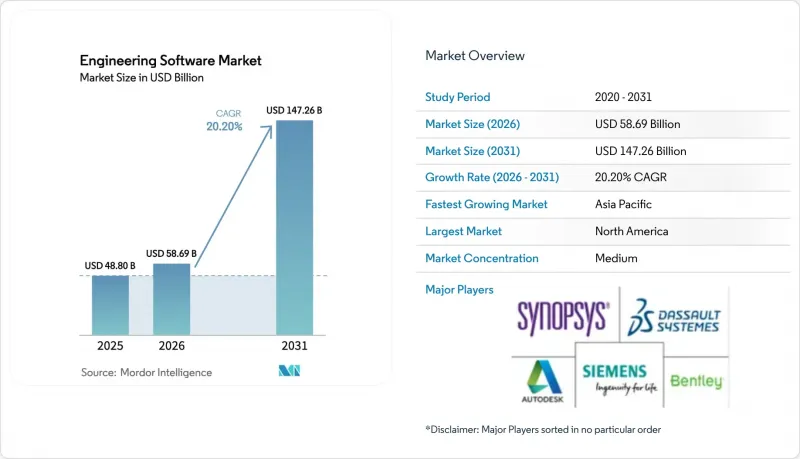
根據 Mordor Intelligence 估計,工程軟體市場在 2026 年的價值將達到 587 億美元,高於 2025 年的 488 億美元,預計到 2031 年將達到 1,473 億美元。
預計從 2026 年到 2031 年,其複合年成長率將達到 20.2%。
本報告按類型(電腦輔助設計 (CAD) 軟體、電腦輔助工程 (CAE) 軟體、電腦輔助製造 (CAM) 軟體等)、部署模式(本地部署、雲端部署、混合部署)、應用領域(設計自動化、工廠和製程設計等)、最終用戶產業(汽車和交通運輸、航太和國防等)以及地區進行細分。市場預測以美元 (USD) 為單位。
全球工程軟體市場趨勢與洞察
基於雲端的部署正成為標準的授權模式。
隨著西門子雲端原生產品 Designcenter 和 Autodesk 的 Token Flex 展示了持續更新和全球協作如何能夠抵銷資本支出預算,企業正將預算分配從伺服器轉向訂閱服務。三分之二的製造商已經開始培訓員工以支援這些平台,但多租戶架構引發了知識產權 (IP) 安全方面的擔憂,促使企業採用混合模式,將敏感工作保留在本地,同時將處理量激增的任務外包到雲端。提供零信任加密和主權雲端選項的供應商將贏得工程軟體市場中那些猶豫不決的細分市場。
CAD和3D建模在中小型企業的廣泛應用。
經濟實惠的SaaS方案正幫助數百萬中小企業進入工程軟體市場。肯亞的一項案例研究表明,用數位檔案取代手工繪圖顯著提高了生產力。然而,經合組織的數據證實,資金和技能差距仍然是推廣應用的障礙,凸顯了低程式碼設計嚮導和內建訓練的必要性。透過將實施支援、模板和合作夥伴生態系統整合到授權協議中,供應商可以縮短價值實現時間,並在價格敏感的經濟體中加速工程軟體市場的擴張。
高級套件產品的初始許可和培訓成本很高。
ANSYS 的企業級模擬軟體包年銷售額超過 28 億美元,其價格對於大多數中小企業而言難以承受,除非分階段實現投資回報。培訓是另一個主要障礙,因為 65% 的製造商需要重新培訓才能適應新工具,這增加了部署預算。雖然訂閱模式可以分攤成本,但總擁有成本有時會超過傳統的永久許可,減緩了成本敏感地區工程軟體市場的成長。
細分市場分析
預計2025年,工程軟體市場中CAD工具市場規模將達181.1億美元,佔總營收的37.10%。這凸顯了CAD工具作為產業基礎工作環境的重要地位。透過持續的基於使用情況的升級,這些工具在建築、機械和工業設計團隊中正日益普及。儘管生成式AI草圖繪製功能加速了概念形成,但下游製造仍依賴精確的參數化CAD,使其在工作流程中保持主導地位。
電腦輔助工程 (CAE) 解決方案正以 13.3% 的複合年成長率 (CAGR) 持續成長,直至 2031 年。這主要得益於人工智慧驅動的求解器,它們透過將基於物理的模擬與代理模型相結合,顯著縮短了計算時間。隨著多學科最佳化被整合到更廣泛的平台中,CAE 在工程軟體市場收入中的佔有率預計將縮小與 CAD 的差距。雖然 CAM、PLM 和 EDA 套件為生產階段提供了必要的連續性,但它們的成長速度落後於旗艦級的 CAD 和 CAE 類別,因為許多客戶已經擁有基礎模組的許可證,並且只是隨著專案規模的擴大而逐步增加許可證數量。
截至2025年,本地部署仍將佔據工程軟體市場54.30%的佔有率。這得益於國防、重型機械和航太公司完善的基礎設施,這些基礎設施能夠保護高度敏感的智慧財產權。本地運算叢集還能確保確定性的效能,即使在處理高密度和複雜物理現象的模擬中,頻寬受限的環境也無法滿足需求。
受訂閱收費、即時擴展和基於瀏覽器的存取等因素的推動,雲端採用率正以 18.8% 的複合年成長率快速成長,這些優勢深受中小企業和全球分散式團隊的青睞。隨著合規主權雲端和敏感運算的日益成熟,預計到 2031 年,雲端授權工程軟體市場規模將超過 924 億美元。混合架構正逐漸成為標準。設計資料儲存在本地,突發容量則路由至加密的雲端節點,既滿足了 IT 策略的要求,也確保了系統的彈性。能夠提供跨環境透明授權漫遊的供應商將降低客戶流失風險,並延長客戶生命週期價值。
區域分析
預計到2025年,北美將佔工程軟體市場收入的32.10%。這主要得益於航太和汽車產業的先驅,他們正在將數位孿生技術整合到整個產品生命週期和工廠運作中。該地區在人工智慧醫療設備領域的政策主導,帶動了醫療設備原始設備製造商(OEM)的溢出效應,而加拿大的清潔能源藍圖則刺激了對可再生能源設計套件的需求。創投持續為人工智慧原生新創公司提供資金,加劇了市場競爭。
亞太地區(APAC)以14.8%的複合年成長率(CAGR)保持著最快的成長速度。 2024年前九個月,中國軟體銷售額超過98.281兆元,領先的本土企業正增加研發預算,以縮小與西方大型企業在功能上的差距。在印度,工程師短缺刺激了對人工智慧輔助工具的需求,而日本和韓國則在先進節點半導體的EDA創新方面處於領先地位。隨著東南亞各國政府吸引製造業轉移,該地區的中小企業正在採用雲端服務,擴大了工程軟體市場的規模。在歐洲,嚴格的永續發展法規得以落實,所有OEM製造商都必須在產品發布前進行嵌入式生命週期評估(LCA),合規成本也因此轉移到了軟體支出中。北歐國家建築生命週期資料的統一化正在加速BIM的普及,德國工業出口商正在整合數位孿生技術以最佳化遠端服務。關於資料主權的法規正在促使人們採取謹慎的態度採用雲端運算,供應商也正轉向在歐盟境內部署多租戶實例,以保護其智慧財產權。
其他好處:
- Excel格式的市場預測(ME)表
- 3個月的分析師支持
目錄
第1章:引言
- 研究假設和市場定義
- 調查範圍
第2章:調查方法
第3章執行摘要
第4章 市場狀況
- 市場概覽
- 市場促進因素
- 基於雲端的部署將成為標準授權模式。
- 擴大中小企業對CAD和3D建模技術的應用
- 主導仿真的數位孿生工程工作流程
- 基於訂閱的SaaS定價模式正在擴大其目標客戶群。
- 利用生成式人工智慧進行設計自動化可以顯著提高生產力。
- 歐盟和亞太地區設計標準必須強制納入與永續性相關的生命週期評估模組。
- 市場限制因素
- 高級軟體套件的初始許可和培訓成本很高。
- 全球專業CAE/CAD人員短缺
- 多租戶雲端平台中的智慧財產權 (IP) 安全性問題
- 資料模型格式與人工智慧原生工具之間的互通性差距
- 監理情勢
- 技術展望
- 波特五力分析
第5章 市場規模與成長預測
- 按類型
- 電腦輔助設計(CAD)軟體
- 電腦輔助工程(CAE)軟體
- 電腦輔助製造(CAM)軟體
- 建築、工程和施工 (AEC/BIM) 軟體
- 電子設計自動化 (EDA) 軟體
- 產品生命週期管理 (PLM) 軟體
- 岩地工程/基礎設施工程軟體
- 部署模式
- 現場
- 雲
- 混合
- 透過使用
- 設計自動化
- 工廠和工藝設計
- 產品設計、測試和數位孿生
- 製圖和3D建模
- 其他特殊用途
- 按最終用戶行業分類
- 汽車和運輸業
- 航太/國防
- 工業機械和重型設備
- 建築和基礎設施
- 電子和半導體
- 能源公用事業
- 醫療保健和醫療設備
- 其他
- 按地區
- 北美洲
- 美國
- 加拿大
- 墨西哥
- 南美洲
- 巴西
- 阿根廷
- 其他南美國家
- 歐洲
- 德國
- 英國
- 法國
- 義大利
- 西班牙
- 俄羅斯
- 其他歐洲國家
- 亞太地區
- 中國
- 日本
- 印度
- 韓國
- 東南亞
- 其他亞太國家
- 中東和非洲
- 中東
- 沙烏地阿拉伯
- 阿拉伯聯合大公國
- 土耳其
- 其他中東國家
- 非洲
- 南非
- 奈及利亞
- 其他非洲國家
- 中東
- 北美洲
第6章 競爭情勢
- 市場集中度分析
- 策略性舉措(併購、資金籌措、合作)
- 市佔率分析
- 公司簡介
- Autodesk Inc.
- Dassault Systemes SE
- Siemens Digital Industries Software
- Bentley Systems Inc.
- PTC Inc.
- ANSYS Inc.
- Synopsys Inc.
- Hexagon AB(Intergraph)
- Trimble Inc.
- AVEVA Group
- IBM Corporation
- SAP SE
- HCLTech
- Altair Engineering Inc.
- Oracle Corporation
- Rockwell Automation Inc.
- Geometric Ltd.
- Tech Soft 3D
- Aspen Tech
第7章 市場機會與未來展望
According to Mordor Intelligence, engineering software market size in 2026 is estimated at USD 58.7 billion, growing from 2025 value of USD 48.8 billion with 2031 projections showing USD 147.3 billion, growing at 20.2% CAGR over 2026-2031.
This report is Segmented by Type (Computer-Aided Design Software, Computer-Aided Engineering Software, Computer-Aided Manufacturing Software, and More), Deployment (On-Premise, Cloud, Hybrid), Application (Design Automation, Plant and Process Design, and More), End-User Industry (Automotive and Transportation, Aerospace and Defence and More), and Geography. The Market Forecasts are Provided in Terms of Value (USD).
Global Engineering Software Market Trends and Insights
Cloud-based deployment becomes default licensing model
Enterprises are shifting budget from servers to subscriptions as Siemens' cloud-native Designcenter and Autodesk's Token Flex show how continuous updates and global collaboration offset capital budgets. Two-thirds of manufacturers are already reskilling staff for these platforms, yet multi-tenant architectures raise IP-security questions, spurring hybrid models that keep sensitive work on-premise while outsourcing compute spikes to the cloud. Vendors that deliver zero-trust encryption and sovereign-cloud options will capture the hesitant segments of the engineering software market.
Growing adoption of CAD and 3-D modelling across SMEs
Affordable SaaS tiers are opening the engineering software market to millions of small firms: Kenyan case studies show productivity jumps once manual drafting is replaced with digital files. Yet OECD data confirm that financial and skills gaps still obstruct uptake, highlighting a need for low-code design wizards and built-in training. Where vendors wrap onboarding, templates, and partner ecosystems into the license, they compress time-to-value and expand the engineering software market faster in price-sensitive economies.
High upfront licence and training costs for advanced suites
Enterprise-class simulation bundles from ANSYS push beyond USD 2.8 billion in annual sales, reflecting price points that few SMEs can absorb without staggered ROI. Training magnifies the hurdle because 65% of manufacturers are reskilling for new tools, inflating onboarding budgets. Although subscriptions spread expense, all-in ownership sometimes outstrips legacy perpetual licences, slowing the engineering software market in cost-sensitive regions.
Other drivers and restraints analyzed in the detailed report include:
- Simulation-driven digital-twin engineering workflows
- Subscription-SaaS price model expands addressable base
- Global shortage of specialised CAE/CAD talent
For complete list of drivers and restraints, kindly check the Table Of Contents.
Segment Analysis
The engineering software market size reached USD 18.11 billion for CAD tools in 2025, equal to 37.10% of total revenue, underscoring their role as the industry's baseline workspace. Continuous usage-based upgrades keep these tools sticky across architecture, mechanical, and industrial design teams. Generative-AI sketching accelerates concept formation, yet downstream manufacturability remains contingent on precise parametric CAD, preserving its primacy in workflows.
Computer-Aided Engineering solutions are scaling at 13.3% CAGR to 2031 on the back of AI-powered solvers that slash compute time by blending physics-based simulation with surrogate models. As multidisciplinary optimisation embeds inside broader platforms, CAE's share of the engineering software market revenue is projected to close the gap with CAD. CAM, PLM, and EDA suites provide essential continuity into production, yet their growth rates trail the flagship CAD and CAE categories because many customers already license basic modules and add incremental seats only as programmes scale.
On-premise installations still hold 54.30% engineering software market share as of 2025, supported by entrenched infrastructure in defence, heavy machinery, and aerospace firms guarding classified IP. Local compute clusters also ensure deterministic performance for dense, multi-physics simulations that can swamp bandwidth-limited locations.
Cloud deployments are expanding at 18.8% CAGR because subscription billing, instant scaling, and browser access appeal to SMEs and globally distributed teams. The engineering software market size for cloud seats is forecast to surpass USD 92.4 billion by 2031 as compliance-ready sovereign clouds and confidential computing mature. Hybrid architecture is becoming the default: design vaults reside on-premise while burst capacity routes to encrypted cloud nodes, satisfying IT policy without forfeiting elasticity. Vendors that provide transparent license roaming between environments will temper churn risk and capture longer lifetime value.
Complete Report Scope:
- By Type
- Computer-Aided Design (CAD) Software
- Computer-Aided Engineering (CAE) Software
- Computer-Aided Manufacturing (CAM) Software
- Architecture, Engineering and Construction (AEC/BIM) Software
- Electronic Design Automation (EDA) Software
- Product Lifecycle Management (PLM) Software
- Geotechnical/Infrastructure Engineering Software
- By Deployment
- On-premise
- Cloud
- Hybrid
- By Application
- Design Automation
- Plant and Process Design
- Product Design, Testing and Digital Twin
- Drafting and 3-D Modelling
- Other Specialised Applications
- By End-user Industry
- Automotive and Transportation
- Aerospace and Defence
- Industrial Machinery and Heavy Equipment
- Construction and Infrastructure
- Electronics and Semiconductor
- Energy and Utilities
- Healthcare and Medical Devices
- Others
- By Geography
- North America
- United States
- Canada
- Mexico
- South America
- Brazil
- Argentina
- Rest of South America
- Europe
- Germany
- United Kingdom
- France
- Italy
- Spain
- Russia
- Rest of Europe
- Asia-Pacific
- China
- Japan
- India
- South Korea
- South-East Asia
- Rest of Asia-Pacific
- Middle East and Africa
- Middle East
- Saudi Arabia
- United Arab Emirates
- Turkey
- Rest of Middle East
- Africa
- South Africa
- Nigeria
- Rest of Africa
- Middle East
- North America
Geography Analysis
North America generated 32.10% of the engineering software market revenue in 2025, buoyed by aerospace and automotive pioneers that embed twins across the product lifecycle and factory operations. The region's policy leadership in AI-enabled medical devices creates spill-over demand from healthcare OEMs, while Canada's clean-electricity roadmap triggers demand for renewable-energy design suites. Venture investment continues to seed AI-native startups, intensifying competition.
APAC records the fastest cadence at 14.8% CAGR, with China's software revenue topping 98,281 billion yuan in the first nine months of 2024 and local champions increasing R&D budgets to close feature gaps with Western majors. India's engineer shortfall stimulates demand for AI-assisted tools, while Japan and South Korea drive EDA innovation for advanced node semiconductors. As Southeast Asian governments court manufacturing shifts, SMEs there adopt cloud subscriptions, widening the engineering software market footprint. Europe maintains stringent sustainability laws that oblige every OEM to run embedded LCA before product release, converting compliance cost into software spend. Nordic harmonisation of building-lifecycle data amps BIM uptake, and German industrial exporters integrate digital twins for remote service optimisation. Data-sovereignty rules shape cautious cloud adoption, nudging vendors toward multi-tenant instances within EU borders to safeguard IP.
- Autodesk Inc.
- Dassault Systemes SE
- Siemens Digital Industries Software
- Bentley Systems Inc.
- PTC Inc.
- ANSYS Inc.
- Synopsys Inc.
- Hexagon AB (Intergraph)
- Trimble Inc.
- AVEVA Group
- IBM Corporation
- SAP SE
- HCLTech
- Altair Engineering Inc.
- Oracle Corporation
- Rockwell Automation Inc.
- Geometric Ltd.
- Tech Soft 3D
- Aspen Tech
Additional Benefits:
- The market estimate (ME) sheet in Excel format
- 3 months of analyst support
TABLE OF CONTENTS
1 INTRODUCTION
- 1.1 Study Assumptions and Market Definition
- 1.2 Scope of the Study
2 RESEARCH METHODOLOGY
3 EXECUTIVE SUMMARY
4 MARKET LANDSCAPE
- 4.1 Market Overview
- 4.2 Market Drivers
- 4.2.1 Cloud-based deployment becomes default licensing model
- 4.2.2 Growing adoption of CAD and 3D modelling across SMEs
- 4.2.3 Simulation-driven digital-twin engineering workflows
- 4.2.4 Subscription-SaaS price model expands addressable base
- 4.2.5 Generative-AI assisted design automation unlocks productivity
- 4.2.6 Mandatory sustainability LCA modules in EU and Asia-Pacific design codes
- 4.3 Market Restraints
- 4.3.1 High upfront licence and training costs for advanced suites
- 4.3.2 Global shortage of specialised CAE/CAD talent
- 4.3.3 IP-security concerns on multi-tenant cloud platforms
- 4.3.4 Format / data-model interoperability gaps across AI-native tools
- 4.4 Regulatory Landscape
- 4.5 Technological Outlook
- 4.6 Porter's Five Forces Analysis
- 4.6.1 Bargaining Power of Suppliers
- 4.6.2 Bargaining Power of Buyers
- 4.6.3 Threat of New Entrants
- 4.6.4 Threat of Substitutes
- 4.6.5 Intensity of Competitive Rivalry
5 MARKET SIZE AND GROWTH FORECASTS (VALUE)
- 5.1 By Type
- 5.1.1 Computer-Aided Design (CAD) Software
- 5.1.2 Computer-Aided Engineering (CAE) Software
- 5.1.3 Computer-Aided Manufacturing (CAM) Software
- 5.1.4 Architecture, Engineering and Construction (AEC/BIM) Software
- 5.1.5 Electronic Design Automation (EDA) Software
- 5.1.6 Product Lifecycle Management (PLM) Software
- 5.1.7 Geotechnical/Infrastructure Engineering Software
- 5.2 By Deployment
- 5.2.1 On-premise
- 5.2.2 Cloud
- 5.2.3 Hybrid
- 5.3 By Application
- 5.3.1 Design Automation
- 5.3.2 Plant and Process Design
- 5.3.3 Product Design, Testing and Digital Twin
- 5.3.4 Drafting and 3-D Modelling
- 5.3.5 Other Specialised Applications
- 5.4 By End-user Industry
- 5.4.1 Automotive and Transportation
- 5.4.2 Aerospace and Defence
- 5.4.3 Industrial Machinery and Heavy Equipment
- 5.4.4 Construction and Infrastructure
- 5.4.5 Electronics and Semiconductor
- 5.4.6 Energy and Utilities
- 5.4.7 Healthcare and Medical Devices
- 5.4.8 Others
- 5.5 By Geography
- 5.5.1 North America
- 5.5.1.1 United States
- 5.5.1.2 Canada
- 5.5.1.3 Mexico
- 5.5.2 South America
- 5.5.2.1 Brazil
- 5.5.2.2 Argentina
- 5.5.2.3 Rest of South America
- 5.5.3 Europe
- 5.5.3.1 Germany
- 5.5.3.2 United Kingdom
- 5.5.3.3 France
- 5.5.3.4 Italy
- 5.5.3.5 Spain
- 5.5.3.6 Russia
- 5.5.3.7 Rest of Europe
- 5.5.4 Asia-Pacific
- 5.5.4.1 China
- 5.5.4.2 Japan
- 5.5.4.3 India
- 5.5.4.4 South Korea
- 5.5.4.5 South-East Asia
- 5.5.4.6 Rest of Asia-Pacific
- 5.5.5 Middle East and Africa
- 5.5.5.1 Middle East
- 5.5.5.1.1 Saudi Arabia
- 5.5.5.1.2 United Arab Emirates
- 5.5.5.1.3 Turkey
- 5.5.5.1.4 Rest of Middle East
- 5.5.5.2 Africa
- 5.5.5.2.1 South Africa
- 5.5.5.2.2 Nigeria
- 5.5.5.2.3 Rest of Africa
- 5.5.5.1 Middle East
- 5.5.1 North America
6 COMPETITIVE LANDSCAPE
- 6.1 Market Concentration Analysis
- 6.2 Strategic Moves (MandA, Funding, Partnerships)
- 6.3 Market Share Analysis
- 6.4 Company Profiles (includes Global level Overview, Market level overview, Core Segments, Financials as available, Strategic Information, Market Rank/Share, Products and Services, Recent Developments)
- 6.4.1 Autodesk Inc.
- 6.4.2 Dassault Systemes SE
- 6.4.3 Siemens Digital Industries Software
- 6.4.4 Bentley Systems Inc.
- 6.4.5 PTC Inc.
- 6.4.6 ANSYS Inc.
- 6.4.7 Synopsys Inc.
- 6.4.8 Hexagon AB (Intergraph)
- 6.4.9 Trimble Inc.
- 6.4.10 AVEVA Group
- 6.4.11 IBM Corporation
- 6.4.12 SAP SE
- 6.4.13 HCLTech
- 6.4.14 Altair Engineering Inc.
- 6.4.15 Oracle Corporation
- 6.4.16 Rockwell Automation Inc.
- 6.4.17 Geometric Ltd.
- 6.4.18 Tech Soft 3D
- 6.4.19 Aspen Tech
7 MARKET OPPORTUNITIES AND FUTURE OUTLOOK
- 7.1 White-space and Unmet-need Assessment

 2026年全球航太製造軟體市場報告2026年全球航太軟體市場報告
 工程軟體市場-2026-2032年全球市場預測電腦輔助設計軟體市場:2026-2032年全球市場預測(依解決方案類型、部署方式、組織規模、授權模式和最終用戶分類)CAD、CAM 和 CAE 軟體市場:按類型、使用者介面設計、應用、最終用戶產業、部署模式和組織規模分類-2026-2032 年全球市場預測
 技術型CAD軟體市場規模、佔有率和成長分析:按技術類型、部署模式、組件、企業規模、平台、最終用戶產業和地區分類-2026-2033年產業預測
 2026-2030年全球模型服務平台市場2026年全球工程軟體市場報告
 工程軟體市場規模、佔有率、成長率和全球產業分析:按類型、應用和地區分類的洞察,2026-2034 年2026年全球電腦輔助設計(CAD)軟體市場報告