


 |
市場調查報告書
商品編碼
2117255
資料中心RFID:市場佔有率分析、產業趨勢與統計、成長預測(2026-2031年)Data Center RFID - Market Share Analysis, Industry Trends & Statistics, Growth Forecasts (2026 - 2031) |
||||||

※ 本網頁內容可能與最新版本有所差異。詳細情況請與我們聯繫。
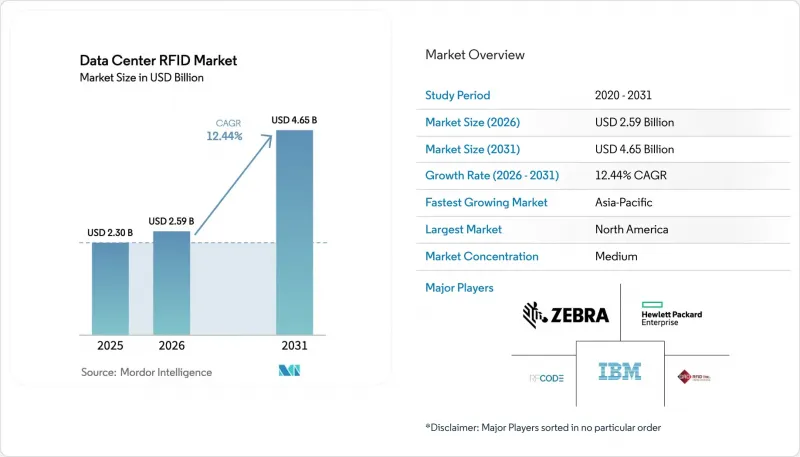
據 Mordor Intelligence 稱,資料中心的 RFID 市場預計到 2026 年價值 25.9 億美元,高於 2025 年的 23 億美元,預計到 2031 年將達到 46.5 億美元。
預計從 2026 年到 2031 年,其複合年成長率將達到 12.44%。
本報告按組件(硬體(標籤、讀寫器、天線等)、軟體和中間件等)、標籤類型(被動式、主動式)、資料中心類型(託管、企業級、邊緣等)、應用(資產追蹤和庫存管理、工作流程自動化等)以及地區(歐洲、亞洲等)進行細分。市場預測以美元計價。
全球RFID市場趨勢及資料中心洞察
即時資產審計方面的合規壓力正在加速市場成長。
持續審計和管治的要求促使企業不斷更新庫存管理系統,而非依賴零星的盤點。 RFID 技術能夠提供條碼系統無法企及的近乎完美的精度。美國社會安全局的 RFID 專案在將審計準確率提升至 99% 的同時,減少了 90% 的工作時間。依賴《薩班斯-奧克斯利法案》合規性的金融機構也取得了類似的成果,在實施 RFID 後,其庫存準確率超過了 99%。持續監控顯著降低了資產損失的修正成本,並實現了滿足監管要求的即時報告。這一趨勢正在推動美國政府機構和跨國銀行增加支出,合規性已成為資料中心 RFID 市場最重要的投資促進因素。
RFID標籤成本的降低使得大規模部署成為可能。
由於300毫米晶圓生產和天線材料的進步,製造效率顯著提高,被動UHF標籤的單位成本已降至每件0.10至0.50美元。主動式標籤也已降至每件15至50美元,這為在大規模園區部署高密度感測器網路提供了更大的預算彈性。 Tageos在美國投資1億美元建設工廠,以及Avery Dennison在墨西哥建造生產線,進一步增強了業界對產量成長的信心。預計到2025年初,半導體短缺問題將有所緩解,供應穩定,營運商可以製定多年部署計劃,而無需擔心價格上漲。單位成本的降低意味著在資料中心部署RFID不再被視為一項可有可無的資本投資,而是一種節省成本的措施。
高額資本支出(CAPEX)及熟練勞動成本所帶來的限制因素。
端到端部署通常需要花費約 27,000 美元,並且需要具備天線實體和資料中心協議方面專業知識的工程師。全球範圍內此類人才的短缺導致專案週期延長和諮詢成本上漲,尤其對於中型企業而言更是如此。儘管長期成本節約可以抵消初始投資,但中小企業仍然將 RFID 視為一項「可有可無的投資」。雖然培訓項目和承包服務包正在湧現以促進部署,但人才短缺仍然阻礙著資料中心 RFID 市場的成長潛力。
細分市場分析
2025年,硬體在資料中心RFID市場仍佔據55.12%的佔有率。這主要得益於新機架安裝過程中伴隨的大規模標籤部署。 RF Code向企業設施交付了超過300萬個標籤,充分展現了實體部署的規模。就收入而言,讀寫器和天線佔據了大部分初始成本,而中間件訂閱則推動了持續獲利。軟體和分析領域雖然規模仍然較小,但其複合年成長率(CAGR)高達13.39%,這主要得益於營運商對人工智慧驅動的洞察日益成長的需求。由於整合、校準和持續最佳化需要專業人員,業務收益的成長與硬體的成長同步。綜上所述,這些支出模式揭示了為何即使價值創造正向資料和自動化層轉移,硬體仍然在資料中心RFID市場佔據主導地位。
隨著標籤單價的下降,營運商現在可以為每個刀鋒伺服器、線材和周邊設備貼上標籤,而需求彈性對硬體的推動作用也更加顯著。隨著企業的發展成熟,他們正從手持式讀寫器轉向連續固定讀寫器網路,並在閒置頻段和裝卸貨平台擴大天線面積。這種演變確保了硬體的多年更新周期,而實體組件仍然是籌資策略的核心。同時,DCIM 連接器、API 介面和網路安全模組的持續授權費用推高了整體擁有成本 (TCO),同時強化了供應商和客戶的鎖定,並有助於在資料中心 RFID 產業內建立一個平衡的生態系統。
由於無需電池,被動式標籤成本極低且壽命長,預計到2025年將佔據71.65%的市場佔有率。在讀取距離僅為幾公分的高密度機架通道中,被動式解決方案能夠以最低的預算滿足審計要求。因此,採用被動式標籤的資料中心RFID市場規模仍遙遙領先。另一方面,主動式標籤的成長速度更快,年複合成長率高達14.46%。這是因為即時環境感知和100公尺的讀取範圍支援熱分佈圖繪製和周界安全監控。現代主動式平台將溫度、濕度甚至振動感測器整合到單一標籤中,這使其在需要精細數據的AI設施中具有更高的單價。
混合型半被動式設計結合了被動讀取模式和電池供電的感測器功能,以中等成本提供五年使用壽命,正逐漸彌合被動式和非被動式技術之間的差距。隨著循環經濟法規要求對從製造到處置的整個生命週期進行追蹤,對更詳細遙測數據的需求日益成長,可能會削弱被動式標籤的現有優勢。然而,規模經濟效應表明,在可預見的未來,被動式標籤仍將佔據銷售主導地位,凸顯了其在資料中心RFID市場中的基礎性作用。
區域分析
預計到2025年,北美將佔據資料中心RFID市場36.95%的佔有率。這主要得益於成熟的超大規模資料中心的部署、嚴格的審計法規以及人工智慧的積極應用(後者需要準確的資產溯源資訊)。由於AWS在密西西比州投資100億美元的項目以及聯邦政府的多站點契約,對RFID標籤的需求預計將保持強勁。零售和通訊業的邊緣部署也在拓展市場機遇,尤其是在5G普及推動下,延遲敏感型運算的需求日益成長。基於NIST SP-800等框架的監管協調正在加強合規性驅動,並鞏固RFID作為資產檢驗事實標準的地位。
亞太地區正以更快的速度擴張,年複合成長率高達15.21%,這主要得益於中國、日本、印度和東南亞的大規模基礎建設。光是Sify Technologies一家就已投資50億美元用於人工智慧資料中心,預計這些資料中心運作後將需要數百萬個標籤。日本不斷上漲的建築成本凸顯了土地和電力供應的限制,迫使營運商轉向高密度機架。這增加了對溫度控管的需求,並加速了感測器的部署。各地法規正日益重視資料主權,這促使人們對本地儲存資料並限制主動遙測的被動式或半被動式標籤產生了濃厚的興趣。
在歐洲,大規模部署與複雜的資料隱私法規並存。能源效率指令要求進行精細化監測,這使得RFID成為碳會計的關鍵。然而,跨境資料流動仍然受到限制,促使人們開發出能夠匿名化或在本地處理標籤遙測資料的架構。在中東和非洲,隨著可再生能源驅動的園區在海灣國家興起,RFID正日益受到重視;在南美洲,隨著巴西和智利雲端區域的部署,RFID也獲得了發展動力。這些多元化的趨勢共同作用,確保了全球資料中心RFID市場將繼續保持穩健的成長動能。
其他好處:
- Excel格式的市場預測(ME)表
- 3個月的分析師支持
目錄
第1章:引言
- 研究假設和市場定義
- 調查範圍
第2章:調查方法
第3章執行摘要
第4章 市場狀況
- 市場概覽
- 市場促進因素
- 即時資產審計方面的合規壓力
- RFID標籤的成本曲線正在下降。
- 與資料中心基礎設施管理 (DCIM) 和資訊服務管理 (ITSM) 技術堆疊的整合
- 超大規模和邊緣資料中心擴展
- 人工智慧驅動的RFID熱成像技術(幕後開發)
- 在循環式 IT 生命週期中追蹤回購(這項工作並未公開進行)
- 市場限制因素
- 高昂的資本投資和技術純熟勞工的人事費用
- 高密度機架中的射頻干擾
- 使用主動式標籤進行遙測的資料主權限制(以規避雷達偵測)
- 關於主動式標籤電池處置的擔憂(這個問題尚未公開解決)
- 價值供應鏈分析
- 監理情勢
- 技術展望
- 波特五力模型
第5章 市場規模與成長預測
- 按組件
- 硬體(標籤、讀寫器、天線)
- 軟體和中介軟體
- 服務(整合、支援)
- 按標籤類型
- 被動的
- 積極的
- 依資料中心類型
- 搭配
- 超大規模資料中心業者雲端服務供應商/雲端服務供應商
- 企業和邊緣運算
- 透過使用
- 資產追蹤和庫存管理
- 環境和溫度監測
- 安全和存取控制
- 工作流程自動化
- 按地區
- 北美洲
- 美國
- 加拿大
- 墨西哥
- 南美洲
- 巴西
- 智利
- 阿根廷
- 其他南美國家
- 歐洲
- 英國
- 德國
- 法國
- 義大利
- 西班牙
- 其他歐洲國家
- 亞太地區
- 中國
- 日本
- 印度
- 新加坡
- 澳洲
- 馬來西亞
- 其他亞太國家
- 中東
- 阿拉伯聯合大公國
- 沙烏地阿拉伯
- 土耳其
- 其他中東國家
- 非洲
- 南非
- 奈及利亞
- 其他非洲國家
- 北美洲
第6章 競爭情勢
- 市場集中度
- 策略趨勢
- 市佔率分析
- 公司簡介
- IBM Corporation
- Zebra Technologies Corp.
- Hewlett Packard Enterprise
- GAO RFID Inc.
- RF Code Inc.
- Alien Technology LLC
- Avery Dennison Corp.
- Omni-ID Ltd.(HID Global)
- Impinj Inc.
- NXP Semiconductors NV
- Honeywell International Inc.
- HID Global Corp.
- Vizinex RFID LLC
- InLogic Inc.
- Quanray Electronics Co. Ltd.
- SmartX Hub Inc.
- Invengo Information Tech. Co. Ltd.
- SATO Holdings Corp.
- Cisco Systems Inc.
- Johnson Controls(Cloudvue RFID)
- Tyco Integrated Security
第7章 市場機會與未來展望
According to Mordor Intelligence, data center RFID market size in 2026 is estimated at USD 2.59 billion, growing from 2025 value of USD 2.3 billion with 2031 projections showing USD 4.65 billion, growing at 12.44% CAGR over 2026-2031.
This report is Segmented Component (Hardware (Tags, Readers, Antennas), Software and Middleware and More), Tag Type(Passive, Active), Data-Center Type(Colocation, Enterprise and Edge and More), Application(asset Tracking and Inventory, Workflow Automation and More), and Geography (Europe, Asia and More). The Market Forecasts are Provided in Terms of Value (USD).
Global Data Center RFID Market Trends and Insights
Real-time Asset Audit Compliance Pressure Drives Market Acceleration
Persistent audit and governance demands oblige operators to maintain continuously updated inventories rather than occasional cycle counts, and RFID delivers near-perfect accuracy that barcode systems cannot match. The Social Security Administration's RFID program achieved a 90% cut in labor hours while improving audit accuracy to 99%. Financial institutions reliant on Sarbanes-Oxley compliance have mirrored these outcomes, reporting inventory accuracy above 99% after RFID rollout. Continuous monitoring slashes remediation costs when assets go misplaced and enables real-time reporting to satisfy regulators. This dynamic amplifies spending among U.S. agencies and multinational banks, placing compliance as a top investment trigger for the data center RFID market.
Declining RFID Tag Cost Curves Enable Mass Deployment
Passive UHF tag pricing has slipped to USD 0.10-0.50 per unit as 300 mm wafer production and antenna material advances scale manufacturing efficiencies. Active tags have fallen to USD 15-50 each, opening budget headroom for dense sensor networks in large campuses. Capital injections such as Tageos' USD 100 million U.S. plant and Avery Dennison's Mexico line underscore industry confidence in rising volumes. As chip shortages ease by early 2025, predictable supply ensures operators can plan multi-year rollouts without price spikes. Lower unit economics now position data center RFID market adoption as a cost-saving initiative rather than a discretionary capital outlay.
High CAPEX and Skilled Labor Cost Constraints
End-to-end deployments often start near USD 27,000 and require engineers versed in antenna physics and data-center protocols. The worldwide shortage of such talent extends project timelines and inflates consulting fees, especially for mid-tier operators. While long-run savings offset upfront expenses, smaller enterprises still label RFID as discretionary. Training programs and turnkey service bundles are emerging to ease adoption, yet the labor gap continues to shave points off the data center RFID market growth potential.
Other drivers and restraints analyzed in the detailed report include:
- Integration with DCIM and ITSM Stacks Enhances Operational Intelligence
- Hyperscale and Edge Data-Center Build-outs Fuel Demand
- RF Interference Inside Dense Racks Creates Technical Challenges
For complete list of drivers and restraints, kindly check the Table Of Contents.
Segment Analysis
Hardware retained 55.12% share of the data center RFID market in 2025 on the back of massive tag rollouts that accompany every new rack build. RF Code has shipped over 3 million tags into enterprise facilities, illustrating the scale of physical deployments. In revenue terms, readers and antennas represent the lion's share of upfront spend, while middleware subscriptions drive recurring margins. Software and analytics, though smaller today, post the fastest 13.39% CAGR as operators demand AI-enabled insights. Services revenue follows hardware growth because integration, calibration, and ongoing optimization require specialized staff. Together, these spending patterns demonstrate why the data center RFID market size for hardware remains dominant even as value creation shifts toward data and automation layers.
Demand elasticity favors hardware even further because tag unit prices are falling, permitting operators to tag every blade, cable, and peripheral. As enterprises mature, they migrate from handheld readers to continuous fixed-reader grids, expanding antenna footprints in both white space and loading docks. This evolution guarantees multi-year hardware refresh cycles, keeping physical components at the center of procurement strategies. Meanwhile, recurring licenses for DCIM connectors, API feeds, and cybersecurity modules elevate total cost of ownership but also deepen vendor-client lock-in, supporting a balanced ecosystem across the data center RFID industry.
Passive tags claimed 71.65% share in 2025 owing to minimal cost and battery-free longevity that stretches asset lifespans. In dense rack aisles where read distances span only centimeters, passive solutions meet audit requirements at the lowest possible budget. The data center RFID market size for passive tagging therefore remains unparalleled. Active tags, however, expand faster at 14.46% CAGR because real-time environmental sensing and 100 meter read ranges support thermal mapping and perimeter security. Modern active platforms integrate temperature, humidity, and even vibration sensors on a single tag, justifying higher unit prices in AI facilities that demand granular data.
Hybrid semi-passive designs have started bridging the gap by pairing passive read modes with battery-assisted sensor functions, enabling five-year lifecycles at mid-tier cost. As circular-economy regulations mandate cradle-to-grave tracking, demand for richer telemetry will likely narrow the lead passive tags hold today. Still, volume economics dictate that passive labels will dominate unit sales for the foreseeable future, underscoring their foundational role in the data center RFID market.
Complete Report Scope:
- By Component
- Hardware (Tags, Readers, Antennas)
- Software and Middleware
- Services (Integration, Support)
- By Tag Type
- Passive
- Active
- By Data-Center Type
- Colocation
- Hyperscalers/Cloud Service Providers
- Enterprise and Edge
- By Application
- Asset Tracking and Inventory
- Environmental and Thermal Monitoring
- Security and Access Control
- Workflow Automation
- By Geography
- North America
- United States
- Canada
- Mexico
- South America
- Brazil
- Chile
- Argentina
- Rest of South America
- Europe
- United Kingdom
- Germany
- France
- Italy
- Spain
- Rest of Europe
- Asia-Pacific
- China
- Japan
- India
- Singapore
- Australia
- Malaysia
- Rest of Asia-Pacific
- Middle East
- United Arab Emirate
- Saudi Arabia
- Turkey
- Rest of Middle East
- Africa
- South Africa
- Nigeria
- Rest of Africa
- North America
Geography Analysis
North America held 36.95% of the data center RFID market in 2025, benefiting from mature hyperscale footprints, stringent audit laws, and aggressive AI adoption that demands accurate asset provenance. AWS's USD 10 billion Mississippi plan and multi-site federal contracts ensure sustained tag volumes. Edge deployments across retail and telecom corridors further expand opportunities, especially as 5G coverage accelerates latency-sensitive compute needs. Regulatory convergence under frameworks like NIST SP-800 strengthens compliance drivers, reinforcing RFID as the de-facto standard for asset validation.
Asia-Pacific is scaling even faster at 15.21% CAGR thanks to large-scale builds in China, Japan, India, and Southeast Asia. Sify Technologies alone earmarked USD 5 billion for AI data centers that will require millions of tags at inception. Japan's construction cost surge underscores restricted land and power, pushing operators toward dense racks that magnify thermal management needs and accelerate sensor uptake. Local regulations tilt toward data sovereignty, prompting interest in passive or semi-passive tags that store data locally while limiting active telemetry.
Europe combines significant installed base with complex data privacy statutes. Energy-efficiency directives mandate granular monitoring, making RFID vital for carbon accounting. Yet cross-border data flows remain constrained, shaping architectures that anonymize or locally process tag telemetry. Middle East and Africa show rising footprints in Gulf countries where renewable-powered campuses emerge, and South America gains traction through cloud-region rollouts in Brazil and Chile. Collectively, these diversification patterns assure the global data center RFID market remains on a structurally sound upward path.
- IBM Corporation
- Zebra Technologies Corp.
- Hewlett Packard Enterprise
- GAO RFID Inc.
- RF Code Inc.
- Alien Technology LLC
- Avery Dennison Corp.
- Omni-ID Ltd. (HID Global)
- Impinj Inc.
- NXP Semiconductors N.V.
- Honeywell International Inc.
- HID Global Corp.
- Vizinex RFID LLC
- InLogic Inc.
- Quanray Electronics Co. Ltd.
- SmartX Hub Inc.
- Invengo Information Tech. Co. Ltd.
- SATO Holdings Corp.
- Cisco Systems Inc.
- Johnson Controls (Cloudvue RFID)
- Tyco Integrated Security
Additional Benefits:
- The market estimate (ME) sheet in Excel format
- 3 months of analyst support
TABLE OF CONTENTS
1 INTRODUCTION
- 1.1 Study Assumptions and Market Definition
- 1.2 Scope of the Study
2 RESEARCH METHODOLOGY
3 EXECUTIVE SUMMARY
4 MARKET LANDSCAPE
- 4.1 Market Overview
- 4.2 Market Drivers
- 4.2.1 Real-time asset audit compliance pressure
- 4.2.2 Declining RFID tag cost curves
- 4.2.3 Integration with DCIM and ITSM stacks
- 4.2.4 Hyperscale and edge data-center build-outs
- 4.2.5 AI-enabled RFID thermal mapping (under-radar)
- 4.2.6 Circular IT lifecycle buy-back tracking (under-radar)
- 4.3 Market Restraints
- 4.3.1 High CAPEX and skilled labor cost
- 4.3.2 RF interference inside dense racks
- 4.3.3 Data-sovereignty limits on active-tag telemetry (under-radar)
- 4.3.4 Battery-waste concerns in active tags (under-radar)
- 4.4 Value/Supply-Chain Analysis
- 4.5 Regulatory Landscape
- 4.6 Technological Outlook
- 4.7 Porter's Five Forces
- 4.7.1 Bargaining Power of Suppliers
- 4.7.2 Bargaining Power of Buyers
- 4.7.3 Threat of New Entrants
- 4.7.4 Threat of Substitutes
- 4.7.5 Industry Rivalry
5 MARKET SIZE AND GROWTH FORECASTS (VALUE, USD)
- 5.1 By Component
- 5.1.1 Hardware (Tags, Readers, Antennas)
- 5.1.2 Software and Middleware
- 5.1.3 Services (Integration, Support)
- 5.2 By Tag Type
- 5.2.1 Passive
- 5.2.2 Active
- 5.3 By Data-Center Type
- 5.3.1 Colocation
- 5.3.2 Hyperscalers/Cloud Service Providers
- 5.3.3 Enterprise and Edge
- 5.4 By Application
- 5.4.1 Asset Tracking and Inventory
- 5.4.2 Environmental and Thermal Monitoring
- 5.4.3 Security and Access Control
- 5.4.4 Workflow Automation
- 5.5 By Geography
- 5.5.1 North America
- 5.5.1.1 United States
- 5.5.1.2 Canada
- 5.5.1.3 Mexico
- 5.5.2 South America
- 5.5.2.1 Brazil
- 5.5.2.2 Chile
- 5.5.2.3 Argentina
- 5.5.2.4 Rest of South America
- 5.5.3 Europe
- 5.5.3.1 United Kingdom
- 5.5.3.2 Germany
- 5.5.3.3 France
- 5.5.3.4 Italy
- 5.5.3.5 Spain
- 5.5.3.6 Rest of Europe
- 5.5.4 Asia-Pacific
- 5.5.4.1 China
- 5.5.4.2 Japan
- 5.5.4.3 India
- 5.5.4.4 Singapore
- 5.5.4.5 Australia
- 5.5.4.6 Malaysia
- 5.5.4.7 Rest of Asia-Pacific
- 5.5.5 Middle East
- 5.5.5.1 United Arab Emirate
- 5.5.5.2 Saudi Arabia
- 5.5.5.3 Turkey
- 5.5.5.4 Rest of Middle East
- 5.5.6 Africa
- 5.5.6.1 South Africa
- 5.5.6.2 Nigeria
- 5.5.6.3 Rest of Africa
- 5.5.1 North America
6 COMPETITIVE LANDSCAPE
- 6.1 Market Concentration
- 6.2 Strategic Moves
- 6.3 Market Share Analysis
- 6.4 Company Profiles (includes Global-level Overview, Market-level Overview, Core Segments, Financials as available, Strategic Information, Market Rank/Share, Products & Services, and Recent Developments)
- 6.4.1 IBM Corporation
- 6.4.2 Zebra Technologies Corp.
- 6.4.3 Hewlett Packard Enterprise
- 6.4.4 GAO RFID Inc.
- 6.4.5 RF Code Inc.
- 6.4.6 Alien Technology LLC
- 6.4.7 Avery Dennison Corp.
- 6.4.8 Omni-ID Ltd. (HID Global)
- 6.4.9 Impinj Inc.
- 6.4.10 NXP Semiconductors N.V.
- 6.4.11 Honeywell International Inc.
- 6.4.12 HID Global Corp.
- 6.4.13 Vizinex RFID LLC
- 6.4.14 InLogic Inc.
- 6.4.15 Quanray Electronics Co. Ltd.
- 6.4.16 SmartX Hub Inc.
- 6.4.17 Invengo Information Tech. Co. Ltd.
- 6.4.18 SATO Holdings Corp.
- 6.4.19 Cisco Systems Inc.
- 6.4.20 Johnson Controls (Cloudvue RFID)
- 6.4.21 Tyco Integrated Security
7 MARKET OPPORTUNITIES AND FUTURE OUTLOOK
- 7.1 White-space and Unmet-Need Assessment


