


 |
市場調查報告書
商品編碼
2117245
電動汽車馬達通訊控制器:市場佔有率分析、產業趨勢與統計、成長預測(2026-2031)Electric Vehicle Motor Communication Controller - Market Share Analysis, Industry Trends & Statistics, Growth Forecasts (2026 - 2031) |
||||||

※ 本網頁內容可能與最新版本有所差異。詳細情況請與我們聯繫。
根據 Mordor Intelligence 預測,電動車馬達通訊控制器市場規模預計將從 2025 年的 3.3 億美元成長到 2026 年的 4.3 億美元,然後從 2026 年到 2031 年以 30.11% 的複合年成長率成長,到 2031 年達到 16 億美元。
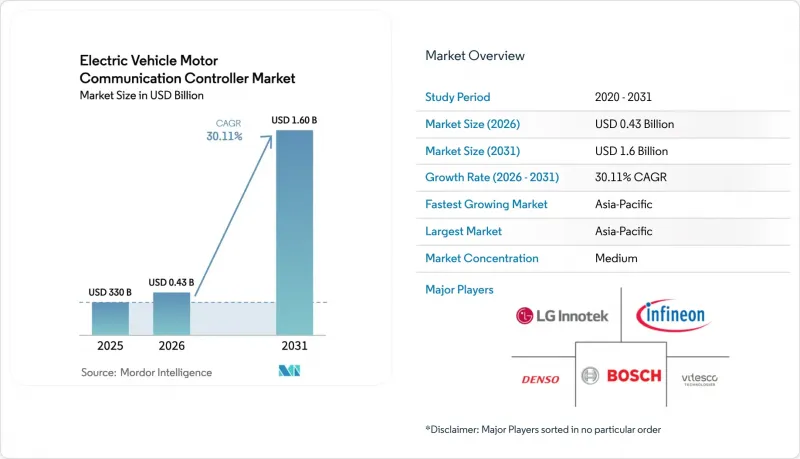
本報告按馬達類型(交流感應馬達、永磁同步馬達(PMSM)、無刷直流馬達等)、通訊協定(CAN 2.0、CAN-FD、車用乙太網路等)、車輛類型(乘用車等)、動力類型(電池式電動車等)和地區進行細分。市場預測以價值(美元)和銷售(台)表示。
全球電動汽車電機通訊控制器市場趨勢及洞察
全球電動車產量激增
2024年,全球電動車產量達1,730萬輛,其中中國產量為1,240萬輛,佔全球總產量的70%以上。如此空前的規模催生了對容錯性強、頻寬高的控制器的需求,以協調雙馬達和三馬達配置、電池管理系統以及車輛中央電腦。預計到2034年,牽引馬達出貨量將超過1.2億台,屆時對控制器的需求也將隨之成長,從而鞏固電動車馬達通訊控制器市場在電動動力傳動系統總成中的關鍵地位。
遷移到 800 V 架構
BMW的「Neue Klasse」平台和採埃孚的「EVSys800」平台表明,800V系統在計算吞吐量方面可實現數量級的提升,但同時也帶來了更苛刻的電磁和熱負載。因此,控制器必須實現先進的時間敏感型網路,並支援碳化矽(SiC)逆變器的協調,這迫使主要OEM廠商轉向以乙太網路為基礎或專有的協議,以實現確定性的即時通訊。
功率半導體供應波動
中國對稀土元素出口實施新的許可限制,可能威脅到歐洲高達98%的磁鐵供應,重蹈2021-2023年半導體短缺的覆轍,當時福特和鈴木的組裝被迫停產。高品質碳化矽晶圓的良率仍低於60%,導致800V平台控制器的供應延遲,迫使原始設備製造商(OEM)延長其專案的檢驗週期。
細分市場分析
2025年,交流感應馬達將佔據電動車馬達通訊控制器市場的大部分佔有率(71.02%),鞏固其在成本敏感型細分市場的地位。然而,無刷直流馬達持續以33.95%的複合年成長率成長,推動了對高速感測和先進整流演算法的需求,這對CAN FD的處理能力提出了更高的要求。
不使用稀土元素的新方法正在湧現,例如採埃孚的I2SM電機和雷諾-法雷奧合作開發的電勵磁同步馬達,這些都重新定義了控制迴路的要求。隨著整車製造商探索混合電機策略,例如在前軸採用感應馬達,在後軸採用永磁電機,控制器供應商可以透過協調多種電機配置來擴大市場佔有率。
截至2025年,CAN 2.0將佔據電動車馬達通訊控制器市場62.85%的佔有率,但隨著車輛向Gigabit骨幹網路過渡,汽車乙太網路的市場佔有率正以31.74%的複合年成長率迅速成長。乙太網路支援時間敏感型網路和資料線供電(PoDL),從而實現控制器整合並減少佈線,這對於面向800V架構的高階平台至關重要。 CAN-FD透過將有效載荷容量提升至64位元組並將資料速率提升至8 Mbps來擴展傳統網路,為車輛低壓區域提供了一條低風險的升級路徑。
FlexRay 仍用於冗餘的線控刹車迴路,LIN 也持續用於車身控制任務,但隨著 OEM 廠商簡化匯流排拓撲,兩者的成長都已停滯不前。展望未來,CAN XL 有望實現 20 Mbit/s 的吞吐量,但其普及取決於半導體技術的成熟度和測試工具的可用性。特斯拉的分時多工接取方案凸顯了專有替代方案可能沿著垂直整合的路線分割電動車馬達通訊控制器市場。
區域分析
預計到2025年,亞太地區將佔49.20%的市佔率。該地區龐大的市場規模、政府獎勵以及馬達、逆變器和控制器工廠之間的緊密合作,使其成本效益遠超其他地區。然而,稀土元素的出口限制和區域地緣政治緊張局勢迫使原始設備製造商(OEM)從中國以外地區購買半導體,這增加了電動汽車馬達通訊控制器市場的物流複雜性。區域內大學和政府資助的研究機構正在加速開發汽車乙太網路和網路安全協議,為工程人才提供了穩定的供應。
預計到2031年,北美將以30.65%的複合年成長率穩步成長,並正利用《通貨膨脹控制法案》的稅額扣抵,實現電池和控制器生產的在地化。通用汽車在底特律-哈姆特拉穆克投資40億美元,以及西門子在加拿大建立價值1.5億加幣的AI研發中心,都像徵著資本正流入垂直整合的電動車供應鏈。這些設施優先生產高功率800V卡車和高階SUV,從而增加了對具備高精度電流感測和先進熱建模功能的控制器的需求。
歐洲在高階汽車領域的傳統和監管領導地位,推動了對高價值控制器的需求,包括根據聯合國歐洲經濟委員會R155號指令強制實施網路安全管理體系。預計到2031年,該市場將以27.85%的複合年成長率成長。諸如Vitesco在奧斯特拉瓦工廠投資5.76億歐元等舉措,正在支持高壓電子模組的發展,並幫助歐洲在面臨來自中國零件進口成本壓力的情況下保持競爭力。歐洲電動汽車馬達通訊控制器市場也受益於促進原始設備製造商(OEM)之間互通性的區域標準化工作。
其他好處:
- Excel格式的市場預測(ME)表
- 3個月的分析師支持
目錄
第1章:引言
- 研究假設和市場定義
- 調查範圍
第2章:調查方法
第3章執行摘要
第4章 市場狀況
- 市場概覽
- 市場促進因素
- 全球電動車產量激增
- 遷移到 800 V 架構
- 降低SiC和IGBT的成本
- 加強對動力傳動系統燃油效率的監管
- OEM廠商轉型為基於區域的電子電氣架構
- 軟體定義車輛(SDV)的商業化
- 市場限制因素
- 功率半導體供應波動
- 與 ISO 26262 合規性相關的成本
- 網路安全認證延誤
- 導熱材料供不應求
- 供應鏈分析
- 監理情勢
- 技術展望
- 波特五力模型
第5章 市場規模與成長預測
- 依馬達類型
- 交流感應馬達
- 永磁同步馬達(PMSM)
- 無刷直流
- 轉變的不情願
- 透過通訊協定
- CAN 2.0
- CAN-FD
- 汽車乙太網
- FlexRay
- LIN
- 按車輛類型
- 搭乘用車
- 輕型商用車
- 中型和大型商用車輛
- 二輪車和三輪車
- 非公路及特殊用途電動車
- 依推進類型
- 電池式電動車
- 插電式混合動力電動車
- 燃料電池電動車
- 按地區
- 北美洲
- 美國
- 加拿大
- 其他北美國家
- 南美洲
- 巴西
- 阿根廷
- 其他南美國家
- 歐洲
- 德國
- 英國
- 法國
- 義大利
- 西班牙
- 俄羅斯
- 其他歐洲國家
- 亞太地區
- 中國
- 日本
- 印度
- 韓國
- 澳洲
- 其他亞太國家
- 中東和非洲
- 沙烏地阿拉伯
- 阿拉伯聯合大公國
- 土耳其
- 南非
- 奈及利亞
- 其他中東和非洲國家
- 北美洲
第6章 競爭情勢
- 市場集中度
- 策略趨勢
- 市佔率分析
- 公司簡介
- Robert Bosch GmbH
- LG Innotek Co., Ltd.
- Mitsubishi Electric Corporation
- Siemens AG
- ABB Ltd.
- Infineon Technologies AG
- Denso Corporation
- Vitesco Technologies Group AG
- Dana TM4 Inc.
- Nidec Corporation
- Tesla Inc.
- BYD Company Ltd.
- Magna International Inc.
- ZF Friedrichshafen AG
- Vector Informatik GmbH
第7章 市場機會與未來展望
According to Mordor Intelligence, the electric vehicle motor communication controller market size is expected to grow from USD 330 million in 2025 to USD 430 million in 2026 and is forecast to reach USD 1.6 billion by 2031 at 30.11% CAGR over 2026-2031.
This report is Segmented Into Motor Type (AC Induction, Permanent-Magnet Synchronous (PMSM), Brushless DC, and More), Communication Protocol (CAN 2. 0, CAN-FD, Automotive Ethernet, and More), Vehicle Type (Passenger Cars and More), Propulsion Type (Battery Electric Vehicles and More), and Geography. The Market Forecasts are Provided in Terms of Value (USD) and Volume (Units).
Global Electric Vehicle Motor Communication Controller Market Trends and Insights
Surging Global EV Production Volumes
Electric-car output rose to 17.3 million units in 2024, with China producing 12.4 million vehicles and exceeding 70% of global volume. This unprecedented scale magnifies the need for resilient, high-bandwidth controllers to coordinate dual and tri-motor configurations, battery-management systems, and central vehicle computers. It has been estimated that traction-motor output will surpass 120 million units by 2034, controller demand grows proportionally, cementing the electric vehicle motor communication controller market as a cornerstone of electrified powertrains.
Shift to 800 V Architectures
BMW's Neue Klasse platform and ZF's EVSys800 demonstrate how 800 V systems raise computational throughput by an order of magnitude while imposing harsher electromagnetic and thermal loads. Controllers must therefore implement advanced time-sensitive networking and support silicon-carbide inverter coordination, steering premium OEMs toward Ethernet-based or proprietary protocols capable of deterministic, real-time exchange.
Power-Semiconductor Supply Volatility
New Chinese licensing rules on rare-earth exports threaten up to 98% of Europe's magnet supply, replicating the 2021-2023 chip shortages that idled assembly lines at Ford and Suzuki. High-quality SiC wafer yields remain below 60%, delaying controller availability for 800 V platforms and exposing OEM programmes to prolonged validation cycles.
Other drivers and restraints analyzed in the detailed report include:
- Falling SiC & IGBT Costs
- Stricter Drivetrain-Efficiency Regulations
- ISO 26262 Compliance Costs
For complete list of drivers and restraints, kindly check the Table Of Contents.
Segment Analysis
AC Induction motors held the majority, 71.02%, of the electric vehicle motor communication controller market share in 2025, cementing their role in cost-sensitive segments. Yet, Brushless DC motors, advancing at 33.95% CAGR, spur demand for high-speed sensing and sophisticated commutation algorithms that stretch CAN FD capacity.
Emerging rare-earth-free initiatives such as ZF's I2SM motor and Renault's cooperation with Valeo on electrically excited synchronous motors reshape control-loop requirements. As OEMs evaluate mixed motor strategies-pairing induction drives on front axles with permanent-magnet units at the rear-controller suppliers can harmonise multi-motor mix gain share.
CAN 2.0 carried 62.85% of the electric vehicle motor communication controller market size in 2025, but Automotive Ethernet is racing ahead at 31.74% CAGR as vehicles migrate to gigabit backbones. Ethernet's compatibility with time-sensitive networking and power over data lines enables controller consolidation and wiring reductions, critical to premium platforms targeting 800 V architectures. CAN-FD extends legacy networks by lifting payloads to 64 bytes and data rates to 8 Mbps, offering a low-risk upgrade path in vehicle low-voltage zones.
FlexRay persists in redundant brake-by-wire loops, while LIN remains for body-control tasks, yet both face flat growth as OEMs streamline bus topologies. On the horizon, CAN XL promises 20 Mbit/s throughput, but adoption hinges on silicon readiness and test-tool availability. Tesla's time-division multiple access scheme underscores the scope for proprietary alternatives that could segment the electric vehicle motor communication controller market along vertical-integration lines.
Complete Report Scope:
- By Motor Type
- AC Induction
- Permanent-Magnet Synchronous (PMSM)
- Brushless DC
- Switched-Reluctance
- By Communication Protocol
- CAN 2.0
- CAN-FD
- Automotive Ethernet
- FlexRay
- LIN
- By Vehicle Type
- Passenger Cars
- Light Commercial Vehicles
- Medium and Heavy Commercial Vehicles
- Two and Three-Wheelers
- Off-Highway & Specialty EVs
- By Propulsion Type
- Battery Electric Vehicles
- Plug-in Hybrid Electric Vehicles
- Fuel-Cell Electric Vehicles
- By Geography
- North America
- United States
- Canada
- Rest of North America
- South America
- Brazil
- Argentina
- Rest of South America
- Europe
- Germany
- United Kingdom
- France
- Italy
- Spain
- Russia
- Rest of Europe
- Asia-Pacific
- China
- Japan
- India
- South Korea
- Australia
- Rest of Asia-Pacific
- Middle East & Africa
- Saudi Arabia
- United Arab Emirates
- Turkey
- South Africa
- Nigeria
- Rest of Middle East & Africa
- North America
Geography Analysis
Asia-Pacific holds 49.20% of market share in 2025 and the region's scale, government incentives, and tight coupling between motor, inverter, and controller factories generate cost efficiencies unmatched elsewhere. However, export controls on rare-earth elements and regional geopolitical tensions force OEMs to dual-source semiconductors outside China, adding logistic complexity to the electric vehicle motor communication controller market. Regional universities and state-funded institutes accelerate the development of automotive Ethernet and cybersecurity protocols, supplying a steady engineering pipeline.
North America grows at a robust CAGR of 30.65% through 2031, leverages the Inflation Reduction Act credits to localise battery and controller production. General Motors' USD 4 billion investment in Detroit-Hamtramck and Siemens' CAD 150 million AI R&D centre in Canada exemplify capital flows into vertically integrated EV supply chains. These facilities prioritise high-power 800 V trucks and premium SUVs, translating into controller demand for high current-sensing precision and advanced thermal modelling.
Europe's legacy in premium vehicles and regulatory leadership spurs high-value controller requirements, including mandatory cybersecurity management systems under UNECE R155, growing at a CAGR of 27.85% till 2031. Investments such as Vitesco's EUR 576 million Ostrava plant support high-voltage electronic modules, keeping Europe competitive amid cost pressure from imported Chinese components. The electric vehicle motor communication controller market in Europe also benefits from regional standardisation efforts that accelerate cross-OEM interoperability.
- Robert Bosch GmbH
- LG Innotek Co., Ltd.
- Mitsubishi Electric Corporation
- Siemens AG
- ABB Ltd.
- Infineon Technologies AG
- Denso Corporation
- Vitesco Technologies Group AG
- Dana TM4 Inc.
- Nidec Corporation
- Tesla Inc.
- BYD Company Ltd.
- Magna International Inc.
- ZF Friedrichshafen AG
- Vector Informatik GmbH
Additional Benefits:
- The market estimate (ME) sheet in Excel format
- 3 months of analyst support
TABLE OF CONTENTS
1 Introduction
- 1.1 Study Assumptions & Market Definition
- 1.2 Scope of the Study
2 Research Methodology
3 Executive Summary
4 Market Landscape
- 4.1 Market Overview
- 4.2 Market Drivers
- 4.2.1 Surging global EV production volumes
- 4.2.2 Shift to 800 V architectures
- 4.2.3 Falling SiC & IGBT costs
- 4.2.4 Stricter drivetrain-efficiency regulations
- 4.2.5 OEM move to zonal E/E architectures
- 4.2.6 Software-defined-vehicle monetisation
- 4.3 Market Restraints
- 4.3.1 Power-semiconductor supply volatility
- 4.3.2 ISO 26262 compliance costs
- 4.3.3 Cyber-security certification delays
- 4.3.4 Thermal-interface material shortages
- 4.4 Supply-Chain Analysis
- 4.5 Regulatory Landscape
- 4.6 Technological Outlook
- 4.7 Porter's Five Forces
- 4.7.1 Threat of New Entrants
- 4.7.2 Bargaining Power of Buyers
- 4.7.3 Bargaining Power of Suppliers
- 4.7.4 Threat of Substitutes
- 4.7.5 Intensity of Rivalry
5 Market Size & Growth Forecasts (Value (USD) and Volume (Units))
- 5.1 By Motor Type
- 5.1.1 AC Induction
- 5.1.2 Permanent-Magnet Synchronous (PMSM)
- 5.1.3 Brushless DC
- 5.1.4 Switched-Reluctance
- 5.2 By Communication Protocol
- 5.2.1 CAN 2.0
- 5.2.2 CAN-FD
- 5.2.3 Automotive Ethernet
- 5.2.4 FlexRay
- 5.2.5 LIN
- 5.3 By Vehicle Type
- 5.3.1 Passenger Cars
- 5.3.2 Light Commercial Vehicles
- 5.3.3 Medium and Heavy Commercial Vehicles
- 5.3.4 Two and Three-Wheelers
- 5.3.5 Off-Highway & Specialty EVs
- 5.4 By Propulsion Type
- 5.4.1 Battery Electric Vehicles
- 5.4.2 Plug-in Hybrid Electric Vehicles
- 5.4.3 Fuel-Cell Electric Vehicles
- 5.5 By Geography
- 5.5.1 North America
- 5.5.1.1 United States
- 5.5.1.2 Canada
- 5.5.1.3 Rest of North America
- 5.5.2 South America
- 5.5.2.1 Brazil
- 5.5.2.2 Argentina
- 5.5.2.3 Rest of South America
- 5.5.3 Europe
- 5.5.3.1 Germany
- 5.5.3.2 United Kingdom
- 5.5.3.3 France
- 5.5.3.4 Italy
- 5.5.3.5 Spain
- 5.5.3.6 Russia
- 5.5.3.7 Rest of Europe
- 5.5.4 Asia-Pacific
- 5.5.4.1 China
- 5.5.4.2 Japan
- 5.5.4.3 India
- 5.5.4.4 South Korea
- 5.5.4.5 Australia
- 5.5.4.6 Rest of Asia-Pacific
- 5.5.5 Middle East & Africa
- 5.5.5.1 Saudi Arabia
- 5.5.5.2 United Arab Emirates
- 5.5.5.3 Turkey
- 5.5.5.4 South Africa
- 5.5.5.5 Nigeria
- 5.5.5.6 Rest of Middle East & Africa
- 5.5.1 North America
6 Competitive Landscape
- 6.1 Market Concentration
- 6.2 Strategic Moves
- 6.3 Market Share Analysis
- 6.4 Company Profiles (includes Global level Overview, Market level overview, Core Segments, Financials as available, Strategic Information, Market Rank/Share for key companies, Products & Services, and Recent Developments)
- 6.4.1 Robert Bosch GmbH
- 6.4.2 LG Innotek Co., Ltd.
- 6.4.3 Mitsubishi Electric Corporation
- 6.4.4 Siemens AG
- 6.4.5 ABB Ltd.
- 6.4.6 Infineon Technologies AG
- 6.4.7 Denso Corporation
- 6.4.8 Vitesco Technologies Group AG
- 6.4.9 Dana TM4 Inc.
- 6.4.10 Nidec Corporation
- 6.4.11 Tesla Inc.
- 6.4.12 BYD Company Ltd.
- 6.4.13 Magna International Inc.
- 6.4.14 ZF Friedrichshafen AG
- 6.4.15 Vector Informatik GmbH
7 Market Opportunities & Future Outlook
- 7.1 White-space & Unmet-Need Assessment

 電動汽車馬達(EVM)控制器市場:按馬達類型、通訊協定、車輛類型、驅動系統、國家和地區分類-全球產業分析、市場規模、市場佔有率及2026年至2033年預測
 智慧型馬達控制器市場規模、佔有率、成長、全球產業分析、區域趨勢及2026-2034年預測
 智慧型馬達控制器市場:2026-2032年全球市場預測(依馬達類型、電壓範圍、控制器類型、冷卻方式、外形規格、終端用戶產業及銷售管道)
 2026年全球電梯馬達控制器市場報告電動汽車馬達控制器市場-策略分析與預測(2026-2031)
 AC-DC控制器市場分析及至2035年預測:類型、產品、技術、組件、應用、最終用戶、功能、安裝配置、解決方案電梯馬達控制器市場:按額定電壓、額定輸出、安裝方式、控制技術、安裝類型、應用和最終用戶分類-2026-2032年全球預測電機控制IC市場分析及預測(至2035年):按類型、產品、技術、組件、應用、最終用戶、功能、安裝類型及解決方案分類2026年全球智慧型馬達控制器市場報告新能源商用車馬達控制器市場(按馬達類型、拓撲結構、額定功率、控制電壓、冷卻方式和應用分類),全球預測(2026-2032年)