


 |
市場調查報告書
商品編碼
2117240
整合威脅管理:市場佔有率分析、產業趨勢與統計、成長預測(2026-2031 年)Unified Threat Management - Market Share Analysis, Industry Trends & Statistics, Growth Forecasts (2026 - 2031) |
||||||

※ 本網頁內容可能與最新版本有所差異。詳細情況請與我們聯繫。
據 Mordor Intelligence 稱,2025 年統一威脅管理 (UTM) 市場價值為 93.2 億美元,預計到 2031 年將從 2026 年的 105.6 億美元成長至 197.5 億美元,預測期(2026-2031 年)的複合成長率為 13.34%。
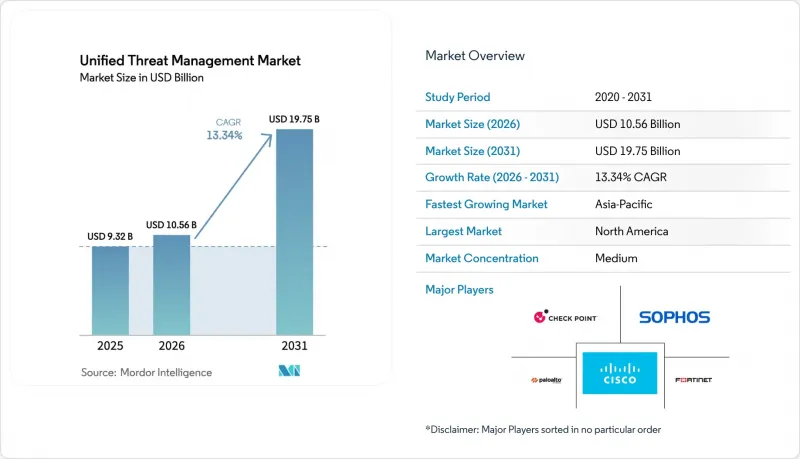
本報告按元件(軟體和服務)、部署模式(雲端和本地部署)、最終用戶企業規模(大型企業和中小企業)、最終用戶行業(銀行、金融服務和保險、電信、媒體等)以及地區進行細分。市場預測以價值(美元)表示。
全球統一威脅管理 (UTM) 市場趨勢與洞察
在中小企業中快速部署經濟高效的整合安全設備。
由於預算和人員有限,中小企業 (SME) 部署獨立的防火牆、入侵防禦系統和內容過濾系統會造成沉重負擔,因此他們正擴大遷移到統一威脅管理 (UTM) 設備。到 2024 年,43% 的中小企業將面臨網路攻擊,其中許多企業的 IT 團隊規模較小。一體化設備既能滿足基本的監管要求,又能降低資本投入和日常管理負擔。託管服務供應商現在正將 UTM 設備整合到固定費率套餐中,有時甚至能使其經常性收入翻倍。那些將企業級控制功能整合到簡化設備中的供應商,正在價格敏感型客戶群中贏得客戶的忠誠度。
與 SD-WAN/SASE 架構整合
網路和安全團隊需要一個能夠同時控制和檢查流量的單一管理介面。思科已將 Catalyst SD-WAN 與微軟安全服務邊緣 (SASE) 整合,使用戶能夠在同一雲端邊緣利用基於策略的路由和威脅防禦。 79% 的受訪公司計劃到 2025 年將對 Web、雲端服務和私有應用程式的存取整合到統一的 SASE 下,這迫使傳統的 UTM 供應商拓展其產品範圍,不再局限於裝置。 Fortinet 的統一 SASE 預計到 2025 年將成長 25.7%,達到 11.5 億美元的年度經常性收入,凸顯了統一雲端交付的強勁勢頭。
所有服務啟用時出現效能瓶頸。
硬體 UTM 裝置在啟用入侵防禦、SSL 偵測和沙箱功能時,吞吐量通常會下降。實驗室篩檢表明,啟用所有功能後,某些設備的額定速度可能會下降 20% 到 30%。例如,啟用深層封包偵測後,850 Mbps 的閘道速度可能會降至 600 Mbps。因此,需要高頻寬的企業可能會選擇在速度和全面防護之間取得平衡,並且在某些情況下,會將偵測任務卸載到雲端代理,從而避免升級其設備。
細分市場分析
預計到2025年,軟體收入將佔總營收的65.72%,複合年成長率(CAGR)為14.93%。軟體領域的統一威脅管理(UTM)市場預計到2025年將達到61.3億美元,並在2031年翻倍。企業正擴大採用可下載的鏡像和虛擬設備,這些設備可以在幾分鐘內部署到資料中心和邊緣節點。持續打補丁可以有效防禦零時差攻擊,而無需現場回應。雖然目前服務仍佔少數,但對威脅情報保全服務的需求正在成長,隨著技能短缺的加劇,託管偵測與回應(MDR)的收入成長超過了產品銷售。供應商透過捆綁用戶引導、策略最佳化和全天候監控服務,確保了高留存率的訂閱收入。專業服務團隊也提供合規性映射支持,特別是針對NIS2和海事相關監管要求。在統一威脅管理 (UTM) 市場中,專注於軟體創新並將其與可選服務功能相結合,以確保買家的敏捷性和專業知識的供應商仍然備受推崇。
第二波創新浪潮正推動軟體定義引擎向容器化格式轉型,使其能夠根據應用需求自動擴展。 Check Point 的「Infinity」架構如今透過單一程式碼庫即可覆蓋本地、雲端和分公司邊緣環境,並透過讓 IT 人員從單一主機進行管理,從而降低整體擁有成本 (TCO)。這種方法符合企業尋求平台整合而非單一產品的更廣泛趨勢。實際上,這波軟體浪潮重新定義了統一安全的標準,建立了人們對一鍵部署、無縫升級和同步分析的期望。隨著訂閱經濟取代硬體轉售的利潤模式,這些趨勢推動了統一威脅管理 (UTM) 市場的蓬勃發展。
預計到 2025 年,雲端模式將佔出出貨收益的 57.65%,並持續以 13.92% 的複合年成長率成長至 2031 年。企業認為,低延遲、無限可擴展性和簡化的全球策略執行是採用 SaaS 的關鍵促進因素。在頻寬需求超過嵌入式 CPU 限制的情況下,基於本地設備的整合威脅管理 (UTM) 的市場佔有率正在下降。然而,在空氣間隙的公共和國防設施中,本地檢查仍然是首選,這導致混合設計越來越受歡迎。策略駐留在雲端,但執行點可以根據合規性要求設定在虛擬或實體環境中。
雲端技術的普及緩解了曾經困擾網路效能下降的主要難題。如今,安全檢查在專為多核心處理設計的大規模資料中心進行。像 Marine Credit Union 這樣的機構表示,遷移到更靠近其生產力工作負載的安全 Web 閘道後,使用者體驗得到了顯著提升。硬體供應商現在在雲端節點上提供相同的規則集,以保持策略的連續性。隨著時間的推移,收費模式已從資本支出轉向營運支出,這不僅增強了供應商的可預測收入來源,也降低了買家的進入門檻。這些因素正在推動統一威脅管理 (UTM) 市場的發展。
區域分析
北美地區在2025年貢獻了36.62%的收入,這主要得益於網路保險法規的成熟和整合平台的早期應用。由於聯邦法規要求航運公司在2025年7月前實施有據可查的控制措施,航運業對相關設備的需求依然強勁。加拿大針對關鍵基礎設施的指導方針也同樣建議採用集中式日誌管理。穩定的預算和緊密的合作夥伴網路將繼續為升級和訂閱續訂提供支援。
亞太地區是成長的主要驅動力,預計到2031年將維持18.14%的複合年成長率。新加坡正在擴大其《網路安全法》的適用範圍,將海外系統納入其中,強制跨國公司總部在被罰款前實施整合式日誌管理。印度的《數位個人資料保護法》規定了資料外洩報告的嚴格期限,促使企業選擇能夠自動報告事件的承包UTM解決方案。日本和韓國的製造商正在部署UTM來監控工業機器人,以透過智慧工廠提高生產力。這些協同效應正在推動全部區域的整合威脅管理(UTM)市場發展。
在歐洲,隨著NIS2法規下能源、運輸和數位服務提供者的事故報告義務擴大,相關領域呈現穩定成長。鹿特丹港和漢堡港將要求船舶自2024年7月起證明其符合IACS UR E26/E27標準,以實施統一交通管理(UTM)。金融服務業的DORA監管機構正在投資整合管理功能,以便向監管機構提供即時儀錶板資訊。雖然隱私權保護和開放標準在歐洲備受重視,但監管重疊的複雜性正在推動對單一平台解決方案的需求。
其他好處:
- Excel格式的市場預測(ME)表
- 3個月的分析師支持
目錄
第1章:引言
- 研究假設和市場定義
- 調查範圍
第2章:調查方法
第3章執行摘要
第4章 市場狀況
- 市場概覽
- 市場促進因素
- 中小企業迅速採用經濟高效的整合安全設備。
- 與 SD-WAN/SASE 架構整合
- 人工智慧驅動的多態惡意軟體激增以及對整合分析的需求
- 監管機構推動整合審計追蹤
- 工業4.0網路中邊緣雲端的普及
- 海上安全和艦隊安全的要求正在催生對 UTM(無人交通管理)系統的小眾需求。
- 市場限制因素
- 啟用所有服務時會出現效能瓶頸
- 向雲端原生 SSE 的遷移正在縮短本地 UTM 的更新周期。
- 直接供應商和加值經銷商生態系統之間的通路競爭
- 缺乏微調多功能政策的技能
- 價值供應鏈分析
- 監理情勢
- 技術趨勢(下一代防火牆、XDR、SASE)
- 波特五力模型
- 投資分析
第5章 市場規模與成長預測
- 按組件
- 軟體
- 服務
- 專業服務
- 託管服務
- 部署模式
- 現場
- 雲
- 按最終用戶公司規模分類
- 中小企業
- 大公司
- 按最終用戶行業分類
- BFSI
- IT/通訊
- 衛生保健
- 零售與電子商務
- 製造業
- 公共產業和能源
- 運輸和物流
- 政府/公共部門
- 其他
- 按地區
- 北美洲
- 美國
- 加拿大
- 墨西哥
- 南美洲
- 巴西
- 阿根廷
- 其他南美國家
- 歐洲
- 德國
- 英國
- 法國
- 義大利
- 俄羅斯
- 西班牙
- 瑞士
- 其他歐洲國家
- 亞太地區
- 中國
- 印度
- 日本
- 韓國
- 馬來西亞
- 新加坡
- 越南
- 印尼
- 其他亞太國家
- 中東和非洲
- 中東
- 沙烏地阿拉伯
- 阿拉伯聯合大公國
- 土耳其
- 其他中東國家
- 非洲
- 奈及利亞
- 南非
- 其他非洲國家
- 中東
- 北美洲
第6章 競爭情勢
- 市場集中度
- 策略趨勢
- 市佔率分析
- 公司簡介
- Avast
- Barracuda Networks
- Check Point Software
- Cisco
- Comodo
- Dell SonicWall
- Fortinet
- Hillstone Networks
- Huawei
- A10 Networks
- SentinelOne
- Juniper Networks
- McAfee
- Sophos
- Trend Micro
- Trustwave
- Venustech
- WatchGuard
- Palo Alto Networks
- Versa Networks
- Proofpoint
- CrowdStrike
第7章 市場機會與未來展望
According to Mordor Intelligence, the unified threat management market size was valued at USD 9.32 billion in 2025 and estimated to grow from USD 10.56 billion in 2026 to reach USD 19.75 billion by 2031, at a CAGR of 13.34% during the forecast period (2026-2031).
This report is Segmented by Component (Software and Services), Deployment Mode (Cloud and On-Premise), End-User Enterprise Size (Large Enterprises and Small and Medium Enterprises (SMEs)), End-User Vertical (BFSI, Telecom and Media and More) and by Geography. The Market Forecasts are Provided in Terms of Value (USD).
Global Unified Threat Management Market Trends and Insights
Rapid SMB adoption of cost-effective integrated security appliances
Small and medium businesses increasingly pivot toward UTM boxes because separate firewalls, intrusion prevention, and content filters strain limited budgets and staff. Forty-three percent of SMBs faced attacks in 2024, yet many run with lean IT teams. An all-in-one unit trims capital outlay and day-to-day management while still meeting regulatory basics. Managed service providers now bundle UTM devices into fixed-price packages, doubling recurring revenue in some cases. Vendors that package enterprise-grade controls in simplified appliances are capturing loyalty in a price-sensitive segment.
Convergence with SD-WAN / SASE architectures
Networking and security teams want a single control pane that steers traffic and inspects it at once. Cisco has blended Catalyst SD-WAN with Microsoft Security Service Edge so users gain policy-based routing plus threat prevention on the same cloud edge. Seventy-nine percent of enterprises surveyed intend to fold web, cloud service, and private-app access under converged SASE by 2025, forcing legacy UTM suppliers to extend beyond appliance footprints. Fortinet's Unified SASE annual recurring revenue rose 25.7% to USD 1.15 billion in 2025, underscoring momentum toward integrated cloud delivery Fortinet.
Performance bottlenecks when all services enabled
Hardware UTM boxes often throttle throughput once intrusion prevention, SSL inspection, and sandboxing are switched on. Lab tests show some devices losing 20-30% of rated speed when every feature is active. For example, an 850 Mbps gateway can dip to 600 Mbps after deep-packet inspection is engaged. High-bandwidth enterprises then weigh speed against full protection and sometimes offload inspection tasks to cloud proxies, curbing appliance upgrades.
Other drivers and restraints analyzed in the detailed report include:
- Surge in AI-driven polymorphic malware and need for unified analytics
- Regulatory push for consolidated audit trails
- Migration to cloud-native SSE reducing on-prem UTM refresh cycles
For complete list of drivers and restraints, kindly check the Table Of Contents.
Segment Analysis
Software captured 65.72% of 2025 revenue, and this slice is climbing at 14.93% CAGR. The Unified Threat Management market size for software reached USD 6.13 billion in 2025 and is forecast to double by 2031. Organizations prefer downloadable images or virtual appliances that spin up in minutes across data centers and edge nodes. Continuous patching guards against zero-day exploits without a truck-roll. Services remain the minority today, yet managed detection and response revenues are outpacing product sales as skills shortages worsen, increasing demand for threat intelligence security services. Vendors bundle onboarding, policy optimization, and 24 X 7 monitoring to lock in sticky, subscription-based income. Professional services teams also guide compliance mapping, especially for NIS2 and maritime mandates. The Unified Threat Management market continues to reward suppliers that anchor innovations in software while layering optional service wrap-arounds, assuring buyers of both agility and expertise.
A second wave of innovation is pushing software-defined engines into container form factors that auto-scale with application demand. Check Point's Infinity architecture now spans on-premise, cloud, and branch edges through a single code base, lowering total cost of ownership because IT staff manage one console. The approach aligns with broader enterprise preference for platform unification rather than separate point products. In effect, the software surge redefines the benchmark for integrated security, setting expectations for one-click deployment, frictionless upgrades, and synchronized analytics. Such dynamics keep the Unified Threat Management market vibrant as subscription economics supplant box resell margins.
Cloud models accounted for 57.65% of 2025 shipments on revenue terms and are tracking a 13.92% CAGR through 2031. Enterprises cite lower latency to SaaS destinations, infinite scalability, and simplified global policy enforcement as key motivations. The Unified Threat Management market share for on-premise appliances is slipping where bandwidth demands exceed embedded CPU limits. Still, air-gapped utilities and defense sites continue to favor local inspection. Hybrid designs therefore proliferate. Policies reside in the cloud, yet enforcement points can be virtual or physical, depending on compliance needs.
Cloud adoption also mitigates the earlier restraint of performance degradation. Inspection takes place in massive data centers engineered for multi-core processing. Organizations such as Marine Credit Union report smoother user experiences after migrating to secure web gateways that sit closer to productivity workloads. Vendors that originated in hardware now offer identical rule sets in cloud nodes to preserve policy continuity. Over time, billing flips from capital expenditure to operational expenditure, reinforcing predictable revenue streams for suppliers and lowering entry thresholds for buyers. These factors feed the forward momentum of the Unified Threat Management market.
Complete Report Scope:
- By Component
- Software
- Service
- Professional Services
- Managed Services
- By Deployment Mode
- On-premise
- Cloud
- By End-user Enterprise Size
- Small and Medium-sized Enterprises (SMEs)
- Large Enterprises
- By End-User Industry
- BFSI
- IT and Telecom
- Healthcare
- Retail and e-Commerce
- Manufacturing
- Utilities and Energy
- Transport and Logistics
- Government and Public Sector
- Others
- By Geography
- North America
- United States
- Canada
- Mexico
- South America
- Brazil
- Argentina
- Rest of South America
- Europe
- Germany
- United Kingdom
- France
- Italy
- Russia
- Spain
- Switzerland
- Rest of Europe
- Asia-Pacific
- China
- India
- Japan
- South Korea
- Malaysia
- Singapore
- Vietnam
- Indonesia
- Rest of Asia-Pacific
- Middle East and Africa
- Middle East
- Saudi Arabia
- United Arab Emirates
- Turkey
- Rest of Middle East
- Africa
- Nigeria
- South Africa
- Rest of Africa
- Middle East
- North America
Geography Analysis
North America generated 36.62% of 2025 revenue, driven by mature cyber insurance mandates and early adoption of integrated platforms. Federal rules compel shipping companies to install documented controls by July 2025, keeping demand steady for maritime-ready appliances. Canada's critical infrastructure guidelines similarly favor centralized log management. Stable budgets and dense partner networks continue to underpin upgrades and subscription renewals.
Asia-Pacific is the growth engine, posting an 18.14% CAGR through 2031. Singapore extends the Cybersecurity Act to overseas systems, pushing multinational headquarters to adopt unified logging before fines begin. India's Digital Personal Data Protection Act requires breach alerts within strict timelines, encouraging businesses to pick turnkey UTM bundles that handle incident reporting automatically. Japanese and South Korean manufacturers deploy UTM to watch industrial robots as they push for smart-factory productivity. The cumulative effect propels the Unified Threat Management market across the region.
Europe records steady expansion as NIS2 broadens incident-reporting duties for energy, transport, and digital-services operators. Ports in Rotterdam and Hamburg now require vessels to certify UTM deployment that aligns with IACS UR E26/E27 standards from July 2024. Organizations subject to DORA in financial services invest in unified controls that feed real-time dashboards to supervisors. Although the continent favors privacy and open standards, the complexity of overlapping regulations reinforces the appeal of single-pane solutions.
- Avast
- Barracuda Networks
- Check Point Software
- Cisco
- Comodo
- Dell SonicWall
- Fortinet
- Hillstone Networks
- Huawei
- A10 Networks
- SentinelOne
- Juniper Networks
- McAfee
- Sophos
- Trend Micro
- Trustwave
- Venustech
- WatchGuard
- Palo Alto Networks
- Versa Networks
- Proofpoint
- CrowdStrike
Additional Benefits:
- The market estimate (ME) sheet in Excel format
- 3 months of analyst support
TABLE OF CONTENTS
1 INTRODUCTION
- 1.1 Study Assumptions and Market Definition
- 1.2 Scope of the Study
2 RESEARCH METHODOLOGY
3 EXECUTIVE SUMMARY
4 MARKET LANDSCAPE
- 4.1 Market Overview
- 4.2 Market Drivers
- 4.2.1 Rapid SMB adoption of cost-effective integrated security appliances
- 4.2.2 Convergence with SD-WAN / SASE architectures
- 4.2.3 Surge in AI-driven polymorphic malware and need for unified analytics
- 4.2.4 Regulatory push for consolidated audit trails
- 4.2.5 Edge-cloud proliferation in Industry 4.0 networks
- 4.2.6 Maritime and fleet-secure mandates creating niche UTM demand
- 4.3 Market Restraints
- 4.3.1 Performance bottlenecks when all services enabled
- 4.3.2 Migration to cloud-native SSE reducing on-prem UTM refresh cycles
- 4.3.3 Channel conflict between direct vendors and VAR ecosystems
- 4.3.4 Skills shortage to fine-tune multi-function policies
- 4.4 Value / Supply-Chain Analysis
- 4.5 Regulatory Landscape
- 4.6 Technological Outlook (NGFW, XDR, SASE)
- 4.7 Porter's Five Forces
- 4.7.1 Threat of New Entrants
- 4.7.2 Bargaining Power of Suppliers
- 4.7.3 Bargaining Power of Buyers
- 4.7.4 Threat of Substitutes
- 4.7.5 Intensity of Competitive Rivalry
- 4.8 Investment Analysis
5 MARKET SIZE AND GROWTH FORECASTS (VALUE)
- 5.1 By Component
- 5.1.1 Software
- 5.1.2 Service
- 5.1.2.1 Professional Services
- 5.1.2.2 Managed Services
- 5.2 By Deployment Mode
- 5.2.1 On-premise
- 5.2.2 Cloud
- 5.3 By End-user Enterprise Size
- 5.3.1 Small and Medium-sized Enterprises (SMEs)
- 5.3.2 Large Enterprises
- 5.4 By End-User Industry
- 5.4.1 BFSI
- 5.4.2 IT and Telecom
- 5.4.3 Healthcare
- 5.4.4 Retail and e-Commerce
- 5.4.5 Manufacturing
- 5.4.6 Utilities and Energy
- 5.4.7 Transport and Logistics
- 5.4.8 Government and Public Sector
- 5.4.9 Others
- 5.5 By Geography
- 5.5.1 North America
- 5.5.1.1 United States
- 5.5.1.2 Canada
- 5.5.1.3 Mexico
- 5.5.2 South America
- 5.5.2.1 Brazil
- 5.5.2.2 Argentina
- 5.5.2.3 Rest of South America
- 5.5.3 Europe
- 5.5.3.1 Germany
- 5.5.3.2 United Kingdom
- 5.5.3.3 France
- 5.5.3.4 Italy
- 5.5.3.5 Russia
- 5.5.3.6 Spain
- 5.5.3.7 Switzerland
- 5.5.3.8 Rest of Europe
- 5.5.4 Asia-Pacific
- 5.5.4.1 China
- 5.5.4.2 India
- 5.5.4.3 Japan
- 5.5.4.4 South Korea
- 5.5.4.5 Malaysia
- 5.5.4.6 Singapore
- 5.5.4.7 Vietnam
- 5.5.4.8 Indonesia
- 5.5.4.9 Rest of Asia-Pacific
- 5.5.5 Middle East and Africa
- 5.5.5.1 Middle East
- 5.5.5.1.1 Saudi Arabia
- 5.5.5.1.2 United Arab Emirates
- 5.5.5.1.3 Turkey
- 5.5.5.1.4 Rest of Middle East
- 5.5.5.2 Africa
- 5.5.5.2.1 Nigeria
- 5.5.5.2.2 South Africa
- 5.5.5.2.3 Rest of Africa
- 5.5.5.1 Middle East
- 5.5.1 North America
6 COMPETITIVE LANDSCAPE
- 6.1 Market Concentration
- 6.2 Strategic Moves
- 6.3 Market Share Analysis
- 6.4 Company Profiles (includes Global level Overview, Market level overview, Core Segments, Financials as available, Strategic Information, Market Rank/Share for key companies, Products and Services, and Recent Developments)
- 6.4.1 Avast
- 6.4.2 Barracuda Networks
- 6.4.3 Check Point Software
- 6.4.4 Cisco
- 6.4.5 Comodo
- 6.4.6 Dell SonicWall
- 6.4.7 Fortinet
- 6.4.8 Hillstone Networks
- 6.4.9 Huawei
- 6.4.10 A10 Networks
- 6.4.11 SentinelOne
- 6.4.12 Juniper Networks
- 6.4.13 McAfee
- 6.4.14 Sophos
- 6.4.15 Trend Micro
- 6.4.16 Trustwave
- 6.4.17 Venustech
- 6.4.18 WatchGuard
- 6.4.19 Palo Alto Networks
- 6.4.20 Versa Networks
- 6.4.21 Proofpoint
- 6.4.22 CrowdStrike
7 MARKET OPPORTUNITIES AND FUTURE OUTLOOK
- 7.1 White-space and Unmet-need Assessment

 統一威脅管理 (UTM) 市場規模、佔有率和成長分析:按組件、部署類型、企業規模、最終用戶產業和地區分類-2026-2033 年產業預測
 統一威脅管理 (UTM) 市場:按解決方案類型、部署模式、最終用戶和地區分類
 2026年全球綜合威脅管理市場報告
 統一威脅管理 (UTM) 市場分析及預測(至 2035 年):按類型、產品類型、服務、技術、組件、應用、部署類型、最終用戶、功能和解決方案分類
 防火牆管理市場 - 2026-2031 年預測
 統一威脅管理 (UTM) - 全球市場佔有率和排名、總收入和需求預測(2025-2031 年)
 統一威脅管理市場 - 全球產業規模、佔有率、趨勢、機會和預測(按組件、按部署類型、按最終用戶、按地區和競爭細分,2020-2030 年預測)
 2025-2029年全球統一威脅管理市場
 全球統一威脅管理市場:市場規模、佔有率、趨勢分析報告 - 按部署、按企業規模、按最終用途、按組件、按地區、展望、預測,2024-2031 年