


 |
市場調查報告書
商品編碼
2117229
金屬加工產品:市場佔有率分析、產業趨勢與統計、成長預測(2026-2031)Fabricated Metal Products - Market Share Analysis, Industry Trends & Statistics, Growth Forecasts (2026 - 2031) |
||||||

※ 本網頁內容可能與最新版本有所差異。詳細情況請與我們聯繫。
據 Mordor Intelligence 稱,2025 年金屬加工產品市場價值為 3590.5 億美元,預計到 2031 年將達到 4655.9 億美元,而 2026 年為 3749.2 億美元,預測期(2026-2031 年)複合年成長率為 4.42%。
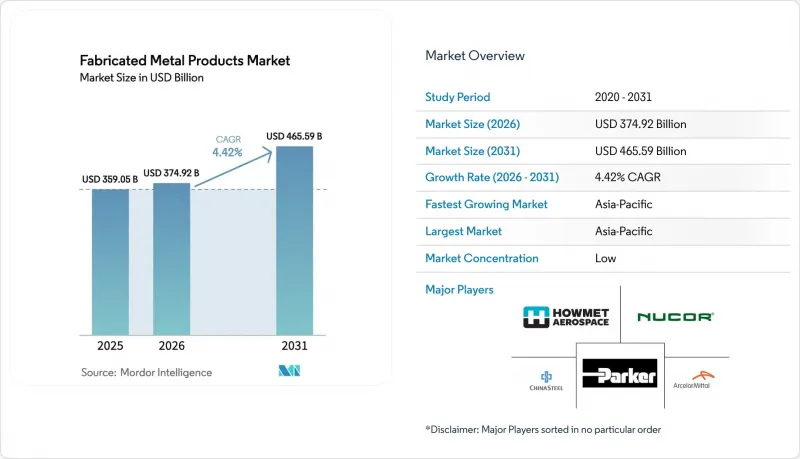
本報告按材料類型(鋼、鋁及其他合金)、製造程序(鑄造、鍛造、機械加工、焊接/管材製造及其他)、終端用戶行業(製造業、電力和公共產業及其他)以及地區(北美、南美、歐洲、亞太地區以及中東和非洲)進行細分。市場預測以美元計價。
全球金屬加工產品市場趨勢及洞察
建築業對結構構件的需求激增
憑藉精密加工的結構鋼、建築金屬製品和模組化建築構件,建築業仍是金屬加工產品市場最大的銷售管道。美國、印度和印尼基礎建設的加速發展,以及東南亞的都市化,正在推高梁、桁架和冷彎截面的累積訂單。建築公司正在縮短專案週期,並越來越依賴只需螺栓連接的預製構件,這導致製造流程的複雜性和利潤率的提高。嚴格的抗震和能源效率標準要求更高的公差和經過認證的焊接工藝,這對能夠透過無損檢測檢驗品質的技術先進的工廠來說是一個優勢。儘管建築支出存在週期性波動,但人口結構變化帶來的住宅和交通基礎設施現代化需求,支撐著未來幾年的持續需求,抵消了間歇性放緩的影響。
可再生能源設備安裝擴建需要金屬加工零件
風能、太陽能和電網加固項目正在加速對精密塔筒組件、支架系統和銅含量高的電氣設備的需求。國際能源總署 (IEA) 預測,到 2025 年,太陽能發電將佔全球新增可再生能源裝置容量的 60% 以上,每兆瓦太陽能發電大約需要 5.5 噸銅導體。中國國家電網公司 2025 年競標採購 175.7 萬噸鋼製電網塔筒,遠超上一年的 46 萬噸,為大截面樑和角鋼製造商帶來了源源不斷的訂單。離岸風力發電建設需要超大型單樁和機艙外殼,這些部件必須能夠承受極端的動態載荷,這為精通多道潛弧焊接的製造商創造了巨大的商機。電池倉儲設施的建設進一步擴大了這個市場範圍,這些設施需要使用鋁板和不銹鋼結構件製造溫度控管機殼。
鋼鐵和鋁價格波動
2024年底,熱軋鋼卷價格徘徊在每噸700美元左右。這得歸功於中國的經濟獎勵策略,但受到歐美需求疲軟以及服務中心庫存過剩的限制。美國對來自14個司法管轄區的鋁擠壓件徵收反傾銷稅,導致進口量減少40萬噸,加劇了國內價格波動,並擠壓了訂單製造商的利潤空間。大型製造商透過遠期避險和成本加成合約來減輕價格波動的影響,而中小企業則難以將額外成本轉嫁給消費者,並推遲接受長期訂單。擔心預算超支的專案客戶也推遲了大量使用鋼材的建設項目,導致金屬加工產品市場運轉率。數位化採購平台和透明的指數掛鉤機制雖然無法消除投入成本的不確定性,但可以減輕其影響,價格波動仍是持續存在的阻礙因素。
細分市場分析
到2025年,鋼材將佔據金屬加工產品市場62.60%的佔有率,這主要得益於其在汽車車架、工字木梁和重型機械外殼等領域的低成本高強度特性。然而,鋁材的銷售額正以5.66%的複合年成長率成長,預計這種輕質金屬將在預測期內成為金屬加工產品市場擴張的最快驅動力。其需求來源包括電動車底盤、航太機身面板和太陽能支架,在這些領域,更輕的重量意味著更高的燃油效率和更方便的現場安裝。等離子霧化技術降低了鈦的投入成本,從而開拓了渦輪機和醫療植入等細分市場;而隨著高電流可再生能源電路的普及,銅的需求也激增。環境評分卡引導買家選擇回收率達95%且碳足跡為每公斤1.52公斤二氧化碳當量(CO2e/kg)的不銹鋼合金,進一步加強了材料選擇與範圍3減排承諾之間的聯繫。
在下游加工環節,合金替代策略正積極應對大宗商品價格波動和抗震標準的修訂。鋼鐵製造商正在提高電弧爐的產能,以擴大廢鋼回收利用範圍;擠壓型材製造商則致力於憑藉其耐腐蝕的6000系列型材贏得太陽能OEM廠商的青睞。除了成本考量之外,鈦的生物相容性和高比強度也為其在整形外科植入和航空航太材料等領域的高利潤應用打開了大門。儘管價格上漲,銅優異的導電性在電動車匯流排和逆變器散熱器中仍然至關重要,加工商正透過嵌套演算法和重熔夥伴關係來最佳化成品率。整合到數位孿生中的生命週期評估(LCA)工具使工程師能夠在估算階段模擬碳排放強度,從而使金屬加工產品市場能夠將永續發展合規性轉化為銷售優勢。
區域分析
預計到2025年,亞太地區將佔據金屬加工產品市場48.35%的佔有率,這與其作為製造業強國和基礎設施樞紐的地位相符。中國競標175.7萬噸特高壓輸電塔項目,為鋼鐵生產提供了支持;印度的「智慧城市計畫」正在資助多式聯運樞紐、地鐵和高架公路的建設,這些項目都需要大量的軋延和焊接鋼材。越南等東南亞國家正在獲得組裝國產電子設備的訂單,推動了對精密鈑金底盤、伺服器機架和散熱器的需求。儘管市場已趨於成熟,但日本和韓國利用精益生產系統,將加工、研磨和測量整合於同一廠房,從而支援高精度半導體設備框架和機器人子組件的出口。亞洲內部貿易走廊正在縮短運輸環節,使鋼捲和鋼筋能夠從鋼鐵廠直接交付到當地加工商,從而增強金屬加工產品市場的競爭力。
北美經濟前景得益於聯邦政府超過2兆美元的獎勵策略主要用於清潔能源、先進半導體和交通走廊建設。 2024年5月,美國製造業建設規模達2,340億美元,較2019年成長217%,顯示夾層結構、暖通空調通風管道及結構框架的訂單積壓已達數年之久。加拿大的「關鍵礦產策略」正在推動對電池材料加工廠的資本投資,從而帶動不銹鋼反應器和合金鋼輸送系統訂單激增。墨西哥受益於白色家電組裝和二級汽車零件的組裝,刺激了對管材雷射加工生產線和機器人MIG焊接單元的投資。跨境價值鏈透過保持地理位置接近性並利用美墨加協定(USMCA)的關稅豁免規則,最大限度地降低了加工零件的物流風險。歐洲正努力應對能源價格波動,但正透過離岸風力發電電單樁、氫電解和醫療設備機殼等高價值利基市場來彌補損失。德國中型企業(Mittelstands)在不銹鋼板材成型方面表現出色,而義大利則將重點轉向豪華汽車的客製化加工。歐盟的碳排放邊境調節機制有利於採用電弧爐且廢鋼利用率高的鋼鐵廠,進而影響低碳鋼的採購趨勢。北歐生產商正利用水力發電提煉更環保的鋁坯,用於海上太陽能發電廠的結構。在中東和非洲,諸如利雅德地鐵和埃及新行政首都等大型企劃正在進行中,推動了對橋樑梁體和建築外觀的需求。在南美洲,儘管宏觀經濟波動,但礦用輸送機的更換和浮體式液化天然氣樞紐的建設維持了對厚鋼板和鋼管產品的需求,凸顯了金屬加工產品市場的地域覆蓋範圍之廣。
其他好處:
- Excel格式的市場預測(ME)表
- 3個月的分析師支持
目錄
第1章:引言
- 研究假設和市場定義
- 調查範圍
第2章:調查方法
第3章執行摘要
第4章 市場狀況
- 市場概覽
- 市場促進因素
- 建築業對結構構件的需求激增
- 製造業活動復甦與回流舉措
- 由於可再生能源設施的擴張,對金屬加工零件的需求正在增加。
- CNC加工和積層製造技術的進步
- 引進數位孿生技術,實現中小企業從設計到製造的一體化。
- 擴大模組化預製資料中心撬裝設備的使用
- 市場限制因素
- 鋼鐵和鋁價格波動
- 最先進的製造設備需要大量資金投入。
- 由於退休潮導致熟練焊工短缺
- 製造商面臨報告範圍 3 排放量的壓力
- 價值供應鏈分析
- 監理情勢
- 技術展望
- 產業吸引力—五力分析
- 新進入者的威脅
- 買方的議價能力
- 供應商的議價能力
- 替代品的威脅
- 競爭公司之間的競爭
第5章 市場規模與成長預測
- 依材料類型
- 鋼
- 鋁
- 其他合金(鈦、銅等)
- 透過製造程序
- 鑄件
- 鍛造
- 加工
- 焊接和管材加工
- 其他(印刷加工、積層製造)
- 按最終用戶行業分類
- 製造業
- 電力/公共產業
- 建築和基礎設施
- 石油和天然氣
- 車
- 航太/國防
- 其他行業
- 按地區
- 北美洲
- 美國
- 加拿大
- 墨西哥
- 南美洲
- 巴西
- 阿根廷
- 秘魯
- 其他南美國家
- 歐洲
- 英國
- 德國
- 法國
- 義大利
- 西班牙
- 比荷盧經濟聯盟(比利時、荷蘭、盧森堡)
- 北歐國家(丹麥、芬蘭、冰島、挪威、瑞典)
- 其他歐洲國家
- 亞太地區
- 中國
- 印度
- 日本
- 澳洲
- 韓國
- 東協(印尼、泰國、菲律賓、馬來西亞、越南)
- 其他亞太國家
- 中東和非洲
- 沙烏地阿拉伯
- 阿拉伯聯合大公國
- 卡達
- 科威特
- 土耳其
- 埃及
- 南非
- 奈及利亞
- 其他中東和非洲國家
- 北美洲
第6章 競爭情勢
- 市場集中度
- 策略趨勢
- 市佔率分析
- 公司簡介
- ArcelorMittal
- Nucor Corporation
- China Steel Corporation
- Howmet Aerospace
- Parker-Hannifin Corporation
- Ametek Inc.
- Ball Corporation
- Generac Holdings Inc.
- Inner Mongolia Baotou Steel Union Co., Ltd.
- Toyota Tsusho Corporation
- Voestalpine AG
- United States Steel Corporation
- JFE Holdings Inc.
- Thyssenkrupp AG
- BlueScope Steel Ltd.
- Reliance Steel & Aluminum Co.
- O'Neal Manufacturing Services
- Mayville Engineering Company Inc.
- BTD Manufacturing
第7章 市場機會與未來展望
According to Mordor Intelligence, the fabricated metal products market size was valued at USD 359.05 billion in 2025 and estimated to grow from USD 374.92 billion in 2026 to reach USD 465.59 billion by 2031, at a CAGR of 4.42% during the forecast period (2026-2031).
This report is Segmented by Material Type (Steel, Aluminum, Other Alloys), by Fabrication Process (Casting, Forging, Machining, Welding & Tubing, Others), by End-User Industry (Manufacturing, Power & Utilities, and More), and by Geography (North America, South America, Europe, Asia-Pacific, Middle East and Africa). The Market Forecasts are Provided in Terms of Value (USD).
Global Fabricated Metal Products Market Trends and Insights
Surge in Demand from the Construction Sector for Structural Components
Precision-engineered structural steel, architectural metalwork, and modular building elements keep the construction sector the single largest off-take channel for the fabricated metal products market. Infrastructure stimulus in the United States, India, and Indonesia is synchronizing with urbanization in Southeast Asia, lifting order backlogs for beams, trusses, and cold-formed sections. Contractors are shortening project cycles, prompting higher reliance on prefabricated assemblies that arrive ready for bolt-up, thereby raising fabrication complexity and margins. Strict seismic and energy-efficiency codes mandate tighter tolerances and certified weld procedures, which play to the strengths of technologically sophisticated shops able to validate quality with non-destructive testing. Although construction spending can be cyclical, demographic pressures for housing and transport renewal underpin a multi-year demand runway that offsets intermittent slowdowns.
Growth in Renewable-Energy Installations Requiring Fabricated Metal Parts
Wind, solar, and grid-reinforcement projects accelerate the need for precision tower sections, racking systems, and copper-intensive electrical hardware. The International Energy Agency expects solar additions to top 60% of new global renewable capacity in 2025, and each megawatt of photovoltaic capacity anchors roughly 5.5 tons of copper conductors. China's State Grid tender for 1.757 million tons of steel lattice towers in 2025 dwarfs the previous year's 460,000 tons, translating into continuous throughput for heavy-section beam and angle-line fabrication shops. Offshore wind construction depends on XL monopiles and nacelle housings that must absorb extreme dynamic loads, rewarding fabricators proficient at multi-pass submerged-arc welding. Battery-energy-storage sites further widen the scope, calling for thermally managed enclosures built from aluminum sheet and stainless structural members.
Volatility in Steel & Aluminum Prices
Hot-rolled coil hovered in the USD 700s per ton through late 2024, propped up by Chinese stimulus yet capped by slack Western demand and bloated service-center inventories. The U.S. antidumping duty on aluminum extrusions from 14 jurisdictions removed 400,000 tons of imports, amplifying domestic price swings and squeezing job-shop margins. While larger fabricators employ futures hedges or cost-plus contracts to mute volatility, small and medium enterprises struggle to pass surcharges through, delaying acceptance of long-term purchase orders. Project owners, wary of budget overruns, sometimes postpone steel-intensive builds, producing uneven utilization rates across the fabricated metal products market. Digital procurement platforms and transparent indexation mechanisms ease, not erase, input uncertainty, leaving price gyrations as a persistent constraint.
Other drivers and restraints analyzed in the detailed report include:
- Resurgence of Manufacturing Activity & Reshoring Initiatives
- Technological Advances in CNC & Additive Manufacturing
- Skilled-Welder Shortage Amid Retirement Cliff
For complete list of drivers and restraints, kindly check the Table Of Contents.
Segment Analysis
Steel held 62.60% of the fabricated metal products market share in 2025, underpinned by its low cost-to-strength ratio for automotive frames, I-beams, and heavy machinery housings. Yet aluminum revenues are climbing at a 5.66% CAGR, positioning the lighter metal as the quickest-expanding contributor to the fabricated metal products market size over the outlook. Demand stems from electric-vehicle chassis, aerospace fuselage panels, and photovoltaic racking, where weight savings translate into fuel economy or easier field installation. Plasma-based powder atomization lowered titanium input prices, opening turbine and medical-implant niches, while copper volumes surge alongside high-ampere renewable circuits. Environmental scorecards guide buyers toward stainless alloys boasting 95% recycled content and 1.52 kg CO2e per kg footprints, tightening the link between material choice and Scope-3 pledges.
Downstream, alloy substitution strategies respond to commodity price gyrations and seismic code revisions. Steel producers ramp electric-arc-furnace capacity to widen scrap recycling loops, whereas extruders court solar OEMs with corrosion-resistant 6000-series profiles. Separate from cost calculus, titanium's biocompatibility and high specific strength unlock orthopedic implant and space-qualified applications that command premium margins. Copper's conductive superiority keeps it indispensable for EV busbars and inverter heat-sinks despite price spikes, pushing fabricators to optimize yield through nesting algorithms and remelt partnerships. Life-cycle assessment tools embedded in digital twins let engineers simulate carbon intensity at the quotation stage, helping the fabricated metal products market transform sustainability compliance into a sales lever.
Complete Report Scope:
- By Material Type
- Steel
- Aluminum
- Other Alloys (Titanium, Copper, etc.)
- By Fabrication Process
- Casting
- Forging
- Machining
- Welding & Tubing
- Others (Stamping, Additive Manufacturing)
- By End-user Industry
- Manufacturing
- Power & Utilities
- Construction & Infrastructure
- Oil & Gas
- Automotive
- Aerospace & Defense
- Other Industries
- By Geography
- North America
- United States
- Canada
- Mexico
- South America
- Brazil
- Argentina
- Peru
- Rest of South America
- Europe
- United Kingdom
- Germany
- France
- Italy
- Spain
- BENELUX (Belgium, Netherlands, and Luxembourg)
- NORDICS (Denmark, Finland, Iceland, Norway, and Sweden)
- Rest of Europe
- Asia-Pacific
- China
- India
- Japan
- Australia
- South Korea
- ASEAN (Indonesia, Thailand, Philippines, Malaysia, Vietnam)
- Rest of Asia-Pacific
- Middle East and Africa
- Saudi Arabia
- United Arab Emirates
- Qatar
- Kuwait
- Turkey
- Egypt
- South Africa
- Nigeria
- Rest of Middle East and Africa
- North America
Geography Analysis
Asia-Pacific's 48.35% stake in the fabricated metal products market share during 2025 aligns with its role as both a manufacturing powerhouse and an infrastructure build-site. China's 1.757 million tons UHV tower tender anchors mill output, while India's Smart Cities Mission funds multi-modal terminals, metro rails, and flyovers that demand high tonnage of rolled and welded sections. Southeast Asian countries like Vietnam capture re-shored electronics assemblies, catalyzing demand for precision sheet-metal chassis, server racks, and heat-sinks. Japan and South Korea, though mature, feed exports of high-precision semiconductor equipment frames and robotic sub-assemblies, capitalizing on lean production systems that blend machining, grinding, and metrology under one roof. Intra-Asia trade corridors shorten transit loops, allowing mill-direct deliveries of coil and bar to regional fabricators, fortifying competitiveness within the fabricated metal products market.
North America's outlook is reinforced by more than USD 2 trillion federal stimulus earmarked for clean energy, advanced chips, and transport corridors. U.S. manufacturing construction hit USD 234 billion annualized in May 2024, a 217% surge versus 2019, indicating multi-year backlogs for mezzanines, HVAC plenums, and structural frames. Canada's Critical Minerals Strategy funnels capital into battery-materials processing plants, inflating orders for stainless reactors and alloy-steel conveyance systems. Mexico gains from near-shoring of white-goods assembly and Tier-2 automotive sub-assemblies, spurring investments in tube-laser lines and robotic MIG cells. Cross-border supply chains leverage USMCA duty-free rules while retaining geographic proximity that minimizes logistics risk for fabricated sub-components. Europe grapples with energy-price volatility yet compensates via high-value niches in offshore wind monopiles, hydrogen electrolyzers, and medical-device housings. Germany's Mittelstand excels at thin-gauge stainless forming, whereas Italy pivots toward boutique machining for luxury automotive. The EU's carbon-border adjustment mechanism privileges mills employing electric-arc furnaces and high scrap ratios, influencing procurement toward low-carbon steel. Nordic producers exploit hydropower to smelt greener aluminum billets destined for offshore solar-farm structures. Middle East and Africa ride public-works megaprojects, Riyadh Metro and Egypt's New Administrative Capital, requiring bridge girders and architectural facades. South America's mining conveyor upgrades and floating LNG hubs sustain demand for heavy-duty plate and tubular fabrications despite macro-volatility, underscoring the geographic breadth of the fabricated metal products market.
- ArcelorMittal
- Nucor Corporation
- China Steel Corporation
- Howmet Aerospace
- Parker-Hannifin Corporation
- Ametek Inc.
- Ball Corporation
- Generac Holdings Inc.
- Inner Mongolia Baotou Steel Union Co., Ltd.
- Toyota Tsusho Corporation
- Voestalpine AG
- United States Steel Corporation
- JFE Holdings Inc.
- Thyssenkrupp AG
- BlueScope Steel Ltd.
- Reliance Steel & Aluminum Co.
- O'Neal Manufacturing Services
- Mayville Engineering Company Inc.
- BTD Manufacturing
Additional Benefits:
- The market estimate (ME) sheet in Excel format
- 3 months of analyst support
TABLE OF CONTENTS
1 Introduction
- 1.1 Study Assumptions & Market Definition
- 1.2 Scope of the Study
2 Research Methodology
3 Executive Summary
4 Market Landscape
- 4.1 Market Overview
- 4.2 Market Drivers
- 4.2.1 Surge in demand from construction sector for structural components
- 4.2.2 Resurgence of manufacturing activity & reshoring initiatives
- 4.2.3 Growth in renewable-energy installations requiring fabricated metal parts
- 4.2.4 Technological advances in CNC & additive manufacturing
- 4.2.5 Adoption of digital twins enabling design-to-fab integration in SMEs
- 4.2.6 Rising use of modular prefabricated data-center skids
- 4.3 Market Restraints
- 4.3.1 Volatility in steel & aluminum prices
- 4.3.2 High CAPEX for advanced fabrication equipment
- 4.3.3 Skilled-welder shortage amid retirement cliff
- 4.3.4 Scope-3 emissions reporting pressure on fabricators
- 4.4 Value / Supply-Chain Analysis
- 4.5 Regulatory Landscape
- 4.6 Technological Outlook
- 4.7 Industry Attractiveness - Porter's Five Forces Analysis
- 4.7.1 Threat of New Entrants
- 4.7.2 Bargaining Power of Buyers
- 4.7.3 Bargaining Power of Suppliers
- 4.7.4 Threat of Substitutes
- 4.7.5 Competitive Rivalry
5 Market Size & Growth Forecasts (Value, In USD Billion)
- 5.1 By Material Type
- 5.1.1 Steel
- 5.1.2 Aluminum
- 5.1.3 Other Alloys (Titanium, Copper, etc.)
- 5.2 By Fabrication Process
- 5.2.1 Casting
- 5.2.2 Forging
- 5.2.3 Machining
- 5.2.4 Welding & Tubing
- 5.2.5 Others (Stamping, Additive Manufacturing)
- 5.3 By End-user Industry
- 5.3.1 Manufacturing
- 5.3.2 Power & Utilities
- 5.3.3 Construction & Infrastructure
- 5.3.4 Oil & Gas
- 5.3.5 Automotive
- 5.3.6 Aerospace & Defense
- 5.3.7 Other Industries
- 5.4 By Geography
- 5.4.1 North America
- 5.4.1.1 United States
- 5.4.1.2 Canada
- 5.4.1.3 Mexico
- 5.4.2 South America
- 5.4.2.1 Brazil
- 5.4.2.2 Argentina
- 5.4.2.3 Peru
- 5.4.2.4 Rest of South America
- 5.4.3 Europe
- 5.4.3.1 United Kingdom
- 5.4.3.2 Germany
- 5.4.3.3 France
- 5.4.3.4 Italy
- 5.4.3.5 Spain
- 5.4.3.6 BENELUX (Belgium, Netherlands, and Luxembourg)
- 5.4.3.7 NORDICS (Denmark, Finland, Iceland, Norway, and Sweden)
- 5.4.3.8 Rest of Europe
- 5.4.4 Asia-Pacific
- 5.4.4.1 China
- 5.4.4.2 India
- 5.4.4.3 Japan
- 5.4.4.4 Australia
- 5.4.4.5 South Korea
- 5.4.4.6 ASEAN (Indonesia, Thailand, Philippines, Malaysia, Vietnam)
- 5.4.4.7 Rest of Asia-Pacific
- 5.4.5 Middle East and Africa
- 5.4.5.1 Saudi Arabia
- 5.4.5.2 United Arab Emirates
- 5.4.5.3 Qatar
- 5.4.5.4 Kuwait
- 5.4.5.5 Turkey
- 5.4.5.6 Egypt
- 5.4.5.7 South Africa
- 5.4.5.8 Nigeria
- 5.4.5.9 Rest of Middle East and Africa
- 5.4.1 North America
6 Competitive Landscape
- 6.1 Market Concentration
- 6.2 Strategic Moves
- 6.3 Market Share Analysis
- 6.4 Company Profiles (includes Global level Overview, Market level overview, Core Segments, Financials as available, Strategic Information, Products & Services, and Recent Developments)
- 6.4.1 ArcelorMittal
- 6.4.2 Nucor Corporation
- 6.4.3 China Steel Corporation
- 6.4.4 Howmet Aerospace
- 6.4.5 Parker-Hannifin Corporation
- 6.4.6 Ametek Inc.
- 6.4.7 Ball Corporation
- 6.4.8 Generac Holdings Inc.
- 6.4.9 Inner Mongolia Baotou Steel Union Co., Ltd.
- 6.4.10 Toyota Tsusho Corporation
- 6.4.11 Voestalpine AG
- 6.4.12 United States Steel Corporation
- 6.4.13 JFE Holdings Inc.
- 6.4.14 Thyssenkrupp AG
- 6.4.15 BlueScope Steel Ltd.
- 6.4.16 Reliance Steel & Aluminum Co.
- 6.4.17 O'Neal Manufacturing Services
- 6.4.18 Mayville Engineering Company Inc.
- 6.4.19 BTD Manufacturing
7 Market Opportunities & Future Outlook
- 7.1 White-space & Unmet-Need Assessment

 穿孔金屬加工服務市場:全球市場預測,2026-2032年
 金屬網狀透明導體市場規模、佔有率和成長分析:按金屬類型、網狀結構、應用、最終用戶和地區分類 - 產業預測,2026-2033年
 金屬加工產品市場:依產品類型、材料、製造流程、最終用戶、國家及地區分類-全球產業分析、市場規模、市場佔有率及2026年至2033年預測
 對建築金屬網市場進行分析和預測,直至 2035 年:按類型、產品、技術、應用、形式、材料類型、最終用戶、功能和安裝類型進行分析和預測。金屬加工產品市場:依產品類型、原料、製造流程、終端用戶產業及銷售管道分類-2026年至2032年全球預測燒結不銹鋼零件市場:依材料等級、製造流程、分銷管道、終端用戶產業和應用分類-全球預測,2026-2032年
 金屬加工產品的美國市場的評估:各金屬類型,各加工流程,各最終用途產業,各地區,機會,預測(2018年~2032年)金屬加工產品的全球市場:各金屬類型,不同製造流程,各最終用途產業,各地區,機會,預測,2018年~2032年