

 |
市場調查報告書
商品編碼
2117221
消費者安全:市場佔有率分析、產業趨勢與統計及成長預測(2026-2031 年)Consumer Security - Market Share Analysis, Industry Trends & Statistics, Growth Forecasts (2026 - 2031) |
||||||

※ 本網頁內容可能與最新版本有所差異。詳細情況請與我們聯繫。
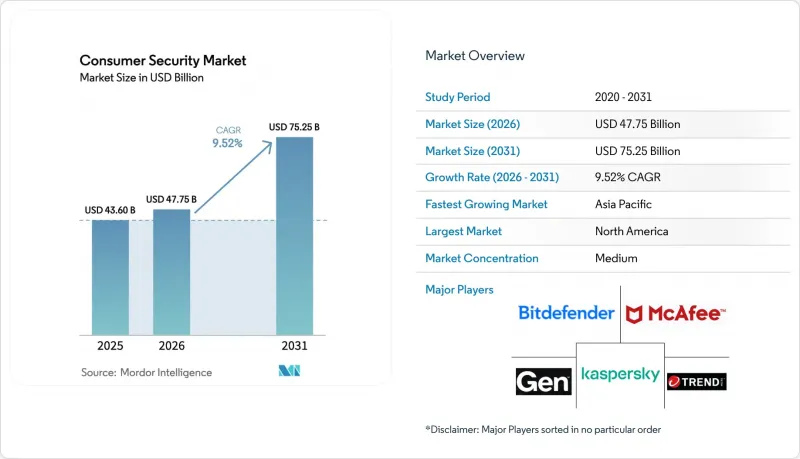
據 Mordor Intelligence 稱,2025 年消費者安全市場價值 436 億美元,預計到 2031 年將達到 752.5 億美元,而 2026 年為 477.5 億美元,預測期(2026-2031 年)的複合年成長率為 9.52%。
本報告按類型(防毒和網際網路安全套件、身分盜竊和隱私套件、虛擬專用網路 (VPN)、密碼管理器等)、元件(軟體、服務(設定、支援、MDR-Home))、部署(本地/設備駐留、雲端/SaaS)、最終用戶產業(政府和國防、銀行、金融服務和保險、IT 和電信、雲端/SaaS)、最終用戶產業(政府和國防、銀行、金融服務和保險、IT 和電信、醫療保健、運輸和物流)以及地區醫療保健和物流
全球消費者安全市場趨勢及洞察
因網路釣魚和勒索軟體造成的損失金額正在激增。
根據美國聯邦調查局 (FBI) 報告,2024 年消費者損失總額達 166 億美元,比前一年增加 33%。網路釣魚攻擊佔通報犯罪案件總數的最大比例,達 193,407 件。醫療機構遭受了 444 起勒索軟體攻擊,凸顯了消費者設備可能成為關鍵系統入侵的入口。每位受害者的平均損失達 19,372 美元,其中老年受害者損失高達 48 億美元。為此,供應商正在簡化介面,並為老年人添加方便用戶使用功能。商業電子郵件入侵 (BEC) 造成的損失達到 27 億美元,促使安全套件的功能從文件掃描擴展到多層防禦,例如安全電子郵件閘道和詐騙警報。隨著受害者遭受直接的經濟損失,他們購買多層安全軟體包的意願日益增強,從免費工具升級到高級套餐。
家庭物聯網的爆炸性成長
智慧家庭的普及擴大了攻擊面,因為日常使用的設備通常在出廠時就預先配置了易受攻擊的憑證。美國商務部的一項調查發現,66%的受訪設備使用了中國晶圓代工廠提供的半導體,導致人們對供應鏈的審查增加。 2024年4月,英國禁止在連網產品中使用預設密碼,並強制規定了最低支援期限,這為其他地區樹立了先例。學術研究表明,消費級物聯網設備通常缺乏強大的入侵偵測能力,因此需要一個能夠保護整個家庭網路(而不僅僅是單一設備)的平台。目前,供應商正在提供將終端應用程式與路由器級掃描器結合的解決方案,而中國政府對人工智慧家用機器人的推廣進一步將智慧設備的成長與家庭安全需求聯繫起來。
作業系統中預設包含免費安全功能。
Windows Defender 和類似的內建工具能夠提供基本的惡意軟體和網路釣魚防護,尤其是在現代作業系統上。由於它們是免費的,注重預算的家庭通常認為沒有必要額外訂閱。然而,2024 年消費者損失高達 166 億美元,創歷史新高,這表明最低限度的防護不足以阻止複雜的社交工程和定向勒索軟體。因此,供應商正在強調整合實用程式未涵蓋的功能,例如進階啟發式分析、銀行保護、暗網監控和 VPN 流量混淆。如今,行銷重點不再是簡單的病毒掃描,而是全面保護用戶免受身分詐騙和提供即時財務警報。
細分市場分析
儘管2025年防毒軟體套裝的銷售額佔比高達41.95%,但家用設備的端點檢測與響應(EDR)市場預計到2031年仍將以18.25%的複合年成長率成長。這項轉變反映了基於特徵碼的引擎已無法有效應對無檔案惡意軟體和「借力攻擊」(LoTL)策略的現實。在終端工具的消費者安全市場中,隨著醫療保健領域新聞的不斷湧現,對勒索軟體防護工具的需求也隨之成長;而隨著資料外洩和解協議的不斷曝光,人們對身分盜竊監控工具的關注度也日益提高。此外,由於遠距辦公模式的興起,人們的隱私意識不斷增強,VPN模組的採用率也穩定上升。關於密碼管理器,儘管已訂定新規禁止在消費者應用程式中使用弱密碼,但其在安全專家中的普及率仍然很高。
為了降低介面複雜性,供應商正日益將這些類別整合到一個統一的入口網站中。因此,當家庭用戶能夠透過統一的控制面板管理筆記型電腦、行動裝置和物聯網裝置時,消費者安全市場的客戶維繫留存率正在提升。供應商也透過家長監控和安全瀏覽功能來吸引數位原住民世代的父母,儘管面臨主流雲端儲存的競爭,用於勒索軟體復原的備份工具仍然發揮著至關重要的作用。
預計到2025年,軟體將佔消費者安全市場規模的81.78%。這是因為終端代理和行動應用仍將是購買流程的第一步。然而,隨著技術水平較低的用戶依賴託管式檢測、設定和全天候支持,服務領域預計將以16.55%的複合年成長率成長。與電信業者的合作正在簡化啟動和收費,並將服務覆蓋範圍擴大到那些不購買獨立套餐的家庭用戶。
混合服務模糊了兩者之間的界線。人工智慧演算法在雲端運行,但可疑活動由人工分析師進行檢驗,這使其成為高風險家庭極具吸引力的提案。 FBI 的數據顯示,商業電子郵件詐騙(BEC) 造成的損失高達 27 億美元,凸顯了當警報升級到設備級威脅之外時,專家指導的必要性。從長遠來看,該服務的附加功能將提高每位用戶平均收入 (ARPU),並創造純軟體供應商難以匹敵的轉換成本。
區域分析
預計到2025年,北美將佔全球銷售額的35.85%,並將繼續成為高階寬頻套餐的主要買家,這主要得益於網路安全意識的增強和強力的監管推動。美國聯邦調查局(FBI)最新的網路犯罪報告估計,消費者損失高達166億美元,這使得經銷商在續約時擁有強大的議價能力。美國聯邦通訊委員會(FCC)將寬頻歸類為通訊服務的決定加強了監管,要求供應商將安全工具與連接套餐捆綁銷售,進一步拓展了該地區的商業機會。加拿大的國家網路安全戰略以及持續140億加元(103億美元)的企業支出顯示了該地區對網路安全的重視。然而,諸如2024年AT&T公司5,100萬筆客戶記錄外洩等備受矚目的資料外洩事件,仍令消費者感到不安。
在亞太地區,數位轉型正在加速,預計到2031年,該地區的複合年成長率將達到15.16%。中國的網路安全市場預計將從2022年的7,120億元成長到2025年的1.078兆元人民幣,約合1,490億美元,凸顯了其龐大的市場規模。在印度,統一支付介面(UPI)系統在2025年5月的交易量比去年同期成長了33%,但詐欺損失也達到了17.7億盧比(約2,100萬美元),這表明公眾對網路風險的意識日益增強。日本正大力推廣人工智慧在消費者服務的應用,這為行為分析帶來了更高的要求,供應商們正競相滿足這些要求。此外,一系列不同的法律法規也迫使供應商將事件回應熱線和資料儲存位置等功能本地化。
在歐洲,隨著GDPR的實施,資料安全市場呈現穩定成長態勢。 GDPR強制要求透明的資料處理和資料外洩報告。英國禁止為智慧型裝置設定初始密碼,加重了合規負擔,並促使消費者加強家庭網路安全。西班牙電信(Telefónica Tech)部署的SASE服務,包括為中小企業及其員工提供終端安全保護,顯示歐洲電信業者對安全捆綁服務有著濃厚的興趣。在中東和非洲,需求正在出現。網路普及率的提高加劇了安全威脅,但價格敏感度減緩了高階安全套件的普及。政府的數位經濟計畫和官民合作關係正在資助安全意識宣傳活動,預計未來基本需求將逐步成長。
其他好處:
- Excel格式的市場預測(ME)表
- 3個月的分析師支持
目錄
第1章:引言
- 研究假設和市場定義
- 調查範圍
第2章:調查方法
第3章執行摘要
第4章 市場狀況
- 市場概覽
- 市場促進因素
- 因網路釣魚和勒索軟體造成的損失金額正在迅速增加。
- 家庭物聯網的爆炸性成長
- 重視隱私的法規正在推動其廣泛應用。
- 訂閱式身分保護套餐
- 電信業者/網際網路服務供應商的嵌入式安全解決方案
- 人工智慧原生個人網路助手
- 市場限制因素
- 作業系統內建的安全功能是標準配置。
- 對價格敏感的新興市場與盜版問題
- 消費者「警示疲勞」正在降低客戶維繫率。
- 對捆綁式 VPN/資料進行反壟斷審查
- 監理情勢
- 技術展望
- 波特五力分析
第5章 市場規模與成長預測
- 按類型
- 防毒和網路安全套件
- 身分盜竊預防和隱私權保護套件
- 虛擬私人網路(VPN)
- 密碼管理器
- 端點檢測與響應(EDR-Home)
- 家長監控與安全瀏覽
- 備份和復原
- 勒索軟體防護
- 按組件
- 軟體
- 服務(設定、支援、MDR-Home)
- 不同的發展
- 本地部署/設備駐留
- 雲/SaaS
- 按最終用戶行業分類
- 政府/國防
- BFSI
- 資訊科技/通訊
- 衛生保健
- 運輸/物流
- 零售與電子商務
- 能源公用事業
- 製造業
- 教育
- 按地區
- 北美洲
- 美國
- 加拿大
- 南美洲
- 巴西
- 其他南美國家
- 歐洲
- 德國
- 英國
- 法國
- 義大利
- 西班牙
- 俄羅斯
- 其他歐洲國家
- 亞太地區
- 中國
- 日本
- 印度
- 韓國
- 澳洲和紐西蘭
- ASEAN
- 其他亞太國家
- 中東和非洲
- GCC
- 土耳其
- 南非
- 其他中東和非洲國家
- 北美洲
第6章 競爭情勢
- 市場集中度
- 策略性舉措(併購、合作、資金籌措)
- 市佔率分析
- 公司簡介
- Gen Digital(Norton, Avast)
- McAfee
- Trend Micro
- Kaspersky Lab
- Bitdefender
- ESET
- Cisco Systems(Umbrella, Security Cloud)
- Microsoft
- Fortinet(FortiClient)
- WatchGuard Technologies
- Sophos Home
- F-Secure
- Panda Security
- AVG Technologies
- 1Password
- Malwarebytes
- Proton
- Lookout
- Nord Security(NordVPN Threat Protection)
- CrowdStrike(Charlotte AI Consumer)
第7章 市場機會與未來展望
According to Mordor Intelligence, the consumer security market size was valued at USD 43.6 billion in 2025 and estimated to grow from USD 47.75 billion in 2026 to reach USD 75.25 billion by 2031, at a CAGR of 9.52% during the forecast period (2026-2031).
This report is Segmented by Type (Anti-Virus and Internet Security Suites, Identity-Theft and Privacy Suites, Virtual Private Network (VPN), Password Managers, and More), Component (Software, Services (Setup, Support, MDR-Home)), Deployment (On-premise/Device-resident, Cloud / SaaS), End-User Vertical (Government and Defense, BFSI, IT and Telecom, Healthcare, Transportation and Logistics, and More), and Geography.
Global Consumer Security Market Trends and Insights
Surging Phishing and Ransomware Losses
Consumer losses reported to the FBI climbed to USD 16.6 billion in 2024, a 33% rise year over year, and phishing accounted for 193,407 complaints, the single largest crime category. Healthcare facilities faced 444 ransomware incidents, underscoring how consumer devices can act as stepping-stones into critical systems. Average loss per victim reached USD 19,372, and seniors lost USD 4.8 billion, prompting vendors to simplify interfaces and add elder-friendly coaching. Business email compromise inflicted USD 2.7 billion in damages, so suites now extend defenses beyond file scanning to include secure mail gateways and fraud alerts. As victims see direct financial fallout, willingness to pay for multi-layer packages climbs, driving upgrades from free tools to premium bundles.
Household IoT Explosion
Smart home ownership expands the attack surface because everyday devices often leave factories with weak credentials. A U.S. Commerce Department study found that 66% of surveyed devices used semiconductors supplied by Chinese foundries, heightening supply-chain scrutiny. The United Kingdom banned default passwords on connected products in April 2024 and mandated minimum support periods, setting a precedent that other regions may follow. Academic work reveals that consumer IoT gear commonly lacks rigorous intrusion detection, creating an opening for platforms that protect the entire home network rather than isolated gadgets. Vendors now couple endpoint apps with router-level scanners, and China's state push for AI-based domestic robots further aligns smart-device growth with demand for household security.
Free Built-in OS Security
Windows Defender and similar native tools deliver an acceptable baseline safety for malware and phishing, especially on modern operating systems. Their zero-price tag reduces the perceived need for extra subscriptions among budget-conscious households. Yet record consumer losses of USD 16.6 billion in 2024 show that baseline protection fails to stop sophisticated social-engineering or targeted ransomware. Vendors, therefore, highlight advanced heuristics, banking shields, dark-web monitoring, and VPN traffic obfuscation that integrated utilities do not cover. Marketing now stresses holistic safeguards against identity fraud and real-time financial alerts rather than simple virus scanning.
Other drivers and restraints analyzed in the detailed report include:
- Privacy-First Regulations Drive Adoption
- Subscription Identity-Protection Bundles
- Consumer Alert Fatigue Lowers Retention
For complete list of drivers and restraints, kindly check the Table Of Contents.
Segment Analysis
Endpoint Detection and Response for home devices is projected to grow at 18.25% CAGR through 2031, even as anti-virus suites commanded 41.95% revenue in 2025. This shift reflects the reality that signature-based engines cannot keep pace with file-less malware and living-off-the-land tactics. Within the consumer security market size for endpoint tools, ransomware shields rise on healthcare headlines, while identity-theft monitors gain visibility each time breach settlements hit the news. VPN modules show steady uptake because work-from-anywhere lifestyles increase privacy consciousness. Password managers follow new rules that ban weak credentials across consumer apps, although penetration stays higher among security-savvy professionals.
Convergence is underway as vendors bundle these categories into one portal to cut interface fatigue. As a result, the consumer security market registers stronger retention when families can cover laptops, mobiles, and IoT hubs under a unified dashboard. Vendors also pitch parental controls and safe browsing to digital-native parents, and backup utilities remain relevant for ransomware recovery despite competition from mainstream cloud drives.
Software made up 81.78% of the consumer security market size in 2025 because endpoint agents and mobile apps remain the first purchase step. However, services are on track for a 16.55% CAGR as non-technical users lean on managed detection, setup, and 24/7 response. Telco alliances simplify activation and billing, expanding reach into households that would not buy standalone packages.
Hybrid offerings blur the line: AI algorithms run in the cloud, yet human analysts validate suspicious activity, producing a compelling value proposition for higher-risk households. FBI data showing USD 2.7 billion lost to business email compromise underlines the need for expert guidance when alerts escalate beyond device-level threats. Over time, service attachments boost average revenue per user and build switching costs that pure-software vendors struggle to match.
Complete Report Scope:
- By Type
- Anti-virus and Internet Security Suites
- Identity-Theft and Privacy Suites
- Virtual Private Network (VPN)
- Password Managers
- Endpoint Detection and Response (EDR-Home)
- Parental Control and Safe-Browsing
- Backup and Recovery
- Ransomware Shield
- By Component
- Software
- Services (Setup, Support, MDR-Home)
- By Deployment
- On-premise / Device-resident
- Cloud / SaaS
- By End-user Vertical
- Government and Defense
- BFSI
- IT and Telecom
- Healthcare
- Transportation and Logistics
- Retail and E-commerce
- Energy and Utilities
- Manufacturing
- Education
- By Geography
- North America
- United States
- Canada
- South America
- Brazil
- Rest of South America
- Europe
- Germany
- United Kingdom
- France
- Italy
- Spain
- Russia
- Rest of Europe
- Asia-Pacific
- China
- Japan
- India
- South Korea
- Australia and New Zealand
- ASEAN
- Rest of Asia-Pacific
- Middle East and Africa
- GCC
- Turkey
- South Africa
- Rest of Middle East and Africa
- North America
Geography Analysis
North America retained 35.85% revenue in 2025 and continues to buy premium suites thanks to mature awareness and a strong regulatory push. The latest FBI Internet Crime Report listed USD 16.6 billion in consumer losses, giving sellers a potent proof point during renewals. The FCC's decision to classify broadband as a telecommunications service increases oversight and forces providers to package safety tools with connectivity plans, further enlarging the local opportunity. Canada's National Cyber Security Strategy and sustained enterprise spending of CAD 14 billion (USD 10.3 billion) demonstrate regional commitment. Yet headline breaches such as the AT&T exposure of 51 million customer records in 2024 keep consumers on edge.
Asia-Pacific posts the highest 15.16% CAGR through 2031 as digital transformation accelerates. China's cybersecurity market is projected to rise from 712 billion yuan in 2022 to 1,078 billion yuan by 2025, translating to almost USD 149 billion and underscoring scale. India's UPI scheme processed 33% more transactions in May 2025 than a year earlier, yet fraud losses hit EUR 177 crore (USD 21 million), alerting citizens to online risks. Japan promotes AI in consumer services, creating advanced requirements for behavioral analytics that vendors rush to meet. A diverse patchwork of laws forces suppliers to localize features such as incident-response hotlines and data-storage zones.
Europe records steady expansion anchored in GDPR enforcement, which obliges transparent data handling and breach reporting. The United Kingdom's prohibition of default passwords on smart devices broadens the compliance burden and encourages consumers to upgrade security across the home. Telefonica Tech showcases European operator appetite for bundled security by rolling out SASE services that include endpoint protection for small firms and their staff. The Middle East and Africa show nascent demand: rising internet penetration fuels threat exposure, but price sensitivity slows uptake of high-end suites. Government digital-economy plans and public-private partnerships are expected to fund awareness campaigns that will raise baseline demand over time.
- Gen Digital (Norton, Avast)
- McAfee
- Trend Micro
- Kaspersky Lab
- Bitdefender
- ESET
- Cisco Systems (Umbrella, Security Cloud)
- Microsoft
- Fortinet (FortiClient)
- WatchGuard Technologies
- Sophos Home
- F-Secure
- Panda Security
- AVG Technologies
- 1Password
- Malwarebytes
- Proton
- Lookout
- Nord Security (NordVPN Threat Protection)
- CrowdStrike (Charlotte AI Consumer)
Additional Benefits:
- The market estimate (ME) sheet in Excel format
- 3 months of analyst support
TABLE OF CONTENTS
1 INTRODUCTION
- 1.1 Study Assumptions and Market Definition
- 1.2 Scope of the Study
2 RESEARCH METHODOLOGY
3 EXECUTIVE SUMMARY
4 MARKET LANDSCAPE
- 4.1 Market Overview
- 4.2 Market Drivers
- 4.2.1 Surging Phishing and Ransomware Losses
- 4.2.2 Household IoT Explosion
- 4.2.3 Privacy-First Regulations Drive Adoption
- 4.2.4 Subscription Identity-Protection Bundles
- 4.2.5 Telco/ISP Embedded Security Offerings
- 4.2.6 AI-Native Personal Cyber Assistants
- 4.3 Market Restraints
- 4.3.1 Free Built-In OS Security
- 4.3.2 Price-Sensitive Emerging Markets and Piracy
- 4.3.3 Consumer "Alert Fatigue" Lowers Retention
- 4.3.4 Antitrust Scrutiny of Bundled VPN/Data
- 4.4 Regulatory Landscape
- 4.5 Technological Outlook
- 4.6 Porter's Five Forces Analysis
- 4.6.1 Threat of New Entrants
- 4.6.2 Bargaining Power of Buyers
- 4.6.3 Bargaining Power of Suppliers
- 4.6.4 Threat of Substitutes
- 4.6.5 Competitive Rivalry
5 MARKET SIZE AND GROWTH FORECASTS (VALUE)
- 5.1 By Type
- 5.1.1 Anti-virus and Internet Security Suites
- 5.1.2 Identity-Theft and Privacy Suites
- 5.1.3 Virtual Private Network (VPN)
- 5.1.4 Password Managers
- 5.1.5 Endpoint Detection and Response (EDR-Home)
- 5.1.6 Parental Control and Safe-Browsing
- 5.1.7 Backup and Recovery
- 5.1.8 Ransomware Shield
- 5.2 By Component
- 5.2.1 Software
- 5.2.2 Services (Setup, Support, MDR-Home)
- 5.3 By Deployment
- 5.3.1 On-premise / Device-resident
- 5.3.2 Cloud / SaaS
- 5.4 By End-user Vertical
- 5.4.1 Government and Defense
- 5.4.2 BFSI
- 5.4.3 IT and Telecom
- 5.4.4 Healthcare
- 5.4.5 Transportation and Logistics
- 5.4.6 Retail and E-commerce
- 5.4.7 Energy and Utilities
- 5.4.8 Manufacturing
- 5.4.9 Education
- 5.5 By Geography
- 5.5.1 North America
- 5.5.1.1 United States
- 5.5.1.2 Canada
- 5.5.2 South America
- 5.5.2.1 Brazil
- 5.5.2.2 Rest of South America
- 5.5.3 Europe
- 5.5.3.1 Germany
- 5.5.3.2 United Kingdom
- 5.5.3.3 France
- 5.5.3.4 Italy
- 5.5.3.5 Spain
- 5.5.3.6 Russia
- 5.5.3.7 Rest of Europe
- 5.5.4 Asia-Pacific
- 5.5.4.1 China
- 5.5.4.2 Japan
- 5.5.4.3 India
- 5.5.4.4 South Korea
- 5.5.4.5 Australia and New Zealand
- 5.5.4.6 ASEAN
- 5.5.4.7 Rest of Asia-Pacific
- 5.5.5 Middle East and Africa
- 5.5.5.1 GCC
- 5.5.5.2 Turkey
- 5.5.5.3 South Africa
- 5.5.5.4 Rest of Middle East and Africa
- 5.5.1 North America
6 COMPETITIVE LANDSCAPE
- 6.1 Market Concentration
- 6.2 Strategic Moves (MandA, Partnerships, Funding)
- 6.3 Market Share Analysis
- 6.4 Company Profiles (includes Global level Overview, Market level overview, Core Segments, Financials as available, Strategic Information, Market Rank/Share, Products and Services, Recent Developments)
- 6.4.1 Gen Digital (Norton, Avast)
- 6.4.2 McAfee
- 6.4.3 Trend Micro
- 6.4.4 Kaspersky Lab
- 6.4.5 Bitdefender
- 6.4.6 ESET
- 6.4.7 Cisco Systems (Umbrella, Security Cloud)
- 6.4.8 Microsoft
- 6.4.9 Fortinet (FortiClient)
- 6.4.10 WatchGuard Technologies
- 6.4.11 Sophos Home
- 6.4.12 F-Secure
- 6.4.13 Panda Security
- 6.4.14 AVG Technologies
- 6.4.15 1Password
- 6.4.16 Malwarebytes
- 6.4.17 Proton
- 6.4.18 Lookout
- 6.4.19 Nord Security (NordVPN Threat Protection)
- 6.4.20 CrowdStrike (Charlotte AI Consumer)
7 MARKET OPPORTUNITIES AND FUTURE OUTLOOK
- 7.1 White-space and Unmet-need Assessment

 2026-2030年全球安全領域人工智慧市場
 企業安全客戶回饋調查:數據亮點
 安全評估市場:依服務類型、組織規模、部署模式、最終用戶、國家及地區分類-全球產業分析、市場規模、市場佔有率及2026年至2033年預測
 安全市場規模、佔有率、趨勢和預測:按系統、服務、最終用戶和地區分類,2026-2034 年
 預測性安全市場-全球產業規模、佔有率、趨勢、機會與預測:按產業、部署模式、企業規模、威脅類型、技術、地區和競爭格局分類,2021-2031年安全設備市場報告:按類型、部署模式、最終用戶、產業和地區分類(2026-2034 年)
 安全領域人工智慧 (AI) 市場規模、佔有率和成長分析:按組件、部署模式、最終用戶和地區分類——2026-2033 年行業預測
 2026年全球安防市場報告2026年全球醫療資訊科技(IT)安全市場報告
 安全評估市場:依保全服務類型、安全類型、組織規模、部署模式、產業分類,全球預測(2026-2032 年)