


 |
市場調查報告書
商品編碼
2117216
汽車測試、檢定和認證(TIC):市場佔有率分析、行業趨勢和統計數據以及成長預測(2026-2031 年)Automotive TIC - Market Share Analysis, Industry Trends & Statistics, Growth Forecasts (2026 - 2031) |
||||||

※ 本網頁內容可能與最新版本有所差異。詳細情況請與我們聯繫。
據 Mordor Intelligence 稱,2025 年汽車測試、檢驗和認證 (TIC) 市場價值為 203.1 億美元,預計到 2031 年將從 2026 年的 212.8 億美元成長至 268.6 億美元,預測期(2026-2031 年)的複合年成長率為 4.7%。
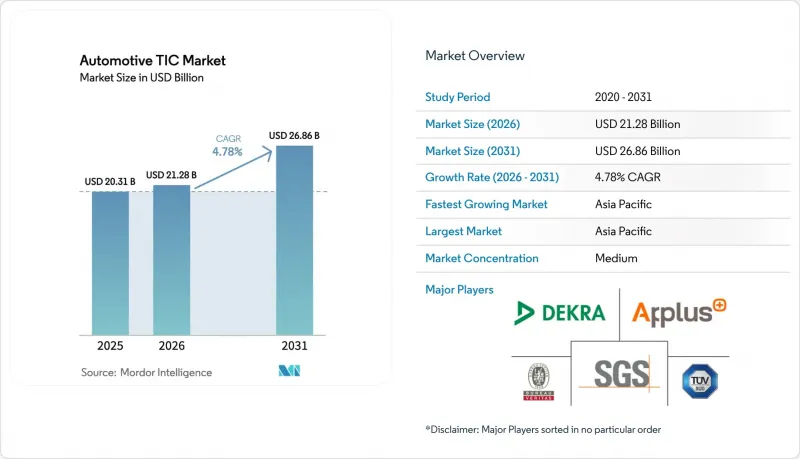
本報告按服務類型(測試服務、檢驗服務、認證服務)、採購方式(內部採購和外包)以及地區(北美、南美、歐洲、亞太、中東和非洲)進行細分。市場預測以美元計價。
全球汽車測試、檢驗和認證 (TIC) 市場趨勢及洞察
聯合國歐洲經濟委員會和國際標準化組織制定了更嚴格的安全法規
自2024年7月起,UNECE R155和R156標準將強制適用於新車,要求在車輛的整個生命週期內證明其網路安全管理能力。為協助OEM廠商滿足這些持續的合規要求,SGS已在其位於德國、荷蘭和新加坡的服務組合中新增了ISO/SAE 21434培訓和通用準則評估服務。 2024年發布的修訂版ISO 24089標準進一步收緊了自動駕駛的檢驗要求,要求製造商在單一審核框架下測試感測器融合、決策演算法和人機介面(HMI)的性能。半導體供應商迅速回應,多家晶片製造商在2024年獲得了ISO 26262 ASIL-D認證。這表明功能安全標準正在滲透到整個供應鏈。因此,能夠提供硬體、軟體和網路安全綜合評估的供應商正在獲得與車型系列更新周期相關的多年期合約。
擴大定期技術檢驗(PTI)外包範圍
各國政府擴大將車輛測試、調校和檢驗 (PTI) 業務外包給專業公司,以便在不增加公共部門資本支出的情況下,獲得先進的測試平台和數據分析平台。 DEKRA 在墨西哥瓜達拉哈拉擁有 61% 的測試生產線,這表明規模和聲譽如何影響公共競標。新的 PTI 測試範圍現在包括煞車顆粒物排放、電池健康狀況,甚至網路安全檢查。測試週期的差異——一些歐盟國家規定 12 個月的週期,而另一些國家則延長至 48 個月——為能夠靈活調整服務以適應不同法規的營運商提供了商機。能夠將數據即時傳輸給監管機構的數位化測試入口網站,使領先的技術檢驗 (TIC) 公司獲得優勢,並進一步加速了外包趨勢。
型式認證高成本,而且產品上市所需時間也很長。
美國CARB、歐7和中國GB標準等不同標準的差異迫使汽車製造商(OEM)對同一子系統進行檢驗。根據TUV Nord的報告顯示,日益嚴格的污染物排放限值、電池耐久性和駕駛輔助功能法規導致型式認證預算膨脹,並造成產品上市計畫延遲數月。 Stellantis公司在對一款歐寶車型進行調查後,被迫進行重新測試和維修,凸顯了誤解法規可能帶來的聲譽風險。中小型供應商受到的衝擊最大,對於一些小眾零件製造商而言,認證成本有時甚至超過年銷售額的10%。隨著向多能源平台宣傳活動,這種負擔進一步加重,因為每種動力系統都必須滿足其獨特的測試標準,而這些標準在監管機構之間並不通用。
細分市場分析
到2025年,測試領域將佔汽車測試、檢驗和認證(TIC)市場的60.85%。這反映了測試在檢驗硬體耐久性、電磁干擾抗擾性和安全關鍵軟體方面發揮的關鍵作用。對全車身碰撞測試、電池熱失控測試設備和車輛在環(VIL)模擬的持續需求,鞏固了該領域的規模優勢。認證領域雖然規模較小,但成長最快,複合年成長率(CAGR)達5.12%。這主要歸功於聯合國歐洲經濟委員會(UNECE)R155/R156標準,該標準要求原始設備製造商(OEM)在註冊新車前證明其具備網路安全和軟體更新能力。獲得各項強制性認證後,即可獲得後續的測試契約,用於定期審核和空中下載(OTA)重新認證。
數位孿生技術的引入正在重塑收入來源。 dSPACE 的 AURELION 平台使梅賽德斯-奔馳能夠檢驗駕駛場景,這些場景能夠忠實地再現感測器行為,監管機構認可其等同於真實駕駛。雖然此類模擬減少了物理原型數量,但並未降低測試量。相反,支出正轉向高效能運算叢集和資料檢驗服務。將測試跑道設施與認證模擬套件結合的供應商正在獲得涵蓋概念、設計和型式認證的多階段訂單。隨著開發商要求監管機構認證虛擬里程以滿足合規性目標,與軟體主導檢驗相關的汽車測試、檢驗和認證 (TIC) 市場預計將會擴張。
區域分析
預計到2025年,亞太地區將佔據48.12%的市場佔有率,並在2031年之前保持5.26%的複合年成長率,鞏固其作為汽車測試、檢驗和認證(TIC)市場中心的地位。中國日益嚴格的輪胎和照明強制性標準,以及其全球領先的電動車普及率,正在推動電池組和電磁相容性(EMC)檢驗業務向國內TIC中心集中。 NATRAX與TUV SUD在印度的合作縮短了ADAS和電磁相容性測試的前置作業時間,從而支持了印度緊湊型SUV出口的激增。日本的先進自動駕駛示範計畫以及韓國在汽車半導體領域的領先地位,進一步促進了軟體和儲存裝置認證的發展。然而,監管協調仍然有限,測試實驗室需要分別獲得GB、AIS和J標準的認證,這為全球營運的供應商提供了多年期的訂單保障。
歐洲憑藉著在主導地位,繼續保持著舉足輕重的地位。歐7排放氣體標準和循環經濟指令推動了對動力傳動系統耐久性、電池回收和報廢車輛拆解審核的強勁需求。該地區擁有由TUV、SGS和必維國際檢驗集團(Bureau Veritas)等權威機構組成的密集認證網路,這些機構均深受監管機構的信賴。東歐國家正吸引投資建造新的測試實驗室,以期找到比傳統的西歐測試地點更具成本效益的選擇。同時,英國脫歐帶來的複雜局面也促使更多認證工作轉移到歐洲大陸的實驗室。聯合國歐洲經濟委員會(UNECE)和國際標準化組織(ISO)標準的持續改進,即使在輕型汽車銷售低迷的情況下,也確保了穩定的收入來源。
在北美,重點在於自動駕駛汽車和網路安全檢驗。 DEKRA公司在密西根州投資2,280萬美元,用於一項2024年擴建項目,新增氣候測試艙和5G測試間,以支援正在進行的車輛軟體更新項目。由於美國聯邦法規和加州空氣資源委員會(CARB)的法規很少完全一致,製造商依賴測試與認證(TIC)公司來分離和管理符合兩種不同監管路徑的專案。隨著墨西哥作為製造地的地位日益提升,跨境測試的需求也隨之成長,尤其是在符合北美自由貿易協定(北美自由貿易組織(NAFTA)的排放氣體和安全認證方面。在南美、中東和非洲,新的機會正在湧現,儘管發展並不均衡。巴西的PROCONVE L7和L8標準正在增加對本地動力傳動系統測試的需求。同時,海灣國家正在投資建造測試中心,以滿足不斷成長的乘用車需求。儘管基礎設施和技術短缺阻礙了發展,但與地方政府合作的全球供應商正在獲得先發優勢。
其他好處:
- Excel格式的市場預測(ME)表
- 3個月的分析師支持
目錄
第1章:引言
- 研究假設和市場定義
- 調查範圍
第2章:調查方法
第3章執行摘要
第4章 市場狀況
- 市場概覽
- 市場促進因素
- 聯合國歐洲經濟委員會和國際標準化組織制定了更嚴格的安全標準
- 擴大定期技術檢驗(PTI)外包範圍
- 電氣化正在推動電池和電動動力傳動系統。
- 聯網汽車的網路安全合規性
- OTA軟體更新檢驗要求
- 循環經濟的二手產品認證
- 市場限制因素
- 型式認證高成本,而且產品上市所需時間也很長。
- 各國PTI法規存在差異
- 電動車認證測試工程師短缺
- 自主系統的倫理人工智慧審計存在差距
- 產業價值鏈分析
- 宏觀經濟因素的影響
- 監理情勢
- 技術展望
- 波特五力分析
第5章 市場規模與成長預測
- 按服務類型
- 測試服務
- 檢查服務
- 身份驗證服務
- 透過採購方式
- 內部
- 外包
- 按地區
- 北美洲
- 美國
- 加拿大
- 墨西哥
- 南美洲
- 巴西
- 阿根廷
- 其他南美國家
- 歐洲
- 德國
- 英國
- 法國
- 義大利
- 西班牙
- 其他歐洲國家
- 亞太地區
- 中國
- 日本
- 印度
- 韓國
- 東南亞
- 其他亞太國家
- 中東和非洲
- 中東
- 沙烏地阿拉伯
- 阿拉伯聯合大公國
- 土耳其
- 其他中東國家
- 非洲
- 南非
- 奈及利亞
- 其他非洲國家
- 中東
- 北美洲
第6章 競爭情勢
- 市場集中度
- 策略趨勢
- 市佔率分析
- 公司簡介
- SGS SA
- Bureau Veritas SA
- DEKRA SE
- TUV SUD AG
- TUV Rheinland AG
- TUV Nord Group
- Intertek Group plc
- Applus Services SA
- UL Solutions Inc.
- ALS Limited
- Lloyd's Register Group Ltd.
- Kiwa NV
- Element Materials Technology Group
- Eurofins Scientific SE
- DNV AS
- RINA SpA
- SOCOTEC Group SA
- Keysight Technologies Inc.
- CSA Group
- MISTRAS Group, Inc.
- MAHLE Powertrain Ltd.
- SAI Global Assurance
- NATRAX
- Cotecna Inspection SA
第7章 市場機會與未來展望
According to Mordor Intelligence, the automotive testing, inspection, and certification market size was valued at USD 20.31 billion in 2025 and estimated to grow from USD 21.28 billion in 2026 to reach USD 26.86 billion by 2031, at a CAGR of 4.78% during the forecast period (2026-2031).
This report is Segmented by Service Type (Testing Services, Inspection Services, and Certification Services), Sourcing Type (In-House and Outsourced), and Geography (North America, South America, Europe, Asia-Pacific, and Middle East and Africa). The Market Forecasts are Provided in Terms of Value (USD).
Global Automotive TIC Market Trends and Insights
Stricter UNECE and ISO Safety Mandates
UNECE R155 and R156, mandatory for new vehicle types since July 2024, require demonstrable cybersecurity management throughout a vehicle's lifespan. SGS enlarged its portfolio to include ISO/SAE 21434 training and Common-Criteria evaluations across Germany, the Netherlands, and Singapore, enabling OEMs to meet these continuous-compliance expectations. ISO 24089 revisions published in 2024 added tougher automated-driving validation, forcing manufacturers to test sensor fusion, decision algorithms, and human-machine-interface (HMI) performance under a single audit umbrella. Semiconductor suppliers responded quickly; multiple chipmakers achieved ISO 26262 ASIL-D in 2024, proving functional-safety standards now permeate the full supply chain. As a result, providers that can deliver integrated hardware, software, and cybersecurity assessments are winning multi-year contracts tied to model-series refresh cycles.
Growing Outsourcing of Periodic Technical Inspection (PTI)
Governments increasingly delegate PTI activities to specialized firms to access advanced test benches and data analytics platforms without public-sector capital outlay. DEKRA secured 61% of inspection lines in Guadalajara, Mexico, showing how scale and reputation sway public tenders.New PTI scopes now cover brake-particle emissions, battery health, and even cybersecurity checks. Fragmented inspection intervals-some EU nations mandate 12-month cycles while others stretch to 48 months-create opportunities for providers adept at tailoring services to divergent rules. Digital inspection portals enabling real-time data transfer to regulators give large TIC firms an edge, reinforcing the outsourcing trajectory.
High Cost and Time-to-Market of Homologation
Divergent U.S. CARB, Euro 7, and Chinese GB standards force OEMs to run parallel validation cycles for identical subsystems. TUV NORD reports that multiplying rules for pollutant limits, battery durability, and driver-assist functions inflate homologation budgets and add months to launch schedules. Stellantis faced investigations over Opel models that triggered retesting and retrofit campaigns, highlighting reputational exposure when rules are misinterpreted.Small suppliers feel the pinch most; certification fees can exceed 10% of annual revenue for niche component makers. The push toward multi-energy platforms intensifies the burden because each propulsion type must satisfy distinct test matrices without cross-credit among regulators.
Other drivers and restraints analyzed in the detailed report include:
- Electrification Driving Battery and E-Powertrain Testing
- Connected-Car Cyber-Security Compliance
- Fragmented Country-Level PTI Regulations
For complete list of drivers and restraints, kindly check the Table Of Contents.
Segment Analysis
Testing held a 60.85% share of the automotive testing, inspection, and certification market in 2025, reflecting its indispensability for validating hardware durability, EMI resilience, and safety-critical software. Continued demand for full-vehicle crash tests, battery thermal-runaway chambers, and vehicle-in-the-loop (VIL) simulations anchors the segment's scale advantage. Certification, though smaller, is growing fastest at 5.12% CAGR because UNECE R155/R156 obligate OEMs to prove cybersecurity and software-update competence before any new model is registered. Each mandatory certificate unlocks downstream testing contracts for periodic audits and OTA re-approvals.
Digital-twin adoption is reshaping revenue composition. dSPACE's AURELION platform enables Mercedes-Benz to perform sensor-realistic driving scenario validation that regulators accept as equivalent to road miles. Such simulation reduces physical-prototype counts, but it does not diminish testing volume; instead, it shifts spend to high-performance computing clusters and data-validation services. Providers pairing track facilities with certified simulation suites secure multi-phase bookings covering concept, design, and homologation. The automotive testing, inspection, and certification market size tied to software-driven validation is set to widen as developers ask regulators to credit virtual kilometers toward compliance targets.
Complete Report Scope:
- By Service Type
- Testing Services
- Inspection Services
- Certification Services
- By Sourcing Type
- In-house
- Outsourced
- By Geography
- North America
- United States
- Canada
- Mexico
- South America
- Brazil
- Argentina
- Rest of South America
- Europe
- Germany
- United Kingdom
- France
- Italy
- Spain
- Rest of Europe
- Asia-Pacific
- China
- Japan
- India
- South Korea
- South-East Asia
- Rest of Asia-Pacific
- Middle East and Africa
- Middle East
- Saudi Arabia
- United Arab Emirates
- Turkey
- Rest of Middle East
- Africa
- South Africa
- Nigeria
- Rest of Africa
- Middle East
- North America
Geography Analysis
Asia-Pacific's 48.12% share in 2025 and 5.26% CAGR through 2031 confirm the region as the gravitational center of the automotive testing, inspection, and certification market. China's mandate for enhanced tyre and lighting standards, couples with the world's highest electric-vehicle adoption, is funneling battery-pack and EMC validation work to domestic TIC zones. India's NATRAX alliance with TUV SUD has cut lead times for ADAS and electromagnetic-compatibility tests, supporting the country's surge in compact SUV exports. Japan's advanced autonomous-drive pilots and South Korea's prominence in automotive semiconductors add layers of software and memory-device certification volume. Yet regulatory harmonization remains modest; labs must hold discrete accreditations for GB, AIS, and J-type standards, reinforcing multiyear project bookings for globally connected providers.
Europe sustains significant weight thanks to rule-making leadership. Euro 7 emissions ceilings and circular-economy directives keep demand robust for powertrain durability, battery recycling, and end-of-life dismantling audits. The region houses dense networks of TUV, SGS, and Bureau Veritas facilities that possess deep regulators' trust. Eastern European nations attract new lab investments as cost-effective alternatives to legacy Western European sites, while Brexit complications channel additional certification runs to continental labs. Continued refinement of UNECE and ISO standards ensures steady revenue even as light-vehicle sales stagnate.
North America concentrates on autonomous-vehicle and cybersecurity validations. DEKRA's USD 22.8 million Michigan expansion in 2024 added climatic chambers and 5G test bays to serve a pipeline of vehicle-software overhauls. U.S. federal and California CARB rules seldom align perfectly, so manufacturers rely on TIC firms to separate and manage dual-path programs. Mexico's rising role as a manufacturing hub generates cross-border testing demand, especially for NAFTA-compliant emissions and safety certifications. South America and the Middle East, and Africa show emerging, if uneven, promise. Brazil's PROCONVE L7 and L8 standards increase local powertrain testing needs, while Gulf countries invest in inspection centers tied to growing passenger-car fleets. Infrastructure gaps and technician shortages temper growth but also create first-mover advantages for global providers that partner with local governments.
- SGS SA
- Bureau Veritas SA
- DEKRA SE
- TUV SUD AG
- TUV Rheinland AG
- TUV Nord Group
- Intertek Group plc
- Applus Services S.A.
- UL Solutions Inc.
- ALS Limited
- Lloyd's Register Group Ltd.
- Kiwa N.V.
- Element Materials Technology Group
- Eurofins Scientific SE
- DNV AS
- RINA S.p.A.
- SOCOTEC Group SA
- Keysight Technologies Inc.
- CSA Group
- MISTRAS Group, Inc.
- MAHLE Powertrain Ltd.
- SAI Global Assurance
- NATRAX
- Cotecna Inspection SA
Additional Benefits:
- The market estimate (ME) sheet in Excel format
- 3 months of analyst support
TABLE OF CONTENTS
1 INTRODUCTION
- 1.1 Study Assumptions and Market Definition
- 1.2 Scope of the Study
2 RESEARCH METHODOLOGY
3 EXECUTIVE SUMMARY
4 MARKET LANDSCAPE
- 4.1 Market Overview
- 4.2 Market Drivers
- 4.2.1 Stricter UNECE and ISO Safety Mandates
- 4.2.2 Growing Outsourcing of Periodic Technical Inspection (PTI)
- 4.2.3 Electrification Driving Battery and E-Powertrain Testing
- 4.2.4 Connected-Car Cyber-Security Compliance
- 4.2.5 OTA Software-Update Validation Needs
- 4.2.6 Circular-Economy End-of-Life Certification
- 4.3 Market Restraints
- 4.3.1 High Cost and Time-to-Market of Homologation
- 4.3.2 Fragmented Country-Level PTI Regulations
- 4.3.3 Shortage of EV-Qualified Test Engineers
- 4.3.4 Ethical-AI Audit Gaps for Autonomous Systems
- 4.4 Industry Value Chain Analysis
- 4.5 Impact of Macroeconomic Factors
- 4.6 Regulatory Landscape
- 4.7 Technological Outlook
- 4.8 Porter's Five Forces Analysis
- 4.8.1 Threat of New Entrants
- 4.8.2 Bargaining Power of Suppliers
- 4.8.3 Bargaining Power of Buyers
- 4.8.4 Threat of Substitutes
- 4.8.5 Competitive Rivalry
5 MARKET SIZE AND GROWTH FORECASTS (VALUE)
- 5.1 By Service Type
- 5.1.1 Testing Services
- 5.1.2 Inspection Services
- 5.1.3 Certification Services
- 5.2 By Sourcing Type
- 5.2.1 In-house
- 5.2.2 Outsourced
- 5.3 By Geography
- 5.3.1 North America
- 5.3.1.1 United States
- 5.3.1.2 Canada
- 5.3.1.3 Mexico
- 5.3.2 South America
- 5.3.2.1 Brazil
- 5.3.2.2 Argentina
- 5.3.2.3 Rest of South America
- 5.3.3 Europe
- 5.3.3.1 Germany
- 5.3.3.2 United Kingdom
- 5.3.3.3 France
- 5.3.3.4 Italy
- 5.3.3.5 Spain
- 5.3.3.6 Rest of Europe
- 5.3.4 Asia-Pacific
- 5.3.4.1 China
- 5.3.4.2 Japan
- 5.3.4.3 India
- 5.3.4.4 South Korea
- 5.3.4.5 South-East Asia
- 5.3.4.6 Rest of Asia-Pacific
- 5.3.5 Middle East and Africa
- 5.3.5.1 Middle East
- 5.3.5.1.1 Saudi Arabia
- 5.3.5.1.2 United Arab Emirates
- 5.3.5.1.3 Turkey
- 5.3.5.1.4 Rest of Middle East
- 5.3.5.2 Africa
- 5.3.5.2.1 South Africa
- 5.3.5.2.2 Nigeria
- 5.3.5.2.3 Rest of Africa
- 5.3.5.1 Middle East
- 5.3.1 North America
6 COMPETITIVE LANDSCAPE
- 6.1 Market Concentration
- 6.2 Strategic Moves
- 6.3 Market Share Analysis
- 6.4 Company Profiles (includes Global level Overview, Market level overview, Core Segments, Financials as available, Strategic Information, Market Rank/Share for key companies, Products and Services, and Recent Developments)
- 6.4.1 SGS SA
- 6.4.2 Bureau Veritas SA
- 6.4.3 DEKRA SE
- 6.4.4 TUV SUD AG
- 6.4.5 TUV Rheinland AG
- 6.4.6 TUV Nord Group
- 6.4.7 Intertek Group plc
- 6.4.8 Applus Services S.A.
- 6.4.9 UL Solutions Inc.
- 6.4.10 ALS Limited
- 6.4.11 Lloyd's Register Group Ltd.
- 6.4.12 Kiwa N.V.
- 6.4.13 Element Materials Technology Group
- 6.4.14 Eurofins Scientific SE
- 6.4.15 DNV AS
- 6.4.16 RINA S.p.A.
- 6.4.17 SOCOTEC Group SA
- 6.4.18 Keysight Technologies Inc.
- 6.4.19 CSA Group
- 6.4.20 MISTRAS Group, Inc.
- 6.4.21 MAHLE Powertrain Ltd.
- 6.4.22 SAI Global Assurance
- 6.4.23 NATRAX
- 6.4.24 Cotecna Inspection SA
7 MARKET OPPORTUNITIES AND FUTURE OUTLOOK
- 7.1 White-space and Unmet-Need Assessment

 電動車測試、檢驗和認證市場-全球及區域分析:按產品、應用和國家分類-分析與預測,2026-2035年
 汽車TIC市場:2026-2032年全球市場預測(依服務類型、零件類型、傳動系統、採購方式、車輛類型和應用程式分類)汽車技術檢驗和認證服務市場:2026-2032年全球市場預測(按服務類型、車輛類型、檢驗方法、應用和最終用戶分類)
 汽車TIC市場分析及至2035年的預測:按類型、產品、服務、技術、組件、應用、流程、最終用戶、功能和解決方案
 電動車檢測認證市場-全球產業規模、佔有率、趨勢、機會與預測:按類型、應用、地區和競爭格局分類,2021-2031年
 汽車資訊通訊技術服務市場機會、成長要素、產業趨勢分析及2026-2035年預測
 2026年全球汽車SMT生產線可追溯性市場報告2026年全球汽車測試、檢驗和認證(TIC)市場報告2026年全球汽車認證服務市場報告
 全球電動車(EV)測試、檢驗和認證(TIC)市場規模、佔有率、趨勢和成長分析報告(2026-2034)