

 |
市場調查報告書
商品編碼
2117198
同意管理:市場佔有率分析、行業趨勢和統計數據、成長預測(2026-2031 年)Consent Management - Market Share Analysis, Industry Trends & Statistics, Growth Forecasts (2026 - 2031) |
||||||

※ 本網頁內容可能與最新版本有所差異。詳細情況請與我們聯繫。
據 Mordor Intelligence 稱,2025 年同意管理市場價值為 9.1 億美元,預計到 2031 年將從 2026 年的 10.7 億美元成長至 23.4 億美元,預測期(2026-2031 年)的複合年成長率為 17.05%。
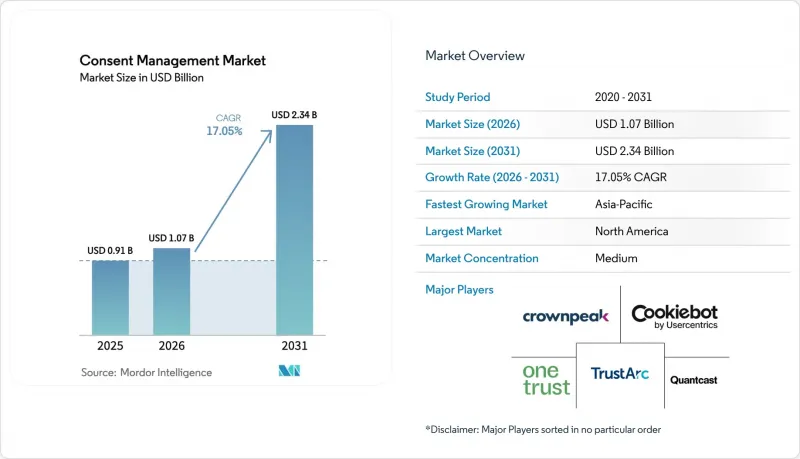
本報告按元件(軟體和服務)、部署模式(雲端和本地部署)、觸點(Web 應用、行動應用、API/SDK)、組織規模(大型企業和中小企業)、最終用戶產業(IT 和電信、銀行、金融服務和保險等)以及地區進行細分。市場預測以美元計價。
全球同意管理市場趨勢與洞察
嚴格的全球隱私法規和特定產業的隱私法規正在推動市場擴張。
2025年,美國八個州頒布了新的隱私法,印度的《數位個人資料保護法》生效,美國司法部新的國家安全法規也相繼生效,這些措施加強了執法力度,迫使企業徹底改革其用戶許可管理工具和管治流程。例如,馬裡蘭州禁止出售敏感數據,新澤西州加強了對未成年人的保護,這些州法律要求設置極其精細的權限,而傳統的cookie彈窗無法實現這一點。金融機構也面臨類似的壓力,包括GDPR規定的更高罰款、印度針對生物識別的保護措施以及澳洲更嚴格的開放銀行監管。 2024年,罰款金額通常高達數百萬美元,這促使用戶許可平台從“可選插件”轉變為“核心基礎設施”,並引發了預算重新分配和董事會層面的監督。
第一方資料策略重塑了同意架構。
谷歌決定在2024年8月發布統一的CMP(用戶同意管理平台)的同時保留第三方Cookie,這項舉措促使企業將焦點從Cookie合規性轉向全面的資料管治,從而提升了用戶同意管理市場的重要性。研究表明,78%的B2C品牌目前優先考慮直接資料收集,這催生了對能夠尊重使用者在網頁、應用程式和伺服器環境中偏好的編配引擎的需求。微軟要求廣告主在2025年5月5日前發送用戶同意訊號,加速了用戶同意模式和即時偏好API的普及。由Didomi等公司推廣的伺服器端標記技術,作為一種既能保護隱私又能維持宣傳活動效果且不影響合規性的替代方案,正日益受到關注。
多個司法管轄區不斷變化的要求是實施的障礙。
在美國19個州、歐盟、中國和印度運營的組織必須協調相互衝突的加入、退出和資料本地化規則,這導致實施負擔加重和法律諮詢成本上升。印度的「授權同意控制者」概念在資料流中引入了一個新的實體,而中國的跨境安全評估則要求同意記錄符合國內網路安全審計機構的資料準則。由於缺乏全球標準,企業隱私團隊必須維護多套平行規則,消耗了高達40%的專案預算,並延長了引進週期。
細分市場分析
到2025年,軟體平台將佔總收入的66.80%。這反映出市場對可擴展至各種數位資產的自動化橫幅廣告展示、偏好庫和合規性儀錶板的持續需求。隨著企業將監管解讀和持續監控外包,涵蓋部署、整合和合規性管理的服務正以每年17.1%的速度成長。這一成長勢頭凸顯出,政策的複雜性已經超過了「點擊式」配置的適用範圍,從而推動了對具備法律、用戶體驗和DevSecOps技能的多學科團隊的需求。
服務供應商正在將自動化掃描、腳本分類和邊緣使用者許可監控整合到打包服務中,從而縮短專案週期並降低整體擁有成本 (TCO)。這使得企業能夠將規則集的持續更新外包,確保橫幅廣告能夠適應法規變化。在預測期內,結合許可軟體和附加價值服務的混合模式將成為主流,尤其是在沒有內部隱私工程師的中型企業買家中。
預計到 2025 年,雲端服務收入將佔總營收的 64.10%,預測期內複合年成長率 (CAGR) 為 18.0%。品牌方正在尋求不斷更新的規則、用於低延遲橫幅廣告呼叫的全球邊緣節點以及用於處理用戶同意訊號的彈性運算。由於無需升級專案的自動化功能發布,雲端解決方案中的用戶同意管理市場預計將以最快的速度成長。由於資料居住要求和內部審計義務要求本地小型資料庫,本地部署在醫療保健和金融服務行業仍然普遍存在。然而,即使是這些產業也在轉向混合架構,將分析資料和非個人識別資料路由到安全的雲端環境。
邊緣運算帶來了另一個微妙的差異。聯網汽車、智慧工廠和遠端醫療設備需要低延遲的授權檢查,而這些檢查不能總是依賴中央伺服器。雲端供應商正在透過提供輕量級代理來解決這個問題,這些代理將策略邏輯快取在本地,並在連接恢復時同步狀態,從而在主權要求和全局編配之間取得平衡。
區域分析
預計到2025年,北美將佔據最大的收入佔有率,達到36.20%,這主要得益於加州《隱私權法案》、各州不斷完善的法規以及企業對第一方資料管治的重視。聯邦機構於2025年4月進一步加強了監管,限制外國存取敏感的美國個人數據,並要求醫療服務提供者和雲端處理商加強同意驗證。隨著加拿大《個人資訊保護和電子文件法案》(PIPEDA)的修訂以及墨西哥相關框架的逐步完善,區域複雜性日益增加,迫使企業轉向能夠自動根據各州和國家調整通知的平台。
亞太地區是成長最快的區域,預計到2031年將以17.4%的複合年成長率成長。這主要得益於印度《數位個人資料保護法》正式定義了“同意控制者”,以及中國對跨境資料傳輸實施安全評估。日本、韓國和澳洲在成熟的法律框架下保持穩定的應用,而印尼、越南和菲律賓正進入實施階段,預計將產生新的需求。人口密集市場的使用者疲勞正在推動視覺效果更佳的通知設計創新,並促使人們建立替代性的法律基礎。
歐洲是一個成熟但仍在不斷發展的市場。儘管GDPR仍然是合規的基礎,但德國的《同意管理法規》和歐盟的《人工智慧法案》都提出了新的要求,需要改善介面並提高演算法的透明度。歐盟範圍內圍繞「同意或付費」模式的討論正在推動提供公平且免費替代方案的偏好中心的發展。在英國,脫歐後的法規改變了退出機制,迫使供應商維護可配置的模板,這些模板既適用於歐盟用戶,也適用於英國用戶。
其他好處:
- Excel格式的市場預測(ME)表
- 3個月的分析師支持
目錄
第1章:引言
- 研究假設和市場定義
- 調查範圍
第2章:調查方法
第3章執行摘要
第4章 市場狀況
- 市場概覽
- 市場促進因素
- 嚴格的全球和特定產業隱私法規(GDPR、CCPA、HIPAA 等)
- 第三方 cookie 的逐步淘汰引發了第一方資料策略的快速擴張。
- 「數據信任用戶體驗」的崛起成為競爭差異化因素。
- 物聯網邊緣設備(穿戴式裝置、汽車等)中嵌入的同意機制
- 在 DevSecOps 技術堆疊中實現「隱私即程式碼」流程的自動化
- Web3生態系中,同意令牌檢驗的身份驗證憑證。
- 市場限制因素
- 跨多個司法管轄區的要求不斷變化
- 中小企業在實施隱私保護工具的預算有限。
- 消費者對同意問題的疲勞導致選擇加入率下降。
- 缺乏普遍認可的互通性標準
- 供應鏈分析
- 監理情勢
- 技術展望
- 波特五力分析
- 市場宏觀經濟趨勢的評估
第5章 市場規模與成長預測
- 按組件
- 軟體
- 服務
- 按部署模式
- 雲
- 現場
- 透過觸點
- Web應用程式
- 行動應用
- API/SDK
- 按組織規模
- 大公司
- 小型企業
- 按最終用戶行業分類
- 資訊科技/通訊
- 政府/公共部門
- 醫療保健和生命科學
- 零售與電子商務
- BFSI
- 媒體與娛樂
- 其他(旅遊、教育)
- 按地區
- 北美洲
- 美國
- 加拿大
- 墨西哥
- 南美洲
- 巴西
- 阿根廷
- 其他南美國家
- 歐洲
- 德國
- 英國
- 法國
- 義大利
- 西班牙
- 俄羅斯
- 其他歐洲國家
- 亞太地區
- 中國
- 日本
- 印度
- 韓國
- 澳洲
- 其他亞太國家
- 中東和非洲
- 中東
- 沙烏地阿拉伯
- 阿拉伯聯合大公國
- 土耳其
- 其他中東國家
- 非洲
- 南非
- 奈及利亞
- 肯亞
- 其他非洲國家
- 中東
- 北美洲
第6章 競爭情勢
- 市場集中度
- 策略趨勢
- 市佔率分析
- 公司簡介
- OneTrust
- TrustArc
- Cookiebot
- Quantcast
- Crownpeak
- Didomi
- BigID
- Osano
- Piwik PRO
- Trunomi
- HIPAA-T
- Ketch
- Usercentrics
- Civic UK
- ConsentManager.net
- Sourcepoint Technologies
- Termly
- Securiti.ai
- MineOS(Mine PrivacyOps)
- Privado.ai
- IBM
- Salesforce
第7章 市場機會與未來展望
According to Mordor Intelligence, the consent management market size was valued at USD 0.91 billion in 2025 and estimated to grow from USD 1.07 billion in 2026 to reach USD 2.34 billion by 2031, at a CAGR of 17.05% during the forecast period (2026-2031).
This report is Segmented by Component (Software and Services), Deployment Model (Cloud and On-Premises), Touchpoint (Web App, Mobile App, and API/SDK), Organization Size (Large Enterprises and SMEs), End-User Industry (IT and Telecom, BFSI, and More), and by Geography. The Market Forecasts are Provided in Terms of Value (USD).
Global Consent Management Market Trends and Insights
Stringent global and sector-specific privacy rules drive market expansion
Intensified enforcement arrived in 2025 as eight additional US state privacy statutes, India's Digital Personal Data Protection Act, and new Department of Justice national-security rules forced enterprises to refresh consent tooling and governance processes. State laws such as Maryland's ban on sensitive data sales and New Jersey's heightened protections for minors require hyper-granular permissioning that legacy cookie pop-ups cannot deliver. Financial institutions face parallel pressures from rising GDPR penalties, India's biometric safeguards, and Australia's stricter open-banking mandates. Penalties levied in 2024, often reaching multimillion-dollar sums, have reframed consent platforms as core infrastructure rather than discretionary add-ons, triggering budget reallocations and board-level oversight.
First-party data strategies reshape consent architecture
Google's decision to retain third-party cookies, while releasing an integrated CMP setup in August 2024, elevated the consent management market by shifting the enterprise focus from cookie compliance to holistic data governance. Research shows that 78% of B2C brands now prioritize direct data collection, creating demand for orchestration engines that honor user preferences across web, app, and server environments. Microsoft's requirement that advertisers pass consent signals by May 5, 2025, accelerated the adoption of consent mode and real-time preference APIs.Server-side tagging, championed by firms such as Didomi, is gaining traction as a privacy-preserving alternative that maintains campaign performance without sacrificing compliance.
Constantly shifting multi-jurisdictional requirements create implementation barriers
Organizations operating across 19 US states, the EU, China, and India must juggle conflicting opt-in, opt-out, and data-localization rules, inflating configuration overhead and legal consulting spend. India's concept of licensed "consent managers" adds a new actor to data flows, while China's cross-border security assessments require consent records that satisfy domestic cybersecurity auditors' data guidance. Absent global standards, enterprise privacy teams maintain parallel rule sets, consuming as much as 40% of total program budgets and prolonging deployment cycles.
Other drivers and restraints analyzed in the detailed report include:
- Data-trust user experience emerges as a competitive differentiator
- Embedded consent inside IoT-edge devices stimulates technical innovation
- SMB budget constraints limit market penetration
For complete list of drivers and restraints, kindly check the Table Of Contents.
Segment Analysis
Software platforms generated 66.80% revenue in 2025, reflecting enduring demand for automated banner rendering, preference vaults, and compliance dashboards that scale across digital estates. Services, covering implementation, integration, and managed compliance, are expanding at 17.1% annually as organizations outsource regulatory interpretation and ongoing monitoring. This momentum underscores how policy complexity outpaces point-and-click configuration, elevating demand for multidisciplinary teams that combine legal, UX, and DevSecOps skill sets.
Services providers are embedding automated scanning, script categorization, and edge consent monitoring into packaged offerings, shortening project timelines and lowering total cost of ownership. Enterprises can thus delegate continuous rule-set updates, ensuring banners adapt as legislatures revise statutes. Over the forecast window, hybrid models bundling licensed software with value-added services will become prevalent, especially for mid-market buyers lacking in-house privacy engineers.
Cloud delivery captured 64.10% revenue in 2025, expected to register a CAGR of 18.0% over the forecast period. As brands pursued always-on rule updates, global edge nodes for latency-free banner calls, and elastic compute for consent signal processing. The consent management market size for cloud solutions will expand fastest, supported by automatic feature releases that eliminate upgrade projects. On-premises deployments persist in healthcare and financial services, where data residency and internal audit obligations dictate local storage, yet even these sectors gravitate toward hybrid architectures that route analytics and non-identifying data to secure-cloud environments.
Edge computing introduces additional nuance. Connected cars, smart factories, and remote medical devices demand low-latency consent checks that cannot always rely on central servers. Cloud vendors respond with lightweight agents that cache policy logic locally while synchronizing state when connectivity resumes, marrying sovereignty requirements with global orchestration.
Complete Report Scope:
- By Component
- Software
- Services
- By Deployment Model
- Cloud
- On-premises
- By TouchPoint
- Web App
- Mobile App
- API/SDK
- By Organisation Size
- Large Enterprises
- Small and Mid-sized Enterprises
- By End-User Industry
- IT and Telecom
- Government and Public Sector
- Healthcare and Life Sciences
- Retail and E-commerce
- BFSI
- Media and Entertainment
- Others (Travel, Education)
- By Geography
- North America
- United States
- Canada
- Mexico
- South America
- Brazil
- Argentina
- Rest of South America
- Europe
- Germany
- United Kingdom
- France
- Italy
- Spain
- Russia
- Rest of Europe
- Asia Pacific
- China
- Japan
- India
- South Korea
- Australia
- Rest of Asia Pacific
- Middle East and Africa
- Middle East
- Saudi Arabia
- United Arab Emirates
- Turkey
- Rest of Middle East
- Africa
- South Africa
- Nigeria
- Kenya
- Rest of Africa
- Middle East
- North America
Geography Analysis
North America generated the largest portion of 2025 revenue at 36.20%, buoyed by the California Privacy Rights Act, rising state-level statutes, and corporate focus on first-party data governance. Federal agencies further tightened oversight in April 2025, restricting foreign access to sensitive US personal data and compelling health providers and cloud processors to upgrade consent verification. Canada's PIPEDA amendments and Mexico's emerging framework compound regional complexity, driving enterprises to platforms that can auto-calibrate notices by state and country.
Asia-Pacific is the fastest-growing region, rising at 17.4% CAGR through 2031 as India's Digital Personal Data Protection Act formalizes "consent managers" and China enforces cross-border transfer security assessments. Japan, South Korea, and Australia maintain stable adoption under mature regimes, while Indonesia, Vietnam, and the Philippines enter enforcement phases that will unlock fresh demand. User fatigue within populous markets fuels innovation in visually streamlined notice design and alternative lawful bases.
Europe remains a mature yet evolving arena. The GDPR continues to anchor compliance, but Germany's Consent Management Ordinance and the EU AI Act add fresh layers that require interface refinements and algorithmic transparency. Pan-EU debate around "consent or pay" models spurs the development of preference centers that offer equitable free alternatives. The United Kingdom's evolving post-Brexit rules create divergent opt-out mechanics, forcing vendors to maintain configurable templates for EU and UK visitors.
- OneTrust
- TrustArc
- Cookiebot
- Quantcast
- Crownpeak
- Didomi
- BigID
- Osano
- Piwik PRO
- Trunomi
- HIPAA-T
- Ketch
- Usercentrics
- Civic UK
- ConsentManager.net
- Sourcepoint Technologies
- Termly
- Securiti.ai
- MineOS (Mine PrivacyOps)
- Privado.ai
- IBM
- Salesforce
Additional Benefits:
- The market estimate (ME) sheet in Excel format
- 3 months of analyst support
TABLE OF CONTENTS
1 INTRODUCTION
- 1.1 Study Assumptions and Market Definition
- 1.2 Scope of the Study
2 RESEARCH METHODOLOGY
3 EXECUTIVE SUMMARY
4 MARKET LANDSCAPE
- 4.1 Market Overview
- 4.2 Market Drivers
- 4.2.1 Stringent global and sector-specific privacy rules (GDPR, CCPA, HIPAA etc.)
- 4.2.2 Explosion of first-party data strategies post third-party cookie deprecation
- 4.2.3 Rise of data-trust UX as a competitive differentiator
- 4.2.4 Embedded consent inside IoT-edge devices (wearables, vehicles)
- 4.2.5 Automated privacy as code pipelines in DevSecOps stacks
- 4.2.6 Consent tokens as verifiable credentials in Web3 ecosystems
- 4.3 Market Restraints
- 4.3.1 Constantly shifting multi-jurisdictional requirements
- 4.3.2 Low executive budgets in SMBs for privacy tooling
- 4.3.3 Consumer consent fatigue reducing opt-in rates
- 4.3.4 Absence of universal consent interoperability standards
- 4.4 Supply-Chain Analysis
- 4.5 Regulatory Landscape
- 4.6 Technological Outlook
- 4.7 Porters Five Forces Analysis
- 4.7.1 Bargaining Power of Suppliers
- 4.7.2 Bargaining Power of Buyers
- 4.7.3 Threat of New Entrants
- 4.7.4 Threat of Substitute Products
- 4.7.5 Intensity of Competitive Rivalry
- 4.8 Assesment of Macroeconomic Trends on the Market
5 MARKET SIZE AND GROWTH FORECASTS (VALUE)
- 5.1 By Component
- 5.1.1 Software
- 5.1.2 Services
- 5.2 By Deployment Model
- 5.2.1 Cloud
- 5.2.2 On-premises
- 5.3 By TouchPoint
- 5.3.1 Web App
- 5.3.2 Mobile App
- 5.3.3 API/SDK
- 5.4 By Organisation Size
- 5.4.1 Large Enterprises
- 5.4.2 Small and Mid-sized Enterprises
- 5.5 By End-User Industry
- 5.5.1 IT and Telecom
- 5.5.2 Government and Public Sector
- 5.5.3 Healthcare and Life Sciences
- 5.5.4 Retail and E-commerce
- 5.5.5 BFSI
- 5.5.6 Media and Entertainment
- 5.5.7 Others (Travel, Education)
- 5.6 By Geography
- 5.6.1 North America
- 5.6.1.1 United States
- 5.6.1.2 Canada
- 5.6.1.3 Mexico
- 5.6.2 South America
- 5.6.2.1 Brazil
- 5.6.2.2 Argentina
- 5.6.2.3 Rest of South America
- 5.6.3 Europe
- 5.6.3.1 Germany
- 5.6.3.2 United Kingdom
- 5.6.3.3 France
- 5.6.3.4 Italy
- 5.6.3.5 Spain
- 5.6.3.6 Russia
- 5.6.3.7 Rest of Europe
- 5.6.4 Asia Pacific
- 5.6.4.1 China
- 5.6.4.2 Japan
- 5.6.4.3 India
- 5.6.4.4 South Korea
- 5.6.4.5 Australia
- 5.6.4.6 Rest of Asia Pacific
- 5.6.5 Middle East and Africa
- 5.6.5.1 Middle East
- 5.6.5.1.1 Saudi Arabia
- 5.6.5.1.2 United Arab Emirates
- 5.6.5.1.3 Turkey
- 5.6.5.1.4 Rest of Middle East
- 5.6.5.2 Africa
- 5.6.5.2.1 South Africa
- 5.6.5.2.2 Nigeria
- 5.6.5.2.3 Kenya
- 5.6.5.2.4 Rest of Africa
- 5.6.5.1 Middle East
- 5.6.1 North America
6 COMPETITIVE LANDSCAPE
- 6.1 Market Concentration
- 6.2 Strategic Moves
- 6.3 Market Share Analysis
- 6.4 Company Profiles (includes Global level Overview, Market level overview, Core Segments, Financials as available, Strategic Information, Market Rank/Share for key companies, Products and Services, and Recent Developments)
- 6.4.1 OneTrust
- 6.4.2 TrustArc
- 6.4.3 Cookiebot
- 6.4.4 Quantcast
- 6.4.5 Crownpeak
- 6.4.6 Didomi
- 6.4.7 BigID
- 6.4.8 Osano
- 6.4.9 Piwik PRO
- 6.4.10 Trunomi
- 6.4.11 HIPAA-T
- 6.4.12 Ketch
- 6.4.13 Usercentrics
- 6.4.14 Civic UK
- 6.4.15 ConsentManager.net
- 6.4.16 Sourcepoint Technologies
- 6.4.17 Termly
- 6.4.18 Securiti.ai
- 6.4.19 MineOS (Mine PrivacyOps)
- 6.4.20 Privado.ai
- 6.4.21 IBM
- 6.4.22 Salesforce
7 MARKET OPPORTUNITIES AND FUTURE OUTLOOK
- 7.1 White-space and Unmet-need Assessment

 同意管理市場-2026-2032年全球市場預測
 醫療保健領域電子同意(eConsent)市場:全球產業規模、佔有率、趨勢、機會和預測(按平台、註冊方法、表單類型和地區分類),競爭格局(2021-2031 年)
 同意管理市場規模、佔有率和趨勢分析報告:按組件、部署模式、接觸點、組織規模、最終用途、地區和細分市場預測(2026-2033 年)醫療保健領域電子知情同意市場:按組件、交付管道、部署方法、最終用戶和應用分類-2026年至2032年全球市場預測
 2026-2034年全球醫療保健電子同意市場規模、佔有率、趨勢和成長分析報告
 同意管理市場分析及預測(至2035年):按類型、產品、服務、技術、組件、應用、部署模式、最終用戶、解決方案和功能分類全球同意管理市場規模、佔有率、趨勢和成長分析報告(2026-2034年)
 醫療保健產業電子知情同意市場:2025年至2032年全球市場分析、市場規模、市場佔有率及按交付方式、組件、最終用戶、應用、國家和地區分類的預測醫療保健電子知情同意市場-2026-2031年預測
 醫療保健電子知情同意市場規模、佔有率和成長分析(按平台、註冊類型、表單類型、最終用途和地區分類)-2026-2033年產業預測