


 |
市場調查報告書
商品編碼
2117192
電池測試和檢測設備:市場佔有率分析、行業趨勢和統計數據、成長預測(2026-2031)Battery Testing And Inspection Equipment - Market Share Analysis, Industry Trends & Statistics, Growth Forecasts (2026 - 2031) |
||||||

※ 本網頁內容可能與最新版本有所差異。詳細情況請與我們聯繫。
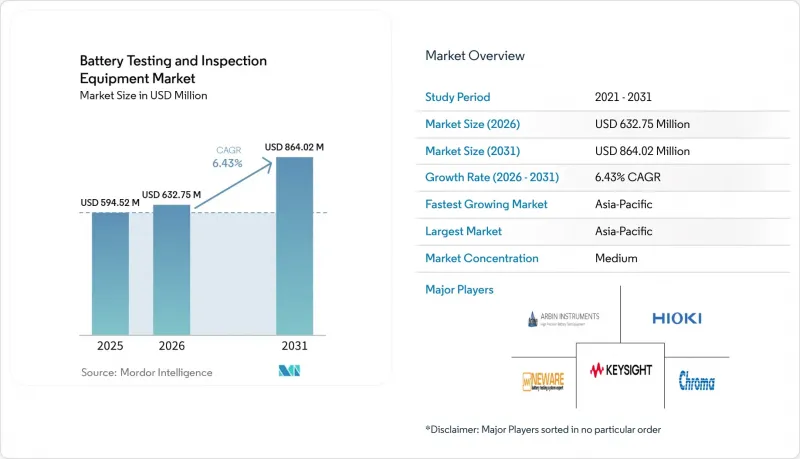
根據 Mordor Intelligence 預測,電池測試和檢測設備的市場規模預計將從 2025 年的 5.9452 億美元成長到 2026 年的 6.3275 億美元,然後從 2026 年到 2031 年以 6.43% 的複合年成長率,到 2031 年達到 2031 年達到 202 億美元。
本報告按產品類型(可攜式、固定式)、應用(電池測試設備等)、最終用戶產業(汽車、消費性電子、能源和公共產業等)和地區(北美、歐洲、亞太地區、拉丁美洲、中東和非洲)對產業進行分類。
全球電池測試及檢測設備市場趨勢及洞察
將加強電動車碰撞安全法規(UNECE-R100 Rev. 4)。
聯合國歐洲經濟委員會R100 Rev. 4標準的全球實施要求所有電動車電池必須符合熱衝擊、機械變形和火災暴露測試標準,這提高了整個電池測試和檢測設備市場的硬體規格。測試台必須以亞秒的同步精度同時記錄電壓、溫度和壓力訊號,迫使實驗室投資建置配備光纖網路的高速資料擷取系統。這項規定促使買家選擇包含熱傳播試驗箱的承包測試設備,導致預算從單一用途的循環測試設備轉向多用途的資本項目。
運作正在迅速增加(2025 年至 2027 年間將新增超過 250 GWh 的產能)。
超級工廠的激增加速了高通道密度週期計的大規模採購,這類測試儀能夠檢驗數千個電池單元。 BMW斥資1億歐元(約1.09億美元)興建的瓦克斯多夫中心就是一個典型的例子,它展現了汽車製造商如何透過將測試環節內部化來縮短產品上市週期。提供模組化、機架式週期計的供應商為工廠管理人員提供了物流優勢,因為他們可以逐行複製相同的模組。
高電流週期計不斷上漲的資本投資成本(銅和矽的成本)
銅匯流排和碳化矽 MOSFET 是 1000 安培測試儀的關鍵組件,預計到 2025 年價格將上漲,導致單位成本增加。一些美國測試實驗室正在推遲升級計劃,並提高現有機架的運轉率。供應商正透過租賃模式來應對這個問題,將資本投資負擔分攤到五年的營運成本期內。
細分市場分析
在電池測試和檢測設備市場,預計到2025年,固定式系統將佔59.20%的銷售額。這一主導地位得益於嚴格嚴苛的測試規程,這些規程要求使用惰性氣體室和防爆裝置。攜帶式測試儀雖然規模較小,但預計也將以8.35%的複合年成長率成長,因為電力公司正在部署現場級分析儀來篩檢電動車電池組,以便進行現場再利用。可攜式設備通常整合到標準的19吋機架控制器中,從而允許兩類設備使用通用備件。為了彌補人手不足,固定式產品線正在轉向機器人托盤裝載,這項變更導致軟體整合成本超過了硬體成本。
在本十年後半期,隨著住宅儲能系統檢測要求的更新,攜帶式電池測試和檢測設備的市場規模預計將超過3.896億美元。自動化設備供應商正與週期計測試設備製造商合作,透過整合每10分鐘更換一次托盤的機械臂來減少不同班次間的循環時間差異。相較之下,固定式測試箱則專注於高電流處理能力,其1兆瓦直流通道可同時測試八個130千瓦時的母線電池組,並符合FMVSS 305a浸泡測試要求。
隨著汽車製造商將終端系統完整性置於單一電芯測量之上,預計到2025年,電池組測試儀將佔據電池測試和檢測設備市場45.40%的佔有率。將熱縮烘箱、壓板和振動台整合到一條生產線上,使工程師無需重新包裝托盤即可進行機械和電氣測試。模組化測試設備仍然是超級工廠中間階段的關鍵品質把關設備,而電芯週期計支援供應商認證。
隨著監管機構要求整包安全資料以進行型式認證,包級優勢變得愈發顯著。整合到線束中的電化學阻抗譜(EIS)感測器簡化了耐久性測試週期中的診斷流程,並提高了每個通道的平均售價(ASP)。模組測試儀正發展成為具有可切換恆流-恆壓(CC-CV)循環和30 Hz電阻掃描功能的混合鑽機,從而拓展了其在需要靈活設置的研發實驗室中的應用範圍。
區域分析
亞太地區受中國、韓國和日本電池製造群的集中影響,預計到2025年將佔據44.80%的市場佔有率,繼續保持電池測試和檢測設備市場的中心地位。中國系統整合商,例如西安道智慧,正在提供國產化率高達98%的承包電池組週期計,這與北京市政府的國產化政策相符。Delta地區的政府補助正在資助區域創新園區內的實驗室擴建,加速了環境檢測實驗室和高速數據採集板的訂單成長。印度針對先進化學電池的生產連結獎勵計畫(PLI)計畫正在促進新興市場的發展,尤其是在100kWh以下的通訊電池和摩托車電池領域,並擴大供應商群體。
在北美,隨著汽車製造商將供應鏈本地化以獲得清潔汽車稅額扣抵抵免,電池出貨量正呈現兩位數成長。預計到2031年,美國和加拿大買家的電池測試和檢測設備市場規模將達到2.234億美元,主要得益於美國東南部超級工廠中心(Gigafactory Hub)的建設。 UL Solutions位於密西根州的實驗室是FMVSS 305a合規性的區域標桿,其開放式模式允許二級供應商無需自建設施即可檢驗電池模組。一家致力於鈉離子正極材料的加拿大礦業公司正與大學研究機構合作,共同開發零下循環壽命測試腳本。
在歐洲,採購重點在於遵守歐盟法規 (EU) 2023/1542。德國原始設備製造商 (OEM) 正在尋求能夠自動計算每個循環碳排放強度並將加密資料發送到雲端控制面板的測試設備,使測試設備成為可追溯性中心。隨著本地製造商部署固態固態電池試點生產線,預計到 2031 年,歐盟 27 國電池測試和檢測設備的市場佔有率將保持在 22.90% 左右。波蘭和匈牙利正在崛起為具有成本競爭力的測試服務中心,為小規模電動車新創公司提供第三方認證服務。
其他好處:
- Excel格式的市場預測(ME)表
- 3個月的分析師支持
目錄
第1章:引言
- 研究假設和市場定義
- 調查範圍
第2章:調查方法
第3章執行摘要
第4章 市場狀況
- 市場概覽
- 市場促進因素
- 關於電動車碰撞安全性的法規已加強(UNECE-R100 rev.4)。
- 運作正在迅速增加(2025 年至 2027 年間將新增超過 250 GWh 的產能)。
- 歐盟將於2024/2025年引進「電池護照」制度
- 將內建的EIS分析功能整合到測試儀中
- 固態試驗生產線需要高壓測試平台。
- 隨著 Second Life 的日益普及,對軟體包進行篩檢已成為強制性要求。
- 市場限制因素
- 高電流週期計不斷上漲的資本投資成本(銅和矽的成本)
- 實驗室人手不足,設施未獲得安全認證。
- IEC 63287全球協調進程的延誤
- 凍結家用電器製造商的資本投資
- 價值供應鏈分析
- 監理情勢
- 技術展望
- 波特五力模型
第5章 市場規模與成長預測
- 依產品類型
- 可攜式的
- 固定式
- 按應用程式類型
- 細胞測試設備
- 模組測試設備
- 包裝測試裝置
- 按最終用戶行業分類
- 車
- 家用電子產品
- 能源公用事業
- 通訊和資料通訊
- 衛生保健
- 航太/國防
- 石油和天然氣
- 工廠自動化和工業設備
- 電池化學成分
- 鋰離子
- 鉛酸
- 鎳基
- 全固態/新一代
- 按地區
- 北美洲
- 美國
- 加拿大
- 墨西哥
- 南美洲
- 巴西
- 阿根廷
- 其他南美國家
- 歐洲
- 英國
- 德國
- 法國
- 義大利
- 西班牙
- 俄羅斯
- 其他歐洲國家
- 亞太地區
- 中國
- 日本
- 韓國
- 印度
- 澳洲
- 其他亞太國家
- 中東和非洲
- GCC
- 南非
- 其他中東和非洲國家
- 北美洲
第6章 競爭情勢
- 市場集中度
- 策略趨勢
- 市佔率分析
- 公司簡介
- Arbin Instruments
- Chroma Systems Solutions
- Keysight Technologies
- Hioki USA
- Neware Battery Testers
- A&D Technology
- Midtronics
- Heinzinger electronic
- Kikusui Electronics
- Megger
- Extech Instruments
- MTI Corporation
- National Instruments
- Rohde and Schwarz
- Digatron
- SPEA
- Bitrode Corporation
- ITECH Electronics
- adaptive balancing power
- PACE Technologies
第7章 市場機會與未來展望
According to Mordor Intelligence, the battery testing & inspection equipment market size is expected to grow from USD 594.52 million in 2025 to USD 632.75 million in 2026 and is forecast to reach USD 864.02 million by 2031 at 6.43% CAGR over 2026-2031.
This report Segments the Industry Into by Product Type (Portable, Stationary), by Application Type (Battery Cell Testing Equipment, and More), by End-User Industry (Automotive, Consumer Electronics, Energy and Utility, and More), and by Geography (North America, Europe, Asia-Pacific, Latin America, Middle East and Africa).
Global Battery Testing And Inspection Equipment Market Trends and Insights
EV crash-safe regulations tighten (UNECE-R100 Rev. 4)
Global roll-out of UNECE-R100 Rev. 4 obliges every electric-vehicle battery to pass thermal-shock, mechanical deformation, and fire-exposure protocols, elevating hardware specifications across the Battery testing & inspection equipment market. Test benches must log simultaneous voltage, temperature, and pressure signals under sub-second synchronization, prompting labs to invest in high-speed DAQ systems with optical-fiber networking. The rule pushes buyers toward turnkey rigs that incorporate thermal-propagation chambers, thereby converting single-purpose cycler budgets into multi-discipline capital projects
Surge in gigafactory commissioning (>=250 GWh added 2025-27)
Proliferation of gigafactories accelerates volume purchasing of channel-dense cyclers that validate thousands of cells in parallel. BMW's Wackersdorf center, a EUR 100 million (USD 109 million) flagship, demonstrates how automakers internalize testing to compress design-to-launch cycles.Vendors supplying modular, rack-mountable cyclers gain a logistical edge as facility managers replicate identical blocks line after line.
High-current cycler cap-ex inflation (Cu & Si costs)
Copper busbars and silicon carbide MOSFETs, critical to 1,000-A testers, face 2025 commodity spikes, inflating unit prices. Some U.S. labs postpone upgrades, raising utilization rates on legacy racks. Vendors respond with leasing models that spread cap-ex pain over five-year OPEX horizons.
Other drivers and restraints analyzed in the detailed report include:
- Adoption of "battery passport" in EU 2024/2025
- Integration of embedded EIS analytics in testers
- Restricted lab talent & safety-certified facilities
For complete list of drivers and restraints, kindly check the Table Of Contents.
Segment Analysis
Stationary systems generated 59.20% of 2025 revenue within the Battery testing & inspection equipment market, a lead upheld by stringent abuse-test protocols that demand inert-gas chambers and explosion vents. Portable testers, though small, post an 8.35% CAGR as utilities deploy field-grade analyzers to screen repurposed EV packs on site. Portable rigs often piggyback on standard 19-inch rack controllers so spare parts stay common across both fleets. Stationary lines migrate toward robot-loaded trays to offset labor scarcity, a shift that magnifies software integration expenditures above hardware costs.
In the second half of the decade, the Battery testing & inspection equipment market size for portable units is projected to top USD 389.6 million, reflecting new inspection mandates for residential-storage packs. Automation vendors partner with cycler OEMs to embed robotic arms that swap trays every 10 minutes, trimming cycle-time variance across shifts. Stationary labs, in contrast, focus on high-current headroom; 1 MW DC channels enable simultaneous testing of eight 130 kWh bus packs, aligning with FMVSS 305a soak-test requirements.
Pack testers held a 45.40% share of the Battery testing & inspection equipment market size in 2025, as automakers prioritize end-system integrity over isolated cell metrics. Heat-shrink ovens, crush plates, and vibration tables integrate into single lines so engineers run mechanical and electrical tests without repalletizing. Module-level rigs remain relevant for mid-stream quality gates inside gigafactories, while cell cyclers underpin supplier qualification.
Pack-level dominance intensifies as regulators demand whole-pack safety data for type approval. Embedded EIS sensors in harness wiring shortcut diagnostics during endurance cycles, raising ASPs per channel. Module testers evolve into hybrid rigs that toggle between CC-CV cycling and 30 Hz impedance sweeps, thereby extending utility into R&D labs seeking flexible assets.
Complete Report Scope:
- By Product Type
- Portable
- Stationary
- By Application Type
- Cell Testing Equipment
- Module Testing Equipment
- Pack Testing Equipment
- By End-user Industry
- Automotive
- Consumer Electronics
- Energy and Utility
- Telecom and Data Communication
- Healthcare
- Aerospace and Defence
- Oil and Gas
- Factory Automation and Industrial Equipment
- By Battery Chemistry
- Lithium-ion
- Lead-acid
- Nickel-based
- Solid-state / Next-Gen
- By Geography
- North America
- United States
- Canada
- Mexico
- South America
- Brazil
- Argentina
- Rest of South America
- Europe
- United Kingdom
- Germany
- France
- Italy
- Spain
- Russia
- Rest of Europe
- APAC
- China
- Japan
- South Korea
- India
- Australia
- Rest of APAC
- Middle East and Africa
- GCC
- South Africa
- Rest of Middle East and Africa
- North America
Geography Analysis
Asia-Pacific remains the epicenter of the Battery testing & inspection equipment market with a 44.80% share in 2025, driven by concentrated cell manufacturing clusters in China, South Korea, and Japan. Chinese integrators such as Xian Dao Intelligent deliver turnkey pack cyclers with 98% domestic parts content, aligning with Beijing's localization push. Government subsidies in the Yangtze River Delta finance lab expansions inside regional innovation parks, accelerating orders for environmental chambers and high-speed DAQ boards. India's PLI scheme for advanced-chemistry cells fosters a nascent market built around sub-100 kWh telecom and two-wheeler batteries, broadening the vendor base.
North America registers double-digit shipment growth as automakers localize supply chains to qualify for clean-vehicle tax credits. The Battery testing & inspection equipment market size for U.S. and Canadian buyers will reach USD 223.4 million by 2031, lifted by gigafactory hubs in the Southeast. UL Solutions' Michigan laboratory serves as a regional reference site for FMVSS 305a readiness, and its open-access model lets Tier 2 suppliers verify modules without building in-house facilities. Canadian miners exploring sodium-ion cathodes partner with university labs to co-develop test scripts targeting sub-zero cycle life.
Europe concentrates on purchasing around compliance with Regulation (EU) 2023/1542. German OEMs demand instruments that auto-calculate carbon intensity per cycle and push encrypted data to cloud dashboards, turning testers into traceability nodes. The Battery testing & inspection equipment market share for EU-27 is expected to stay near 22.90% through 2031 as local manufacturers integrate solid-state pilot lines. Poland and Hungary emerge as cost-competitive lab-services hubs, offering third-party certification to smaller e-mobility start-ups.
- Arbin Instruments
- Chroma Systems Solutions
- Keysight Technologies
- Hioki USA
- Neware Battery Testers
- A&D Technology
- Midtronics
- Heinzinger electronic
- Kikusui Electronics
- Megger
- Extech Instruments
- MTI Corporation
- National Instruments
- Rohde and Schwarz
- Digatron
- SPEA
- Bitrode Corporation
- ITECH Electronics
- adaptive balancing power
- PACE Technologies
Additional Benefits:
- The market estimate (ME) sheet in Excel format
- 3 months of analyst support
TABLE OF CONTENTS
1 INTRODUCTION
- 1.1 Study Assumptions and Market Definition
- 1.2 Scope of the Study
2 RESEARCH METHODOLOGY
3 EXECUTIVE SUMMARY
4 MARKET LANDSCAPE
- 4.1 Market Overview
- 4.2 Market Drivers
- 4.2.1 EV crash-safe regulations tighten (UNECE-R100 rev.4)
- 4.2.2 Surge in gigafactory commissioning (>=250 GWh added 2025-27)
- 4.2.3 Adoption of "battery passport" in EU 2024/2025
- 4.2.4 Integration of embedded EIS analytics in testers
- 4.2.5 Solid-state pilot lines require high-voltage test platforms
- 4.2.6 Rise of second-life repurposing mandates pack-level screening
- 4.3 Market Restraints
- 4.3.1 High-current cycler cap-ex inflation (Cu and Si costs)
- 4.3.2 Restricted lab talent and safety-certified facilities
- 4.3.3 Delay in global IEC 63287 harmonisation
- 4.3.4 CAPEX freeze among consumer-electronics OEMs
- 4.4 Value / Supply-Chain Analysis
- 4.5 Regulatory Landscape
- 4.6 Technological Outlook
- 4.7 Porter's Five Forces
- 4.7.1 Bargaining Power of Suppliers
- 4.7.2 Bargaining Power of Buyers
- 4.7.3 Threat of New Entrants
- 4.7.4 Threat of Substitutes
- 4.7.5 Competitive Rivalry
5 MARKET SIZE AND GROWTH FORECASTS (VALUE)
- 5.1 By Product Type
- 5.1.1 Portable
- 5.1.2 Stationary
- 5.2 By Application Type
- 5.2.1 Cell Testing Equipment
- 5.2.2 Module Testing Equipment
- 5.2.3 Pack Testing Equipment
- 5.3 By End-user Industry
- 5.3.1 Automotive
- 5.3.2 Consumer Electronics
- 5.3.3 Energy and Utility
- 5.3.4 Telecom and Data Communication
- 5.3.5 Healthcare
- 5.3.6 Aerospace and Defence
- 5.3.7 Oil and Gas
- 5.3.8 Factory Automation and Industrial Equipment
- 5.4 By Battery Chemistry
- 5.4.1 Lithium-ion
- 5.4.2 Lead-acid
- 5.4.3 Nickel-based
- 5.4.4 Solid-state / Next-Gen
- 5.5 By Geography
- 5.5.1 North America
- 5.5.1.1 United States
- 5.5.1.2 Canada
- 5.5.1.3 Mexico
- 5.5.2 South America
- 5.5.2.1 Brazil
- 5.5.2.2 Argentina
- 5.5.2.3 Rest of South America
- 5.5.3 Europe
- 5.5.3.1 United Kingdom
- 5.5.3.2 Germany
- 5.5.3.3 France
- 5.5.3.4 Italy
- 5.5.3.5 Spain
- 5.5.3.6 Russia
- 5.5.3.7 Rest of Europe
- 5.5.4 APAC
- 5.5.4.1 China
- 5.5.4.2 Japan
- 5.5.4.3 South Korea
- 5.5.4.4 India
- 5.5.4.5 Australia
- 5.5.4.6 Rest of APAC
- 5.5.5 Middle East and Africa
- 5.5.5.1 GCC
- 5.5.5.2 South Africa
- 5.5.5.3 Rest of Middle East and Africa
- 5.5.1 North America
6 COMPETITIVE LANDSCAPE
- 6.1 Market Concentration
- 6.2 Strategic Moves
- 6.3 Market Share Analysis
- 6.4 Company Profiles {(includes Global level Overview, Market level overview, Core Segments, Financials as available, Strategic Information, Market Rank/Share for key companies, Products and Services, and Recent Developments)}
- 6.4.1 Arbin Instruments
- 6.4.2 Chroma Systems Solutions
- 6.4.3 Keysight Technologies
- 6.4.4 Hioki USA
- 6.4.5 Neware Battery Testers
- 6.4.6 A&D Technology
- 6.4.7 Midtronics
- 6.4.8 Heinzinger electronic
- 6.4.9 Kikusui Electronics
- 6.4.10 Megger
- 6.4.11 Extech Instruments
- 6.4.12 MTI Corporation
- 6.4.13 National Instruments
- 6.4.14 Rohde and Schwarz
- 6.4.15 Digatron
- 6.4.16 SPEA
- 6.4.17 Bitrode Corporation
- 6.4.18 ITECH Electronics
- 6.4.19 adaptive balancing power
- 6.4.20 PACE Technologies
7 MARKET OPPORTUNITIES AND FUTURE OUTLOOK
- 7.1 White-space and Unmet-need Assessment

 儲能電池測試系統市場:全球市場預測,2026-2032年
 電池測試設備市場:依功能、設備類型、產業、國家及地區分類-全球產業分析、市場規模、市場佔有率及2026年至2033年預測電池測試設備市場:按設備類型、電池類型、測試模式、技術、應用、最終用戶和銷售管道分類-2026-2032年全球預測汽車電池測試器市場:按測試方法、產品類型、技術、應用和最終用戶分類-2026-2032年全球預測高功率電池測試設備市場:依產品類型、技術、應用、最終用戶和分銷管道分類,全球預測,2026-2032年
 電池測試設備市場分析及預測(至2035年):類型、產品類型、服務、技術、組件、應用、形式、最終用戶、功能
 全球電池測試設備市場:市場規模、佔有率、成長、依類型和應用劃分的產業分析、區域洞察及預測(2026-2034)鋰測試服務市場(按服務類型、測試方法、應用、最終用戶產業和分銷管道分類),全球預測(2026-2032年)鋰離子電池檢測市場:按技術、檢測方法、設備類型、缺陷類型、檢測階段、外形規格和最終用戶分類,全球預測,2026-2032年
 電池測試設備市場規模、佔有率和成長分析(按產品類型、測試類型、應用、電池類型和地區分類)-2026-2033年產業預測