


 |
市場調查報告書
商品編碼
2116903
車載對講系統:市場佔有率分析、產業趨勢與統計、成長預測(2026-2031)Vehicle Intercom System - Market Share Analysis, Industry Trends & Statistics, Growth Forecasts (2026 - 2031) |
||||||

※ 本網頁內容可能與最新版本有所差異。詳細情況請與我們聯繫。
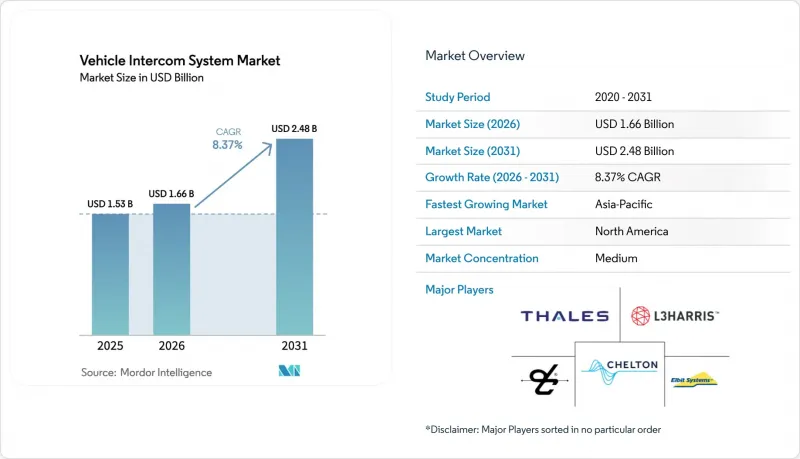
據 Mordor Intelligence 稱,2025 年汽車對講系統市場價值為 15.3 億美元,預計到 2031 年將達到 24.8 億美元,而 2026 年為 16.6 億美元,預測期(2026-2031 年)的複合年成長率為 8.37%。
本報告按應用領域(軍用車輛、緊急和公共安全車輛、商用和工業卡車等)、組件類型(耳機和手機、乘員和控制站等)、類型(有線和無線)、技術(類比和數位)以及地區(北美、歐洲、亞太等)進行細分。市場預測以美元計價。
全球車載對講系統市場趨勢與洞察
網路中心戰(NCW)戰術的傳播
美國陸軍的“移動裝甲編隊網路”先導計畫展示了車輛如何作為“移動節點”,在行進過程中傳輸大量語音、影像和感測器數據。車內對講系統必須能夠無縫連接到衛星、地面和網狀網路,同時支援加密、服務品質 (QoS) 和即時資料融合。北約互通性指南鼓勵供應商採用開放式架構和通用波形,這賦予了軟體定義音訊閘道競爭優勢。隨著多域作戰的擴展,乘員希望能夠透過單一介面在語音、數據和人工智慧驅動的分析之間切換,而無需更換硬體,這加速了對可擴展數位平台的需求。隨著盟軍標準化新的戰場通訊理論,這種轉變正在推動車載車內對講系統市場持續升級。
亞太地區和中東及北非地區的國防現代化預算增加。
日本2025年預算為無人平台和遠程精確火力分配了大量資金,這兩項都需要強大的車載通訊系統。阿拉伯聯合大公國的類似項目,例如EDGE與泰雷茲的無線電合作,展示了區域各國政府如何整合國產和進口技術,以建構自身的指揮控制能力。採購計劃與更廣泛的部隊配置計劃一致,使供應商能夠獲得可預測的訂單量。現成(COTS)子系統正獲得軍用電磁相容性(EMC)和網路安全標準的認證,從而降低整合風險,並逐漸被廣泛接受。因此,裝甲車、後勤車輛和邊防安全車輛的持續維修和新車合約正在推動車載對講系統市場的發展。
與稀土元素電子元件相關的供應鏈風險
稀土元素磁體和特殊半導體是安全音訊模組的基礎,但其供應仍集中在中國少數幾家煉油廠。美國國防部已承認,現有庫存無法滿足戰時需求,這使得成本加成合約極易受到價格大幅上漲的影響。供應商正在考慮使用鐵氧體材料和國內回收資源作為替代方案,但軍用級純度要求使得快速找到解決方案變得困難。對講機製造商通常對來自單一供應商的電子基板進行漫長的環境測試後才會進行認證,而當生產設施搬遷時,這一流程需要重複,從而導致交貨延遲。這套頸部正在減緩車載對講系統市場的成長,而該市場原本預計將穩定擴張。
細分市場分析
到2025年,軍用車輛將佔據大部分收入,佔車載對講系統市場佔有率的54.12%。然而,緊急和公共安全車輛預計將以11.23%的複合年成長率成長,並有望成為下一個主要收入來源。許多警車、消防車和救護車車隊仍在使用近百年前的模擬無線電,這些無線電無法支援多媒體情境察覺,也無法滿足FirstNet等國家寬頻計畫設定的網路安全要求。目前,各機構正在以功能強大的原生IP對講中心取代固定主機,這些對講中心整合了LTE、5G和衛星回程傳輸。
執法記錄器和配備高密度感測器的穿戴式裝置的日益普及,也刺激了對低延遲語音路徑和邊緣分析的需求。相較之下,國防領域對無人地面車輛的網路整合要求更高,需要對講系統來協調人機協作。由於安全法規日益嚴格,商用卡車和機場地面支援等細分市場呈現中等個位數的成長率,但其在整個車輛對講系統市場中所佔佔有率仍然相對較小。雖然軍方的升級週期持續支撐基準銷售,但預計到2031年,緊急服務領域將成為推動增量成長的主要力量。
預計到2025年,乘員和控制站將佔總銷售額的41.65%,這反映了它們在裝甲車、後勤車輛和救援車輛中的核心作用。儘管如此,隨著乘員對無線移動性和在嘈雜的車內環境中自適應降噪功能的需求不斷成長,先進的耳機和手機正以9.73%的複合年成長率成長。隨著無線耳機取代傳統的綁帶式對講機,車載對講系統市場中隨身聽設備的市場規模預計將穩步擴大。
Honeywell的QUIETPRO QP400具備主動防護與多通道功能,是新一代穿戴式裝置將聽力保護與指揮網路存取結合的典範。配套硬體,例如無線閘道器和中央處理器,正朝著模組化插件設計發展,這與美國陸軍旨在標準化安裝配置的SAVE舉措相契合。軟體內容持續成長,使供應商即使在實體安裝完成後也能透過功能升級獲得持續的收入來源。這些趨勢正在推動車載對講系統售後市場的發展。
區域分析
受美國陸軍指揮所綜合基礎設施計畫和加拿大對北約的承諾的推動,北美地區預計到2025年將佔全球銷售額的39.05%。該地區擁有成熟的國防工業基礎,實用化尖端的人工智慧降噪模組和網路安全增強型波形。對海外稀土元素加工供應鏈的依賴仍然是一個策略性弱點,促使企業努力將相關業務轉移到國內。儘管零件採購模式可能會發生變化,但預計支出水準仍將保持高位。
亞太地區是成長最快的地區,複合年成長率達9.71%,主要得益於該地區各國軍隊為應對地緣政治緊張局勢所做的準備。日本加強其「遠程作戰能力」的努力以及澳洲簽署的三方安全協議,正在推動對下一代指揮控制系統的投資。本地化義務促進了技術轉移協議的達成,並為西方供應商創造了合資企業等新的銷售管道。中國的現代化進程促使鄰國加速車輛工程建設,間接推動了韓國、印度以及整個東南亞地區車載對講系統市場的發展。
在歐洲,北約標準化預計將帶來穩定的中位數成長,英國緊急服務網和德國聯邦國防軍的升級改造樹立了採購先例。東歐成員國正優先部署可互通的無線電設備,以應對不斷變化的區域安全形勢,並強調需求的永續性。中東波灣合作理事會(GCC)成員國繼續採購精選的高價值產品,例如阿拉伯聯合大公國與泰雷茲公司聯合建立並本地生產的軟體定義無線電(SDR)工廠。非洲市場仍在發展中,但來自維和行動和邊防安全的零星訂單確保了車載對講系統市場的地理分佈仍然多元化。
其他好處:
- Excel格式的市場預測(ME)表
- 3個月的分析師支持
目錄
第1章:引言
- 研究假設和市場定義
- 調查範圍
第2章:調查方法
第3章執行摘要
第4章 市場狀況
- 市場概覽
- 市場促進因素
- 網路中心戰理論
- 亞太地區和中東及北非地區的國防現代化預算增加。
- 從類比對講機過渡到基於IP的數位對講機
- 對無線人員行動解決方案的需求日益成長
- 無人地面車輛對低尺寸、重量和功耗(SWaP)對講機的需求
- 引入人工智慧降噪和語音分析技術
- 市場限制因素
- 與稀土元素電子元件相關的供應鏈風險
- 遵守電磁干擾 (EMI) 法規所帶來的負擔
- 增強戰術網路中IP對講機網路彈性的相關成本
- 廠商透過專有介面造成的鎖定阻礙了多廠商整合的進程。
- 價值鏈分析
- 監理情勢
- 技術展望
- 波特五力分析
第5章 市場規模與成長預測
- 透過使用
- 軍用車輛
- 緊急車輛和公共安全車輛
- 商用和工業用卡車
- 機場地面保障設備
- 建築和採礦設備
- 依組件類型
- 耳機和手機
- 船員和控制站
- 無線介面/閘道器單元
- 中央處理器 (CPU) 與網路集線器
- 線材、配件、軟體
- 按類型
- 有線
- 無線的
- 透過技術
- 模擬
- 數位的
- 按地區
- 北美洲
- 美國
- 加拿大
- 墨西哥
- 歐洲
- 德國
- 英國
- 法國
- 義大利
- 俄羅斯
- 其他歐洲國家
- 亞太地區
- 中國
- 日本
- 印度
- 韓國
- 澳洲
- 其他亞太國家
- 南美洲
- 巴西
- 其他南美國家
- 中東和非洲
- 中東
- 阿拉伯聯合大公國
- 沙烏地阿拉伯
- 土耳其
- 其他中東國家
- 非洲
- 南非
- 其他非洲國家
- 中東
- 北美洲
第6章 競爭情勢
- 市場集中度
- 策略趨勢
- 市佔率分析
- 公司簡介
- Thales Group
- Chelton Limited
- L3Harris Technologies, Inc.
- Elbit Systems Ltd.
- David Clark Company
- INVISIO AB
- HM Electronics, Inc.
- Aselsan AS
- Leonardo DRS, Inc.
- Gentex Corporation
- SyTech Corporation
- WolfElec Ltd.
- TELDAT, SAU
- Communications-Applied Technology(C-AT)
- Setcom Corporation
- Axnes AS
- EID SA
- General Dynamics Mission Systems, Inc.(General Dynamics Corporation)
第7章 市場機會與未來展望
According to Mordor Intelligence, the vehicle intercom system market size was valued at USD 1.53 billion in 2025 and estimated to grow from USD 1.66 billion in 2026 to reach USD 2.48 billion by 2031, at a CAGR of 8.37% during the forecast period (2026-2031).
This report is Segmented by Application (Military Vehicles, Emergency and Public Safety Vehicles, Commercial and Industrial Trucks, and More), Component Type (Headsets and Handsets, Crew and Control Stations, and More), Type (Wired and Wireless), Technology (Analog and Digital), and Geography (North America, Europe, Asia-Pacific, and More). The Market Forecasts are Provided in Terms of Value (USD).
Global Vehicle Intercom System Market Trends and Insights
Proliferation of Network-Centric Warfare Doctrines
The US Army's Armored Formation Network On The Move pilot shows how vehicles turn into rolling nodes that pass high-capacity voice, video, and sensor feeds during maneuvers. Intercom systems must connect seamlessly to satellite, terrestrial, and mesh networks while supporting encryption, quality of service, and real-time data fusion. NATO interoperability guidelines push vendors toward open architectures and common waveforms, which favors software-defined audio gateways. As multi-domain operations expand, crews expect the same interface to switch between voice, data, and AI-driven analytics without hardware swap-outs, accelerating demand for scalable digital platforms. This shift keeps the vehicle intercom system market on a steady upgrade cycle as allied forces standardize a new battlefield communications doctrine.
Rising Defense Modernization Budgets in APAC and MENA
Japan's FY 2025 budget earmarks sizable funds for unmanned platforms and long-range precision fires, each requiring resilient onboard communications. Parallel programs in the UAE, highlighted by the EDGE-Thales radio partnership, show regional governments blending local manufacturing with imported technology to build sovereign command-and-control capacity. Procurement timelines are tied to broader force-structure plans, giving suppliers predictable order books. Commercial off-the-shelf sub-systems are gaining acceptance when certified to military EMC and cyber standards, trimming integration risk. Consequently, the vehicle intercom system market benefits from recurring retrofit work and new-build vehicle contracts across armored, logistics, and border-patrol fleets.
Supply-Chain Exposure to Rare-Earth Electronic Components
Rare-earth magnets and specialty semiconductors underpin secure voice modules yet remain concentrated in a handful of Chinese refineries. The US Department of Defense admitted existing stockpiles cannot cover wartime demand, making cost-plus contracts vulnerable to sudden price spikes. Vendors explore substitution with ferrite materials or domestic recycling streams, but military-grade purity complicates quick fixes. After lengthy environmental testing, intercom producers often qualify single-source electronic boards; relocating production repeats the process and delays deliveries. This bottleneck tempers the otherwise robust expansion of the vehicle intercom system market.
Other drivers and restraints analyzed in the detailed report include:
- Shift from Analog to IP-Based Digital Intercoms
- Growing Demand for Wireless Crew-Mobility Solutions
- Electromagnetic-Interference Compliance Burden
For complete list of drivers and restraints, kindly check the Table Of Contents.
Segment Analysis
Military vehicles generated the bulk of 2025 revenues, accounting for 54.12% of the vehicle intercom system market. Emergency and public-safety vehicles, however, are tracking an 11.23% CAGR that positions them as the next major value pool. Many police, fire, and ambulance fleets run century-old analog radios that cannot support multimedia situational awareness or meet cyber mandates set by national broadband programs like FirstNet. Agencies now replace static consoles with ruggedized, IP-native intercom hubs that integrate LTE, 5G, and satellite backhauls.
The widening adoption of body-worn cameras and sensor-rich wearables also stimulates demand for low-latency voice paths and edge analytics. In contrast, the defense segment seeks deeper network integration for unmanned ground vehicles, necessitating intercoms orchestrating human and robotic teammates. Commercial truck and airport ground-support niches post mid-single-digit expansion as safety regulations tighten, yet they remain comparatively small slices of the vehicle intercom system market. Military upgrade cycles will continue to fund the baseline volume, while emergency services deliver the highest incremental growth through 2031.
Crew and control stations represented 41.65% of 2025 sales, reflecting their centrality within armored, logistics, and rescue vehicles. Nonetheless, advanced headsets and handsets rise at a 9.73% CAGR because crews demand untethered movement and adaptive noise cancellation inside loud cabins. The vehicle intercom system market size for portable audio devices is projected to expand steadily as wireless headsets replace traditional lanyard-based talk-backs.
Honeywell's QUIETPRO QP400, featuring active protection and multiple channels, typifies next-generation wearables that combine hearing protection with command-net access. Supporting hardware like radio gateways and central processors shift toward modular plug-ins, aligning with the US Army's SAVE initiative that standardizes mounting envelopes. Software content keeps rising, giving vendors a recurring revenue stream through capability upgrades even after the physical install is complete. These dynamics strengthen the aftermarket within the vehicle intercom system market.
Complete Report Scope:
- By Application
- Military Vehicles
- Emergency and Public Safety Vehicles
- Commercial and Industrial Trucks
- Airport Ground-Support Equipment
- Construction and Mining Equipment
- By Component Type
- Headsets and Handsets
- Crew and Control Stations
- Radio Interface/Gateway Units
- Central Processing Units and Networking Hubs
- Cables, Ancillaries and Software
- By Type
- Wired
- Wireless
- By Technology
- Analog
- Digital
- By Geography
- North America
- United States
- Canada
- Mexico
- Europe
- Germany
- United Kingdom
- France
- Italy
- Russia
- Rest of Europe
- Asia-Pacific
- China
- Japan
- India
- South Korea
- Australia
- Rest of Asia-Pacific
- South America
- Brazil
- Rest of South America
- Middle East and Africa
- Middle East
- United Arab Emirates
- Saudi Arabia
- Turkey
- Rest of Middle East
- Africa
- South Africa
- Rest of Africa
- Middle East
- North America
Geography Analysis
North America generated 39.05% of 2025 revenues, anchored by the US Army's Command Post Integrated Infrastructure program and Canada's NATO commitments. The region boasts a mature defense industrial base that fields cutting-edge AI noise-reduction modules and cyber-secure waveforms. Supply-chain exposure to overseas rare-earth processing remains a strategic vulnerability, prompting on-shoring initiatives that may shift component sourcing patterns yet keep spending elevated.
Asia-Pacific is the fastest-growing region, rising at 9.71% CAGR as regional militaries hedge against geopolitical tension. Japan's standoff-capability push and Australia's trilateral security pact drive next-generation command-and-control investment. Indigenous production mandates encourage technology-transfer deals, creating joint-venture channels for Western suppliers. China's modernization spurs neighboring countries to accelerate vehicle programs, indirectly bolstering the vehicle intercom system market across South Korea, India, and Southeast Asia.
Europe delivers steady, mid-single-digit growth under NATO standardization, with the UK's Emergency Services Network and Germany's Bundeswehr upgrades setting procurement precedence. Eastern members prioritize rapid fielding of interoperable radios in response to regional security shifts, underscoring sustained demand. Gulf Cooperation Council states in the Middle East continue selective high-ticket buys, as seen in the UAE-Thales software-defined-radio plant that localizes production. Africa remains nascent, yet peacekeeping and border-security funds generate sporadic orders, ensuring the geographic footprint of the vehicle intercom system market remains diverse.
- Thales Group
- Chelton Limited
- L3Harris Technologies, Inc.
- Elbit Systems Ltd.
- David Clark Company
- INVISIO AB
- HM Electronics, Inc.
- Aselsan A.S.
- Leonardo DRS, Inc.
- Gentex Corporation
- SyTech Corporation
- WolfElec Ltd.
- TELDAT, S.A.U
- Communications-Applied Technology (C-AT)
- Setcom Corporation
- Axnes AS
- EID S.A
- General Dynamics Mission Systems, Inc. (General Dynamics Corporation)
Additional Benefits:
- The market estimate (ME) sheet in Excel format
- 3 months of analyst support
TABLE OF CONTENTS
1 INTRODUCTION
- 1.1 Study Assumptions and Market Definition
- 1.2 Scope of the Study
2 RESEARCH METHODOLOGY
3 EXECUTIVE SUMMARY
4 MARKET LANDSCAPE
- 4.1 Market Overview
- 4.2 Market Drivers
- 4.2.1 Proliferation of network-centric warfare doctrines
- 4.2.2 Rising defense modernization budgets in APAC and MENA
- 4.2.3 Shift from analog to IP-based digital intercoms
- 4.2.4 Growing demand for wireless crew-mobility solutions
- 4.2.5 Need for low-SWaP intercoms for unmanned ground vehicles
- 4.2.6 Adoption of AI-enabled noise-cancellation and voice analytics
- 4.3 Market Restraints
- 4.3.1 Supply-chain exposure to rare-earth electronic component
- 4.3.2 Electromagnetic-interference compliance burden
- 4.3.3 Cyber-hardening costs for IP intercoms in tactical networks
- 4.3.4 Proprietary interface lock-in slowing multi-vendor integration
- 4.4 Value Chain Analysis
- 4.5 Regulatory Landscape
- 4.6 Technological Outlook
- 4.7 Porter's Five Forces Analysis
- 4.7.1 Threat of New Entrants
- 4.7.2 Bargaining Power of Buyers
- 4.7.3 Bargaining Power of Suppliers
- 4.7.4 Threat of Substitutes
- 4.7.5 Intensity of Competitive Rivalry
5 MARKET SIZE AND GROWTH FORECASTS (VALUE)
- 5.1 By Application
- 5.1.1 Military Vehicles
- 5.1.2 Emergency and Public Safety Vehicles
- 5.1.3 Commercial and Industrial Trucks
- 5.1.4 Airport Ground-Support Equipment
- 5.1.5 Construction and Mining Equipment
- 5.2 By Component Type
- 5.2.1 Headsets and Handsets
- 5.2.2 Crew and Control Stations
- 5.2.3 Radio Interface/Gateway Units
- 5.2.4 Central Processing Units and Networking Hubs
- 5.2.5 Cables, Ancillaries and Software
- 5.3 By Type
- 5.3.1 Wired
- 5.3.2 Wireless
- 5.4 By Technology
- 5.4.1 Analog
- 5.4.2 Digital
- 5.5 By Geography
- 5.5.1 North America
- 5.5.1.1 United States
- 5.5.1.2 Canada
- 5.5.1.3 Mexico
- 5.5.2 Europe
- 5.5.2.1 Germany
- 5.5.2.2 United Kingdom
- 5.5.2.3 France
- 5.5.2.4 Italy
- 5.5.2.5 Russia
- 5.5.2.6 Rest of Europe
- 5.5.3 Asia-Pacific
- 5.5.3.1 China
- 5.5.3.2 Japan
- 5.5.3.3 India
- 5.5.3.4 South Korea
- 5.5.3.5 Australia
- 5.5.3.6 Rest of Asia-Pacific
- 5.5.4 South America
- 5.5.4.1 Brazil
- 5.5.4.2 Rest of South America
- 5.5.5 Middle East and Africa
- 5.5.5.1 Middle East
- 5.5.5.1.1 United Arab Emirates
- 5.5.5.1.2 Saudi Arabia
- 5.5.5.1.3 Turkey
- 5.5.5.1.4 Rest of Middle East
- 5.5.5.2 Africa
- 5.5.5.2.1 South Africa
- 5.5.5.2.2 Rest of Africa
- 5.5.5.1 Middle East
- 5.5.1 North America
6 COMPETITIVE LANDSCAPE
- 6.1 Market Concentration
- 6.2 Strategic Moves
- 6.3 Market Share Analysis
- 6.4 Company Profiles (includes Global level Overview, Market level overview, Core Segments, Financials as available, Strategic Information, Market Rank/Share for key companies, Products and Services, and Recent Developments)
- 6.4.1 Thales Group
- 6.4.2 Chelton Limited
- 6.4.3 L3Harris Technologies, Inc.
- 6.4.4 Elbit Systems Ltd.
- 6.4.5 David Clark Company
- 6.4.6 INVISIO AB
- 6.4.7 HM Electronics, Inc.
- 6.4.8 Aselsan A.S.
- 6.4.9 Leonardo DRS, Inc.
- 6.4.10 Gentex Corporation
- 6.4.11 SyTech Corporation
- 6.4.12 WolfElec Ltd.
- 6.4.13 TELDAT, S.A.U
- 6.4.14 Communications-Applied Technology (C-AT)
- 6.4.15 Setcom Corporation
- 6.4.16 Axnes AS
- 6.4.17 EID S.A
- 6.4.18 General Dynamics Mission Systems, Inc. (General Dynamics Corporation)
7 MARKET OPPORTUNITIES AND FUTURE OUTLOOK
- 7.1 White-space and Unmet-Need Assessment


