


 |
市場調查報告書
商品編碼
2116896
一鍵通話:市場佔有率分析、產業趨勢與統計、成長預測(2026-2031)Push To Talk - Market Share Analysis, Industry Trends & Statistics, Growth Forecasts (2026 - 2031) |
||||||

※ 本網頁內容可能與最新版本有所差異。詳細情況請與我們聯繫。
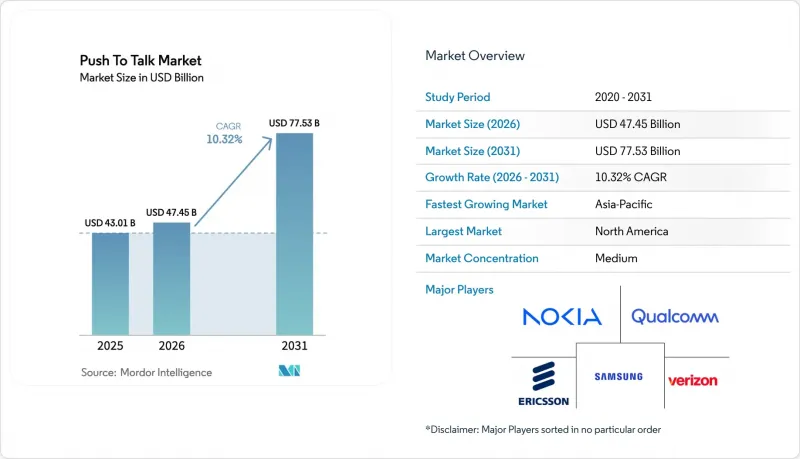
據 Mordor Intelligence 稱,2025 年一鍵通話(PTT) 市值為 430.1 億美元,預計到 2031 年將達到 775.3 億美元,而 2026 年為 474.5 億美元,預測期(2026-2031 年)的複合年成長率為 10.32%。
本報告按組件(硬體、軟體和服務)、網路類型(地面行動無線和蜂窩網路)、產業(公共安全、政府和國防以及商業)和地區進行分類。
全球一鍵通話(PTT)市場趨勢與洞察
從傳統地面行動無線(LMR) 向 LTE/5G PoC 解決方案過渡
類比和早期數位陸地行動無線電 (LMR) 系統正接近使用壽命終點,各機構正在向寬頻「蜂窩網路一鍵通 (PoC)」遷移,以便在單一服務中處理語音、影像和資料。英國的緊急服務網路清楚地展示了公共安全機構如何在優先考慮寬頻能力的同時,保持關鍵任務的可用性標準。在北美,FirstNet 使各機構能夠在不影響覆蓋範圍的情況下逐步淘汰 P25 設備。工廠和海上平台內部的專用 5G 網路正在消除先前阻礙 LMR 部署的視距限制。這些應用案例共同推動一鍵通話市場向蜂巢式架構的轉型。
公共安全領域對關鍵任務通訊的需求日益成長。
警察、消防和急救團隊早已不再侷限於語音通訊。如今,第一線人員期望使用寬頻PTT服務,以便將執法記錄器影像、無人機影像和感測器資料無縫傳輸至指揮中心。北約在2025年進行的實地演習展示了5G如何保障多機構協同行動中的安全通訊,凸顯了高度互通性和低延遲服務的重要性。儘管地方政府預算緊張,但聯邦政府的津貼正在加速系統升級,將預測分析和位置感知功能融入日常運作。這些需求確保了公共安全將繼續成為一鍵通話市場的核心垂直領域。
頻段分配碎片化和監管延遲
國家層級的優先事項衝突使得關鍵任務頻率的分配難以協調。在美國,關於4.9 GHz頻段側鏈使用的長期爭論正在延緩全州的部署。在歐洲,對380-470 MHz TETRA頻道的依賴給與700 MHz寬頻分配的整合帶來了挑戰。認證週期可能長達兩年以上,這阻礙了小規模供應商進入新市場,並延緩了一鍵通話)市場的商業化進程。
細分市場分析
到2025年,硬體銷售額仍將達到245億美元,成為一鍵通話市場中最大的單一細分市場。設備銷售保持穩定,這主要得益於石化工廠對本質安全型無線設備的強勁需求以及建築工地對堅固耐用型智慧型手機的需求。然而,涵蓋設備管理、網路安全和全天候網路監控的託管服務合約的成長速度超過了銷售成長速度。服務供應商目前正將預測性維護和分析儀表板捆綁銷售,這增加了轉換成本並延長了客戶生命週期。這種轉變符合企業採購團隊的政策,他們更傾向於關注營運成本而非前期資本支出。
服務業正以每年 12.18% 的速度成長,其業務範圍日益涵蓋監管諮詢、津貼申請支援和用戶培訓訂閱等。軟體供應商正按使用者數量對人工智慧模組收費,並提供可自訂的事件回應功能,無需購買新硬體。因此,預計到 2031 年,一鍵通 (PTT) 服務市場規模將超過 357 億美元,這標誌著收入結構中對實體設備的依賴程度顯著降低。部署的複雜性,尤其是在混合 LMR 和蜂窩網路環境下,為未來幾年專業服務收入的穩定成長奠定了堅實的基礎。
區域分析
2024年,北美地區創造了最大的區域收入,這得益於FirstNet不斷擴大的服務範圍、聯邦政府的津貼以及大量亟需互通性獎勵廣域的互通性,而墨西哥的加工廠則需要統一的通訊管道來支援高效率的工作流程。
歐洲現代化計畫著重於實現無縫跨境漫遊。斯堪地那維亞的納維亞半島的先導計畫已驗證了運營商間多用戶按鍵通話(MCPTT)切換功能,即使在高速列車上也能保持一鍵通話(PTT)會話。 700 MHz頻段窄頻頻率相關法規的明確正在加速競標活動,但供應鏈限制有時會阻礙設備交付。
亞太地區以11.12%的最高成長率領先,受益於中國、日本和印度的大規模5G部署和工業自動化加速發展。當地供應商提供的低成本專用終端正在加速中小企業採用寬頻PTT(一鍵通)技術。澳洲和紐西蘭仍是專注於礦業安全應用的細分市場,但其嚴格的設備標準為高階終端製造商創造了可觀的利潤空間。
儘管中東和非洲地區的絕對銷售額落後於其他地區,但在能源和智慧城市公共安全等垂直市場,該地區正展現出強勁的成長勢頭。波灣合作理事會(GCC)成員國正在投資網路切片技術,以確保大型企劃的安全;而南非則利用寬頻一鍵通(PTT)技術監控深海採礦作業。隨著覆蓋盲點的逐步填補,蜂窩優先技術的應用有望擴大一鍵通話的基本客群,使新參與企業能夠完全繞過傳統的地面行動無線(LMR)。
其他好處:
- Excel格式的市場預測(ME)表
- 3個月的分析師支持
目錄
第1章:引言
- 研究假設和市場定義
- 調查範圍
第2章:調查方法
第3章執行摘要
第4章 市場狀況
- 市場概覽
- 市場促進因素
- 從傳統LMR到LTE/5G PoC解決方案的過渡
- 公共安全領域對關鍵任務通訊的需求日益成長。
- 具備內建PTT功能的智慧型設備日益普及。
- 人工智慧驅動的調度分析與態勢監控
- 營運商整合 MCPTT 標準(3GPP Release 18 及更高版本)
- 工業專用5G園區網路,實現超低延遲PTT
- 市場限制因素
- 頻率分配細分和監管延遲
- 公共網路上的概念驗證 (PoC) 中的安全漏洞
- LMR與寬頻PTT平台之間的互通性差距
- 公共部門機構資本投資的預算限制
- 價值/價值鏈分析
- 監理情勢
- 技術展望
- 波特五力分析
- 宏觀經濟衝擊評估
第5章 市場規模與成長預測
- 按組件
- 硬體
- PTT無線電
- 堅固型/超堅固型智慧型設備
- 閘道器和中繼器
- 音訊配件
- 解決方案
- PoC 軟體(MCPTT、PoC、iPTT)
- 調度和指揮中心主機
- 應用整合中介軟體
- 服務
- 專業服務
- 託管服務
- 培訓和支持
- 硬體
- 依網路類型
- 地面行動無線(LMR)
- 模擬 LMR
- 數位式陸地行動無線電(DMR、TETRA、P25、dPMR、NXDN)
- 細胞
- 3G
- 4G/LTE
- 5G
- 地面行動無線(LMR)
- 按行業
- 公安
- 警察
- 消防/救援
- 緊急醫療服務
- 政府/國防
- 商業的
- 運輸/物流
- 製造業
- 建造
- 石油、天然氣和公共產業
- 飯店和零售業
- 公安
- 按地區
- 北美洲
- 美國
- 加拿大
- 墨西哥
- 南美洲
- 巴西
- 阿根廷
- 其他南美國家
- 歐洲
- 德國
- 英國
- 法國
- 俄羅斯
- 其他歐洲國家
- 亞太地區
- 中國
- 日本
- 韓國
- 印度
- 澳洲和紐西蘭
- 其他亞太國家
- 中東和非洲
- 中東
- 沙烏地阿拉伯
- 阿拉伯聯合大公國
- 土耳其
- 其他中東國家
- 非洲
- 南非
- 奈及利亞
- 其他非洲國家
- 中東
- 北美洲
第6章 競爭情勢
- 市場集中度
- 策略趨勢
- 市佔率分析
- 公司簡介
- Motorola Solutions
- AT&T(FirstNet)
- Verizon Communications
- Hytera Communications
- Tait Communications
- Iridium Communications
- Telstra
- Qualcomm Technologies
- Zebra Technologies
- Samsung Electronics
- Airbus Defence and Space
- Cisco Systems
- Nokia
- Ericsson
- L3Harris Technologies
- Sonim Technologies
- Sepura
- ESChat
- RugGear
- Siyata Mobile
第7章 市場機會與未來展望
According to Mordor Intelligence, the push to talk market size was valued at USD 43.01 billion in 2025 and estimated to grow from USD 47.45 billion in 2026 to reach USD 77.53 billion by 2031, at a CAGR of 10.32% during the forecast period (2026-2031).
This report is Segmented by Component (Hardware, Software, and Services), Network Type (Land Mobile Radio and Cellular), Vertical (Public Safety, Government and Defense, and Commercial), and Geography.
Global Push To Talk Market Trends and Insights
Migration from Legacy LMR to LTE/5G PoC Solutions
Analog and early digital LMR systems are approaching end-of-life, and agencies are turning to broadband Push to Talk over Cellular (PoC) to address voice, video, and data in one service. The United Kingdom's Emergency Services Network provides a prominent illustration of how public safety organizations are prioritizing broadband capability while preserving mission-critical availability standards. In North America, FirstNet allows agencies to phase out P25 equipment gradually without jeopardizing coverage. Private 5G networks inside factories and offshore platforms remove the line-of-sight constraints that previously complicated LMR roll-outs. Together, these use cases continue to accelerate the Push to Talk market shift toward cellular architectures.
Growing Mission-Critical Communications Demand in Public Safety
Police, fire, and emergency medical teams have moved beyond voice-only communication. Today's frontline personnel expect broadband Push to Talk services that seamlessly stream body-worn camera feeds, drone footage, and sensor data back to command centers. NATO field exercises in 2025 validated how 5G can maintain secure communications across multiple agencies operating jointly, highlighting the need for interoperable, low-latency services. Despite tight municipal budgets, federal grants motivate system upgrades that bring predictive analytics and location awareness into routine operations. These requirements ensure that public safety will remain the anchor vertical within the Push to Talk market.
Fragmented Spectrum Allocation and Regulatory Delays
Conflicting national priorities complicate the hunt for harmonized mission-critical spectrum. In the United States, protracted debates around 4.9 GHz sidelink usage have slowed statewide deployments. Europe's reliance on 380-470 MHz TETRA channels poses integration challenges with 700 MHz broadband allocations. Certification cycles can stretch past two years, deterring smaller vendors from entering new territories and delaying revenue realization for the Push to Talk market.
Other drivers and restraints analyzed in the detailed report include:
- Proliferation of Rugged Smart Devices with Integrated PTT
- AI-Driven Dispatch Analytics and Situational Awareness
- Security Vulnerabilities in PoC over Public Networks
For complete list of drivers and restraints, kindly check the Table Of Contents.
Segment Analysis
Hardware still generated USD 24.5 billion in 2025, representing the largest single slice of the Push to Talk market. Strong demand for intrinsically safe radios in petrochemical sites and for rugged smartphones in construction has kept device revenues steady. Nevertheless, managed service contracts that wrap device management, cybersecurity, and 24/7 network monitoring are outpacing unit sales growth. Service providers now bundle predictive maintenance and analytics dashboards, which elevate switching costs and lengthen customer lifecycles. The evolution aligns with enterprise procurement teams that favor operational expenditure over lump-sum capital purchases.
The services category, growing at 12.18% annually, increasingly includes regulatory advisory, grant-writing assistance, and user-training subscriptions. Software vendors monetize artificial-intelligence modules on a per-seat basis, delivering customizable incident-command features without fresh hardware purchases. As a result, the Push to Talk market size for services is projected to exceed USD 35.7 billion by 2031, indicating a substantial shift in revenue mix away from physical equipment. Deployment complexity, particularly in hybrid LMR-cellular environments, guarantees a multi-year runway for professional services revenue.
Complete Report Scope:
- By Component (Value)
- Hardware
- PTT Radios
- Rugged / Ultra-rugged Smart Devices
- Gateways and Repeaters
- Audio Accessories
- Solutions
- PoC Software (MCPTT, PoC, iPTT)
- Dispatch and Command-Centre Consoles
- Application-Integration Middleware
- Services
- Professional Services
- Managed Services
- Training and Support
- Hardware
- By Network Type (Value)
- Land Mobile Radio (LMR)
- Analog LMR
- Digital LMR (DMR, TETRA, P25, dPMR, NXDN)
- Cellular
- 3G
- 4G / LTE
- 5G
- Land Mobile Radio (LMR)
- By Vertical (Value)
- Public Safety
- Police
- Fire and Rescue
- Emergency Medical Services
- Government and Defense
- Commercial
- Transportation and Logistics
- Manufacturing
- Construction
- Oil and Gas and Utilities
- Hospitality and Retail
- Public Safety
- By Geography (Value)
- North America
- United States
- Canada
- Mexico
- South America
- Brazil
- Argentina
- Rest of South America
- Europe
- Germany
- United Kingdom
- France
- Russia
- Rest of Europe
- Asia Pacific
- China
- Japan
- South Korea
- India
- Australia and New Zealand
- Rest of Asia Pacific
- Middle East and Africa
- Middle East
- Saudi Arabia
- United Arab Emirates
- Turkey
- Rest of Middle East
- Africa
- South Africa
- Nigeria
- Rest of Africa
- Middle East
- North America
Geography Analysis
North America generated the largest regional revenue in 2024, underpinned by extended FirstNet coverage, federal grant incentives, and a sizable installed base of P25 networks needing upgrades. Canada's public safety agencies prioritize interoperability across vast territories, while Mexico's maquiladora factories seek unified communication channels to support lean workflows.
Europe's modernization programs focus on seamless roaming across borders. Pilot projects in Scandinavia demonstrate cross-carrier MCPTT hand-offs that preserve push-to-talk sessions during high-speed rail travel. Regulatory clarity on 700 MHz narrowband spectrum has accelerated tender activity, though supply-chain constraints occasionally disrupt device deliveries.
Asia Pacific, the fastest-growing region at 11.12%, benefits from large-scale 5G roll-outs and industrial automation drives in China, Japan, and India. Local vendors supply purpose-built terminals at lower price points, encouraging small- and mid-size enterprises to adopt broadband Push to Talk. Australia and New Zealand remain niche markets that emphasize mining safety applications, yet their stringent equipment standards create attractive margins for premium device makers.
The Middle East and Africa trail on absolute revenue yet show momentum in verticals such as energy and smart city public safety. Gulf Cooperation Council members invest in network slicing to support megaproject security, while South Africa leans on broadband PTT to monitor deep-level mine operations. As coverage gaps close, cellular-first deployments may let new entrants bypass legacy LMR entirely, broadening the Push to Talk market addressable base.
- Motorola Solutions
- AT&T (FirstNet)
- Verizon Communications
- Hytera Communications
- Tait Communications
- Iridium Communications
- Telstra
- Qualcomm Technologies
- Zebra Technologies
- Samsung Electronics
- Airbus Defence and Space
- Cisco Systems
- Nokia
- Ericsson
- L3Harris Technologies
- Sonim Technologies
- Sepura
- ESChat
- RugGear
- Siyata Mobile
Additional Benefits:
- The market estimate (ME) sheet in Excel format
- 3 months of analyst support
TABLE OF CONTENTS
1 INTRODUCTION
- 1.1 Study Assumptions and Market Definition
- 1.2 Scope of the Study
2 RESEARCH METHODOLOGY
3 EXECUTIVE SUMMARY
4 MARKET LANDSCAPE
- 4.1 Market Overview
- 4.2 Market Drivers
- 4.2.1 Migration from legacy LMR to LTE/5G PoC solutions
- 4.2.2 Growing mission-critical communications demand in public safety
- 4.2.3 Proliferation of rugged smart devices with integrated PTT
- 4.2.4 AI-driven dispatch analytics and situational awareness
- 4.2.5 Carrier-integrated MCPTT standards (3GPP Release 18+)
- 4.2.6 Industrial private-5G campus networks enabling ultra-low-latency PTT
- 4.3 Market Restraints
- 4.3.1 Fragmented spectrum allocation and regulatory delays
- 4.3.2 Security vulnerabilities in PoC over public networks
- 4.3.3 Interoperability gaps between LMR and broadband PTT platforms
- 4.3.4 Budgetary capex constraints in public-sector agencies
- 4.4 Value /Chain Analysis
- 4.5 Regulatory Landscape
- 4.6 Technological Outlook
- 4.7 Porter's Five Forces Analysis
- 4.7.1 Threat of New Entrants
- 4.7.2 Bargaining Power of Buyers
- 4.7.3 Bargaining Power of Suppliers
- 4.7.4 Threat of Substitutes
- 4.7.5 Intensity of Competitive Rivalry
- 4.8 Assessment of Macro-Economic Shocks
5 MARKET SIZE AND GROWTH FORECASTS (VALUE)
- 5.1 By Component (Value)
- 5.1.1 Hardware
- 5.1.1.1 PTT Radios
- 5.1.1.2 Rugged / Ultra-rugged Smart Devices
- 5.1.1.3 Gateways and Repeaters
- 5.1.1.4 Audio Accessories
- 5.1.2 Solutions
- 5.1.2.1 PoC Software (MCPTT, PoC, iPTT)
- 5.1.2.2 Dispatch and Command-Centre Consoles
- 5.1.2.3 Application-Integration Middleware
- 5.1.3 Services
- 5.1.3.1 Professional Services
- 5.1.3.2 Managed Services
- 5.1.3.3 Training and Support
- 5.1.1 Hardware
- 5.2 By Network Type (Value)
- 5.2.1 Land Mobile Radio (LMR)
- 5.2.1.1 Analog LMR
- 5.2.1.2 Digital LMR (DMR, TETRA, P25, dPMR, NXDN)
- 5.2.2 Cellular
- 5.2.2.1 3G
- 5.2.2.2 4G / LTE
- 5.2.2.3 5G
- 5.2.1 Land Mobile Radio (LMR)
- 5.3 By Vertical (Value)
- 5.3.1 Public Safety
- 5.3.1.1 Police
- 5.3.1.2 Fire and Rescue
- 5.3.1.3 Emergency Medical Services
- 5.3.2 Government and Defense
- 5.3.3 Commercial
- 5.3.3.1 Transportation and Logistics
- 5.3.3.2 Manufacturing
- 5.3.3.3 Construction
- 5.3.3.4 Oil and Gas and Utilities
- 5.3.3.5 Hospitality and Retail
- 5.3.1 Public Safety
- 5.4 By Geography (Value)
- 5.4.1 North America
- 5.4.1.1 United States
- 5.4.1.2 Canada
- 5.4.1.3 Mexico
- 5.4.2 South America
- 5.4.2.1 Brazil
- 5.4.2.2 Argentina
- 5.4.2.3 Rest of South America
- 5.4.3 Europe
- 5.4.3.1 Germany
- 5.4.3.2 United Kingdom
- 5.4.3.3 France
- 5.4.3.4 Russia
- 5.4.3.5 Rest of Europe
- 5.4.4 Asia Pacific
- 5.4.4.1 China
- 5.4.4.2 Japan
- 5.4.4.3 South Korea
- 5.4.4.4 India
- 5.4.4.5 Australia and New Zealand
- 5.4.4.6 Rest of Asia Pacific
- 5.4.5 Middle East and Africa
- 5.4.5.1 Middle East
- 5.4.5.1.1 Saudi Arabia
- 5.4.5.1.2 United Arab Emirates
- 5.4.5.1.3 Turkey
- 5.4.5.1.4 Rest of Middle East
- 5.4.5.2 Africa
- 5.4.5.2.1 South Africa
- 5.4.5.2.2 Nigeria
- 5.4.5.2.3 Rest of Africa
- 5.4.5.1 Middle East
- 5.4.1 North America
6 COMPETITIVE LANDSCAPE
- 6.1 Market Concentration
- 6.2 Strategic Moves
- 6.3 Market Share Analysis
- 6.4 Company Profiles (includes Global level Overview, Market level overview, Core Segments, Financials as available, Strategic Information, Market Rank/Share, Products and Services, and Recent Developments)
- 6.4.1 Motorola Solutions
- 6.4.2 AT&T (FirstNet)
- 6.4.3 Verizon Communications
- 6.4.4 Hytera Communications
- 6.4.5 Tait Communications
- 6.4.6 Iridium Communications
- 6.4.7 Telstra
- 6.4.8 Qualcomm Technologies
- 6.4.9 Zebra Technologies
- 6.4.10 Samsung Electronics
- 6.4.11 Airbus Defence and Space
- 6.4.12 Cisco Systems
- 6.4.13 Nokia
- 6.4.14 Ericsson
- 6.4.15 L3Harris Technologies
- 6.4.16 Sonim Technologies
- 6.4.17 Sepura
- 6.4.18 ESChat
- 6.4.19 RugGear
- 6.4.20 Siyata Mobile
7 MARKET OPPORTUNITIES AND FUTURE OUTLOOK
- 7.1 White-space & Unmet-Need Assessment

 一鍵通話市場 - 全球產業規模、佔有率、趨勢、機會、預測:按產品、網路類型、垂直市場、員工規模、技術、地區和競爭格局分類,2021-2031 年
 基於行動電話的一鍵通話市場報告:按連接方式、組件、應用和地區分類(2026-2034 年)
 2026年全球一鍵通話市場報告2026年全球蜂窩一鍵通話市場報告
 手機對講服務市場規模、佔有率、成長及全球產業分析:按類型、應用和地區的洞察,2026-2034年預測
 一鍵通話市場分析及至 2035 年預測:按類型、產品類型、服務、技術、組件、應用、部署類型、最終用戶和解決方案分類
 按產品、網路類型、垂直產業和地區一鍵通話市場規模、佔有率和成長分析 - 2026-2033 年產業預測
 全球一鍵通話(PTT)市場全球一鍵通話市場規模(按組件、網路類型、公司規模、區域覆蓋範圍)預測至 2025 年