


 |
市場調查報告書
商品編碼
2116824
美國高級計量基礎設施 (AMI):市場佔有率分析、行業趨勢和統計數據以及成長預測 (2026-2031)United States Advanced Metering Infrastructure (AMI) - Market Share Analysis, Industry Trends & Statistics, Growth Forecasts (2026 - 2031) |
||||||

※ 本網頁內容可能與最新版本有所差異。詳細情況請與我們聯繫。
美國先進計量基礎設施市場預計將從 2025 年的 232.3 億美元成長到 2026 年的 256.3 億美元,然後在 2031 年達到 418.4 億美元,2026 年至 2031 年的複合年成長率為 10.33%。
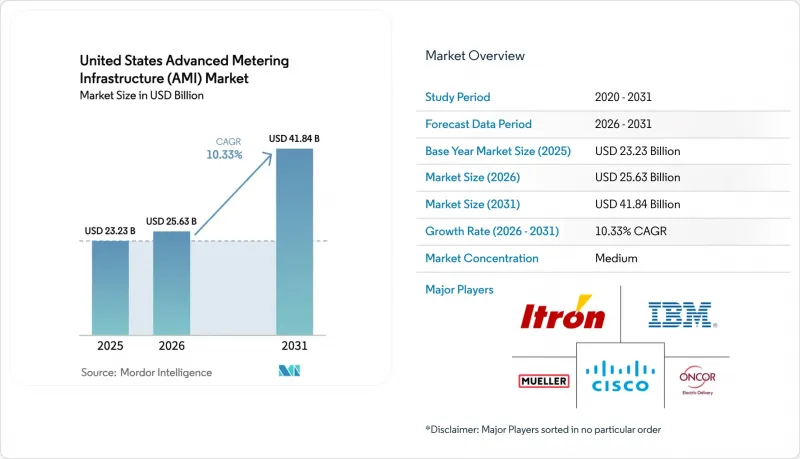
本報告按組件(智慧電錶設備、解決方案和服務)、最終用戶(住宅、商業和工業)、通訊技術(射頻網狀網路、電力線通訊、蜂窩網路和Wi-Fi)、公共產業所有權類型(投資者擁有的公共產業、國有電力公司和電力合作社)以及地區進行細分。市場預測以美元計價。
美國進階計量基礎設施(AMI)市場趨勢與洞察
聯邦政府強制執行並大幅增加資金籌措。
美國史上規模最大的聯邦支出正在改變美國智慧電錶基礎設施市場的經濟結構,透過提供直接資金來降低公共產業的初始成本風險。電網韌性與創新夥伴關係計畫已透過兩輪提案徵集撥款57億美元,其中智慧電網津貼涵蓋智慧電錶、監控工具和自動化硬體。為各州和部落制定的專案津貼為韌性項目額外增加了13億美元,其中許多項目被明確指定為「監控技術」。根據《通貨膨脹控制法案》,直接支付稅額扣抵允許地方政府公共產業和合作社申報高達符合條件的智慧電錶投資30%的稅收抵免,從而改善專案現金流。這些機制縮短了法規核准流程,並使小規模的公共產業能夠將智慧電錶升級與更廣泛的電網專案相結合。採購活動曾經在電價變動前後達到高峰,現在則全年持續進行,使美國智慧電錶基礎設施市場的供應商累積訂單更加穩定。
電力系統現代化和分散式能源(DER)併網的需求日益成長
隨著分散式能源 (DER) 的擴張,電力公司被迫更換缺乏時間同步資料的過時電錶。美國能源部的「互聯社區 2.0」計畫已撥款 3,200 萬美元用於先導計畫,這些項目利用間隔數據進行電動車充電管理和可再生能源協調。目前,AMI 資料集正被用於佇列管理軟體,以加速清潔能源併網,例如 i2X 的「創新佇列管理解決方案」專案。電力公司需要確保線路層面的確定性可視性,並在數小時內而非數月內完成容量調查。這項營運要求正在將 AMI 從單純的計費系統升級轉變為美國 AMI 市場的核心電網感知層。可再生能源目標較高的州正在指導配電系統升級指南,以提升電錶可視性,從而形成良性循環的需求驅動機制。
傳統IT與OT之間互通性的差距。
在許多第一代部署中,由於對企業架構投資不足,導致系統各自獨立,資料交換複雜。電力公司目前面臨部署成本高昂的中間件的挑戰,這些中間件需要將AMI前端系統與其停電管理、配電和客戶管理平台整合。加上人手不足,專案預算不斷膨脹,對於缺乏內部專業知識的小規模公用事業公司尤其如此。雖然雲端原生前端系統和開放式API可能是解決方案,但從本地環境遷移仍然是耗時數年的過程。這種技術複雜性可能會減緩美國AMI市場的供應商採購和收入成長。
細分市場分析
截至2025年,智慧電錶終端將占美國高級計量基礎設施(AMI)市場46.62%的佔有率,顯示電錶更換計畫仍在持續進行。但軟體領域預計將超越這一佔有率,到2031年將以13.62%的複合年成長率成長。這一成長將由分析模組驅動,這些模組可以將間隔數據轉化為可產生收益的電網服務和以客戶為中心的洞察。預計到預測期末,美國高階計量基礎設施市場軟體市場規模與設備市場之間的收入差距將縮小。電力公司正在將通訊閘道器和前端系統與雲端儀表板結合,以對變壓器負載進行基準測試並實現電壓設定的自動化。隨著數據價值超過已安裝電錶的數量,供應商正在合約中加入訂閱層級,以創造可增加利潤率的經常性收入來源。
服務正從基礎安裝發展到基於績效的契約,這些合約能夠保證抄表成功率,並根據分析結果提供節能方案。對於無法組成全新資料科學團隊的電力公司而言,託管服務極具吸引力。在美國高階計量基礎設施市場,供應商正在提案承包模式,也就是由供應商擁有後端基礎設施,並透過安全API提供抄寫資料。這降低了客戶的資本支出(CAPEX),加快了系統部署,並提高了供應商的合約總價值。
預計到2025年,住宅收入將佔總收入的88.35%,這反映了美國龐大的家庭數量以及聯邦政府對公平性的重視。大型公用事業公司正透過將鼓勵節能的收費系統與高階計量指標(AMI)的實施相結合,加強其在住宅領域的滲透。同時,隨著工廠生產流程電氣化程度的提高和可再生能源的整合,預計到2031年,工業用電的複合年成長率將達到12.92%,成為成長最快的領域。儘管工業用戶在美國高級計量基礎設施市場中的佔有率仍然小規模,但需求定價、電能品質監測以及參與批發電力市場所需的精細計量正在推動其高速成長。
許多工業設施以產消者的身分運營,利用太陽能、儲能或微電網等能源。這些設施依賴時間同步資料進行計費和確保可靠性。一些工廠需要冗餘通訊路徑和網路安全認證,因為通訊故障會直接導致生產損失。提供功能強大的電錶和即時分析功能的供應商正抓住這一機遇,並不斷擴大其在美國高級計量基礎設施(AMI)市場工業領域的佔有率。
其他好處:
- Excel格式的市場預測(ME)表
- 3個月的分析師支持
目錄
第1章:引言
- 研究假設和市場定義
- 調查範圍
第2章:調查方法
第3章執行摘要
第4章 市場狀況
- 市場概覽
- 市場促進因素
- 聯邦政府強制執行並大幅增加資金投入。
- 日益成長的電網現代化需求和分散式能源(DER)的整合
- 加強關鍵基礎設施的網路安全標準
- 客戶對近即時收費分析的需求
- 過渡到蜂窩AMI回程傳輸
- 利用人工智慧實現計量數據分析的商業化
- 市場限制因素
- 傳統IT與OT之間互通性的差距。
- 強烈反對消費者隱私保護
- 公共產業部門缺乏具備數位基礎設施應用技能的人員
- 全球半導體供應受限,以公尺為單位
- 產業價值鏈分析
- 監理情勢
- 宏觀經濟因素的影響
- 技術展望
- 波特五力分析
第5章 市場規模與成長預測
- 按組件
- 智慧電錶設備(電力、水、瓦斯)
- 解決方案
- 計量通訊基礎設施
- 軟體
- 計量資料管理
- 計量數據分析
- 服務
- 最終用戶
- 住宅
- 商業
- 產業
- 透過通訊技術
- 射頻網狀網路
- 電力線路通訊(PLC)
- 細胞
- Wi-Fi 和其他通訊技術
- 按公共產業所有權類型分類
- 私人公共產業
- 公有電力供應商
- 電力合作社
第6章 競爭情勢
- 市場集中度
- 策略趨勢
- 市佔率分析
- 公司簡介
- Itron Inc.
- Landis+Gyr AG
- Sensus USA Inc.
- Honeywell International Inc.
- Aclara Technologies LLC
- Cisco Systems Inc.
- Siemens Industry Inc.
- Eaton Corporation plc
- Trilliant Holdings Inc.
- NuriFlex Inc.
- General Electric Company
- Mitsubishi Electric Power Products Inc.
- Schneider Electric USA Inc.
- Silver Spring Networks LLC
- Mueller Systems LLC
- Oracle America Inc.
- Badger Meter Inc.
- Kamstrup A/S
- Elster Solutions LLC
第7章 市場機會與未來展望
According to Mordor Intelligence, the US AMI market size is expected to grow from USD 23.23 billion in 2025 to USD 25.63 billion in 2026 and is forecast to reach USD 41.84 billion by 2031 at 10.33% CAGR over 2026-2031.
This report is Segmented by Component (Smart Metering Devices, Solutions, and Services), End-User (Residential, Commercial, and Industrial), Communication Technology (RF Mesh, Power Line Carrier, Cellular, Wi-Fi, and More), and Utility Ownership Type (Investor-Owned Utilities, Public Power Utilities, and Electric Cooperatives) and Geography. The Market Forecasts are Provided in Terms of Value (USD).
United States Advanced Metering Infrastructure (AMI) Market Trends and Insights
Federal Roll-Out Mandates and Funding Surge
Historic federal spending is changing the economics of the US AMI market by providing direct capital that lowers upfront cost risk for utilities. The Grid Resilience and Innovation Partnerships program has directed USD 5.7 billion across two rounds, with smart grid grants covering AMI, monitoring tools, and automation hardware. State and tribal formula grants have added USD 1.3 billion for resilience projects, many tagged specifically as "monitoring and control technologies." Direct-pay tax credits under the Inflation Reduction Act allow municipal utilities and cooperatives to claim up to 30% of qualifying AMI investments, which improves project cash flow. These mechanisms shorten regulatory approval cycles and let smaller utilities bundle AMI upgrades with broader grid projects. Procurement momentum that once peaked near rate-case windows now continues year-round, giving vendors steadier order books across the US AMI market.
Rising Grid Modernization and DER Integration Needs
Distributed energy resource growth is forcing utilities to replace legacy meters that lack time-synchronized data. The Department of Energy's Connected Communities 2.0 program awarded USD 32 million to pilot projects that rely on interval data for EV charging management and renewable coordination. AMI datasets now feed queue-management software that accelerates clean-energy interconnections, as seen in the i2X Innovative Queue Management Solutions program. Utilities need deterministic visibility at the feeder level to run hosting-capacity studies in hours rather than months. This operational requirement turns AMI from a billing upgrade into a core grid-sensing layer for the US AMI market. States with high renewable targets are issuing guidance that any distribution upgrade plan must include metering visibility enhancements, feeding a virtuous cycle of demand.
Legacy IT/OT Interoperability Gaps
Many first-generation rollouts underinvested in enterprise architecture, producing siloed systems that complicate data exchange. Utilities now face costly middleware deployments to link AMI head-ends with outage, distribution, and customer platforms. Integration of labour shortages inflates project budgets, especially for small public power entities that lack in-house talent. Cloud-native head-ends and open APIs promise relief, yet migration from on-premises environments remains a multiyear process. These technical complexities can delay procurement and slow revenue realization for vendors in the US AMI market.
Other drivers and restraints analyzed in the detailed report include:
- Increasing Cybersecurity Standards for Critical Infrastructure
- AI-Driven Meter Data Analytics Monetization
- Persistent Consumer Privacy Pushback
For complete list of drivers and restraints, kindly check the Table Of Contents.
Segment Analysis
Smart Metering Devices represented 46.62% of the US AMI market in 2025, underlining ongoing meter replacement programs, yet Software is set to outpace with a 13.62% CAGR to 2031. This growth pivots on analytics modules that transform interval data into revenue-generating grid services and customer-focused insights. The US AMI market size for software is forecast to narrow the revenue gap with devices before the forecast horizon ends. Utilities pair communication gateways and head-end systems with cloud dashboards that benchmark transformer loading and automate voltage set-points. As data value overtakes meter counts, vendors bundle subscription layers into contracts, creating an annuity stream that boosts margins.
Services are evolving from basic installation to outcome-based agreements, such as guaranteed read-success thresholds and analytics-driven energy savings. Managed services appeal to utilities that cannot staff new data science teams. In the US AMI market, suppliers now propose turnkey models where they own backend infrastructure and deliver meter data through secure APIs. This reduces customer capex and speeds adoption while enlarging vendors' total contract value.
Residential connections made up 88.35% of 2025 revenue, reflecting household volume and federal equity priorities. Large utilities tie AMI rollouts to rate structures that reward conservation, reinforcing residential penetration. Industrial accounts, however, are posting the highest 12.92% CAGR through 2031 as factories electrify processes and integrate renewables. The US AMI market share for industrial users is still modest, yet high growth stems from granular metering needed for demand charges, power-quality monitoring, and wholesale participation.
Many industrial sites operate as prosumers with behind-the-meter solar, storage, or microgrids. They rely on time-synchronized data for settlement and reliability assurances. Some plants require redundant communications paths and cybersecurity certifications because outages translate directly to production losses. Vendors with hardened meters and real-time analytics capture this opportunity, raising the visibility of the industrial segment inside the US AMI market.
Complete Report Scope:
- By Component
- Smart Metering Devices (Electricity - Water - Gas)
- Solutions
- Meter Communication Infrastructure
- Software
- Meter Data Management
- Meter Data Analytics
- Services
- By End-User
- Residential
- Commercial
- Industrial
- By Communication Technology
- RF Mesh
- Power Line Carrier (PLC)
- Cellular
- Wi-Fi and Other Communication Technologies
- By Utility Ownership Type
- Investor-Owned Utilities
- Public Power Utilities
- Electric Cooperatives
List of Companies Covered in this Report:
- Itron Inc.
- Landis+Gyr AG
- Sensus USA Inc.
- Honeywell International Inc.
- Aclara Technologies LLC
- Cisco Systems Inc.
- Siemens Industry Inc.
- Eaton Corporation plc
- Trilliant Holdings Inc.
- NuriFlex Inc.
- General Electric Company
- Mitsubishi Electric Power Products Inc.
- Schneider Electric USA Inc.
- Silver Spring Networks LLC
- Mueller Systems LLC
- Oracle America Inc.
- Badger Meter Inc.
- Kamstrup A/S
- Elster Solutions LLC
Additional Benefits:
- The market estimate (ME) sheet in Excel format
- 3 months of analyst support
TABLE OF CONTENTS
1 INTRODUCTION
- 1.1 Study Assumptions and Market Definition
- 1.2 Scope of the Study
2 RESEARCH METHODOLOGY
3 EXECUTIVE SUMMARY
4 MARKET LANDSCAPE
- 4.1 Market Overview
- 4.2 Market Drivers
- 4.2.1 Federal Roll-out Mandates and Funding Surge
- 4.2.2 Rising Grid Modernization and DER Integration Needs
- 4.2.3 Increasing Cybersecurity Standards for Critical Infrastructure
- 4.2.4 Customer Demand for Near Real-Time Billing Insights
- 4.2.5 Shift Toward Cellular-Based AMI Backhaul
- 4.2.6 AI-Driven Meter Data Analytics Monetization
- 4.3 Market Restraints
- 4.3.1 Legacy IT/OT Interoperability Gaps
- 4.3.2 Persistent Consumer-Privacy Pushback
- 4.3.3 Utility Workforce Skill Shortages for DI Apps
- 4.3.4 Semiconductor Supply Constraints for Meter ICs
- 4.4 Industry Value-Chain Analysis
- 4.5 Regulatory Landscape
- 4.6 Impact of Macroeconomic Factors
- 4.7 Technological Outlook
- 4.8 Porter's Five Forces Analysis
- 4.8.1 Threat of New Entrants
- 4.8.2 Bargaining Power of Buyers
- 4.8.3 Bargaining Power of Suppliers
- 4.8.4 Threat of Substitute Products
- 4.8.5 Intensity of Competitive Rivalry
5 MARKET SIZE AND GROWTH FORECASTS (VALUE)
- 5.1 By Component
- 5.1.1 Smart Metering Devices (Electricity - Water - Gas)
- 5.1.2 Solutions
- 5.1.2.1 Meter Communication Infrastructure
- 5.1.2.2 Software
- 5.1.2.2.1 Meter Data Management
- 5.1.2.2.2 Meter Data Analytics
- 5.1.3 Services
- 5.2 By End-User
- 5.2.1 Residential
- 5.2.2 Commercial
- 5.2.3 Industrial
- 5.3 By Communication Technology
- 5.3.1 RF Mesh
- 5.3.2 Power Line Carrier (PLC)
- 5.3.3 Cellular
- 5.3.4 Wi-Fi and Other Communication Technologies
- 5.4 By Utility Ownership Type
- 5.4.1 Investor-Owned Utilities
- 5.4.2 Public Power Utilities
- 5.4.3 Electric Cooperatives
6 COMPETITIVE LANDSCAPE
- 6.1 Market Concentration
- 6.2 Strategic Moves
- 6.3 Market Share Analysis
- 6.4 Company Profiles (includes Global level Overview, Market level overview, Core Segments, Financials as available, Strategic Information, Market Rank/Share for key companies, Products AND Services, and Recent Developments)
- 6.4.1 Itron Inc.
- 6.4.2 Landis+Gyr AG
- 6.4.3 Sensus USA Inc.
- 6.4.4 Honeywell International Inc.
- 6.4.5 Aclara Technologies LLC
- 6.4.6 Cisco Systems Inc.
- 6.4.7 Siemens Industry Inc.
- 6.4.8 Eaton Corporation plc
- 6.4.9 Trilliant Holdings Inc.
- 6.4.10 NuriFlex Inc.
- 6.4.11 General Electric Company
- 6.4.12 Mitsubishi Electric Power Products Inc.
- 6.4.13 Schneider Electric USA Inc.
- 6.4.14 Silver Spring Networks LLC
- 6.4.15 Mueller Systems LLC
- 6.4.16 Oracle America Inc.
- 6.4.17 Badger Meter Inc.
- 6.4.18 Kamstrup A/S
- 6.4.19 Elster Solutions LLC
7 MARKET OPPORTUNITIES AND FUTURE OUTLOOK
- 7.1 White-Space and Unmet-Need Assessment

 先進計量基礎設施(AMI):市場佔有率分析、產業趨勢與統計數據及成長預測(2026-2031 年)
 智慧電錶和先進測量基礎設施市場預測——全球分析(按組件、電錶類型、通訊技術、應用、最終用戶和地區分類)——2034年
 AMI電錶市場規模、佔有率和成長分析:按電錶類型、通訊技術、組件、最終用途和地區分類-2026-2033年產業預測
 先進計量基礎設施市場:按組件、通訊技術、最終用戶和地區分類
 進階測量基礎設施 (AMI) 市場規模、佔有率、趨勢和預測:按產品類型、最終用戶和地區分類,2026-2034 年
 先進計量基礎設施市場:按組件、通訊技術、應用和最終用戶分類-2026-2032年全球市場預測
 2026年全球先進測量基礎設施市場報告2026年全球先進計量基礎設施(AMI)燃氣表市場報告
 高級計量基礎設施 (AMI) 市場規模、佔有率和預測:依計量類型(電力、燃氣、水)、通訊技術(PLC、RF Mesh、蜂窩網路)和智慧電網功能劃分 - 全球預測 (2026-2036)全球電能品質監測系統市場預測至2034年:依產品、設備類型、拓樸結構、應用、最終用戶及地區分類