


 |
市場調查報告書
商品編碼
2116802
東協電動自行車市場:市場佔有率分析、產業趨勢與統計及成長預測(2026-2031)ASEAN E-Bike - Market Share Analysis, Industry Trends & Statistics, Growth Forecasts (2026 - 2031) |
||||||

※ 本網頁內容可能與最新版本有所差異。詳細情況請與我們聯繫。
預計到 2026 年,東協電動自行車市場規模將達到 3.9 億美元,高於 2025 年的 3.5 億美元,預計到 2031 年將達到 6.5 億美元。
預計從 2026 年到 2031 年,其複合年成長率將達到 10.82%。
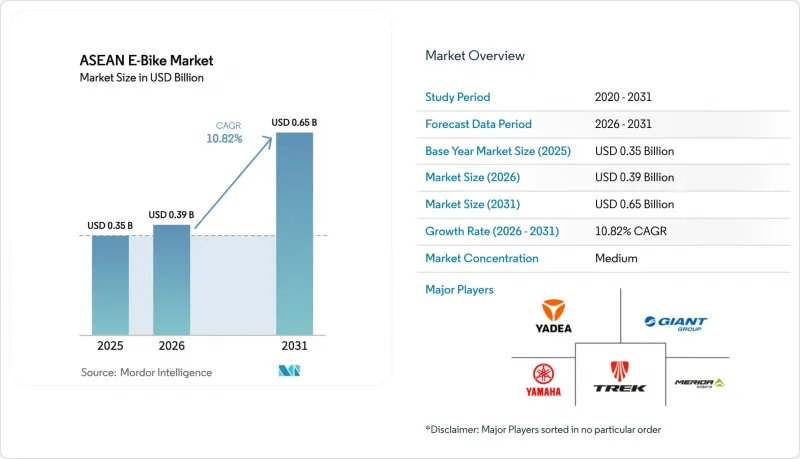
本報告按驅動系統(腳踏助力、油門輔助等)、馬達類型(輪轂式馬達、中置馬達等)、電池化學成分(鋰離子電池、鉛酸電池)、應用領域(都市區通勤、旅行/電動山地車、其他)、價格區間(1000美元以下、1000-2000美元、其他)以及其他國家(越南地區(越南)和其他國家細分市場進行細分、其他國家/馬來西亞地區。市場預測以美元計價。
東協電動自行車市場趨勢與洞察
政府對電動車的獎勵措施和購車補貼
財政支持正在加速從汽油摩托車向電動機車的轉型。在越南,0%的註冊稅和公共充電站的部署,在2025年上半年促進了電動摩托車的銷售,使其成為全球第三大市場。印尼在2025年將大額現金補貼轉向增值稅(VAT)折扣,但仍在2024年增加了符合條件的車輛數量。泰國的「BEV 3.5計畫」結合了關稅減免和在地採購生產獎勵措施,馬來西亞和菲律賓也在製定類似的扶持措施。這些措施共同顯示出明顯的市場需求,為生產設施的投資提供了依據,並提高了東協電動機車市場中期前景的透明度。
擴大企業電動機車車隊規模,用於最後一公里物流
為了降低燃料成本並符合低排放氣體區法規,B2B買家正在將其摩托車車隊電動化。越南的一項共享旅遊法令規定,到2029年必須更換40萬輛摩托車。印尼雅加達和泗水的宅配業者自採用電動自行車以來,營運成本顯著降低,並因此簽訂了多年採購合約。車隊營運商優先考慮電池更換相容性、堅固的車架和長期保修,這催生了一種利基設計需求,這種需求有利於商用級平台,並確保東協電動自行車市場的重複訂單。
公共充電和換電基礎設施有限
截至2025年3月,印尼僅有3772個公共充電樁,遠低於2030年的目標。農村地區的騎乘者往往家中沒有車庫,續航里程的擔憂也阻礙了電動自行車的普及。私人投資者只有在交通流量足以支撐投資的情況下才願意進入市場,這形成了一個惡性循環,減緩了電動自行車在東協農村地區的普及速度。
細分市場分析
2025年,輔助型電動自行車在東協電動自行車市場佔有62.60%的佔有率,反映出消費者既重視鍛鍊又重視電動輔助。預計到2031年,雙模混合動力汽車將以12.20%的複合年成長率成長,吸引那些既想在坡道上自由控制油門,又想享受在自行車道上免駕照騎行便利的騎行者,從而推動東協電動自行車市場的成長。監管政策的柔軟性,尤其是在將助力型自行車認定為自行車的地區,有助於其被通勤者廣泛接受。
在同一小標題下,也提到,僅靠油門驅動的車型在頻繁啟停的送貨服務領域佔據了一定的市場佔有率,而越南監管機構可能會強制要求高速車型安裝後視鏡和轉向燈。隨著車型種類日益豐富,製造商正在為其配備智慧控制器,實現人力驅動和純電動驅動模式之間的切換,從而提升東協電動自行車市場的價值。
輪轂式馬達憑藉其較低的製造成本、能夠抵禦熱帶雨水的密封結構以及易於維護等優點,預計到2025年將佔據東協電動自行車市場81.90%的佔有率。然而,中置馬達正以12.60%的複合年成長率快速成長,因為運動型通勤者和貨運公司看重其重量平衡和扭力放大效果。目前,各大品牌正在銷售可拆卸的中置馬達動力傳動系統,這簡化了車隊的維護,也顯示東協電動自行車市場正在經歷一場漸進的技術變革。
同時,摩擦驅動套件仍然受到那些希望以低於300美元的價格將現有自行車電動化的用戶的歡迎。儘管銷量不高,但這些套件吸引了一些新用戶,他們最終可能會過渡到製造商生產的電動自行車,從而推動東協電動自行車市場的未來更換需求。
其他好處:
- Excel格式的市場預測(ME)表
- 3個月的分析師支持
目錄
第1章:引言
- 研究假設和市場定義
- 調查範圍
第2章:調查方法
第3章執行摘要
第4章 市場狀況
- 市場概覽
- 市場促進因素
- 政府對電動車的獎勵措施和購車補貼
- 各公司正在擴大電動自行車在最後一公里物流的應用。
- 都市區壅塞收費系統及內燃機車輛相關法規
- 透過提高電池能量密度降低總體擁有成本。
- 專注於度假島嶼旅遊業的微型旅遊計畫。
- 區域城市太陽能電池換電站試點項目
- 市場限制因素
- 公共充電和換電基礎設施有限
- 低價冰上滑板車的受歡迎程度
- 東南亞國協型式認可標準的差異
- 鋰離子電池的進口關稅和物流瓶頸
- 價值供應鏈分析
- 監理情勢
- 技術展望
- 波特五力模型
第5章 市場規模與成長預測
- 依推進類型
- 腳踏輔助型
- 油門輔助類型(按需輸出)
- 雙模/混合
- 依馬達類型
- 輪轂式馬達
- 中置馬達
- 其他類型的馬達(例如摩擦馬達)
- 電池化學成分
- 鋰離子
- 鉛酸
- 透過使用
- 都市區的通勤
- 徒步/電動登山車
- 貨物/多用途
- 配送和車輛(最後一公里)
- 折疊式/緊湊
- 按價格範圍
- 不到1000美元
- 1000美元至2000美元
- 超過2000美元
- 國家
- 越南
- 印尼
- 馬來西亞
- 泰國
- 新加坡
- 菲律賓
- 其他東南亞國協
第6章 競爭情勢
- 市場集中度
- 策略趨勢
- 市佔率分析
- 公司簡介
- Giant Manufacturing Co. Ltd
- Merida Industry Co. Ltd
- Trek Bicycle Corporation
- Yadea Technology Group Co. Ltd
- Yamaha Motor Co. Ltd
- Brompton Bicycle Ltd
- Gogoro Inc.
- VinFast Trading & Manufacturing JSC
- Aima Technology Group Co., Ltd
- Niu Technologies
- Phoenix Cycle Co. Ltd
- Qualisports Technology Co. Ltd
- Fuji-ta Bicycle Co. Ltd
- Tailing Electric Vehicle Co. Ltd
- Asama Vietnam Co. Ltd
第7章 市場機會與未來展望
According to Mordor Intelligence, ASEAN e-bike market size in 2026 is estimated at USD 0.39 billion, growing from 2025 value of USD 0.35 billion with 2031 projections showing USD 0.65 billion, growing at 10.82% CAGR over 2026-2031.
This report is Segmented by Propulsion Type (Pedal-Assisted, Throttle-Assisted, and More), Motor Type (Hub-Motor, Mid-Drive, and More), Battery Chemistry (Lithium-Ion, Lead-Acid), Application (City/Urban Commuting, Trekking/E-MTB, and More), Price Band (Below USD 1, 000, USD 1, 000-2, 000, and More), and Country (Vietnam, Indonesia, Malaysia, and More). The Market Forecasts are Provided in Terms of Value (USD).
ASEAN E-Bike Market Trends and Insights
Government E-Mobility Incentives and Purchase Subsidies
Fiscal support is accelerating shifts from gasoline motorcycles to electric options. Vietnam's 0% registration tax and public-charger rollout underpinned notable sales in H1 2025, ranking the country third worldwide . Indonesia moved from a significant cash grant to a VAT discount in 2025, yet still lifted subsidized volumes in 2024. Thailand's BEV 3.5 plan combines duty relief and local-content bonuses, and Malaysia plus the Philippines are drafting parallel packages. These converging measures send reliable demand signals that justify tooling investments and raise the Asean e-bike market's medium-term visibility.
Expansion of Corporate E-Bike Fleets for Last-Mile Logistics
B2B buyers are electrifying two-wheeler fleets to cut fuel costs and comply with low-emission-zone rules. Vietnam's ride-hailing decree obliges 400,000 motorcycles to switch by 2029. Indonesian couriers in Jakarta and Surabaya report significant operating cost savings after adopting e-bikes, prompting multi-year procurement contracts. Fleet operators value battery-swap compatibility, heavy-duty frames, and extended warranties, creating design niches that favor commercial-grade platforms and lock in repeat orders for the Asean e-bike market.
Limited Public Charging/Swapping Infrastructure
Indonesia fielded only 3,772 public charging points as of March 2025, a notable share of its 2030 target . Rural riders lack home garages, so range anxiety dampens uptake. Private investors hesitate until traffic justifies payback, prolonging the chicken-and-egg cycle that restricts rural penetration of the Asean e-bike market.
Other drivers and restraints analyzed in the detailed report include:
- Urban Congestion Pricing and ICE-Vehicle Restrictions
- Rising Battery Energy Density Lowering Total Cost of Ownership
- Popularity of Low-Priced ICE Scooters
For complete list of drivers and restraints, kindly check the Table Of Contents.
Segment Analysis
The pedal-assist category represented 62.60% of the ASEAN e-bike market share in 2025 as consumers valued hybrid exercise and electric thrust. Dual-mode hybrids should log the top-line 12.20% CAGR through 2031, widening the ASEAN e-bike market by attracting riders who want throttle freedom on hills yet license-free status on cycle lanes. Regulatory flexibility, especially where pedal-assists qualify as bicycles, supports broad commuter acceptance.
Continuation of the same sub-heading adds that throttle-only variants hold niches in delivery services requiring constant stop-start bursts, while regulators in Vietnam may demand mirrors and turn signals for higher-speed classes. As model choice diversifies, manufacturers integrate smart controllers that toggle between human-power bias and full motor drive, increasing perceived value in the ASEAN e-bike market.
Hub motors owned 81.90% of the ASEAN e-bike market share in 2025 because they are cheap to produce, sealed against tropical rain, and simple to service. Yet the mid-drive slice is expanding at 12.60% CAGR as sport commuters and cargo couriers appreciate balanced weight and torque multiplication. Brands now market removable mid-drive powertrains that simplify fleet maintenance, hinting at a gradual technological pivot within the ASEAN e-bike market.
At the same time, friction-drive kits survive in retrofit circles where riders wish to electrify existing bicycles for under USD 300. Although marginal in volume, such kits introduce new users who could migrate to factory e-bikes, feeding future replacement cycles in the ASEAN e-bike market.
Complete Report Scope:
- By Propulsion Type
- Pedal-assisted
- Throttle-assisted (Power-on-demand)
- Dual-mode / Hybrid
- By Motor Type
- Hub-motor
- Mid-drive
- Other motors (e.g., friction)
- By Battery Chemistry
- Lithium-ion
- Lead-acid
- By Application
- City / Urban Commuting
- Trekking / E-MTB
- Cargo / Utility
- Delivery and Fleet (Last-mile)
- Folding / Compact
- By Price Band
- Below USD 1,000
- USD 1,000 -2,000
- Above USD 2,000
- By Country
- Vietnam
- Indonesia
- Malaysia
- Thailand
- Singapore
- Philippines
- Rest of ASEAN
List of Companies Covered in this Report:
- Giant Manufacturing Co. Ltd
- Merida Industry Co. Ltd
- Trek Bicycle Corporation
- Yadea Technology Group Co. Ltd
- Yamaha Motor Co. Ltd
- Brompton Bicycle Ltd
- Gogoro Inc.
- VinFast Trading & Manufacturing JSC
- Aima Technology Group Co., Ltd
- Niu Technologies
- Phoenix Cycle Co. Ltd
- Qualisports Technology Co. Ltd
- Fuji-ta Bicycle Co. Ltd
- Tailing Electric Vehicle Co. Ltd
- Asama Vietnam Co. Ltd
Additional Benefits:
- The market estimate (ME) sheet in Excel format
- 3 months of analyst support
TABLE OF CONTENTS
1 Introduction
- 1.1 Study Assumptions & Market Definition
- 1.2 Scope of the Study
2 Research Methodology
3 Executive Summary
4 Market Landscape
- 4.1 Market Overview
- 4.2 Market Drivers
- 4.2.1 Government E-Mobility Incentives and Purchase Subsidies
- 4.2.2 Expansion of Corporate E-Bike Fleets for Last-Mile Logistics
- 4.2.3 Urban Congestion Pricing and ICE-Vehicle Restrictions
- 4.2.4 Rising Battery Energy Density Lowering Total Cost of Ownership
- 4.2.5 Tourism-Focused Micro-Mobility Schemes in Resort Islands
- 4.2.6 Solar-Powered Swap-Station Pilots in Secondary Cities
- 4.3 Market Restraints
- 4.3.1 Limited Public Charging/Swapping Infrastructure
- 4.3.2 Popularity of Low-Priced ICE Scooters
- 4.3.3 Fragmented Homologation Standards Across ASEAN
- 4.3.4 Lithium-Ion Cell Import Tariffs and Logistics Bottlenecks
- 4.4 Value / Supply-Chain Analysis
- 4.5 Regulatory Landscape
- 4.6 Technological Outlook
- 4.7 Porter's Five Forces
- 4.7.1 Threat of New Entrants
- 4.7.2 Bargaining Power of Buyers
- 4.7.3 Bargaining Power of Suppliers
- 4.7.4 Threat of Substitutes
- 4.7.5 Competitive Rivalry
5 Market Size & Growth Forecasts (Value, USD)
- 5.1 By Propulsion Type
- 5.1.1 Pedal-assisted
- 5.1.2 Throttle-assisted (Power-on-demand)
- 5.1.3 Dual-mode / Hybrid
- 5.2 By Motor Type
- 5.2.1 Hub-motor
- 5.2.2 Mid-drive
- 5.2.3 Other motors (e.g., friction)
- 5.3 By Battery Chemistry
- 5.3.1 Lithium-ion
- 5.3.2 Lead-acid
- 5.4 By Application
- 5.4.1 City / Urban Commuting
- 5.4.2 Trekking / E-MTB
- 5.4.3 Cargo / Utility
- 5.4.4 Delivery and Fleet (Last-mile)
- 5.4.5 Folding / Compact
- 5.5 By Price Band
- 5.5.1 Below USD 1,000
- 5.5.2 USD 1,000 -2,000
- 5.5.3 Above USD 2,000
- 5.6 By Country
- 5.6.1 Vietnam
- 5.6.2 Indonesia
- 5.6.3 Malaysia
- 5.6.4 Thailand
- 5.6.5 Singapore
- 5.6.6 Philippines
- 5.6.7 Rest of ASEAN
6 Competitive Landscape
- 6.1 Market Concentration
- 6.2 Strategic Moves
- 6.3 Market Share Analysis
- 6.4 Company Profiles (includes Global Level Overview, Market Level Overview, Core Segments, Financials as Available, Strategic Information, Market Rank/Share for Key Companies, Products and Services, SWOT Analysis, and Recent Developments)
- 6.4.1 Giant Manufacturing Co. Ltd
- 6.4.2 Merida Industry Co. Ltd
- 6.4.3 Trek Bicycle Corporation
- 6.4.4 Yadea Technology Group Co. Ltd
- 6.4.5 Yamaha Motor Co. Ltd
- 6.4.6 Brompton Bicycle Ltd
- 6.4.7 Gogoro Inc.
- 6.4.8 VinFast Trading & Manufacturing JSC
- 6.4.9 Aima Technology Group Co., Ltd
- 6.4.10 Niu Technologies
- 6.4.11 Phoenix Cycle Co. Ltd
- 6.4.12 Qualisports Technology Co. Ltd
- 6.4.13 Fuji-ta Bicycle Co. Ltd
- 6.4.14 Tailing Electric Vehicle Co. Ltd
- 6.4.15 Asama Vietnam Co. Ltd
7 Market Opportunities & Future Outlook
- 7.1 White-space & Unmet-need Assessment

 電動自行車市場:按電池類型、應用、驅動機制、插電式/電池式、運作模式、等級、銷售管道和地區分類
 折疊式電動自行車市場-2026-2032年全球市場預測電動自行車市場:2026-2032年全球市場預測(按推進類型、馬達配置、電池類型、電池容量、最終用戶和分銷管道分類)
 共享電動滑板車市場預測至2034年-全球分析(按滑板車類型、電池類型、營運模式、所有權模式、充電基礎設施、最終用戶和地區分類)電動自行車市場預測至2034年—全球產品類型、電池類型、驅動系統、分銷管道、應用、最終用戶和區域分析
 英國電動自行車:市場佔有率分析、產業趨勢與統計及成長預測(2026-2031)
 折疊式電動車市場報告:按車型、電池類型、銷售管道、用戶年齡層和地區分類(2026-2034 年)
 全球電動自行車市場:按類別、電池、馬達、系統、應用、速度、電池容量、組件和地區分類-預測(至2035年)
 全球電動自行車市場規模、佔有率、趨勢和成長分析報告(2026-2034)電動自行車市場:2026-2032年全球市場預測(依產品類型、電池類型、驅動系統、功率輸出、速度類型、應用和銷售管道)