


 |
市場調查報告書
商品編碼
2116777
西班牙屋頂太陽能發電:市場佔有率分析、行業趨勢和統計數據以及成長預測(2026-2031 年)Spain Rooftop Solar - Market Share Analysis, Industry Trends & Statistics, Growth Forecasts (2026 - 2031) |
||||||

※ 本網頁內容可能與最新版本有所差異。詳細情況請與我們聯繫。
根據 Mordor Intelligence 預測,西班牙屋頂太陽能發電市場規模(以裝置容量計算)預計將在 2025 年達到 9.32 吉瓦,2026 年達到 10.37 吉瓦,到 2031 年達到 15.42 吉瓦,2026 年至 2031 年的複合年成長率為 2031 年。
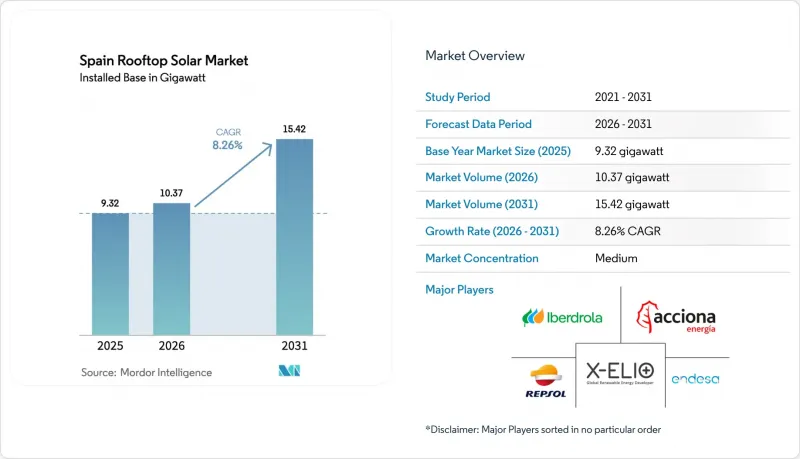
本報告按功率輸出範圍(10千瓦以下、10-100千瓦、100千瓦以上)、安裝類型(新建和維修)以及最終用途(住宅、商業和工業)進行細分。市場規模和預測均以裝置容量(吉瓦)為基礎。
西班牙屋頂太陽能發電市場趨勢與分析
擴大淨計量和剩餘電力補償制度
244/2019號皇家法令廢除了“太陽能稅”,允許產消者根據零售價格抵扣剩餘電力。對於裝置容量達數兆瓦的工業太陽能發電廠而言,這無疑是一項意外之喜,因為它們在周末的發電量通常超過自身用電量。該法令還批准了2000公尺半徑範圍內的集體自用,允許工廠集群共同利用屋頂並共用一個電網連接點。工業納稅人透過加速折舊和提高內部盈利,在節能效果顯現之前就顯著提高了獲利能力。由於這些機制,到2023年,自用裝置容量將超過核能發電,運作中自用裝置容量將達到7154兆瓦,而核子反應爐的裝置容量為7117兆瓦,其中大部分核反應器都安裝在工廠屋頂上。
降低模組和BOS成本
2023年,太陽能板價格下降了17%,600瓦組件的大宗訂單現在只需每瓦0.17美元即可清關。商用級逆變器和鋁製安裝系統的價格也隨之下降,使得工業屋頂發電的平準化電成本(LCOE)降至每千瓦時0.044美元,與地面安裝項目持平。一家年產能達82.1吉瓦的西班牙逆變器工廠有效保障了供應鏈免受運輸成本飆升的影響,使EPC公司能夠在經濟波動的情況下獲得固定價格合約。此外,7.5億歐元(約8.25億美元)的製造津貼進一步加強了國內零件的採購。
強制安裝併網智慧逆變器
巴塞隆納一座現有2兆瓦發電廠的維修計畫可能需要超過14個月才能獲得當地社區協會的批准,因為負責人需要編制消防安全報告、結構證明和景觀影響評估報告。布魯塞爾方面警告西班牙,此類延誤可能會危及「REPowerEU」計畫里程碑的實現。赫羅納一座中型發電廠的案例就耗時七年才獲得批准,這令風險規避型企業的財務長們感到擔憂,並導致軟成本增加,相當於專案總成本的6%。
細分市場分析
スペインの100 kW超の太陽光発電屋根設置市場の規模は、2025年に5.76 GWに達し、総裝置容量の61.8%を占めました。このカテゴリーの中で、数メガワット規模の産業用屋根設置は、部品の一括購入による価格低下や、キロワット当たりのソフトコストを低減する一括系統連系料金を背景に、CAGR11.1%を記録しています。10~100 kWのプロジェクトにおけるスペインの太陽光発電屋根設置市場の規模は2.41 GWに達しており、3年間の系統調査を必要とせず、ネットメータリングを重視する倉庫や超級市場を対象としています。
規模經濟效應已將5兆瓦屋頂太陽能發電系統的安裝成本降至0.68歐元/瓦,比住宅基準值低34%。透過將組件額定功率設定得高於逆變器額定功率,無需額外的系統平衡(BOS)設備即可提高發電量。同時,由於補貼上限的降低,10千瓦以下的系統市佔率正在下降。儘管如此,它們在郊區上網電價補貼(FIT)叢集中仍然至關重要。透過不斷更新智慧逆變器的韌體,超過100千瓦的系統可以提供電壓穿越和復合慣性功能,使工廠屋頂能夠用作微電網,並在緊急情況下作為電網資產發揮作用。
其他好處:
- Excel格式的市場預測(ME)表
- 3個月的分析師支持
目錄
第1章:引言
- 研究假設和市場定義
- 調查範圍
第2章:調查方法
第3章執行摘要
第4章 市場狀況
- 市場概覽
- 市場促進因素
- 擴大淨計量和剩餘電力補償制度
- 降低模組和BOS成本
- 企業永續發展與購電協議的推廣
- 歐盟綠色新政資金分配
- 強制引入併網智慧逆變器
- 自給自足型消費合作社數量不斷增加
- 市場限制因素
- 從當地政府獲得許可的過程很漫長。
- 2000 年前建造的建築物屋頂的結構承載極限
- 熟練屋頂安裝工人短缺
- 歷史保護區的眩光預防與景觀法規
- 供應鏈分析
- 監理情勢
- 技術展望
- 波特五力模型
- PESTLE分析
第5章 市場規模與成長預測
- 按生產能力範圍分類
- 10千瓦或以下
- 10~100 kW
- 100千瓦或以上
- 按安裝類型
- 新成立
- 改裝
- 按最終用途
- 住宅
- 商業的
- 產業
第6章 競爭情勢
- 市場集中度
- 策略趨勢(併購、聯盟、購電協議)
- 市場佔有率分析(主要公司的市場排名和市場佔有率)
- 公司簡介
- Acciona SA
- Iberdrola SA
- Endesa SA
- Repsol SA
- X-ELIO Energy
- Solaria Energia y Medio Ambiente SA
- Clidom SA
- Exiom Solution SA
- Soltec Energias Renovables SL
- Gransolar Group
- Avenir Energia
- SunPower Corp.
- SotySolar
- SMA Solar Technology AG
- REC Group
- Solarpack Corporacion Tecnologica SA
- Zelestra
- Gestamp Solar(Univergy/Grenergy)
- Grupotec Servicios de Ingenieria SL
- Zytech Solar
第7章 市場機會與未來展望
According to Mordor Intelligence, the Spain rooftop solar market size in terms of installed base is projected to be 9.32 gigawatt in 2025, 10.37 gigawatt in 2026, and reach 15.42 gigawatt by 2031, growing at a CAGR of 8.26% from 2026 to 2031.
This report is Segmented by Capacity Range (Up To 10 KW, 10 To 100 KW, and Above 100 KW), Installation Type (New-Build and Retrofit), and End-Use (Residential, Commercial, Industrial). The Market Sizes and Forecasts are Provided in Terms of Installed Capacity (GW).
Spain Rooftop Solar Market Trends and Insights
Net-metering expansion & surplus compensation scheme
Royal Decree 244/2019 eliminated the "sun tax," allowing prosumers to credit excess power at retail rates, a windfall for multi-megawatt industrial arrays that routinely over-generate on weekends. The law also green-lights collective self-consumption within 2,000 m, enabling factory clusters to pool rooftops and share one grid interconnection. Industrial taxpayers turbo-charge returns through accelerated depreciation, lifting internal rates of return even before energy savings kick in. These mechanisms helped self-consumption capacity overtake nuclear in 2023, with 7,154 MW online versus 7,117 MW for reactors, most of it sitting on factory roofs.
Declining module & BOS costs
Panel prices slid 17% in 2023, and large orders for 600-W modules now clear customs for as little as USD 0.17/W. Commercial-grade inverters and aluminum racking fell in tandem, pulling the levelized cost of industrial rooftop electricity down to USD 0.044/kWh, on par with ground-mount projects. Spain's inverter plants, rated at 82.1 GW per year, shield supply chains from freight shocks and let EPC firms lock in fixed-price contracts despite global volatility. A EUR 750 million (USD 825 million) manufacturing grant further anchors component sourcing at home.
Grid-interactive smart-inverter mandate
Town-hall approval for a 2 MW Barcelona retrofit can exceed 14 months, as planners juggle fire-safety reports, structural affidavits, and visual-impact statements. Brussels warned Spain that such delays jeopardize REPowerEU milestones. Girona's seven-year saga to clear a mid-scale plant frightened risk-averse industrial CFOs, adding soft costs equal to 6% of total project spend.
Other drivers and restraints analyzed in the detailed report include:
- Corporate sustainability & PPAs proliferation
- EU Green Deal funds allocation
- Scarce skilled rooftop-installer workforce
For complete list of drivers and restraints, kindly check the Table Of Contents.
Segment Analysis
Spain's solar rooftop market size for arrays above 100 kW reached 5.76 GW in 2025, equal to 61.8% of total installed capacity. Within this cohort, multi-megawatt industrial roofs are logging 11.1% CAGR on the back of bulk component pricing and single interconnection fees that dilute per-kilowatt soft costs. The Spain solar rooftop market size for 10-100 kW projects stood at 2.41 GW, addressing warehouses and supermarkets that value net-metering without three-year grid studies.
Economies of scale slash installed outlays to EUR 0.68/W for 5-MW rooftops, 34% below residential benchmarks. Overdimensioning modules to inverter ratings boosts yield without extra BOS hardware. Meanwhile, under-10 kW systems lose share as subsidy caps shrink, though they remain vital in suburban feed-in clusters. Continual smart-inverter firmware updates let >100 kW systems offer voltage ride-through and synthetic inertia, turning factory roofs into microgrids that double as grid assets during contingency events.
Complete Report Scope:
- By Capacity Range
- Up to 10 kW
- 10 to 100 kW
- Above 100 kW
- By Installation Type
- New-build
- Retrofit
- By End-use
- Residential
- Commercial
- Industrial
List of Companies Covered in this Report:
- Acciona SA
- Iberdrola SA
- Endesa SA
- Repsol SA
- X-ELIO Energy
- Solaria Energia y Medio Ambiente SA
- Clidom SA
- Exiom Solution SA
- Soltec Energias Renovables SL
- Gransolar Group
- Avenir Energia
- SunPower Corp.
- SotySolar
- SMA Solar Technology AG
- REC Group
- Solarpack Corporacion Tecnologica SA
- Zelestra
- Gestamp Solar (Univergy/Grenergy)
- Grupotec Servicios de Ingenieria SL
- Zytech Solar
Additional Benefits:
- The market estimate (ME) sheet in Excel format
- 3 months of analyst support
TABLE OF CONTENTS
1 Introduction
- 1.1 Study Assumptions & Market Definition
- 1.2 Scope of the Study
2 Research Methodology
3 Executive Summary
4 Market Landscape
- 4.1 Market Overview
- 4.2 Market Drivers
- 4.2.1 Net-metering expansion & surplus compensation scheme
- 4.2.2 Declining module & BOS costs
- 4.2.3 Corporate sustainability & PPAs proliferation
- 4.2.4 EU Green Deal funds allocation
- 4.2.5 Grid-interactive smart-inverter mandate
- 4.2.6 Rising self-consumption cooperatives
- 4.3 Market Restraints
- 4.3.1 Lengthy municipal permitting cycles
- 4.3.2 Rooftop structural load limitations in pre-2000 buildings
- 4.3.3 Scarce skilled rooftop-installer workforce
- 4.3.4 Anti-glare & aesthetic restrictions in heritage zones
- 4.4 Supply-Chain Analysis
- 4.5 Regulatory Landscape
- 4.6 Technological Outlook
- 4.7 Porter's Five Forces
- 4.7.1 Competitive Rivalry
- 4.7.2 Threat of New Entrants
- 4.7.3 Bargaining Power of Suppliers
- 4.7.4 Bargaining Power of Buyers
- 4.7.5 Threat of Substitutes
- 4.8 PESTLE Analysis
5 Market Size & Growth Forecasts
- 5.1 By Capacity Range
- 5.1.1 Up to 10 kW
- 5.1.2 10 to 100 kW
- 5.1.3 Above 100 kW
- 5.2 By Installation Type
- 5.2.1 New-build
- 5.2.2 Retrofit
- 5.3 By End-use
- 5.3.1 Residential
- 5.3.2 Commercial
- 5.3.3 Industrial
6 Competitive Landscape
- 6.1 Market Concentration
- 6.2 Strategic Moves (M&A, Partnerships, PPAs)
- 6.3 Market Share Analysis (Market Rank/Share for key companies)
- 6.4 Company Profiles (includes Global level Overview, Market level overview, Core Segments, Financials as available, Strategic Information, Products & Services, and Recent Developments)
- 6.4.1 Acciona SA
- 6.4.2 Iberdrola SA
- 6.4.3 Endesa SA
- 6.4.4 Repsol SA
- 6.4.5 X-ELIO Energy
- 6.4.6 Solaria Energia y Medio Ambiente SA
- 6.4.7 Clidom SA
- 6.4.8 Exiom Solution SA
- 6.4.9 Soltec Energias Renovables SL
- 6.4.10 Gransolar Group
- 6.4.11 Avenir Energia
- 6.4.12 SunPower Corp.
- 6.4.13 SotySolar
- 6.4.14 SMA Solar Technology AG
- 6.4.15 REC Group
- 6.4.16 Solarpack Corporacion Tecnologica SA
- 6.4.17 Zelestra
- 6.4.18 Gestamp Solar (Univergy/Grenergy)
- 6.4.19 Grupotec Servicios de Ingenieria SL
- 6.4.20 Zytech Solar
7 Market Opportunities & Future Outlook
- 7.1 White-space & Unmet-Need Assessment

 屋頂太陽能發電市場:2026-2032年全球市場預測(按面板類型、系統規模、組件、併網方式、建築整合、屋頂結構、安裝方式、最終用途和銷售管道)
 屋頂太陽能發電市場規模、佔有率和成長分析:按技術、併網類型、容量、組件、安裝類型、最終用戶和地區分類-2026-2033年產業預測
 分散式太陽能和屋頂光伏市場預測——按安裝類型、所有權/資金籌措模式、容量範圍、技術、應用和地區分類的全球分析——2034年
 屋頂太陽能發電EPC市場-全球產業規模、佔有率、趨勢、機會、預測:按產能、最終用戶、地區和競爭格局分類,2021-2031年
 2026年全球屋頂太陽能發電市場報告全球屋頂太陽能發電系統市場:2026-2032年市場預測(按系統容量、安裝方式、組件技術、屋頂材料、應用、安裝商類型、最終用戶和所有權狀態分類)
 日本屋頂太陽能發電市場規模、佔有率、趨勢和預測:按併網類型、最終用戶和地區分類,2026-2034年分散式屋頂太陽能發電市場-全球產業規模、佔有率、趨勢、機會、預測:容量、終端用戶、地區和競爭格局(2021-2031年)屋頂太陽能發電市場-全球產業規模、佔有率、趨勢、機會和預測:按部署方式、技術、電網類型、最終用戶、地區和競爭格局分類,2021-2031年屋頂太陽能電站市場預測至2032年:按類型、容量、組件、安裝類型、技術、最終用戶和地區分類的全球分析