


 |
市場調查報告書
商品編碼
2116770
磷脂質:市場佔有率分析、產業趨勢和統計數據、成長預測(2026-2031)Phospholipids - Market Share Analysis, Industry Trends & Statistics, Growth Forecasts (2026 - 2031) |
||||||

※ 本網頁內容可能與最新版本有所差異。詳細情況請與我們聯繫。
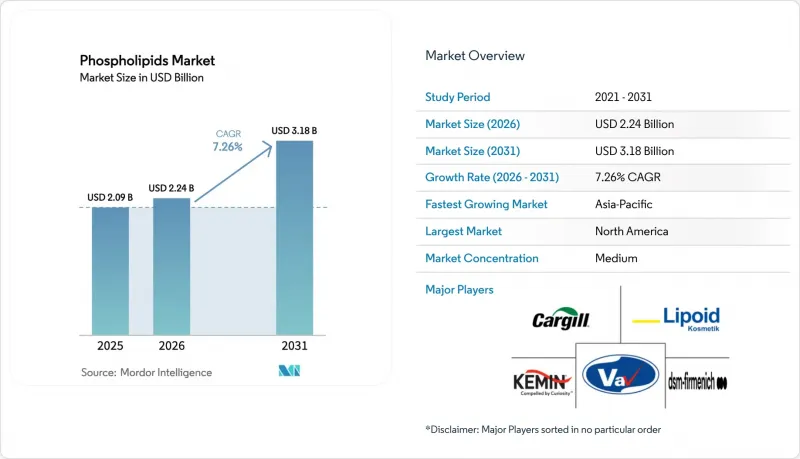
據 Mordor Intelligence 稱,2025 年磷脂市值為 20.9 億美元,預計到 2031 年將達到 31.8 億美元,而 2026 年為 22.4 億美元,預測期(2026-2031 年)的複合年成長率為 7.26%。
本報告按類型(絲胺酸、磷脂醯膽鹼及其他)、來源(大豆、葵花籽、雞蛋及其他)、應用(食品飲料、膳食補充劑、藥品及其他)和地區(北美、歐洲、亞太、南美、中東和非洲)進行細分。報告以百萬美元為以金額為準呈現市場規模和預測數據。
全球磷脂市場趨勢及洞察
人們對旨在維持和改善認知健康的營養補充劑的需求日益成長。
人們對認知功能重要性的認知不斷提高,以及消費者生活方式的改變,正在推動對支持大腦健康的營養保健品的需求。磷脂因其在神經功能和結構中的作用而成為人體必需的成分。歐洲食品安全局 (EFSA) 建議每日攝取 400 毫克膽鹼,高於典型飲食中的攝取量,顯示磷脂補充劑市場潛力巨大。各公司正在開發專門的配方,以滿足不同的認知健康需求。 2024 年,Indena 推出了 Virtiva Plus,這是一款銀杏葉萃取物和絲胺酸的組合產品,體現了市場向高階專業產品的轉變。隨著年輕消費者尋求透過絲胺酸補充劑來提升認知能力,絲胺酸市場正在向壓力管理和運動營養領域拓展。這一趨勢正在鞏固絲胺酸作為全球營養保健品市場中高價值、多功能成分的地位。
純素和植物來源磷脂的供應正在迅速成長。
消費者對植物來源磷脂來源的日益偏好源於對永續性和避免過敏原的要求,這正在改變供應鏈。預計在2020年代後期之前,非基因改造食品市場將顯著成長,從而支撐對葵花籽油衍生磷脂質的需求。採用乙醇萃取方法取代己烷萃取法符合歐盟現行的食品加工溶劑法規。這種萃取方法的轉變表明,該行業正在適應監管要求,同時保持生產效率和產品品質。隨著製造商投資於永續實踐和替代加工方法以滿足消費者需求和監管標準,市場將持續發展。
藥用級磷脂成本高
藥用級磷脂的高昂價格嚴重限制了市場成長。尤其是在新興經濟體,成本問題限制了其在各種治療應用中的廣泛應用。黑田生命科學事業部報告稱,2024年銷售額為5.043億歐元,年減16%,其中磷脂質僅佔總銷售額的1%。這凸顯了維持高規格產品盈利的巨大挑戰。嚴格的「品質源於設計(QbD)」要求對藥用脂質製劑提出了高昂的監管合規成本,使得小型製造商越來越難以應對,並最終加速了市場供應商之間的整合。
細分市場分析
預計到2025年,磷脂醯膽鹼將佔據42.98%的市場佔有率,這主要歸功於其在認知支持補充劑和藥物製劑中的應用。大量研究已證實,磷脂醯膽鹼作為合成乙醯膽鹼的膽鹼來源,能夠支持記憶和學習。隨著多個地區監管機構的批准,磷脂醯膽鹼的市場地位不斷鞏固,其他類型的磷脂難以獲得顯著的市場佔有率。
絲胺酸預計到2031年將以7.78%的複合年成長率成長,這主要得益於其在運動營養產品中應用日益廣泛,以及新研究證實其具有壓力管理功效。這種化合物在運動表現增強補充劑和心理健康產品中日益普及,為磷脂市場的生產商和供應商創造了新的機會。
區域分析
預計到2025年,北美將佔據32.10%的市場佔有率,這主要得益於其先進的藥物研發基礎設施、完善的法規結構以及成熟的膳食補充劑市場。對mRNA疫苗技術和藥物遞送系統的投資進一步鞏固了該地區的領先地位。例如,Moderna公司2024年的淨銷售額達到31億美元,充分展現了磷脂質療法的商業性成功。此外,強大的供應鏈基礎設施、完善的研究機構以及產學研在創新磷脂應用開發方面的緊密合作,也進一步鞏固了該地區的主導地位。
預計亞太地區將成為成長最快的地區,到2031年複合年成長率將達到7.66%。這一成長主要歸功於中產階級的壯大、健康意識的提高以及法規結構的完善,這些都為新型磷脂原料進入市場提供了支持。中國國家衛生健康委員會於2024年批准L-α-甘油磷酸膽鹼作為食品配料,代表監管方面的支持,進一步拓展了市場機會。中國核准流程的簡化,例如縮短核准週期和提高核准通過率,為海外磷脂供應商創造了巨大的成長機會。該地區快速的工業化進程、不斷成長的醫療保健支出以及對預防醫學日益重視,都將進一步加速市場成長。
儘管監管複雜,歐洲市場仍維持穩定成長。歐盟委員會對嬰幼兒配方奶粉法規的修訂雖然對磷脂的應用產生了一定影響,但區域永續性措施正在推動對環保植物來源磷脂的需求。該地區成熟的市場特徵,加上嚴格的品質標準和對永續生產方式的重視,為磷脂質生產商和供應商創造了一個穩定而又充滿競爭力的環境。
其他好處
- Excel格式的市場預測(ME)表
- 3個月的分析師支持
目錄
第1章:引言
- 研究假設和市場定義
- 調查範圍
第2章:調查方法
第3章執行摘要
第4章 市場狀況
- 市場概覽
- 市場促進因素
- 人們對旨在維持和改善認知健康的營養補充劑的需求日益成長。
- 純素和植物來源磷脂的供應正在迅速成長。
- 嬰幼兒營養產品的需求不斷成長
- 藥物遞送系統中對磷脂質的需求日益成長
- 萃取和純化技術的進步
- 組織工程和細胞培養的新應用
- 市場限制因素
- 藥用級磷脂成本高
- 複雜的萃取和純化過程
- 法規的區域差異
- 高溫食品加工穩定性差
- 供應鏈分析
- 監理展望
- 波特五力模型
第5章 市場規模與成長預測
- 按類型
- 絲胺酸
- 磷脂醯膽鹼
- 其他
- 按供應來源
- 大豆
- 向日葵
- 蛋
- 其他
- 透過使用
- 飲食
- 營養補充品
- 製藥
- 其他
- 按地區
- 北美洲
- 美國
- 加拿大
- 墨西哥
- 其他北美國家
- 歐洲
- 德國
- 法國
- 英國
- 西班牙
- 荷蘭
- 義大利
- 瑞典
- 波蘭
- 比利時
- 其他歐洲國家
- 亞太地區
- 中國
- 印度
- 日本
- 澳洲
- 韓國
- 印尼
- 泰國
- 新加坡
- 其他亞太國家
- 南美洲
- 巴西
- 阿根廷
- 智利
- 哥倫比亞
- 秘魯
- 其他南美國家
- 中東和非洲
- 阿拉伯聯合大公國
- 南非
- 奈及利亞
- 沙烏地阿拉伯
- 埃及
- 摩洛哥
- 土耳其
- 其他中東和非洲國家
- 北美洲
第6章 競爭情勢
- 市場集中度
- 策略趨勢
- 市場排名分析
- 公司簡介
- Cargill, Incorporated
- VAV Life Sciences
- Lipoid GmbH
- DSM-Firmenich
- Kemin Industries
- Matlani Group(Sonic Biochem)
- BOC Sciences
- Matrix Life Science
- Botanic Healthcare Pvt. Ltd.(LipsoBio)
- ChemFaces
- Amitex Agro Product Pvt. Ltd.
- Croda International Plc(Croda Pharma)
- Creative Biolabs
- Agro Solvent Products Pvt Ltd(Sun Nutrafoods)
- Fengchen Group Co.,Ltd
- Biosynth
- Merck KGaA
- Chemi SpA
- FUJIFILM Corporation(FUJIFILM Wako Pure Chemical Corporation)
- Nippon Fine Chemical
第7章 市場機會與未來展望
According to Mordor Intelligence, the phospholipids market size was valued at USD 2.09 billion in 2025 and estimated to grow from USD 2.24 billion in 2026 to reach USD 3.18 billion by 2031, at a CAGR of 7.26% during the forecast period (2026-2031).
This report is Segmented by Type (Phosphatidylserine, Phosphatidylcholine, and Others), Source (Soy, Sunflower, Egg, and Others); Application (Food and Beverages, Dietary Supplements, Pharmaceutical, and Others); and Geography (North America, Europe, Asia-Pacific, South America, and the Middle East and Africa). The Report Offers Market Size and Forecasts in Value (USD Million).
Global Phospholipids Market Trends and Insights
Growing Demand in Nutraceuticals for Cognitive Health Support
The growing recognition of cognitive health importance and changing consumer lifestyles are driving demand for brain health nutraceuticals. Phospholipids have become essential ingredients due to their role in neural function and structure. The European Food Safety Authority recommends a daily choline intake of 400 mg, which is higher than typical dietary consumption, indicating a significant market opportunity for phospholipid supplements. Companies are developing specialized formulations to address various cognitive health requirements. In 2024, Indena introduced Virtiva Plus, which combines Ginkgo biloba extract with phosphatidylserine, illustrating the market's shift toward premium, specialized products. The phospholipids market is expanding into stress management and sports nutrition segments, as younger consumers seek cognitive performance enhancement through phospholipid supplements. This trend strengthens phospholipids' position as high-value, multifunctional ingredients in the global nutraceutical market.
Surging Vegan and Plant-Based Phospholipid Sources
The increasing preference for plant-based phospholipid sources is driven by sustainability concerns and allergen avoidance requirements, which are changing supply chain patterns. The non-GMO foods market is projected to experience significant growth in the forecast period through the end of this decade, supporting the demand for sunflower-derived phospholipids. The adoption of ethanol-based extraction methods instead of hexane extraction aligns with current EU regulations on food processing solvents. This transition in extraction methodology demonstrates the industry's adaptation to regulatory requirements while maintaining production efficiency and product quality. The market continues to evolve as manufacturers invest in sustainable practices and alternative processing methods to meet consumer demands and regulatory standards.
High Cost of Pharmaceutical Grade Phospholipids
High prices of pharmaceutical-grade phospholipids significantly constrain market growth, particularly in emerging economies where cost concerns restrict their widespread adoption across various therapeutic applications. Croda's Life Sciences segment reported sales of EUR 504.3 million in 2024, representing a 16% decline, with phospholipids contributing only 1% of total sales, demonstrating the substantial challenges in maintaining profitability for high-specification products. The stringent quality-by-design requirements for pharmaceutical lipid formulations impose substantial regulatory compliance costs, which smaller manufacturers find increasingly difficult to manage, ultimately driving consolidation trends among suppliers in the market.
Other drivers and restraints analyzed in the detailed report include:
- High Demand in Infant Nutrition Products
- Rising Demand of Phospholipids in Drug Delivery Systems
- Complex Extraction and Refining Process
For complete list of drivers and restraints, kindly check the Table Of Contents.
Segment Analysis
Phosphotidylcholine holds 42.98% of the market share in 2025, primarily due to its use in cognitive health supplements and pharmaceutical formulations. Its function as a choline source for acetylcholine synthesis, which supports memory and learning, has been validated through extensive research. The segment's market position is strengthened by regulatory approvals across multiple regions, making it difficult for alternative phospholipid types to gain significant market share.
Phosphotidylserine is projected to grow at 7.78% CAGR through 2031, driven by increased adoption in sports nutrition products and new research demonstrating its stress management benefits. The compound's growing popularity in athletic performance supplements and mental wellness products has created new opportunities for manufacturers and suppliers in the phospholipid market .
Complete Report Scope:
- By Type
- Phosphotidylserine
- Phosphotidylcholine
- Others
- By Source
- Soy
- Sunflower
- Egg
- Others
- By Application
- Food and Beverage
- Dietary Supplements
- Pharmaceutical
- Others
- By Geography
- North America
- United States
- Canada
- Mexico
- Rest of North America
- Europe
- Germany
- France
- United Kingdom
- Spain
- Netherlands
- Italy
- Sweden
- Poland
- Belgium
- Rest of Europe
- Asia-Pacific
- China
- India
- Japan
- Australia
- South Korea
- Indonesia
- Thailand
- Singapore
- Rest of Asia-Pacific
- South America
- Brazil
- Argentina
- Chile
- Colombia
- Peru
- Rest of South America
- Middle East and Africa
- United Arab Emirates
- South Africa
- Nigeria
- Saudi Arabia
- Egypt
- Morocco
- Turkey
- Rest of Middle East and Africa
- North America
Geography Analysis
North America holds a dominant 32.10% market share in 2025, driven by advanced pharmaceutical research and development infrastructure, supportive regulatory frameworks, and established nutraceutical markets. The region's prominence is reinforced by investments in mRNA vaccine technologies and drug delivery systems, as evidenced by Moderna's USD 3.1 billion net product sales in 2024, validating the commercial success of phospholipid-based therapeutics. The region's leadership position is further strengthened by its robust supply chain infrastructure, established research institutions, and strong collaboration between industry and academia in developing innovative phospholipid applications.
Asia-Pacific exhibits the highest growth rate at 7.66% CAGR through 2031. This growth stems from expanding middle-class populations, rising health awareness, and improved regulatory frameworks that support market entry for new phospholipid ingredients. China's National Health Commission's 2024 approval of L-alpha-Glycerylphosphorylcholine as a food raw material demonstrates regulatory support that enhances market opportunities. The streamlined approval process in China, featuring reduced review periods and higher acceptance rates, presents significant expansion opportunities for international phospholipid suppliers. The region's rapid industrialization, increasing healthcare expenditure, and growing focus on preventive healthcare further accelerate market growth.
Europe maintains consistent growth despite complex regulations. The European Commission's revised infant formula regulations influence phospholipid applications, while regional sustainability initiatives increase demand for plant-based phospholipid sources that meet environmental standards. The region's mature market characteristics, combined with stringent quality standards and emphasis on sustainable production methods, create a stable but competitive environment for phospholipid manufacturers and suppliers.
- Cargill, Incorporated
- VAV Life Sciences
- Lipoid GmbH
- DSM-Firmenich
- Kemin Industries
- Matlani Group (Sonic Biochem)
- BOC Sciences
- Matrix Life Science
- Botanic Healthcare Pvt. Ltd. (LipsoBio)
- ChemFaces
- Amitex Agro Product Pvt. Ltd.
- Croda International Plc (Croda Pharma)
- Creative Biolabs
- Agro Solvent Products Pvt Ltd (Sun Nutrafoods)
- Fengchen Group Co.,Ltd
- Biosynth
- Merck KGaA
- Chemi S.p.A.
- FUJIFILM Corporation (FUJIFILM Wako Pure Chemical Corporation)
- Nippon Fine Chemical
Additional Benefits:
- The market estimate (ME) sheet in Excel format
- 3 months of analyst support
TABLE OF CONTENTS
1 INTRODUCTION
- 1.1 Study Assumptions and Market Definition
- 1.2 Scope of the Study
2 RESEARCH METHODOLOGY
3 EXECUTIVE SUMMARY
4 MARKET LANDSCAPE
- 4.1 Market Overview
- 4.2 Market Drivers
- 4.2.1 Growing Demand in Nutraceuticals for Cognitive Health Support
- 4.2.2 Surging Vegan and Plant-Based Phospholipid Sources
- 4.2.3 High Demand in Infant Nutrition Products
- 4.2.4 Rising Demand of Phospholipids in Drug Delivery Systems
- 4.2.5 Technological Advancements in Extraction and Purification
- 4.2.6 Emerging Application in Tissue Engineering and Cell Culture
- 4.3 Market Restraints
- 4.3.1 High Cost of Pharmaceutical Grade Phospholipids
- 4.3.2 Complex Extraction and Refining Process
- 4.3.3 Regulatory Variability Across Geography
- 4.3.4 Low Stability in High-Temperature Food Processing
- 4.4 Supply Chain Analysis
- 4.5 Regulatory Outlook
- 4.6 Porter's Five Forces
- 4.6.1 Threat of New Entrants
- 4.6.2 Bargaining Power of Buyers/Consumers
- 4.6.3 Bargaining Power of Suppliers
- 4.6.4 Threat of Substitute Products
- 4.6.5 Intensity of Competitive Rivalry
5 MARKET SIZE AND GROWTH FORECASTS (VALUE)
- 5.1 By Type
- 5.1.1 Phosphotidylserine
- 5.1.2 Phosphotidylcholine
- 5.1.3 Others
- 5.2 By Source
- 5.2.1 Soy
- 5.2.2 Sunflower
- 5.2.3 Egg
- 5.2.4 Others
- 5.3 By Application
- 5.3.1 Food and Beverage
- 5.3.2 Dietary Supplements
- 5.3.3 Pharmaceutical
- 5.3.4 Others
- 5.4 By Geography
- 5.4.1 North America
- 5.4.1.1 United States
- 5.4.1.2 Canada
- 5.4.1.3 Mexico
- 5.4.1.4 Rest of North America
- 5.4.2 Europe
- 5.4.2.1 Germany
- 5.4.2.2 France
- 5.4.2.3 United Kingdom
- 5.4.2.4 Spain
- 5.4.2.5 Netherlands
- 5.4.2.6 Italy
- 5.4.2.7 Sweden
- 5.4.2.8 Poland
- 5.4.2.9 Belgium
- 5.4.2.10 Rest of Europe
- 5.4.3 Asia-Pacific
- 5.4.3.1 China
- 5.4.3.2 India
- 5.4.3.3 Japan
- 5.4.3.4 Australia
- 5.4.3.5 South Korea
- 5.4.3.6 Indonesia
- 5.4.3.7 Thailand
- 5.4.3.8 Singapore
- 5.4.3.9 Rest of Asia-Pacific
- 5.4.4 South America
- 5.4.4.1 Brazil
- 5.4.4.2 Argentina
- 5.4.4.3 Chile
- 5.4.4.4 Colombia
- 5.4.4.5 Peru
- 5.4.4.6 Rest of South America
- 5.4.5 Middle East and Africa
- 5.4.5.1 United Arab Emirates
- 5.4.5.2 South Africa
- 5.4.5.3 Nigeria
- 5.4.5.4 Saudi Arabia
- 5.4.5.5 Egypt
- 5.4.5.6 Morocco
- 5.4.5.7 Turkey
- 5.4.5.8 Rest of Middle East and Africa
- 5.4.1 North America
6 COMPETITIVE LANDSCAPE
- 6.1 Market Concentration
- 6.2 Strategic Moves
- 6.3 Market Ranking Analysis
- 6.4 Company Profiles (includes Global-level Overview, Market-level Overview, Core Segments, Financials (if available), Strategic Information, Market Rank/Share, Products and Services, Recent Developments)
- 6.4.1 Cargill, Incorporated
- 6.4.2 VAV Life Sciences
- 6.4.3 Lipoid GmbH
- 6.4.4 DSM-Firmenich
- 6.4.5 Kemin Industries
- 6.4.6 Matlani Group (Sonic Biochem)
- 6.4.7 BOC Sciences
- 6.4.8 Matrix Life Science
- 6.4.9 Botanic Healthcare Pvt. Ltd. (LipsoBio)
- 6.4.10 ChemFaces
- 6.4.11 Amitex Agro Product Pvt. Ltd.
- 6.4.12 Croda International Plc (Croda Pharma)
- 6.4.13 Creative Biolabs
- 6.4.14 Agro Solvent Products Pvt Ltd (Sun Nutrafoods)
- 6.4.15 Fengchen Group Co.,Ltd
- 6.4.16 Biosynth
- 6.4.17 Merck KGaA
- 6.4.18 Chemi S.p.A.
- 6.4.19 FUJIFILM Corporation (FUJIFILM Wako Pure Chemical Corporation)
- 6.4.20 Nippon Fine Chemical


