


 |
市場調查報告書
商品編碼
2116652
液化天然氣儲存槽:市場佔有率分析、產業趨勢與統計、成長預測(2026-2031)LNG Storage Tank - Market Share Analysis, Industry Trends & Statistics, Growth Forecasts (2026 - 2031) |
||||||

※ 本網頁內容可能與最新版本有所差異。詳細情況請與我們聯繫。
據 Mordor Intelligence 稱,2025 年液化天然氣儲存槽市值為 164.5 億美元,預計到 2031 年將達到 262.7 億美元,而 2026 年為 177.8 億美元,預測期內(2026-2031 年)的複合成長率預計為 8.13%。
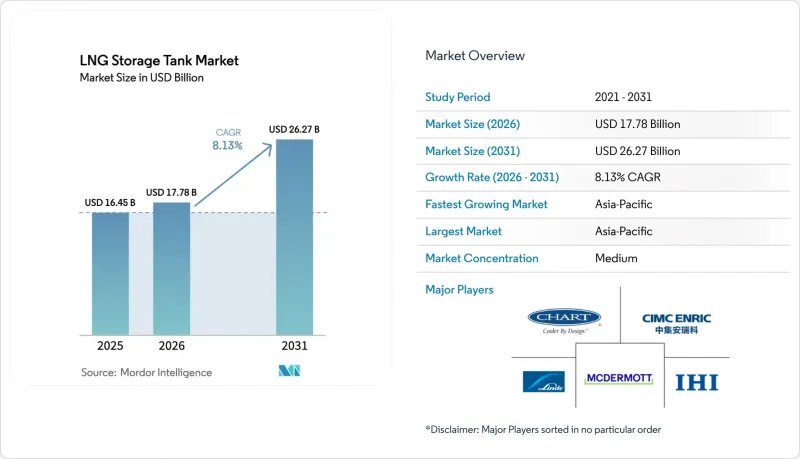
本報告按以下方式分類:容器類型(全封閉式儲罐、膜式儲罐等)、儲罐類型(A 型、B 型、C 型)、材質(9% 鎳鋼、鋁合金等)、安裝位置(陸上固定儲罐、海上 FLNG/FSRU 儲罐等)、終端(進口/再氣化、船舶燃料供應設施等地區(北美燃料設施等)和地區(北美燃料供應設施等)。
全球液化天然氣儲存槽市場趨勢與洞察
擴大液化天然氣燃料庫基礎設施以實現航運脫碳
國際海事組織 (IMO) 的排放上限迫使船東轉向液化天然氣 (LNG) 動力,這推動了新加坡、鹿特丹和美國墨西哥灣沿岸大規模加註中心的建設。美國船級社 (ABS) 預測,到 2027 年,LNG 動力船舶的數量將超過 1000 艘,這一轉變刺激了對能夠承受快速循環載荷的高壓 C 型儲罐的需求。港口正在快速推進加註運營商的許可證發放和專用儲罐泊位的擴建,縮短了項目前置作業時間,並加速了模組化儲罐組件的採用,從而最大限度地減少了對碼頭的影響。亞太地區的進展最為迅速,該地區密集的支線航線和靈活的船對船 (S/S)傳輸旺盛,需要緊湊、高周轉率率的倉儲設施。隨著租船人尋求相容且面向未來的解決方案,擁有成熟膜式或圓柱式設計的供應商正在儘早獲得合約。
浮體式液化天然氣進口終端(FSRU)的成長
2022年能源衝擊後,面臨迫在眉睫的供不應求的國家紛紛青睞浮體式再氣化裝置的日產能將達到78億立方英尺,約佔全球供應量的8%。巴基斯坦、埃及和德國新訂購的裝置表明了該模式的多功能性及其相對寬鬆的授權要求。因此,能夠承受浮體船舶動態運動的儲氣系統需求日益成長,而薄膜技術正是實現這一目標的主要途徑。能夠在確保抗晃動性能的同時實現高貨物周轉率的設計者正在贏得大部分工程總承包(EPC)合約。
鋼鐵和鎳價格波動
由於鎳含量最高可達9%,原物料價格波動是影響成本的主要因素。根據Argus評估,2024年鎳現貨價格預計將波動超過35%。對於一個18萬立方米的全封閉儲罐,鋼板成本可能占到EPC合約總成本的45%,如果避險失敗,製造商將面臨風險。一些亞洲鋼廠正在試生產鎳含量為7%的TMCP鋼板,以在不影響低溫韌性的前提下降低合金成本,而EPC公司則正在簽訂長期供應合約以穩定競標價格。
細分市場分析
由於其卓越的安全性和合規性,全封閉式儲槽系統在2025年佔總銷售額的41.75%。高容量進口碼頭的業者高度重視雙層壁結構,因為它能有效防止洩漏並簡化維護。在儲存槽市場,中國、日本和印度新建設施持續採用16萬立方公尺至23萬立方公尺規格的儲罐,凸顯了市場對此設計的信心。膜式儲槽因其在浮體式和模組化專案中的優異性能而備受青睞,預計到2031年將保持11.02%的複合年成長率,這反映了造船廠優先考慮快速組裝和卓越容積效率的趨勢。 2025年至2027年,德國和巴西浮體式再氣化設施的部署預計將進一步推動膜式儲槽的應用。
膜式儲槽供應商正加大對晃動研究和阻隔箔合金的研發投入,以期將設計壽命延長40年以上。 GTT公司的「NEXT1」型儲槽已獲得多項重要認證,並從亞洲多家造船廠獲得訂單,顯示其市場接受度不斷提高。在成本是首要考慮因素的特定尖峰用電調節電站中,單體式儲槽結構仍被廣泛應用;而在地質條件允許開挖洞室的地區,混凝土地下儲槽方案則被採用。總體而言,隨著開發商根據專案條件最佳化設計,LNG儲存槽市場預計將在全封閉式儲罐的成熟安全性與膜式儲罐的優勢(例如建造速度更快、面積更小)之間找到平衡點。
到2025年,A型矩形儲槽將佔據39.12%的市場佔有率,在土地資源有限的碼頭中佔據主導地位,其高空間利用率的優勢得以充分發揮。韓國、中國和歐洲成熟的生產線保持著每立方公尺成本的競爭力,而透過蒸氣處理設備的維修,資產價值也不斷提升。同時,C型鋼瓶預計將在小規模的分銷網路和燃料庫樞紐中以10.05%的複合年成長率成長。其真空絕熱結構顯著減少了蒸發損失,能夠在將燃料輸送到多個地點的同時最大限度地減少損失。
Waltzira公司在4000至40000立方米級裝運船隻展示的緊湊型再液化模組與C型儲罐完美結合,實現了點對點物流。 B型球形儲槽在極端壓力環境下能夠保持穩定,但面臨高額資本投入和漫長建造週期等挑戰。開發商正在嘗試將不同形狀的儲罐組合起來,以滿足各種應用需求。例如,矩形岸邊儲槽用於碼頭末端,圓柱形吊耳儲槽用於加油駁船,球形儲槽用於老舊的FLNG改裝船,這反映了LNG儲存槽市場運作範圍的多樣性。
區域分析
預計到2025年,亞太地區將佔全球銷售額的44.10%,並在2031年之前以8.94%的複合年成長率成長。光是在中國,就有超過30個新的終端正在建設中,每個終端都配備多個22萬立方公尺的全封閉儲罐,以應對現貨市場的波動。日本新近批准的一項戰略儲備計畫要求維持穩定的庫存,從而為儲存需求增加可預測的提取和補充週期。印度正在將其東海岸的儲存能力加倍,並鼓勵城市燃氣供應商租賃浮體式儲存裝置(FSRU),擴大目標需求。區域製造商受益於鋼板和合金供應物流鏈的縮短,從而縮短了交貨時間,並鞏固了該地區的液化天然氣儲存槽市場。
受德國、法國和荷蘭部署緊急浮式儲存再氣化裝置(FSRU)的推動,歐洲進口能力在2021年至2024年底期間增加了34%。儘管由於氣候變暖導致天然氣消耗量下降,2024年的出貨量有所減少,但監管機構仍在繼續批准建造更多陸上儲存槽,以儲存未來的氫氣和氨氣混合物。對氨氣相容組件的政策壓力正促使二級屏障和蒸發系統進行重新設計。北美地區的計畫等待名單最長,面臨訴訟和聯邦審查等挑戰。開發商已將工期延長了12至18個月,導致建築鋼板的需求延遲,但基本需求本身仍保持不變。
中東和非洲正在崛起為新的成長中心。隨著卡達北部氣田產能的擴大,拉斯拉凡氣田需要新的儲存槽來滿足新增生產線的需求。同時,阿拉伯聯合大公國已簽署一份EPC契約,將在魯瓦伊斯計畫建造兩個20萬立方公尺的低溫儲罐,預計2029年交付。非洲的浮體式液化天然氣(FLNG)計畫將為剛果、茅利塔尼亞和塞內加爾帶來配備多級膜式儲槽的浮體結構。各國政府正將這些項目定位為增加出口收入和保障國內能源供應的基石,這將確保液化天然氣儲存槽市場在多個地區的持續成長。
其他好處:
- Excel格式的市場預測(ME)表
- 3個月的分析師支持
目錄
第1章:引言
- 研究假設和市場定義
- 調查範圍
第2章:調查方法
第3章執行摘要
第4章 市場狀況
- 市場概覽
- 市場促進因素
- 擴大液化天然氣燃料庫基礎設施,以實現航運業的脫碳。
- 浮體式天然氣進口終端(FSRU)數量增加
- 亞洲天然氣需求激增與能源安全政策
- 推出鎳含量為9%的低溫焊接機器人
- 模組化預製地面安裝式膜罐
- 小規模天然氣衛星樞紐正在推動對C型天然氣的需求。
- 市場限制因素
- 鋼鐵和鎳價格波動
- 海岸儲罐區許可證核准延誤
- 一種替代新興地下液化天然氣儲存方式的方案
- 涉及膜罐的專利訴訟正在縮小供應商數量。
- 供應鏈分析
- 監理情勢
- 技術展望
- 波特五力模型
第5章 市場規模與成長預測
- 透過隔離法
- 完全密封罐
- 單級儲罐
- 膜罐
- 地下式/低溫混凝土儲罐
- 坦克型
- A型(棱鏡型)
- B型(球形)
- C型(圓柱形,真空絕緣)
- 材料
- 碳鋼
- 9%鎳鋼
- 鋁合金
- 預力混凝土
- 按位置
- 陸基固定式儲槽
- 用於海上FLNG/FSRU的儲罐
- 液化天然氣燃料庫駁船
- 透過使用
- 液化裝置
- 進口和再氣化終端
- 尖峰用電調節與衛星工廠
- 船用燃料供應設施
- 按地區
- 北美洲
- 美國
- 加拿大
- 墨西哥
- 歐洲
- 德國
- 英國
- 法國
- 俄羅斯
- 西班牙
- 其他歐洲國家
- 亞太地區
- 中國
- 日本
- 印度
- 韓國
- 新加坡
- 馬來西亞
- 澳洲
- 亞太地區(其他)
- 南美洲
- 巴西
- 阿根廷
- 其他南美國家
- 中東和非洲
- 沙烏地阿拉伯
- 阿拉伯聯合大公國
- 卡達
- 南非
- 其他中東和非洲國家
- 北美洲
第6章 競爭情勢
- 市場集中度
- 策略趨勢(併購、聯盟、購電協議)
- 市場佔有率分析(主要公司的市場排名和佔有率)
- 公司簡介
- Chart Industries Inc.
- China International Marine Containers(CIMC Enric)
- Linde plc
- McDermott International
- IHI Corporation
- Wartsila Oyj
- Samsung Heavy Industries
- Mitsubishi Heavy Industries
- KOGAS Tech
- Air Water Inc.
- IsIsan AS
- Cryolor SA
- INOX India Ltd.
- Wison Offshore & Marine
- Saipem SpA
- Technip Energies
- Victaulic Company
- Fives
- CSIC Hudong-Zhonghua
- GTT(Gaztransport & Technigaz)
第7章 市場機會與未來展望
According to Mordor Intelligence, the LNG storage tank market size was valued at USD 16.45 billion in 2025 and estimated to grow from USD 17.78 billion in 2026 to reach USD 26.27 billion by 2031, at a CAGR of 8.13% during the forecast period (2026-2031).
This report is Segmented by Containment Type (Full Containment Tanks, Membrane Tanks, and More), Tank Type (Type-A, Type-B, and Type-C), Material (9%-Nickel Steel, Aluminium Alloys, and More), Location (On-Shore Fixed Tanks, Offshore FLNG/FSRU Tanks, and More), Application (Import and Regasification Terminals, Marine Bunkering Facilities, and More), and Geography (North America, Asia-Pacific, and More).
Global LNG Storage Tank Market Trends and Insights
Expansion of LNG Bunkering Infrastructure for Maritime Decarbonization
International Maritime Organization emission caps are steering shipowners toward LNG propulsion, which is fostering the development of large-scale bunkering nodes in Singapore, Rotterdam, and the US Gulf. The American Bureau of Shipping anticipates that the LNG-powered fleet will exceed 1,000 vessels by 2027, a shift that is stimulating demand for high-pressure Type-C tanks capable of withstanding rapid cyclic loading. Ports are racing to license bunker operators and add dedicated storage berths, which is accelerating project lead-times and encouraging modular tank packages that minimize quayside disruption. The Asia-Pacific region is moving at the fastest pace, thanks to dense feeder routes and flexible ship-to-ship transfers that require compact, high-turnover storage. Suppliers with proven membrane or cylindrical designs are capturing early contracts as charterers seek compatible, future-proof solutions.
Growth in Floating LNG Import Terminals (FSRUs)
Countries facing urgent supply gaps after the 2022 energy shock favor FSRUs, as build times of 18-24 months compare favorably with the 4-6 year horizon of onshore terminals. The U.S. Energy Information Administration estimates 2024 floating regas capacity at 7.8 billion cubic feet per day, or approximately 8% of global send-out . The new units ordered for Pakistan, Egypt, and Germany demonstrate the model's portability and lower permitting requirements. Containment systems tailored to the dynamic motions of floating hulls-predominantly membrane variants-are consequently in high demand. Designers able to guarantee sloshing resistance while enabling high cargo turnover are winning the majority of EPC awards.
Volatility in Steel & Nickel Prices
Nickel content up to 9% makes raw material swings a key cost factor, with Argus assessments showing spot nickel prices gyrating by more than 35% during 2024. For a 180,000 m3 full-containment tank, plate costs can equate to 45% of delivered EPC value, leaving fabricators exposed when hedging fails. Some Asian mills are trialing 7%-nickel TMCP plate to reduce alloying cost without losing low-temperature toughness, and EPCs are locking in longer-term supply contracts to stabilize bids.
Other drivers and restraints analyzed in the detailed report include:
- Surge in Asian Gas Demand & Energy Security Policies
- Adoption of 9%-Nickel Cryogenic Welding Robots
- Permitting Delays for Coastal Tank Farms
For complete list of drivers and restraints, kindly check the Table Of Contents.
Segment Analysis
Full containment systems accounted for 41.75% of 2025 revenues, thanks to robust safety credentials and regulatory familiarity. Operators servicing high-throughput import terminals value the double-wall configuration that confines spills and simplifies maintenance. The LNG storage tank market continues to witness consistent specifications for 160,000 m3-230,000 m3 units at new Chinese, Japanese, and Indian sites, affirming confidence in the design. Membrane tanks, favored for floating and modular projects, are projected to log an 11.02% CAGR through 2031, reflecting yard preferences for faster assembly and superior volumetric efficiency. During 2025-2027, floating regas deployments in Germany and Brazil are expected to anchor further membrane conversions.
Membrane suppliers are investing in sloshing research and barrier-foil alloys to extend design life beyond 40 years. GTT's NEXT1 earned major approvals and several Asian yard orders, signaling broader acceptance. Single containment persists in niche peak-shaving plants where cost is a primary consideration, while concrete in-ground concepts are employed in geologies that allow for mined cavern approaches. Overall, the LNG storage tank market is likely to strike a balance between proven full-containment safety and membrane-driven speed and footprint gains as developers optimize their designs by project context.
Type-A rectangular tanks held a 39.12% share in 2025, dominating land-constrained terminals that utilize their high space efficiency. Mature fabrication lines in Korea, China, and Europe maintain a competitive cost per cubic meter, and retrofits of vapor handling gear extend asset value. Yet small-scale distribution networks and bunkering hubs propel Type-C cylinders at a forecast 10.05% CAGR. Their vacuum insulation slashes boil-off, supporting multi-stop fuel delivery with minimal loss.
Compact reliquefaction modules, showcased by Wartsila in the 4,000-40,000 m3 carrier range, pair naturally with Type-C to enable point-to-point logistics. Type-B spheres maintain a foothold in extreme-pressure contexts but face high capital expenditures and longer build schedules. Across various applications, developers are combining geometries: prismatic shore tanks at the jetty head, cylindrical lag tanks on bunker barges, and spheres on older FLNG conversions, reflecting the diverse service envelopes within the LNG storage tank market.
Complete Report Scope:
- By Containment Type
- Full Containment Tanks
- Single Containment Tanks
- Membrane Tanks
- In-ground/Cryogenic Concrete Tanks
- By Tank Type
- Type-A (Prismatic)
- Type-B (Spherical)
- Type-C (Cylindrical, Vacuum-insulated)
- By Material
- Carbon Steel
- 9 %-Nickel Steel
- Aluminium Alloys
- Prestressed Concrete
- By Location
- On-shore Fixed Tanks
- Offshore FLNG/FSRU Tanks
- LNG Bunkering Barges
- By Application
- Liquefaction Plants
- Import and Regasification Terminals
- Peak-Shaving and Satellite Plants
- Marine Bunkering Facilities
- By Geography
- North America
- United States
- Canada
- Mexico
- Europe
- Germany
- United Kingdom
- France
- Russia
- Spain
- Rest of Europe
- Asia-Pacifc
- China
- Japan
- India
- South Korea
- Singapore
- Malaysia
- Australia
- Rest of Asia-Pacifc
- South America
- Brazil
- Argentina
- Rest of South America
- Middle East and Africa
- Saudi Arabia
- United Arab Emirates
- Qatar
- South Africa
- Rest of Middle East and Africa
- North America
Geography Analysis
Asia-Pacific generated 44.10% of global revenue in 2025 and is on track for a 8.94% CAGR to 2031. China alone is building more than thirty new terminals, each equipped with multiple 220,000 m3 full-containment tanks, to safeguard against spot-market volatility. Japan's newly approved strategic stockpile scheme mandates a standing cargo inventory, adding predictable drawdown and replenishment cycles to storage demand. India is doubling its Eastern-coast capacity and incentivizing city-gas distributors to charter floating storage, thereby broadening the addressable volume. Regional fabricators benefit from shorter logistics chains for plate and alloy supply, which compresses delivery times and solidifies the LNG storage tank market in the area.
Europe's import capacity rose 34% between 2021 and the end of 2024 as Germany, France, and the Netherlands installed emergency FSRUs. Although send-out fell in 2024 due to mild weather curbing gas burn, regulators continue to approve incremental shore tanks sized for future hydrogen or ammonia blends. The policy push for ammonia-ready components has prompted revisions to the design of secondary barriers and boil-off systems. North America hosts the deepest project queue but faces challenges from litigation and federal reviews. Developers prolong schedules by 12-18 months, delaying construction plate demand but not eroding the underlying need for it.
The Middle East and Africa are emerging growth poles. Qatar's expanded North Field output will require new tankage at Ras Laffan to handle incremental trains, while the UAE's Ruwais project awards EPC contracts for dual 200,000 m3 cryogenic tanks delivering by 2029. Africa's FLNG wave will bring floating hulls fitted with multi-row membrane tanks to Congo, Mauritania, and Senegal. Local governments view these assets as revenue boosters for exports and enablers of domestic power, positioning the LNG storage tank market for sustained momentum across multiple regions.
- Chart Industries Inc.
- China International Marine Containers (CIMC Enric)
- Linde plc
- McDermott International
- IHI Corporation
- Wartsila Oyj
- Samsung Heavy Industries
- Mitsubishi Heavy Industries
- KOGAS Tech
- Air Water Inc.
- IsIsan A.S.
- Cryolor SA
- INOX India Ltd.
- Wison Offshore & Marine
- Saipem SpA
- Technip Energies
- Victaulic Company
- Fives
- CSIC Hudong-Zhonghua
- GTT (Gaztransport & Technigaz)
Additional Benefits:
- The market estimate (ME) sheet in Excel format
- 3 months of analyst support
TABLE OF CONTENTS
1 Introduction
- 1.1 Study Assumptions & Market Definition
- 1.2 Scope of the Study
2 Research Methodology
3 Executive Summary
4 Market Landscape
- 4.1 Market Overview
- 4.2 Market Drivers
- 4.2.1 Expansion of LNG bunkering infrastructure for maritime decarbonization
- 4.2.2 Growth in floating LNG import terminals (FSRUs)
- 4.2.3 Surge in Asian gas demand & energy security policies
- 4.2.4 Adoption of 9 %-nickel cryogenic welding robots
- 4.2.5 Modular prefabricated on-ground membrane tanks
- 4.2.6 Small-scale LNG satellite hubs boosting Type-C demand
- 4.3 Market Restraints
- 4.3.1 Volatility in steel & nickel prices
- 4.3.2 Permitting delays for coastal tank farms
- 4.3.3 Emerging underground LNG storage alternatives
- 4.3.4 Membrane-tank patent litigation narrowing supplier base
- 4.4 Supply-Chain Analysis
- 4.5 Regulatory Landscape
- 4.6 Technological Outlook
- 4.7 Porter's Five Forces
- 4.7.1 Threat of New Entrants
- 4.7.2 Bargaining Power of Buyers
- 4.7.3 Bargaining Power of Suppliers
- 4.7.4 Threat of Substitutes
- 4.7.5 Intensity of Competitive Rivalry
5 Market Size & Growth Forecasts
- 5.1 By Containment Type
- 5.1.1 Full Containment Tanks
- 5.1.2 Single Containment Tanks
- 5.1.3 Membrane Tanks
- 5.1.4 In-ground/Cryogenic Concrete Tanks
- 5.2 By Tank Type
- 5.2.1 Type-A (Prismatic)
- 5.2.2 Type-B (Spherical)
- 5.2.3 Type-C (Cylindrical, Vacuum-insulated)
- 5.3 By Material
- 5.3.1 Carbon Steel
- 5.3.2 9 %-Nickel Steel
- 5.3.3 Aluminium Alloys
- 5.3.4 Prestressed Concrete
- 5.4 By Location
- 5.4.1 On-shore Fixed Tanks
- 5.4.2 Offshore FLNG/FSRU Tanks
- 5.4.3 LNG Bunkering Barges
- 5.5 By Application
- 5.5.1 Liquefaction Plants
- 5.5.2 Import and Regasification Terminals
- 5.5.3 Peak-Shaving and Satellite Plants
- 5.5.4 Marine Bunkering Facilities
- 5.6 By Geography
- 5.6.1 North America
- 5.6.1.1 United States
- 5.6.1.2 Canada
- 5.6.1.3 Mexico
- 5.6.2 Europe
- 5.6.2.1 Germany
- 5.6.2.2 United Kingdom
- 5.6.2.3 France
- 5.6.2.4 Russia
- 5.6.2.5 Spain
- 5.6.2.6 Rest of Europe
- 5.6.3 Asia-Pacifc
- 5.6.3.1 China
- 5.6.3.2 Japan
- 5.6.3.3 India
- 5.6.3.4 South Korea
- 5.6.3.5 Singapore
- 5.6.3.6 Malaysia
- 5.6.3.7 Australia
- 5.6.3.8 Rest of Asia-Pacifc
- 5.6.4 South America
- 5.6.4.1 Brazil
- 5.6.4.2 Argentina
- 5.6.4.3 Rest of South America
- 5.6.5 Middle East and Africa
- 5.6.5.1 Saudi Arabia
- 5.6.5.2 United Arab Emirates
- 5.6.5.3 Qatar
- 5.6.5.4 South Africa
- 5.6.5.5 Rest of Middle East and Africa
- 5.6.1 North America
6 Competitive Landscape
- 6.1 Market Concentration
- 6.2 Strategic Moves (M&A, Partnerships, PPAs)
- 6.3 Market Share Analysis (Market Rank/Share for key companies)
- 6.4 Company Profiles (includes Global level Overview, Market level overview, Core Segments, Financials as available, Strategic Information, Products & Services, and Recent Developments)
- 6.4.1 Chart Industries Inc.
- 6.4.2 China International Marine Containers (CIMC Enric)
- 6.4.3 Linde plc
- 6.4.4 McDermott International
- 6.4.5 IHI Corporation
- 6.4.6 Wartsila Oyj
- 6.4.7 Samsung Heavy Industries
- 6.4.8 Mitsubishi Heavy Industries
- 6.4.9 KOGAS Tech
- 6.4.10 Air Water Inc.
- 6.4.11 IsIsan A.S.
- 6.4.12 Cryolor SA
- 6.4.13 INOX India Ltd.
- 6.4.14 Wison Offshore & Marine
- 6.4.15 Saipem SpA
- 6.4.16 Technip Energies
- 6.4.17 Victaulic Company
- 6.4.18 Fives
- 6.4.19 CSIC Hudong-Zhonghua
- 6.4.20 GTT (Gaztransport & Technigaz)
7 Market Opportunities & Future Outlook
- 7.1 White-space & Unmet-Need Assessment

 液化天然氣儲存槽市場-2026-2032年全球市場預測
 全球液化天然氣儲存槽市場規模、佔有率、趨勢和成長分析報告(2026-2034年)
 全球液化天然氣儲存槽市場
 液化天然氣儲槽市場-全球產業規模、佔有率、趨勢、機會及預測,按儲槽類型、按儲槽位置、按最終用途產業、按地區及競爭情況細分,2020-2030 年預測
 液化天然氣儲存槽市場規模、佔有率、趨勢分析報告:按類型、材料、地區、細分市場預測,2025-2030年
 全球液化天然氣儲存槽市場(按材料、類型、最終用途行業和地區分類)- 2029 年預測
 新加坡液化天然氣儲存槽:市場佔有率分析、產業趨勢與統計、成長預測(2025-2030 年)