


 |
市場調查報告書
商品編碼
2116440
中空纖維過濾:市場佔有率分析、產業趨勢與統計、成長預測(2026-2031)Hollow Fiber Filtration - Market Share Analysis, Industry Trends & Statistics, Growth Forecasts (2026 - 2031) |
||||||

※ 本網頁內容可能與最新版本有所差異。詳細情況請與我們聯繫。
根據 Mordor Intelligence 預測,中空纖維過濾市場將從 2025 年的 9.4 億美元成長到 2026 年的 10.7 億美元,然後在 2031 年達到 20.9 億美元,2026 年至 2031 年的複合年成長率為 14.28%。
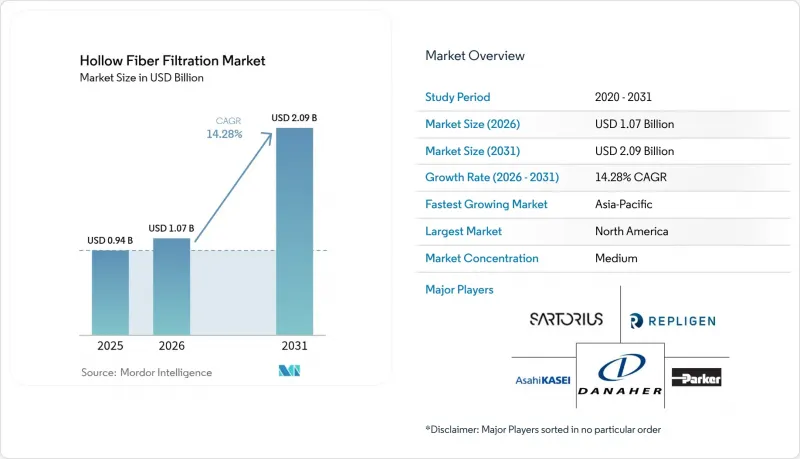
本報告按材料(合成聚合物和陶瓷)、技術(微過濾和超過濾)、終端用戶(製藥和生物技術等)、應用(蛋白質濃縮和過濾等)以及地區(北美、歐洲、亞太、中東和非洲以及南美)進行細分。市場預測以美元計價。
全球中空纖維過濾市場趨勢及洞察
全球生物製藥研發管線的快速擴張。
到2025年,將有超過6500種單株抗體進入臨床開發階段,與2024年市售的360種分子相比,過濾量和開發批次規模將發生顯著變化。每種候選藥物都需要從臨床到商業化的可擴展過濾解決方案,這推動了對可根據開發規模快速切換的高柔軟性中空纖維膜組件的需求。雙特異性抗體和抗體藥物複合體(ADC)等複雜製劑需要傳統微濾無法始終滿足的選擇性,因此超過濾的應用日益廣泛。目前,大部分研發管線成長來自亞太地區的申辦方,迫使供應商建立本地技術支援系統和薄膜製造地以保持競爭力。因此,技術供應商優先考慮將膜組件與線上感測相結合的整合系統,以支援全球各地的製程驗證和可比性。
一次性生物製程設備的應用日益普及
從2019年到2024年,全球一次性使用系統的銷售額將以超過10%的複合年成長率成長,這主要得益於一次性最佳化型中空纖維濾芯的推廣。省去就地清洗(CIP)循環降低了資本投資和驗證成本,使先進的過濾技術對新興生物技術和細胞療法開發公司更具經濟實惠。 Cytiva和Pall公司聯合投資15億美元(其中3億美元用於一次性產品線),這充分體現了供應商對預滅菌、耐伽馬射線輻照膜組件的承諾。亞洲新建工廠正在加速採用一次性使用系統,因為從運作第一天起即可指定使用一次性配置。然而,隨著人們對塑膠廢棄物的環境關注度日益提高,可回收外殼和可堆肥聚合物的研發正在加速推進,永續性標準也正被納入採購決策。
嚴格的監管驗證和文件要求
FDA和EMA的指南要求對每種膜配置提供全面的性能證據,導致複雜生技藥品的檢驗成本超過每項製程100萬美元。由於小規模創新公司缺乏專業團隊,且通常依賴擁有成熟應用經驗的合約研發生產機構(CDMO),儀器的直接銷售正在放緩。區域監管差異——尤其是在使用前完整性測試方面——迫使重複測試,使工期延長至多18個月。目前,擁有符合審計要求的資料包的供應商享有優先供貨地位,但創建此類文件需要大量資源,並對新進入者構成准入門檻。
細分市場分析
2025年,合成聚合物在中空纖維過濾市場佔據77.88%的市場佔有率,主要得益於成熟的供應鏈和極具吸引力的價格。在該類別中,聚醚碸因其4.52 L/m²·h·atm的水質淨化滲透性和穩定的pH耐受性,仍然是抗體純化領域的首選材料。聚二氟亞乙烯(PVDF)作為一種溶劑密集型原料,市佔率有所成長,而聚碸則適用於高壓製程。聚丙烯繼續用於蛋白質吸附風險較低的應用領域。陶瓷膜雖然仍屬於小眾產品,但隨著工廠對更長使用壽命和更強耐洗滌性的需求增加,其年複合成長率(CAGR)達到了16.48%。氧化鋁和氧化鋯陶瓷膜能夠耐受腐蝕性環境和反脈衝處理,從而減少灌注管線的停機時間。隨著連續生產過程的擴展,陶瓷膜的吸引力日益增強,因為其成本可以透過多年宣傳活動攤提。預計到 2031 年,這一趨勢將導致陶瓷膜在中空纖維過濾市場的銷售佔有率大幅成長。
到2025年,微濾將佔銷售額的61.72%,這主要得益於適用於0.1–0.45 µm截留範圍的細胞收集和培養基澄清操作。切向流微濾(TFF)因其更高的通量和成熟的監管記錄(相比於死端法),在大規模抗體生產工廠中佔據主導地位。然而,超過濾的發展趨勢顯而易見。以16.55%的複合年成長率,運營商擴大使用10–100 kDa的膜進行緩衝液交換和濃縮,從而在減少滲濾工作量的同時,實現超過99.75%的截留率。整合到全連續平台中的單一途徑配置可顯著縮短停留時間並加快批次放行測試,使超過濾成為下一代工廠佈局的核心。供應商正透過減少污染的化學成分和即時檢驗孔隙完整性的隨線分析功能來脫穎而出。
區域分析
到2025年,北美將佔據中空纖維過濾市場40.88%的佔有率。這得益於數十年來對波士頓、舊金山和三角研究園的投資,這些投資鞏固了由供應商和用戶組成的完善生態系統。美國食品藥物管理局(FDA)發布的指導意見,為微生物截留、萃取和完整性測試提供了明確的指南,正在加速新型膜化學品的合格。FUJIFILM在北卡羅來納州投資12億美元,將生物反應器產能提高16萬公升,標誌著該地區產能的持續擴張。
歐洲依然佔有重要地位,主要得益於德國的工程技術實力和英國的細胞與基因治療叢集。歐洲藥品管理局(EMA)的環境重點在於推動陶瓷膜和可重複使用外殼的應用,同時,低碳生物程序技術也正透過「地平線歐洲」資助計畫獲得投資。這項政策框架有效地管理了供應商需求,同時促進了永續性指標的技術差異化。
亞太地區仍是成長最快的地區,複合年成長率達15.42%。預計2029年,中國生物製藥市場規模將超過1.4兆元,政府津貼將擴大國內膜製造規模,縮短本土生技新創企業的研發前置作業時間。韓國正崛起為區域出口中心,這得益於MilliporeSigma在韓國大田投資3億歐元的工廠,該工廠向更廣泛的亞洲基本客群供應無菌過濾耗材。日本憑藉在精密陶瓷領域的專業技術,為連續生產線提供極為光滑的管腔表面。同時,新加坡透過其快速核准流程,已成為First-in-Class過濾材料的監管沙盒。預計到2030年,這些趨勢將逐步重塑全球中空纖維過濾市場的營收佔有率格局。
其他好處:
- Excel格式的市場預測(ME)表
- 3個月的分析師支持
目錄
第1章:引言
- 研究假設和市場定義
- 調查範圍
第2章:調查方法
第3章執行摘要
第4章 市場狀況
- 市場概覽
- 市場促進因素
- 全球生物製藥研發管線的快速擴張。
- 一次性生物處理設備的應用日益廣泛
- 向連續生產和灌註生產過渡
- 將外包業務擴展到合約研發生產組織(CDMO)
- 先進處方藥的商業化進程正在迅速加速。
- 對高純度植物蛋白和培養蛋白的加工需求不斷成長。
- 市場限制因素
- 嚴格的監管檢驗和文件要求
- 因膜污染而反覆更換的成本
- 大型過濾設備的高資本投入
- 高黏度基因載體溶液的性能局限性
- 監理情勢
- 波特五力分析
第5章 市場規模與成長預測
- 材料
- 合成聚合物
- 聚醚碸(PES)
- 聚二氟亞乙烯(PVDF)
- 聚碸(PS)
- 聚丙烯(PP)
- 陶瓷製品
- 氧化鋁
- 氧化鋯
- 合成聚合物
- 透過方法
- 微濾
- 死胡同
- 切向流(TFF)
- 超過濾
- 死胡同
- 切向流(TFF)
- 微濾
- 最終用戶
- 製藥和生物技術
- 合約/臨床研究機構
- 學術研究機構
- 透過使用
- 蛋白質濃縮和透析過濾
- 細胞純化/回收
- 病毒/病毒樣顆粒(VLP)生產
- 原料過濾
- 其他用途
- 地區
- 北美洲
- 美國
- 加拿大
- 墨西哥
- 歐洲
- 德國
- 英國
- 法國
- 義大利
- 西班牙
- 其他歐洲國家
- 亞太地區
- 中國
- 日本
- 印度
- 澳洲
- 韓國
- 其他亞太國家
- 中東和非洲
- GCC
- 南非
- 其他中東和非洲國家
- 南美洲
- 巴西
- 阿根廷
- 其他南美國家
- 北美洲
第6章 競爭情勢
- 市場集中度
- 市佔率分析
- 公司簡介
- Repligen Corporation
- Sartorius AG
- Danaher Corporation
- Asahi Kasei Co Ltd
- Parker Hannifin
- Koch Separation Solutions
- Meissner Filtration Products
- Merck Millipore(MilliporeSigma)
- 3M Company
- Alfa Laval
- Microdyn-Nadir
- Fresenius Medical Care
- WL Gore & Associates
- Pentair
- Toyobo Co., Ltd.
- Sumitomo Electric Industries
- Antylia Scientific
- Mar Cor
- Biotree
第7章 市場機會與未來展望
According to Mordor Intelligence, the hollow fiber filtration market size is expected to grow from USD 0.94 billion in 2025 to USD 1.07 billion in 2026 and is forecast to reach USD 2.09 billion by 2031 at 14.28% CAGR over 2026-2031.
This report is Segmented by Material (Synthetic Polymer and Ceramic), Technique (Microfiltration and Ultrafiltration), End User (Pharmaceutical & Biotechnology, and More), Application (Protein Concentration & Diafiltration, and More), and Geography (North America, Europe, Asia-Pacific, Middle East & Africa, South America). The Market Forecasts are Provided in Terms of Value (USD).
Global Hollow Fiber Filtration Market Trends and Insights
Rapid Expansion of Global Biologic Drug Pipeline
More than 6,500 monoclonal antibodies were in clinical development in 2025 versus 360 commercialized molecules in 2024, triggering a step-change in filtration run volumes and development batches. Each therapeutic candidate requires scalable filtration solutions through clinical and commercial phases, intensifying orders for flexible hollow fiber modules that switch quickly between development scales. Complex formats-bispecifics and antibody-drug conjugates-raise selectivity needs that conventional microfiltration cannot meet consistently, prompting ultrafiltration adoption. Most pipeline growth now stems from Asia-Pacific sponsors, driving suppliers to build local technical support and membrane production hubs to stay competitive. Technology providers therefore prioritize integrated systems combining membrane modules with in-line sensing to support process validation and comparability across global sites.
Rising Adoption of Single-Use Bioprocess Equipment
Global single-use system sales expanded at more than 10% CAGR between 2019-2024, and hollow fiber cartridges optimized for disposability are capturing the upside. Eliminating clean-in-place cycles lowers capital outlay and validation costs, making advanced filtration affordable for emerging biotechs and cell therapy developers. Investments by Cytiva and Pall totaling USD 1.5 billion-including USD 300 million earmarked for single-use lines-demonstrate supplier commitment to pre-sterilized, gamma-stable membrane assemblies. Uptake accelerates in greenfield Asian plants that can specify single-use architectures from day one. Environmental scrutiny over plastic waste, however, is spurring R&D into recyclable housings and compostable polymers, inserting sustainability criteria into procurement decisions.
Stringent Regulatory Validation and Documentation Requirements
FDA and EMA guidelines mandate exhaustive performance evidence for every membrane configuration, driving validation spend beyond USD 1 million per step on complex biologics. Smaller innovators lack specialized teams and often defer to CDMOs with proven filings, which slows direct equipment sales. Divergent regional rules-particularly around pre-use integrity testing-force dual studies, lengthening timelines by up to 18 months. Vendors with audit-ready data packages now enjoy preferential supplier status, but generating those dossiers is resource-intensive and raises barriers for new entrants.
Other drivers and restraints analyzed in the detailed report include:
- Shift Toward Continuous and Perfusion Manufacturing
- Surge in Advanced Therapy Commercialization
- Membrane Fouling Leading to Recurrent Replacement Costs
For complete list of drivers and restraints, kindly check the Table Of Contents.
Segment Analysis
Synthetic polymers held 77.88% of hollow fiber filtration market share in 2025 thanks to mature supply chains and attractive unit costs. Within this cohort, polyethersulfone remains preferred for antibody purification owing to 4.52 L/m2*h*atm clean-water permeability and stable pH tolerance. Polyvinylidene fluoride gains in solvent-rich feeds, while polysulfone supports higher-pressure steps. Polypropylene persists where protein adsorption risk is low. Ceramic membranes, although still niche, are scaling at a 16.48% CAGR as plants seek longer life cycles and aggressive cleaning compatibility. Alumina and zirconia variants withstand caustic regimes and back-pulse procedures, reducing downtime in perfusion lines. Cost amortization over multi-year campaigns makes ceramics increasingly attractive as continuous processing expands, a trend that should raise their revenue share materially within the hollow fiber filtration market by 2031.
Microfiltration kept 61.72% revenue in 2025, driven by cell harvest and broth clarification tasks that fit its 0.1-0.45 µm cut-off range. Tangential-flow microfiltration (TFF) reigns in large-scale antibody plants, offering higher throughput than dead-end modes and proven regulatory lineage. The pivot to ultrafiltration, however, is unmistakable: at 16.55% CAGR, operators increasingly rely on 10-100 kDa membranes for buffer exchange and concentration, achieving >99.75% retention while trimming diafiltration volume. Single-pass configurations embedded in fully continuous platforms slash hold times and accelerate batch release testing, making ultrafiltration central to next-gen plant layouts. Suppliers differentiate via low-fouling chemistries and inline analytics that certify pore integrity in real time.
Complete Report Scope:
- By Material
- Synthetic Polymer
- Polyethersulfone (PES)
- Polyvinylidene Fluoride (PVDF)
- Polysulfone (PS)
- Polypropylene (PP)
- Ceramic
- Alumina
- Zirconia
- Synthetic Polymer
- By Technique
- Microfiltration
- Dead-end
- Tangential Flow (TFF)
- Ultrafiltration
- Dead-end
- Tangential Flow (TFF)
- Microfiltration
- By End User
- Pharmaceutical & Biotechnology
- Contract/Clinical Research Organizations
- Academic & Research Institutes
- By Application
- Protein Concentration & Diafiltration
- Cell Clarification / Harvest
- Virus / VLP Production
- Raw Material Filtration
- Other Applications
- Geography
- North America
- United States
- Canada
- Mexico
- Europe
- Germany
- United Kingdom
- France
- Italy
- Spain
- Rest of Europe
- Asia-Pacific
- China
- Japan
- India
- Australia
- South Korea
- Rest of Asia-Pacific
- Middle East & Africa
- GCC
- South Africa
- Rest of Middle East & Africa
- South America
- Brazil
- Argentina
- Rest of South America
- North America
Geography Analysis
North America accounted for 40.88% of hollow fiber filtration market share in 2025 as decades of investment in Boston, San Francisco, and the Research Triangle reinforced a sophisticated supplier-user ecosystem. FDA guidance-clear on microbial retention, extractables, and integrity testing-speeds qualification of novel membrane chemistries. Fujifilm's USD 1.2 billion expansion in North Carolina adding 160,000 L of bioreactor volume exemplifies continued regional capacity growth.
Europe sustains a sizeable presence led by Germany's engineering strength and the United Kingdom's cell-and-gene therapy cluster. The EMA's environmental leanings promote ceramic membranes and reusable housings, while Horizon Europe funding channels pour capital into low-carbon bioprocess technologies. This policy framework both disciplines supplier claims and cultivates technology differentiation in sustainability metrics.
Asia-Pacific remains the fastest-growing area at 15.42% CAGR. China's biopharma market is forecast to exceed 1.4 trillion yuan by 2029, and state grants favor domestic membrane manufacturing scale-ups, trimming lead times for local biotech startups. South Korea emerges as a regional export hub, underscored by MilliporeSigma's EUR 300 million Daejeon plant that delivers sterile filtration consumables to a wider Asian customer base. Japan leverages precision ceramics expertise to supply ultra-smooth lumen surfaces for continuous lines, whereas Singapore positions itself as a regulatory sandbox for first-in-class filtration materials through fast-track approvals. Together these dynamics will gradually rebalance global revenue shares in the hollow fiber filtration market before 2030.
- Repligen
- Sartorius
- Danaher
- Asahi Kasei
- Parker Hannifin
- Koch Separation Solutions
- Meissner Filtration Products
- Merck Millipore (MilliporeSigma)
- 3M
- Alfa Laval
- Microdyn-Nadir
- Fresenius
- W. L. Gore & Associates
- Pentair
- Toyobo Co., Ltd.
- Sumitomo Electric Industries
- Antylia Scientific
- Mar Cor
- Biotree
Additional Benefits:
- The market estimate (ME) sheet in Excel format
- 3 months of analyst support
TABLE OF CONTENTS
1 Introduction
- 1.1 Study Assumptions & Market Definition
- 1.2 Scope of the Study
2 Research Methodology
3 Executive Summary
4 Market Landscape
- 4.1 Market Overview
- 4.2 Market Drivers
- 4.2.1 Rapid Expansion of Global Biologic Drug Pipeline
- 4.2.2 Rising Adoption of Single-Use Bioprocess Equipment
- 4.2.3 Shift Toward Continuous and Perfusion Manufacturing
- 4.2.4 Growing Outsourcing to Contract Development and Manufacturing Organizations
- 4.2.5 Surge in Advanced Therapy Medicinal Product Commercialization
- 4.2.6 Emerging Demand for High-Purity Plant And Cultured Protein Processing
- 4.3 Market Restraints
- 4.3.1 Stringent Regulatory Validation and Documentation Requirements
- 4.3.2 Membrane Fouling Leading to Recurrent Replacement Costs
- 4.3.3 High Capital Expenditure for Large-Scale Filtration Skids
- 4.3.4 Performance Limitations with High-Viscosity Gene Vector Solutions
- 4.4 Regulatory Landscape
- 4.5 Porter's Five Forces Analysis
- 4.5.1 Threat of New Entrants
- 4.5.2 Bargaining Power of Buyers
- 4.5.3 Bargaining Power of Suppliers
- 4.5.4 Threat of Substitutes
- 4.5.5 Competitive Rivalry
5 Market Size & Growth Forecasts (Value, USD)
- 5.1 By Material
- 5.1.1 Synthetic Polymer
- 5.1.1.1 Polyethersulfone (PES)
- 5.1.1.2 Polyvinylidene Fluoride (PVDF)
- 5.1.1.3 Polysulfone (PS)
- 5.1.1.4 Polypropylene (PP)
- 5.1.2 Ceramic
- 5.1.2.1 Alumina
- 5.1.2.2 Zirconia
- 5.1.1 Synthetic Polymer
- 5.2 By Technique
- 5.2.1 Microfiltration
- 5.2.1.1 Dead-end
- 5.2.1.2 Tangential Flow (TFF)
- 5.2.2 Ultrafiltration
- 5.2.2.1 Dead-end
- 5.2.2.2 Tangential Flow (TFF)
- 5.2.1 Microfiltration
- 5.3 By End User
- 5.3.1 Pharmaceutical & Biotechnology
- 5.3.2 Contract/Clinical Research Organizations
- 5.3.3 Academic & Research Institutes
- 5.4 By Application
- 5.4.1 Protein Concentration & Diafiltration
- 5.4.2 Cell Clarification / Harvest
- 5.4.3 Virus / VLP Production
- 5.4.4 Raw Material Filtration
- 5.4.5 Other Applications
- 5.5 Geography
- 5.5.1 North America
- 5.5.1.1 United States
- 5.5.1.2 Canada
- 5.5.1.3 Mexico
- 5.5.2 Europe
- 5.5.2.1 Germany
- 5.5.2.2 United Kingdom
- 5.5.2.3 France
- 5.5.2.4 Italy
- 5.5.2.5 Spain
- 5.5.2.6 Rest of Europe
- 5.5.3 Asia-Pacific
- 5.5.3.1 China
- 5.5.3.2 Japan
- 5.5.3.3 India
- 5.5.3.4 Australia
- 5.5.3.5 South Korea
- 5.5.3.6 Rest of Asia-Pacific
- 5.5.4 Middle East & Africa
- 5.5.4.1 GCC
- 5.5.4.2 South Africa
- 5.5.4.3 Rest of Middle East & Africa
- 5.5.5 South America
- 5.5.5.1 Brazil
- 5.5.5.2 Argentina
- 5.5.5.3 Rest of South America
- 5.5.1 North America
6 Competitive Landscape
- 6.1 Market Concentration
- 6.2 Market Share Analysis
- 6.3 Company Profiles {(includes Global level Overview, Market level overview, Core Segments, Financials as available, Strategic Information, Market Rank/Share for key companies, Products & Services, and Recent Developments)}
- 6.3.1 Repligen Corporation
- 6.3.2 Sartorius AG
- 6.3.3 Danaher Corporation
- 6.3.4 Asahi Kasei Co Ltd
- 6.3.5 Parker Hannifin
- 6.3.6 Koch Separation Solutions
- 6.3.7 Meissner Filtration Products
- 6.3.8 Merck Millipore (MilliporeSigma)
- 6.3.9 3M Company
- 6.3.10 Alfa Laval
- 6.3.11 Microdyn-Nadir
- 6.3.12 Fresenius Medical Care
- 6.3.13 W. L. Gore & Associates
- 6.3.14 Pentair
- 6.3.15 Toyobo Co., Ltd.
- 6.3.16 Sumitomo Electric Industries
- 6.3.17 Antylia Scientific
- 6.3.18 Mar Cor
- 6.3.19 Biotree
7 Market Opportunities & Future Outlook
- 7.1 White-space & Unmet-Need Assessment

 2026-2034年全球中空纖維過濾市場規模、佔有率、趨勢和成長分析報告
 中空纖維過濾市場-2026-2032年全球市場預測
 全球中空纖維過濾市場:按膜材料、製程、技術、應用、最終用戶和地區分類中空纖維超過濾市場:依材料類型、技術、製程類型、通路和應用分類-2026-2032年全球預測中空纖維濾膜TFF組件市場:依應用、終端用戶產業、膜材料、流速及組件配置分類-全球預測,2026-2032年
 中空纖維過濾市場分析及預測(至2035年):依類型、產品類型、服務、技術、應用、材質、最終用戶、製程及功能分類
 2026年全球中空纖維過濾市場報告
 中空纖維過濾市場-全球產業規模、佔有率、趨勢、機會及預測(依材料、應用、技術、最終用戶、地區和競爭格局分類,2021-2031年)PES中空纖維超濾膜市場:按組件設計、流動模式、分子量截留值、膜面積、製造技術、應用和最終用途分類-全球預測,2026-2032年依流速配置、組件類型、孔徑、材料、終端用戶產業和應用分類的中空纖維過濾膜市場-2026-2032年全球預測