


 |
市場調查報告書
商品編碼
2116316
智慧冷藏庫:市場佔有率分析、產業趨勢與統計及成長預測(2026-2031)Smart Refrigerator - Market Share Analysis, Industry Trends & Statistics, Growth Forecasts (2026 - 2031) |
||||||

※ 本網頁內容可能與最新版本有所差異。詳細情況請與我們聯繫。
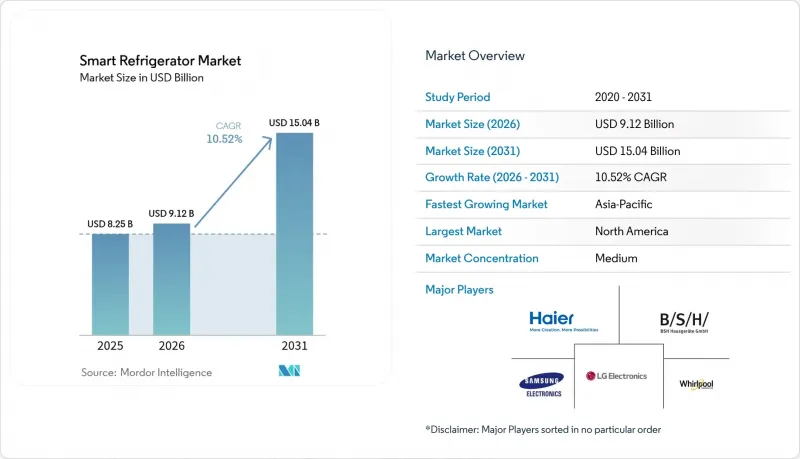
根據 Mordor Intelligence 預測,智慧冷藏庫市場規模將從 2025 年的 82.5 億美元成長到 2026 年的 91.2 億美元,然後在 2031 年達到 150.4 億美元,2026 年至 2031 年的複合年成長率為 10.52%。
本報告按產品類型(單門冷藏庫、雙門冷藏庫等)、連接功能(支援Wi-Fi、整合語音助理和人工智慧等)、容量(300公升以下、300-500公升、其他)、最終用戶(住宅、商用)、分銷管道(B2C、B2B)和地區(北美、南美、其他)進行細分。市場預測以美元計價。
全球智慧冷藏庫市場趨勢及洞察
擴大智慧家庭生態系統的應用
Matter 1.3 於 2024 年 5 月發布,正式認證支援跨平台控制的冷藏庫,簡化了在 Apple Home、Google Home 和 Amazon Alexa 等不同環境下的設定流程。博世家電 (BSH) 於 2025 年初推出了支援 Matter 的冷藏庫,這表明互通性如今已成為智慧冷藏庫市場的必備功能。擁有多台連網型設備的家庭正擴大升級其他家電,以實現統一的語音控制、日曆整合和能源管理。高階機型更進一步推動了這一趨勢,配備了 9 吋 AI 智慧家庭顯示螢幕,可在用戶視線範圍內顯示食譜提案、家庭日曆和能源儀錶板。
嚴格的能源效率法規正在更換。
2024年12月,美國能源局加強了冷藏庫能源效率標準,要求從2025年5月起提交認證申請。紐約州的標準預計到2035年每年可為消費者節省2.64億美元,並優先考慮具備需量反應能力的連網產品。 2025年4月,英國開始實施「智慧需量反應」要求,使家電能夠自動將負載轉移到用電低谷時段。加拿大第18號修正案將於2026年起與美國法規接軌,獎勵製造商在北美地區設計統一的產品線。這些措施將提高老舊產品的運作成本,進而加速產品自然更換,進而刺激智慧冷藏庫市場的發展。
與傳統模型相比,初始成本較高
智慧冷藏庫依然昂貴,令注重預算的消費者望而卻步,尤其是在價格是主要購買因素的國家。這筆額外費用主要被富裕家庭所接受,其中北美家庭最願意為智慧互聯功能買單。這使得製造商陷入兩難:是採用新技術,還是降低最終價格使其更容易接受?持續的通貨膨脹和經濟不確定性加劇了這一局面,許多人推遲更換冷藏庫,更換舊冰箱徹底損壞。此外,消費者往往難以理解降低能源成本和進行預測性維護是否足以抵消高昂的初始成本,因此品牌需要提供更清晰、更量化的論證,以證明投資回報的實質。
細分市場分析
到2025年,雙門冰箱仍將佔據智慧冷藏庫市場最大的佔有率,達到29.40%。這是因為消費者普遍認為這種佈局能帶來可靠的冷氣循環。此外,雙門冰箱還能受益於一些無需改變櫃體設計的升級功能,例如Wi-Fi模組和觸控顯示器。同時,法式對開門冰箱將以11.96%的複合年成長率(CAGR)成為成長最快的冰箱,這主要得益於高階廚房改造的需求、門中門係帶來的額外儲物空間以及用於存放食品準備容器的寬敞擱架。三星最新的AI混合冷卻系統在不增加外部尺寸的情況下,將內部容量提升了25公升,充分展現了先進技術如何解決實際空間限制問題。
隨著法式對開門冰箱的日益普及,這種佈局已成為重要的創新中心,許多原始設備製造商(OEM)紛紛在此展示高解析度攝影機、食譜推薦引擎和人工智慧保鮮演算法。由於這種佈局中冷藏食品與視線齊平,視覺模組可以捕捉清晰的圖像用於機器學習,從而提高識別精度。隨著生產規模的擴大,物料清單(BOM)的減少將降低零售價格,進一步加速傳統雙門冷藏庫的淘汰,並推動智慧冷藏庫市場的發展。
Wi-Fi 連線正逐漸成為一項基本功能,預計到 2025 年,其在智慧冰箱出貨量中的比例將達到 44.30%,並為入門級智慧冷藏庫的市場規模奠定基礎。製造商正在預先安裝應用程式,透過標準化的無線協議提供韌體更新、能耗儀錶板和診斷代碼。整合語音助理和人工智慧的型號正以 11.12% 的複合年成長率成長,實現了免持式食品管理和食譜規劃。與 Alexa、Google Assistant 和 Samsung Bixby 的整合是主要推動要素,但 LG 的 ThinQ 和 GE 的 SmartHQ 也在擴展其自然語言處理庫。
多重通訊協定晶片現在將 Wi-Fi、Thread 和藍牙低功耗 (Bluetooth LE) 整合到單一晶片上,從而降低了模組成本並有助於獲得 Matter 1.3 認證。這種整合簡化了消費者的設定流程,提高了支援語音助理的 SKU 的普及率,並進一步擴大了智慧家庭的覆蓋範圍。原始設備製造商 (OEM) 將自然語言視為支撐其龐大家電生態系統的「使用者互動介面」。因此,「語音優先」控制預計將在預測期內成為事實上的標準,從而推動智慧冷藏庫市場的更換需求。
區域分析
由於採用智慧家庭的早期普及、較高的可支配收入以及強大的安裝網路,北美在2025年仍將保持29.60%的智慧冷藏庫市場佔有率。電力公司針對連接型家電的補貼計畫進一步推動了具備即時追蹤功能的「能源之星」最高效節能型冰箱的銷售。在品牌信心指數中,Bosch、惠而浦和LG的表現優於新參與企業,這表明老牌製造商可能擁有強大的品牌股權「護城河」。高階廚房改造持續推動功能不足但性能尚可的冷藏庫的更換,從而形成強勁的更換週期,而具備先進人工智慧視覺功能且兼容第三方生鮮平台的冰箱更受青睞。
以中國為首的亞太地區正在縮小差距,預計到2031年複合年成長率將達到9.95%。中國、印度和東南亞都市區中產階級收入的成長推動了高階智慧冰箱產品(例如具備語音控制和人工智慧保鮮功能的智慧冰箱)的普及。海爾和海信等中國代工製造商正利用其本土化生產規模優勢,在全球市場積極推行產品定價策略,進一步加速產品滲透。區域內對智慧家庭基礎設施和碳中和生活方式的政策獎勵,也為智慧冷藏庫市場的長期成長動能提供了支撐。
歐洲雖然技術成熟,但仍是一個受監管主導的市場。歐盟的氟化氣體法規和永續產品生態設計法規迫使製造商採用天然冷媒,並在產品設計中優先考慮耐用性(ec.europa.eu)。消費者更重視能源效率等級和「從搖籃到搖籃」的可回收性,而非花俏的附加功能,而競爭對手則專注於效率演算法和模組化維修。博世家電的Matter智慧產品和LG計畫第一季發布的AI智慧冷藏庫,都透過結合低全球暖化潛值冷媒和開放協議實現互通性,滿足了消費者的這些偏好。歐洲範圍內的監管協調正在統一產品要求,有效擴大智慧冷藏庫的潛在市場。
其他好處:
- Excel格式的市場預測(ME)表
- 3個月的分析師支持
目錄
第1章:引言
- 研究假設和市場定義
- 調查範圍
第2章:調查方法
第3章執行摘要
第4章 市場狀況
- 市場概覽
- 市場促進因素
- 智慧家庭生態系統的廣泛應用
- 嚴格的能源效率法規正在推動設備的更換。
- 降低物聯網模組和感測器的成本
- 製造商整合的人工智慧用於預測性維護
- 零售商利用連網冷藏庫實現遙測數據貨幣化。
- 嚴格控制溫度儲存居家醫療藥品。
- 市場限制因素
- 與之前的型號相比,初始價格溢價較高
- 網路安全和資料隱私漏洞
- 即使 Matter 的應用不斷普及,互通性仍然很分散。
- 對「修復權」和「埋藏碳」的審查
- 產業價值鏈分析
- 波特五力分析
- 洞察最新市場趨勢與創新
- 洞察近期市場趨勢(新產品發布、策略性舉措、投資、合作、合資、業務擴張、併購等)
第5章 市場規模與成長預測
- 依產品
- 單門冷藏庫
- 雙門冷藏庫
- 上置式冷凍庫櫃
- 底部冷凍庫型
- 對開門冷藏庫
- 法式對開門冷藏庫
- 其他冷藏庫
- 連結性別
- 支援Wi-Fi(可透過應用程式控制)
- 語音助理和人工智慧整合(例如,Family Hub)
- Bluetooth/Zigbee/Thread
- 附螢幕的智慧冷藏庫
- 以體積(公升)
- 小於300公升
- 300~500 L
- 501~700 L
- 超過700公升
- 最終用戶
- 住宅
- 商業
- 透過分銷管道
- B2C/零售
- 多品牌商店
- 品牌經銷店
- 線上
- 其他分銷管道
- B2B/廠商直銷
- B2C/零售
- 按地區
- 北美洲
- 加拿大
- 美國
- 墨西哥
- 南美洲
- 巴西
- 秘魯
- 智利
- 阿根廷
- 其他南美國家
- 亞太地區
- 印度
- 中國
- 日本
- 澳洲
- 韓國
- 東南亞(新加坡、馬來西亞、泰國、印尼、越南、菲律賓)
- 其他亞太國家
- 歐洲
- 英國
- 德國
- 法國
- 西班牙
- 義大利
- 比荷盧經濟聯盟(比利時、荷蘭、盧森堡)
- 北歐國家(丹麥、芬蘭、冰島、挪威、瑞典)
- 其他歐洲國家
- 中東和非洲
- 阿拉伯聯合大公國
- 沙烏地阿拉伯
- 南非
- 奈及利亞
- 其他中東和非洲國家
- 北美洲
第6章 競爭情勢
- 市場集中度
- 策略趨勢
- 市佔率分析
- 公司簡介
- Samsung Electronics Co. Ltd.
- LG Electronics Inc.
- Haier Smart Home Co. Ltd.(Incl. GE Appliances)
- Whirlpool Corporation
- BSH Hausgerate GmbH(Bosch, Siemens, Gaggenau)
- Electrolux AB(Incl. Frigidaire)
- Midea Group
- Hisense Home Appliances
- Panasonic Corporation
- Sub-Zero Group Inc.
- Liebherr-Hausgerate GmbH
- Sharp Corporation
- Smeg SpA
- Hitachi Global Life Solutions
- Godrej Appliances
- Arcelik AS(Beko, Grundig)
- Miele & Cie. KG
- Fisher & Paykel Appliances Ltd.
- Thermador(BSH Group)
- Viking Range LLC
- Dacor Inc.
- Gorenje Group
第7章 市場機會與未來展望
According to Mordor Intelligence, the smart refrigerator market size is expected to grow from USD 8.25 billion in 2025 to USD 9.12 billion in 2026 and is forecast to reach USD 15.04 billion by 2031 at 10.52% CAGR over 2026-2031.
This report is Segmented by Product (Single-Door Refrigerator, Double-Door Refrigerator, and More), Connectivity (Wi-Fi Enabled, Voice-Assistant & AI-Integrated, and More), Capacity (Less Than 300 L, 300 - 500 L, and More), End-User (Residential, and Commercial), Distribution Channel (B2C, and B2B), and Geography (North America, South America, and More). The Market Forecasts are Provided in Terms of Value (USD).
Global Smart Refrigerator Market Trends and Insights
Rising Adoption of Smart-Home Ecosystems
Matter 1.3, launched in May 2024, officially certified refrigerators for cross-platform control and reduced set-up friction between Apple Home, Google Home, and Amazon Alexa environments. BSH introduced Matter-enabled refrigerators in early 2025, signaling that interoperability is now table stakes in the smart refrigerator market. Households adopting multiple connected devices display a higher propensity to upgrade additional appliances to gain unified voice control, calendar integration, and energy scheduling. Premium models strengthen this dynamic through 9-inch AI Home displays that place recipe suggestions, family calendars, and energy dashboards at eye level.
Stringent Energy-Efficiency Regulations Driving Replacements
The U.S. Department of Energy tightened refrigerator efficiency standards in December 2024 and mandated certification submissions starting May 2025. New York State's standards forecast USD 264 million in yearly consumer savings by 2035 and specifically reward connected units that prove demand-response compatibility . In April 2025, the UK began requiring smart readiness so that appliances can automatically shift load to off-peak periods. Canada's Amendment 18 will harmonize with U.S. rules from 2026, giving manufacturers an incentive to design uniform North American portfolios. These measures accelerate natural replacement by making legacy units comparatively expensive to operate, thereby uplifting the smart refrigerator market.
High Upfront Price Premium Versus Conventional Models
Smart refrigerators still carry a hefty price tag, which puts off buyers who watch their budgets, especially in countries where price is the first filter. The extra cost is mainly acceptable to well-off households, and North American families are the most willing to pay for connected features. That leaves manufacturers stuck between loading in new tech and keeping the final price within reach of a wider audience. Ongoing inflation and economic jitters make matters worse because many people delay replacing an old fridge until it stops working. On top of that, shoppers often have trouble seeing how lower energy bills or predictive maintenance justify the bigger upfront spend, so brands need clearer, numbers-based stories that show the payback in real terms.
Other drivers and restraints analyzed in the detailed report include:
- Declining IoT Module and Sensor Costs
- Manufacturer-Integrated AI for Predictive Maintenance
- Cyber-Security and Data-Privacy Vulnerabilities
For complete list of drivers and restraints, kindly check the Table Of Contents.
Segment Analysis
The double-door format retained the largest slot with a 29.40% smart refrigerator market share in 2025 because buyers still equate the layout with reliable cold air circulation. The segment also benefits from incremental upgrades, such as Wi-Fi boards and touch displays, that can be added without retooling cabinet designs. French-door units, however, are charting the fastest 11.96% CAGR on the back of premium kitchen remodels, additional door-within-door storage, and wider shelves that accommodate meal-prepping containers. Samsung's latest AI Hybrid Cooling model boosts interior volume by 25 L without expanding external dimensions, underscoring how premium engineering solves real-world space constraints.
The growing popularity of French-door configurations positions the format as the principal innovation sandbox where OEMs debut high-resolution cameras, recipe recommendation engines, and AI-powered freshness algorithms. Because the layout places refrigerated foods at eye level, vision modules can capture clearer images for machine learning, increasing recognition accuracy. As production scales, BOM reductions should feed back into lower Street prices, enabling further substitution of legacy double-door units and reinforcing the expansion of the smart refrigerator market.
Wi-Fi connectivity became a baseline expectation, constituting 44.30% of shipments in 2025 and anchoring the smart refrigerator market size for entry-level SKUs. Manufacturers preload apps that issue firmware updates, energy-usage dashboards, and diagnostic codes via standardized over-the-air protocols. Voice-assistant and AI-integrated models are growing at an 11.12% CAGR because they enable hands-free grocery management and recipe planning. Integration with Alexa, Google Assistant, and Samsung Bixby is the main pull, but LG's ThinQ and GE's SmartHQ are expanding their natural language libraries.
Multi-protocol chips now embed Wi-Fi, Thread, and Bluetooth LE on a single die, cutting module cost, which in turn smooths Matter 1.3 certification. That convergence reduces consumer setup friction, driving higher attach rates of voice-assistant SKUs to broader smart-home deployments. OEMs view natural language as the sticky interface that anchors their wider appliance ecosystems. Consequently, voice-first control is expected to become the de facto standard during the forecast window, amplifying replacement demand in the smart refrigerator market.
Complete Report Scope:
- By Product
- Single-Door Refrigerator
- Double-Door Refrigerator
- Top Freezer
- Bottom Freezer
- Side-By-Side Door Refrigerator
- French-Door Refrigerator
- Other Refrigerators
- By Connectivity
- Wi-Fi Enabled (App-Controlled)
- Voice-Assistant & AI-Integrated (e.g., Family-Hub)
- Bluetooth / Zigbee / Thread
- Screen-Based Smart Fridges
- By Capacity (Liters)
- Less than 300 L
- 300 - 500 L
- 501 - 700 L
- Greater than 700 L
- By End-User
- Residential
- Commercial
- By Distribution Channel
- B2C / Retail
- Multi-Brand Stores
- Exclusive Brand Outlets
- Online
- Other Distribution Channels
- B2B / Directly From The Manufacturers
- B2C / Retail
- By Geography
- North America
- Canada
- United States
- Mexico
- South America
- Brazil
- Peru
- Chile
- Argentina
- Rest Of South America
- Asia-Pacific
- India
- China
- Japan
- Australia
- South Korea
- South East Asia (Singapore, Malaysia, Thailand, Indonesia, Vietnam, And Philippines)
- Rest of Asia-Pacific
- Europe
- United Kingdom
- Germany
- France
- Spain
- Italy
- BENELUX (Belgium, Netherlands, And Luxembourg)
- NORDICS (Denmark, Finland, Iceland, Norway, And Sweden)
- Rest Of Europe
- Middle East And Africa
- United Arab Emirates
- Saudi Arabia
- South Africa
- Nigeria
- Rest Of Middle East And Africa
- North America
Geography Analysis
North America preserved a 29.60% share of the smart refrigerator market in 2025 due to early smart-home adoption, high disposable income, and a well-developed installer network. Utility rebate programs covering connected appliances further shift purchasing toward ENERGY STAR Most Efficient models that embed real-time tracking . Brand trust indices place Bosch, Whirlpool and LG above newcomers, illustrating the latent brand-equity moat that cushions incumbents. Premium kitchen remodels continue to substitute working but feature-poor refrigerators, extending a robust upgrade cycle that favors advanced AI Vision capabilities compatible with third-party grocery platforms.
Asia-Pacific, led by China, is closing the gap at a forecast 9.95% CAGR through 2031. Middle-class income expansion in urban China, India, and Southeast Asia is driving the uptake of premium SKUs that incorporate voice control and AI freshness monitoring. Chinese OEMs such as Haier and Hisense translate local manufacturing scale into aggressive global pricing, further democratizing access. Regional policy incentives aimed at smart-home infrastructure and carbon-neutral living support long-run momentum in the smart refrigerator market.
Europe remains a technologically mature yet regulation-driven arena. The EU F-Gas Regulation and the Ecodesign for Sustainable Products Regulation press manufacturers to adopt natural refrigerants and design for durability ec.europa.eu. Consumers prioritize energy scorecards and cradle-to-cradle recyclability over flashy add-ons, steering the competitive battle toward efficiency algorithms and modular repairability. BSH's Matter-enabled releases and LG's Q1 2025 AI-ready refrigerators both respond to these preferences by coupling low global-warming-potential refrigerants with open-protocol interoperability. Regulatory convergence across the continent harmonizes product requirements, effectively enlarging the addressable smart refrigerator market.
- Samsung Electronics Co. Ltd.
- LG Electronics Inc.
- Haier Smart Home Co. Ltd. (Incl. GE Appliances)
- Whirlpool Corporation
- BSH Hausgerate GmbH (Bosch, Siemens, Gaggenau)
- Electrolux AB (Incl. Frigidaire)
- Midea Group
- Hisense Home Appliances
- Panasonic Corporation
- Sub-Zero Group Inc.
- Liebherr-Hausgerate GmbH
- Sharp Corporation
- Smeg S.p.A
- Hitachi Global Life Solutions
- Godrej Appliances
- Arcelik A.S. (Beko, Grundig)
- Miele & Cie. KG
- Fisher & Paykel Appliances Ltd.
- Thermador (BSH Group)
- Viking Range LLC
- Dacor Inc.
- Gorenje Group
Additional Benefits:
- The market estimate (ME) sheet in Excel format
- 3 months of analyst support
TABLE OF CONTENTS
1 Introduction
- 1.1 Study Assumptions & Market Definition
- 1.2 Scope of the Study
2 Research Methodology
3 Executive Summary
4 Market Landscape
- 4.1 Market Overview
- 4.2 Market Drivers
- 4.2.1 Rising Adoption of Smart-Home Ecosystems
- 4.2.2 Stringent Energy-Efficiency Regulations Driving Replacements
- 4.2.3 Declining IoT Module And Sensor Costs
- 4.2.4 Manufacturer-Integrated AI For Predictive Maintenance
- 4.2.5 Retailer Telemetry Monetization From Connected Fridges
- 4.2.6 Home-Health Medication Storage With Temperature Compliance
- 4.3 Market Restraints
- 4.3.1 High Upfront Price Premium Versus Conventional Models
- 4.3.2 Cyber-Security And Data-Privacy Vulnerabilities
- 4.3.3 Fragmented Interoperability Despite Matter Roll-Out
- 4.3.4 Right-To-Repair And Embedded-Carbon Scrutiny
- 4.4 Industry Value Chain Analysis
- 4.5 Porter's Five Forces Analysis
- 4.5.1 Threat Of New Entrants
- 4.5.2 Bargaining Power Of Suppliers
- 4.5.3 Bargaining Power Of Buyers
- 4.5.4 Threat Of Substitutes
- 4.5.5 Competitive Rivalry
- 4.6 Insights Into The Latest Trends And Innovations In The Market
- 4.7 Insights On Recent Developments (New Product Launches, Strategic Initiatives, Investments, Partnerships, JVs, Expansion, M&As, Etc.) In The Market
5 Market Size & Growth Forecasts (Value)
- 5.1 By Product
- 5.1.1 Single-Door Refrigerator
- 5.1.2 Double-Door Refrigerator
- 5.1.2.1 Top Freezer
- 5.1.2.2 Bottom Freezer
- 5.1.3 Side-By-Side Door Refrigerator
- 5.1.4 French-Door Refrigerator
- 5.1.5 Other Refrigerators
- 5.2 By Connectivity
- 5.2.1 Wi-Fi Enabled (App-Controlled)
- 5.2.2 Voice-Assistant & AI-Integrated (e.g., Family-Hub)
- 5.2.3 Bluetooth / Zigbee / Thread
- 5.2.4 Screen-Based Smart Fridges
- 5.3 By Capacity (Liters)
- 5.3.1 Less than 300 L
- 5.3.2 300 - 500 L
- 5.3.3 501 - 700 L
- 5.3.4 Greater than 700 L
- 5.4 By End-User
- 5.4.1 Residential
- 5.4.2 Commercial
- 5.5 By Distribution Channel
- 5.5.1 B2C / Retail
- 5.5.1.1 Multi-Brand Stores
- 5.5.1.2 Exclusive Brand Outlets
- 5.5.1.3 Online
- 5.5.1.4 Other Distribution Channels
- 5.5.2 B2B / Directly From The Manufacturers
- 5.5.1 B2C / Retail
- 5.6 By Geography
- 5.6.1 North America
- 5.6.1.1 Canada
- 5.6.1.2 United States
- 5.6.1.3 Mexico
- 5.6.2 South America
- 5.6.2.1 Brazil
- 5.6.2.2 Peru
- 5.6.2.3 Chile
- 5.6.2.4 Argentina
- 5.6.2.5 Rest Of South America
- 5.6.3 Asia-Pacific
- 5.6.3.1 India
- 5.6.3.2 China
- 5.6.3.3 Japan
- 5.6.3.4 Australia
- 5.6.3.5 South Korea
- 5.6.3.6 South East Asia (Singapore, Malaysia, Thailand, Indonesia, Vietnam, And Philippines)
- 5.6.3.7 Rest of Asia-Pacific
- 5.6.4 Europe
- 5.6.4.1 United Kingdom
- 5.6.4.2 Germany
- 5.6.4.3 France
- 5.6.4.4 Spain
- 5.6.4.5 Italy
- 5.6.4.6 BENELUX (Belgium, Netherlands, And Luxembourg)
- 5.6.4.7 NORDICS (Denmark, Finland, Iceland, Norway, And Sweden)
- 5.6.4.8 Rest Of Europe
- 5.6.5 Middle East And Africa
- 5.6.5.1 United Arab Emirates
- 5.6.5.2 Saudi Arabia
- 5.6.5.3 South Africa
- 5.6.5.4 Nigeria
- 5.6.5.5 Rest Of Middle East And Africa
- 5.6.1 North America
6 Competitive Landscape
- 6.1 Market Concentration
- 6.2 Strategic Moves
- 6.3 Market Share Analysis
- 6.4 Company Profiles (Includes Global Level Overview, Market Level Overview, Core Segments, Financials As Available, Strategic Information, Market Rank/Share For Key Companies, Products & Services, And Recent Developments)
- 6.4.1 Samsung Electronics Co. Ltd.
- 6.4.2 LG Electronics Inc.
- 6.4.3 Haier Smart Home Co. Ltd. (Incl. GE Appliances)
- 6.4.4 Whirlpool Corporation
- 6.4.5 BSH Hausgerate GmbH (Bosch, Siemens, Gaggenau)
- 6.4.6 Electrolux AB (Incl. Frigidaire)
- 6.4.7 Midea Group
- 6.4.8 Hisense Home Appliances
- 6.4.9 Panasonic Corporation
- 6.4.10 Sub-Zero Group Inc.
- 6.4.11 Liebherr-Hausgerate GmbH
- 6.4.12 Sharp Corporation
- 6.4.13 Smeg S.p.A
- 6.4.14 Hitachi Global Life Solutions
- 6.4.15 Godrej Appliances
- 6.4.16 Arcelik A.S. (Beko, Grundig)
- 6.4.17 Miele & Cie. KG
- 6.4.18 Fisher & Paykel Appliances Ltd.
- 6.4.19 Thermador (BSH Group)
- 6.4.20 Viking Range LLC
- 6.4.21 Dacor Inc.
- 6.4.22 Gorenje Group
7 Market Opportunities & Future Outlook
- 7.1 Integration with Voice Assistants and smart home ecosystems:

 智慧家庭設備市場-2026-2032年全球市場預測智慧冷藏庫市場:2026-2032年全球市場預測(按產品類型、組件、技術、分銷管道和最終用戶分類)
 智慧家庭設備市場規模、佔有率和成長分析:按產品類型、連接技術、應用、銷售管道、最終用戶和地區分類-2026-2033年產業預測
 智慧冷藏庫市場機會、成長要素、產業趨勢分析及2026-2035年預測
 消費機器人和智慧家居設備
 智慧家庭設備市場分析及預測(至2035年):依類型、產品類型、服務、技術、組件、應用、形式、最終用戶及功能分類
 全球智慧冷藏庫市場規模、佔有率、趨勢和成長分析報告(2026-2034)
 2026年全球智慧冷藏庫市場報告
 智慧家居設備市場-全球產業規模、佔有率、趨勢、機會和預測:按產品類型、最終用戶、銷售管道、地區和競爭格局分類,2021-2031年
 智慧冷藏庫市場規模、佔有率和成長分析(按門類型、最終用途、分銷管道和地區分類)—產業預測(2026-2033 年)