


 |
市場調查報告書
商品編碼
2116290
美國商業建築自動化:市場佔有率分析、產業趨勢與統計及成長預測(2026-2031 年)United States Commercial Building Automation - Market Share Analysis, Industry Trends & Statistics, Growth Forecasts (2026 - 2031) |
||||||

※ 本網頁內容可能與最新版本有所差異。詳細情況請與我們聯繫。
根據 Mordor Intelligence 預測,美國商業建築自動化市場規模將從 2025 年的 212.3 億美元成長到 2026 年的 225.3 億美元,然後在 2031 年達到 303.4 億美元,2026 年至 2031 年的複合年成長率為 6.12%。
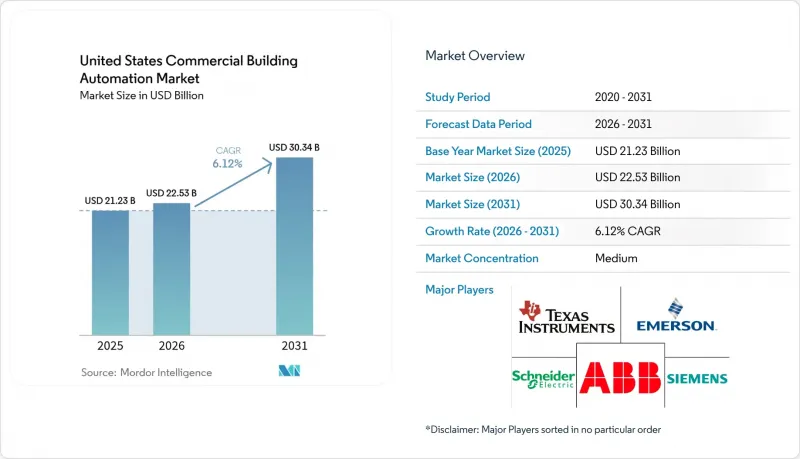
本報告依產品類型(暖通空調控制系統、安防及門禁系統、其他)、建築類型(辦公大樓、公共設施、零售場所、飯店、其他)、組件(控制器及現場設備、感測器、其他)及通訊協定(BACnet、Modbus、KNX、其他)進行分類。市場預測以美元計價。
美國商業建築自動化市場趨勢與洞察
聯邦和州淨零排放和電氣化要求
聯邦性能標準規定,到2030年,面積超過25,000平方英尺的建築能耗必須降低30%,迫使業主實施功能齊全的自動化系統以滿足合規要求。加州第24號法規和紐約州第97號地方法律規定了更嚴格的碳排放上限,並已開始實施處罰,這推動了政府、教育和醫療保健等行業的設備快速升級。連網的暖通空調、照明和插座負載控制正成為新租賃協議的標配,因為手動調度無法達到20-40%的減排目標。供應商現在提供合規性儀表板,可以將感測器數據轉化為可審計的報告,從而將競標決策從成本驅動轉向合規驅動。這種連鎖反應正在擴大競標範圍,不僅包括早期採用者,還包括希望避免罰款並吸引聯邦租戶的普通業主。
受ESG主導驅動,企業對即時能源數據的需求不斷成長。
美國證券交易委員會(SEC)的新氣候資訊揭露法規要求財富500強企業每15分鐘發布一次範圍2排放數據,這推動了對分錶計量和雲端分析的需求激增。在多租戶辦公大樓中,租戶級計量表正在安裝,使業主能夠準確分配成本,並將ESG(環境、社會和治理)儀錶板作為高級配套設施提供。能夠自動將資料輸入揭露範本的軟體即服務(SaaS)平台減輕了人工報告的負擔,同時也提高了訂閱費用。即時透明度也在改變租賃談判。租戶現在強烈要求辦公大樓能夠讓他們檢驗在實現永續發展目標方面取得的進展。為此,自動化解決方案供應商正與ESG軟體供應商合作,整合資料管道,簡化合規流程,並開發新的、經常性的收入來源。
網路化大樓自動化系統(BAS) 的網路安全責任和保險除外責任
據美國保險監管協會 (NAIC) 稱,目前 40% 的商業財產保險單不承保物聯網相關的損失,這使得業主面臨資料外洩可能造成的損失超過 100 萬美元。醫療和金融機構本就受到嚴格的數據監管,因此不願將操作技術(OT) 暴露在公共網際網路上。專業網路保險的保費從每平方英尺每年 0.50 美元到 1 美元不等,導致投資回收期延長和專案延期。諸如 BACnet Secure Connect 和 NIST 規範等標準仍處於草案階段,未來的合規成本仍存在不確定性。供應商正透過零信任架構和資安管理服務來應對這一問題,但買家仍持謹慎態度。
細分市場分析
2025年,暖通空調控制系統佔銷售額的40.92%,主要得益於各州強制要求使用自動化通風和溫度控制的性能標準。然而,由於業主希望在整個設施中實現30%至50%的能源效率提升(而這僅靠孤立的子系統是無法實現的),整合式建築管理平台正以7.22%的複合年成長率加速成長。這種發展趨勢使得這些平台有望在預測期內佔據美國商業建築自動化市場更大的佔有率。
此外,該平台的採用反映了暖通空調、照明、安防和電力等領域ESG報告模式的統一化趨勢。供應商現在提供雲端儀錶板,可以聚合資料流並以「單一介面」視圖呈現,從而簡化合規和維護工作流程。與BACnet和無線協議的互通性增強了其面向未來的潛力,使此整合平台成為優先考慮穩健資產表現的投資者的理想選擇。
到2025年,辦公物業將在美國商業建築自動化市場保持35.01%的佔有率,這得益於企業環境、社會和治理(ESG)資訊揭露要求以及對混合辦公模式相關分析的需求。同時,隨著城市規劃者擴大將零售、住宅和辦公空間等功能融合在一起,需要先進區域控制的混合用途設施預計將以7.01%的複合年成長率成長。
混合用途物業多樣化的租戶模式要求配備靈活的自動化系統,以便按小時調整暖通空調(HVAC)的運作時間表。業主將這種適應性視為應對租戶組合變化的保障,而市政當局則透過分區激勵措施鼓勵綜合開發。辦公大樓業主不斷部署先進的建築自動化系統(BAS)以維持其A級評級,但由於與注重體驗的混合用途項目的競爭,競爭日益激烈。
其他好處
- Excel格式的市場預測(ME)表
- 3個月的分析師支持
目錄
第1章:引言
- 研究假設和市場定義
- 調查範圍
第2章:調查方法
第3章執行摘要
第4章 市場狀況
- 市場概覽
- 市場促進因素
- 聯邦和州淨零排放和電氣化要求
- 受ESG主導驅動,企業對即時能源數據的需求不斷成長。
- 《通膨控制法》為高效率暖通空調和控制設備。
- 向混合辦公模式過渡需要對靈活辦公空間的利用進行分析。
- 降低開放原始碼物聯網感測器和邊緣控制器的成本和互通性。
- 透過電力公司主導的需量反應,實現自動負載削減的商業化。
- 市場限制因素
- 網路連接型建築自動化系統的網路安全責任及保險除外責任
- 分散的傳統基礎設施 → 高昂的整合成本
- 建築自動化系統試運行和分析領域熟練勞動力短缺
- 中小商業不動產投資報酬率不足
- 產業價值鏈分析
- 監理情勢
- 技術展望
- 波特五力分析
- 宏觀經濟因素的影響
第5章 市場規模與成長預測
- 依產品類型
- 暖通空調控制系統
- 安全和存取控制系統
- 能源管理和電力監控系統
- 照明和遮陽控制系統
- 消防和災害預防系統
- 整合建築管理平台
- 依建築類型
- 辦公室
- 公共設施(教育和醫療保健)
- 零售
- 飯店業
- 工業和倉儲
- 混合用途及其他商業設施
- 按組件
- 控制器現場設備
- 感應器
- 軟體和分析平台
- 服務(諮詢、系統整合、維護)
- 透過通訊協定和網路
- BACnet
- Modbus
- KNX
- LonWorks
- Zigbee 和其他無線協議
- EnOcean能源採集協議
- 專有協議
第6章 競爭情勢
- 市場集中度
- 策略趨勢
- 市佔率分析
- 公司簡介
- ABB Ltd.
- Advantech Co., Ltd.
- Autani, LLC
- Carrier Global Corporation
- Crestron Electronics, Inc.
- Delta Electronics, Inc.
- Distech Controls Inc.
- Emerson Electric Co.
- Honeywell International Inc.
- Johnson Controls International plc
- Lutron Electronics Co., Inc.
- Mitsubishi Electric Corporation
- Omron Corporation
- Phoenix Contact GmbH and Co. KG
- Robert Bosch GmbH
- Schneider Electric SE
- Siemens AG
- Texas Instruments Incorporated
- Trane Technologies plc
- Tridium, Inc.
- BuildingIQ, Inc.
- Resideo Technologies, Inc.
第7章 市場機會與未來展望
According to Mordor Intelligence, the United States commercial building automation market size is expected to grow from USD 21.23 billion in 2025 to USD 22.53 billion in 2026 and is forecast to reach USD 30.34 billion by 2031 at 6.12% CAGR over 2026-2031.
This report is Segmented by Product Type (HVAC Control Systems, Security and Access Control Systems, and More), Building Type (Office, Institutional, Retail, Hospitality, and More), Component (Controllers and Field Devices, Sensors, and More), Communication Protocol (BACnet, Modbus, KNX, and More). The Market Forecasts are Provided in Terms of Value (USD).
United States Commercial Building Automation Market Trends and Insights
Federal and State Net-Zero Electrification Mandates
Federal performance standards compel buildings larger than 25,000 square feet to cut energy use 30% by 2030, pushing owners toward full-featured automation for compliance. California Title 24 and New York Local Law 97 add stricter carbon caps with penalties already in force, prompting rapid upgrades across government, education, and healthcare portfolios. Manual scheduling cannot reach 20-40% reduction thresholds, so connected HVAC, lighting, and plug-load controls have become default specifications in new leases. Vendors now bundle compliance dashboards that translate sensor data into audit-ready reports, shifting procurement decisions from cost-centric to mandate-driven. The ripple effect has expanded bid pipelines beyond early adopters to mainstream owners aiming to avoid fines and attract federal tenants.
Corporate ESG-Driven Demand for Real-Time Energy Data
New SEC climate disclosure rules require Fortune 500 firms to publish 15-minute Scope 2 emissions data, spurring a surge in sub-metering and cloud analytics. Multi-tenant towers are wiring tenant-level meters so landlords can allocate costs accurately and supply ESG dashboards as a premium amenity. SaaS platforms that auto-populate disclosure templates command higher subscription fees while reducing manual reporting labor. Real-time transparency is also reshaping lease negotiations; tenants now insist on buildings capable of validating sustainability targets. In response, automation suppliers have partnered with ESG software vendors to integrate data pipelines that streamline compliance and unlock new recurring-revenue streams.
Cyber-Security Liabilities and Insurance Exclusions for Connected BAS
40% of commercial property policies now exclude IoT-related losses, exposing owners to more than USD 1 million in potential breach costs, according to NAIC. Health-care and financial campuses, already subject to stringent data regulations, hesitate to expose operational technology to the public internet. Specialty cyber cover costs USD 0.50-1.00 per square foot annually, extending paybacks and delaying projects. Standards such as BACnet Secure Connect and NIST profiles remain in draft, leaving uncertainty over future compliance spending. Vendors answer with zero-trust architectures and managed security services, yet buyer caution persists.
Other drivers and restraints analyzed in the detailed report include:
- Inflation Reduction Act Tax Incentives for High-Efficiency HVAC and Controls
- Hybrid-Work Shift Requiring Flexible Space-Utilization Analytics
- Fragmented Legacy Infrastructure and High Integration Costs
For complete list of drivers and restraints, kindly check the Table Of Contents.
Segment Analysis
HVAC control systems accounted for 40.92% of 2025 revenue, driven by state performance standards that mandate the use of automated ventilation and temperature control. Yet, integrated building-management platforms are accelerating at a 7.22% CAGR, as owners pursue 30-50% whole-facility efficiency gains that are unattainable through siloed subsystems. This evolution positions platforms to capture a larger slice of the United States commercial building automation market over the forecast horizon.
Platform adoption also reflects a preference for unified ESG reporting that spans HVAC, lighting, security, and power. Vendors now offer cloud dashboards that aggregate data streams into single-pane-of-glass views, simplifying compliance and maintenance workflows. Interoperability with BACnet and wireless protocols ensures future-proofing, making integrated platforms attractive to investors valuing resilient asset performance.
Office properties retained 35.01% share of the United States commercial building automation market size in 2025, benefiting from corporate ESG disclosure obligations and hybrid-work analytics needs. Mixed-use complexes, however, are forecast to rise at 7.01% CAGR as urban planners combine retail, residential, and workspace functions that demand sophisticated zonal control.
Diverse occupancy patterns in mixed-use assets necessitate flexible automation that can adjust HVAC schedules by the hour. Landlords view such adaptability as a hedge against evolving tenant mixes, while municipalities encourage integrated developments through zoning incentives. Office owners continue to deploy advanced BAS to retain Class A designation, but competition from experience-driven mixed-use projects intensifies the technology race.
Complete Report Scope:
- By Product Type
- HVAC Control Systems
- Security and Access Control Systems
- Energy Management and Power-Monitoring Systems
- Lighting and Shading Control Systems
- Fire and Life-Safety Systems
- Integrated Building-Management Platforms
- By Building Type
- Office
- Institutional (Education and Healthcare)
- Retail
- Hospitality
- Industrial and Warehouse
- Mixed-Use and Other Commercial
- By Component
- Controllers and Field Devices
- Sensors
- Software and Analytics Platforms
- Services (Consulting, Integration and Maintenance)
- By Communication Protocol / Network
- BACnet
- Modbus
- KNX
- LonWorks
- Zigbee and Other Wireless Protocols
- EnOcean and Energy-Harvesting Protocols
- Proprietary Protocols
List of Companies Covered in this Report:
- ABB Ltd.
- Advantech Co., Ltd.
- Autani, LLC
- Carrier Global Corporation
- Crestron Electronics, Inc.
- Delta Electronics, Inc.
- Distech Controls Inc.
- Emerson Electric Co.
- Honeywell International Inc.
- Johnson Controls International plc
- Lutron Electronics Co., Inc.
- Mitsubishi Electric Corporation
- Omron Corporation
- Phoenix Contact GmbH and Co. KG
- Robert Bosch GmbH
- Schneider Electric SE
- Siemens AG
- Texas Instruments Incorporated
- Trane Technologies plc
- Tridium, Inc.
- BuildingIQ, Inc.
- Resideo Technologies, Inc.
Additional Benefits:
- The market estimate (ME) sheet in Excel format
- 3 months of analyst support
TABLE OF CONTENTS
1 INTRODUCTION
- 1.1 Study Assumptions and Market Definition
- 1.2 Scope of the Study
2 RESEARCH METHODOLOGY
3 EXECUTIVE SUMMARY
4 MARKET LANDSCAPE
- 4.1 Market Overview
- 4.2 Market Drivers
- 4.2.1 Federal and state net-zero / electrification mandates
- 4.2.2 Corporate ESG-driven demand for real-time energy data
- 4.2.3 Inflation Reduction Act tax incentives for high-efficiency HVAC and controls
- 4.2.4 Hybrid-work shift requiring flexible space-utilization analytics
- 4.2.5 Falling cost and interoperability of open-source IoT sensors / edge controllers
- 4.2.6 Utility-sponsored demand-response monetisation for automated load-shedding
- 4.3 Market Restraints
- 4.3.1 Cyber-security liabilities and insurance exclusions for connected BAS
- 4.3.2 Fragmented legacy infrastructure -> high integration cost
- 4.3.3 Skilled-labour shortages in BAS commissioning and analytics
- 4.3.4 Unclear ROI for small-/mid-size commercial properties
- 4.4 Industry Value Chain Analysis
- 4.5 Regulatory Landscape
- 4.6 Technological Outlook
- 4.7 Porter's Five Forces Analysis
- 4.7.1 Bargaining Power of Suppliers
- 4.7.2 Bargaining Power of Buyers
- 4.7.3 Threat of New Entrants
- 4.7.4 Threat of Substitutes
- 4.7.5 Intensity of Competitive Rivalry
- 4.8 Impact of Macroeconomic Factors
5 MARKET SIZE AND GROWTH FORECASTS (VALUE)
- 5.1 By Product Type
- 5.1.1 HVAC Control Systems
- 5.1.2 Security and Access Control Systems
- 5.1.3 Energy Management and Power-Monitoring Systems
- 5.1.4 Lighting and Shading Control Systems
- 5.1.5 Fire and Life-Safety Systems
- 5.1.6 Integrated Building-Management Platforms
- 5.2 By Building Type
- 5.2.1 Office
- 5.2.2 Institutional (Education and Healthcare)
- 5.2.3 Retail
- 5.2.4 Hospitality
- 5.2.5 Industrial and Warehouse
- 5.2.6 Mixed-Use and Other Commercial
- 5.3 By Component
- 5.3.1 Controllers and Field Devices
- 5.3.2 Sensors
- 5.3.3 Software and Analytics Platforms
- 5.3.4 Services (Consulting, Integration and Maintenance)
- 5.4 By Communication Protocol / Network
- 5.4.1 BACnet
- 5.4.2 Modbus
- 5.4.3 KNX
- 5.4.4 LonWorks
- 5.4.5 Zigbee and Other Wireless Protocols
- 5.4.6 EnOcean and Energy-Harvesting Protocols
- 5.4.7 Proprietary Protocols
6 COMPETITIVE LANDSCAPE
- 6.1 Market Concentration
- 6.2 Strategic Moves
- 6.3 Market Share Analysis
- 6.4 Company Profiles (includes Global level Overview, Market level overview, Core Segments, Financials as available, Strategic Information, Market Rank/Share for key companies, Products and Services, and Recent Developments)
- 6.4.1 ABB Ltd.
- 6.4.2 Advantech Co., Ltd.
- 6.4.3 Autani, LLC
- 6.4.4 Carrier Global Corporation
- 6.4.5 Crestron Electronics, Inc.
- 6.4.6 Delta Electronics, Inc.
- 6.4.7 Distech Controls Inc.
- 6.4.8 Emerson Electric Co.
- 6.4.9 Honeywell International Inc.
- 6.4.10 Johnson Controls International plc
- 6.4.11 Lutron Electronics Co., Inc.
- 6.4.12 Mitsubishi Electric Corporation
- 6.4.13 Omron Corporation
- 6.4.14 Phoenix Contact GmbH and Co. KG
- 6.4.15 Robert Bosch GmbH
- 6.4.16 Schneider Electric SE
- 6.4.17 Siemens AG
- 6.4.18 Texas Instruments Incorporated
- 6.4.19 Trane Technologies plc
- 6.4.20 Tridium, Inc.
- 6.4.21 BuildingIQ, Inc.
- 6.4.22 Resideo Technologies, Inc.
7 MARKET OPPORTUNITIES AND FUTURE OUTLOOK
- 7.1 White-space and Unmet-Need Assessment


