


 |
市場調查報告書
商品編碼
2116055
整合計費:市場佔有率分析、產業趨勢與統計資料、成長預測(2026-2031 年)Convergent Billing - Market Share Analysis, Industry Trends & Statistics, Growth Forecasts (2026 - 2031) |
||||||

※ 本網頁內容可能與最新版本有所差異。詳細情況請與我們聯繫。
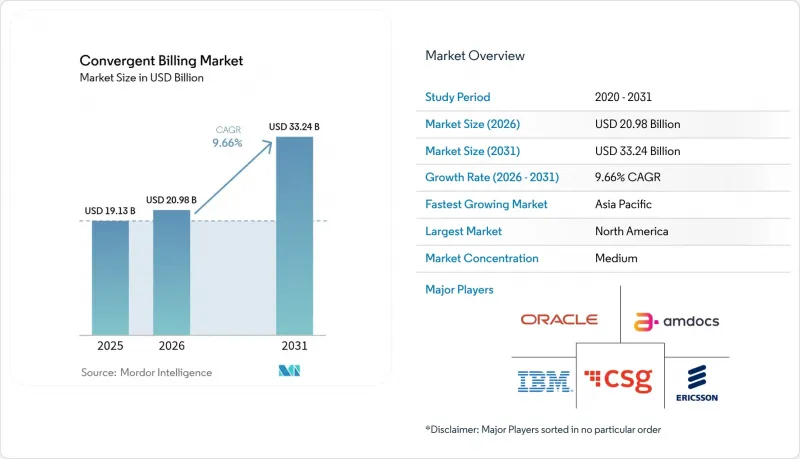
根據 Mordor Intelligence 預測,綜合計費市場規模預計將從 2025 年的 191.3 億美元成長到 2026 年的 209.8 億美元,然後在 2031 年達到 332.4 億美元,2026 年至 2031 年的複合年成長率為 9.6%。
本報告按元件(解決方案和服務)、部署模式(雲端和本地部署)、解決方案類型(發票週期最佳化、發票和帳戶管理、自動產生發票和帳單、付款和收款、客戶關係管理)、營運商/應用程式(行動、固網、寬頻、電視/串流媒體)以及地區進行細分。市場預測以美元(USD)為單位。
全球綜合計費市場趨勢與洞察
即時5G網路切片的商業化
商用網路切片仍然稀缺,到2024年中期,只有不到15%的服務供應商(CSP)能夠成功實現網路切片的商業化,但早期專案已經證明了高價策略的可行性。 TIM Brasil和愛立信推出了巴西首個農業物聯網的獨立網路切片,其收費比標準行動寬頻高出30%。 ETSI的OpenSlice API已於2024年獲得批准,前置作業時間縮短至不到六個月。隨著網路切片的動態擴展,傳統的每15分鐘批量處理使用情況的計費系統將錯失收入來源。因此,服務提供者正在轉向事件驅動的收費模式,在200毫秒內觸發計費。沃達豐面向工廠的私有5G服務融合了連接、邊緣運算和應用,因此需要一個統一的計費結構,將成本分配到各個層面。
電信業者、OTT 和物聯網服務的商品搭售
Verizon 的「myPlan」計畫允許用戶按月開啟或關閉 Netflix、Max 和 Disney+ 服務,這就要求收費系統即時匹配第三方存取權限。 T-Mobile 的「Netflix On Us」促銷活動使捆綁包的用戶解約率降低了 18 個百分點。中國移動預計到 2024 年將管理 25 億個物聯網連接,每個連接都會產生微交易,給傳統收費系統帶來壓力。愛立信的「IoT Accelerator」將設備事件匯總到每月帳單中,從而將每筆交易的成本降低了 60%。歐盟的互通性法規要求電信業者開放訂閱 API,這在一定程度上限制了利潤率管理,但整合計費市場的潛在收入正在不斷成長。
從舊有系統遷移成本高昂
沃達豐耗資10億歐元、歷時七年的現代化項目涵蓋21個國內市場和200多個應用,其投入規模遠超小規模業者。德國電信則面臨雙重支出,並行營運每年額外耗資1.31億美元,直到最終切換完成,降低了其投資報酬率。英國電信集團已根據英國功能分離法規的要求,撥款5億收費累計分離消費者和批發收費。據TM Forum稱,58%的通訊服務供應商(CSP)低估了資料清理的重要性,他們發現,在遷移之前,他們需要花費長達14個月的時間來匹配重複的客戶記錄。因此,南美和非洲的許多業者仍在長期使用舊版技術棧,儘管基於補丁的維護會增加技術債務,並阻礙統一計費市場的創新。
細分市場分析
至2025年,服務業將佔據綜合計費市場的62.05%。這主要得益於與多年平台升級相關的整合、諮詢和營運管理。沃達豐耗時七年、投資10億歐元的轉型項目動用了400多名顧問,這充分說明了為何預計到2031年業務收益將以10.78%的複合年成長率成長。德國電信採取了舊有系統和雲端系統並行18個月的策略,導致服務費用增加了1.31億美元,並增加了對外部專業知識的需求。
解決方案授權仍然佔據主導地位,但隨著TM Forum標準API允許多家供應商混合使用,其面臨價格壓力。缺乏內部DevOps基礎設施的二級電信業者對託管服務的需求成長最為迅速。 Comarch在中歐簽訂的2024年固定費率合約將資本支出轉化為可預測的營運成本。 Amdocs在其與AT&T續約的2024年合約中加入了價值5億美元的託管服務層級,確保了未來五年的穩定收入。培訓服務是一個被低估的成長驅動力,因為67%的通訊服務提供者需要供應商主導的技能培訓才能操作雲端原生收費系統。因此,將軟體與長期服務合約結合的供應商在整合計費市場中具有顯著優勢。
到2025年,雲端採用率將佔統一計費市場佔有率的45.78%,預計到2031年將繼續以10.47%的複合年成長率超越本地部署。樂天移動透過將其600萬用戶的整體擁有成本(TCO)較傳統BSS降低了40%,證明了其經濟可行性。Oracle與沃達豐簽訂的價值1億美元的年度契約,將沃達豐的歐洲收費負載遷移到Oracle雲端基礎設施,並關閉多個資料中心。 Airtel在排燈節期間的流量高峰期採用了基於亞馬遜雲端服務(AWS)的愛立信計費方案,以在不造成永久性超額配置的情況下擴展容量。
在本地化和延遲受限的地區,本地部署環境仍然普遍存在。中國移動維護支援25億物聯網連接的國內設施,以滿足國內數據法規的要求。英國電信集團的混合模式將核心收費處理保留在本地,同時在雲端運行分析處理。安全問題阻礙了中東和非洲(MEA)地區部分市場對公共雲端的採用,GSMA的調查顯示,42%的電信業者認為資料外洩風險是一大障礙。然而,獨立於供應商的微服務使電信服務供應商(CSP)能夠跨雲端遷移工作負載,從而緩解供應商鎖定問題,並推動雲端在統一計費市場的長期發展。
區域分析
2025年,北美佔全球綜合計費市場規模的32.30%。 Verizon和T-Mobile持續提供光纖、無線和進階影片捆綁服務,推動收費平台實現亞秒訂閱調整。 AT&T與Amdocs續簽了一份價值5億美元的年度契約,以維護其成熟的系統。 CSG從Dish Network獲得了一份價值7500萬美元的訂單,負責為超過800萬條線路構建後付費5G收費系統。 Rogers採用Oracle Cloud來支援加拿大的獨立5G核心網。 America Movil提前於2026年完成了其在墨西哥的收費系統遷移,並開始將其遷移到愛立信計費系統。
預計到2031年,亞太地區的複合年成長率將達到10.19%,成為綜合計費市場成長最快的地區。 Bharti Airtel部署的愛立信計費系統涵蓋18個電路,服務3.5億用戶。 Jio將電商、音樂和電影整合到一個錢包中,這清楚地展現了超級應用程式收費的複雜性。中國移動25億物聯網連線需要Petabyte級微交易收費系統。日本KDDI和韓國SK Telecom推出了網路切片費率方案,需要基於策略的即時收費。東南亞錢包市場年增41%,電信業者的交易量佔比高達72%,顯示收費系統正日益深入地融入人們的日常生活。
在歐洲,由於資料居住要求,企業正面臨成本上升的困境。沃達豐為了遵守資料法規,營運18個不同的實例。 Orange已與Oracle合作,整合收費系統,但每個國家仍需要各自的資料庫。英國電信集團(BT Group)正根據英國的功能分離法規,將其批發業務與消費者業務支援系統(BSS)分開。義大利電信(Telecom Italia)每天花費1500歐元聘請顧問來彌補技能缺口,這導致其專案進度延誤。在中東,e&已撥款2億美元用於建構雲端原生BSS,以推動其轉型為金融科技。隨著非洲行動支付交易量達到1.4兆美元,統一錢包至關重要,MTN和沃達康(Vodacom)正在將通話費、資料通訊費和商家支付整合到一張帳單中。南美洲的TIM Brasil正以30%的溢價對其5G農產品業務進行貨幣化,這凸顯了透過即時統一計費增加收入的潛力。
其他好處:
- Excel格式的市場預測(ME)表
- 3個月的分析師支持
目錄
第1章:引言
- 研究假設和市場定義
- 調查範圍
第2章:調查方法
第3章執行摘要
第4章 市場狀況
- 市場概覽
- 市場促進因素
- 透過即時 5G 網路切片實現獲利
- 電信業者與OTT/物聯網服務的商品搭售
- 實現雲端原生微服務收費系統
- 人工智慧驅動的收入保障和詐欺分析
- 中東和非洲預付數位錢包的快速成長
- B2B專用網路收費需求日益成長
- 市場限制因素
- 從舊有系統遷移成本高昂
- 資料主權和跨境隱私法規
- 熟練的OSS/BSS人員短缺
- 與雲端超大規模資料中心業者雲端服務商相關的供應商鎖定風險
- 產業價值鏈分析
- 監理情勢
- 技術展望
- 波特五力模型
第5章 市場規模與成長預測
- 按組件
- 解決方案
- 服務
- 按安裝模式
- 雲
- 現場
- 按解決方案類型
- 最佳化計費週期
- 帳單和帳戶管理
- 自動產生發票和發票對帳單
- 付款和收款
- 客戶關係管理(CRM)
- 電信業者/透過申請
- 移動的
- 固定的
- 寬頻
- 電視/串流媒體
- 按地區
- 北美洲
- 美國
- 加拿大
- 墨西哥
- 南美洲
- 巴西
- 阿根廷
- 其他南美國家
- 歐洲
- 德國
- 英國
- 法國
- 義大利
- 西班牙
- 其他歐洲國家
- 亞太地區
- 中國
- 印度
- 日本
- 韓國
- 其他亞太國家
- 中東和非洲
- 中東
- 阿拉伯聯合大公國
- 沙烏地阿拉伯
- 其他中東國家
- 非洲
- 南非
- 奈及利亞
- 其他非洲國家
- 中東
- 北美洲
第6章 競爭情勢
- 市場集中度
- 策略趨勢
- 市佔率分析
- 公司簡介
- Amdocs Ltd.
- International Business Machines Corporation
- Oracle Corporation
- Telefonaktiebolaget LM Ericsson
- CSG Systems International Inc.
- Huawei Technologies Co. Ltd.
- Comarch SA
- Tecnotree Oyj
- Netcracker Technology Corp.
- Nokia Corporation
- Optiva Inc.
- Cerillion plc
- Matrixx Software Inc.
- Subex Ltd.
- Mahindra Comviva Ltd.
- Sterlite Technologies Ltd.
- Zuora Inc.
- Aria Systems Inc.
- BillingPlatform LLC
- Chargebee Inc.
- CloudBilling BV
第7章 市場機會與未來展望
According to Mordor Intelligence, the convergent billing market size is expected to grow from USD 19.13 billion in 2025 to USD 20.98 billion in 2026 and is forecast to reach USD 33.24 billion by 2031 at 9.66% CAGR over 2026-2031.
This report is Segmented by Component (Solution, and Services), Deployment Model (Cloud, and On-Premise), Solution Type (Bill-Cycle Optimisation, Billing-Account Management, Automated Invoice and Bill Generation, Payment and Collection, Customer-Relationship Management), Operator/Application (Mobile, Fixed, Broadband, TV/Streaming), and Geography. The Market Forecasts are Provided in Terms of Value (USD).
Global Convergent Billing Market Trends and Insights
Real-Time 5G Network-Slicing Monetization
Commercial slices remain scarce, fewer than 15% of CSPs had monetized slicing by mid-2024, but early projects prove that premium pricing is viable. TIM Brasil and Ericsson launched the first Brazilian standalone slice for agribusiness IoT, charging a 30% premium over standard mobile broadband. ETSI's OpenSlice APIs, ratified in 2024, shorten multi-vendor integration timelines to under six months. Legacy mediation systems that batch usage every 15 minutes leak revenue because slices scale dynamically, so CSPs are shifting to event-driven charging that triggers invoices within 200 milliseconds. Vodafone's private-5G offer for factories blends connectivity, edge computing, and applications, demanding convergent billing that apportions costs across each layer.
Bundling of Telco, OTT, and IoT Services
Verizon's myPlan allows subscribers to toggle Netflix, Max, and Disney+ on a monthly basis, forcing billing stacks to reconcile third-party entitlements in real-time. T-Mobile's "Netflix On Us" promotion reduced churn by 18 percentage points among bundled lines. China Mobile managed 2.5 billion IoT connections in 2024, each generating micro-transactions that strain legacy billing engines. Ericsson's IoT Accelerator aggregates device events into monthly invoices and cuts per-transaction costs by 60%. EU interoperability rules now compel operators to expose subscription APIs, slightly eroding margin control but widening addressable revenue for the convergent billing market.
High Legacy-System Migration Costs
Vodafone's seven-year EUR 1 billion modernization covers 21 national markets and more than 200 applications, an outlay that smaller operators cannot match. Deutsche Telekom's parallel run added USD 131 million per year until the final cutover, illustrating the double-spend that drags down the return on investment. BT Group has set aside GBP 500 million to decouple consumer billing from wholesale, a mandatory step under U.K. functional separation rules. The TM Forum found that 58% of CSPs underestimate the importance of data cleansing and spend up to 14 months reconciling duplicate customer records before migration. Many South American and African operators, therefore, extend the life of legacy stacks, even though patch-based maintenance grows technical debt and stifles innovation in the convergent billing market.
Other drivers and restraints analyzed in the detailed report include:
- Cloud-Native Micro-Services Billing Adoption
- AI-Powered Revenue Assurance and Fraud Analytics
- Data-Sovereignty and Cross-Border Privacy Rules
For complete list of drivers and restraints, kindly check the Table Of Contents.
Segment Analysis
Services represented 62.05% of the convergent billing market share in 2025, driven by integration, consulting, and managed operations that accompany multi-year platform upgrades. Vodafone's seven-year, EUR 1 billion transformation employed more than 400 consultants and exemplifies why service revenue will climb at a 10.78% CAGR to 2031. Deutsche Telekom's policy of running legacy and cloud stacks in parallel for 18 months added USD 131 million to service fees, reinforcing demand for external expertise.
Solution licenses stay dominant, but face pricing pressure as TM Forum standard APIs enable vendor mixing. Managed services are rising fastest among Tier-2 operators that lack in-house DevOps. Comarch's 2024 fixed-fee contract in Central Europe converts capital expense into predictable operating expense. Amdocs bundled a USD 500 million managed-services layer into its 2024 AT&T renewal, locking in five more years of recurring revenue. Training services are an under-appreciated growth lever because 67% of CSPs need vendor-run upskilling to operate cloud-native billing. The convergent billing market, therefore, rewards vendors that pair software with long-term service engagement.
Cloud deployment held 45.78% of the convergent billing market size in 2025 and will outgrow on-premise at a 10.47% CAGR through 2031. Rakuten Mobile validated the economics by cutting the total cost of ownership by 40% relative to traditional BSS for 6 million subscribers. Oracle's USD 100 million annual deal with Vodafone migrates European billing workloads to Oracle Cloud Infrastructure, retiring multiple data centers. Airtel adopted Ericsson Charging on Amazon Web Services to burst capacity during Diwali traffic peaks without permanent over-provisioning.
On-premise persists where localization or latency constraints apply. China Mobile maintains in-country installations for 2.5 billion IoT connections to satisfy national data rules. BT Group's hybrid model keeps core billing on-site while analytics run in the cloud. Security worries curb public-cloud adoption in several MEA markets, 42% of operators surveyed by GSMA cite breach risk as a barrier. Yet, vendor-agnostic microservices reduce perceived lock-in by allowing CSPs to redeploy workloads across clouds, supporting the long-term ascendancy of cloud in the convergent billing market.
Complete Report Scope:
- By Component
- Solution
- Services
- By Deployment Model
- Cloud
- On-premise
- By Solution Type
- Bill-cycle Optimisation
- Billing-account Management
- Automated Invoice and Bill Generation
- Payment and Collection
- Customer-relationship Management
- By Operator / Application
- Mobile
- Fixed
- Broadband
- TV / Streaming
- By Geography
- North America
- United States
- Canada
- Mexico
- South America
- Brazil
- Argentina
- Rest of South America
- Europe
- Germany
- United Kingdom
- France
- Italy
- Spain
- Rest of Europe
- Asia-Pacific
- China
- India
- Japan
- South Korea
- Rest of Asia-Pacific
- Middle East and Africa
- Middle East
- United Arab Emirates
- Saudi Arabia
- Rest of Middle East
- Africa
- South Africa
- Nigeria
- Rest of Africa
- Middle East
- North America
Geography Analysis
North America produced 32.30% of convergent billing market size in 2025. Verizon and T-Mobile continue bundling fiber, wireless, and premium video, pushing billing platforms toward sub-second entitlement reconciliation. AT&T signed a USD 500 million annual renewal with Amdocs to keep proven systems in place. CSG won USD 75 million from Dish Network to stand up postpaid 5G billing for more than 8 million lines. Rogers adopted Oracle Cloud to support Canada's standalone 5G core. America Movil started migrating Mexican billing to Ericsson Charging ahead of its 2026 completion target.
Asia-Pacific will post a 10.19% CAGR through 2031, the fastest regional growth in the convergent billing market. Bharti Airtel's Ericsson Charging rollout spans 18 circles and 350 million subscribers. Jio integrates commerce, music, and cinema under a single wallet, illustrating super-app billing complexity. China Mobile's 2.5 billion IoT connections demand micro-transaction billing at petabyte scale. KDDI in Japan and SK Telecom in South Korea launched network-slicing tariffs that require policy-based real-time charging. Southeast Asian wallets grew 41% year over year, and telecom brands captured 72% of transaction volume, embedding billing deeper into daily life.
Europe confronts cost inflation from data residency. Vodafone runs 18 distinct instances to comply with the Data Act. Orange partners with Oracle to consolidate billing across France, Spain, and Poland, but each country still needs its own database. BT Group decouples wholesale from consumer BSS under U.K. functional separation. Telecom Italia spends EUR 1,500 per consultant day to plug skills gaps, extending timelines. In the Middle East, e& earmarked USD 200 million for cloud-native BSS to power its fintech pivot. Africa's USD 1.4 trillion mobile-money throughput makes unified wallets essential, and MTN plus Vodacom integrate airtime, data, and merchant payments under one bill. South America's TIM Brasil monetizes 5G agribusiness slices at a 30% premium, underscoring revenue upside from real-time convergent billing.
- Amdocs Ltd.
- International Business Machines Corporation
- Oracle Corporation
- Telefonaktiebolaget LM Ericsson
- CSG Systems International Inc.
- Huawei Technologies Co. Ltd.
- Comarch SA
- Tecnotree Oyj
- Netcracker Technology Corp.
- Nokia Corporation
- Optiva Inc.
- Cerillion plc
- Matrixx Software Inc.
- Subex Ltd.
- Mahindra Comviva Ltd.
- Sterlite Technologies Ltd.
- Zuora Inc.
- Aria Systems Inc.
- BillingPlatform LLC
- Chargebee Inc.
- CloudBilling BV
Additional Benefits:
- The market estimate (ME) sheet in Excel format
- 3 months of analyst support
TABLE OF CONTENTS
1 INTRODUCTION
- 1.1 Study Assumptions and Market Definition
- 1.2 Scope of the Study
2 RESEARCH METHODOLOGY
3 EXECUTIVE SUMMARY
4 MARKET LANDSCAPE
- 4.1 Market Overview
- 4.2 Market Drivers
- 4.2.1 Real-Time 5G Network-Slicing Monetisation
- 4.2.2 Bundling Of Telco + OTT/IoT Services
- 4.2.3 Cloud-Native Micro-Services Billing Adoption
- 4.2.4 AI-Driven Revenue-Assurance And Fraud Analytics
- 4.2.5 Rapid Growth Of Prepaid Digital Wallets In Middle East and Africa
- 4.2.6 Emerging B2B Private-Network Billing Demand
- 4.3 Market Restraints
- 4.3.1 High Legacy-System Migration Costs
- 4.3.2 Data-Sovereignty And Cross-Border Privacy Rules
- 4.3.3 Shortage Of OSS/BSS Skilled Talent
- 4.3.4 Vendor Lock-In Risk With Cloud Hyperscalers
- 4.4 Industry Value Chain Analysis
- 4.5 Regulatory Landscape
- 4.6 Technological Outlook
- 4.7 Porter's Five Forces
- 4.7.1 Bargaining Power of Suppliers
- 4.7.2 Bargaining Power of Buyers
- 4.7.3 Threat of New Entrants
- 4.7.4 Threat of Substitutes
- 4.7.5 Competitive Rivalry
5 MARKET SIZE AND GROWTH FORECASTS (VALUE)
- 5.1 By Component
- 5.1.1 Solution
- 5.1.2 Services
- 5.2 By Deployment Model
- 5.2.1 Cloud
- 5.2.2 On-premise
- 5.3 By Solution Type
- 5.3.1 Bill-cycle Optimisation
- 5.3.2 Billing-account Management
- 5.3.3 Automated Invoice and Bill Generation
- 5.3.4 Payment and Collection
- 5.3.5 Customer-relationship Management
- 5.4 By Operator / Application
- 5.4.1 Mobile
- 5.4.2 Fixed
- 5.4.3 Broadband
- 5.4.4 TV / Streaming
- 5.5 By Geography
- 5.5.1 North America
- 5.5.1.1 United States
- 5.5.1.2 Canada
- 5.5.1.3 Mexico
- 5.5.2 South America
- 5.5.2.1 Brazil
- 5.5.2.2 Argentina
- 5.5.2.3 Rest of South America
- 5.5.3 Europe
- 5.5.3.1 Germany
- 5.5.3.2 United Kingdom
- 5.5.3.3 France
- 5.5.3.4 Italy
- 5.5.3.5 Spain
- 5.5.3.6 Rest of Europe
- 5.5.4 Asia-Pacific
- 5.5.4.1 China
- 5.5.4.2 India
- 5.5.4.3 Japan
- 5.5.4.4 South Korea
- 5.5.4.5 Rest of Asia-Pacific
- 5.5.5 Middle East and Africa
- 5.5.5.1 Middle East
- 5.5.5.1.1 United Arab Emirates
- 5.5.5.1.2 Saudi Arabia
- 5.5.5.1.3 Rest of Middle East
- 5.5.5.2 Africa
- 5.5.5.2.1 South Africa
- 5.5.5.2.2 Nigeria
- 5.5.5.2.3 Rest of Africa
- 5.5.5.1 Middle East
- 5.5.1 North America
6 COMPETITIVE LANDSCAPE
- 6.1 Market Concentration
- 6.2 Strategic Moves
- 6.3 Market Share Analysis
- 6.4 Company Profiles (includes Global level Overview, Market level overview, Core Segments, Financials as available, Strategic Information, Market Rank/Share for key companies, Products and Services, and Recent Developments)
- 6.4.1 Amdocs Ltd.
- 6.4.2 International Business Machines Corporation
- 6.4.3 Oracle Corporation
- 6.4.4 Telefonaktiebolaget LM Ericsson
- 6.4.5 CSG Systems International Inc.
- 6.4.6 Huawei Technologies Co. Ltd.
- 6.4.7 Comarch SA
- 6.4.8 Tecnotree Oyj
- 6.4.9 Netcracker Technology Corp.
- 6.4.10 Nokia Corporation
- 6.4.11 Optiva Inc.
- 6.4.12 Cerillion plc
- 6.4.13 Matrixx Software Inc.
- 6.4.14 Subex Ltd.
- 6.4.15 Mahindra Comviva Ltd.
- 6.4.16 Sterlite Technologies Ltd.
- 6.4.17 Zuora Inc.
- 6.4.18 Aria Systems Inc.
- 6.4.19 BillingPlatform LLC
- 6.4.20 Chargebee Inc.
- 6.4.21 CloudBilling BV
7 MARKET OPPORTUNITIES AND FUTURE OUTLOOK
- 7.1 White-space and Unmet-Need Assessment

 2034年計費和發票軟體市場預測:按軟體類型、部署模式、功能、應用、最終用戶和地區分類的全球分析
 融合計費市場規模、佔有率和成長分析:按組件、部署模式、收費類型、最終用戶、企業規模、應用程式和地區分類-2026-2033年產業預測
 2026年全球支付和計費市場報告2026年全球計量收費市場報告2026年全球計費市場報告
 融合計費市場:按解決方案、最終用戶、產業和部署模式分類 - 2026-2032 年全球預測計量收費軟體市場:按計費模式、功能、企業規模、部署模式、使用者角色和最終用戶分類,全球預測,2026-2032 年
 電子帳單市場規模、佔有率、成長及全球產業分析:按類型、應用和地區分類的洞察,2026-2034年預測全球融合計費市場規模、佔有率、趨勢和成長分析報告(2026-2034)電信收費和即時收費市場預測至2032年:按解決方案類型、服務類型、收費模式、應用、最終用戶和地區分類的全球分析