


 |
市場調查報告書
商品編碼
2116038
高等教育學習系統:市場佔有率分析、產業趨勢與統計、成長預測(2026-2031)Higher Education Learning Systems - Market Share Analysis, Industry Trends & Statistics, Growth Forecasts (2026 - 2031) |
||||||

※ 本網頁內容可能與最新版本有所差異。詳細情況請與我們聯繫。
據 Mordor Intelligence 稱,2025 年高等教育學習系統市場價值為 92 億美元,預計到 2026 年將達到 105.4 億美元,在預測期(2026-2031 年)內以 14.61% 的複合年成長率成長,到 2031 年將達到 208.3 億美元。
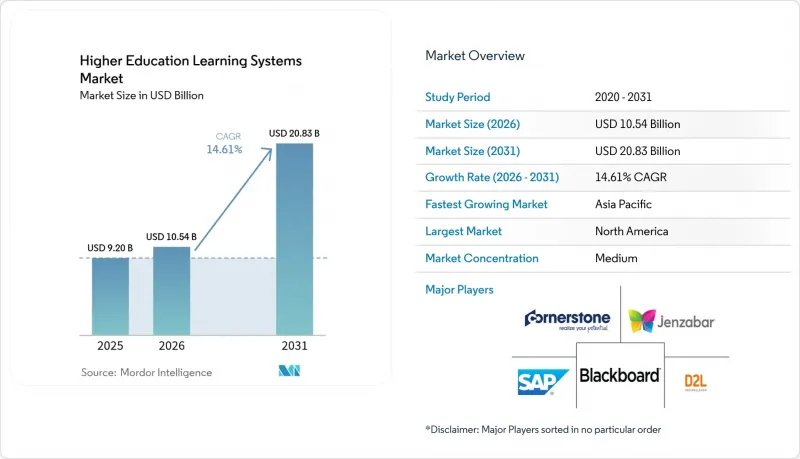
本報告按類型(軟體和服務)、部署模式(雲端和本地部署)、教育機構類型(州立大學、私立大學、社區學院)、學習方式(教師主導、自主學習、混合/融合)以及地區(北美、南美、歐洲、亞太及其他地區)進行細分。市場預測以美元計價。
全球高等教育學習系統市場趨勢及洞察
高等教育機構中「雲端優先」策略的擴展。
大學正逐步淘汰本地資料中心,轉而優先採用彈性SaaS環境,以降低資本支出、提高運作運作時間並縮短功能發布週期。根據Internet2的NET+調查,2024年中期,78%的會員機構將至少將一個主要學術系統遷移到雲端,高於2022年的54%。澳洲NCRIS基金會已投入7.5億澳元(4.88億美元)用於實現雲端遷移里程碑,這正在加速整個產業的雲端採用。雲端平台還能簡化與協作和人工智慧服務的整合,而這些服務在本地環境中難以處理。合規性要求也是推動這一趨勢的因素,ISO/IEC 27001認證已成為供應商獲取高等教育客戶的實際要求。這些因素共同作用,短期內將使高等教育學習系統市場的複合年成長率(CAGR)提高3個百分點以上。
人工智慧驅動的自適應學習工具的普及
人工智慧驅動的個人化學習已超越試點階段,擴展到生產環境,並有助於提高完成率。特拉維夫大學的TAUDT系統透過自然語言產生的學習計劃,在2024年將一年級STEM(科學、技術、工程和數學)專業學生的輟學率降低了12%。同年,培生集團的人工智慧輔導系統進行了120萬次自適應評估,使補習數學的及格率提高了15%。 2025年初,加州大學透過實施全校範圍的預測性警報系統,將人工智慧的應用擴展到28.5萬名學生,以識別有風險的學生。這些成功案例促使平台供應商原生整合機器學習API,在中期內將複合年成長率提高約3個百分點,同時也活性化了關於演算法透明度和符合IEEE標準的倫理規範的討論。
網路安全和資料隱私合規成本正在飆升。
在更嚴格的《家庭教育權利和隱私法案》(FERPA) 和《一般資料保護規範》(GDPR) 審計之後,2024 年教育機構的平均安全支出達到 120 萬美元,比 2022 年增加 23%。歐洲各大學在 2023 年因 GDPR 面臨 12 億歐元的罰款,迫使它們緊急重新分配預算。加州大學在 2024 年發生資料外洩後,投資 1,400 萬美元用於勒索軟體復原和監控。這些成本給創新資金帶來了壓力,預計短期內將使成長率下降兩個百分點以上。
細分市場分析
預計到2031年,包括諮詢、整合、培訓和託管支援業務收益將以15.94%的複合年成長率成長,超過軟體產業(2025年軟體產業佔總支出的68.74%)。各機構越來越將平台採用視為“轉型管理流程”,並利用整合商進行傳統內容遷移、單一登入設定以及建立自訂分析層。Accenture高等教育部門預計2024年將成長19%,這主要得益於符合FERPA和GDPR監管要求的雲端遷移藍圖的需求。隨著服務供應商量化學生留存率的提高和成本節約,高等教育學習系統市場正從中受益,他們將技術定位為推動業績成長的關鍵因素,而不僅僅是採購清單。
持續的託管服務合約減輕了校園內人員有限的IT團隊的負擔,並確保按時應用合規性修補程式。專注於人工智慧驅動的個人化輔導、抄襲檢測或無障礙功能改進的利基公司,正利用高等教育學習系統行業特有的開放API來實現盈利。在整個預測期內,各院校將優先考慮基於實證的投資回報率指標,例如畢業率、學分獲取速度和就業率,從而推動更深入的諮詢合約。因此,預計到2031年,服務業將在高等教育學習系統市場中佔據越來越大的佔有率。
到2025年,雲端運算將佔高等教育學習系統市場的72.36%,預計到2031年將以15.89%的複合年成長率成長,因為SaaS將成為新採購的標準。愛丁堡大學於2025年完成了為期三年的AWS遷移,每年節省成本180萬英鎊(230萬美元),並實現了可擴展性,以應對尖峰負載。 FedRAMP、ISO/IEC 27001及類似認證現已成為最低准入要求,增強了人們對敏感學生資料外部部署儲存的信心。多租戶設計正在加速高等教育學習系統市場的創新週期,因為供應商可以在不造成校園停機的情況下交付功能更新。
在資料存儲法規強制要求小型資料庫,或傳統科研計算叢集仍保留在企業內部的情況下,混合模式仍然被採用。然而,即使是較為謹慎的機構也在將影片轉碼等運算密集型任務卸載到公共雲端,以應對突發工作負載。更短的維護週期、可預測的訂閱價格和自動修補程式正在鞏固雲端採用趨勢,其在高等教育學習系統市場的佔有率也在穩步成長。
區域分析
到2025年,北美將佔全球整體收入的39.72%,這得益於其大規模的州立大學系統、私立大學的捐贈基金以及雄厚的IT預算。儘管由於平台應用較為成熟,該地區的複合年成長率較為溫和,但持續的更新周期和分析升級正在維持其穩定成長。此外,對《家庭教育權利和隱私保護法》(FERPA)的嚴格遵守以及頻繁發生的勒索軟體攻擊,推動了網路安全方面的持續投入,並創造了新的服務機會。
亞太地區預計將在2031年前以16.94%的複合年成長率成長,這主要得益於中國和印度的國家級數位化計畫。中國教育部已累計150億元人民幣(約21億美元)用於200所大學的現代化改造,並計畫在2027年實現80%的雲端運算普及率。印度的「國家教育政策」旨在2035年實現50%的入學率,這需要大幅提升線上教育能力。東南亞各國政府也從這些模式中汲取靈感,利用多租戶架構來滿足多語言使用者和應對頻寬環境的需求。
在歐洲,由於伊拉斯謨式學生交流計畫和提高供應商篩選標準的嚴格GDPR要求,教育科技領域正保持穩定成長。英國學生辦公室(Office for Students)一項9,200萬英鎊的津貼計劃,將資金與基於數據分析的學生留存率提升以及平台升級加速掛鉤。南美洲的發展則不平衡。巴西的公立大學正迅速採用學習管理系統(LMS)平台,而小規模的經濟體仍在努力發展網路連結。在中東,沙烏地阿拉伯耗資13億美元的「2030願景」教育科技計畫主導,優先部署智慧校園以實現經濟多元化。非洲仍在發展中,但隨著遠端教育解決農村地區的教育資源匱乏問題,一些地區的教育科技領域已實現兩位數成長。
其他好處:
- Excel格式的市場預測(ME)表
- 3個月的分析師支持
目錄
第1章:引言
- 研究假設和市場定義
- 調查範圍
第2章:調查方法
第3章執行摘要
第4章 市場狀況
- 市場概覽
- 市場促進因素
- 高等教育機構中「雲端優先」策略的擴展。
- 人工智慧驅動的自適應學習工具的普及
- 政府對數位校園的經濟措施
- 國際學生的快速流動正在推動多租戶架構的發展。
- 全校對學習分析儀錶板的需求日益成長。
- 對永續性的需求正在推動無紙化工作流程。
- 市場限制因素
- 與網路安全和資料隱私相關的合規成本不斷上升。
- 教育科技系統管理技能缺口
- 社區大學預算凍結
- 圍繞專有生態系統的供應商鎖定問題令人擔憂
- 產業價值鏈分析
- 監理情勢
- 技術展望
- 宏觀經濟因素的影響
- 波特五力分析
- 高等教育學習系統的現狀
第5章 市場規模與成長預測
- 按類型
- 軟體
- 服務
- 按部署模式
- 雲
- 現場
- 按機構類型分類
- 州立大學
- 私立學院
- 社區大學
- 不同的學習模式
- 講師主導
- 自主學習
- 混合型/混種型
- 按地區
- 北美洲
- 美國
- 加拿大
- 墨西哥
- 南美洲
- 巴西
- 阿根廷
- 其他南美國家
- 歐洲
- 德國
- 英國
- 法國
- 義大利
- 西班牙
- 俄羅斯
- 其他歐洲國家
- 亞太地區
- 中國
- 日本
- 印度
- 韓國
- 澳洲
- 其他亞太國家
- 中東和非洲
- 中東
- 沙烏地阿拉伯
- 阿拉伯聯合大公國
- 土耳其
- 其他中東國家
- 非洲
- 南非
- 奈及利亞
- 埃及
- 其他非洲國家
- 中東
- 北美洲
第6章 競爭情勢
- 市場集中度
- 策略趨勢
- 市佔率分析
- 公司簡介
- Anthology Inc.
- Blackboard Inc.
- Cornerstone OnDemand Inc.
- Desire2Learn Corporation
- Ellucian Company LP
- Epignosis LLC
- IBM Corporation
- iSpring Solutions Inc.
- Instructure Holdings Inc.
- Jenzabar Inc.
- McGraw Hill LLC
- Moodle Pty Ltd.
- Oracle Corporation
- Pearson PLC
- SAP SE
- SumTotal Systems LLC
- The rSmart Group Inc.
- Unifyed LLC
- Workday Inc.
- Civitas Learning Inc.
第7章 市場機會與未來展望
According to Mordor Intelligence, the higher education learning systems market size was valued at USD 9.20 billion in 2025 and estimated to grow from USD 10.54 billion in 2026 to reach USD 20.83 billion by 2031, at a CAGR of 14.61% during the forecast period (2026-2031).
This report is Segmented by Type (Software, and Services), Deployment Model (Cloud, and On-Premises), Institution Type (State Universities, Private Colleges, and Community Colleges), Learning Mode (Instructor-Led, Self-Paced, and Hybrid/Blended), and Geography (North America, South America, Europe, Asia Pacific, and More). The Market Forecasts are Provided in Terms of Value (USD).
Global Higher Education Learning Systems Market Trends and Insights
Increasing Cloud-First Strategies Among Higher-Ed Institutions
Universities are dismantling on-premises data centers in favor of elastic SaaS environments that compress capital outlays, expand uptime, and shorten feature-release cycles. Internet2's NET+ survey revealed that 78% of member institutions had transitioned at least one core academic system to the cloud by mid-2024, up from 54% in 2022. Australia's NCRIS fund tied AUD 750 million (USD 488 million) to cloud migration milestones, catalyzing accelerated adoption across the sector. Cloud platforms also streamline integrations with collaboration and AI services that on-premises stacks struggle to support. Compliance drivers reinforce momentum as ISO/IEC 27001 certification gains de facto status for vendors courting higher education clients. Collectively, these factors contribute more than three percentage points to the higher education learning systems market CAGR during the short term.
Proliferation of AI-Powered Adaptive Learning Tools
AI-driven personalization has moved beyond pilots, scaling across production environments to raise completion metrics. Tel Aviv University's TAUDT system lowered first-year STEM attrition by 12% in 2024 through natural-language-generated study plans. Pearson's AI tutor delivered 1.2 million adaptive assessments the same year, lifting remedial-math pass rates by 15%. In early 2025, the University of California deployed predictive early-warning systems system-wide to flag at-risk students, broadening AI reach to 285,000 learners. These successes spur platform vendors to embed machine-learning APIs natively, driving nearly three percentage points of incremental CAGR over the medium term while elevating conversations around algorithmic transparency and IEEE-aligned ethics.
Escalating Cybersecurity and Data-Privacy Compliance Costs
The median security spend per institution reached USD 1.2 million in 2024, a 23% increase from 2022, as FERPA and GDPR audits intensified. European universities faced EUR 1.2 billion in GDPR fines during 2023, driving emergency budget reallocations. The University of California invested USD 14 million in ransomware remediation and monitoring following the 2024 breach. These costs siphon funds from innovation and subtract more than two percentage points from growth during the near term.
Other drivers and restraints analyzed in the detailed report include:
- Government Digital-Campus Stimulus Packages
- Campus-Wide Demand for Learning Analytics Dashboards
- Skills Gap in EdTech Systems Administration
For complete list of drivers and restraints, kindly check the Table Of Contents.
Segment Analysis
Services revenue, including consulting, integration, training, and managed support, is projected to rise at a 15.94% CAGR through 2031, outstripping software, even though the latter captured 68.74% of 2025 spending. Institutions increasingly view platform rollouts as change-management journeys, engaging integrators to migrate legacy content, configure single sign-on, and build custom analytics layers. Accenture's higher-education practice grew 19% in 2024, driven by demand for cloud-migration roadmaps that align with FERPA and GDPR guardrails. The higher education learning systems market benefits as service providers quantify retention lifts and cost savings, repositioning technology as an outcome driver rather than a procurement checklist.
Ongoing managed-service contracts reduce strain on lean campus IT teams and ensure regulatory patches are applied on schedule. Niche firms specializing in AI-powered tutoring, plagiarism detection, or accessibility remediation monetize open APIs that characterize the higher education learning systems industry. Over the forecast period, institutions will emphasize evidence-based ROI metrics, such as graduation rates, credit completion velocity, and employability, encouraging deeper advisory engagements. As a result, services are set to command a growing slice of the higher education learning systems market by 2031.
Cloud deployments owned 72.36% of the higher education learning systems market in 2025 and are poised for a 15.89% CAGR through 2031 as SaaS becomes the default for new procurements. The University of Edinburgh completed a three-year migration to AWS in 2025, saving GBP 1.8 million (USD 2.3 million) annually while easing peak-load scaling. FedRAMP, ISO/IEC 27001, and similar attestations are now the minimum entry requirements, boosting confidence in the off-premises storage of sensitive student data. Multi-tenant designs allow vendors to push feature updates without campus downtime, shortening innovation cycles across the higher education learning systems market.
Hybrid models persist where data-residency statutes require local storage or where legacy research compute clusters remain on-site. Nonetheless, even cautious institutions offload compute-intensive tasks, such as video transcoding, to public clouds to manage burst workloads. Reduced maintenance windows, predictable subscription pricing, and automated patching cement cloud's trajectory, ensuring its share of the higher education learning systems market size widens steadily.
Complete Report Scope:
- By Type
- Software
- Services
- By Deployment Model
- Cloud
- On-Premises
- By Institution Type
- State Universities
- Private Colleges
- Community Colleges
- By Learning Mode
- Instructor-Led
- Self-Paced
- Hybrid/Blended
- By Geography
- North America
- United States
- Canada
- Mexico
- South America
- Brazil
- Argentina
- Rest of South America
- Europe
- Germany
- United Kingdom
- France
- Italy
- Spain
- Russia
- Rest of Europe
- Asia Pacific
- China
- Japan
- India
- South Korea
- Australia
- Rest of Asia Pacific
- Middle East and Africa
- Middle East
- Saudi Arabia
- United Arab Emirates
- Turkey
- Rest of Middle East
- Africa
- South Africa
- Nigeria
- Egypt
- Rest of Africa
- Middle East
- North America
Geography Analysis
North America generated 39.72% of global revenue in 2025, fueled by large state systems, private endowment spending, and robust IT budgets. Mature platform penetration moderates regional CAGR, yet ongoing refresh cycles and analytics upgrades sustain steady expansion. Stringent FERPA compliance obligations and frequent ransomware incidents also drive sustained cybersecurity spending, adding incremental service opportunities.
The Asia Pacific is forecast to lead growth at a 16.94% CAGR through 2031, as China and India deploy national digitization blueprints. China's Ministry of Education has earmarked CNY 15 billion (USD 2.1 billion) to modernize 200 universities, aiming for 80% cloud adoption by 2027. India's National Education Policy aims for a 50% gross enrollment rate by 2035, necessitating a massive expansion of online capacity. Southeast Asian governments emulate these models, leveraging multi-tenant architectures to support multilingual users and variable bandwidth conditions.
Europe maintains steady growth underpinned by Erasmus-style student mobility and strict GDPR mandates that elevate vendor vetting. The U.K. Office for Students' GBP 92 million grant program links funding to analytics-driven retention improvements, stimulating platform upgrades. South America shows uneven progress; Brazil's public universities adopt LMS platforms quickly, whereas smaller economies struggle with connectivity. The Middle East, led by Saudi Arabia's USD 1.3 billion Vision 2030 EdTech plan, prioritizes smart campus rollouts to diversify its economies. Africa remains nascent, yet it records pockets of double-digit growth as distance learning addresses rural access.
- Anthology Inc.
- Blackboard Inc.
- Cornerstone OnDemand Inc.
- Desire2Learn Corporation
- Ellucian Company L.P.
- Epignosis LLC
- IBM Corporation
- iSpring Solutions Inc.
- Instructure Holdings Inc.
- Jenzabar Inc.
- McGraw Hill LLC
- Moodle Pty Ltd.
- Oracle Corporation
- Pearson PLC
- SAP SE
- SumTotal Systems LLC
- The rSmart Group Inc.
- Unifyed LLC
- Workday Inc.
- Civitas Learning Inc.
Additional Benefits:
- The market estimate (ME) sheet in Excel format
- 3 months of analyst support
TABLE OF CONTENTS
1 INTRODUCTION
- 1.1 Study Assumptions and Market Definition
- 1.2 Scope of the Study
2 RESEARCH METHODOLOGY
3 EXECUTIVE SUMMARY
4 MARKET LANDSCAPE
- 4.1 Market Overview
- 4.2 Market Drivers
- 4.2.1 Increasing Cloud-First Strategies Among Higher-Ed Institutions
- 4.2.2 Proliferation of AI-Powered Adaptive Learning Tools
- 4.2.3 Government Digital-Campus Stimulus Packages
- 4.2.4 Rapid International Student Mobility Driving Multi-Tenant Architectures
- 4.2.5 Campus-Wide Demand for Learning Analytics Dashboards
- 4.2.6 Sustainability Mandates Pushing Paperless Workflows
- 4.3 Market Restraints
- 4.3.1 Escalating Cybersecurity and Data-Privacy Compliance Costs
- 4.3.2 Skills Gap in EdTech Systems Administration
- 4.3.3 Budget Freezes at Community Colleges
- 4.3.4 Vendor Lock-In Concerns Over Proprietary Ecosystems
- 4.4 Industry Value Chain Analysis
- 4.5 Regulatory Landscape
- 4.6 Technological Outlook
- 4.7 Impact of Macroeconomic Factors
- 4.8 Porter's Five Forces Analysis
- 4.8.1 Bargaining Power of Suppliers
- 4.8.2 Bargaining Power of Buyers
- 4.8.3 Threat of New Entrants
- 4.8.4 Threat of Substitute Products
- 4.8.5 Intensity of Competitive Rivalry
- 4.9 Higher Education Learning Systems Landscape
5 MARKET SIZE AND GROWTH FORECASTS
- 5.1 By Type
- 5.1.1 Software
- 5.1.2 Services
- 5.2 By Deployment Model
- 5.2.1 Cloud
- 5.2.2 On-Premises
- 5.3 By Institution Type
- 5.3.1 State Universities
- 5.3.2 Private Colleges
- 5.3.3 Community Colleges
- 5.4 By Learning Mode
- 5.4.1 Instructor-Led
- 5.4.2 Self-Paced
- 5.4.3 Hybrid/Blended
- 5.5 By Geography
- 5.5.1 North America
- 5.5.1.1 United States
- 5.5.1.2 Canada
- 5.5.1.3 Mexico
- 5.5.2 South America
- 5.5.2.1 Brazil
- 5.5.2.2 Argentina
- 5.5.2.3 Rest of South America
- 5.5.3 Europe
- 5.5.3.1 Germany
- 5.5.3.2 United Kingdom
- 5.5.3.3 France
- 5.5.3.4 Italy
- 5.5.3.5 Spain
- 5.5.3.6 Russia
- 5.5.3.7 Rest of Europe
- 5.5.4 Asia Pacific
- 5.5.4.1 China
- 5.5.4.2 Japan
- 5.5.4.3 India
- 5.5.4.4 South Korea
- 5.5.4.5 Australia
- 5.5.4.6 Rest of Asia Pacific
- 5.5.5 Middle East and Africa
- 5.5.5.1 Middle East
- 5.5.5.1.1 Saudi Arabia
- 5.5.5.1.2 United Arab Emirates
- 5.5.5.1.3 Turkey
- 5.5.5.1.4 Rest of Middle East
- 5.5.5.2 Africa
- 5.5.5.2.1 South Africa
- 5.5.5.2.2 Nigeria
- 5.5.5.2.3 Egypt
- 5.5.5.2.4 Rest of Africa
- 5.5.5.1 Middle East
- 5.5.1 North America
6 COMPETITIVE LANDSCAPE
- 6.1 Market Concentration
- 6.2 Strategic Moves
- 6.3 Market Share Analysis
- 6.4 Company Profiles (includes Global level Overview, Market level overview, Core Segments, Financials as available, Strategic Information, Market Rank/Share for key companies, Products and Services, and Recent Developments)
- 6.4.1 Anthology Inc.
- 6.4.2 Blackboard Inc.
- 6.4.3 Cornerstone OnDemand Inc.
- 6.4.4 Desire2Learn Corporation
- 6.4.5 Ellucian Company L.P.
- 6.4.6 Epignosis LLC
- 6.4.7 IBM Corporation
- 6.4.8 iSpring Solutions Inc.
- 6.4.9 Instructure Holdings Inc.
- 6.4.10 Jenzabar Inc.
- 6.4.11 McGraw Hill LLC
- 6.4.12 Moodle Pty Ltd.
- 6.4.13 Oracle Corporation
- 6.4.14 Pearson PLC
- 6.4.15 SAP SE
- 6.4.16 SumTotal Systems LLC
- 6.4.17 The rSmart Group Inc.
- 6.4.18 Unifyed LLC
- 6.4.19 Workday Inc.
- 6.4.20 Civitas Learning Inc.
7 MARKET OPPORTUNITIES AND FUTURE OUTLOOK
- 7.1 White-Space and Unmet-Need Assessment

 數位與智慧教育生態系統市場:全球市場預測,2026-2032年
 2026年全球智慧教育與學習市場報告智慧教育與學習管理市場:依組件、內容類型、設備類型、最終用戶與部署模式分類-2026-2032年全球市場預測2026年全球智慧教育市場報告
 智慧教育市場預測至2034年—按組成部分、學習風格、技術、應用、最終用戶和地區分類的全球分析2026年全球虛擬解剖實驗室市場報告
 高等教育領域個人電腦市場規模估算
 2026-2030年全球STEM教育虛擬實驗室市場
 2026-2030年全球智慧教育市場
 智慧教學市場規模、佔有率及成長分析(按軟體、硬體、服務、應用、部署和地區分類)-產業預測(2026-2033)