


 |
市場調查報告書
商品編碼
2116020
黑啟動發電機:市佔率分析、產業趨勢與統計及成長預測(2026-2031 年)Black Start Generator - Market Share Analysis, Industry Trends & Statistics, Growth Forecasts (2026 - 2031) |
||||||

※ 本網頁內容可能與最新版本有所差異。詳細情況請與我們聯繫。
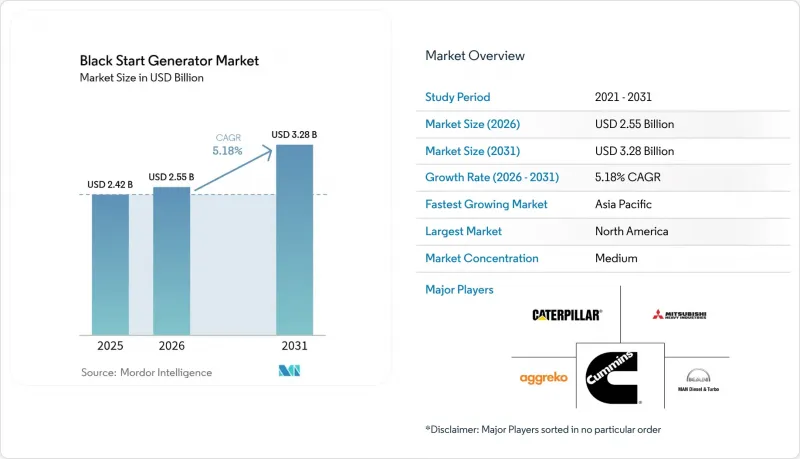
據 Mordor Intelligence 稱,黑啟動發電機的市場規模預計在 2026 年達到 25.5 億美元,高於 2025 年的 24.2 億美元,預計到 2031 年將達到 32.8 億美元。
預計 2026 年至 2031 年的複合年成長率為 5.18%。
本報告按燃料類型(柴油、天然氣、混合動力(電池柴油)、其他)、額定功率(1 MW 以下、1-5 MW、5 MW 以上)、啟動技術(柴油引擎、燃氣渦輪機渦輪機、電池/儲能輔助、壓縮空氣/氣動)、最終用戶(電力公司和輸配電運營商;運營商、資料中心和 ICT 樞紐、其他地區。
全球黑啟動發電機市場趨勢與洞察
關於系統故障頻率和斷電容許度的規定
2024年,美國因計畫外停電累計造成15億小時的客戶損失後,聯邦法規訂定,要求輸電業者在三小時內恢復供電,並在無需外部援助的情況下至少維持16小時的運作。因此,電力公司正在投資雙燃料和混合動力系統,以確保即使在長時間停電期間也能確保燃料供應,這一趨勢在歐洲也同樣存在。在歐洲,近期天然氣價格飆升促使輸電系統營運商(TSO)設立新的恢復區。已獲得快速啟動檢驗和延長運作認證的供應商正在贏得多年框架合約。保險公司現在要求大規模工業設施在承保業務中斷保險之前提供黑啟動能力證明,這加速了私營部門的採購。因此,黑啟動發電機市場正穩步取代傳統設備,取而代之的是符合Tier 4排放標準或混合動力機組。
可再生能源併網規範合規性
美國聯邦能源監管委員會(FERC)第901號指令規定,到2030年,基於逆變器的電源將採用基於性能的穿越和監控標準,並將恢復程序轉向電網形成控制。北海的示範計畫表明,離岸風力發電可以透過使用先進的轉換器,在重新啟動過程中提供獨立的電壓和頻率支援。歐洲的BLADE等項目旨在2027年將這些研究成果商業化,從而有望減少沿海停電期間柴油發電機的運作。然而,由於間歇性問題,仍需要結合儲能和同步慣性的混合配置來穩定頻率波動。發電機製造商目前正在使用數位協調器,在恢復過程中調節柴油發電機、電池和可再生能源之間的輸出,從而提高重啟可靠性和排放性能。
加強柴油排放氣體法規
加州空氣資源委員會 (CARB) 正在製定第五階段非道路排放標準,計劃於 2029 年至 2034 年間分階段實施,該標準將要求進一步降低備用引擎的氮氧化物 (NOx) 和顆粒物排放。美國環保署 (EPA) 的第四階段最終框架已要求顆粒物排放量比第一階段減少 94%,這增加了後處理系統的複雜性和成本。雖然專用緊急車輛仍享有有限的豁免,但許多電力公司仍在超過 50 小時的維護限制運作,導致因不符合標準而受到處罰。歐盟類似的第五階段法規要求所有後處理發電機都必須配備柴油顆粒過濾器,這增加了資本投資,並推動了都市區部署中向燃氣或混合動力系統的轉變。因此,專案發起人越來越傾向於在城市設施中使用電池輔助啟動系統和燃氣微型渦輪機。
細分市場分析
到2025年,柴油發電機組將佔據黑啟動發電機組市場61.20%的佔有率。這主要歸因於電力公司對能源密度的重視以及在緊急儲備方面建立的成熟價值鏈。然而,在都市區低排放區政策的推動下,混合動力(電池-柴油)技術預計將以8.95%的複合年成長率成長。這種轉型將透過引入高階混合動力撬裝設備,同時保留柴油發電機組作為核心,以滿足延長運作時間的需求,從而維持黑啟動發電機組市場的整體健康發展。
天然氣佔第二大市場佔有率,其優勢在於可透過管道輸送至大規模發電廠,但也容易受到寒流期間供應中斷的影響。氫化植物油和生物柴油等替代燃料正在歐洲獲得試點計畫的資金支持,但其供應仍有限。燃料組合凸顯了營運商對冗餘系統的重視。許多新型機組都配備了雙燃料噴射器,可在幾秒鐘內完成天然氣和柴油之間的切換,並與電池模組無縫同步。
至2025年,1兆瓦以下的機組將佔黑啟動發電機市場規模的52.80%。這主要是由於商業建築、醫院和分散式可再生能源項目需要在地化的重新啟動設施。 1-5兆瓦功率範圍的需求成長最快,複合年成長率達8.12%,這主要得益於資料中心叢集和工業園區將多個饋線整合到園區微電網中。
客戶更傾向於選擇在面積、成本和階梯負載性能之間取得平衡的中功率發電機。超過 5 兆瓦的發電機目前仍主要應用於石化聯合裝置和大規模變電站等特殊領域。雖然產量較小,但客製化工程確保了較高的利潤率。模組化封裝的普及使得系統整合商能夠透過並聯小型機組來建造 10 兆瓦級發電機,與單體式引擎相比,安裝更加簡單。
區域分析
預計到2025年,北美將引領黑啟動發電機市場,佔37.70%的市場。這主要得益於美國在冬季風暴「烏裡」之後加大的電網韌性投資,以及聯邦政府為電網加強計畫提供的激勵資金。光是德克薩斯州的電力公司就利用了18億美元的津貼,為零售連鎖店和關鍵服務機構資金籌措微電網和快速啟動引擎。在加拿大,各省正在為以水力發電為主的電網實施重新啟動計畫;而在墨西哥,製造業走廊正在擴大發電能力,以確保出口供應鏈的安全。
歐洲排名第二。這主要歸功於「第五階段」排放氣體法規,該法規將加速混合動力汽車的普及,以及離岸風力發電試點計畫對渦輪機黑啟動場景的檢驗。德國擁有174座指定重新啟動電廠,但其中只有26座簽訂了商業性契約,這表明市場仍有透過競標進行重組的空間。在北歐地區,同步電容器與水力發電結合的推廣正在穩步推進,而中歐和東歐成員國則利用歐盟資金對柴油發電廠維修,加裝選擇性催化還原(SCR)裝置。
亞太地區是成長最快的地區,年複合成長率達8.55%,這主要得益於中國830億美元的電網維修計畫以及印度為提高重新啟動覆蓋率而擴大抽水蓄能電站規模。日本正在對老舊的火力發電廠維修,採用雙燃料引擎;韓國則在投資興建配備輔助發電機的液化天然氣發電廠。東協新興經濟體正在工業園區部署1兆瓦貨櫃式電站,以支援快速電氣化並防止季風停電造成的生產力損失。
其他好處:
- Excel格式的市場預測(ME)表
- 3個月的分析師支持
目錄
第1章:引言
- 研究假設和市場定義
- 調查範圍
第2章:調查方法
第3章執行摘要
第4章 市場狀況
- 市場概覽
- 市場促進因素
- 關於系統故障頻率和斷電容忍度的監管要求。
- 遵守可再生能源併網規範
- 老舊基礎設施現代化改造計劃
- 擴展關鍵任務資料中心位置
- 離岸風電高壓直流輸電平台需要船用級單元
- 混合動力(電瓶-柴油)系統符合都市區的零啟動法規
- 市場限制因素
- 加強柴油車排放氣體法規
- 一種使用逆變器系統的新型黑啟動替代方案
- 稀土元素發電材料供應瓶頸
- 與遠端啟動相關的網路安全合規成本
- 供應鏈分析
- 監理情勢
- 技術展望
- 波特五力模型
第5章 市場規模與成長預測
- 按燃料類型
- 柴油引擎
- 天然氣
- 油電混合電池柴油
- 其他(生質柴油、氫化植物油等)
- 額定功率
- 1兆瓦或以下
- 1~5 MW
- 5兆瓦或以上
- 啟動技術
- 啟動柴油引擎
- 燃氣渦輪機啟動
- 電瓶儲能輔助啟動
- 壓縮空氣/氣動啟動
- 按最終用戶行業分類
- 電力公司及輸配電業者
- 石油和天然氣的上游和中游領域
- 製造業及加工工業
- 資料中心和資訊通訊技術中心
- 商業和公共機構及其他
- 按地區
- 北美洲
- 美國
- 加拿大
- 墨西哥
- 歐洲
- 德國
- 英國
- 法國
- 義大利
- 北歐國家
- 俄羅斯
- 其他歐洲國家
- 亞太地區
- 中國
- 印度
- 日本
- 韓國
- 東南亞國協
- 其他亞太國家
- 南美洲
- 巴西
- 阿根廷
- 其他南美國家
- 中東和非洲
- 沙烏地阿拉伯
- 阿拉伯聯合大公國
- 南非
- 埃及
- 其他中東和非洲國家
- 北美洲
第6章 競爭情勢
- 市場集中度
- 策略趨勢(併購、聯盟、購電協議)
- 市場佔有率分析(主要公司的市場排名和佔有率)
- 公司簡介
- Caterpillar Inc.
- Cummins Inc.
- Aggreko plc
- Rolls-Royce Power Systems(mtu)
- Mitsubishi Heavy Industries Ltd.
- Generac Holdings Inc.
- Wartsila Corp.
- Kohler Co.
- Doosan Power Systems
- Siemens Energy AG
- Atlas Copco AB
- Hyundai Heavy Industries Power Systems
- FG Wilson(Caterpillar)
- Perkins Engines Company Ltd.
- Yanmar Holdings Co. Ltd.
- Himoinsa SL
- JCB Power Products(Broadcrown)
- MAN Energy Solutions SE
- GE Vernova
- Kirloskar Oil Engines Ltd.
第7章 市場機會與未來展望
According to Mordor Intelligence, black start generator market size in 2026 is estimated at USD 2.55 billion, growing from 2025 value of USD 2.42 billion with 2031 projections showing USD 3.28 billion, growing at 5.18% CAGR over 2026-2031.
This report is Segmented by Fuel Type (Diesel, Natural Gas, Hybrid Battery-Diesel, and Others), Power Rating (Up To 1 MW, 1 To 5 MW, and Above 5 MW), Starter Technology (Diesel Engine, Gas Turbine, Battery-Energy-Storage-Assisted, and Compressed-air/Pneumatic), End-User (Power Utilities and T&D Operators, Data Centres and ICT Hubs, and More), and Geography (North America, Europe, Asia-Pacific, and More).
Global Black Start Generator Market Trends and Insights
Grid-Disturbance Frequency & Blackout Resilience Mandates
Unplanned outages totalled 1.5 billion customer-hours in the United States during 2024, prompting federal rules that oblige transmission operators to restore service within three hours and sustain operation for at least 16 hours without external support.Utilities are therefore investing in dual-fuel and hybrid systems that guarantee fuel availability during prolonged events, a trend mirrored across Europe, where TSOs built new restoration zones after recent gas-price shocks. Suppliers that demonstrate rapid-start verification and extended run-time certification are winning multi-year framework contracts. Insurance carriers now require proof of black start capability at large industrial sites before underwriting business-interruption policies, accelerating private-sector procurement. As a result, the black start generator market is witnessing a steady replacement of legacy fleets with Tier 4-compliant or hybrid units.
Grid-Code Compliance for Renewable Integration
FERC Order 901 establishes performance-based ride-through and monitoring standards for inverter-based resources by 2030, shifting restoration procedures toward grid-forming controls. Demonstrations in the North Sea proved that offshore wind farms can deliver independent voltage and frequency support during restart sequences using advanced converters. European projects such as Carbon Trust's BLADE aim to commercialize these findings by 2027, potentially reducing diesel run-time during coastal blackouts. However, intermittency still necessitates hybrid arrangements that combine storage with synchronous inertia to stabilize frequency fluctuations. Generator OEMs now bundle digital coordinators that manage dispatch between diesel sets, batteries, and renewable feeders during restoration, improving restart certainty and emission performance.
Stricter Diesel-Emission Legislation
California's Air Resources Board is preparing Tier 5 off-road standards that phase in between 2029 and 2034, requiring further reductions in NOx and particulate matter from standby engines. The EPA Tier 4 Final framework already requires a 94% reduction in particulates compared to Tier 1, adding after-treatment complexity and cost. While emergency-only units still qualify for limited exemptions, many utilities operate beyond the 50-hour maintenance ceiling, triggering non-attainment penalties. Similar Stage V rules in the European Union require diesel particulate filters across mobile generator fleets, which raises capital expenditures and prompts a shift toward gas or hybrid systems in urban deployments. Consequently, project sponsors increasingly favor battery-assisted starts or gas microturbines for downtown installations.
Other drivers and restraints analyzed in the detailed report include:
- Expansion of Mission-Critical Data-Centre Footprint
- Aging Infrastructure Modernization Programs
- Emerging Inverter-Based Black-Start Alternatives
For complete list of drivers and restraints, kindly check the Table Of Contents.
Segment Analysis
The diesel category accounted for 61.20% of the black start generator market share in 2025, as utilities value energy density and established supply chains for emergency stockpiling. Hybrid battery-diesel technology, however, is forecast to grow at 8.95% CAGR, supported by urban low-emission zones that reward reduced idling. This transition maintains the overall health of the black start generator market by introducing premium hybrid skids while retaining diesel anchors for long-duration coverage.
Natural gas occupies the second slot, benefiting from pipeline access at large plants yet exposed to supply cuts during cold snaps. Alternatives, such as hydrotreated vegetable oil and biodiesel, receive pilot funding in Europe, but their volumes remain small. The fuel-type split underscores operators' preference for redundancy; many new packages are engineered with dual-fuel injectors that switch between gas and diesel within seconds and synchronize seamlessly with battery modules.
Units up to 1 MW contributed 52.80% of the black start generator market size in 2025 because commercial buildings, hospitals, and distributed renewables require localized restart assets. Demand in the 1-5 MW range is rising fastest, at an 8.12% CAGR, as data-center clusters and industrial parks consolidate multiple feeders into campus-wide microgrids.
Customers prefer mid-range sets that strike a balance between footprint, cost, and step-load performance. Above 5 MW machines remain specialized for petrochemical complexes and large utility substations; although fewer in number, they command high margins because of bespoke engineering. The shift toward modular packages enables integrators to parallel smaller units to reach a 10 MW class without the installation complexity of a single-frame engine.
Complete Report Scope:
- By Fuel Type
- Diesel
- Natural Gas
- Hybrid Battery-Diesel
- Others (Bio-diesel, HVO, etc.)
- By Power Rating
- Up to 1 MW
- 1 to 5 MW
- Above 5 MW
- By Starter Technology
- Diesel Engine Start
- Gas Turbine Start
- Battery-Energy-Storage-Assisted Start
- Compressed-air/Pneumatic Start
- By End-User Industry
- Power Utilities and T&D Operators
- Oil and Gas Upstream and Midstream
- Manufacturing and Process Industries
- Data Centres and ICT Hubs
- Commercial/Institutional and Others
- By Geography
- North America
- United States
- Canada
- Mexico
- Europe
- Germany
- United Kingdom
- France
- Italy
- NORDIC Countries
- Russia
- Rest of Europe
- Asia-Pacific
- China
- India
- Japan
- South Korea
- ASEAN Countries
- Rest of Asia-Pacific
- South America
- Brazil
- Argentina
- Rest of South America
- Middle East and Africa
- Saudi Arabia
- United Arab Emirates
- South Africa
- Egypt
- Rest of Middle East and Africa
- North America
Geography Analysis
North America led the black start generator market with 37.70% share in 2025, buoyed by the United States' resilience investments after Winter Storm Uri and federal funding that rewards grid-hardening projects. Utilities in Texas alone tapped USD 1.8 billion in grants to finance microgrids and fast-start engines for retail chains and critical services. Canada enforces provincial restart plans for hydro-dominated grids, while Mexico's manufacturing corridor adds capacity to secure export supply chains.
Europe ranked second, shaped by Stage V emission rules that accelerate hybrid adoption and by offshore wind pilots that test turbine-based black start scenarios. Germany maintains 174 designated restart plants, yet contracts only 26 of them commercially, indicating scope for market reshaping through auctions. The Nordic region is advancing synchronous condensers linked to hydropower, whereas Central and Eastern member states leverage EU funds to retrofit diesel fleets with SCR kits.
The Asia-Pacific is the fastest-growing hub, with an 8.55% CAGR, spearheaded by China's USD 83 billion grid-upgrade plan and India's pumped-storage ramp-up, which enhances restart coverage. Japan upgrades aging thermal plants with dual-fuel engines, and South Korea invests in LNG-to-power terminals equipped with auxiliary generators. Emerging ASEAN economies are deploying containerized 1 MW sets at industrial parks to support rapid electrification and prevent productivity losses during monsoon-induced power outages.
- Caterpillar Inc.
- Cummins Inc.
- Aggreko plc
- Rolls-Royce Power Systems (mtu)
- Mitsubishi Heavy Industries Ltd.
- Generac Holdings Inc.
- Wartsila Corp.
- Kohler Co.
- Doosan Power Systems
- Siemens Energy AG
- Atlas Copco AB
- Hyundai Heavy Industries Power Systems
- FG Wilson (Caterpillar)
- Perkins Engines Company Ltd.
- Yanmar Holdings Co. Ltd.
- Himoinsa S.L.
- JCB Power Products (Broadcrown)
- MAN Energy Solutions SE
- GE Vernova
- Kirloskar Oil Engines Ltd.
Additional Benefits:
- The market estimate (ME) sheet in Excel format
- 3 months of analyst support
TABLE OF CONTENTS
1 Introduction
- 1.1 Study Assumptions & Market Definition
- 1.2 Scope of the Study
2 Research Methodology
3 Executive Summary
4 Market Landscape
- 4.1 Market Overview
- 4.2 Market Drivers
- 4.2.1 Grid-disturbance frequency & blackout resilience mandates
- 4.2.2 Grid-code compliance for renewable integration
- 4.2.3 Aging infrastructure modernization programs
- 4.2.4 Expansion of mission-critical data-centre footprint
- 4.2.5 Offshore-wind HVDC platforms needing marine-class units
- 4.2.6 Hybrid battery-diesel systems to meet urban zero-start rules
- 4.3 Market Restraints
- 4.3.1 Stricter diesel-emission legislation
- 4.3.2 Emerging inverter-based black-start alternatives
- 4.3.3 Rare-earth alternator material bottlenecks
- 4.3.4 Cyber-security compliance costs for remote start
- 4.4 Supply-Chain Analysis
- 4.5 Regulatory Landscape
- 4.6 Technological Outlook
- 4.7 Porter's Five Forces
- 4.7.1 Bargaining Power of Suppliers
- 4.7.2 Bargaining Power of Buyers
- 4.7.3 Threat of New Entrants
- 4.7.4 Threat of Substitutes
- 4.7.5 Intensity of Competitive Rivalry
5 Market Size & Growth Forecasts
- 5.1 By Fuel Type
- 5.1.1 Diesel
- 5.1.2 Natural Gas
- 5.1.3 Hybrid Battery-Diesel
- 5.1.4 Others (Bio-diesel, HVO, etc.)
- 5.2 By Power Rating
- 5.2.1 Up to 1 MW
- 5.2.2 1 to 5 MW
- 5.2.3 Above 5 MW
- 5.3 By Starter Technology
- 5.3.1 Diesel Engine Start
- 5.3.2 Gas Turbine Start
- 5.3.3 Battery-Energy-Storage-Assisted Start
- 5.3.4 Compressed-air/Pneumatic Start
- 5.4 By End-User Industry
- 5.4.1 Power Utilities and T&D Operators
- 5.4.2 Oil and Gas Upstream and Midstream
- 5.4.3 Manufacturing and Process Industries
- 5.4.4 Data Centres and ICT Hubs
- 5.4.5 Commercial/Institutional and Others
- 5.5 By Geography
- 5.5.1 North America
- 5.5.1.1 United States
- 5.5.1.2 Canada
- 5.5.1.3 Mexico
- 5.5.2 Europe
- 5.5.2.1 Germany
- 5.5.2.2 United Kingdom
- 5.5.2.3 France
- 5.5.2.4 Italy
- 5.5.2.5 NORDIC Countries
- 5.5.2.6 Russia
- 5.5.2.7 Rest of Europe
- 5.5.3 Asia-Pacific
- 5.5.3.1 China
- 5.5.3.2 India
- 5.5.3.3 Japan
- 5.5.3.4 South Korea
- 5.5.3.5 ASEAN Countries
- 5.5.3.6 Rest of Asia-Pacific
- 5.5.4 South America
- 5.5.4.1 Brazil
- 5.5.4.2 Argentina
- 5.5.4.3 Rest of South America
- 5.5.5 Middle East and Africa
- 5.5.5.1 Saudi Arabia
- 5.5.5.2 United Arab Emirates
- 5.5.5.3 South Africa
- 5.5.5.4 Egypt
- 5.5.5.5 Rest of Middle East and Africa
- 5.5.1 North America
6 Competitive Landscape
- 6.1 Market Concentration
- 6.2 Strategic Moves (M&A, Partnerships, PPAs)
- 6.3 Market Share Analysis (Market Rank/Share for key companies)
- 6.4 Company Profiles (includes Global level Overview, Market level overview, Core Segments, Financials as available, Strategic Information, Products & Services, and Recent Developments)
- 6.4.1 Caterpillar Inc.
- 6.4.2 Cummins Inc.
- 6.4.3 Aggreko plc
- 6.4.4 Rolls-Royce Power Systems (mtu)
- 6.4.5 Mitsubishi Heavy Industries Ltd.
- 6.4.6 Generac Holdings Inc.
- 6.4.7 Wartsila Corp.
- 6.4.8 Kohler Co.
- 6.4.9 Doosan Power Systems
- 6.4.10 Siemens Energy AG
- 6.4.11 Atlas Copco AB
- 6.4.12 Hyundai Heavy Industries Power Systems
- 6.4.13 FG Wilson (Caterpillar)
- 6.4.14 Perkins Engines Company Ltd.
- 6.4.15 Yanmar Holdings Co. Ltd.
- 6.4.16 Himoinsa S.L.
- 6.4.17 JCB Power Products (Broadcrown)
- 6.4.18 MAN Energy Solutions SE
- 6.4.19 GE Vernova
- 6.4.20 Kirloskar Oil Engines Ltd.
7 Market Opportunities & Future Outlook
- 7.1 White-space & Unmet-need Assessment

 雙燃料發電機市場-2026-2032年全球市場預測
 全球發電機市場:依設計、銷售管道、燃料類型、功率等級、應用、最終用戶和地區分類-預測至2031年發電機市場:2026-2032年全球市場預測(依發電機類型、技術、輸出功率、便攜性、相數、冷卻系統、銷售管道和最終用戶分類)
 2026年全球微電網黑啟動市場報告
 黑啟動發電機市場規模、佔有率和成長分析:按燃料類型、額定功率、應用、最終用戶和地區分類-2026-2033年產業預測
 發電機控制面板市場 - 全球產業規模、佔有率、趨勢、機會和預測:按功率類型、額定輸出、燃料、配件、地區和競爭格局分類,2021-2031年
 商用備用發電機組市場規模、佔有率和成長分析:按輸出功率、燃料類型、冷卻系統、相數、便攜性、應用、最終用戶和地區分類-2026-2033年產業預測
 發電機市場預測至2034年—按類型、額定功率、燃料類型、安裝配置、應用、最終用戶和地區分類的全球分析
 工業發電機市場規模、佔有率和成長分析:按產品類型、額定功率、應用、便攜性、最終用戶產業和地區分類-2026-2033年產業預測
 射頻發生器市場:按射頻發生器類型、頻寬、最終用戶和地區分類