


 |
市場調查報告書
商品編碼
2116015
再生紙:市場佔有率分析、產業趨勢與統計、成長預測(2026-2031)Recovered Paper - Market Share Analysis, Industry Trends & Statistics, Growth Forecasts (2026 - 2031) |
||||||

※ 本網頁內容可能與最新版本有所差異。詳細情況請與我們聯繫。
2025年再生紙市值為598.1億美元,預計到2031年將達到705.6億美元,而2026年為614.8億美元,預測期(2026-2031年)複合年成長率為2.79%。
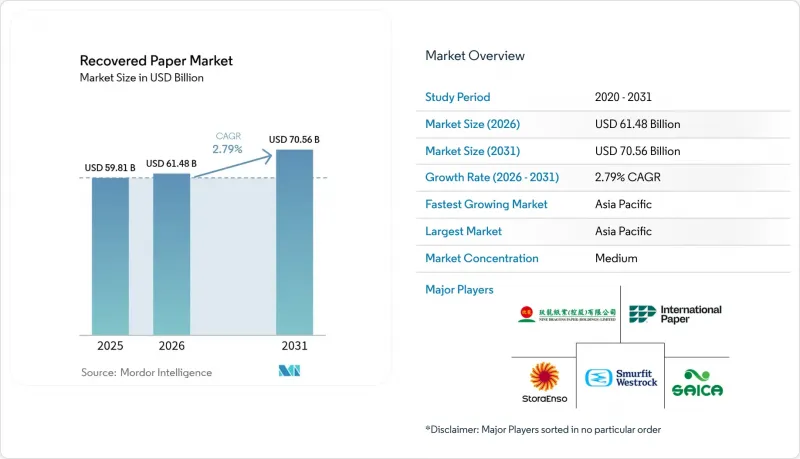
本報告按紙張類型(廢舊瓦楞紙箱、混合紙等)、最終用途行業(包裝和瓦楞紙箱、紙巾和衛生用品等)、收集來源(住宅、商業和工業等)、處理技術(無墨回收、非無墨回收等)以及地區進行細分。市場預測以美元計價。
全球再生紙市場趨勢及洞察
電子商務的快速發展正在推動對貨櫃板材的需求。
2024年,全球線上零售業處理的小包裹數量達到153億件,較去年同期成長12%。每筆訂單至少需要一個瓦楞紙箱,這些紙箱最終都會進入回收流程。小包裹密度的增加提高了回收效率,並增強了再生紙市場原料供應的穩定性。目前,物流中心正在配備逆向物流碼頭,用於現場包裝瓦楞紙箱,從而減少污染並縮短卡車運輸距離。即時銷售分析使紙板加工商能夠根據訂單波動調整生產批量,最大限度地減少邊角料廢棄物,並穩定紡織品需求,不受季節影響。此外,大型零售商正在資助回收項目,在商店入口處收集顧客丟棄的紙板包裝材料,從而建立一個超越路邊回收的更廣泛的回收系統。這些閉合迴路實踐透過確保廢舊紙箱(OCC)的穩定供應,為造紙廠提供可預測的原料,從而鞏固了再生紙市場的基礎。
監管促進使用含有再生材料的包裝材料
歐盟已製定具有法律約束力的目標,力爭2030年實現85%的瓦楞紙板和75%的其他紙質包裝的回收利用。此外,一項生產者延伸責任制(EPR)計畫將要求品牌所有者承擔所有收集和處理成本。美國多個州也在推動類似的立法。這些強制性規定正在加速再生紙漿的採購,並支持德國、西班牙和美國中西部地區已宣布的造紙廠擴建計畫。安姆科等公司提供的基於區塊鏈的追蹤系統,可以記錄紙漿的來源、包裝重量和污染程度,從而確保產品層面符合法規要求。資訊揭露要求的提高也提升了投資者對回收基礎設施的興趣,因為在最低含量法規的約束下,這些要求能夠改善收益前景。
報紙紙張和辦公用紙供應來源萎縮
數位新聞平台和無紙化辦公室的普及正在減少優質紙漿的供應。許多大都會圈日報已改為僅在周末印刷,這將進一步減少到2025年進入回收流程的廢棄報紙噸位。雲端儲存的廣泛使用同樣減少了辦公用紙的浪費,導致「分類辦公用紙」短缺,而這種紙張傳統上是高檔衛生紙脫墨紙漿的原料。造紙商正透過重新利用低品質的混合紙來彌補供應缺口,但雜質的添加增加了漂白劑和表面活性劑的消耗,從而提高了營運成本。一些工廠正在引入近紅外線分類機來彌補品質下降,但所需的資本投資阻礙了中小企業進入該領域,加劇了市場整合的壓力。
細分市場分析
預計到2025年,廢棄舊瓦楞紙板(OCC)將佔再生紙銷售額的42.14%,鞏固其在再生紙市場的核心地位。 OCC的高回收率、低油墨含量和均勻的紙張結構使其能夠有效率地進行再製漿,從而提升了瓦楞紙板原紙的成本競爭力。隨著電子商務小包裹處理量的成長,OCC衍生原紙的再生紙市場規模預計將持續擴大。配送中心引入的智慧打包機提高了打包密度,降低了運輸成本。品牌提供的紙板回收回饋計畫進一步增強了OCC的供應穩定性,即使在假期季節尖峰時段期也能保持供應。
分揀紙 (SOP) 是成長最快的紙張等級,預計到 2031 年將以 3.32% 的複合年成長率成長。企業檔案數位化宣傳活動導致大量舊文件被銷毀,暫時提高了原料的品質。脫墨廠更傾向於使用 SOP,因為其長纖維和低機械磨損性能可以提高高檔衛生紙的抗張強度。為了抓住這一機遇,營運商正與檔案管理服務商簽訂收集協議,以確保纖維供應並鎖定價格。混合紙的質量波動較大。雖然光學分類系統的引入降低了風險,但利潤率仍在持續下降。報紙紙張市場持續萎縮,造紙商正轉向纖維素隔熱材料等特殊應用領域。喬治亞太平洋公司的「Juno」系統等先進製漿技術表明,創新可以透過從難以加工的材料中提取更高附加價值來擴大可用纖維資源。
到2025年,包裝和瓦楞紙箱將佔再生紙市場佔有率的57.72%,這主要得益於食品宅配和全通路零售對紙板的強勁需求。生產商正在紙箱生產設施附近建造回收工廠,以降低運輸成本和減少碳排放。此外,包裝用再生紙市場規模的擴大也受益於「可回收性設計」指南,該指南優先考慮單纖維解決方案而非塑膠複合材料。
儘管市場規模較小,但紙巾和衛生用品預計將成為成長最快的品類,到2031年複合年成長率預計為3.71%,這主要得益於消費者對環保標籤廁所用衛生紙和紙巾的偏好。從標準有機紙漿中提取的脫墨紙漿能夠提高紙張的亮度和柔軟度,使紙巾品牌能夠推出高階再生紙產品系列。雖然印刷和書寫應用持續下滑,但對安全性要求極高的文件領域仍然是一個小眾市場,並享有溢價。非紙質應用,例如用於建築的纖維增強板材,正在蓬勃發展,這得益於LEED認證對再生材料使用的認可。
區域分析
北美是技術應用中心,尤其以美國最為集中,造紙廠現代化計畫層出不窮。歐文紙漿造紙公司在新不倫瑞克省斥資8.1億美元開展的「下一代」重組項目,透過實施先進的篩檢技術和閉合迴路水處理系統,增強了該地區的競爭力。穩定的回收計畫和充足的倉儲空間確保了高效的紙包整合,但卡車駕駛人短缺導致運輸成本顯著波動。加拿大正利用其林業專長向衛生紙加工商供應漂白再生紙漿,而墨西哥近岸外包業務的激增則推動了箱板紙需求的成長,並加速了原紙板回收(OCC)基礎設施的建設。
在歐洲,嚴格的法規加上消費者對回收計畫的高度參與,使得歐洲的回收率位居世界前列。德國和英國正在投資人工智慧輔助的物料回收設施(MRF),這些設施能夠及早檢測雜質並分離不適用的材料。斯特拉勒恩索公司(Strahler Enso)的2025年重組計劃正將其資本從日漸衰落的造紙業務轉移到紡織包裝業務,這標誌著該公司向高利潤的細分市場進行了戰略轉型。國家綠色新政的資金進一步津貼了分類系統的升級和廢水處理設施的維修。在南歐的多個地區,紙質飲料盒的押金返還計劃正在實施,以縮小回收率的差距。
亞太地區仍是主要的加工中心,這主要得益於中國對用於出口包裝的瓦楞紙板原紙的需求。進口限制迫使國內造紙企業在當地採購纖維,推動了越南、泰國和馬來西亞二次加工設施的擴張。 QP集團位於胡志明市附近的工廠回收了先前重新出口到中國的混合紙,體現了該地區的發展勢頭。日本在提高脫墨效率方面繼續發揮先鋒作用,而澳洲各州政府正在資助開發上門回收系統,以滿足住宅對原料日益成長的需求。島國和內陸州的物流成本仍然是阻礙因素,但數位貨運平台開始整合回程運輸能力,從而緩解不斷上漲的貨運成本。
其他好處:
- Excel格式的市場預測(ME)表
- 3個月的分析師支持
目錄
第1章:引言
- 研究假設和市場定義
- 調查範圍
第2章:調查方法
第3章執行摘要
第4章 市場狀況
- 市場概覽
- 市場促進因素
- 電子商務的快速發展正在推高對貨櫃板材的需求。
- 監管促進使用含有再生材料的包裝材料
- 與原生紙漿相比,具有成本優勢
- 利用人工智慧驅動的光學分選技術提高了產量。
- 品牌所有者的範圍 3 脫碳目標
- 再生紙出口的限制正在促進國內投資。
- 市場限制因素
- 報紙紙張和辦公用紙供應減少
- 物流導致紡織品價格波動
- 複合包裝材料所含的雜質
- 為脫墨廢水製定更嚴格的標準
- 產業價值鏈分析
- 監理情勢
- 技術展望
- 波特五力分析
- 宏觀經濟因素對市場的影響
第5章 市場規模與成長預測
- 按紙張等級
- 廢棄紙箱(OCC)
- 混合紙(MWP)
- 舊報紙紙張(ONP)
- 分類商業文件(SOP)
- 其他類型的紙張
- 按最終用途行業分類
- 包裝和瓦楞紙箱
- 紙巾和衛生用品
- 列印/書寫
- 報紙紙張和出版
- 其他終端用戶產業
- 數據來源
- 住宅
- 商業和工業用途
- 機構
- 零售和電子商務退貨
- 透過加工技術
- 下坡
- 回收利用,未經去墨處理
- 高濃度製漿
- 化學回收
- 按地區
- 北美洲
- 美國
- 加拿大
- 墨西哥
- 南美洲
- 巴西
- 阿根廷
- 智利
- 其他南美國家
- 歐洲
- 英國
- 德國
- 法國
- 西班牙
- 義大利
- 其他歐洲國家
- 亞太地區
- 中國
- 印度
- 日本
- 澳洲
- 韓國
- 越南
- 其他亞太國家
- 中東和非洲
- 中東
- 沙烏地阿拉伯
- 阿拉伯聯合大公國
- 土耳其
- 其他中東國家
- 非洲
- 南非
- 奈及利亞
- 埃及
- 其他非洲國家
- 中東
- 北美洲
第6章 競爭情勢
- 市場集中度
- 策略趨勢
- 市佔率分析
- 公司簡介
- Nine Dragons Paper(Holdings)Limited
- Smurfit WestRock
- International Paper Company
- Stora Enso Oyj
- SA Industrias Celulosa Aragonesa SA(SAICA)
- Tay Paper Recycling Pte. Ltd.
- Visy Industries Holdings Pty Ltd.
- Oji Holdings Corporation
- Cascades Inc.
- Packaging Corporation of America
- Lee & Man Paper Manufacturing Limited
- Mondi plc
- Pratt Industries Inc.
- UPM-Kymmene Corporation
- Klabin SA
- Nippon Paper Industries Co., Ltd.
- Resolute Forest Products Inc.
- Georgia-Pacific LLC
第7章 市場機會與未來展望
According to Mordor Intelligence, the recovered paper market size was valued at USD 59.81 billion in 2025 and estimated to grow from USD 61.48 billion in 2026 to reach USD 70.56 billion by 2031, at a CAGR of 2.79% during the forecast period (2026-2031).
This report is Segmented by Paper Grade (Old Corrugated Containers, Mixed Paper, and More), End-Use Industry (Packaging and Corrugated Boxes, Tissue and Sanitary, and More), Source of Collection (Residential, Commercial and Industrial, and More), Processing Technology (De-Inking Lines, Non-De-Inked Recycling, and More), and Geography. The Market Forecasts are Provided in Terms of Value (USD).
Global Recovered Paper Market Trends and Insights
E-commerce Surge Boosting Containerboard Demand
Global online retail fulfilled 15.3 billion parcels in 2024, up 12% year on year, and each shipment required at least one corrugated box that ultimately enters the recycling stream. High parcel density improves collection efficiency and strengthens the recovered paper market's feedstock security. Distribution centers now embed reverse-logistics docks that bale used boxes on-site, reducing contamination and trucking miles. Real-time sales analytics allow box converters to align run lengths with order volatility, minimizing trim waste and stabilizing fiber demand across seasons. Large retailers also fund take-back programs that gather corrugated packaging from customers at store entrances, widening the capture funnel beyond curbside pickups. These closed-loop practices anchor the recovered paper market by guaranteeing predictable OCC flows for mill re-feeds.
Regulatory Push for Recycled-Content Packaging
The European Union has adopted a binding target that 85% of corrugated cardboard and 75% of other paper packaging be recycled by 2030, while extended producer responsibility schemes make brand owners pay the full cost of collection and processing. Similar bills are advancing in several U.S. states. These obligations accelerate procurement of recycled fiber, underpinning mill expansion projects announced across Germany, Spain and the Midwest United States. Blockchain-based tracking offered by companies such as Amcor records fiber origin, bale weights and contamination scores, thus confirming regulatory compliance at item level. Mandated disclosures also bolster investor appetite for recycling infrastructure because revenue visibility improves under minimum-content rules.
Shrinking Newsprint and Office-Paper Supply Pool
Digital news platforms and paperless offices are eroding high-grade fiber availability. With many metropolitan dailies switching to weekend-only print runs, tonnage of old newsprint entering recovery circuits declined further in 2025. Cloud storage adoption equally trims office-paper waste, tightening supply of Sorted Office Paper that historically fed de-inked pulp used in premium tissue. Mills compensate by diverting lower-grade mixed paper, yet contamination elevates bleach and surfactant consumption, raising operating costs. Some plants add near-infrared pre-sorters to offset quality loss, but capital needs deter smaller operators, amplifying market consolidation pressure.
Other drivers and restraints analyzed in the detailed report include:
- AI-Enabled Optical Sorting Improving Yield
- Scope-3 Decarbonization Targets of Brand Owners
- Logistics-Driven Fiber-Price Volatility
For complete list of drivers and restraints, kindly check the Table Of Contents.
Segment Analysis
Old Corrugated Containers contributed 42.14% of 2025 revenue, confirming their centrality to the recovered paper market. High collection rates, low ink loads and uniform sheet structure allow efficient re-pulping, driving cost leadership in containerboard furnish. The recovered paper market size for OCC-sourced furnish is projected to rise in line with e-commerce parcel volumes, while smart balers installed at distribution hubs enhance bale density and lower freight spend. Brand programs that offer box-return credits further stabilize OCC availability across holiday peaks.
Sorted Office Paper represents the fastest-expanding grade with a 3.32% CAGR to 2031. Corporate archive digitization campaigns yield large purges of legacy files, temporarily boosting feedstock quality. De-inking plants prefer SOP because its long fibers and limited mechanical wear improve tensile strength in premium tissue. To capitalize, operators sign takeback contracts with records-management providers that guarantee fiber flow and lock in pricing. Mixed Paper faces quality variability; optical sort upgrades mitigate risk, yet margin dilution persists. Old Newsprint continues to contract, encouraging mills to pivot toward specialty uses such as cellulose insulation. Advanced pulping technologies like Georgia-Pacific's Juno system unlock higher value from difficult grades, demonstrating that innovation can extend usable fiber pools.
Packaging and corrugated boxes held 57.72% of the recovered paper market share in 2025, anchored by robust cartonboard demand from grocery delivery and omnichannel retail. Producers integrate recycling plants adjacent to box-making units, shaving transport cost and reducing carbon footprints. The recovered paper market size tied to packaging also benefits from design-for-recyclability guidelines that favor mono-fiber solutions over plastic composites.
Tissue and sanitary products, though smaller in base, register the highest 3.71% CAGR through 2031 as consumers favor eco-labeled toilet tissue and paper towels. De-inked pulp from SOP improves brightness and softness, allowing tissue brands to market premium recycled lines. Printing and writing uses continue to slide, yet high-security documents sustain a niche that commands price premiums. Non-paper applications such as fiber-reinforced panels for construction collect momentum, underpinned by LEED credits that reward recycled content.
Complete Report Scope:
- By Paper Grade
- Old Corrugated Containers (OCC)
- Mixed Paper (MWP)
- Old Newsprint (ONP)
- Sorted Office Paper (SOP)
- Other Paper Grades
- By End-use Industry
- Packaging and Corrugated Boxes
- Tissue and Sanitary
- Printing and Writing
- Newsprint and Publishing
- Other End-use Industries
- By Source of Collection
- Residential
- Commercial and Industrial
- Institutional
- Retail and E-commerce Returns
- By Processing Technology
- De-inking Lines
- Non-de-inked Recycling
- Advanced High-Consistency Pulping
- Chemical-assisted Recycling
- By Geography
- North America
- United States
- Canada
- Mexico
- South America
- Brazil
- Argentina
- Chile
- Rest of South America
- Europe
- United Kingdom
- Germany
- France
- Spain
- Italy
- Rest of Europe
- Asia-Pacific
- China
- India
- Japan
- Australia
- South Korea
- Vietnam
- Rest of Asia-Pacific
- Middle East and Africa
- Middle East
- Saudi Arabia
- United Arab Emirates
- Turkey
- Rest of Middle East
- Africa
- South Africa
- Nigeria
- Egypt
- Rest of Africa
- Middle East
- North America
Geography Analysis
North America anchors technology deployment, with the United States hosting the largest cluster of mill modernization projects. Irving Pulp and Paper's USD 810 million NextGen rebuild in New Brunswick adds advanced screening and closed-loop water treatment, reinforcing regional competitiveness. Stable collection programs and abundant warehouse space enable efficient bale aggregation, yet trucking shortages raise delivered-cost volatility. Canada leverages forestry expertise to supply bleached recycled pulp to tissue converters, whereas Mexico's near-shoring surge lifts containerboard demand and stimulates OCC recovery infrastructure.
Europe combines rigorous regulation with high consumer participation in recycling schemes, underpinning one of the world's highest recovery rates. Germany and the United Kingdom invest in AI-assisted MRFs that flag contaminants early and divert unsuitable material. Stora Enso's 2025 reorganization channels capital toward fiber-based packaging and away from declining paper segments, illustrating a strategic pivot to higher-margin niches. National Green Deal funding further subsidizes sorting upgrades and effluent-treatment retrofits. Regions in Southern Europe push to close collection gaps by adding deposit-return schemes for paper beverage cartons.
Asia-Pacific remains the volume heavyweight, driven by China's demand for containerboard used in export packaging. Import curbs pushed domestic mills to source fiber locally and to expand secondary processing hubs in Vietnam, Thailand and Malaysia. Q P Group's plant near Ho Chi Minh City demonstrates regional momentum, capturing mixed paper once re-exported to China. Japan continues to pioneer de-inking efficiencies, while Australia's state governments fund curbside upgrades to handle rising residential feedstock. Logistics costs across archipelagic nations and inland provinces remain a restraint, but digital freight platforms start to pool backhaul capacity, easing rate spikes.
- Nine Dragons Paper (Holdings) Limited
- Smurfit WestRock
- International Paper Company
- Stora Enso Oyj
- S.A. Industrias Celulosa Aragonesa S.A. (SAICA)
- Tay Paper Recycling Pte. Ltd.
- Visy Industries Holdings Pty Ltd.
- Oji Holdings Corporation
- Cascades Inc.
- Packaging Corporation of America
- Lee & Man Paper Manufacturing Limited
- Mondi plc
- Pratt Industries Inc.
- UPM-Kymmene Corporation
- Klabin S.A.
- Nippon Paper Industries Co., Ltd.
- Resolute Forest Products Inc.
- Georgia-Pacific LLC
Additional Benefits:
- The market estimate (ME) sheet in Excel format
- 3 months of analyst support
TABLE OF CONTENTS
1 INTRODUCTION
- 1.1 Study Assumptions and Market Definition
- 1.2 Scope of the Study
2 RESEARCH METHODOLOGY
3 EXECUTIVE SUMMARY
4 MARKET LANDSCAPE
- 4.1 Market Overview
- 4.2 Market Drivers
- 4.2.1 E-commerce surge boosting containerboard demand
- 4.2.2 Regulatory push for recycled-content packaging
- 4.2.3 Cost advantage versus virgin pulp
- 4.2.4 AI-enabled optical sorting improving yield
- 4.2.5 Scope-3 decarbonization targets of brand owners
- 4.2.6 Export curbs on wastepaper spurring local investment
- 4.3 Market Restraints
- 4.3.1 Shrinking newsprint and office-paper supply pool
- 4.3.2 Logistics-driven fiber-price volatility
- 4.3.3 Composite-packaging contaminants
- 4.3.4 Stricter de-inking effluent norms
- 4.4 Industry Value Chain Analysis
- 4.5 Regulatory Landscape
- 4.6 Technological Outlook
- 4.7 Porter's Five Forces Analysis
- 4.7.1 Bargaining Power of Suppliers
- 4.7.2 Bargaining Power of Buyers
- 4.7.3 Threat of New Entrants
- 4.7.4 Threat of Substitutes
- 4.7.5 Intensity of Competitive Rivalry
- 4.8 The Impact of Macroeconomic Factors on the Market
5 MARKET SIZE AND GROWTH FORECASTS (VALUE)
- 5.1 By Paper Grade
- 5.1.1 Old Corrugated Containers (OCC)
- 5.1.2 Mixed Paper (MWP)
- 5.1.3 Old Newsprint (ONP)
- 5.1.4 Sorted Office Paper (SOP)
- 5.1.5 Other Paper Grades
- 5.2 By End-use Industry
- 5.2.1 Packaging and Corrugated Boxes
- 5.2.2 Tissue and Sanitary
- 5.2.3 Printing and Writing
- 5.2.4 Newsprint and Publishing
- 5.2.5 Other End-use Industries
- 5.3 By Source of Collection
- 5.3.1 Residential
- 5.3.2 Commercial and Industrial
- 5.3.3 Institutional
- 5.3.4 Retail and E-commerce Returns
- 5.4 By Processing Technology
- 5.4.1 De-inking Lines
- 5.4.2 Non-de-inked Recycling
- 5.4.3 Advanced High-Consistency Pulping
- 5.4.4 Chemical-assisted Recycling
- 5.5 By Geography
- 5.5.1 North America
- 5.5.1.1 United States
- 5.5.1.2 Canada
- 5.5.1.3 Mexico
- 5.5.2 South America
- 5.5.2.1 Brazil
- 5.5.2.2 Argentina
- 5.5.2.3 Chile
- 5.5.2.4 Rest of South America
- 5.5.3 Europe
- 5.5.3.1 United Kingdom
- 5.5.3.2 Germany
- 5.5.3.3 France
- 5.5.3.4 Spain
- 5.5.3.5 Italy
- 5.5.3.6 Rest of Europe
- 5.5.4 Asia-Pacific
- 5.5.4.1 China
- 5.5.4.2 India
- 5.5.4.3 Japan
- 5.5.4.4 Australia
- 5.5.4.5 South Korea
- 5.5.4.6 Vietnam
- 5.5.4.7 Rest of Asia-Pacific
- 5.5.5 Middle East and Africa
- 5.5.5.1 Middle East
- 5.5.5.1.1 Saudi Arabia
- 5.5.5.1.2 United Arab Emirates
- 5.5.5.1.3 Turkey
- 5.5.5.1.4 Rest of Middle East
- 5.5.5.2 Africa
- 5.5.5.2.1 South Africa
- 5.5.5.2.2 Nigeria
- 5.5.5.2.3 Egypt
- 5.5.5.2.4 Rest of Africa
- 5.5.5.1 Middle East
- 5.5.1 North America
6 COMPETITIVE LANDSCAPE
- 6.1 Market Concentration
- 6.2 Strategic Moves
- 6.3 Market Share Analysis
- 6.4 Company Profiles (includes Global Level Overview, Market Level Overview, Core Segments, Financials as available, Strategic Information, Market Rank/Share for key companies, Products and Services, and Recent Developments)
- 6.4.1 Nine Dragons Paper (Holdings) Limited
- 6.4.2 Smurfit WestRock
- 6.4.3 International Paper Company
- 6.4.4 Stora Enso Oyj
- 6.4.5 S.A. Industrias Celulosa Aragonesa S.A. (SAICA)
- 6.4.6 Tay Paper Recycling Pte. Ltd.
- 6.4.7 Visy Industries Holdings Pty Ltd.
- 6.4.8 Oji Holdings Corporation
- 6.4.9 Cascades Inc.
- 6.4.10 Packaging Corporation of America
- 6.4.11 Lee & Man Paper Manufacturing Limited
- 6.4.12 Mondi plc
- 6.4.13 Pratt Industries Inc.
- 6.4.14 UPM-Kymmene Corporation
- 6.4.15 Klabin S.A.
- 6.4.16 Nippon Paper Industries Co., Ltd.
- 6.4.17 Resolute Forest Products Inc.
- 6.4.18 Georgia-Pacific LLC
7 MARKET OPPORTUNITIES AND FUTURE OUTLOOK
- 7.1 White-space and Unmet-need Assessment

 再生紙市場規模、佔有率和成長分析:按來源、等級、紙張類型、應用、最終用途產業、分銷管道和地區分類-2026-2033年產業預測
 2026年全球紙張回收市場報告
 再生紙市場-全球產業規模、佔有率、趨勢、機會及預測(依等級、類型、最終用途產業、地區及競爭格局分類,2021-2031年)
 全球紙張和紙板回收服務市場(按服務類型、廢棄物類型、收集方式、服務提供者、處理類型和終端用戶產業分類)預測,2026-2032年廢紙收集和回收服務市場(按紙張類型、客戶類型、收集方式、服務模式和最終用途分類),全球預測,2026-2032年瓦楞紙箱回收服務市場按客戶類型、客戶規模、服務範圍、服務頻率和最終用途行業分類,全球預測(2026-2032年)紙箱回收服務市場:材料類型、服務模式、收集方式、定價模式和最終用戶分類,全球預測,2026-2032年
 廢紙回收市場規模、佔有率和成長分析(按紙張類型、回收方法、等級、應用、最終用戶和地區分類)-2026-2033年產業預測廢紙管理市場-全球產業規模、佔有率、趨勢、機會和預測,按廢紙類型、服務、最終用戶、地區和競爭細分,2020-2030 年預測
 廢紙管理市場分析及預測至 2033 年:依類型、產品、服務、技術、應用、流程、最終使用者、材料類型、功能、設備