


 |
市場調查報告書
商品編碼
2116008
美國臉部認證:市場佔有率分析、產業趨勢與統計及成長預測(2026-2031 年)United States Facial Recognition - Market Share Analysis, Industry Trends & Statistics, Growth Forecasts (2026 - 2031) |
||||||

※ 本網頁內容可能與最新版本有所差異。詳細情況請與我們聯繫。
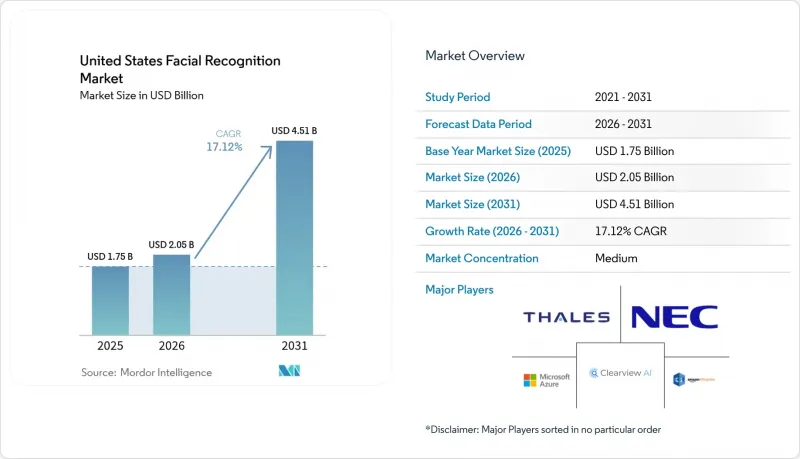
美國臉部認證市場預計將從 2025 年的 17.5 億美元成長到 2026 年的 20.5 億美元,到 2031 年達到 45.1 億美元,2026 年至 2031 年的複合年成長率為 17.12%。
本報告按技術(例如,3D人臉部辨識、2D人臉部認證)、元件(例如,硬體、軟體/演算法)、應用(例如,門禁控制和身分驗證、安全和監控)以及最終用戶產業(例如,政府和執法機關、運輸)進行分類。市場預測以美元計價。
美國臉部認證市場趨勢與洞察
國防安全保障部的現代化資金正在推動人工智慧驅動的邊境監控。
新撥付的聯邦資金正推動自主監控塔和旅客檢驗服務的擴展。該服務已處理超過3億名旅客訊息,並識別出1800名冒名頂替者。與航空公司和郵輪系統的整合正在改變旅客體驗,打造從機場入口到登機口的無縫身份驗證層。隨著該服務擴展至79個機場和12個港口,能夠提供雲端原生、高精度平台的供應商將更有優勢獲得長期服務合約。
REAL-ID 的到期促使各州車輛管理局升級臉部影像註冊系統。
隨著2025年5月實施日期的臨近,加州車輛管理局(DMV)的投資正在加速推進,但據估計,到截止日期時,只有61%至66%的身分證件能夠符合標準。目前,加州已有62.5萬名居民正在試用結合了活體檢測技術的臉部認證行動駕駛執照,預示著人們將長期轉向使用數位錢包。將車輛登記、身分證件發放和移動認證系統連接起來的系統整合商,將能夠記錄長達數年的續期資訊。
金融科技詐騙激增和深度造假的風險正在推動臉部認證的應用。
預計到2023年,深度造假將造成1,580億美元的經濟損失,其中40%的攻擊目標是銀行。臉部認證結合語音和行為生物辨識技術,並具備可靠的「生物特徵偵測」能力,正迅速成為電子身分驗證(e-KYC)的預設標準。隨著傳統視訊身份驗證流程的逐步淘汰,將人工智慧與防欺騙功能整合到低延遲API中的供應商正在贏得市場佔有率。
細分市場分析
預計到2025年,3D識別將佔據美國臉部認證市場37.15%的佔有率,凸顯其卓越的準確性和抗冒充能力。該領域的深度映射技術即使在光照條件變化和部分遮擋的情況下也能實現一致的匹配,為邊境、機場和高安全級別企業等應用場景樹立了標竿。豐富的紋理深度學習演算法進一步提升了準確性。美國國家標準與技術研究院(NIST)在其最新評估中追蹤了來自378家開發商的1149種演算法。同時,隨著零售商和醫療保健專業人員利用情緒分析進行產品銷售和診斷,臉部分析和情緒偵測預計將成為成長最快的細分市場,複合年成長率(CAGR)將達到19.95%。熱成像技術在關鍵基礎設施等低光照環境下的應用仍然至關重要,而2D技術則繼續用於預算有限的部署。
開發人員不斷改進變壓器架構,以處理頻譜輸入,從而降低邊緣節點的推理延遲。這項技術進步強化了分級定價模式,該模式將高階3D和熱成像硬體與基於訂閱的分析服務結合。在整個預測期內,能夠將設備端隱私保護與基於雲端的重新訓練相結合的供應商,將在美國人臉部認證市場這一以分析主導的垂直領域擁有無與倫比的交叉銷售機會。
到2025年,以相機模組和邊緣AI晶片組為主導的硬體將佔據美國臉部認證市場41.60%的佔有率。同時,涵蓋整合、雲端API和託管監控等服務,隨著買家轉向按營運成本付費模式,正以18.15%的複合年成長率快速成長。中美貿易限制推高了晶片價格,促使買家考慮使用國產半導體,這為專注於低功耗視覺神經網路處理器的無晶圓廠新創公司創造了商機。
服務供應商正透過工具包實現差異化競爭,這些工具包能夠實現快速部署、零信任資料管治以及基於結果的服務等級保證。這些經常性收入穩定了利潤率,並抵消了硬體週期帶來的波動。這種綜合交付策略支撐著向端到端技術堆疊的更廣泛發展趨勢,從而鞏固了整個美國臉部認證市場的終身價值。
其他好處:
- Excel格式的市場預測(ME)表
- 3個月的分析師支持
目錄
第1章:引言
- 研究假設和市場定義
- 調查範圍
第2章:調查方法
第3章執行摘要
第4章 市場狀況
- 市場概覽
- 市場促進因素
- 用於國防安全保障現代化的資金正在推動人工智慧在邊境監控中的應用。
- 隨著 REAL-ID 即將到期,各州的車輛管理部門都在升級其臉部影像註冊系統。
- 零售業的庫存損失和有組織的零售犯罪正在推動損失預防措施的實施。
- TSA 2026:非接觸式機場查核點藍圖
- 金融科技相關詐欺的激增以及深度造假的風險正在推動臉部認證的應用。
- 政府支持的數位身分/錢包試點項目,這些項目需要活體偵測功能(例如,Apple Wallet)。
- 市場限制因素
- 各州在活體檢測隱私法方面存在差異,這增加了訴訟的風險。
- 市政當局暫停使用警力的政策正在減少公共部門的需求。
- 對演算法偏見的審查導致聯邦採購出現延誤。
- 由於中美之間的貿易限制,邊緣人工智慧晶片的成本正在上升。
- 價值供應鏈分析
- 監理展望
- 技術趨勢與專利分析
- 波特五力模型
第5章 市場規模與成長預測
- 透過技術
- 2D人臉部認證
- 3D臉部辨識
- 熱成像/紅外線臉部認證
- 臉部分析和情緒檢測
- 按組件
- 硬體(攝影機、邊緣AI晶片組)
- 軟體/演算法
- 服務(整合、託管、雲端 API)
- 透過使用
- 存取控制和身份驗證
- 安全監控
- 身份驗證/電子身份驗證
- 考勤和人事管理
- 情緒識別與客戶洞察
- 按最終用戶行業分類
- 政府和執法機關
- 交通運輸(機場、港口、大眾運輸)
- BFSI
- 醫療保健和生命科學
- 零售與電子商務
- 旅遊與飯店
- 汽車與智慧運輸
- 教育
- 能源公用事業
第6章 競爭情勢
- 市場集中度
- 策略性舉措(併購、資金籌措、合約)
- 市佔率分析
- 公司簡介
- Amazon Web Services(Rekognition)
- Microsoft Corp.(Azure Face)
- NEC Corporation
- Thales Group(Idemia)
- Clearview AI Inc.
- Cognitec Systems GmbH
- Aware Inc.
- FaceFirst Inc.
- Panasonic Connect North America
- Google Cloud Vision
- Apple Inc.(FaceID Ecosystem)
- Meta Platforms(DeepFace Research)
- Veritone Inc.
- Daon Inc.
- BioID GmbH
- AnyVision(Oosto)
- Intel(RealSense)
- Snap Inc.(Cameos and AR Lenses)
- Rank One Computing
- Onfido
第7章 市場機會與未來展望
According to Mordor Intelligence, the US facial recognition market size is expected to grow from USD 1.75 billion in 2025 to USD 2.05 billion in 2026 and is forecast to reach USD 4.51 billion by 2031 at 17.12% CAGR over 2026-2031.
This report is Segmented by Technology (3D Facial Recognition, 2D Facial Recognition, and More), Component (Hardware, Software/Algorithms, and More), Application (Access Control and Authentication, Security and Surveillance, and More), End-User Industry (Government and Law Enforcement, Transportation, and More). The Market Forecasts are Provided in Terms of Value (USD).
United States Facial Recognition Market Trends and Insights
Homeland Security modernization funds fueling AI-based border surveillance
Fresh federal allocations are expanding autonomous surveillance towers and the Traveler Verification Service, which has already processed more than 300 million travelers and identified 1,800 impostors.Integration with airline and cruise line systems is reshaping traveler journeys, creating a contiguous identity layer from curb to boarding gate. Vendors able to deliver cloud-native, high-accuracy platforms are positioned to win long-term service contracts as coverage extends to 79 airports and 12 seaports.
REAL-ID deadline driving state DMV facial capture upgrades
The May 2025 enforcement date is accelerating DMV investments, with only 61-66% of credentials expected to be compliant at the deadline. Mobile driver's licenses tied to liveness-verified face biometrics, already piloted by 625,000 Californians, indicate a longer-range pivot toward digital wallets. System integrators linking enrollment, credential issuance, and mobile verification stand to capture a multi-year replacement cycle.
FinTech fraud surge & deepfake risk boosting e-KYC face verification
Deepfakes caused USD 158 billion in financial losses in 2023, with 40% of attacks aimed at banks. Liveness-assured facial verification, combined with voice or behavioral biometrics, is fast becoming the default e-KYC standard. Vendors embedding spoof-resistant AI in low-latency APIs are gaining wallet share as traditional video-ID workflows phase out.
Other drivers and restraints analyzed in the detailed report include:
- Retail shrink & organized retail crime pushing loss-prevention deployments
- TSA 2026 road-map for touch-less airport checkpoints
- State-backed digital ID pilots requiring liveness detection
For complete list of drivers and restraints, kindly check the Table Of Contents.
Segment Analysis
3D recognition accounted for 37.15% of the US facial recognition market share in 2025, underscoring its superiority in accuracy and spoof resistance. The segment's depth mapping allows consistent matches across lighting variables and partial occlusions, making it the benchmark in border, airport, and high-security enterprise use cases. Texture-rich deep-learning algorithms are further raising accuracy; NIST tracked 1,149 algorithms from 378 developers in its latest evaluation.At the same time, facial analytics and emotion detection are the fastest-growing niche, projected at a 19.95% CAGR, as retailers and clinicians mine sentiment for merchandising and diagnostics. Thermal imaging maintains relevance for low-light installations such as critical infrastructure, while 2D remains in budget-constrained deployments.
Developers are iterating on transformer architectures that process multi-spectral inputs, shortening inference latency at edge nodes. This technical evolution reinforces a tiered pricing model that packages premium 3D or thermal hardware with subscription analytics services. Over the forecast horizon, vendors able to combine on-device privacy with cloud retraining will capture outsized cross-sell in analytics-driven verticals of the US facial recognition market.
Hardware secured 41.60% of the US facial recognition market size in 2025, driven by camera modules and edge AI chipsets. Yet services, covering integration, cloud APIs, and managed monitoring, are advancing at an 18.15% CAGR as buyers shift to operating-expense models. US-China trade controls are inflating chip prices and prompting buyers to evaluate domestic silicon, creating openings for fabless startups specializing in low-power vision neural processors.
Service providers are differentiating through rapid deployment toolkits, zero-trust data governance, and outcome-based service-level guarantees. Their recurring revenue stabilizes margins, offsetting hardware cyclicality. This blended delivery strategy underscores a broader movement toward end-to-end stacks that lock in lifetime value across the US facial recognition market.
Complete Report Scope:
- By Technology
- 2D Facial Recognition
- 3D Facial Recognition
- Thermal/Infra-red Facial Recognition
- Facial Analytics and Emotion Detection
- By Component
- Hardware (Cameras, Edge AI Chipsets)
- Software/Algorithms
- Services (Integration, Managed, Cloud API)
- By Application
- Access Control and Authentication
- Security and Surveillance
- Identity Verification / e-KYC
- Attendance and Workforce Management
- Emotion Recognition and Customer Insights
- By End-user Industry
- Government and Law Enforcement
- Transportation (Airports, Ports, Public Transit)
- BFSI
- Healthcare and Life Sciences
- Retail and E-commerce
- Travel and Hospitality
- Automotive and Smart Mobility
- Education
- Energy and Utilities
List of Companies Covered in this Report:
- Amazon Web Services (Rekognition)
- Microsoft Corp. (Azure Face)
- NEC Corporation
- Thales Group (Idemia)
- Clearview AI Inc.
- Cognitec Systems GmbH
- Aware Inc.
- FaceFirst Inc.
- Panasonic Connect North America
- Google Cloud Vision
- Apple Inc. (FaceID Ecosystem)
- Meta Platforms (DeepFace Research)
- Veritone Inc.
- Daon Inc.
- BioID GmbH
- AnyVision (Oosto)
- Intel (RealSense)
- Snap Inc. (Cameos and AR Lenses)
- Rank One Computing
- Onfido
Additional Benefits:
- The market estimate (ME) sheet in Excel format
- 3 months of analyst support
TABLE OF CONTENTS
1 INTRODUCTION
- 1.1 Study Assumptions and Market Definition
- 1.2 Scope of the Study
2 RESEARCH METHODOLOGY
3 EXECUTIVE SUMMARY
4 MARKET LANDSCAPE
- 4.1 Market Overview
- 4.2 Market Drivers
- 4.2.1 Homeland Security Modernization Funds Fueling AI-based Border Surveillance
- 4.2.2 REAL-ID Deadline Driving State DMV Facial Capture Upgrades
- 4.2.3 Retail Shrink and Organized Retail Crime Pushing Loss-Prevention Deployments
- 4.2.4 TSA 2026 Road-map for Touch-less Airport Check-points
- 4.2.5 FinTech Fraud Surge and Deepfake Risk Boosting e-KYC Face Verification
- 4.2.6 State-backed Digital ID/Wallet Pilots (e.g., Apple Wallet) Requiring Liveness Detection
- 4.3 Market Restraints
- 4.3.1 Patchwork of State Biometric Privacy Laws Escalating Litigation Risk
- 4.3.2 Municipal Moratoriums on Police Use Reducing Public-sector Demand
- 4.3.3 Algorithmic Bias Scrutiny Triggering Federal Procurement Delays
- 4.3.4 Edge-AI Chip Cost Inflation from US-China Trade Controls
- 4.4 Value / Supply-Chain Analysis
- 4.5 Regulatory Outlook
- 4.6 Technological Outlook and Patent Analysis
- 4.7 Porter's Five Forces
- 4.7.1 Bargaining Power of Suppliers
- 4.7.2 Bargaining Power of Buyers
- 4.7.3 Threat of New Entrants
- 4.7.4 Threat of Substitutes
- 4.7.5 Intensity of Competitive Rivalry
5 MARKET SIZE AND GROWTH FORECASTS (VALUE)
- 5.1 By Technology
- 5.1.1 2D Facial Recognition
- 5.1.2 3D Facial Recognition
- 5.1.3 Thermal/Infra-red Facial Recognition
- 5.1.4 Facial Analytics and Emotion Detection
- 5.2 By Component
- 5.2.1 Hardware (Cameras, Edge AI Chipsets)
- 5.2.2 Software/Algorithms
- 5.2.3 Services (Integration, Managed, Cloud API)
- 5.3 By Application
- 5.3.1 Access Control and Authentication
- 5.3.2 Security and Surveillance
- 5.3.3 Identity Verification / e-KYC
- 5.3.4 Attendance and Workforce Management
- 5.3.5 Emotion Recognition and Customer Insights
- 5.4 By End-user Industry
- 5.4.1 Government and Law Enforcement
- 5.4.2 Transportation (Airports, Ports, Public Transit)
- 5.4.3 BFSI
- 5.4.4 Healthcare and Life Sciences
- 5.4.5 Retail and E-commerce
- 5.4.6 Travel and Hospitality
- 5.4.7 Automotive and Smart Mobility
- 5.4.8 Education
- 5.4.9 Energy and Utilities
6 COMPETITIVE LANDSCAPE
- 6.1 Market Concentration
- 6.2 Strategic Moves (MandA, Funding, Contracts)
- 6.3 Market Share Analysis
- 6.4 Company Profiles {(includes Global level Overview, Market level overview, Core Segments, Financials as available, Strategic Information, Market Rank/Share for key companies, Products and Services, and Recent Developments)}
- 6.4.1 Amazon Web Services (Rekognition)
- 6.4.2 Microsoft Corp. (Azure Face)
- 6.4.3 NEC Corporation
- 6.4.4 Thales Group (Idemia)
- 6.4.5 Clearview AI Inc.
- 6.4.6 Cognitec Systems GmbH
- 6.4.7 Aware Inc.
- 6.4.8 FaceFirst Inc.
- 6.4.9 Panasonic Connect North America
- 6.4.10 Google Cloud Vision
- 6.4.11 Apple Inc. (FaceID Ecosystem)
- 6.4.12 Meta Platforms (DeepFace Research)
- 6.4.13 Veritone Inc.
- 6.4.14 Daon Inc.
- 6.4.15 BioID GmbH
- 6.4.16 AnyVision (Oosto)
- 6.4.17 Intel (RealSense)
- 6.4.18 Snap Inc. (Cameos and AR Lenses)
- 6.4.19 Rank One Computing
- 6.4.20 Onfido
7 MARKET OPPORTUNITIES AND FUTURE OUTLOOK
- 7.1 White-space and Unmet-Need Assessment

 2026年全球邊緣面匹配市場報告
 邊緣運算驅動的臉部辨識市場:按組件、技術、部署方式、應用和最終用戶分類 - 全球市場預測(2026-2032 年)臉部辨識市場:2026-2032年全球市場預測(按組件、技術類型、部署模式、應用、最終用戶產業和銷售管道)
 全球臉部辨識市場規模、佔有率、趨勢和成長分析報告(2026-2034)
 臉部辨識市場報告:按組件、技術、應用、終端用戶產業和地區分類(2026-2034 年)
 臉部辨識系統市場:按技術、組件、應用和地區分類臉部辨識市場:按組件、技術、應用和地區分類2026年全球臉部辨識監控閘道器市場報告2026年全球臉部辨識市場報告人工智慧臉部辨識市場按組件、技術、應用、部署模式和最終用戶產業分類,全球預測(2026-2032年)